The Best Tire Tread Depth Gauges
Tread depth is the one safety check on your car that costs almost nothing to make and almost nothing to fix — if you catch it early. Worn tread doesn't announce itself. Your tires look fine, they hold air, and then one rainy exit ramp goes sideways. A gauge takes about three minutes to run across all four tires, and it tells you exactly how much margin you have left. The legal floor in every state is 2/32 inch, but most tire makers say to replace at 4/32. A gauge is how you see that gap coming.
Here's the honest part: none of these tools will feel exciting, and most of them do roughly the same job. A gauge that's accurate to a hundredth of a millimeter isn't meaningfully safer than one that reads in 32nds, because the decision you're making is coarse — replace now, replace soon, or check again next month. What separates these products is how easy they are to read, how well they survive a glove box or a tool pouch, and whether they're a dedicated tread tool at all. Several popular ones aren't.
You also need to know what you're buying. Some of the best-selling products in this category are pressure gauges that happen to mention tread, and a couple bundle a cheap tread stick as a throw-in. If you want a tread number you'll actually trust and act on, buy a tool built only for that. We think that the JACO TreadPro is the best tire tread depth gauge for most people, and that the Preciva Tire Tread Depth Gauge is the one to buy if you'd rather read a digital number than a dial.
Everything we recommend

Color-coded dial, no batteries, and it holds the reading

A big digital screen if you'd rather read a number than a needle

The one to hand a technician who works around dropped tools
A cheap, accurate pressure gauge for every glove box you own
At a glance
| Product | Depth Range | Increment | Price | |
|---|---|---|---|---|
 | Accutire MS-4350B Setpoint Tire GaugeAlso consider | — | — | $17.95 |
 | Longacre Racing TIRE Tread Depth GaugeAlso in lineup | — | — | $47.26 |
| AstroAI Digital Tire Pressure Gauge 150PSIBudget pick | — | — | $6.58On sale |
 | Vondior Digital Tire Pressure Gauge with InflatorAlso consider | 0-1 inch | 1/32 inch | $26.99 |
| Preciva Tire Tread Depth GaugeRunner-up | 0-1 in (25.4mm) | 0.01mm | $15.99 |
| Steelman Dial-Type Color-Coded Tread Depth GaugeAlso great | 0-14/32 in | 1/32 in | $15.99 |
| JACO TreadPro Tire Tread Depth GaugeTop pick | 0-14/32 in | 1/32 in | $15.90On sale |
 | Milton Industries EXELAIR by MiltonAlso in lineup | 0-1 in (25mm) | — | $8.39On sale |
How we picked
Dedicated tread measurement. We prioritized tools built to measure tread and nothing else, since combination gauges consistently treat tread as an afterthought. Listings that bundle a tread stick as a bonus were ranked below purpose-built instruments.
Readability at a glance. We compared display specs and owner feedback on legibility in dim garages and at arm's length. Color-coded zones or a large screen mattered more to us than resolution past 1/32 inch.
Durability and power. Spec sheets told us which bodies are metal and which are plastic, and owner reports told us which battery doors fall off. Battery-free dial gauges got credit for being ready whenever you pick them up.
Range that covers real tires. Passenger tires ship around 10/32 to 11/32 inch, so a 14/32 range covers them for life. We flagged any gauge that can't read a new all-terrain truck tire.
Track record. We weighed how much owner feedback each product has accumulated and how consistent the complaints are. A gauge with a recurring structural complaint didn't earn a pick.
Top pickOn sale
Color-coded dial, no batteries, and it holds the reading
JACO TreadPro Tire Tread Depth Gauge
A pocket-size dial gauge that reads tread in 32nds against a green-yellow-red scale, so you get a number and a verdict at the same time. It needs no battery, it fits in a shirt pocket, and the needle stays put after you pull it out of the groove.
$15.90fromAmazonList priceThe color scale is what makes this the one to buy. Numbers alone put the work on you: is 5/32 fine? Is 3/32 urgent? The TreadPro answers that on the face of the dial. Green means you're good, yellow means start shopping, red means stop putting it off. You still get the exact 32nds reading if you want it, but you don't have to remember any thresholds to use the tool correctly. That's the difference between a gauge you buy and a gauge you actually use.
It also holds the reading. You press the probe into the groove, pull it out, and the needle stays where it landed — so you can read it at eye level instead of crouching next to a wheel well squinting at a dial in the dark. If you're checking four tires and four grooves each, that's sixteen readings, and being able to stand up between them makes the whole job less annoying. Owners who check tires on motorcycles mention the same thing.
There's no battery, which quietly matters more than it sounds. Digital gauges in this category are notorious for dying in a glove box between uses, either because a cell drained or because a battery door popped open and lost a coin cell somewhere under the seat. A dial gauge you bought two years ago works the day you pick it up. Owner feedback on the TreadPro leans heavily on build quality — it's small but it feels solid, not hollow.
The specification that separates it from the other dial gauges here is resolution. It's marked in 1/32-inch increments with unlabeled 1/128-inch marks between them, and JACO rates accuracy to within a quarter of a percent. If you're checking tires on a used car before you buy it, that precision is negotiating leverage: catching tread at 3.5/32 rather than reading it as "about 4" is the difference between a tire credit and none. It also ships with a leather pouch, which is the kind of small thing that keeps a tool from getting scratched up.
Flaws but not dealbreakers
The scale tops out at 14/32 inch. Passenger tires leave the factory around 10/32 to 11/32, so you're covered for the entire life of a normal tire. But new all-terrain and mud-terrain truck tires often start at 16/32 or deeper, and this gauge simply can't read them on day one. It'll work fine once they wear in. If you run aggressive truck tires and want a baseline measurement from new, this isn't the tool.
A dial is a mechanical instrument, and owners note it isn't drop-proof. Knock it off a workbench onto concrete and you can knock it out of calibration in a way you might not notice. It also asks slightly more of you than a digital readout — you're reading a needle against tick marks, not a number. Most people get comfortable with it in about two tires.
Runner-up
A big digital screen if you'd rather read a number than a needle
Preciva Tire Tread Depth Gauge
A dedicated digital tread gauge with a 2.5-inch screen and readings in inches, millimeters or 32nds fractions. If you want to write measurements down and track wear month over month, the exact numbers make that easier than a dial does.
$15.99fromAmazonThe screen is the reason to pick this over our top pick. At 2.5 inches, it's the largest display in this group by a wide margin, and you can read it standing up at arm's length. If your eyes aren't what they were, or you're checking tires in a dim garage, that alone can settle the decision. There's no needle to line up and no tick marks to interpret — just a number, in whichever unit you asked for.
It's the most flexible gauge here on units. One button cycles between inches, millimeters and 32nds fractions. That sounds like a spec-sheet nicety until you're comparing a reading against a tire forum thread in millimeters and a service invoice in 32nds. The resolution is 0.01mm across a 0–25.4mm range, which is finer than the decision you're making, but it means you can watch tread drop by small amounts across a few months and estimate when you'll need to buy.
It zeroes at any depth, not just from flat. That's genuinely useful for the pro tip nobody follows: measuring shoulder wear. You can also use it on brake shoes and pads, which is a second job for the same tool. Owners describe it as the kind of thing that ends up living in a pocket rather than a drawer — it weighs about as much as a phone and it's short enough not to catch on anything.
Owner feedback is unusually consistent for a newer brand, and it skews toward people who bought it to stop using the penny test. Several mention dropping it without consequence, which is a fair bit better than the plastic body suggests. It ships with a case and a spare battery, which tells you the manufacturer knows a coin cell is the weak point in any digital gauge.
Flaws but not dealbreakers
The body is ABS plastic. It's fine for a glove box and it resists corrosion, but it's not the tool to hand a technician who drops things onto concrete daily and works around tire lubricant. Our top pick and the Steelman both hold up better to that kind of life.
There's no color coding. You get a precise number and nothing telling you what it means, so you need to remember that 4/32 is the replacement threshold and 5/32 for winter tires. That's a small thing for someone who reads guides like this one, and a real gap if you're buying a gauge for a teenager or a family member who won't.
Also great
The one to hand a technician who works around dropped tools
Steelman Dial-Type Color-Coded Tread Depth Gauge
A compact dial gauge in a powder-coated zinc alloy case, with the same green-yellow-red scale as our top pick. It's built for a tool pouch and a busy shop floor, where a plastic-bodied digital gauge tends not to last a season.
$15.99fromAmazonMetal is the whole argument here. The powder-coated zinc alloy case shrugs off the drops and the lubricant exposure that crack plastic gauges. Owners who use it professionally describe carrying it in a pocket every day for over a year without trouble. If a gauge lives in a tool pouch rather than a glove box, that construction is worth more than any accuracy figure on the box.
The color-coded face does the same job as the TreadPro's: green, yellow, red, with the SAE scale marked in 1/32-inch increments and unlabeled 1/128 marks in between. Range runs 0 to 14/32. In a shop, the practical benefit is that a service writer can look at the gauge and tell a customer what it means without translating fractions. No batteries, so it's ready whenever someone grabs it.
It's a bit larger in the face than our top pick, and several owners call that out as a plus — a bigger dial is easier to read quickly. The body itself is still small enough to disappear into a pocket, roughly two and a half inches across, and it comes with a case.
Flaws but not dealbreakers
A recurring complaint is that the clear lens over the dial face works loose and falls out. It doesn't stop the gauge from working, but it means the face collects fingerprints and grit, and you may end up gluing it back in.
Like any dial gauge, it's not the tool for documenting an exact decimal value on a repair order. If your paperwork needs "3.8/32" rather than "in the yellow," reach for a digital gauge instead.
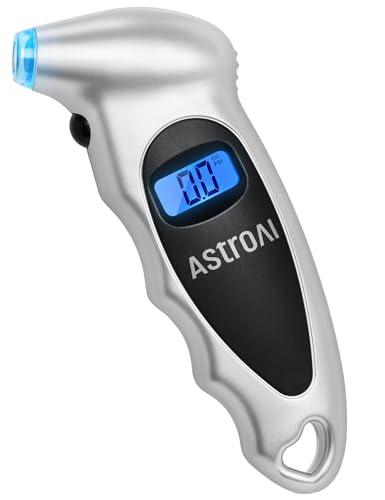
Budget pickOn sale
A cheap, accurate pressure gauge for every glove box you own
AstroAI Digital Tire Pressure Gauge 150PSI
This is a pressure gauge, not a tread gauge, and it's the one to buy if pressure is the check you'll actually keep up with. It's calibrated to within a pound, the nozzle lights up, and it's cheap enough to put one in every car you own.
$6.58fromAmazonList pricePressure and tread are two halves of the same job, and pressure is the one that changes weekly. Underinflated tires wear the shoulders first, which is exactly the wear a tread gauge catches months later. This AstroAI reads 0 to 150 PSI with ±1 PSI accuracy, which is close enough to match the number on your door jamb sticker without argument.
The lit nozzle solves a problem nobody puts on a spec sheet. Finding a valve stem in a dark driveway usually means holding a phone in your teeth. A tip light and a backlit screen mean you can do the whole check one-handed at night. One button cycles PSI, bar, kg/cm² and kPa, so you're never hunting for a conversion.
It's the most widely owned product in this guide by an enormous margin, and the feedback is boringly consistent: it matches the car's own pressure sensors, it's easy to hold, and it lasts. Several owners describe replacing one after years of use with the same model. It shuts off after 30 seconds to protect the batteries, which is why they last as long as they do.
Flaws but not dealbreakers
It does not meaningfully measure tread. If tread depth is what you came for, this isn't the tool — buy the Preciva or the TreadPro instead, and treat this as the companion purchase rather than the substitute.
The battery compartment is a known irritation. Some units require removing screws to get at the cells rather than opening a door, so a battery swap turns into a small project. Owners also report the occasional unit that stops turning on after a few years, which is about what you'd expect at this price.
Who this is for
Buy a tread gauge if you own the car you're driving and plan to keep it. It's the tool that lets you replace tires on your schedule instead of a tire shop's, and it pays for itself the first time it tells you a set has another winter left. It's also the single most useful thing you can carry to look at a used car — four measurements tell you whether you're inheriting a tire bill. If you lease, drive a nearly new car, or have a shop check your tires at every oil change, you can skip this. Your tread wear indicators will catch the legal minimum, and that's most of what you need.
This guide covers handheld gauges for passenger cars, light trucks and motorcycles. We've included two pressure-focused tools because they're what many people in this category are actually shopping for, but we're clear about which is which. We don't cover shop-mounted laser tread scanners, tire pressure monitoring systems, or the drive-over sensor plates that dealerships use.
How we picked
We started from listing specifications, published product information and owner feedback themes, then weighed a few things heavily. Dedicated design: a tool built only for tread beats a pressure gauge with a tread feature bolted on. Readability: a color-coded dial or an oversized screen beats a fractionally finer resolution, because the decision you're making is coarse and the light is usually bad. Durability: metal bodies and battery-free mechanisms survive glove boxes and tool pouches better than plastic and coin cells, and owner complaints about battery doors and loose lenses are common enough to take seriously. Range: 0 to 14/32 inch covers a passenger tire for its whole life, but not a new off-road tire. Track record: consistent, high-volume owner feedback carried more weight than a spec we couldn't corroborate.
Other tire tread depth gauges worth considering
If you want one pressure gauge you'll keep for years: The Accutire MS-4350B Setpoint Tire Gauge ($17.95) — The Accutire MS-4350B is a pressure gauge, not a tread tool, but it's a good one and it comes with a five-year warranty — the longest term stated for anything in this guide. Its trick is a programmable setpoint: enter your factory-recommended front and rear PSI once, and every check afterward becomes a simple pass or fail instead of a number you have to remember. It reads 5–99 PSI in half-pound steps on a big blue backlit screen. Owners like how it clamps onto the valve stem without hissing air. What it gives up is any real tread measurement, so pair it with the TreadPro or the Preciva rather than treating it as a substitute.
If you already run a home air compressor: The Vondior Digital Tire Pressure Gauge with Inflator ($26.99) — The Vondior combines a 250 PSI inflator, deflator and pressure gauge on a braided hose with a brass swivel and a quarter-inch quick-connect, and it throws in a basic tread stick calibrated in 32nds. If you top off tires at home every month, this consolidates three tools into one and owners consistently say it makes inflation faster and less fiddly. But the bundled tread gauge is a freebie, not a reason to buy, and the whole assembly is far too bulky for a glove box. A few owners report the chuck doesn't clamp onto every valve stem cleanly. Buy it for the inflator; get your tread readings elsewhere.
The competition
These are the gauges our research turned up alongside the picks, not a complete map of the category. Each one lost on something specific rather than on general quality, and in a couple of cases the thing it lost on won't matter to you.
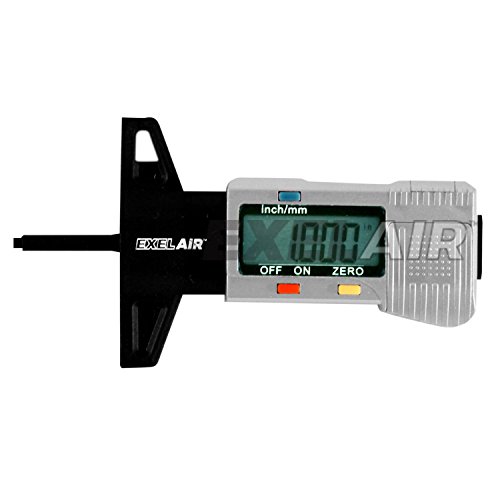
The Milton Industries EXELAIR by Milton ($8.39) — The Milton EXELAIR EX448DIG is a dedicated digital tread gauge from an industrial tool brand with a long history, and on paper it should compete with the Preciva: dual inch and millimeter readouts, a zero/tare function at any depth, two buttons and no menus. Owner feedback is where it falls apart. The rating distribution is the weakest of anything here, and the complaints cluster around build quality — a battery cover that falls off repeatedly, a body that feels flimsy enough that owners store it carefully rather than tossing it in a glove box. Several buyers also object that it doesn't read in 32nds, which is the unit American tire shops actually use. If you want the brand and you'll keep it somewhere safe, it measures accurately. Most people should take the Preciva instead.
The Longacre Racing TIRE Tread Depth Gauge ($47.26) — The Longacre Racing tread depth gauge is a dial indicator aimed at race teams, and Longacre has built professional motorsport tools for decades. The appeal is calibration stability over thousands of measurements and no battery to fail on a race weekend. The problem is that there's almost nothing to go on: the listing says little beyond that it's built for racing demands, there's no meaningful owner feedback to corroborate durability or accuracy claims, and it costs several times what our picks do. If you're setting up race tires between qualifying sessions, that precision is the job and the price is a rounding error. Everyone else is buying a much more expensive version of a measurement the TreadPro makes just as usefully.
How to use a tread gauge correctly
Push the probe straight down into the groove, not at an angle, until the base plate sits flat against the tread blocks. Angle the probe and you'll read shallow. The part most people skip: check all four main circumferential grooves on each tire, plus the inner and outer shoulders, and write down the lowest number. Uneven wear from bad alignment or chronic underinflation shows up on a shoulder long before it reaches the center, and the shallowest groove is your real safety margin — it's also the one a state inspector will probe. Zero a digital gauge before each tire. Replace summer and all-season tires at 4/32 inch, and winter tires at 5/32, rather than waiting for the wear bars at 2/32.
Questions we get
What is the minimum legal tire tread depth in the United States?
It's 2/32 inch, or 1.6mm, in all fifty states. Below that, a tire fails inspection and isn't legal on public roads. But that's a floor, not a target — tire manufacturers and safety organizations broadly recommend replacing at 4/32 inch to keep wet braking usable.
Is the penny test good enough?
It's better than nothing, and it's a fine way to catch a tire that's already unsafe. But it only tells you whether you're above or below roughly 2/32 inch, which is the legal minimum rather than the point where you should replace. A gauge gives you a number, so you can watch tread drop from 6/32 to 5/32 to 4/32 and plan the purchase instead of being surprised by it.
How often should I check?
Monthly, and before any long drive. If you're in heavy rain, snow, or somewhere hot enough to chew through tires, make it every couple of weeks. Checking all four tires takes about three minutes once you know where the grooves are.
Digital or dial — which should I get?
Dial gauges need no batteries, survive drops better, and the color-coded ones tell you what the number means without any interpretation. Digital gauges give you an exact figure that's easier to write down and compare month to month, and the screens are usually easier to read. Both are far more accurate than the decision requires, so pick based on how you'll use it rather than resolution.
Do I still need a gauge if my tires have wear bars?
Yes, if you want any warning. The raised bars molded into the grooves only become flush with the tread at 2/32 inch — the legal minimum, and well past the point where wet braking has degraded. They tell you nothing in between, so you can't track how fast you're wearing or budget for the replacement.
Can I use these on motorcycle tires?
Yes. The probe tips on these gauges are narrow enough for motorcycle grooves, and owners of our top pick specifically mention buying it for bikes. Motorcycle tires curve across the tread, so be deliberate about holding the probe perpendicular. Note that the legal minimum for motorcycles is 1/32 inch in most states, not 2/32.
Why you should trust us
For this guide:
- We read the manufacturer specifications and listing details for every gauge in this guide, comparing measurement ranges, resolution, body materials and power requirements side by side.
- We reviewed owner feedback across all eight products, looking for complaints that repeat — loose lenses, battery doors that fall off, units that won't power on — rather than isolated reports.
- We compared each product against published tire-industry guidance on replacement thresholds to judge whether a gauge's range and readout actually support the decision a driver needs to make.
- We read owner reviews on every listing, weighted toward the critical ones, because that is where the recurring failures show up.
- We have a systematic way of automatically fetching the latest prices, so the numbers on this page stay current.
- This is a research-focused guide, so the team may not own every product listed — though we often do own the top winners, which gives us extra context for the recommendations.
- We don't accept free products, and the retailer commission never changes which product we recommend.
Sources
Tire Safety — National Highway Traffic Safety Administration, NHTSA
Wet Weather Tire Performance and Tread Depth — Stopping Distance Testing, Tire Rack
When Should You Replace Your Tires?, Consumer Reports
Tire Safety and Tread Depth Recommendations, Bridgestone
How to Check Tire Tread Depth, Goodyear
Amazon product listings and owner reviews for all 8 products
Manufacturer specification pages for each product
Some passages in this guide may be paraphrased with AI help. Prices are refreshed automatically.
More like this.
Continue exploring electronics reviews and recommendations.

The Best Tire Pressure Gauges
Air leaks out of tires slowly, and you can't see it happening. A tire can look completely normal and still be several pounds low. That's a mileage…

The Best Tire Chains and Snow Traction Cables
Chains live in your trunk for years and matter for about twenty minutes. But those twenty minutes tend to happen on a dark shoulder, in falling snow, with…

The Best Tire Pressure Monitoring Systems
Your tires are losing air right now. Nothing dramatic - just the ordinary seep of one to two pounds a month, according to the Tire Industry Association,…

The Best Portable Tire Inflators
Tire pressure is one of those things you ignore until it costs you. A tire that's five pounds low wears out faster, hurts your mileage, and handles worse…

The Best Garage Tire Inflators
Tire pressure is the one bit of car maintenance you can actually do yourself in two minutes. Tires lose roughly a pound of pressure a month, and more when…

The Best All-Weather Windshield Wipers
Wipers are one of the easiest safety upgrades on your car, and most people ignore them until a downpour turns the windshield into frosted glass. Bad…