The Best Tire Pressure Gauges
Air leaks out of tires slowly, and you can't see it happening. A tire can look completely normal and still be several pounds low. That's a mileage problem: the Department of Energy figures every 1 PSI drop in average pressure costs about 0.2 percent in fuel economy. It's also a safety problem, since NHTSA links underinflation to more than 11,000 crashes a year in the U.S. AAA suggests checking monthly and before long trips, because pressure falls roughly 1 PSI for every 10-degree drop in temperature.
Here's the honest part. No gauge in this class is a laboratory instrument, and none of them will agree with each other exactly. Autoblog's comparison found digital gauges landing within about half a pound of a certified shop reference, while uncalibrated dial gauges drifted by 2 to 3 PSI. Your car's built-in monitor will disagree with all of them. And no handheld gauge tells you what number to aim for. That comes off the sticker in the driver's door jamb, never the tire sidewall.
So the goal isn't perfection. You want a gauge that reads the same today as it did last month, that you can see at night, and that reaches a valve stem hiding behind a wheel spoke without a fight. Format matters more than brand here. Family Handyman found pen-style stick gauges swinging by as much as 4 PSI between repeated checks on the same tire, so skip those entirely. We think that the JACO ElitePro Digital Tire Pressure Gauge is the best tire pressure gauge for most people, and that the AstroAI Digital Tire Pressure Gauge is the one to buy if you want a budget option for every glove box in the family.
Everything we recommend

More gauge than most drivers need, and worth carrying anyway
A coarser reading in exchange for pocket size and low cost

The precise one, if you care about a half-pound either way

No batteries to die, and a dial you can read in the dark
Prices as of Oct 25, 6:48 AM PT · Details
At a glance
| Product | Display type | Max pressure | Price | |
|---|---|---|---|---|
| JACO ElitePro Digital Tire Pressure Gauge -Top pick | Digital | 100 PSI | $29.90 |
| AstroAI Digital Tire Pressure Gauge 150PSIBudget pick | Digital | 150 PSI | $6.99 |
 | Milton S-932 Single Head Dial GaugeAlso in lineup | Dial | 60 PSI | $30.57 |
| Longacre 52-53000 Pro Digital Tire Pressure GaugeUpgrade pick | Digital | 60 psi | $116.49 |
| Rhino USA Heavy Duty Tire Pressure GaugeAlso great | Glow dial, 2 inch | 60 PSI | $15.90 |
 | FOBO Bike 2 for Trike Smart BluetoothAlso consider | — | — | $148 |
Prices as of Oct 25, 6:48 AM PT · Details
How we picked
Certified accuracy. We favored gauges whose specs state a calibration standard, ideally ANSI B40.1, whose Grade 2A class is rated to 1.5 percent of full scale. Published comparisons put good digital gauges within about half a pound of a certified shop reference, which set the threshold for this guide.
Readable in the dark. Backlights, lit nozzles and glow dials come up constantly in owner feedback, because most people check pressure at night or in a dim garage. A gauge you need a flashlight to read is a gauge you'll skip.
Chuck and hose. Swivel heads, flexible hoses and angled chucks decide whether you can reach the valve stem on a modern alloy wheel. We looked for 360-degree swivels, real hoses, or a second chuck in the box.
Range for your vehicles. Sixty PSI covers passenger cars and motorcycles, but a compact spare or a trailer tire needs more headroom. We gave extra weight to higher-range gauges for anyone who owns more than one kind of vehicle.
Durability and power. Spec sheets and owner reports both point to drops as the main way a gauge dies, so we looked for brass bodies, shock bumpers and protective guards. For digital models, auto shutoff and a battery indicator mattered.
Top pick
More gauge than most drivers need, and worth carrying anyway
JACO ElitePro Digital Tire Pressure Gauge -
The ElitePro is calibrated to ANSI 2A standards, reads to a tenth of a pound, and has a 10-inch swivel hose that reaches around brake calipers and wheel spokes. The backlit screen holds your reading until you clear it, and a bleeder valve lets you dump air without losing the number.
$29.90fromAmazonPrices as of Oct 25, 6:48 AM PT · Details
This is the gauge to buy if you're only buying one. JACO certifies the ElitePro to ANSI B40.1 Grade 2A, the accuracy class that gets used as the benchmark when consumer gauges are compared, and the listing puts its dual sensors at half a percent of full scale. In plain terms, you can trust the number it gives you. That matters more than any other feature on this page.
The hose is the part you'll appreciate most. Ten inches of flexible line with a 360-degree swivel chuck means you're not wrestling a rigid stick onto a valve stem tucked behind a spoke. If you drive anything with low-profile tires or fussy alloy wheels, you already know the problem. You press the chuck on, hear one short hiss, and read the number standing up.
Readings lock on the screen until you press the button. That sounds minor until you're crouched behind a rear tire in a dark driveway with wet knees. The LCD is backlit and about two and a half inches across, and a battery indicator means you're not guessing about power. It shuts off after 150 seconds, which is long enough to do all four tires without waking it up again.
The built-in bleeder valve is the feature you didn't know you wanted. Overshoot at the air pump and you can bleed pressure down while the display updates live, instead of pulling the gauge off, letting air out by feel, and checking again. JACO backs the gauge with a lifetime warranty, and reviewers at Car and Driver call that out against competitors offering one or two years.
Flaws but not dealbreakers
It's bulkier than a pocket gauge. Between the brass body, the protective guard, and the coiled hose, you won't forget this thing is in your glove box. Owners also report the usual digital annoyance: the chuck wants a clean, square press onto the valve, and a sloppy angle gives you a low reading or just a hiss and nothing at all.
The 100 PSI ceiling covers cars, trucks, motorcycles, and most trailers, but heavy commercial tires above that are out of scope. And it needs batteries. Two AAAs come in the box, though a dial gauge never leaves you standing there with a dead screen.
The ElitePro comes with JACO's 100 percent lifetime warranty.
Budget pick
A coarser reading in exchange for pocket size and low cost
AstroAI Digital Tire Pressure Gauge 150PSI
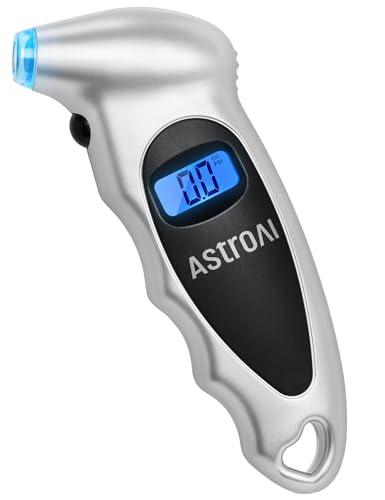
The AstroAI S1 is factory-calibrated to within 1 PSI, covers 0 to 150 PSI, and cycles through PSI, bar, kgf/cm² and kPa with one button. A lit nozzle helps you find the valve stem in the dark, and the gauge powers down after 30 seconds so the batteries last.
$6.99fromAmazonPrices as of Oct 25, 6:48 AM PT · Details
For a monthly top-up, 1 PSI of accuracy is plenty. Your door-jamb sticker says 35, so you set 35. No tire on earth notices the difference between 34.8 and 35.0. What matters is that the gauge reads consistently from one month to the next, and this one does, which is a big part of why it's among the most widely bought digital gauges around.
The lit nozzle is the small thing that makes it worth owning. Anyone who's checked pressure in an unlit driveway has done the flashlight-in-the-teeth routine. A tiny lamp on the chuck puts light exactly where the valve stem is, and the backlit LCD handles the reading itself. It's a simple trick, and plenty of pricier gauges skip it.
Four units matter more than you'd expect. If you also air up a European motorcycle that lists bar, or a bike pump that reads kPa, you're not doing conversion math on your phone in a parking lot. One button cycles through all of them. The 150 PSI range also covers the compact spare in your trunk, which usually wants around 60.
It's small enough to live in a glove box and be forgotten about, and honestly that's the pitch. Buy two, keep one in each car, and you've run out of excuses. Owners do note that the body is plastic and the chuck feels flimsy next to a brass-bodied gauge, but it survives being dropped on concrete more often than it doesn't.
Flaws but not dealbreakers
Resolution is the trade. It reads in half-pound steps against the JACO's tenths, and its stated tolerance is a full 1 PSI rather than a fraction of a percent. For setting track pressures or chasing a slow leak, that isn't enough. For keeping four street tires where the sticker says, it's fine.
The chuck is short and rigid. On wheels where the valve stem sits behind a spoke, you'll be working at an awkward angle, and a bad seal reads low. Owners also mention the 30-second auto-off can cut you out mid-check if you're fumbling with a valve cap.
Upgrade pick
The precise one, if you care about a half-pound either way
Longacre 52-53000 Pro Digital Tire Pressure Gauge
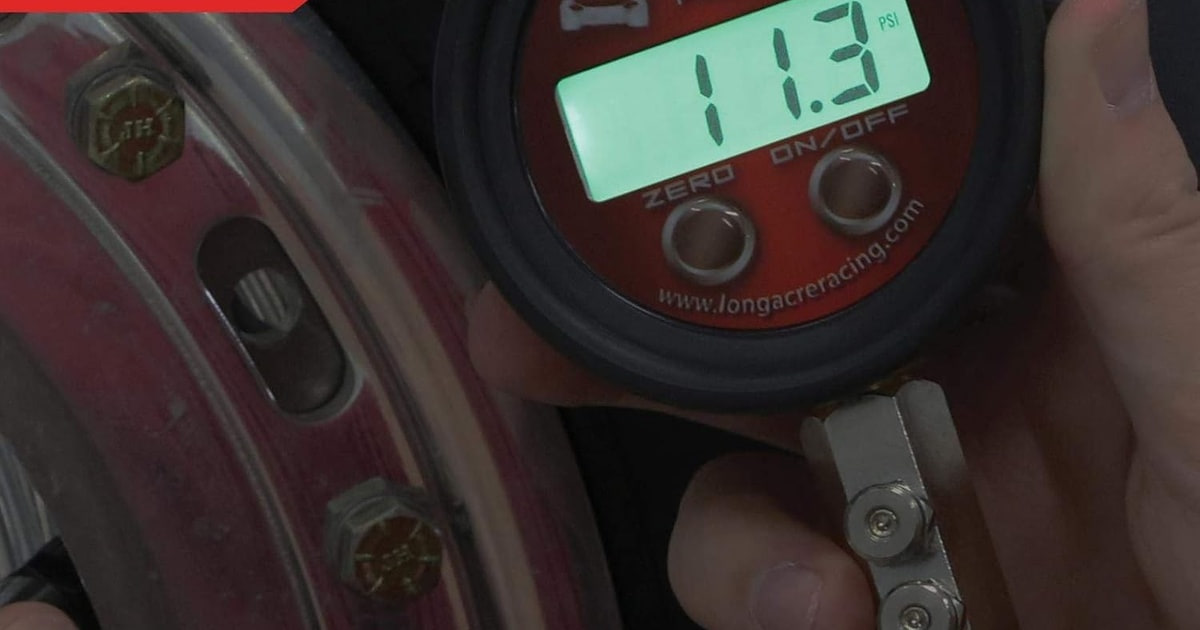
The Longacre 52-53000 reads 0 to 60 PSI within 2 percent, ships with both an angle chuck and a ball chuck, and has dual bleed buttons for dialing pressure down quickly. A shock-resistant bumper and a hard case come in the box, which is why it turns up in so many race trailers.
$116.49fromAmazonPrices as of Oct 25, 6:48 AM PT · Details
Racers care about tire pressure in a way street drivers don't. A half-pound across an axle changes how a car turns in. That's the world this gauge comes from, and you can see it in the details: dual bleed buttons so you can bring a hot tire down without pulling the chuck off, and a stated tolerance of 2 percent across a narrow 60 PSI scale.
The two chucks are the real reason to pick this over a cheaper digital. The angle chuck handles car wheels where the stem points inward at an ugly angle. The ball chuck seats on stems you can only reach head-on, like the inner wheel of a dually or a deep motorcycle rim. Most gauges hand you one head and expect you to make it work.
The display is large and backlit, and it holds the reading until you release it, so you can set the gauge down, write the number on your hand, and move on. Longacre ships it in a hard case with the shock bumper already fitted. If your gauge rides in a toolbox that gets tossed into a truck bed, that packaging isn't decoration.
You give up range for that precision. Sixty PSI is the ceiling, which covers passenger cars, most motorcycles, and plenty of light-truck tires, but not a heavy trailer tire or a compact spare that wants more. It runs on user-replaceable AAAs, which is good, and it's a chunky thing to carry around, which is not.
Flaws but not dealbreakers
It costs considerably more than the picks above, and what you're buying is precision rather than convenience. If you only ever set street pressures once a month, you won't get your money's worth out of the extra resolution.
The 60 PSI ceiling is the practical limit. If you tow, run high-load truck tires, or want one gauge that handles every vehicle in the driveway, that range will bite you eventually. The hard case is also bulky enough that most people leave it in the garage instead of the car, which rather defeats the point of owning a gauge you'll actually use.
Also great
No batteries to die, and a dial you can read in the dark
Rhino USA Heavy Duty Tire Pressure Gauge
Rhino's dial gauge is certified to ANSI B40.1, reads 0 to 60 PSI on a glowing two-inch face, and uses a braided hose with a brass 360-degree swivel chuck. A deflator valve on the head lets you air down for sand or trails without carrying a separate tool.
$15.90fromAmazonPrices as of Oct 25, 6:48 AM PT · Details
A good dial gauge never runs out of battery. That's not a small thing for a tool that lives in a glove box and gets used a dozen times a year. There's no screen to wake, no auto-off to fight, and nothing to fail on a cold morning. Rhino certifies this one to ANSI B40.1, the accuracy class that separates a serious dial gauge from the ones bolted to gas-station air hoses.
The glow face is genuinely useful. Charge it under a garage light for a few seconds and you can read pressure at a dark campsite without holding a flashlight in your mouth. The needle also holds its reading after you pull the chuck off, which is exactly the behavior you want when you're squatting between a truck and a curb.
Off-road drivers get the deflator valve, and it's why this gauge shows up in so many trail kits. Airing down from street pressure to something soft enough for sand normally means poking at a valve core and guessing. Here you press the deflator, watch the needle drop, and stop where you want it. Then air back up on the way home.
Against the digital picks, you're trading resolution for simplicity. A needle on a two-inch face gets you to about the nearest pound if you read it honestly, and Autoblog's comparison is a good reminder that dial gauges as a group drift more than digital ones. The ANSI certification is what keeps this particular one out of that bucket.
Flaws but not dealbreakers
Sixty PSI is the ceiling here too, so a heavy-duty trailer tire is outside its range. And a dial is a dial. You're reading a needle between hash marks, which means two people can look at the same tire and call it 32 or 33.
The braided hose adds bulk. It's a nicer hose than most gauges in its class carry, but folded up this is a fist-sized tool, not something that disappears into a door pocket. Owners also point out that once the glow charge fades, you're back to needing a light anyway.
Who this is for
If you own a car, you should own a gauge. That's about the size of it. This guide covers handheld gauges for cars, trucks, motorcycles, trailers and RVs, the kind you keep in a glove box and use once a month. It doesn't cover portable inflators with a gauge built into the pump, shop-floor inflation guns, or bicycle floor pumps, all of which are different tools with different jobs. It also skips pen-style stick gauges on purpose, because they're the least consistent format you can buy.
You still want one even if your car shows per-tire pressure on the dash. Those sensors have their own tolerance, they read warm tires after you've been driving, and they usually warn you only once you're well below spec. A handheld gauge lets you check cold, in your driveway, before anything is wrong. If you already own an accurate gauge that reads to the pressures your vehicles need, there's no reason to replace it, though a second one for the other car is cheap insurance.
How we picked
We looked for five things. Accuracy: a stated calibration standard, preferably ANSI B40.1, since Grade 2A gauges are rated to 1.5 percent of full scale and published comparisons put good digital units within roughly half a pound of a shop reference. Readability: a backlit screen, a lit nozzle or a glow dial, because most people check pressure at night. Reach: a swivel chuck, a flexible hose, or a second chuck head for valve stems buried behind spokes. Range: enough headroom for a compact spare or a trailer tire, not just street pressures. Durability: brass hardware, shock guards and hard cases, since owner feedback says drops are what actually kill these tools.
Other tire pressure gauges worth considering
If you want a warning before a slow leak becomes a flat: The FOBO Bike 2 for Trike Smart Bluetooth — The FOBO Bike 2 isn't a gauge at all. It's a set of Bluetooth caps that replace your valve caps and stream pressure and temperature to a phone, with alerts pushed to a watch or a headset, and it works without an internet connection. MotorTrend found that systems like this can flag a slow leak hours before you'd catch it with a manual spot check. The trade-offs are real. This particular kit is built for three-wheeled motorcycles, it costs far more than any handheld gauge here, and you're now maintaining sensors instead of a simple tool. You'll still want a gauge for setting pressure at the pump.
The competition
This is what our research turned up, not a map of everything for sale. Tire gauges are a crowded, inexpensive category, and plenty of perfectly decent ones never make it into a review roundup.
The Milton S-932 Single Head Dial Gauge — The Milton S-932 is a single-head dial gauge reading to 60 PSI, and it's the shape most people picture when they think of a shop gauge: no batteries, no screen, a needle that holds until you press the release. Milton's dial gauges have a long reputation in professional shops, and reviewers who bench-test the format note that dial gauges tend to hold calibration well even after getting knocked around. But the listing doesn't state a certification standard, the head is fixed rather than swiveling, and there's no light of any kind. The Rhino covers the same ground with an ANSI certification, a glow face and a hose. Buy the Milton if you want the simplest possible tool and you already know your valve stems are easy to reach.
Care and calibration
Check pressure cold. That means before you drive, or after the car has sat for a few hours, because rolling heats the air inside and pushes the reading up by a few pounds. Set your number from the sticker in the driver's door jamb, not the figure molded into the sidewall, which is a maximum rather than a target. Expect to add air as the weather turns, since pressure drops roughly 1 PSI for every 10 degrees the temperature falls. No consumer gauge can be recalibrated at home, so once a year, compare yours against a second gauge or a shop gauge. If it's drifted by more than a pound or two, replace it. And keep it out from under the toolbox lid, because drops are what kill these things.
Questions we get
How often should I check my tire pressure?
AAA recommends at least once a month, plus before any long road trip. Weather matters more than people expect, since pressure falls about 1 PSI for every 10-degree drop in ambient temperature. A tire that was perfect in September can be several pounds low by December.
Are digital gauges more accurate than dial gauges?
Usually, but the certification matters more than the format. Autoblog's comparison found digital gauges averaging within about half a pound of a certified shop reference, while uncalibrated analog dial gauges varied by 2 to 3 PSI. A dial gauge certified to ANSI B40.1, like the Rhino, closes most of that gap. An uncertified one of either type is a gamble.
What PSI should my tires be at?
Use the sticker inside the driver's door jamb, which lists the pressures your car's manufacturer specified for the original tire size. Don't use the number molded into the tire sidewall. That's the maximum the tire can safely hold, not the pressure it should run at, and it's often 10 or 15 pounds higher.
Why does my gauge disagree with my car's built-in monitor?
Both have tolerances, and they're rarely measuring under the same conditions. Your car's system reads while the tires are warm from driving, which inflates the number by a few pounds compared with a cold check in the driveway. A difference of 1 to 3 PSI is normal. If the gap is larger than that, compare your gauge against a second one before assuming the car is wrong.
Do tire pressure gauges need to be calibrated?
They drift, and no consumer gauge can be recalibrated at home. The practical approach is to check yours once a year against another gauge or the one at a tire shop. If two readings on the same cold tire differ by more than a couple of pounds, replace the one you trust less. Gauges with a stated ANSI B40.1 certification tend to hold their accuracy longer.
Can I use a car tire gauge on a bicycle tire?
On a mountain bike with Schrader valves, yes. On a road bike, usually not. Road tires use narrow Presta valves that need an adapter, and they run at pressures well above what a 60 or 100 PSI automotive gauge reads accurately at the top of its scale. A floor pump with a built-in gauge is the better tool for drop-bar bikes.
Why you should trust us
For this guide:
- We read the manufacturer spec sheets for every gauge here and compared their stated calibration claims against the ANSI B40.1 standard.
- We drew on published comparisons from Autoblog, Car and Driver, Family Handyman, Popular Mechanics and MotorTrend, plus safety and fuel-economy figures from NHTSA, the Department of Energy and AAA.
- We also went through owner feedback for recurring themes about chuck sealing, battery life, display readability and how these gauges survive being dropped.
- We read owner reviews on every listing, weighted toward the critical ones, because that is where the recurring failures show up.
- We have a systematic way of automatically fetching the latest prices, so the numbers on this page stay current.
- This is a research-focused guide, so the team may not own every product listed — though we often do own the top winners, which gives us extra context for the recommendations.
- We don't accept free products, and the retailer commission never changes which product we recommend.
Sources
Tire Safety: Everything You Need to Know, NHTSA
Best Tire Pressure Gauges, Consumer Reports
How to Check Tire Pressure the Right Way, Family Handyman
The Best Tire Pressure Gauges for Your Car, Car and Driver
ANSI B40.1 Pressure Gauge Accuracy Grades Explained, Ashcroft (ANSI standards reference)
Underinflated Tires and Fuel Economy, FuelEconomy.gov (U.S. Dept. of Energy)
Best Tire Pressure Gauges Tested, Popular Mechanics
Tire Pressure Monitoring Systems vs. Manual Gauges, Tire Rack
AAA Guide to Tire Maintenance and Pressure Checks, AAA
Best Tire Pressure Gauges for RVs and Trailers, RV Life
Digital vs. Analog Tire Gauges: Which Is More Accurate?, Autoblog
Bluetooth Tire Pressure Monitors Reviewed, MotorTrend
Amazon product listings and owner reviews for all 6 products
Manufacturer specification pages for each product
Some passages in this guide may be paraphrased with AI help.
Product prices and availability are accurate as of the date/time indicated and are subject to change. Any price and availability information displayed on Amazon.com at the time of purchase will apply to the purchase of this product.
More like this.
Continue exploring electronics reviews and recommendations.

The Best Tire Tread Depth Gauges
Tread depth is the one safety check on your car that costs almost nothing to make and almost nothing to fix - if you catch it early. Worn tread doesn't…

The Best Tire Pressure Monitoring Systems
Your tires are losing air right now. Nothing dramatic - just the ordinary seep of one to two pounds a month, according to the Tire Industry Association,…

The Best Tire Chains and Snow Traction Cables
Chains live in your trunk for years and matter for about twenty minutes. But those twenty minutes tend to happen on a dark shoulder, in falling snow, with…

The Best Garage Tire Inflators
Tire pressure is the one bit of car maintenance you can actually do yourself in two minutes. Tires lose roughly a pound of pressure a month, and more when…

The Best Portable Tire Inflators
Tire pressure is one of those things you ignore until it costs you. A tire that's five pounds low wears out faster, hurts your mileage, and handles worse…

The Best Home Blood Pressure Monitors
We compared ten upper-arm monitors on reading consistency, cuff fit, everyday usability and data sharing for people tracking blood pressure at…