The Best Gifts For Campers And RV Owners
Camping gear gets used hard and gets replaced slowly. That's what makes it good gift territory. The person on your list probably has a tent and a stove already, but they're likely still hauling ice bags to the campsite, still hunting for an outlet to charge a phone, still rinsing off with a jug of cold water. Those small daily annoyances are exactly where a well-chosen gift lands. And camping is booming — the Outdoor Industry Association counted 58.7 million Americans camping in a recent year, up about 10% over pre-pandemic levels.
Here's the honest catch: nothing in this category is one-size-fits-all. A tent camper counts every ounce, while an RV owner with 30-amp shore power can bring a grill that weighs more than a toddler. Gear that's perfect for one is dead weight for the other. Power gear also comes with strings — some of it needs a compatible base unit or a paid subscription to work at all. So the single most important thing you can figure out before buying is how your person actually camps.
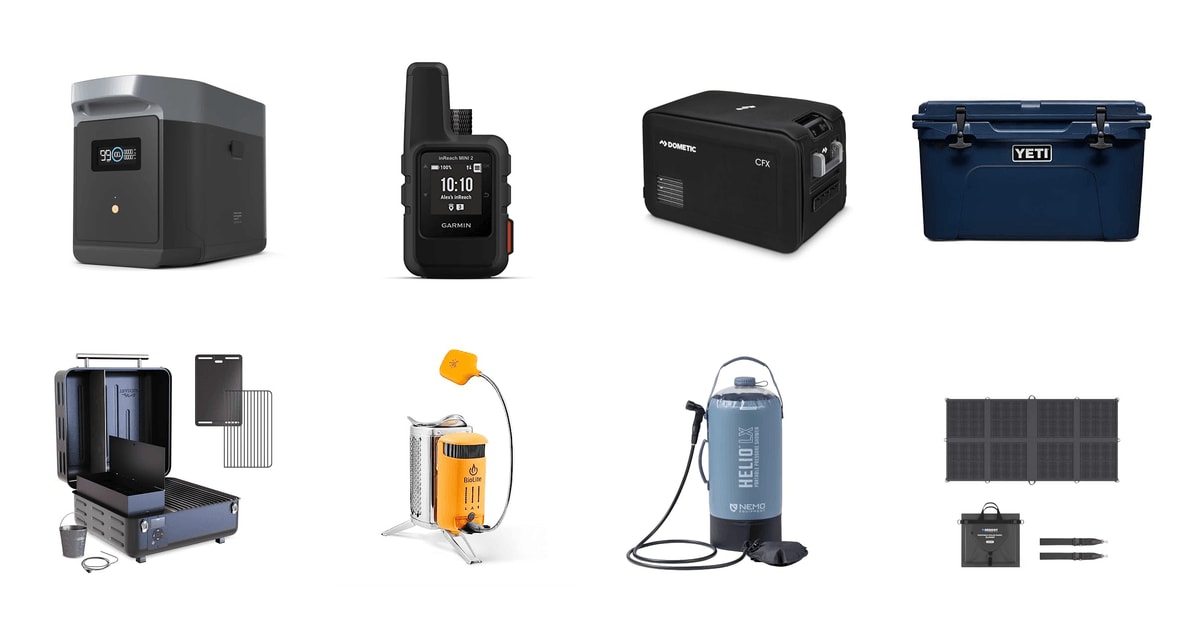
We've picked for both camps, tent and RV. Our favorite gift here is the Garmin inReach Mini 2, which works for anyone who goes anywhere without cell service, and the YETI Tundra 45 is the safe choice when you're less sure of their setup — everybody who camps needs a cooler, and almost nobody buys themselves a nice one.
Everything we recommend

A way to call for help when there's no signal at all
For the one who hikes alone and never tells anyone where
$338.55 from Amazon
Everyone who camps needs one, and nobody buys themselves this one
For anyone who camps at all and still uses a supermarket cooler
$325 from Amazon
Free power with no wiring, no roof mount, no learning curve
For the van camper who's curious about solar but not about drilling holes
$237.99 from Amazon
Real wood smoke at a campsite, from a standard outlet
For the RV owner who misses their backyard smoker
$479.99 from Amazon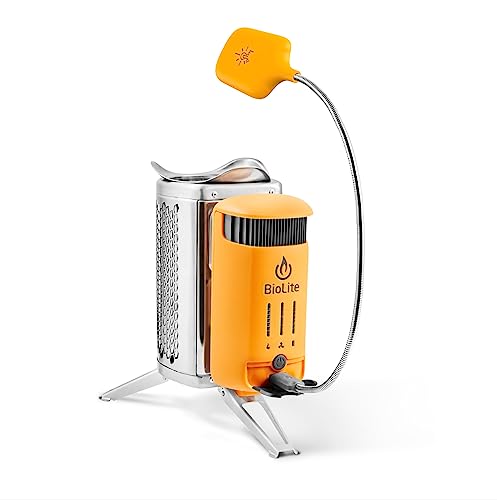
It cooks on twigs and charges a phone off the fire
For the tinkerer who'd rather burn sticks than buy fuel canisters
$149.89 from Amazon
For the camper who hates the campground shower building
$199.95 from Amazon
For the boondocker who already owns a DELTA 2 Max
$879 from Amazon
For the RV owner whose 12V fridge lives in the truck bed
$119.99 from AmazonHow we picked
Solves a real problem. We looked for gear that fixes something a camper deals with on every trip — hauling ice, finding an outlet, rinsing off after a hike. Novelty gadgets that duplicate what they already own didn't make the list.
Power that fits. We checked manufacturer specs for what each item actually needs: 12V DC, 120V shore power, solar input or nothing at all. Anything requiring a separate base unit or subscription got flagged so you know before you buy.
Weight and packing. Tent campers count ounces and RV owners count cubic feet. We noted published weights and folded dimensions for each item, and matched them to camping styles rather than assuming one answer fits everyone.
Built to last. We favored construction that survives a truck bed and a rainy weekend — rotomolded shells, IP-rated weather resistance, LFP battery chemistry rated for 3,000-plus cycles versus 500 to 1,000 for standard lithium-ion.
Unwraps well. A gift has to land in the moment, not just on the third trip. We weighed whether each item is obvious on opening, whether sizing or taste is a risk, and whether the recipient would face a setup chore.
Our favorite giftOn sale
A way to call for help when there's no signal at all
Garmin inReach® Mini 2
For the one who hikes alone and never tells anyone where
The inReach Mini 2 sends two-way text messages and an SOS over satellite, so your person can reach someone from a canyon or a forest road with zero bars. It weighs about 3.5 ounces and clips to a pack strap.
$338.55fromAmazonList priceThis is the rare gift that changes what someone is willing to do. People skip the solo trip, the unmarked trailhead, the campsite two hours past the last cell tower — not because they don't want to go, but because nobody would know if something went wrong. The Mini 2 removes that. It's small enough to forget about until the moment it matters, and it turns "I probably shouldn't" into "sure, why not."
It runs on the Iridium satellite network, which Garmin says covers 100% of the globe, poles included. That's the whole point. Cell-based safety apps and phone SOS features work until they don't, and where your person is going is usually exactly where they don't. Owner feedback from hikers in slot canyons and deep woods consistently describes messages getting through in places where a phone was a paperweight.
It does more than emergencies. There's two-way texting, so your person can tell someone at home they made camp. TracBack routing walks them back the way they came. A MapShare page lets family follow along, and the digital compass gives a heading even standing still. It pairs with the Garmin Explore app for trip planning and with other Garmin devices if they already own one.
One warning worth saying out loud before you wrap it: the satellite features need an active paid subscription, which the recipient sets up and pays for. That's not a small footnote on a gift. Some givers add the first few months as a card tucked in the box, which is a genuinely nice touch and avoids the awkward moment where a present arrives with a bill attached.
Flaws but not dealbreakers
The subscription is the real cost over time, and it's ongoing. If your person camps twice a year at established campgrounds with decent reception, this is more device than they need, and they may resent the recurring charge.
It's slow by phone standards. Messages go out over satellite, and owners note it can take a while to get a fix and send, especially under tree cover or canyon walls. The tiny screen and the small button interface make composing anything longer than a sentence tedious. Think of it as texting from 1998, but from the middle of nowhere.
Some jurisdictions regulate or restrict satellite communicators, which matters if your person travels internationally.
Safest bet
Everyone who camps needs one, and nobody buys themselves this one
YETI Tundra 45 Cooler
For anyone who camps at all and still uses a supermarket cooler
The Tundra 45 is a rotomolded hard cooler that holds about 26 cans at the recommended two-to-one ice ratio. It's the thing your person has been meaning to upgrade for years and keeps not doing.
$325fromAmazonAlmost nobody buys their own premium cooler. They look at the price, look at the twenty-dollar one in the trunk, and put it off another season. That's what makes this such a reliable gift — it's a want that never quite becomes a purchase. Hand someone a Tundra and you've broken a stalemate they've been having with themselves for a decade.
Ice retention is the whole job, and this one does it. OutdoorGearLab's multi-cooler comparison found the Tundra 45 held ice roughly five days under standardized field conditions, a top-tier result in its class. Up to three inches of insulation and a thick-walled design are doing that work. For a long weekend, that means one ice fill instead of a mid-trip run to the nearest gas station.
The build is genuinely overkill in a good way. Rotomolded construction means it's formed as one piece with no seams to split, and it's certified bear-resistant. The rubber T-Rex latches don't snap the way plastic clasps do. Owners who've had theirs for years describe them as basically permanent objects, which is the argument for giving one instead of another cheap cooler that'll crack in three summers.
It also unwraps beautifully. It comes in real colors, the logo reads as a small status object, and it's immediately obvious what it is and what it cost you. If you're shopping for someone whose camping style you don't know well, a cooler is the one item that works for a tent camper, a van lifer and an RV owner alike.
Flaws but not dealbreakers
It's heavy and it's bulky. Empty, it's 23 pounds and over two feet long, so it eats trunk space and it's a two-person carry when loaded. Backpackers and anyone with a small car should look elsewhere.
Interior capacity is smaller than the outside suggests, because those thick walls have to go somewhere. Once you add the recommended ice ratio, there's less usable room than a cheap cooler of similar footprint, and some owners have been surprised by that. Tall bottles and big sandwiches don't always fit the way you'd expect.
It's the most expensive way to solve the cold-food problem, and for someone who only camps at sites with a camp store nearby, a basic cooler genuinely does the job.
Best for beginners
Free power with no wiring, no roof mount, no learning curve
Renogy 200 Watt Solar Panel Blanket
For the van camper who's curious about solar but not about drilling holes
This 200-watt folding solar blanket weighs under nine pounds and packs down to about backpack size. It plugs straight into a power station or charges phones through its own USB ports, so there's nothing to install.
$237.99fromAmazonSolar is where new campers get intimidated, and this skips all of it. There's no roof mounting, no charge controller to wire, no holes in anything. Your person unfolds it, points it at the sun and plugs in. That's the entire process. For a gift, that matters — the last thing you want is a present that sits in a closet waiting for a free weekend and a drill.
The portability is the real feature here. Renogy lists it at 8.82 pounds with an eight-fold design, which is what makes it something a car camper will actually bring. Owners describe throwing it across a windshield or the roof of an SUV, or hanging it between trees when the van's parked in shade. A rigid panel of the same wattage is heavy and awkward enough that it stays home.
The cell technology is current. Renogy rates the N-type cells at up to 25% efficiency against roughly 22.5% for standard panels, which means more watts from the same patch of sun. There's a USB-C port and two USB-A ports for charging phones and tablets directly, plus a six-and-a-half-foot cable for feeding a power station or a 12V system. The IP65 rating covers rain and dust.
It pairs naturally with a power station, which is worth knowing if you're splitting a bigger gift with someone else. On its own it charges devices; connected to a battery, it's what keeps a boondocker off the generator. Either way it fits a specific and common frustration — being three days out with nowhere to plug in.
Flaws but not dealbreakers
Real-world output rarely matches the rating. Owners report figures in the 135 to 185 watt range in good sun, and at least one has been openly disappointed after several days of trying to hit the number in strong desert light. That's normal for solar, but it's worth setting expectations if your person is expecting 200 watts on the dot.
It needs sun and it needs aiming. Cloudy days cut output sharply, and a blanket laid flat on a roof collects less than one angled properly. Someone camping under heavy tree cover will get frustrated.
A few owners found the connector cables stiff and fiddly to detach at first.
Best splurge
Real wood smoke at a campsite, from a standard outlet
Traeger Ranger Portable Wood Pellet Grill &
For the RV owner who misses their backyard smoker
The Ranger is a tabletop pellet grill that smokes, grills and sears using real wood pellets and a digital controller. It plugs into a normal 120V outlet, which makes it one of the few genuine smokers that works on RV shore power.
$479.99fromAmazonFor anyone who left a smoker behind to travel, this is the gift that fixes it. Camp cooking usually means a propane burner and a skillet, which is fine and also a little sad after the third night. The Ranger burns actual hardwood pellets, so a brisket at the campsite tastes like a brisket at home. Owners who sold houses to go full-time RV describe it as the thing that made the kitchen downgrade bearable.
The controls do the hard part. A digital controller holds temperature between 165°F and 450°F, and the grilling logic keeps it steady without babysitting, so a long smoke doesn't mean sitting next to it adjusting vents for six hours. There's a built-in meat probe for internal temp and a keep-warm mode for when dinner's ready before people are. It comes with a cast iron griddle and porcelain-coated grates.
Power is what makes it RV-friendly rather than just small. It runs off a standard 120V outlet, which means shore power at a campground handles it without any adapters or special wiring. Some owners run it off a large power station instead when they're off-grid. That flexibility is rare — most real smokers assume a garage and a permanent home.
Consider the giving logistics too. This is a large, heavy box that's obviously a grill, so surprise is off the table, and it needs a sturdy surface and clearance from the awning. If your person camps in a tent or a small car, this is the wrong gift entirely. For a travel trailer or a Class C with a picnic table, it's close to perfect.
Flaws but not dealbreakers
It's 54 pounds and it takes up real storage space. In an RV, everything has to live somewhere, and this needs a dedicated basement bay or cargo area. Ask yourself whether your person has room before you buy.
Pellets are an ongoing supply issue. They need to stay dry, they take up their own storage, and running out mid-trip means the grill is a paperweight until the next town. There's also ash cleanup after cooks, which is messier than propane.
Multiple owners flag the same small annoyance: the rubber feet covers fall off. It's a cheap-feeling detail on an otherwise well-built unit.
Most personal
It cooks on twigs and charges a phone off the fire
BioLite CampStove 2+ Wood Burning
For the tinkerer who'd rather burn sticks than buy fuel canisters
The CampStove 2+ burns sticks, pinecones and wood scraps to cook, and converts some of that heat into USB power. It boils a liter of water in about four and a half minutes and packs down to roughly the size of a wide-mouth water bottle.
$149.89fromAmazonSome people love gear that does something clever, and this is that gift. A thermoelectric module turns fire into electricity — up to 3 watts of USB output, stored in a 3,200 mAh internal battery so it keeps charging after the flames die down. It's not going to power a laptop. But watching a phone charge off a handful of twigs is genuinely delightful, and that reaction is the point of a present.
The practical case is the fuel. No canisters to buy, carry, track or dispose of — the forest floor is the fuel supply. For someone who camps often, that's one fewer thing to remember and one fewer thing rattling around the gear bin. A four-speed fan makes the burn hot and reasonably smokeless, and the scalloped pot stand and folding legs keep a pot steady.
It packs small at about five by eight inches and just over two pounds, so it fits a moto-camping or backpacking kit where a big stove wouldn't. A 100-lumen LED FlexLight, stuff sack, firestarter and USB cord come in the box, which makes it feel complete on unwrapping rather than like the first piece of a system.
Buy it for the right person, though. This suits someone who enjoys the process of building a small fire — feeding it, adjusting it, watching it. Someone who wants dinner in four minutes with no fuss will be happier with a screw-on propane burner, and won't be shy about saying so.
Flaws but not dealbreakers
It needs tending. You feed it constantly, and owners note that boiling water means lifting the pot to add more wood mid-cook. That's charming on a relaxed evening and irritating when it's raining and you're hungry.
Charging is slow. Three watts tops up a phone over a long fire, not in a hurry, and it won't touch anything power-hungry. Treat the USB output as a nice bonus rather than a power plan.
At two pounds it's heavier than a minimalist canister stove, which some backpackers find hard to justify. Fire bans also make it unusable in dry-season areas where open flame isn't allowed — worth checking where your person camps.
Who this is for
This guide shops for people who already camp. Weekend tent campers upgrading a kit that's mostly hand-me-downs, full-time RV dwellers and digital nomads, boondockers who park where there are no hookups, families who want the trip to feel comfortable, and overlanders who sleep near their vehicle. The RV Industry Association counted 11.2 million U.S. households owning an RV, with first-time buyers making up nearly 45% of shipments in a recent year — so there's a good chance your person is newer at this than they let on and still has gaps in their gear.
It works across giver situations, but not equally. Several picks here are close-friend or spouse territory: they're expensive, they take up storage, and a few need setup or a subscription. For an office gift exchange or a coworker you like but don't know well, skip to the shower or the fridge cover — both are useful, neither is presumptuous. We don't cover clothing, sleeping bags, tents or anything sized to a body, since fit is a return waiting to happen. And if your person has never camped at all, this isn't the guide — start with the basics before the accessories.
How we picked
We weighed the same things a thoughtful giver would. Solves a real problem: the gift has to fix something that comes up every trip, not duplicate gear they own. Power that fits: we checked published specs for 12V, 120V, solar and USB compatibility, and flagged anything needing a base unit or a paid plan. Weight and packing: ounces matter for tent campers, cubic feet matter in an RV, so we matched each item to a camping style. Built to last: rotomolded shells, IP ratings and LFP cells rated for 3,000-plus cycles beat gear that cracks in a season. Unwraps well: it should be obvious and welcome on opening, with no sizing risk and no setup homework.
Other gifts for campers and rv owners worth considering
If you want the most useful gift for the money: The NEMO Equipment Helio Portable Camp Shower - ($199.95) — The NEMO Helio is a portable pressure shower that solves the single most-complained-about part of camping without hookups. It holds 22 liters, and a foot pump pressurizes it — no batteries, no electricity, nothing to charge. NEMO says it delivers 7 to 10 minutes of continuous steady spray, and the seven-foot neoprene hose is long enough to hold overhead like a real shower rather than crouching under a dribbling bag. The two-stage nozzle switches between trigger and continuous, and the wide screw cap means filling from a spigot or a lake without a hose. At under three pounds empty it packs easily. It's a modest gift next to a power station, and it may well be the one they use most. The catch is that water heats by sun, so an early-morning rinse is a cold one.
More good gifts
These are the other products our research turned up, not a survey of everything sold. Each suits a particular person on your list — a boondocker with a specific power setup, or someone who already owns the expensive thing and needs it protected.
The EF ECOFLOW DELTA 2 Max Power Station ($879) — This is the 2048Wh LiFePO4 expansion battery for EcoFlow's DELTA 2 Max — not a standalone power station. Read that twice before you buy, because it does nothing on its own. If your person already runs a DELTA 2 Max and keeps hitting empty on longer stays, this doubles their capacity, and two of them push a setup to 6144Wh. The LFP chemistry is rated for 3,000-plus cycles to 80% capacity, roughly six times a standard lithium-ion pack, so it's a decade of regular use for someone who camps a lot. Owners describe hooking it up as plug-and-play, recognized immediately by the main unit. It's 42 pounds, so it lives in a bay rather than moving around. Confirm the exact model your person owns first — the wrong pairing is an expensive return.
The Dometic CFX 35L Protective Cover ($119.99) — This is a custom-fit protective cover for Dometic's 35L portable fridge, sized for the CFX5 35 and also fitting the CFX3 35. It's an accessory, not the fridge, so it only makes sense for someone who already owns one — but for that person it's a genuinely thoughtful pick. EVA foam and 1200D nylon guard against the scrapes a fridge picks up in a truck bed, cutouts leave the bottle opener and control panel usable, and zippered pockets hold cords and tools where they're findable. It's vented so the compressor doesn't overheat. Owners consistently describe the fit as glove-tight, tight enough that the zippers take patience. One reports the black fabric fading quickly in sun, and several think it's expensive for what it is. As a small add-on gift for someone with a nice fridge to protect, it works.
Giving notes and setup
A few of these need a heads-up rather than a surprise. The inReach needs an active satellite subscription the recipient signs up for, so either mention it or include the first few months as part of the gift. The EcoFlow battery only works with a matching DELTA 2 Max, and the Dometic cover only fits a 35L CFX — confirm what your person owns before ordering, because both are awkward returns. The Traeger and the YETI are big, heavy boxes that give themselves away under a tree, and both need storage space your person may not have. If you're shipping directly, warn them something bulky is coming so it isn't sitting on a porch for a week while they're out camping.
Questions we get
What's the best gift for someone who lives in their RV full time?
Look at what they're doing the hard way every day. For most full-timers that's power or food storage, which points to the Traeger for someone who misses cooking properly, or a solar blanket for anyone who parks away from hookups. Full-timers are also brutally short on storage, so ask about space before you buy anything large. A small, high-quality item they'll use daily usually beats a big one they have to find a home for.
Do campers really need a satellite communicator, or is it overkill?
It depends entirely on where they go. For someone who camps at developed campgrounds with cell service, it's overkill and the subscription will feel like a waste. For anyone who hikes alone, camps on forest roads, or travels past the last tower, it's the single most useful safety item they can carry. The line is simple: if they regularly spend time with zero bars, it's worth it.
What's the difference between a 12V portable fridge and a regular cooler?
A 12V fridge runs a compressor off a battery or shore power and holds a set temperature indefinitely, so there's no ice and no soggy food. A cooler is passive — it holds cold as long as the ice lasts, then it's a box. Fridges cost much more upfront and need a power source, but they end the daily ice run. Coolers are simpler, cheaper and work anywhere, which is why plenty of RV owners keep both.
What's a good practical gift for someone who camps off-grid without hookups?
Power and water, in that order. A portable solar panel like the Renogy blanket keeps their devices and power station topped up without running a generator, and it takes no installation. A pressure shower solves the other big off-grid complaint. Cooking gear tends to be lower on a boondocker's list, because they've usually already sorted that out.
Are portable pellet grills worth it for campsite cooking?
For RV campers with shore power, yes — they produce real wood smoke flavor and hold temperature without babysitting, which a camp stove can't do. For tent campers, no. They're heavy, they need an outlet, and pellets require dry storage. The Traeger Ranger at 54 pounds is only sensible if your person has a vehicle with room and a place to plug in.
How do I know if a solar panel will work with their setup?
Most portable panels output through common connectors and work with a wide range of power stations and 12V charge controllers, so compatibility is usually fine. The things to check are the input voltage range on their power station and whether they need a specific adapter cable. The Renogy blanket also has USB-A and USB-C ports built in, so it charges phones and tablets directly even if the rest doesn't line up.
Why you should trust us
For this guide:
- We read manufacturer specifications for every product here, including battery chemistry and cycle ratings, published output figures, weights and folded dimensions.
- We compared published review findings, including OutdoorGearLab's multi-cooler ice-retention comparison, and industry participation data from the Outdoor Industry Association, the RV Industry Association and KOA's camping report.
- We read through owner feedback for each listing to identify recurring complaints — subscription costs, real-world solar output, storage bulk and small build annoyances — and reflected those themes in the flaws above.
- We read owner reviews on every listing, weighted toward the critical ones, because that is where the recurring failures show up.
- We have a systematic way of automatically fetching the latest prices, so the numbers on this page stay current.
- This is a research-focused guide, so the team may not own every product listed — though we often do own the top winners, which gives us extra context for the recommendations.
- We don't accept free products, and the retailer commission never changes which product we recommend.
Sources
Best Portable Power Stations 2026 — Wirecutter, Wirecutter
Best Coolers 2025 — OutdoorGearLab, OutdoorGearLab
Best Camping Grills 2026 — Outdoor Life, Outdoor Life
EcoFlow Delta 2 Full Review — CNET, CNET
Garmin inReach Mini 2 In-Depth Review — DC Rainmaker, DC Rainmaker
Best Portable Refrigerators for RVing — RV Magazine, RV Magazine
2024 Outdoor Participation Trends Report — Outdoor Industry Association, Outdoor Industry Association
North American Camping & Outdoor Hospitality Report 2024 — KOA, Kampgrounds of America (KOA)
RVIA 2023 Annual RV Industry Report — RV Industry Association, RV Industry Association (RVIA)
BioLite CampStove 2+ Long-Term Review — Backpacker Magazine, Backpacker Magazine
Best Solar Panels for RVs and Van Life 2025 — Gear Junkie, Gear Junkie
Dometic CFX3 35 Portable Fridge Review — Truck Camper Magazine, Truck Camper Magazine
Amazon product listings and owner reviews for all 8 products
Manufacturer specification pages for each product
Some passages in this guide may be paraphrased with AI help. Prices are refreshed automatically.
More like this.
Continue exploring lifestyle reviews and recommendations.

The Best Self-Help Books for Mental Health
A mental health book has to work on your worst week, not your best one. That's the real test. You'll pick it up at 11 at night, read four pages, and put…

The Best Books for Anxiety and Mental Health
An anxiety book has one job: to give you something to do at 3 a.m. when your chest is tight and your brain won't stop looping. That's a different job than…

The Best Gifts for Artists and Crafters
Art supplies are a strange thing to shop for. The person you're buying for probably has a drawer full of half-used tubes and a favorite pencil they've had…

The Best Rolling Backpacks for Students and Commuters
A bag loaded with textbooks, a laptop and a water bottle can easily hit twenty pounds, and your shoulders feel every one of them by the third block.…

The Best Dusters
Dust isn't just ugly. It's mostly you - dead skin makes up somewhere between 20 and 50 percent of household dust, according to the American Lung…

The Best Rechargeable Hand Warmers
Cold hands ruin an otherwise good day outside. A rechargeable hand warmer is a small lithium battery wrapped in a metal or plastic shell that heats up on…