The Best Dusters
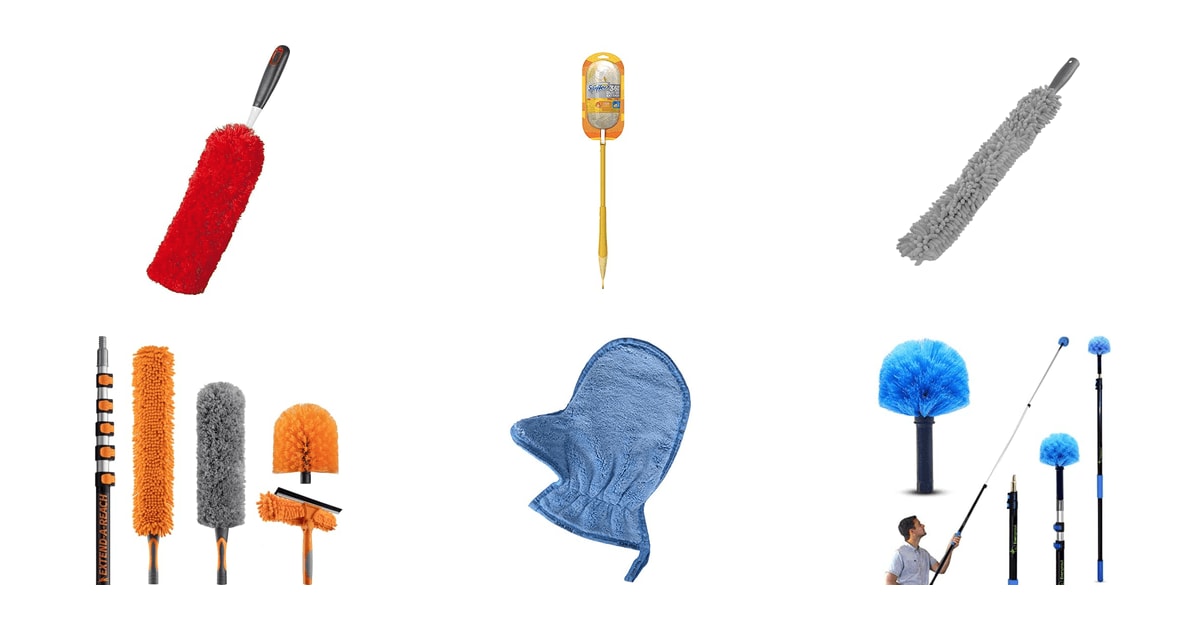
Dust isn't just ugly. It's mostly you — dead skin makes up somewhere between 20 and 50 percent of household dust, according to the American Lung Association, mixed in with pet dander, pollen, mold spores and dust mite waste. The EPA reports that indoor air carries two to five times more pollutants than the air outside, and we spend roughly 90% of our time breathing it. So the thing you drag across your shelves matters. A good duster picks particles up and holds them. A bad one just relocates them.
Here's the catch: no duster fixes a dusty house by itself. Guidance for allergy sufferers leans on damp microfiber and vacuuming, not dry passes over a shelf. Every duster here misses tight corners, and every one eventually needs a hard shake over a trash can or a trip through the wash. Reusable heads shed a few fibers. Disposable ones cost money forever. Pick the trade-off you can live with, then dust more often than you think you need to.
We read published testing from the Good Housekeeping Institute, Consumer Reports, Reviewed and Bob Vila, along with manufacturer specs and a lot of owner feedback, and the pattern held everywhere. Split microfiber wins. Feathers lose. What separates the good ones is reach, washability, and how well the head bends around a fan blade or a vent. We think that the OXO Good Grips Microfiber Hand Duster is the best duster for most people, and that the UNGER Commercial StarDuster ProFlex Elite is the one to buy if you have high ceilings and a pole to put it on.
Everything we recommend

Traps dust instead of flinging it, and the head goes in the wash

A bendable pro duster that takes a pole and hundreds of washes

The easiest way to dust around clutter, if you'll buy refills

Ladder-free reach for vaulted ceilings and outdoor eaves
At a glance
| Product | Reach | Material | Price | |
|---|---|---|---|---|
| OXO Good Grips Microfiber Hand DusterTop pick | 18 in | Microfiber | $14.99 |
| Swiffer Dusters 360 Extendable Handle Starter KitBudget pick | Extendable | — | $24.98On sale |
| UNGER Commercial StarDuster Proflex Elite 18" MicrofiberRunner-up | 18 in | Microfiber | $31.29On sale |
| 30 Foot High Reach Duster Kit withAlso great | Up to 36 Ft | — | $97.97 |
 | Norwex Microfiber Dusting MittAlso consider | — | Microfiber | $19.03 |
 | EVERSPROUT 5-to-12 Foot Cobweb Duster & PoleAlso in lineup | Up to 20 Ft | Bristle | $64.99 |
 | 2 Pack of Microfiber Flexible DustersAlso consider | — | Microfiber | $13.98 |
How we picked
Dust capture, not dispersal. We leaned on independent lab work cited by Reviewed, which found feather dusters returning up to 60% of disturbed dust to the air while dense split microfiber held over 95% of it. Anything that mostly rearranges dust was out.
Reach and pole options. Ceiling fans and crown molding are where dusters get bought and abandoned. We favored telescoping handles and heads that thread onto a standard or branded extension pole.
Washable versus disposable. We compared manufacturer wash-cycle ratings against the ongoing cost of refill packs. Reusable heads had to survive dozens of washes to earn a spot; disposables had to offer something reusables can't.
Head shape and flex. Spec sheets and owner feedback both point to the same thing: a head that bends around a fan blade or into a vent cleans more in one pass. Flat, rigid dusters kept missing the middle.
Safe on delicate stuff. Screens, wood blinds and open electronics shelves rule out anything stiff or abrasive. We looked for chemical-free operation and soft, dense fibers that won't scratch.
Top pick
Traps dust instead of flinging it, and the head goes in the wash
OXO Good Grips Microfiber Hand Duster
The OXO hand duster puts a wide microfiber head on a slim 18-inch handle, and that head unsnaps for the washing machine. It pulls dust off shelves, shutters and stereo gear without any chemicals, and it holds onto that dust until you shake it out.
$14.99fromAmazonThis is the duster you'll actually reach for. It weighs about three and a half ounces, the grip is soft and non-slip, and the head is wide enough to clear a shelf in one swipe. There's nothing to assemble and nothing to refill. Owners describe the same thing again and again: the fibers grab dust and keep it, then release it with a shake over the trash.
Microfiber's advantage is physical, not marketing. Consumer Reports puts premium split microfiber at over 200,000 fibers per square inch, against fewer than 1,000 for cotton terry — orders of magnitude more surface area to hold particles. In lab work cited by Reviewed, dry feather dusters put up to 60% of the dust they disturbed back into the air, while dense split microfiber kept more than 95% of it locked in the fibers.
The head comes off and goes in the wash, which is the whole argument for buying it. Snap it loose, run it through the machine, air-dry it without heat, and you're back in business. Wirecutter's long-term wear work found that quality washable microfiber heads keep capturing dust through 50 to 100 cycles. A replacement head is available if yours finally wears out.
The slim profile matters more than it sounds like it should. It slides between stereo components, behind picture frames, and through plantation shutter slats without knocking anything over. If you own a lot of electronics, that's the job owners mention most — dusting a shelf of gear, then the shelf underneath it, without moving a single cable.
Flaws but not dealbreakers
It doesn't extend. Eighteen inches of handle is plenty for shelves, blinds and baseboards, but you're still getting a step stool for the ceiling fan. If your ceilings are high, treat this as your everyday duster and buy a pole tool for everything above your reach.
Some owners notice loose fibers shedding off the head, especially when it's new, and those end up on the floor or your socks. It calms down after a few washes. The head also loads up faster than you'd expect, so shake it out partway through a job rather than pushing a gray clump around at the end.
Runner-upOn sale
A bendable pro duster that takes a pole and hundreds of washes
UNGER Commercial StarDuster Proflex Elite 18" Microfiber
This is the flexible 18-inch duster commercial cleaning crews buy. The wand bends so the dual-sided microfiber sleeve wraps around a fan blade or a vent, the sleeve is rated for hundreds of washes, and it locks onto Unger extension poles when you need height.
$31.29fromAmazonList priceStart with the sleeve. Unger rates it for up to 300 wash cycles, which is years of weekly dusting in most homes. It's dual-sided, so you get two working faces before you swap, and a spare 18-inch sleeve comes in the box. A washable head stops costing you anything the day you buy it. Refill packs never stop.
The bendable wand is what justifies stepping up from a flat hand duster. Fan blades, ceiling vents, the top edge of a door, the gap behind a monitor — you shape the duster to the surface instead of jabbing at it. A stiff duster skips the curved middle of a fan blade and calls it done. This one wraps around it.
It accepts Unger extension poles through the ErgoTec locking cone adaptor, which is the upgrade path most people never notice. Bob Vila found that extension-pole dusters cut ceiling fan cleaning time by about 74% compared with the step-stool-and-cloth routine, and that they hold loosened dust better instead of scattering it around the room.
Nothing about it is charming. It's gray and black, built for a janitorial cart, and it looks the part on your kitchen counter. But it's the same tool hotels and office buildings buy by the case, and that's a reasonable proxy for durability when nobody in your house is being gentle with the cleaning supplies.
Flaws but not dealbreakers
The pole isn't included, and neither is the adaptor. If reach is the reason you want this, plan on buying both — on its own the duster is about 23 inches long, roughly the same as a hand duster with a generous handle.
It's also a lot of duster for a small apartment. An 18-inch sleeve is wonderful across a wall of bookshelves and clumsy inside a curio cabinet. With a firm spine under the microfiber, you'll want to move deliberately around thin-walled vases and crowded open shelving.
Budget pickOn sale
The easiest way to dust around clutter, if you'll buy refills
Swiffer Dusters 360 Extendable Handle Starter Kit
The 360 kit pairs an extendable, pivoting handle with fluffy disposable heads that grab dust from every direction at once. Get it if your shelves are crowded with small objects, or if you want the ceiling fan handled without dragging out a step stool.
$24.98fromAmazonList priceNothing else here conforms to clutter this well. The fibers point every direction, so the head closes around a candlestick, a picture frame or a blind slat instead of sliding past it. Procter & Gamble's own comparison claims about three times the dust trapping of a dry cloth, from a fiber design that builds an electrostatic charge as you sweep. Owners with a lot of knickknacks on display are devoted to it.
The handle telescopes to roughly 27 inches and pivots at the head, which covers a ceiling fan or the top of a kitchen cabinet for most people of average height. That's the job owners bring up constantly — fan blades, cabinet tops, the fronts of blinds. Four refills come in the kit, so you're not ordering anything else for a while.
It's the low-commitment option, and that counts for something. There's no washing routine, no laying a head flat to dry, no wondering whether the fibers still work. You use it, it turns gray, you toss it and clip on a fresh one. In a dorm room or a first apartment, that simplicity beats any fiber-count spec.
Flaws but not dealbreakers
The refills are the real cost of this thing, and they keep coming. Dust weekly and you'll be reordering indefinitely, with every spent head going to a landfill. A washable microfiber head pays for itself within a few weeks of ordinary use. That's the trade you're making for convenience.
The handle is thin. Owners report it flexing and occasionally cracking when they lean into a stubborn spot, so treat it as a duster rather than a scrub brush. Several also find the refill fiddly to thread onto the handle the first couple of times.
Also great
Ladder-free reach for vaulted ceilings and outdoor eaves
30 Foot High Reach Duster Kit with
This is a telescoping aluminum pole plus a kit of heads: a microfiber feather duster, a cobweb brush and a squeegee. It collapses to about five feet for the closet and extends past twenty, which is how you clean a two-story foyer while standing on the floor.
$97.97fromAmazonThe reason to own this has nothing to do with fiber counts. It's the ladder. The highest, dustiest spots in a house — the foyer light, the beam over the stairs, the eaves outside — are exactly the ones that tempt you onto a wobbly step stool over a hard floor. Standing flat with a pole in your hands takes that gamble off the table.
It telescopes from about five feet collapsed to more than twenty extended, and the retracted length fits in a car trunk. Four attachments come with it: a cobweb brush for corners and porch ceilings, a microfiber feather duster for flat surfaces, and a squeegee for the windows you otherwise can't get to. The universal tip also takes standard threaded accessories.
Pole dusting keeps more of the dust off the furniture underneath. Bob Vila found that extension-pole dusters cut ceiling fan cleaning time by roughly 74% versus the step-stool-and-cloth method, and that they hold loosened dust in the head rather than raining it onto whatever's below. If you've ever cleaned a fan the hard way, you know what ends up on the couch.
The kit solves problems that aren't dusting at all. That universal attachment point fits paint rollers, light bulb changers and fruit pickers, so the pole earns its closet space the rest of the year. It needs to, because at nearly seven pounds this isn't something you'll leave propped by the front door for quick touch-ups.
Flaws but not dealbreakers
It's heavy and it's long. Fully extended, seven pounds of aluminum held overhead gets tiring quickly, and detail work — getting between fan blades rather than dragging across them — is hard from that far away. Plan on doing the high stuff in short bursts.
Storage is the other problem. Even collapsed, this is a five-foot pole, which is a genuine ask in a small apartment. And the duster heads are fine rather than excellent, so use one of the other picks for surfaces you can reach and save this for the heights.
EXTEND-A-REACH backs the kit with a three-year warranty.
Who this is for
If dust is a health issue in your house, not just a housekeeping one, this guide is aimed squarely at you. The AAAAI attributes 85% of asthma cases and half of allergic rhinitis cases in the US to dust mite allergens, and the AAFA reports that regular electrostatic or damp-cloth dusting can cut measurable household allergen levels by up to 52% over three months. Pet owners fighting dander on blinds and shelves are in the same boat. So is anyone with ceilings above nine feet, where the dust you can't see is the dust that eventually falls on everything.
You can skip most of this if you already own a good microfiber duster that still grabs dust after a wash — replacing it won't change your life. We cover handheld dusters, extendable dusters and pole kits for home use. We don't cover vacuums, air purifiers, dusting sprays or robot cleaners, and no duster in here is a substitute for vacuuming with a decent filter.
How we picked
We built the shortlist around five things. Capture: the head has to hold particles rather than launch them, which in practice means dense split microfiber over feathers or cotton. Reach: a telescoping handle or pole compatibility, because ceiling fans and crown molding are the jobs people give up on. Cost over time: washable heads rated for dozens of cycles, weighed against the endless refill bill of a disposable system. Flex: a head that wraps a fan blade or slips into a vent beats a stiff paddle every time. Surface safety: soft, chemical-free fibers that won't scratch a monitor, a wood blind or a piano lid.
Other dusters worth considering
If you want to dust delicate things with your hand and nothing else: The Norwex Microfiber Dusting Mitt ($19.03) — The Norwex mitt slips over your hand like an oven mitt, so you feel the surface you're cleaning. That makes it the gentlest thing here for screens, houseplant leaves, mini blinds and coffee tables, and it works wet or dry with plain water — no sprays. Norwex's BacLock microfiber is independently verified to remove up to 99% of bacteria from hard surfaces with water alone, provided your technique is right. What you give up is reach and coverage: it's about ten inches by five and a half, it puts your hand within an inch of whatever you're dusting, and it will never touch a ceiling fan.
If you already own an extension pole: The 2 Pack of Microfiber Flexible Dusters ($13.98) — These two flexible dusters from Microfiber Wholesale thread onto any standard acme-thread pole, the same fitting most paint rollers use. A wire core lets the head bend into whatever shape a fan blade, chandelier arm or light fixture demands, and the professional-grade split microfiber is the type rated to hold particles down to 0.3 microns — small enough for dust mite fragments and mold spores. You get two, which is genuinely useful when one is in the wash. The catch is obvious: there's no handle in the box. If you don't already have a pole, you're buying a bare head with nothing to put it on.
The competition
This is what our research surfaced, not a survey of every duster on the market. The category is enormous and mostly interchangeable, so we focused on products with published testing behind them, clear specs, or a long track record with owners.
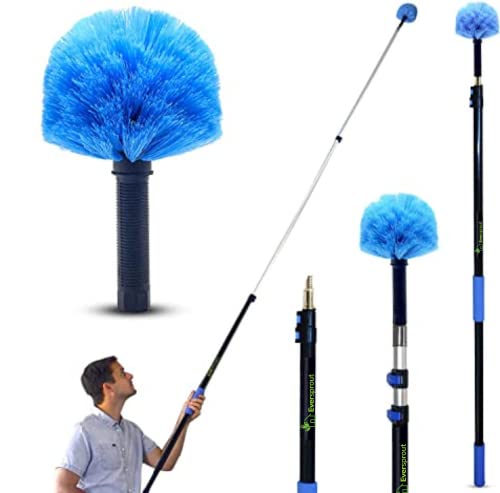
The EVERSPROUT 5-to-12 Foot Cobweb Duster & Pole ($64.99) — The EVERSPROUT cobweb duster and pole combo is a good tool for a narrow job. The three-stage aluminum pole goes from five feet to twelve and gives about twenty feet of standing reach, and at roughly a pound and a half it's far easier to hold overhead than a full kit. But the head is a stiff-bristled cobweb brush, not microfiber — it's built to rake webs off a garage rafter, not to trap fine dust on a shelf. There's only one head, so you can't switch tasks. If your problem is spiders in the eaves and webs in a vaulted corner, this is lighter and simpler than our high-reach pick. If your problem is dust, it isn't.
Care and maintenance
Microfiber fails in two ways, and both are avoidable. Fabric softener coats the fibers and kills the static grab that makes them work, so wash heads without it, and skip dryer sheets for the same reason. High heat melts the fibers outright — air-dry, or use the lowest setting your machine has. Wash duster heads separately from towels and cotton, which shed lint straight into them. Mid-job, shake the head out over a trash can rather than pushing a saturated clump around your shelves. A head that leaves streaks or stops picking anything up after a wash is done; that usually shows up somewhere past 50 cycles. Store dusters hanging or flat, not crushed at the back of a closet.
Questions we get
Are microfiber dusters actually better than feather dusters?
Yes, and it isn't close. Consumer Reports puts premium split microfiber at over 200,000 fibers per square inch versus fewer than 1,000 for cotton terry, which is why it holds particles instead of sweeping them along. Lab work cited by Reviewed found dry feather dusters returning up to 60% of disturbed dust to the air, while dense split microfiber retained over 95% of it.
Should I dust before or after I vacuum?
Dust first, vacuum second. Dusting knocks particles loose and some of them settle on the floor no matter how good your duster is, so vacuuming afterward picks up the fallout. Work top to bottom in each room for the same reason. For allergy sufferers, guidance favors this order plus damp microfiber over dry dusting alone.
What's the best duster if you have allergies or asthma?
A washable split-microfiber head used slightly damp, followed by vacuuming. The AAAAI links dust mite allergens to 85% of asthma cases in the US, and the AAFA reports that regular electrostatic or damp-cloth dusting can reduce measurable household allergen levels by up to 52% over three months. Our top pick's head is washable, which matters — a dirty duster is just an allergen applicator.
How often should you wash a microfiber duster head?
Whenever it stops grabbing, which for most homes means every few sessions. Wirecutter's long-term wear work found quality washable heads keep capturing dust through roughly 50 to 100 wash cycles before performance drops off. Unger rates its sleeves for up to 300. Replace the head when it starts smearing dust instead of lifting it.
Can I use a duster on my TV, monitor or laptop screen?
On a dry, soft microfiber head, yes — it's one of the safer ways to clear dust off a screen. Use light pressure and no cleaning spray, and never press a stiff or gritty duster against a display. A microfiber mitt gives you the most control here, since you can feel exactly how hard you're pushing.
Are Swiffer refills worth it compared with a washable duster?
It depends on what you're optimizing for. Disposable heads conform around clutter better than anything washable and require zero maintenance, which is a real advantage in a small apartment full of small objects. But the refill cost never ends and every head goes to a landfill, while a washable microfiber head stops costing you anything after a few weeks of ordinary use.
Why you should trust us
For this guide:
- We read published duster testing from the Good Housekeeping Institute, Consumer Reports, Reviewed and Bob Vila, plus long-term microfiber wear findings from Wirecutter.
- We compared manufacturer specifications for every product here — wash-cycle ratings, extended lengths, head dimensions and pole compatibility — against each other rather than taking marketing claims at face value.
- We reviewed recurring themes in owner feedback, particularly around fiber shedding, handle durability and how these tools hold up on ceiling fans and blinds.
- We read owner reviews on every listing, weighted toward the critical ones, because that is where the recurring failures show up.
- We have a systematic way of automatically fetching the latest prices, so the numbers on this page stay current.
- This is a research-focused guide, so the team may not own every product listed — though we often do own the top winners, which gives us extra context for the recommendations.
- We don't accept free products, and the retailer commission never changes which product we recommend.
Sources
Best Dusters — Wirecutter / New York Times, Wirecutter
Best Dusters Tested by the Good Housekeeping Institute, Good Housekeeping Institute
Best Dusters of 2026 — Reviewed (USA Today), Reviewed.com
Microfiber vs. Cotton Cleaning Cloths — Consumer Reports, Consumer Reports
Indoor Air Quality: Particle Pollution and Your Health — U.S. EPA, U.S. Environmental Protection Agency
Dust and Allergy Overview — American Lung Association, American Lung Association
Dust Mite Allergy — American Academy of Allergy, Asthma & Immunology, AAAAI
Reduce Allergens in Your Home — Asthma and Allergy Foundation of America, AAFA
Best Dusters for Every Surface — Bob Vila, Bob Vila
How to Properly Dust Your Home — The Spruce, The Spruce
Amazon product listings and owner reviews for all 7 products
Manufacturer specification pages for each product
Some passages in this guide may be paraphrased with AI help. Prices are refreshed automatically.
More like this.
Continue exploring lifestyle reviews and recommendations.

The Best Dust-Free Drywall Sanders
Sanding drywall is the part of a remodel nobody warns you about. The mudding goes fine, the taping goes fine, and then you spend an afternoon filling your…

The Best Baby Shower Gifts
Baby shower gifts get judged twice. Once at the party, when the wrapping comes off and everyone says something nice. And again at 3 a.m. six weeks later,…

The Best Ground Blinds for Deer Hunting
A ground blind does one job: it hides you at eye level with the deer. That's harder than it sounds. You're sitting where a whitetail's nose, ears and eyes…

The Best Outdoor Grills
A grill gets used more than almost anything else you keep outside. On a Tuesday you want it hot in ten minutes so the chicken is done before the kids melt…

The Best Binoculars for Birdwatching and Nature
Good binoculars change what a walk feels like. A bird that was a gray smudge in a hedge becomes a chipping sparrow with a rusty cap. What matters most…

The Best Disc Golf Starter Sets
Disc golf is easy to start and hard to shop for. A course near you is probably free, the rules take five minutes to learn, and one afternoon is usually…