The Best Binoculars for Birdwatching and Nature

Good binoculars change how a walk looks. A gray smudge in a hedge turns into a warbler with a black mask and a yellow throat. Power matters less than comfort: you want a view wide enough to find the bird, bright enough for a dawn trail, and a body light enough that the pair is still around your neck on the way back to the car. That's why so many birders land on 8x42.
No binocular does all of it. Spend less and you give up contrast in flat light, with purple fringing where a branch meets bright sky. Spend more and you're still carrying a precision instrument that scratches, fogs if a seal fails, and occasionally shows up damaged. Nothing holds a bird steady at 10x if your hands shake, and nothing focuses on a dragonfly at your boot unless the spec sheet says it can. Budget glass has gotten much better. It hasn't closed the gap.
So we built this guide around the format most people actually use all day, then sorted the lineup by what the spec sheets claim, what published reviews and lab measurements show, and what owners keep complaining about. If you wear glasses, that changes the answer. If you mostly watch feeders from a window, so does that. We think that the Vortex Diamondback HD 8x42 is the best binocular for birdwatching and nature for most people, and that the Nikon Monarch M5 8x42 is the one to buy if you wear glasses and need more room behind the eyecups.
Everything we recommend

Sharp, bright, and backed by a warranty with no fine print

More eye relief and ED glass, if your glasses get in the way

A bright, light first pair without the ED-glass premium

Flatter edges and a locking diopter for all-day birding

Punchy contrast and a very fast focus wheel
At a glance
| Product | Configuration | Glass and coatings | Price | |
|---|---|---|---|---|
| Nikon PROSTAFF P3 8x42 BinocularBudget pick | 8x42 | Multilayer-coated | $156.95 |
 | Celestron Nature DX 8x42 Waterproof Binoculars forAlso consider | 8x42 | Phase-coated BaK-4 | $148.99On sale |
| Vortex Diamondback HD 8x42 BinocularsTop pick | 8x42 | — | $239 |
| ZEISS Terra ED Binoculars 8x42 CompactAlso great | 8x42 | ED, 88% transmission | $469.86 |
| Nikon Monarch M5 8x42Runner-up | 8x42 | — | $349.95 |
| Vortex Viper HD Roof Prism Binoculars 8x42Upgrade pick | 8x42 | — | $489 |
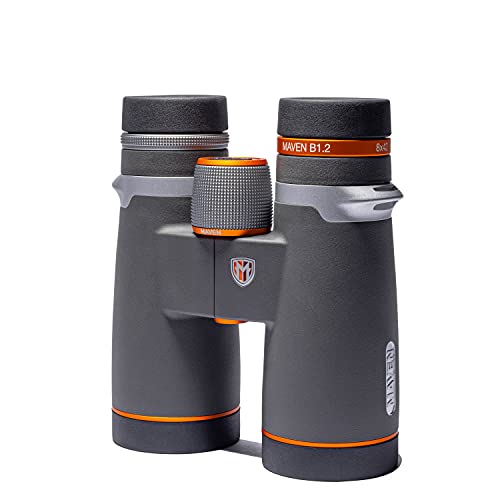 | Maven B1.2 8x42 mm BinocularsAlso in lineup | 8x42 | ED glass | $1,100 |
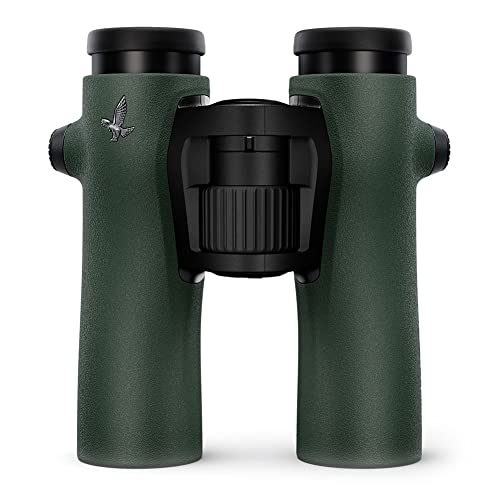 | SWAROVSKI Optik NL Pure 8x32 BinocularsAlso consider | 8x32 | SWAROVISION | $2,799 |
How we picked
Magnification and format. We treated 8x with a 32mm to 42mm objective as the baseline, following the Cornell Lab of Ornithology's guidance for birding. Exit pupil math backs it up: about 5.25mm for an 8x42 versus 4.2mm for a 10x42, which is why the 8x stays usable later into the evening.
Glass and prisms. We looked for ED or HD glass, phase-corrected roof prisms, and dielectric or equivalent prism coatings on the spec sheets, since phase correction is what prevents the resolution and contrast loss uncorrected roof prisms suffer. Where a listing stayed silent on phase coating, we said so.
Field of view. We compared published field-of-view figures at 1,000 yards, because a wider view is how you find and follow a bird that won't sit still. We relied on the manufacturers' own numbers, which range from 335 feet to 450 feet across this lineup.
Glasses and eye relief. We prioritized pairs that publish eye relief of roughly 15mm or more and use turn-and-slide eyecups, since that's the difference between a full view and a dark tunnel if you wear glasses.
Sealing and warranty. We required O-ring sealing with nitrogen or argon purging, then weighed service reputation. Vortex's VIP warranty is unconditional and transferable with no repair charge, which lowers the long-term cost of owning the binocular.
Top pick
Sharp, bright, and backed by a warranty with no fine print
Vortex Diamondback HD 8x42 Binoculars
The Diamondback HD 8x42 hits the format most birders settle on, with select glass elements, dielectric prism coatings, and a rubber-armored, argon-purged body. It's tripod-adaptable, comes with a chest harness, and carries Vortex's unconditional lifetime warranty, which is rare at this end of the market.
$239fromAmazonThis is the pair we'd hand a friend who just got into birds. The Cornell Lab of Ornithology points birders toward 8x or 10x with 32mm to 42mm objectives, and 8x42 sits right in the middle of that. Divide 42 by 8 and you get an exit pupil of about 5.25mm, versus 4.2mm for a 10x42. In plain terms, you see more at dawn, and the image wobbles less in your hands.
Vortex builds this one with select glass elements, anti-reflective coatings on every air-to-glass surface, and a dielectric prism coating that keeps color honest instead of pushing everything slightly cool or yellow. Published reviews and owner feedback converge on the same point: the view is brighter and cleaner than you'd expect from a mid-tier roof prism, and color fringing on high-contrast edges stays mild rather than distracting.
The handling is undramatic, which is what you want. Eyecups twist up and down, the center wheel moves both barrels together, and a diopter on the right eyepiece sorts out the difference between your eyes. Armortek coating on the outer lenses shrugs off fingerprints and grit. Argon purging and O-ring seals mean a soaking rain or a cold car trunk won't fog the inside.
The warranty is the quiet reason to buy Vortex. The VIP warranty is unlimited, unconditional, and transferable, and Vortex will repair or replace the binocular at no charge. It doesn't cover loss, theft, deliberate damage, or cosmetic scuffs that don't hurt performance. Over ten years of trail dust and dropped straps, that policy is worth more than a small spec advantage.
Flaws but not dealbreakers
It doesn't carry an ED glass label, and in hard backlight — a hawk circling against a white sky — you'll see a little more color fringing than the Zeiss Terra ED or the Monarch M5 show. Edge sharpness is good, not flat-to-the-edge; the Viper HD is the clear step up there.
The diopter doesn't lock, so it can creep if you're rough with the eyepieces. Owners also grumble about the included case, which feels like an afterthought next to the actually useful GlassPak harness.
Vortex covers the Diamondback HD with its unlimited, unconditional, transferable VIP warranty, which promises repair or replacement at no charge for damage or defects.
Runner-up
More eye relief and ED glass, if your glasses get in the way
Nikon Monarch M5 8x42
The Monarch M5 8x42 pairs Nikon's ED glass with a high-eyepoint design and roughly 19.5mm of eye relief, per Nikon's spec sheet. If you wear glasses and keep seeing a dark ring around the edges of your view, this is the pair to try first.
$349.95fromAmazonPut glasses on and most binoculars shrink. Your lenses hold your eyes an extra few millimeters back, the field closes in, and you end up peering down a tunnel. Nikon designed the M5 around that problem: the high-eyepoint eyepieces leave room between your brow and the eyecups, and Nikon publishes eye relief of about 19.5mm. Anything from 15mm up is generally enough for glasses wearers, so this has margin.
The ED glass is the other reason to pick it. Extra-low dispersion elements cut the color fringing that shows up on high-contrast edges — a dark wing against a bright sky, bare branches at noon. Nikon uses the same glass in its camera lenses and spotting scopes. Published reviews consistently rate the Monarch line a step above entry-level optics on contrast and color accuracy, and that's the step you're paying for.
Day to day it's easy. Turn-and-slide eyecups let you set the right position with or without glasses, the body is waterproof and fogproof, and an oil- and water-repellent coating on the outer glass means a quick wipe clears drizzle. Nikon lists a 335-foot field of view at 1,000 yards, which is plenty for tracking a chickadee working through a shrub. This listing also throws in a lens pen, cloth, case, and strap.
Flaws but not dealbreakers
That 335-foot field of view is the narrowest among our picks. The Viper HD publishes 409 feet and the Swarovski 450 feet, and you notice the difference when you're trying to relocate a bird that just moved three branches over.
This is a bundle assembled with accessories rather than a bare Nikon box, so your warranty paperwork and service path may be less straightforward than buying direct. Owner feedback includes at least one account of a frustrating warranty claim on a Monarch, where the repair wasn't honored and a replacement purchase was pitched instead. Worth registering your pair and keeping the receipt.
Budget pick
A bright, light first pair without the ED-glass premium
Nikon PROSTAFF P3 8x42 Binocular
The PROSTAFF P3 8x42 is a sensible way into real birding optics without spending much. It's waterproof, fogproof, under a pound and a half, and bright enough at dusk that owners use it for stargazing as well as warblers.
$156.95fromAmazonIf you're not sure you'll stick with birding, start here. The P3 weighs about 1.27 pounds, which matters more than it sounds like it should on a three-hour walk. The body is fiberglass-reinforced polycarbonate under rubber armor, with O-ring seals and nitrogen purging, so rain, snow, humidity, and a cold morning after a warm car won't put moisture inside.
The image punches above what you'd guess from a budget pair. Multilayer coatings on the lenses and a silver-alloy prism coating keep the view bright and the colors close to life. Owner feedback repeatedly describes people who assumed they needed ED glass, bought this instead on a whim, and never sent it back. A few compare it favorably against a tour leader's far more expensive pair.
The turn-and-slide eyecups and long eye relief mean glasses wearers generally do fine, and the central focus wheel is smooth enough to follow a bird that keeps dropping behind leaves. There's nothing clever here. It's a plain, well-sealed 8x42 that does the main job, which is why it has been the standard first recommendation for years.
Flaws but not dealbreakers
There's no ED glass, and the listing doesn't claim phase-corrected prisms. Phase correction is what keeps roof prisms from losing resolution and contrast, so this is a real gap versus the Celestron Nature DX, which does state phase-coated BaK-4 prisms. In soft light you won't care. Against a bright sky, you'll see more fringing and slightly less bite in fine detail than the Diamondback HD or Monarch M5 give you.
The polycarbonate body feels less solid in the hand than a magnesium-chassis binocular, and the view isn't flat to the edges. If you already know birding is your thing, skip straight to one of the pricier picks.
Upgrade pick
Flatter edges and a locking diopter for all-day birding
Vortex Viper HD Roof Prism Binoculars 8x42
The Viper HD 8x42 is the pair for people who bird most weekends. Its high-density optical system holds detail out toward the edges of a 409-foot field of view, the right-eye diopter locks, and the same unconditional Vortex warranty applies.
$489fromAmazonThe extra money buys you the edges of the image. Vortex's high-density optical system and XR anti-reflective coatings are built for resolution that holds up away from the center, which is where cheaper roof prisms go soft and smeary. Published reviews and owner comparisons put the Viper HD in the conversation with binoculars costing several times more, and the recurring phrase in that feedback is edge-to-edge clarity.
At 409 feet of field of view at 1,000 yards, you get noticeably more room than the Monarch M5's 335 feet. That matters when a mixed flock moves through a canopy and you're trying to keep up. The locking right-eye diopter is the other upgrade worth having: set it once for your eyes and it stays set, even after the binocular rattles around in a pack.
Ergonomics are better thought out than the spec list suggests. Rubber armor with thumb indents puts your hands in the same place every time, twist-up eyecups set your eye relief where you want it, and the fine-pitched center wheel lets you nail focus on a bird at twenty feet. The included GlassPak chest harness holds the weight off your neck, which is the single best thing you can do for a long day out.
Argon purging and O-ring seals handle weather, and Armortek guards the outer glass against scratches and oil. Combined with the transferable VIP warranty, this is a buy-once pair for someone who expects to still be birding in fifteen years.
Flaws but not dealbreakers
Build quality isn't flawless. Owner feedback includes accounts of twist-up eyecup mechanisms loosening or failing after about a year of use, on more than one copy. The warranty covers it, but you'll be without your binoculars while it's handled.
It's bulkier and heavier in the hand than the Diamondback HD, and the step up in optics is real but incremental. If you bird a few times a year, the extra money is better spent on a good harness and a field guide.
Vortex's unconditional, transferable VIP warranty covers the Viper HD for repair or replacement at no charge, excluding loss, theft, and deliberate damage.
Also great
Punchy contrast and a very fast focus wheel
ZEISS Terra ED Binoculars 8x42 Compact
The Terra ED 8x42 is the entry point into Zeiss glass, with ED optics and a claimed 88% light transmission. Its oversized focus wheel moves fast, which helps when a bird appears at the feeder and then moves to the treeline.
$469.86fromAmazonThe Terra's calling card is contrast. Zeiss pairs ED glass in a Schmidt-Pechan prism system with its own anti-reflective and hydrophobic coatings, and claims 88% light transmission. In practice, owners describe exactly what that number implies: a bright, high-contrast view that pulls detail out of shaded brush and holds up at the dim ends of the day.
The focus wheel is the feature you'll notice first. It's big, grippy, and geared fast, and your index finger falls on it without reaching. When a bird drops from the top of a tree to the lawn, you get there in one short turn instead of three. Owners who watch feeders a few steps outside a window also report it focuses close enough for that, which is the use case most people actually have.
The body is fiberglass-reinforced and waterproof, and the hydrophobic coating sheds rain rather than beading it across your view. It's simple, compact, and genuinely tough. For a beginner who wants to buy one nice pair and be done, this is a defensible place to spend the money.
Flaws but not dealbreakers
A fast focus wheel trades away fine control. Dialing in a bird at distance takes a lighter touch here than on the Viper HD, and some people never warm to it. The clip-on objective lens caps are similarly divisive — handy for some, in the way for others, though they pop off easily.
The Terra is the entry tier of the Zeiss line, so you don't get the field-flattening optics that keep the pricier models sharp to the very edge. Owner feedback also includes a complaint about a precision instrument arriving damaged in a thin shipping box, so unbox and check the collimation before your first trip.
Who this is for
This guide is for anyone who wants one pair of binoculars for birds, wildlife, and the occasional scenic overlook. If you've been squinting through an old pair from a closet, almost anything here will feel like a different hobby. Beginners, gift buyers, and families should look at the budget pick or the Celestron below; glasses wearers should start with the runner-up; people who already bird most weekends will get real use out of the upgrade pick. If you're buying for a kid, weight and durability matter more than glass quality.
A few people should look elsewhere. If your hands shake badly, consider an image-stabilized binocular or a tripod-mounted spotting scope instead — several pairs here have tripod sockets, but none fixes shake on its own. If you mainly want astronomy, a larger objective serves you better than any 42mm. And we've stuck to 8x roof-prism models in the 32mm to 42mm range, so this guide doesn't cover 10x and 12x pairs, compact 25mm models, porro prisms, or rangefinding and stabilized binoculars.
How we picked
Format: We started from 8x with a 32mm to 42mm objective, the range the Cornell Lab of Ornithology recommends for birding, and checked exit pupil to confirm which pairs stay bright at dusk. Glass: We looked for ED or HD elements, phase-corrected prisms, and good prism coatings on the spec sheets, and flagged the listings that never mention phase correction. Field of view: We compared published figures at 1,000 yards, since a wide view is how you find a bird before it leaves. Glasses: We favored roughly 15mm or more of eye relief with turn-and-slide eyecups. Durability and service: We required sealed, gas-purged bodies, then gave weight to warranties that are unconditional, transferable, and free to use.
Other binoculars for birdwatching and nature worth considering
If you want phase-coated prisms on a tight budget: The Celestron Nature DX 8x42 Waterproof Binoculars for ($148.99) — The Celestron Nature DX 8x42 states what the Nikon PROSTAFF P3 doesn't: phase-coated BaK-4 prisms and fully multi-coated lenses, which is the single most meaningful optical upgrade at this level. It also has a built-in tripod socket for long, shake-free sessions at a marsh, and owners praise its smooth focus and close-focus ability on a bird fifteen feet away. The trade-off is weight — it's listed at 1.75 pounds, noticeably more than the P3 — and you still don't get ED glass, so bright-sky fringing remains. Owner feedback is unusually broad and positive here, including from eyeglass wearers and from families handing one pair between a nine-year-old and an eighty-year-old.
If you want the widest view available and the money isn't the issue: The SWAROVSKI Optik NL Pure 8x32 Binoculars ($2,799) — The Swarovski NL Pure 8x32 is the benchmark. Swarovski publishes 450 feet of field of view at 1,000 yards — one of the widest made — and SWAROVISION field flattener lenses keep the image sharp and distortion-free right to the edges, so the frame almost disappears. At 22.8 ounces it's lighter than most 42mm pairs, which is the real argument for the 32mm format: you'll carry it all day without thinking about it. What you give up is light. An 8x32 has a 4mm exit pupil versus 5.25mm for an 8x42, so it dims earlier in the evening than our picks. One owner also reports the forehead rest shown in the description wasn't in the box, so check what's actually included before you buy.
The competition
This is what our research surfaced, not a census of the market. Plenty of well-reviewed pairs — Kowa, Pentax, higher Nikon and Zeiss tiers, and most 10x configurations — aren't here because they weren't in the lineup we set out to compare.
The Maven B1.2 8x42 mm Binoculars ($1,100) — The Maven B1.2 8x42 is a genuinely excellent binocular that lost on fit rather than quality. It's a direct-to-consumer design with ED glass, a silky focus mechanism, generous depth of field, and the tack-sharp edge-to-edge view that normally costs much more; owners who own Zeiss and Vortex glass describe it as landing somewhere between the Viper HD and the top European pairs. Two things keep it out of our picks. It's heavy — listed at 1.75 pounds, and owners who cross-shopped it against the Kowa BD II XD and Nikon Monarch HG called out the weight — and it ships with a microfiber bag rather than a proper case, which stings at this tier. If you want boutique optics with a custom-built feel and you don't mind the extra heft around your neck, it's a satisfying buy.
Care and field handling
Set your binoculars up once and they'll work better forever. Fold the eyecups down if you wear glasses, up if you don't, then adjust the hinge until the two circles merge into one. Cover the right objective, focus the center wheel on something distant with your left eye, then cover the left and turn only the diopter ring until it's sharp for your right eye. Leave the diopter alone after that. For cleaning, blow or brush off grit first, then use a lens pen or a microfiber cloth with a drop of lens fluid — dragging dust across coated glass is how scratches happen. Store them dry with the caps on, and use a chest harness instead of the neck strap on long walks. Your neck will notice.
Questions we get
Is 8x or 10x better for birdwatching?
For most people, 8x. The Cornell Lab of Ornithology recommends 8x or 10x, but 8x gives you a wider field of view to find the bird, a brighter image in dim light, and far less visible hand shake. Choose 10x only if you mostly watch open water, shorelines, or distant raptors, and you can brace your arms or use a tripod.
What are the best binoculars for birdwatching if I wear glasses?
Look for published eye relief of about 15mm or more and twist-up or turn-and-slide eyecups. The Nikon Monarch M5 8x42 is our pick here, since Nikon lists roughly 19.5mm of eye relief and designs the eyepieces to sit back from your brow. If you keep seeing a black ring around the edge of the image, your eyecups are probably still extended — fold them all the way down.
What does ED glass mean, and do I need it for birding?
ED stands for extra-low dispersion. It's glass that keeps different colors of light focusing at the same point, which cuts the purple-green fringing you see on a dark wing against a bright sky. You don't need it to enjoy birding, and the Nikon PROSTAFF P3 proves that. But ED or HD glass is the clearest optical upgrade between an entry-level pair and a mid-tier one.
What's the difference between roof prism and porro prism binoculars?
Porro prisms have the classic zigzag shape with offset barrels; roof prisms are the straight-barreled design nearly every modern birding binocular uses. Roof prisms are more compact and easier to seal against water, but they need phase-correction coatings to avoid losing resolution and contrast. Every pair in this guide is a roof prism, which is why we checked each spec sheet for phase coating.
How close should binoculars focus for butterflies and dragonflies?
Under about 6 feet is the threshold worth caring about. Below that you can watch a dragonfly on a reed at arm's length instead of backing up and losing it. Most manufacturers publish a close-focus distance, but several of these listings don't, so check the spec sheet before you buy if insects are part of the plan. The Viper HD and Terra ED are the ones credited with the closest focus in this group.
Are waterproof and fogproof binoculars necessary?
Yes, and the good news is they're standard now. Every pair here uses O-ring seals with nitrogen or argon purging, which keeps water out and stops the inner surfaces from fogging when you walk from an air-conditioned car into July humidity. Internal fogging isn't something you can fix yourself. Avoid any binocular that doesn't state sealing and gas purging.
Why you should trust us
For this guide:
- We read the manufacturer spec sheets for every pair here, including Nikon's eye-relief figure for the Monarch M5 and the published field-of-view numbers from Nikon, Vortex, and Swarovski.
- We compared those specs against published reviews and independent lab measurements of light transmission, field sharpness, distortion, and chromatic aberration, along with the Cornell Lab of Ornithology's guidance on magnification and objective size.
- We also read through owner feedback on each listing to find the complaints that repeat — eyecup durability, focus feel, packaging, and warranty service — rather than the one-off gripes.
- We read owner reviews on every listing, weighted toward the critical ones, because that is where the recurring failures show up.
- We have a systematic way of automatically fetching the latest prices, so the numbers on this page stay current.
- This is a research-focused guide, so the team may not own every product listed — though we often do own the top winners, which gives us extra context for the recommendations.
- We don't accept free products, and the retailer commission never changes which product we recommend.
Sources
Binoculars Buying Guide - Cornell Lab of Ornithology (All About Birds), Cornell Lab of Ornithology
Best Binoculars for Bird Watching - Audubon, National Audubon Society
Binocular Reviews - Wirecutter, Wirecutter
Binoculars Reviews - Outdoor Gear Lab, OutdoorGearLab
Binocular Reviews and Tests - Allbinos, Allbinos
Binocular Comparison Tests - Optics Trade, Optics Trade
Best Binoculars - Consumer Reports, Consumer Reports
Manufacturer specifications - Swarovski Optik EL, Swarovski Optik
Manufacturer specifications and VIP Warranty - Vortex Optics, Vortex Optics
Manufacturer specifications - Nikon Sport Optics, Nikon
Amazon product listings and owner reviews for all 8 products
Manufacturer specification pages for each product
Some passages in this guide may be paraphrased with AI help. Prices are refreshed automatically.
More like this.
Continue exploring lifestyle reviews and recommendations.

The Best Marine Binoculars
On a boat, binoculars aren't a luxury item. They're how you read a channel marker before you're on top of it, how you tell a crab pot buoy from a…

The Best Breathable Fly Fishing Waders
Waders are the difference between fishing the good water and standing on the bank wishing you could. Breathable ones fixed the old problem: a shell that…

The Best Gas Grills for Outdoor Entertaining
A grill that's fine for two pork chops on a Tuesday falls apart when twelve people show up. You need enough grate space to get everything off at once,…

The Best RV Leveling Blocks
Pull into a campsite and the pad is never flat. One tire sits low, the trailer leans, and by dinner your soup slides to one side of the pot. Leveling…

The Best Ways to Display Collectibles in a Small Apartment
Collections grow faster than apartments do. The average US apartment has shrunk from 941 square feet in 2015 to about 882, and studios in big cities often…

The Best Snake Bite First Aid Kits
Snakes bite about 7,000 to 8,000 people in the US every year, according to the CDC, and fewer than 10 of those people die - almost entirely because…