The Best Marine Binoculars
On a boat, binoculars aren't a luxury item. They're how you read a channel marker before you're on top of it, how you tell a crab pot buoy from a swimmer's head, and how you spot the color of a distant hull at dusk. What works on land often fails here. Spray gets on the lenses, the deck won't hold still, and the light you care about most is the flat gray light at dawn. So the specs that matter on the water are different from the ones on a birding review.
Here's the honest part. No marine binocular gives you a rock-steady, high-power view without either a lot of money or a battery. The classic 7x50 is bright and forgiving, but 7x isn't much reach. Push to 10x or 14x and you'll need image stabilization, which means electronics on a wet boat. Compasses are handy but only roughly accurate, and rangefinder reticles need you to know an object's height. Nothing here does all of it at once.
Most people don't need to solve that. You need a bright, sealed pair that survives being dropped and floats or hangs off a strap that does. Get the sealing and the exit pupil right and the rest is preference. We think that the Fujinon Mariner 7x50 WPC-XL is the best marine binocular for most people, and that the Nikon 7x50 OceanPro CF WP is the one to buy if you want a compass you can actually read at night.
Everything we recommend

Bright, sealed, and floats — the sane default for a boat

A better compass and a faster focus, with more heft

Compass, reticle, and real sealing for very little money

Real reach on a moving deck, if you'll carry batteries
Stabilized and light enough for a kayak deck bag
Prices as of Oct 25, 6:48 AM PT · Details
At a glance
| Product | Magnification | Compass | Price | |
|---|---|---|---|---|
 | Steiner Optics Commander 7x50 Marine BinocularsAlso consider | 7x50 | — | $1,169.10On sale |
| Fujifilm Fujinon Mariner 7x50 WPC-XL Porro PrismTop pick | 7x50 | World compass | $279 |
| Fujinon Techno-Stabi TS-X 14x40 Image Stabilization BinocularUpgrade pick | 14x40 | — | $1,499 |
| Canon 10x30 is II Image Stabilized BinocularsAlso great | 10x30 | — | $634.95 |
| Nikon 7x50 OceanPro CF WP Global CompassRunner-up | 7x50 | Illuminated global | Check price |
 | Bushnell Marine 7x50 Waterproof Binoculars with CompassAlso in lineup | 7x50 | Built-in analog | $212.79 |
| Barska Deep Sea 7x50mm Marine BinocularsBudget pick | 7x50 | — | Check price |
Prices as of Oct 25, 6:48 AM PT · Details
How we picked
Sealing and fog proofing. We required a listing to state waterproof construction, and we gave preference to models that specify nitrogen or argon purging with O-ring seals. That's what keeps the inside of a lens from fogging when you carry binoculars from a cool cabin into humid deck air.
Exit pupil and brightness. We favored the 7x50 configuration because dividing a 50mm objective by 7x yields a roughly 7.1mm exit pupil, close to the widest a human eye opens in the dark. Manufacturer specifications from Steiner and Fujinon point to the same reasoning behind the naval standard.
Stays findable. A floating body or a floating strap had to be either included or clearly listed, since gear coverage in the sailing press treats it as basic marine equipment. A pair dropped over the side is almost never recovered.
Steadiness at power. For anything above 7x we required image stabilization, because published manufacturer documentation from Canon and Fujinon is clear that gyro-driven correction is what makes 10x to 14x usable off a rocking deck.
Navigation extras. We looked for a built-in compass or a rangefinder reticle, which the Coast Guard Boating Safety Resource Center recommends as an aid for identifying buoys, vessels, and landmarks. We treated it as a strong bonus rather than a requirement.
Top pick
Bright, sealed, and floats — the sane default for a boat
Fujifilm Fujinon Mariner 7x50 WPC-XL Porro Prism
The Mariner is a straightforward 7x50 porro-prism binocular with individual eyepiece focus, a built-in compass, and a strap that keeps it afloat if it goes over the rail. It covers the things that actually break binoculars at sea without charging for extras you won't use.
$279fromAmazonPrices as of Oct 25, 6:48 AM PT · Details
This is the configuration the marine world settled on, and the Mariner does it without fuss. A 50mm objective divided by 7x magnification gives you a 7.1mm exit pupil, which is about as wide as your own pupil opens in low light. That's the whole argument for 7x50. At dawn, at dusk, and under a gray sky, the view stays bright when a compact pair goes dim. You'll notice it most when you're trying to read a buoy number an hour before sunrise.
The focus setup takes a few minutes to get used to, and then you mostly stop touching it. Each eyepiece adjusts on its own instead of a center wheel. Set them once for your eyes and everything past 20 or 30 yards stays sharp. That's fine on the water, where almost nothing you're looking at is close. It also means fewer moving parts on the outside for salt water to work its way into.
Fujinon lists this as a waterproof porro-prism design, and it floats when you use the supplied strap. That last bit matters more than it sounds. Drop a pair off a dock and you're usually just out a pair of binoculars. Owners who sail full-time consistently report keeping these in service for many seasons, and a few describe pairs that outlasted the boats they bought them for.
The compass is a world compass, so it reads correctly in either hemisphere. It's useful for calling out a bearing to someone at the helm or confirming which point of land you're actually looking at. Don't expect the precision of a fixed binnacle compass. Think of it as a fast sanity check, which is exactly how the Coast Guard Auxiliary suggests using a binocular compass or reticle in the first place.
Flaws but not dealbreakers
It's not the toughest thing Fujinon makes. Owners describe it as a solid working binocular rather than an armored one, and several note it feels lighter-built than the pricier Fujinon marine models. It'll take normal boat life. It's less obviously a tool you can bounce off a nonskid deck without wincing.
At about 2.6 pounds it's heavy on your neck over a long watch. And individual eyepiece focus annoys some people, especially if you share the binoculars with someone whose eyes are very different from yours. You'll be resetting the eyepieces each time.
Runner-up
A better compass and a faster focus, with more heft
Nikon 7x50 OceanPro CF WP Global Compass
Nikon's OceanPro pairs the same 7x50 formula with an illuminated global compass, a distance-estimating scale, and a center focus wheel. If you want to take a bearing at night or hand the binoculars to a guest, this is the easier one to live with.
Check priceatAmazonPrices as of Oct 25, 6:48 AM PT · Details
The compass here is the reason to pick it. It's illuminated and automatically corrects declination for the Northern or Southern Hemisphere, so a bearing you read at three in the morning is a bearing you can trust enough to act on. There's also an integral scale for working out subject size and distance. Point it at a lighthouse whose height you know and you can estimate range without any electronics.
Nikon went with a center focus wheel, and that's a real convenience trade-off. Hand these to a friend and they'll be focused in two seconds. No explaining eyepiece diopters. Nikon also lists long eye relief, which means eyeglass wearers get the full field of view instead of a tunnel. If more than one person on your boat uses the binoculars, that alone can settle the decision.
The body is rubber-armored polycarbonate, waterproof and fog proof, with a nylon floating strap in the box. The optics are multicoated Eco-glass. Nothing exotic. But the combination of a sealed body, a floating lanyard, and a compass you can read in the dark is the practical core of a marine binocular, and Nikon's put all three in one package.
One full-time sailor's account in the owner feedback is telling. Their OceanPro broke and they bought a Fujinon as a stopgap while it was repaired, then described the Fujinon as the budget option by comparison. That's a fair read of where these two sit relative to each other.
Flaws but not dealbreakers
It's the heaviest pair here at 3.75 pounds. On a rolling deck that weight helps steady the view, but around your neck for an afternoon of watching for tuna birds, it wears on you. A harness helps more than a strap.
A center focus wheel is one more opening in a body that spends its life getting sprayed. Nikon rates it waterproof and it has a long track record, but purists still prefer the sealed individual-focus design for offshore work.
Budget pick
Compass, reticle, and real sealing for very little money
Barska Deep Sea 7x50mm Marine Binoculars
Barska's Deep Sea covers the marine checklist on paper: 7x50 optics with BAK-4 prisms, nitrogen purging, a compass, a rangefinder reticle, and a floating strap. It's the pair to buy when you'd rather not think hard about leaving binoculars on the boat.
Check priceatAmazonPrices as of Oct 25, 6:48 AM PT · Details
For a first boat, this is enough binocular. You get the standard 7x50 geometry, so the low-light brightness advantage is the same physics as on the expensive pairs. Barska lists BAK-4 prism glass, dry nitrogen purging with sealed housings, and a floating neck strap. That's the short list of things that separate a marine binocular from a general-purpose one, and it's all here.
The compass and internal rangefinder reticle are the surprise inclusions at this level. There's an LED light for reading the compass after dark. None of it is precision instrumentation, but knowing roughly which way you're pointed and roughly how far off that headland sits is genuinely useful when you're learning a new stretch of coast.
Buy this one if you expect to abuse it. These are the binoculars you leave clipped in the cockpit rather than stowed in a cabin locker, the pair you hand to a kid, the pair that lives in a center console. Losing or breaking a cheap sealed binocular stings a lot less than losing an expensive one, and on a boat something eventually gets lost or broken.
Flaws but not dealbreakers
Owner feedback on this one is noticeably more mixed than on the other picks, with recurring complaints about optical sharpness and long-term durability. Expect softer edges and less contrast than the Fujinon or the Nikon, especially in flat light.
The listed weight of about a pound seems light for a 7x50 marine binocular, so treat the specification with some caution. Either way, this is entry-level construction. It should be treated as a spare or a starter pair, not the one you count on offshore.
Upgrade pick
Real reach on a moving deck, if you'll carry batteries
Fujinon Techno-Stabi TS-X 14x40 Image Stabilization Binocular
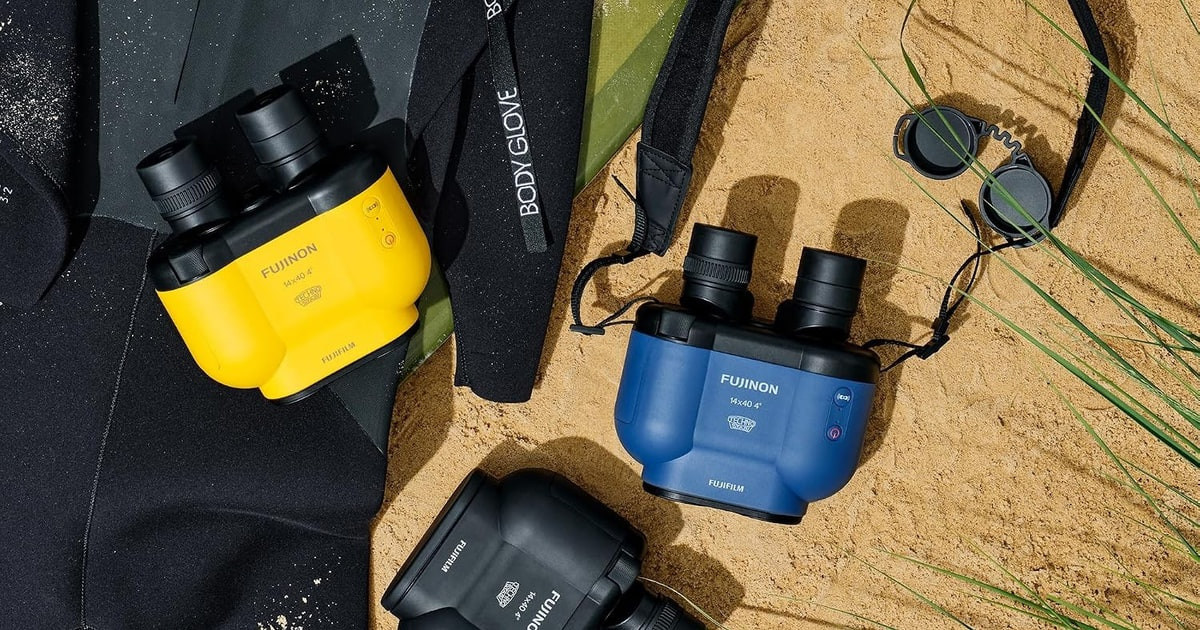
The Techno-Stabi TS-X 14x40 uses gyro sensors to cancel out the motion of a boat, which makes 14x magnification usable at sea. Nothing else here lets you read a hull number or identify a distant sail from that far out.
$1,499fromAmazonPrices as of Oct 25, 6:48 AM PT · Details
Try holding a 14x binocular steady on a boat and you'll see the problem immediately. The image jumps so much it's useless. Fujinon's stabilization uses a gyro sensor to detect motion and correct for it in real time, and that changes what the magnification is for. Instead of a shaky, unreadable view, you get something you can actually study.
If your day depends on spotting things far away, this is the one that changes the job. Offshore anglers scanning for birds working bait, or a delivery skipper trying to identify a ship's aspect at range, are the people who get the most out of it. Fujinon's EBC multi-coating controls flare and ghosting, and the optical layout uses four objective elements in three groups with six ocular elements in four groups to keep chromatic aberration down and the edges sharp.
It's still built for the water. The body is rubber-armored for grip, and the seals are nitrogen-purged with O-rings, so it resists both water and internal fogging. The bright yellow finish isn't a style choice. It's easier to find when you set it down in a cluttered cockpit or need to spot it in the water.
The 40mm objectives at 14x give you a much smaller exit pupil than a 7x50, so this isn't your dawn-patrol binocular. It's a daylight instrument for reaching out. Most people who buy one keep a 7x50 aboard too, and that's the right way to think about it.
Flaws but not dealbreakers
It needs power. Stabilization runs on batteries, and a dead battery turns a very expensive binocular into a very heavy 14x one that's hard to hold still. Keep spares in a dry bag.
It's the priciest option here by a wide margin, and it's the bulkiest at 2.8 pounds. The narrow field of view that comes with 14x also makes it slower to find things. Sweep with a 7x50 first, then confirm with this.
Also great
Stabilized and light enough for a kayak deck bag
Canon 10x30 is II Image Stabilized Binoculars
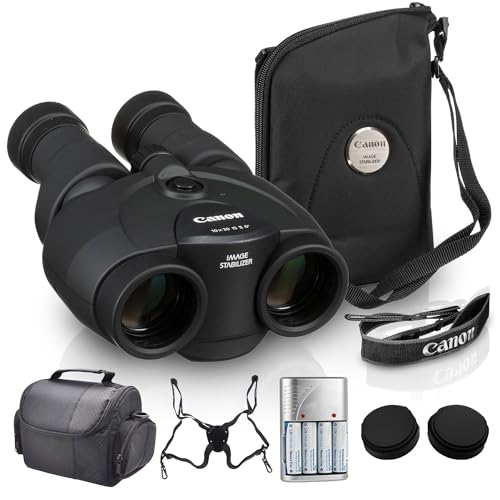
Canon's 10x30 IS II weighs about 21 ounces and uses vari-angle prisms with gyro sensors to steady a 10x view. For paddlers, small-boat sailors, and anyone tired of hauling a 3-pound porro prism around, that's a real trade.
$634.95fromAmazonPrices as of Oct 25, 6:48 AM PT · Details
Weight is the whole story. A traditional 7x50 runs somewhere in the 32 to 40 ounce range. This Canon is a little over 21 ounces and just 5.9 inches long, so it fits in a deck bag or a jacket pocket. If you paddle, that difference decides whether you bring binoculars at all.
Canon's stabilization works differently from Fujinon's, using vari-angle prisms driven by gyro sensors and a microcomputer to correct hand shake as it happens. The result is that 10x becomes something you can hold on a moving surface. Canon rates two AA batteries for up to about nine hours of continuous stabilization at room temperature, and the batteries are included in this bundle along with a harness strap, travel bag, and cleaning kit.
The catch is that this isn't a marine binocular, and you shouldn't treat it like one. Canon doesn't list waterproofing or nitrogen purging, so spray and rain are a genuine risk. It also won't float. Buy it if you want stabilized optics you can carry easily and you're willing to keep it in a dry bag between uses. Don't buy it as your only pair for offshore work.
Optically it's pleasant for long sessions. Canon lists a 60-degree apparent angle of view, a 315-foot field at 1,000 yards, 14.5mm of eye relief, and a doublet field flattener that keeps the edges from smearing. The Porro prism layout gives you good depth perception. For coastal wildlife watching from a kayak, it's a lot of capability in a small package.
Flaws but not dealbreakers
No stated waterproofing or fog proofing is the big one. On a wet boat that's disqualifying for a primary pair, and it's why this sits below the sealed 7x50s rather than above them.
The 30mm objectives at 10x produce a 3mm exit pupil, so low-light performance is well behind any 7x50 here. At dusk you'll notice the view getting dim. And it depends on batteries for its main advantage.
Who this is for
Buy now if you're on the water regularly and you're still squinting at markers, borrowing a pair, or using land binoculars that fog up. Weekend boaters, coastal anglers, cruisers, and people who watch birds from a beach or a kayak all get real use out of a proper sealed pair. If you already own a working 7x50 that hasn't fogged, there's not much here that will change your life. Upgrade only if you specifically want a compass, a reticle, or stabilization you don't currently have.
This guide covers handheld binoculars suited to use on or near the water. It doesn't cover mounted big-eye binoculars, monoculars, thermal or night-vision optics, or rangefinding laser devices. We also don't cover accessories like harnesses and cases on their own. One product in this lineup is an astronomy binocular that a marine search turned up, and we've set it aside for that reason rather than ranked it.
How we picked
We built the shortlist around a handful of things that decide whether a binocular survives on a boat and earns its place in a locker. Sealing: waterproof construction was mandatory, with nitrogen or argon purging and O-ring seals preferred, since temperature swings between cabin and deck are what fog optics from the inside. Brightness: we leaned on the 7x50 formula because its roughly 7.1mm exit pupil matches how wide your eye opens at dawn and dusk. Findability: a floating body or floating strap had to be included or specified, because a dropped pair on open water is gone. Steadiness: anything above 7x needed image stabilization, per Canon and Fujinon documentation on gyro-based correction. Navigation: a built-in compass or rangefinder reticle counted as a strong bonus, consistent with Coast Guard guidance on using optics as a navigational aid.
Other marine binoculars worth considering
If you want the toughest body and a warranty that outlives the boat: The Steiner Optics Commander 7x50 Marine Binoculars — Steiner's Commander 7x50 is built around a Makrolon polycarbonate chassis with a floating prism system that uses flexible silicon to soak up impact, and it's submersible to 10 meters with nitrogen fill. The Sports-Auto-Focus setup is the interesting part: calibrate it to your eyes once and everything from 20 yards to infinity stays sharp, so you can work it one-handed while holding a shroud. It also comes with a hard case, a floating belt, a ClicLoc neoprene strap, a rain cover, and lens caps, and it's covered by a transferable lifetime warranty with no-questions-asked repair or replacement. What you give up is a compass, which the Fujinon and Nikon both include, and it's noticeably more expensive than either. Buy it if durability and the warranty matter more to you than navigation extras.
The competition
This is what our research turned up on the marine binocular category, not a survey of everything for sale. Several well-regarded models weren't available to confirm, and the lineup skews toward what's widely stocked. Here's the one that didn't earn a pick.
The Bushnell Marine 7x50 Waterproof Binoculars with Compass — Bushnell's Marine 7x50 gets a lot right for a mid-priced pair. It's nitrogen-purged and O-ring sealed, uses porro prisms with individual focusing, carries fully multi-coated optics, and includes both an analog compass and an illuminated range-finding reticle. The rubber armoring floats on its own, which is better than relying on a strap, and the 350-foot field at 1,000 yards is respectable. It lost to the Fujinon on optical reputation and to the Nikon on compass quality, and at 37 ounces it's heavy for what it is. Still, if you want a floating body and a lit reticle without paying premium prices, it's a reasonable buy and it's clearly built for saltwater rather than adapted to it.
Care and maintenance
Salt is what kills marine optics, and rinsing is most of the fix. After a day on the water, rinse the body with fresh water and let it dry before it goes back in the case, because a damp case traps salt against the armor and the strap fittings. For the lenses, blow off grit first, then use a lens brush, then a damp microfiber cloth. Dragging dried salt across coated glass is how coatings get scratched. Set the individual eyepieces once for your eyes and leave them alone. Check that the floating strap is actually attached at both ends before you leave the dock, since it does nothing sitting in a drawer. If you own a stabilized pair, pull the batteries when you store it for the season and carry spares aboard in a dry bag.
Questions we get
What magnification is best for marine binoculars?
For a handheld pair on a boat, 7x is the practical answer. Higher power amplifies every roll and pitch until the image is unusable. If you want more reach, you need image stabilization, which is what makes 10x or 14x viable on a moving deck.
Why are 7x50 binoculars considered the marine standard?
It comes down to the exit pupil. Divide the 50mm objective by 7x magnification and you get about 7.1mm, which is roughly how wide the human eye opens in low light. That match is why the view stays bright at dawn and dusk, and it's the reason navies settled on the configuration.
Are image-stabilized binoculars worth it for boating?
They're worth it if you regularly need to identify something far away, like a hull number, a distant sail, or birds working bait offshore. Canon and Fujinon both use gyro sensors to cancel hand shake and boat motion, which makes higher magnifications usable. If you mostly read nearby markers and scan the horizon, a 7x50 is enough and doesn't need batteries.
Do marine binoculars float if you drop them overboard?
Some do and some don't, so check before you trust it. Bushnell's Marine 7x50 has rubber armoring that floats on its own, while the Fujinon Mariner and Nikon OceanPro float or stay findable via an included strap. Always clip the floating strap on. Without it, a dropped pair on open water is almost never recovered.
What's the difference between marine and regular binoculars?
Three things, mainly. Marine models are sealed and gas-purged so they don't flood or fog internally, they often use individual eyepiece focus instead of a center wheel because it seals better, and they favor 7x50 optics for low-light brightness and a steady handheld image. Many also add a compass or a rangefinder reticle.
Can I use marine binoculars for bird watching on land?
Yes, and they're good at it in poor light. The trade-offs are weight and reach. A 7x50 porro prism runs heavy on your neck for a long walk, and 7x is modest magnification for small birds at distance. For shorebirds and waterfowl, though, the brightness works in your favor.
Why you should trust us
For this guide:
- We read manufacturer specifications and technical documentation from Steiner, Fujinon, Canon, Nikon, Bushnell, Barska, and Celestron for every product in this lineup.
- We compared those specifications against published marine gear coverage from outlets including Practical Sailor and Cruising World, plus guidance from the U.S. Coast Guard Boating Safety Resource Center and West Marine's binocular buying guide.
- We reviewed recurring themes in owner feedback for each model, particularly around fogging, long-term durability, and focus mechanisms.
- We read owner reviews on every listing, weighted toward the critical ones, because that is where the recurring failures show up.
- We have a systematic way of automatically fetching the latest prices, so the numbers on this page stay current.
- This is a research-focused guide, so the team may not own every product listed — though we often do own the top winners, which gives us extra context for the recommendations.
- We don't accept free products, and the retailer commission never changes which product we recommend.
Sources
Steiner Marine Commander Series Technical Specifications, Steiner Optics
Fujinon Mariner and TechnoStabi Marine Binocular Specifications, Fujifilm/Fujinon
Canon Image Stabilized Binoculars Lineup, Canon USA
Nikon Oceanpro Waterproof Binocular Specifications, Nikon USA
Bushnell Marine Binoculars Product Specifications, Bushnell
Celestron OceanaView Binocular Series, Celestron
Barska Deep Sea Binocular Specifications, Barska
Practical Sailor Gear Testing: Marine Binoculars, Practical Sailor
Cruising World Gear Reviews and Buying Guides, Cruising World
West Marine Binocular Buying Guide, West Marine
U.S. Coast Guard Boating Safety Resource Center, U.S. Coast Guard
NOAA Nautical Charts and Navigation Resources, NOAA
Amazon product listings and owner reviews for all 7 products
Manufacturer specification pages for each product
Some passages in this guide may be paraphrased with AI help.
Product prices and availability are accurate as of the date/time indicated and are subject to change. Any price and availability information displayed on Amazon.com at the time of purchase will apply to the purchase of this product.
More like this.
Continue exploring electronics reviews and recommendations.

The Best Marine GPS Fish Finders
A fish finder earns its keep on the slow days. When nothing's biting, the screen tells you whether you're sitting over flat mud or a submerged brush pile…

The Best Binoculars for Birdwatching and Nature
Good binoculars change how a walk looks. A gray smudge in a hedge turns into a warbler with a black mask and a yellow throat. Power matters less than…

The Best Noise-Cancelling Headphones for Focus and Deep Work
Most of us don't get to pick where we work. The open-plan office hums, the espresso machine shrieks, and the guy two desks over takes every call on…

The Best Travel Power Banks
A power bank is the one travel gadget you notice only when it's missing. Your phone dies at the gate, the airport outlet is blocked by someone's suitcase,…

The Best Folding Windshield Sun Shades of 2026
Park in an open lot on a July afternoon and your car turns into an oven. AAA's research found that a cabin sitting in 80-degree weather climbs to 116…

The Best Smart Light Bulbs
A smart bulb earns its keep in the small moments. You're carrying groceries and the kitchen lights come on by themselves. You're already in bed when you…