The Best Travel Power Banks
A power bank is the one travel gadget you notice only when it's missing. Your phone dies at the gate, the airport outlet is blocked by someone's suitcase, and the rental car's USB port barely trickles. A good bank fixes all of that. But travel adds rules that home use doesn't. It has to ride in your carry-on. It has to stay under the watt-hour limit your airline enforces. And it has to earn the space it takes in a bag you've already overpacked, which means weight and port count matter as much as capacity.
Here's what no power bank does well. The number on the box is measured at the cell's voltage, so you'll get roughly 60 to 70 percent of it into your phone. A 10,000mAh bank is closer to two full phone charges than three. High-wattage banks also get warm, and they slow down when they do. Airline policy keeps moving, too: several carriers and countries now restrict using a bank during the flight, not just packing one. So check your airline before you go.
Buy for the trip you actually take. One phone and a tablet? A 10,000mAh bank is plenty and weighs almost nothing. A laptop you work on at altitude wants 20,000mAh and at least 65W of output. Watch for recalls, too — Anker pulled more than a million PowerCore 10000 units in the U.S. over fire and burn reports. We think that the UGREEN Nexode 20,000mAh is the best power bank for travel for most people, and that the Baseus 45W Ultra Slim is the one to buy if you want something pocket-sized with cables already attached.
Everything we recommend

Enough power for a laptop, small enough to actually pack

Two cables built in, thin enough to forget you packed it

Laptop-class output and the largest capacity a plane allows

Snaps onto the back of an iPhone and charges with no cable
At a glance
| Product | Capacity | Max output | Price | |
|---|---|---|---|---|
| Anker Prime Power BankUpgrade pick | 26,250mAh (99.75Wh) | 300W total | $199.99On sale |
 | EF ECOFLOW Rapid Pro Power BankAlso in lineup | 99.54Wh | 300W total | $109.99On sale |
 | Anker Nano Magnetic Power BankAlso in lineup | 5,000mAh | 20W USB-C, 15W Qi | $54.99On sale |
 | Nitecore NB10000 Gen4Also consider | 10,000mAh | 22.5W | $83.95 |
| Anker MagGo Power BankAlso great | 10,000mAh | 30W USB-C, 15W Qi | $79.86 |
| UGREEN Nexode 20000mAh 130W Portable PD PowerTop pick | 20,000mAh | 100W | $59.99On sale |
| Baseus 45W Ultra Slim 10000mAh Power BankBudget pick | 10,000mAh | 45W | $28.99On sale |
 | INIU Magnetic Slimmest Power BankAlso consider | 10,000mAh | 45W PD, 25W Qi2 | $54.99 |
How we picked
Watt-hours, not mAh. We converted every published capacity to watt-hours, because that's the number airlines actually enforce. Anything over 100Wh needs approval, so we stayed under it.
Real output per port. We read spec sheets for per-port wattage, not just the total, since a 300W bank split four ways won't run a laptop. Anything we recommend for laptops states at least 65W from one USB-C port.
Weight and shape. We compared listed weights and dimensions, because a bank you leave at home is worthless. Pocket picks had to be around half an inch thick; laptop picks had to stay under about a pound and a half.
Safety and recalls. We checked CPSC recall notices and looked for stated safety certifications and temperature protection. Owner reports of overheating counted against a product.
Display and recharge. We favored banks with a numeric display over four-dot indicators, and we weighed how fast each one refills itself from published input wattage.
Top pickOn sale
Enough power for a laptop, small enough to actually pack
UGREEN Nexode 20000mAh 130W Portable PD Power
The Nexode holds 20,000mAh — about 72Wh, well under every airline's unrestricted limit — and pushes up to 100W from its top port, enough to charge a MacBook Pro while your phone sips from the second. A color display tells you exactly how much is left.
$59.99fromAmazonList priceThis is the capacity that fits the most trips. Twenty thousand milliamp-hours works out to roughly 72Wh, so there's no paperwork, no two-spare limit, no conversation at the gate. It's also enough to refill a phone three or four times, or get a dead laptop back to useful. UGREEN says half an hour on the 100W port takes a 16-inch MacBook Pro to 43 percent. You won't want more unless you're off-grid for days.
The column shape is the quiet win here. Most 20,000mAh banks are flat bricks that slide around a tote; this one is a chunky cylinder a bit over five inches long, and it sits in your palm. Drop it in a backpack's water-bottle pocket and it stays put. It's a little over a pound, so you'll feel it in a sling bag, but it disappears in a carry-on.
The TFT display earns its place. It shows charge level as a number, plus input and output wattage, voltage and remaining time. That matters more than it sounds. When your laptop isn't charging, the screen tells you whether the bank is actually sending 100W or has quietly dropped to a trickle because of a bad cable. Four little indicator lights can't do that.
Owner feedback keeps circling back to how steady it is. The recurring theme is that it charges what it claims to, the display stays honest, and it doesn't cook itself under load. UGREEN uses automotive-grade cells with real-time temperature monitoring and the usual safety certifications. That's unglamorous engineering, and it's exactly what you want sharing a bag with your passport.
Flaws but not dealbreakers
It's the heaviest of the compact banks here, roughly double a 10,000mAh slab, so it's not a pocket bank. You'll carry it in a bag or you won't carry it at all.
You also need the right cable. UGREEN says to use the included 5A USB-C cable for full speed, and a thin generic cord will quietly cap you well below 100W. That 100W is a single-port ceiling, too — split the load and each device gets less. And there's no wireless charging, so iPhone owners who like magnetic top-ups will still want something smaller alongside it.
Budget pickOn sale
Two cables built in, thin enough to forget you packed it
Baseus 45W Ultra Slim 10000mAh Power Bank
This one is about half an inch thick and weighs around 7 ounces, with two USB-C cables attached to the body so you can leave your cords at home. It puts out up to 45W, plenty for any phone or tablet, and it can feed four devices at once in a pinch.
$28.99fromAmazonList pricePicture the middle seat with no outlet. You pull this out of a jacket pocket, flip out one of the built-in cables, and your phone is charging — no digging for a cord tangled around your headphones. The second cable handles your seatmate's phone. There's a separate USB-C port and a USB-A port too, so earbuds and a watch can join in without anyone unplugging.
Forty-five watts is the sweet spot for phone-first travel. Baseus says it takes an iPhone 17 Pro to 67 percent in half an hour and a Galaxy S25 Ultra to 60 percent, which is about as fast as those phones will accept anyway. It won't run a big laptop at full tilt, but it'll keep one alive. It also recharges at 30W, so a coffee stop gets you most of the way back.
Thin matters more than light. At roughly half an inch it lies flat against a laptop in a sleeve, or slides into the back pocket of a backpack where a cylinder would bulge. And 10,000mAh is about 36Wh, so no airline will ever ask you about it. If one isn't enough, you can bring two.
Baseus rates both built-in cables for more than 10,000 pulls and bends, and adds NTC temperature control to keep things cool at full output. Built-in cables are usually the first thing to fail on a bank like this, so a durability rating is worth something — though it's a spec, not a promise.
Flaws but not dealbreakers
Built-in cables cut both ways. If one frays, you can't replace it, and you're left with a two-port charger. Both of them are USB-C, so an older device with a Lightning or micro-USB plug still needs its own cord from the USB-A port.
It's also the newest and least-proven product here. Owner feedback is still thin, so there's no long track record to lean on for early failures. And 10,000mAh won't carry a laptop through a workday — plan on a phone, a tablet and small stuff.
Upgrade pickOn sale
Laptop-class output and the largest capacity a plane allows
Anker Prime Power Bank
At 26,250mAh, or 99.75Wh, this is about as big as a power bank gets while still flying without airline approval. It pushes 300W across three ports and 140W from one of them, so two laptops can charge at once, and it refills itself to half in roughly 13 minutes.
$199.99fromAmazonList priceIf you work on a laptop while you travel, this is the one. A single USB-C port delivers up to 140W, which is full speed for a 16-inch MacBook Pro, and Anker says 27 minutes gets an M4 Pro to half. Total output is 300W across two USB-C ports and a USB-A, so your laptop, phone and tablet all charge properly instead of politely taking turns.
The input is the part people underrate. Dual USB-C charging at up to 250W takes the bank to 50 percent in about 13 minutes — roughly the length of a boarding line. Most banks this size need hours. That changes how you use it. You top it up at the gate instead of babysitting it in a hotel the night before.
The screen and app are genuinely useful on a trip. The display shows watts in and out per port plus a precise charge level, and the app lets you cap output. Owners who travel with it mention the same two things, over and over: the information is great, and the screen washes out in bright sun. That's a fair trade.
That 99.75Wh figure is the whole point. Anything over 100Wh needs airline approval, and you're capped at two spares. This slips under, so it travels like any other carry-on item. Anker says it'll refill a MacBook Pro (M4) about 0.8 times, which, with a phone and earbuds on the side, covers a long-haul day of actual work.
Flaws but not dealbreakers
It's heavy — about a pound and a third, roughly a small hardcover. You'll notice it on a long walk with a daypack, and it's far too big for any pocket.
It's also the most expensive option here by a wide margin, and the magnetic charging base that owners love is sold separately. Complaints about the display being hard to read outdoors are common. And unless you're charging a laptop or several devices at once, most of that 300W just sits there unused.
The Anker Prime comes with a 24-month warranty.
Also great
Snaps onto the back of an iPhone and charges with no cable
Anker MagGo Power Bank
The MagGo sticks magnetically to an iPhone 12 or newer and charges it wirelessly at up to 15W, so you can keep using the phone while it fills. A 30W USB-C port handles everything else, and 10,000mAh is good for roughly 1.8 charges of an iPhone 15 Pro.
$79.86fromAmazonYou're walking to your gate with a boarding pass on screen and 9 percent battery left. Click the MagGo onto the back of your phone and keep walking. That's the entire argument for a magnetic bank — no cable dangling, no third hand required. For navigating an unfamiliar city on foot, it's the format you'll actually use instead of leaving it in the bag.
Qi2 certification is what makes the wireless part worth it. Older magnetic banks topped out around 7.5W, which barely kept pace with a screen that's on. Qi2 allows 15W, and this one hits it. You still lose energy to heat going wireless, so plug into the 30W USB-C port when you've got time and care about efficiency. Both options live in the same slim body.
It's slim for 10,000mAh — a bit over half an inch — with a metal frame and aerogel insulation that keeps the outside from getting unpleasant. Owner feedback is broadly warm on magnet strength and build quality. The recurring gripe is heat with older iPhones, where people end up charging in shorter stints rather than leaving it on all afternoon.
Anker designs this one for iPhones and says so plainly, since magnet alignment varies on Android phones. Owners with MagSafe-style Android cases report it sticking fine, but you're outside what Anker supports. If you carry a Pixel or a Galaxy as your main phone, a bank with a cable is the safer buy.
Flaws but not dealbreakers
Wireless charging wastes energy. You'll get noticeably fewer full phone charges out of it magnetically than you would over the cable, and the pack warms up while it works.
It costs more than a plain 10,000mAh bank of the same capacity, 15W is slow next to the 45W a wired bank can push, and the included cable is short. Owners with older iPhone models flag heat under sustained charging often enough that it's worth planning around.
The Anker MagGo comes with a 24-month warranty.
Who this is for
This guide is for people who fly or take long trips and want one battery that handles it. If you're carry-on only, if you work on a laptop in airports, or if you've ever watched your phone die while a map was open in a city you don't know, you're the reader we had in mind. We cover banks from 5,000mAh up to the 99.75Wh ceiling that airlines allow without approval, including magnetic Qi2 models for iPhones and ultralight ones for backpacking.
We don't cover anything over 100Wh, portable power stations, solar panels, or wall chargers — different rules, different bags, different guide. If you already own a working 10,000mAh bank and you only charge a phone, you probably don't need a new one; capacity fades slowly, and a bank that still gets you through a day is fine. The exception is a recall. If your model is on the CPSC list, replace it now and don't wait for a trip.
How we picked
We started from the rules and worked back to the products. Watt-hours: every pick converts to under 100Wh so it flies without airline approval, and we treated 99.75Wh as the practical ceiling. Output per port: laptop picks needed at least 65W from a single USB-C port, because a big total output split across four ports won't charge a MacBook. Weight and shape: we compared published weights and dimensions and favored banks you'll genuinely carry — half an inch thick for pocket use, under about a pound and a half for laptop duty. Safety: we checked CPSC recall notices, stated certifications and temperature protection, and counted repeated owner reports of overheating against a product. Display and recharge: a numeric screen beats four indicator lights, and fast input matters more than most people expect when your only free outlet is at the gate.
Other travel power banks worth considering
If you want the lightest bank that still holds 10,000mAh: The Nitecore NB10000 Gen4 ($83.95) — The Nitecore NB10000 Gen4 weighs 4.94 ounces — less than a deck of cards, and under half what a comparable bank weighs. It's IPX7 rated, so rain and splashes are a non-issue, and the included lanyard doubles as a USB-C cable, which is a genuinely clever fix for the cord you always forget. Both USB-C ports charge in and out at 22.5W, with pass-through support when there's only one outlet. Knock it to see the charge level. You give up speed and any laptop ambition, and owner feedback on this generation is still thin. For a thru-hike or a one-bag trip, it's what we'd carry.
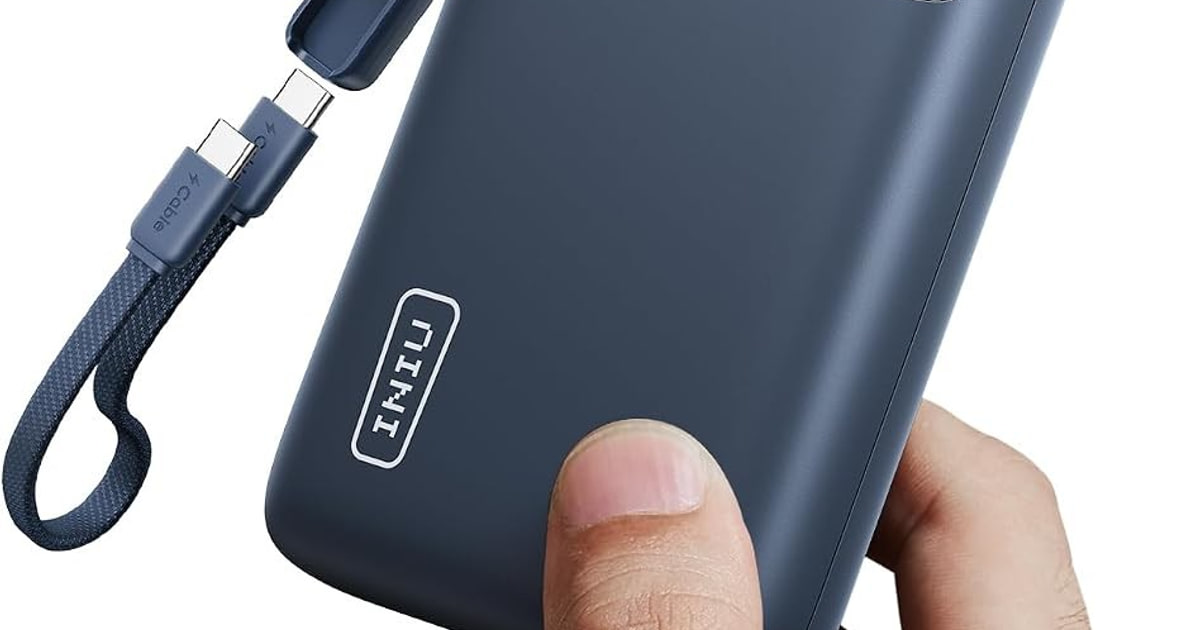
If you want magnetic charging and a cable in one slim package: The INIU Magnetic Slimmest Power Bank ($54.99) — INIU's magnetic bank is half an inch thick, holds 10,000mAh, and does Qi2 at 25W instead of the usual 15W — INIU says that takes an iPhone 17 Pro to half in 33 minutes. The attached USB-C GoCord detaches and becomes a 45W charging cable, so you get wireless convenience and wired speed from a single object, and a digital display shows the exact percentage. It's the most feature-dense 10,000mAh bank in this group. We kept the Anker MagGo ahead of it because Anker's track record and owner history run longer, but it's a close call, and the detachable cord is a real advantage.
The competition
This is what our research turned up in the sizes travelers actually buy, not a survey of everything for sale. New power banks appear constantly and plenty of good ones never cross our path. Here's why the rest of this group didn't make the cut.
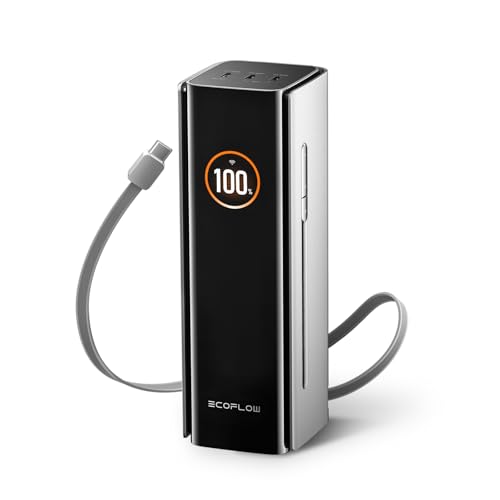
The EF ECOFLOW Rapid Pro Power Bank ($109.99) — The EcoFlow Rapid Pro goes toe to toe with the Anker Prime: 99.54Wh, 300W total across four ports, a 140W built-in USB-C cable, a 3.9-inch screen, and a 0-to-80-percent refill in about 20 minutes on 320W input. On paper it's the better-equipped of the two. In practice it's heavier than the Prime and bulkier in a bag, and owner feedback is more mixed — including reports that USB-C Power Delivery negotiation fails on certain ports with some laptops and hubs, and that it throttles once it warms up. If the attached 140W cable sells you, it's a reasonable buy. We'd take the Prime's steadier reputation.
The Anker Nano Magnetic Power Bank ($54.99) — The Anker Nano Magnetic is the genuinely slim one — a third of an inch thick, Qi2-certified at 15W, with graphene cooling that Anker says holds it under 104°F. It barely changes the shape of a phone, and it's a pleasure to carry. But 5,000mAh is roughly one charge of a modern flagship, which is thin for travel, and owners note it runs warm while you'd expect more capacity for what it costs. Buy it for a long day out rather than a trip. If you want magnetic and slim for travel, the MagGo or the INIU gives you twice the power in a similar footprint.
Travel and charging tips
Keep it in your carry-on, always. The FAA requires spare lithium batteries and power banks in the cabin rather than checked bags, because nobody can reach a fire in the hold. Then check your airline's policy on using one in flight; several carriers and countries now restrict that even when the bank itself is fine to bring. Store it around half charged if you won't touch it for months, and keep it out of a hot car, since heat ages cells faster than use does. Use the cable the manufacturer includes if you want full wattage. And before any trip, search the CPSC recall list for your model — Anker pulled more than a million PowerCore 10000 units in the U.S. over fire and burn reports.
Questions we get
Can I bring a power bank on a plane?
Yes, in your carry-on. The FAA requires spare lithium-ion batteries and power banks to travel in the cabin, not in checked baggage. Anything 100Wh or less needs no approval from the airline. Keep the terminals protected so nothing metal can short them in your bag.
What's the maximum power bank size allowed on flights?
Up to 100Wh, you're free to bring it with no approval. From 101Wh to 160Wh you need your airline's permission, and you're limited to two spares. Above 160Wh it's not allowed in passenger baggage at all. Every pick in this guide stays under 100Wh.
Can I put a power bank in checked luggage?
No. Spare lithium batteries and power banks have to go in the cabin under FAA rules. The reason is simple: if a cell fails in the hold, nobody can get to it. If you check a bag with a bank inside by accident, tell the airline before the bag is loaded.
How many mAh is 100Wh?
Multiply mAh by the 3.6V nominal cell voltage and divide by 1,000 to get watt-hours. So 27,650mAh works out to about 99.5Wh, which is why premium travel banks cluster right around that figure. A 20,000mAh bank is roughly 72Wh and a 10,000mAh bank about 36Wh, both well clear of the limit.
Can I use my power bank during a flight?
That depends on the airline, and it's changed fast. Emirates restricted in-flight use of power banks, and other carriers and national regulators, including Singapore's, have introduced similar rules. Check your specific airline's current policy before you fly. Bringing a bank aboard and using it mid-flight are now two separate questions.
How many times can a 10,000mAh power bank charge a phone?
About one and a half to two full charges for a typical flagship with a 4,000 to 5,000mAh battery. The printed capacity is measured at the cell's voltage, so you only get roughly 60 to 70 percent of it into your phone after conversion losses. Wireless charging loses more than a cable does. If you want two confident charges plus a tablet, step up to 20,000mAh.
Why you should trust us
For this guide:
- We compared manufacturer specifications for every bank here — stated watt-hours, per-port wattage, input speed, weight and dimensions — and did the mAh-to-watt-hour math so the airline numbers line up.
- We read FAA and IATA guidance on carrying lithium batteries, along with CPSC recall notices, to separate the actual rules from marketing language like "TSA-approved."
- We also worked through owner feedback themes on each listing, looking for repeated complaints about heat, built-in cable failures, and charging that stops short of what's advertised.
- We read owner reviews on every listing, weighted toward the critical ones, because that is where the recurring failures show up.
- We have a systematic way of automatically fetching the latest prices, so the numbers on this page stay current.
- This is a research-focused guide, so the team may not own every product listed — though we often do own the top winners, which gives us extra context for the recommendations.
- We don't accept free products, and the retailer commission never changes which product we recommend.
Sources
Lithium Batteries - FAA PackSafe, FAA
TSA - Power Banks / Portable Chargers guidance, TSA
Battery and Power Bank Recalls, U.S. Consumer Product Safety Commission
Portable Power Bank Reviews, RTINGS.com
Best Portable Chargers - Wirecutter, Wirecutter
Best Power Banks - PCMag, PCMag
Qi2 Wireless Charging Standard, Wireless Power Consortium
USB Power Delivery, USB Implementers Forum
Anker Prime Power Bank (27,650mAh, 250W) product page, Anker (manufacturer specs)
Amazon product listings and owner reviews for all 8 products
Manufacturer specification pages for each product
Some passages in this guide may be paraphrased with AI help. Prices are refreshed automatically.
More like this.
Continue exploring electronics reviews and recommendations.

The Best Solar Power Banks and Portable Chargers
A charger you carry outside has one job: keep your phone alive when there's no outlet for days. That sounds simple until you're three nights into a trip…

The Best Lithium Jump Starter Power Banks
A dead battery almost never happens at a convenient moment. It happens in a parking garage at 11 p.m., or on the first genuinely cold morning of the year,…

The Best Portable Power Stations for Camping
A power station is the quiet fix for the two things that actually annoy you at a campsite: a cooler that has to keep working, and phones that die by…

The Best Power Strips With USB Ports
Look at your desk or your nightstand and count what's plugged in. A laptop, a phone, maybe a monitor, a lamp, earbuds, a tablet that's permanently at 12…

The Best Cordless Power Tool Combo Kits
A combo kit is how most people start a cordless collection, and the choice sticks around longer than you'd think. You're not really buying a drill and an…

The Best Portable Generators for Power Outages
When the lights go out, you don't need to power your whole house. You need the fridge to stay cold, a few lamps on, phones charged, and maybe a CPAP…