The Best Indoor Air Quality Monitors
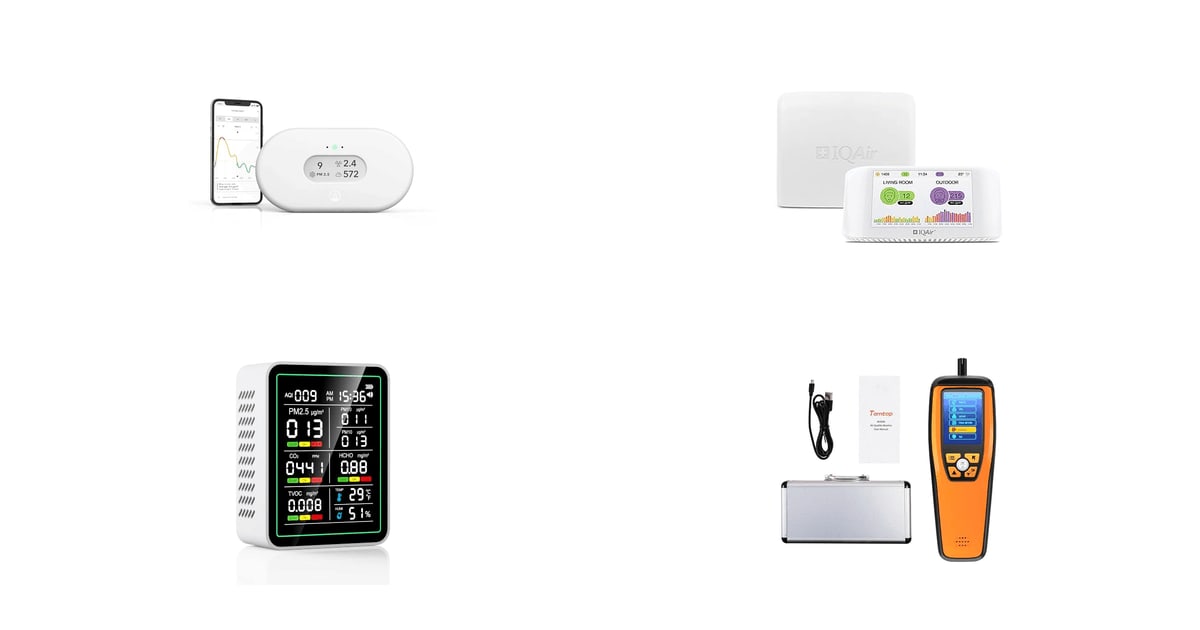
You can't see most of what you breathe at home. Cooking throws fine particles across the kitchen. A closed bedroom door pushes CO2 past the point where you wake up foggy. New flooring off-gasses for weeks. The EPA says indoor pollutant levels often run two to five times higher than outdoor levels, and occasionally far worse. A monitor doesn't fix any of that. What it does is tell you when to run the range hood, crack a window, or turn on the purifier — instead of guessing.
Here's the honest part: none of these are lab instruments. VOC sensors report a relative index, not a measurement of any specific chemical, so a spike tells you something changed and not what it was. Particle counts drift when humidity climbs. Plenty of monitors estimate CO2 from VOC data instead of measuring it, which makes those numbers close to useless for deciding when to open a window. And no monitor cleans anything. You still need a purifier, a hood, or a window.
So buy for the sensors you'll actually act on. If you're chasing radon in a basement, you need a device that detects it, and most don't. If you're a remote worker fighting the afternoon slump, you want a real NDIR CO2 sensor and nothing less. If you only want to know when the kitchen gets smoky, a simple particle reader is plenty. We think that the Airthings View Plus is the best indoor air quality monitor for most people, and that the Temtop M2000 2nd is the one to buy if you'd rather have a screen than an app.
Everything we recommend

Radon, CO2 and particles in one place, if you'll live in the app

A real screen and a real CO2 sensor, no account required

Bare-bones particle tracking that plays well with your purifier

Indoor and outdoor numbers side by side, if you'll pay for both
At a glance
| Product | Pollutants Tracked | Power Source | Price | |
|---|---|---|---|---|
| Airthings 2960 View Plus - Battery PoweredTop pick | Radon, CO2, PM2.5 | Battery Powered | $329.99 |
| IQAir AirVisual Air Quality Monitor BundleUpgrade pick | PM2.5, CO2, Smoke, Dust | Rechargeable | $599.99 |
 | ZEMEOLLO Air Quality Monitor IndoorAlso in lineup | 10-in-1 | 2000mAh Battery | $29.99 |
| Temtop Air Quality Monitor CO2 Detector ProfessionalRunner-up | 8-in-1 | — | $209.99 |
| GoveeLife Smart Air Quality Monitor with PM2.5Budget pick | PM2.5, Temp, Humidity | Wired | $45.99 |
How we picked
Measured, not guessed. We separated monitors with true NDIR CO2 sensors from those reporting eCO2 estimated from VOC data, because the second kind can't reliably tell you when a bedroom needs ventilation. Spec sheets that named an actual sensor supplier carried more weight than vague accuracy claims.
Radon coverage. Radon detection is rare in consumer hardware, and the EPA ranks radon as the second leading cause of lung cancer in the US. We noted which devices detect it, which method they use, and treated it as a genuine differentiator rather than a bullet point.
How you read it. We looked at whether there's an on-device display, a phone app, or both, and whether alerts reach you when you're not home. A monitor you have to walk over to and squint at is a monitor you'll stop consulting.
Data you keep. We favored devices with meaningful history — cloud dashboards, onboard logging, or USB and file export — and checked owner feedback for whether the export actually works as advertised. Subscription gates on your own readings counted against a device.
Holding up over time. We read through owner feedback looking for repeated themes rather than one-off gripes: sensors that drift, units that die early, apps that break. Sensor drift is normal, so built-in calibration routines counted in a device's favor.
Top pick
Radon, CO2 and particles in one place, if you'll live in the app
Airthings 2960 View Plus - Battery Powered
The View Plus tracks radon, PM2.5, CO2, VOCs, humidity, temperature and air pressure, then charts all of it in a free app with alerts. It's the only monitor here that measures radon, and that alone makes it the one worth mounting on a wall.
$329.99fromAmazonRadon is the reason to buy this one. It's the second leading cause of lung cancer in the United States, and the EPA attributes about 21,000 deaths a year to it. You can't smell it or see it. The View Plus uses alpha-spectroscopy detection updated hourly — the same approach professional continuous monitors use, not the cheaper electrochemical shortcut. A hardware-store test kit gives you one snapshot; this gives you a running average as seasons and basement humidity shift.
The rest of the sensor list is unusually broad for a home device. You get particles, CO2, VOCs, humidity, temperature and air pressure alongside the radon. Owners regularly describe watching a VOC alert fire after someone deep-cleaned the floors with something harsh, or catching a humidity climb that turned out to be a failing A/C. That's the real payoff: patterns over weeks, not a single reading you stare at once.
The app doesn't hold the basics hostage. Live readings, trends, notifications and a local pollen forecast are all included, and there's no subscription gate on the numbers your own device collects. You do have to create an account, and the monitor needs Wi-Fi to report anywhere but its own screen. Airthings has been doing radon and air quality hardware for fifteen years, which shows in how legible the dashboard is.
Set against the Temtop, this is a trade of screen for reach. The View Plus shows a modest readout on the wall, but its value is that it pings your phone while you're at work and the basement radon climbs. The Temtop puts far more on a display at once — and only tells you anything when you're standing in front of it.
Flaws but not dealbreakers
Owner feedback is rougher than the spec sheet suggests. A meaningful share of buyers report units that quit well short of two years, and a recurring complaint involves CO2 readings that wander high and stay there until support intervenes. Airthings support gets consistently good marks for responding, but a monitor you have to argue with is a monitor you eventually stop believing.
It runs on batteries, which is great until you add a second Airthings sensor. Then this one becomes the hub and has to stay plugged in around the clock, which undercuts the whole put-it-anywhere pitch. Radon also demands patience — you'll want days before the first number means much, and months before the long-term average does.
There's no offline mode. Without an account and a connection, you're left with the small on-device display, and the historical data that makes this device worth owning lives in Airthings' cloud rather than on your own drive.
Airthings covers the View Plus with a standard warranty that you can extend to five years by registering the product for free.
Runner-up
A real screen and a real CO2 sensor, no account required
Temtop Air Quality Monitor CO2 Detector Professional
The M2000 2nd measures CO2 with a SenseAir NDIR sensor, formaldehyde with a Dart sensor, plus PM2.5, PM10, temperature and humidity — all on one bright display. There's no app, no account and no cloud, just a screen, an alarm and a USB cable.
$209.99fromAmazonIf CO2 is what you actually care about, this is the sensible buy. It uses a genuine NDIR sensor rather than estimating CO2 from VOC readings, and that distinction matters enormously. Harvard researchers found cognitive scores were 61% higher in well-ventilated, low-CO2 spaces, and CO2 in a closed bedroom routinely blows past 2,000 ppm overnight. An estimated number can't tell you that reliably. A measured one can.
It's also the least demanding device here. No Wi-Fi setup, no account, no phone app between you and the numbers. You turn it on, it starts reading, and the color display shows everything at once with an audible alarm at whatever threshold you pick. If you've been burned by a smart device that stopped working when a company changed its app, that's a genuine feature.
The data handling is better than the price bracket usually allows. Temtop rates the onboard memory for tens of thousands of readings and months of continuous logging, and you can pull it all off over USB as a file you own. There's also a built-in calibration routine for CO2 and formaldehyde, which is exactly what you want in a sensor that drifts.
It runs on a rechargeable battery in a carry case, so you can walk it around. Hold it in a stuffy conference room, then step outside and watch CO2 drop toward the low 400s. That's the fastest way to learn what your own house does, and it's something a wall-mounted monitor can never show you.
Flaws but not dealbreakers
The logging isn't as complete as the marketing implies. Owners report that exported files leave out some of what the screen displays, and that particle values come through rounded rather than precise. At least one buyer found the export feature didn't work at all. If data export is the reason you're buying, verify it works within your return window.
Battery life on continuous display is short, so in practice this lives plugged in. The printed manual is famously tiny, and you'll likely end up downloading the PDF. There's no radon sensor, no Wi-Fi, no smart home integration and no phone alerts — if you want to know what your house is doing while you're away, this isn't the one.
Temtop includes a 12-month warranty with phone and email support.
Budget pick
Bare-bones particle tracking that plays well with your purifier
GoveeLife Smart Air Quality Monitor with PM2.5
The GoveeLife H5106 reads PM2.5, temperature and humidity, shows them on a small LED display, and refreshes every couple of seconds. Its best trick is automation: it can switch a Govee purifier, humidifier or fan on and off by itself when the air turns.
$45.99fromAmazonThink of this as a smoke-and-dust gauge, not an air quality lab. It covers PM2.5, temperature and humidity — that's it. But particles are what actually change fastest in a home, and this thing reacts in about two seconds. Burn toast, light a candle, blow one out, vacuum the rug: you'll see it move immediately, which is genuinely useful feedback about your own habits.
The automation is what earns it a spot. If you already own Govee purifiers, humidifiers or fans, the monitor becomes the trigger for all of them. You set a target air quality level and the purifier handles itself while you're at work. Buying a monitor and then manually reacting to it is a chore most people abandon after a month; letting the monitor do the reacting is the whole point.
Data storage is more generous than you'd expect at this level. You get thirteen-day graphs in the app and can export up to two years of readings, at no extra cost. For tracking whether the new HVAC filter actually did anything, or whether the neighbor's fire pit reaches your bedroom, that history is enough.
Flaws but not dealbreakers
The accuracy spec is coarse. Govee rates PM2.5 to within about 15 µg/m³, and the WHO's annual guideline is 5 µg/m³ — so this can tell you that something got worse, but not whether your baseline is genuinely clean. Owners also note that running a humidifier nearby sends the reading up, because mist droplets look like particles to an optical sensor.
It's locked into Govee's ecosystem. Automations only reach other Govee gear, and buyers report that the app doesn't play nicely with Alexa, Google Home or HomeKit, and insists on precise location permission just to view your own sensors. There's no battery either, so it has to sit near an outlet on its USB-C cable. And there's no CO2, no VOC and no radon — for a bedroom or a home office, those absences are the whole problem.
Upgrade pick
Indoor and outdoor numbers side by side, if you'll pay for both
IQAir AirVisual Air Quality Monitor Bundle
This IQAir bundle pairs an indoor AirVisual monitor with a weatherproof outdoor unit, so you can compare what's in your living room against what's actually at your curb. Each outdoor unit carries two sensors, and the app pulls from thousands of public stations.
$599.99fromAmazonThe point of this bundle is context, not just readings. A PM2.5 number means very little on its own. Knowing your indoor level sits at a third of what's outside tells you your filtration is working; knowing it matches outside tells you your envelope is leaking. IQAir's app can also pull real-time data from tens of thousands of global stations, so you get the comparison even before you mount the outdoor unit.
During wildfire season or a nearby demolition, that comparison stops being academic. People downwind of a fire have used these to decide when it's safe to open windows and when to keep the house sealed, which is precisely the decision a single indoor number can't help you make. The outdoor unit reports independently of whichever public station happens to be miles away and behind a hill.
The hardware reflects the ambition. IQAir uses professional-grade sensors for PM2.5 and CO2, doubles up the sensors in each weatherproof outdoor housing, and supports phone, tablet and desktop dashboards over Wi-Fi. The indoor unit charges over USB or a wall outlet, so it can move between rooms without losing its history.
Compared with our top pick, this is a different question answered. The Airthings tells you what's happening inside your walls, including radon. IQAir tells you how inside relates to outside. If you live somewhere with genuinely bad ambient air, that second question is the more useful one.
Flaws but not dealbreakers
This is by far the most expensive setup here, and the owner feedback pool is small — which makes it harder to judge than the others. The complaints that do exist cluster on hardware rather than accuracy: outdoor units that wouldn't power up out of the box, indoor units that stopped charging after light use, and buyers who found customer service slow to help.
The outdoor unit needs mains power and a plug arrangement that not every American house has waiting outdoors. Plan the run before you buy. And there's no radon sensor, so if radon is on your list, this doesn't replace our top pick — it sits alongside it.
Who this is for
Buy a monitor if you have a specific question you want answered. Maybe someone in the house has asthma and you want to know what sets it off. Maybe you work from a spare bedroom with the door shut and wonder why you're useless by mid-afternoon. Maybe you just finished a renovation and can still smell it. Maybe your house has a basement and you've never once tested for radon. In every one of those cases, a monitor turns a vague worry into a number you can act on.
Skip it if you're expecting the monitor to improve anything on its own. These devices measure; they don't filter, ventilate or remediate. You'll still be buying a purifier, using the range hood, or calling a radon contractor. This guide covers plug-in and battery-powered monitors for homes and home offices — not professional field instruments, not standalone carbon monoxide alarms, and not the single-use radon test kits you mail to a lab. If you need a CO alarm, buy a certified CO alarm. None of these replace one.
How we picked
We built the shortlist around five things. CO2 method: true NDIR sensors only, since eCO2 estimated from VOC readings isn't accurate enough to decide when to open a window. Radon: whether the device detects it at all, and with what technology — most consumer monitors skip it entirely. Readout: a display you'll glance at, an app that reaches your phone when you're away, or ideally both. Your data: history you can actually keep, through a cloud dashboard or USB export, without a subscription standing between you and your own readings. Durability: recurring themes in owner feedback around sensor drift, early failures and abandoned apps, plus whether the device offers a calibration routine when readings wander.
The competition
This is what our research surfaced, not a census of the category. Plenty of capable monitors — from Awair, Kaiterra, PurpleAir and others — didn't make it into this lineup, and their absence isn't a verdict on them. Here's the one remaining device we looked at and where it landed.
The ZEMEOLLO Air Quality Monitor Indoor ($29.99) — The ZEMEOLLO 10-in-1 packs a lot onto one battery-powered screen: CO2, formaldehyde, TVOC, benzene, PM2.5 and PM10, with a claimed error margin under 5% and roughly twenty hours per charge. It lost to the Temtop on transparency. Temtop names its suppliers — SenseAir for CO2, Dart for formaldehyde — while ZEMEOLLO's accuracy figure isn't tied to any identified sensor, and there's no logging, no export and no app to check trends. The owner history is also thin so far. Still, if you want something you can carry from the nursery to the car and read on the spot, and you don't care about keeping the numbers, it's a reasonable pocket checker.
Placement and calibration
Where you put a monitor changes what it says. Keep it at breathing height, a few feet from walls, and well away from the stove, an open window, a humidifier or a vent — all of those produce readings about that spot, not about the room. For radon, put it in the lowest lived-in level of the house and leave it alone; the first useful numbers take days, and the average that matters takes months. Expect drift. CO2 sensors in particular wander over time, which is why a built-in calibration routine is worth having. The usual method is to zero the sensor outdoors on a calm day, where CO2 sits in the low 400s. Do that a couple of times a year, keep the particle inlet free of dust, and don't chase individual spikes — trends are what tell you anything.
Questions we get
What counts as a dangerous CO2 level indoors?
Outdoor air sits in the low 400s ppm. Once you're past roughly 1,000 ppm, research links the level to measurable declines in concentration and decision-making, and a closed bedroom with two people in it routinely doubles that overnight. If your monitor reads above 1,000, open a door or window, or turn on ventilation. It's not toxic at those levels — it's just a reliable sign the room isn't exchanging air.
Do I still need a monitor if I already own an air purifier?
Yes, and arguably more so. A purifier's own indicator light only reports what its sensor sees in its immediate vicinity, and it tells you nothing about CO2, radon or VOCs. A separate monitor tells you whether the purifier is sized right for the room, whether it's running when it should, and when the filter has stopped doing much. It also tells you when the problem is ventilation rather than filtration — which is a problem no purifier solves.
Can an air quality monitor replace a carbon monoxide detector?
No. Treat that as a firm rule. CO alarms are certified life-safety devices with audible alarms designed to wake you, and they're built and tested to standards these monitors don't meet. Some air quality monitors report CO as one reading among many, but that's informational. Keep certified CO alarms on every level of your home regardless of what else you buy.
Do I need a separate radon detector?
Unless your monitor specifically detects radon, yes. Most consumer air quality monitors don't measure it at all, and it's the one indoor pollutant with a clear, documented link to lung cancer. Of the devices here, only the Airthings View Plus detects radon. If you buy something else and have a basement or a ground-floor bedroom, add a dedicated radon monitor or a mail-in test kit.
What's the difference between PM2.5 and PM10?
The number is particle size in micrometers. PM10 covers coarser stuff like pollen, mold spores and construction dust, which your nose and throat catch reasonably well. PM2.5 is fine enough to reach deep into your lungs and cross into your bloodstream, which is why it's the more serious health concern and why it appears on nearly every monitor. Cooking, candles, wood smoke and wildfire haze are all PM2.5 sources.
How accurate are these compared with professional equipment?
Directionally good, absolutely imperfect. Consumer laser particle sensors track real changes well but can overstate readings when humidity is high, since moisture droplets scatter light like particles do. NDIR CO2 sensors are the most trustworthy readings in this class; VOC sensors report a relative index rather than a concentration of any specific chemical. Use these devices to spot changes and patterns, not to certify that a room meets a standard.
Why you should trust us
For this guide:
- We read the manufacturer specifications and sensor documentation for every monitor here, paying particular attention to whether CO2 is measured with an NDIR sensor or estimated from VOC data.
- We compared these devices against published EPA and WHO guidance on radon, PM2.5 and VOC exposure, and against published reviews of the category.
- We read through owner feedback looking for recurring themes — sensor drift, early hardware failures, app restrictions and export problems — rather than isolated complaints.
- We read owner reviews on every listing, weighted toward the critical ones, because that is where the recurring failures show up.
- We have a systematic way of automatically fetching the latest prices, so the numbers on this page stay current.
- This is a research-focused guide, so the team may not own every product listed — though we often do own the top winners, which gives us extra context for the recommendations.
- We don't accept free products, and the retailer commission never changes which product we recommend.
Sources
Introduction to Indoor Air Quality — U.S. EPA, U.S. EPA
Health Risk of Radon — U.S. EPA, U.S. EPA
Office Air Quality May Affect Employees' Cognition, Work Performance — Harvard T.H. Chan School of Public Health, Harvard T.H. Chan School of Public Health
WHO Global Air Quality Guidelines 2021, World Health Organization
Volatile Organic Compounds' Impact on Indoor Air Quality — U.S. EPA, U.S. EPA
Best Air Quality Monitors — Wirecutter (NYT), Wirecutter
Best Air Quality Monitors �� CNET, CNET
Best Air Quality Monitors — Tom's Guide, Tom's Guide
Best Air Quality Monitors — Good Housekeeping, Good Housekeeping
Indoor Air Quality and Health — American Lung Association, American Lung Association
PurpleAir Sensor Technology — PurpleAir, PurpleAir
Airthings View Plus Product Page — Airthings, Airthings
Amazon product listings and owner reviews for all 5 products
Manufacturer specification pages for each product
Some passages in this guide may be paraphrased with AI help. Prices are refreshed automatically.
More like this.
Continue exploring home reviews and recommendations.

The Best Indoor Hydroponic Herb Garden Kits
Fresh herbs are the one grocery item that always seems to rot before you use half the bunch. That's the pitch for a countertop hydroponic garden: you snip…

The Best Toaster Oven Air Fryer Combos
A countertop oven earns its space by handling the small stuff. Reheating two slices of pizza, roasting a sheet pan of broccoli, crisping frozen fries at…

The Best Baby Monitors
A baby monitor is one of the few gadgets you'll use every single night for years. What matters isn't the spec sheet. It's whether you can glance at a…

The Best Hygrometers and Humidity Monitors
Indoor humidity is the thing you notice only when it's wrong. Too dry and you get static shocks off the doorknob, cracked window trim, and a scratchy…

The Best Smart Plugs With Energy Monitoring for Alexa
Most of us have no idea which appliance is quietly eating the electric bill. The fridge? The space heater in the basement? The old game console that never…

The Best Indoor and Countertop Composters
A kitchen composter solves a small, daily annoyance: the coffee grounds, onion skins and half-eaten banana that sit in your trash can getting riper by the…