The Best Inflatable Paddle Boards for Beginners
Your first hour on a paddle board is mostly about not falling in. That's why width matters more than length when you're starting out, and why a 32-inch deck feels like a different sport than a 30-inch one. OutdoorGearLab's stability comparisons found that novice paddlers came off narrow boards far more often than wide ones in the same calm water. An inflatable also solves the boring problem, which is where the thing lives. It rolls into a backpack and sits in a closet.
No inflatable is as stiff as a hard board. Even good ones give a little under your feet, and that flex gets worse fast if you quit early on the pump. Most makers want 12 to 15 PSI, and reaching that by hand runs roughly 12 to 18 minutes. Inflatables also punish neglect. Sun, not rocks, is what ends most of them — industry data points to UV as the leading cause of failure, so a board left baking on a dock all summer won't last.
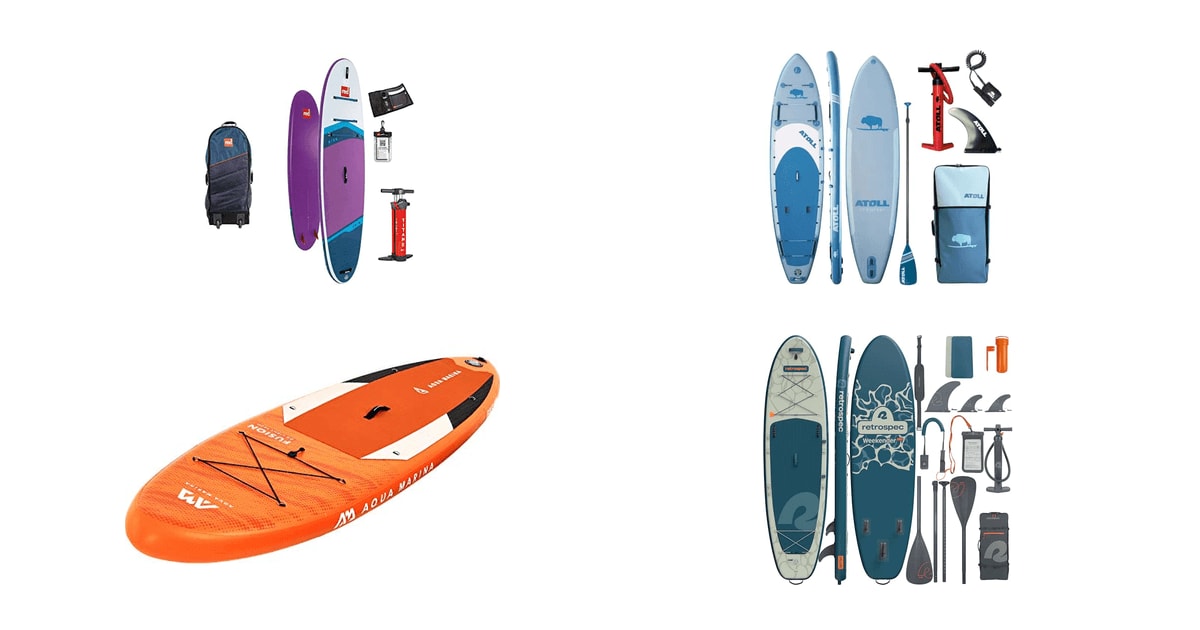
Most first-timers don't need a fast board. You need one that's wide, that comes with a paddle and pump you won't immediately want to replace, and that shrugs off being dragged across a gravel launch by someone who's never done this. That narrows the field quickly. A Paddling Magazine survey found 78% of first-time buyers chose inflatable over hard, mostly for storage and transport. We think that the Retrospec Weekender Plus is the best inflatable paddle board for beginners for most people, and that the Aqua Marina Fusion is the one to buy if you want the lightest kit to carry down to the water.
Everything we recommend

Wide, forgiving, and it turns into a kayak when you tire out

Lighter to haul, a little narrower to stand on

Close to hard-board stiffness, for a serious premium

For big paddlers, fishing rods and a dog, all at once
At a glance
| Product | Length | Width | Price | |
|---|---|---|---|---|
| 2023 Red Paddle Co 10'6" x 32"Upgrade pick | 10'6" | 32in | Check price |
| Atoll New 12ft Outrider Inflatable Stand UpAlso great | 12ft | 34in | $699.99 |
| Aqua Marina FusionRunner-up | 330cm | 32in | $289 |
| Retrospec Weekender Plus 10'6" Inflatable Paddle BoardTop pick | 10'6" | 33in | $303.89 |
How we picked
Width first. We treated 32 inches as the minimum deck width for a beginner board, based on stability comparisons from OutdoorGearLab showing novices falling off narrower boards far more often. Anything wider we counted as a bonus, not a requirement.
Layers, not just PSI. We favored dual-layer or fused drop-stitch construction over single-layer, since published reporting puts the flex reduction at roughly 30 to 50% at the same pressure. Less flex means less work for you and an easier time balancing.
Capacity and volume. We checked manufacturer weight ratings against REI's rule of thumb: multiply your body weight in pounds by 1.1 to 1.4 for the liters of volume you need. Boards that only clear that for a light paddler got marked down.
The whole kit. A board that arrives without a usable paddle, pump, leash and bag isn't really cheaper. We looked at what's in the box and whether owner feedback flags any of it as an immediate replacement.
Warranty and support. We compared stated warranty terms and the reputation of each brand's support, since a seam or valve problem in the first season is the failure that actually strands you.
Top pick
Wide, forgiving, and it turns into a kayak when you tire out
Retrospec Weekender Plus 10'6" Inflatable Paddle Board
At 33 inches wide with dual-layer PVC, this board gives you a lot of room to wobble without going in. The kit covers everything — pump, paddle, fins, leash, backpack, phone case — plus a seat that converts it to a kayak.
$303.89fromAmazonThe 33-inch deck is the whole reason this is our top pick. Beginner stability comes from width, and OutdoorGearLab's comparisons found novices falling off sub-30-inch boards far more often than wider ones under the same conditions. Thirty-three inches sits near the top of what you'll find outside the specialty fishing boards. Owners describe standing on it with a kid or a dog aboard, which tells you more than a spec sheet does.
Dual-layer PVC is the other reason. Retrospec calls its version AerGlide-Fusion, and the practical effect is less flex at the same pressure — reporting from Wirecutter puts the reduction somewhere around 30 to 50% versus single-layer boards. You feel it in the middle of the board, where a soft inflatable sags and quietly makes balancing harder. Owners moving up from cheap single-layer boards notice it right away.
The kayak conversion sounds like a gimmick until the wind picks up. Clip in the seat, add the second blade, and you sit down and keep going instead of fighting to stay upright. For a lake day where kids and adults trade off, that's genuinely useful. It also makes the board easier to justify in a household where not everyone is sold on standing.
At 24 pounds the whole setup packs into one backpack, and owners consistently praise the bag's stitching and the way each piece arrives in its own sleeve. That matters more than it sounds. A bad bag is why boards end up living in a car trunk, and a board living in a hot trunk is a board with a shorter life.
Flaws but not dealbreakers
The fins are the weak spot. They're molded plastic, and owner feedback includes a snapped side fin from a rock strike in moving water. On a flat lake you'll never think about it. On a shallow river you'll want spares in the bag.
Hand-pumping to full pressure is a slog — plan on the better part of 15 minutes, and expect to want an electric pump by your third outing. And 10'6" is short if you're tall and chasing distance. The board glides fine for cruising, but it isn't quick.
Runner-up
Lighter to haul, a little narrower to stand on
Aqua Marina Fusion
The Fusion is about five pounds lighter than our top pick and a bit longer, so it carries easily and tracks reasonably straight. You give up an inch of deck width and the kayak seat to get there.
$289fromAmazonNineteen pounds doesn't sound like much of a difference until you're carrying a board a quarter mile from the parking lot. The Fusion is the lightest package here by a clear margin, and that changes how often you actually go out. A board you can sling over one shoulder gets used. A thirty-pound board gets talked about.
Thirty-two inches is the floor we'd accept for a first board, and the Fusion sits right on it. Aqua Marina broadened the tail on this shape to add volume where beginners need it, which is under your back foot when you start to wobble. The nose is high and rounded, so small chop rides up and over instead of stopping you cold. On a calm lake it's forgiving.
The kit is complete without being fancy. You get a three-piece paddle, a dual-action pump, a leash, a center fin, a bungee cargo system, and a backpack that swallows all of it. None of it is premium, but none of it needs replacing before you know whether you like the sport. This is one of Aqua Marina's long-running shapes, and the owner feedback reflects that consistency.
Double-wall drop-stitch construction keeps the deck from ballooning, and the machine-pressed EVA pad uses a sand-ripple texture that stays grippy wet. Grip is worth more than it seems if you plan on any yoga or bringing a dog, both of which involve knees and paws landing somewhere you didn't plan for.
Flaws but not dealbreakers
An inch of width is a real inch. Next to a 33- or 34-inch deck, the Fusion feels tippier for your first few outings, and heavier paddlers will notice it more than light ones.
The single center fin tracks less confidently than a tri-fin setup when a side wind pushes you around, so expect to switch paddling sides more often. The included paddle is aluminum-shafted and a bit heavy too — fine for an hour, tiring over three.
Upgrade pick
Close to hard-board stiffness, for a serious premium
2023 Red Paddle Co 10'6" x 32"
Red Paddle Co's RSS battened rails stiffen the sides so the board barely gives underfoot. It's the most expensive board here by a wide margin, and it's the only one that makes the flex problem mostly go away.
Check priceatAmazonStiffness is the one thing inflatables are genuinely bad at, and the Ride is the only board here that largely fixes it. In independent bend comparisons, the Ride 10'6" deflected measurably less under center load than other inflatables in its class, and SUPBOARDER Magazine credits the RSS battened rail system for getting it near hard-board rigidity. You feel that as a deck that pushes back instead of sagging.
What that buys you is progress. On a soft board, every stroke loses energy to the deck bending under your weight, so you work harder for less glide. Take that away and paddling gets easier right when you start caring about distance. If you already suspect you'll be out most weekends, this is the board you won't outgrow in a season.
The 10'6" size runs 32 inches wide, which is plenty stable for a beginner but not the roomiest deck here. Red Paddle Co builds it from high-density MSL drop-stitch with a rounded all-around nose, and the brand's boards are the ones review sites tend to reach for when they need a rigidity benchmark.
Flaws but not dealbreakers
The price is the flaw, and it's a big one. This board costs several times what our top pick does, and if you paddle three times a summer you'll never feel the difference in your legs, only in your wallet.
Red Paddle Co also sells boards and accessories more separately than the value brands do, so a complete setup adds up faster than the board alone suggests. If you're not certain you'll stick with paddling, start cheaper and upgrade once you know.
Also great
For big paddlers, fishing rods and a dog, all at once
Atoll New 12ft Outrider Inflatable Stand Up
At 12 feet by 34 inches with a 400-pound capacity, the Outrider is the one to buy if you're heavy, hauling gear, or fishing. It's also the largest and most awkward board here to carry, inflate and turn.
$699.99fromAmazonREI's sizing guidance says to multiply your weight in pounds by 1.1 to 1.4 to get the minimum volume in liters you need for stable flatwater paddling. Run that at 250 pounds and most 10-foot beginner boards start to look marginal. The Outrider's footprint and 400-pound rating give heavier paddlers real margin, which you notice as a board that rides high instead of squatting.
Thirty-four inches is the widest deck here, and it changes what you can do up there. Standing to cast, kneeling to land a fish, moving through yoga poses, or letting a kid ride the nose all get easier when the platform stops arguing with you. Atoll adds three action mounts and two Scotty plates, so rod holders and cameras bolt on without aftermarket surgery.
Construction is dual-layer MSL fused PVC with reinforced rail stringers and heat-welded seams rather than glued ones. That's the same broad approach the premium brands use, and it's why this board resists the warping that shows up on cheap single-layer boards. The kit includes an adjustable paddle, a 10-foot coiled leash, an 8-inch touring fin, a hand pump and a travel backpack.
Flaws but not dealbreakers
Twelve feet is a lot of board. It's heavier to carry, slower to pump up, and harder to turn than anything else here. If you paddle narrow creeks or launch from a crowded dock, you'll feel that every single trip.
Lighter paddlers should skip it. A 400-pound-capacity board under a 140-pound person mostly just catches more wind, and the extra length makes it harder to spin around when you want to go back the way you came.
The Outrider is backed by a two-year manufacturer's warranty.
Who this is for
This guide is for people buying their first paddle board, or replacing a very cheap one. That includes families who want a single board adults and kids can share, apartment dwellers with nowhere to hang a hard board, travelers who need something that fits in a car trunk, and heavier paddlers who've been talked out of narrow boards. If you're worried about balance, you're exactly who we had in mind — every board here is at least 32 inches wide.
Skip this guide if you're shopping for racing, downwind or serious surf boards. Those want narrow, stiff, purpose-built shapes, and everything we recommend here is a stable all-around cruiser. You should also hold off if you have a garage and mostly paddle one local lake; a hard board will be stiffer and faster for the same money, and storage is the main reason to go inflatable at all.
How we picked
Width: we set 32 inches as the floor, because OutdoorGearLab's stability comparisons found novices coming off narrower boards far more often in the same water. Construction: we preferred dual-layer or fused drop-stitch, which published reporting credits with cutting flex by roughly 30 to 50% at the same pressure. Capacity: we checked stated weight ratings against REI's guidance to multiply your weight in pounds by 1.1 to 1.4 for minimum volume in liters. Kit: we looked for a paddle, pump, leash, fins and a bag that you won't want to replace in the first month. Support: we compared warranty terms and each brand's track record on parts and replacements.
The competition
This is what our research surfaced on Amazon for beginner-friendly inflatable boards, not a map of the whole market. Plenty of well-regarded brands sell mainly through their own sites, and several of the search results for these boards turned out to be accessories rather than boards. Every board we could confirm here earned a spot above, so there's nothing left in the also-ran column. If you're cross-shopping, the questions worth asking are the same ones behind this guide: how wide is the deck, how many layers of PVC, what's the rated capacity, and what actually comes in the bag.
Care and storage
Sun is what kills these boards, not rocks. Industry guidance points to UV degradation rather than punctures as the leading cause of failure over time, and a well-kept inflatable generally lasts somewhere between five and ten years. So the routine is simple. Rinse with fresh water after saltwater, let the deck dry all the way, then roll it loosely from the nose with the valve open. Store it deflated and indoors, away from a sunny window. Don't leave a fully inflated board in a hot car or sitting on a dock all afternoon, since heat raises internal pressure and stresses the seams. Keep the patch kit in the bag, not on a shelf in the garage where you'll forget it exists.
Questions we get
How wide should a beginner paddle board be?
Aim for 32 inches or wider. OutdoorGearLab's stability comparisons found novice paddlers fell off boards under 30 inches noticeably more often than wider boards in identical calm water. Width does more for your balance than length does, and every board we recommend clears that bar.
What PSI should I inflate my board to?
Most manufacturers call for 12 to 15 PSI, and you should treat that as a requirement rather than a suggestion. Below about 10 PSI, boards flex noticeably along their length, which makes balancing harder for exactly the people who need the most help. Expect 12 to 18 minutes by hand to reach 15 PSI, or 5 to 8 minutes with an electric pump.
Are inflatables as good as hard boards for beginners?
For learning on flat water, yes — and arguably better, since inflatables are softer to fall onto and easier to store. Hard boards are stiffer and faster, so serious paddlers still prefer them. The gap narrows most with battened construction like Red Paddle Co's RSS system, which independent bend comparisons show flexes measurably less than typical inflatables.
What size board do I need for my weight?
REI's guide suggests multiplying your weight in pounds by 1.1 to 1.4 to find the minimum volume in liters you need for stable flatwater paddling. Then check the board's rated capacity and leave room for gear, a cooler, or a dog. If you're over about 250 pounds, look at high-capacity boards like the Atoll Outrider rather than a standard 10-footer.
How long do inflatable paddle boards last?
Roughly five to ten years with reasonable care. Store it deflated, rinse off salt water, and keep it out of prolonged sun — UV exposure, not punctures, is what industry data flags as the main cause of failure. Dual-layer boards hold up better than single-layer ones over that span.
Can two people ride one board?
On a wide, high-capacity board, sometimes — an adult plus a small child is realistic on a 33- or 34-inch deck. Two adults usually isn't, unless the board is rated well above their combined weight plus gear. Check the manufacturer's capacity number and treat it as a ceiling, not a target.
Why you should trust us
For this guide:
- We read published reviews and independent stiffness comparisons from outlets including OutdoorGearLab and SUPBOARDER Magazine, plus sizing guidance from REI Co-op.
- We compared manufacturer specifications for width, volume, construction layers, weight capacity, warranty terms and included accessories across every board in this lineup.
- We read through owner feedback looking for recurring themes about stability, kit quality and fin durability rather than isolated complaints.
- We read owner reviews on every listing, weighted toward the critical ones, because that is where the recurring failures show up.
- We have a systematic way of automatically fetching the latest prices, so the numbers on this page stay current.
- This is a research-focused guide, so the team may not own every product listed — though we often do own the top winners, which gives us extra context for the recommendations.
- We don't accept free products, and the retailer commission never changes which product we recommend.
Sources
Best Inflatable Paddle Boards 2026 — OutdoorGearLab, OutdoorGearLab
Best Paddle Boards 2026 — Wirecutter (NYT), Wirecutter
How to Choose a Stand-Up Paddle Board — REI Co-op Expert Advice, REI Co-op
Best Inflatable SUP Boards for Beginners — PaddleboardingMag, PaddleboardingMag
Red Paddle Co Ride 10'6" In-Depth Review — SUPBOARDER Magazine, SUPBOARDER Magazine
Inflatable vs. Hard Paddle Board: Which Is Better? — Paddling Magazine, Paddling Magazine
Best Inflatable Paddle Boards — The Adventure Junkies, The Adventure Junkies
iRocker Cruiser 10'6" Review — SUP World Mag, SUP World Mag
Stand-Up Paddleboard Market Size & Forecast 2024–2030 — Grand View Research, Grand View Research
How Long Do Inflatable Paddle Boards Last? — Standup Paddler, Standup Paddler
Amazon product listings and owner reviews for all 4 products
Manufacturer specification pages for each product
Some passages in this guide may be paraphrased with AI help. Prices are refreshed automatically.
More like this.
Continue exploring lifestyle reviews and recommendations.

The Best Inflatable Kayaks
An inflatable kayak solves the problem that keeps most people off the water: where to put the boat. A hardshell wants a garage, a roof rack, and a friend…

The Best Inflatable Kayaks and River Craft
An inflatable kayak solves the problem that keeps most people off the water: storage and hauling. You don't need a garage bay or a roof rack. You need a…

The Best Inflatable Hot Tubs
An inflatable hot tub is one of the few backyard upgrades you can be using the day after it arrives. You unroll it on a flat patch of patio, let the pump…

The Best Inflatable Paddleboards
An inflatable paddleboard earns most of its keep off the water. It rolls into a bag you can shove in a closet or a trunk, and it doesn't need a roof rack,…

The Best Off-Road Recovery Boards
Getting stuck isn't really an if. Drop a tire into a sand wash, sink into spring mud on a forest road, or spin out on a snowed-in trailhead approach, and…

The Best Inflatable Holiday Yard Decorations
An inflatable is the one decoration your neighbors can see from the street without slowing down. You plug in a cord, a fan spins up, and a flat nylon…