The Best Off-Road Recovery Boards
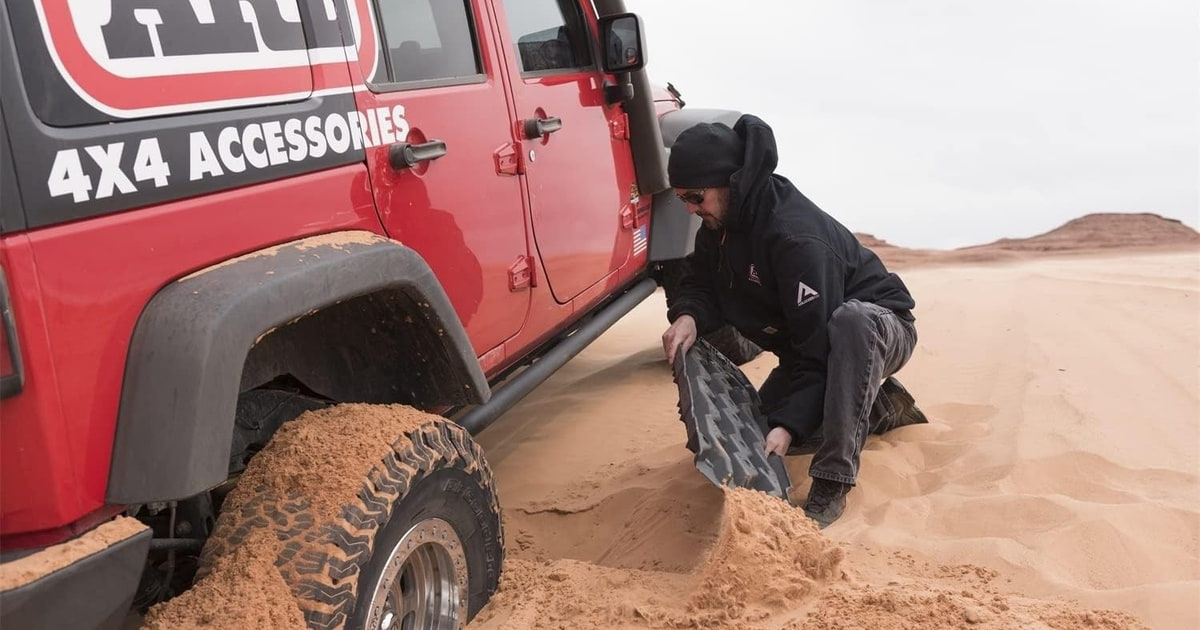
Getting stuck isn't really an if. Drop a tire into a sand wash, sink into spring mud on a forest road, or spin out on a snowed-in trailhead approach, and you'll want two pieces of plastic in the back of your rig. Recovery boards wedge under a spinning tire and give it something solid to climb. Done right, that's a ten-minute stop instead of a half-day wait for a tow truck that may not come. The good ones are light enough that you'll actually carry them and tough enough to survive being used more than once.
Here's the honest part: no board saves you from bad throttle technique. Spin the tire hard and you'll melt or shear the traction teeth on any board here, including the expensive ones. Load ratings are also close to meaningless as a shopping filter, since brands print big numbers with no independent verification behind them. And a pair of boards is the bare minimum. In deep sand or sustained mud, one axle's worth of traction often isn't enough to move a loaded truck.
So what separates these is more mundane: how long the deck is, how the teeth are shaped, whether the plastic stays flexible when it's cold, and how much rack space the boards eat. We think that the MAXTRAX MKII is the best recovery board for most people, and that the X-BULL New Recovery Traction Tracks Gen 3 is the one to buy if you only get stuck once or twice a season.
Everything we recommend

The board that still works after the twentieth recovery
Same premium performance, half the rack space

Enough board for a few recoveries a year

The best accessory package in the middle of the range
Prices as of Oct 22, 7:36 AM PT · Details
At a glance
| Product | Price | |
|---|---|---|
| MAXTRAX MKII Black Vehicle Recovery BoardTop pick | $279.99 |
| ARB TRED PRO TREDPROR Recovery Boards TractionUpgrade pick | $359.95 |
| Rhino USA Off-Road Recovery Traction Boards -Also great | $149.90 |
 | SmittyBilt Recovery Traction Boards - SB2890Also consider | $169.99 |
 | Rhino USA Off-Road Recovery Traction Boards -Also consider | $149.90 |
| X-BULL New Recovery Traction Tracks Sand MudBudget pick | $107.90 |
Prices as of Oct 22, 7:36 AM PT · Details
How we picked
Material and cold. We compared manufacturer material claims and published field reviews to separate reinforced-nylon boards from standard HDPE. Anything a buyer might use below freezing needed a credible cold-temperature rating.
Deck length. We read spec sheets for deck length and width, since run-up distance is what gets a tire out of a deep rut. Boards under about 1,150mm got flagged as light-duty.
Tooth design. We looked for angled or cross-shaped teeth that shed mud rather than packing solid, a distinction published off-road testing treats as a real separator between designs.
Storage and mounting. We compared stacked thickness and mounting-hole spacing against common rack systems. Boards that won't fit your rack tend not to get carried.
What's in the box. We noted which sets include carry bags, retrieval leashes, and rack pins, and we weighed owner reports about ejection and retrieval injuries when judging how much those extras matter.
Top pick
The board that still works after the twentieth recovery
MAXTRAX MKII Black Vehicle Recovery Board
The MAXTRAX MKII is a long, light reinforced-nylon board that flexes instead of cracking in the cold and keeps its teeth through repeated use. It's the standard other boards get compared to, and it's the one to buy if you go off pavement regularly.
$279.99fromAmazonPrices as of Oct 22, 7:36 AM PT · Details
The material is the whole argument. MAXTRAX uses a reinforced nylon compound rather than the commodity HDPE most budget boards are molded from. The practical difference shows up in two places: cold and wear. Nylon keeps flexing at sub-zero temperatures where cheaper plastic gets brittle and can crack under a loaded tire. Published field reviews also credit the nylon boards with holding their traction teeth far longer under repeated high-RPM wheelspin.
It's long, and length is what gets you out of a rut. The deck runs roughly 46 inches. That extra run-up matters when your tire is sitting a foot below grade in a soft-bottomed rut and needs to climb rather than just grab. Short boards technically fit under the tire, but they hand you less distance to build momentum. If you're pulling a heavy rig out of deep sand, that difference is the recovery working on the first try.
The tooth geometry is angled to shed, not just to grip. The pins sit in a bidirectional grid at roughly 45 degrees, which lets packed mud and wet sand clear as the tire rolls across. Perpendicular pins tend to fill in and pack solid, and once they do, the board stops biting and your tire re-embeds. Expedition Portal's long-running field coverage points to that shedding behavior as a real separator between board designs.
It's light enough that you'll bring it. Reinforced nylon lets MAXTRAX keep the weight down without giving up strength, so a set doesn't punish your rack or your back. That matters more than it sounds. Boards that live in the garage because they're heavy and awkward have a recovery success rate of zero. These are easy to place under an aired-down tire and easy to sling back on the rack afterward.
Flaws but not dealbreakers
This is the most expensive way to solve the problem. A pair costs real money, and the standard advice — carry four, one per driven wheel — doubles that. If you wheel a few weekends a year on maintained trails, you're buying durability you'll never spend down. The budget boards in this guide will get an occasionally-stuck SUV out of mud and snow just fine.
Black is a bad color for desert use and for finding your boards. The dark deck soaks up sun, and in summer heat the surface gets unpleasant to handle barehanded. It also vanishes in dark mud and low light after a spinning tire flings it fifteen feet into the brush. If you wheel solo or in low-contrast terrain, a high-vis board is genuinely easier to recover.
MAXTRAX doesn't publish a warranty term in this listing, so check with the seller before you buy.
Upgrade pick
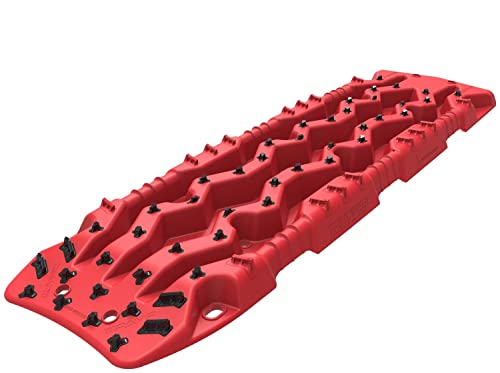
Same premium performance, half the rack space
ARB TRED PRO TREDPROR Recovery Boards Traction
The ARB TRED PRO stacks nearly flat, so a pair takes up about a third of the vertical space that ribbed boards do. If you run a slimline rack or store boards in a drawer, that's the reason to pay for these instead of the MAXTRAX.
$359.95fromAmazonPrices as of Oct 22, 7:36 AM PT · Details
Storage geometry is the entire pitch, and it's a good one. ARB's patented nested design lets two boards sit at roughly 37mm stacked, against 80 to 100mm for conventional ribbed boards. If your crossbars sit close to a rooftop tent, or your boards have to share a drawer with a fridge slide and a tool roll, that's the difference between fitting and not. Nobody talks about this until they're the one trying to make it fit.
The composite is built for the two things that kill boards. ARB's EXOTRED construction pairs flexible nylon with glass-filled nylon teeth. The flexible body is what lets the board conform to a rut instead of snapping across it. The harder teeth are what survive a driver who gets impatient with the throttle. It's a sensible split, and it addresses the most common way budget boards fail.
The tooth profile is designed off real tire data. ARB's SIPE-LOCK grip pattern was shaped around actual 4x4 tire dimensions and tread patterns, and it's aimed at a specific failure: the board squirting out from under a spinning tire. That's the thing that makes recoveries dangerous, since an ejected board becomes a projectile. Anything that keeps the board planted under load is worth having.
The handle earns its keep during placement. The ergonomic handle gives you shovel-like control, which sounds like marketing until you're on your knees trying to work a board under an aired-down 35 with mud packed around it. The low-profile leading edge helps here too, sliding under a tire that's barely off the ground more easily than a thick ribbed board does.
Flaws but not dealbreakers
You pay a premium for a storage benefit, not a traction benefit. In the terrain that matters — sand, mud, snow — published reviews put the TRED PRO and the MAXTRAX in the same tier. If your boards live on a full-height rack or strapped to a bed bar with room to spare, you're spending extra for a problem you don't have.
The flat profile gives up a little clearance in deep ruts. The thinner deck means slightly less lift under the leading edge when the board is going into a genuinely deep hole. It's a minor thing and rarely decides a recovery, but it's the trade you make for the stacking advantage.
Red and black disappear in the woods. In dark mud, deep forest duff, or dim early-morning light, these are harder to spot than orange or yellow boards. Add a retrieval leash if you wheel alone.
Budget pick
Enough board for a few recoveries a year
X-BULL New Recovery Traction Tracks Sand Mud
The X-BULL Gen 3 comes as a complete kit with a carry bag and optional rack pins, and the cross-shaped teeth are a real improvement over the brand's older design. It's the sensible starting point if you're not sure how often you'll actually need boards.
$107.90fromAmazonPrices as of Oct 22, 7:36 AM PT · Details
The Gen 3 teeth fixed the original's real problem. Earlier X-BULL boards had a habit of sliding under the tire rather than biting into it, which is the worst outcome for a recovery board. The cross-shaped teeth on this generation grab tire tread and terrain at the same time. X-BULL also says they're shaped to resist melting under hard wheelspin, which is the usual way cheap boards die.
It's a full kit, not just two slabs of plastic. You get a carry bag, and mounting pins are available for most roof racks. That matters more than it sounds, because bare boards end up loose in the bed sliding around and getting chewed up. Boards that have a bag get stored properly and stay in the truck.
The size is right for lighter rigs. At about 41.7 inches long and 12.2 inches wide, these are sized for a mid-size truck or an SUV on all-terrains. If you're pulling a Tacoma out of a wet campsite or a Subaru off a snowy shoulder, that's plenty of board. The temperature range covers most of what a weekend driver deals with.
Volume has an upside. These are among the most-purchased recovery boards anywhere, which means the design has been exposed to an enormous amount of real-world use and the failure modes are well known. Owners who use them for occasional sand, mud, and snow recovery generally report they do the job. Problems cluster around hard, sustained wheelspin — which is a technique issue as much as a board issue.
Flaws but not dealbreakers
They're heavy for the size. A pair runs over eleven pounds, which is a lot of weight for a board this short. You're carrying near-premium mass while getting less deck than the MAXTRAX gives you. On a rack, that's noticeable.
The plastic isn't a cold-weather choice. These are rated down to about -4°F, and sustained deep cold is where budget board material starts getting brittle. If you wheel Rockies winters or northern-tier backcountry, spend up for reinforced nylon.
Short boards don't love deep ruts. Under a heavily loaded truck sunk into a deep hole, 41.7 inches of run-up is thin. These work best in shallower stuck situations and lighter vehicles.
Also great
The best accessory package in the middle of the range
Rhino USA Off-Road Recovery Traction Boards -
The Rhino USA boards include retrieval leashes and a zippered carry bag, and the mounting holes match standard rack pin spacing. They're the step up to make if the X-BULL feels too thin but the MAXTRAX feels like too much.
$149.90fromAmazonPrices as of Oct 22, 7:36 AM PT · Details
Retrieval leashes are the underrated safety item here. A spinning tire can throw a board a good distance into soft terrain, and going after it barehanded is how people get cut on sharp edge burrs. Leashes let you pull the board back without groping around in mud. Most budget boards leave them out, and most buyers don't miss them until the first real recovery.
The mounting holes actually match your rack. Rhino uses the 270mm industry-standard spacing, so pins from ARB, Rhino-Rack, Yakima, and Thule line up without drilling or improvising. If you already have a rack, that saves a frustrating afternoon. Verify against your specific crossbar model anyway.
The material is built for sitting outside. UV-stable construction is aimed squarely at boards that live on a roof rack year-round instead of in a garage. Sun degradation is a slow, quiet failure — the board looks fine and then cracks when you finally need it. If your rig is parked outdoors, this matters more than any spec on the box.
Small details address common budget-board failures. Reinforced wheel studs help keep the board from squirting out under wheelspin, and the contoured ends clear dirt as the tire rolls on. There's also a jack base built in, which is useful when you need controlled lift before placement.
Flaws but not dealbreakers
It's HDPE, so cold is a limit. These don't have the reinforced-nylon cold tolerance of the MAXTRAX. In sustained sub-zero conditions the material gets less forgiving, and that's exactly when you can't afford a cracked board.
The deck is shorter than the premium boards. At about 43 inches you get less run-up in a deep rut than a MAXTRAX or a SmittyBilt gives you. Fine for most stuck situations, thin for a fully loaded heavy-duty truck.
Who this is for
Buy recovery boards if you leave pavement at all — sand, snow, forest roads, a soft campsite, a beach access ramp. They're the simplest self-recovery tool there is, and unlike a winch they don't need an anchor point or wiring. This guide covers boards for passenger 4x4s, trucks, and SUVs, sold in pairs and sized to fit under a normal all-terrain or mud-terrain tire.
Skip them if your driving is all pavement, or if your stuck scenarios are always within cell range of a tow truck. We're not covering winches, kinetic ropes, shovels, or air compressors here, though a full recovery kit includes those and boards work best alongside them. We also stay away from load-rating comparisons as a buying filter, since the numbers on these listings range from 11,000 pounds to 20,000 to 10 tons with no independent verification behind any of them.
How we picked
Material: reinforced nylon keeps flexing in deep cold where standard HDPE turns brittle, so we favored nylon for anyone driving below freezing. Length: longer decks give a sunk tire more run-up, and we treated roughly 1,150mm as the line between full-size-truck capable and light-duty. Teeth: angled and cross-shaped tooth geometry sheds packed mud instead of filling in, which is what keeps a tire from re-embedding on the first pull. Storage: we compared stacked height and 270mm mounting-hole compatibility against common rack systems, because a board that won't mount won't get carried. Kit contents: carry bags, retrieval leashes, and rack pins do real work, and owner feedback about ejected boards and cut hands convinced us leashes belong on the list.
Other off-road recovery boards worth considering
If you want the same Rhino boards in a color you can find: The Rhino USA Off-Road Recovery Traction Boards - — This is the orange version of our Also great pick, identical in construction, kit contents, and mounting hole spacing. The only difference is visibility, and it's not a small one. A spinning tire can eject a board well past arm's reach, and a black board in a snowfield or dark mud effectively disappears. Orange doesn't. If you wheel solo, in winter, or in dense forest, take the orange one — you're giving up nothing but a stealthier look.
If you drive a full-size or heavy-duty truck: The SmittyBilt Recovery Traction Boards - SB2890 — The SmittyBilt SB2890 is 47 inches long and 13 inches wide, which is the right footprint for wide LT tires under an F-250, a Ram 2500, or a loaded Gladiator. It's nylon-reinforced plastic with a built-in jack base, and that jack base is genuinely useful when a heavy rig needs controlled lift before you can slide a board underneath. What you give up: no carry bag, no retrieval leashes, and a ribbed profile that wants more vertical clearance on a rack than the flat-stacking ARB. Availability is also spotty.
The competition
This is what our research surfaced across the mainstream recovery board market, not a complete census of everything sold. Brands enter and leave this category constantly, and plenty of listings are the same mold with a different name printed on it.
Using boards without getting hurt
Wear gloves. Boards develop sharp burrs along the edges after a few recoveries, and reaching for one barehanded after a tire has chewed it is how people end up with deep cuts on a trail with no cell service. Use slow, controlled throttle rather than spinning the tire — aggressive wheelspin is the single fastest way to destroy traction teeth on any board, premium or budget, and it's what turns a board into a projectile. Clear mud out of the teeth before you stow the boards, or the packed grit grinds them down. If you mount to a roof rack, add a secondary retention strap on top of the pins, since trail vibration works pin-only mounts loose over time. And carry four boards if you go anywhere remote — one per driven wheel.
Questions we get
How many recovery boards do I need?
Two is the minimum, and it's enough for mild terrain with an easy exit. Four — one under each driven wheel — is what serious overlanders carry, because single-axle placement often can't generate enough traction to move a loaded rig out of deep sand or mud. Four boards also let you recover somebody else's vehicle without a winch, which comes up on group trips. If you're carrying four, a flat-stacking design like the ARB TRED PRO saves a lot of rack volume.
Are premium boards actually worth it over cheap ones?
It depends entirely on how often you get stuck. Published field reviews consistently find that reinforced-nylon boards hold their traction teeth much longer than HDPE under repeated hard use, with budget boards showing visible wear after fifteen or twenty recoveries. If you wheel a few times a year, the X-BULL or Rhino boards will outlast your need for them. If you depend on self-recovery in remote terrain, the MAXTRAX earns the difference.
What size boards do I need for a full-size truck?
Look for at least about 1,150mm of length and 13 inches of width. The SmittyBilt SB2890 at 47 by 13 inches and the MAXTRAX MKII at roughly 46 by 13 inches both fit that description. Shorter boards will physically go under the tire, but they give a heavy, loaded truck much less distance to climb out. Width matters for wide LT tires — 285s, 33s, and 37s want full contact across the deck.
Do these work in snow and ice, or just mud and sand?
They work in snow, but material matters more in the cold. Reinforced nylon stays flexible at sub-zero temperatures where standard HDPE gets brittle and can crack under load. If you drive mountain or northern-tier backcountry in winter, that's a strong argument for the MAXTRAX or the ARB. Above freezing, every board here handles snow fine.
What's the real difference between the MAXTRAX MKII and the ARB TRED PRO?
Storage, mostly. The MAXTRAX uses reinforced nylon with a conventional ribbed profile; the ARB uses its EXOTRED composite in a patented nested design that stacks to about 37mm. Published reviews put their traction and durability in the same tier, so the deciding question is whether your rack or drawer system has room to spare. If it does, the MAXTRAX costs less for equivalent capability.
How do I mount boards to a roof rack so they stay put?
Most boards here use 270mm mounting hole spacing, which matches standard pins from ARB, Rhino-Rack, Yakima, and Thule. Always add a secondary retention strap on top of the pins, because vibration on washboard roads loosens pin-only mounts over time. Flat-stacking boards need less clearance between the boards and your crossbars, which helps on slimline racks. Check your specific rack model's spacing before you order pins.
Why you should trust us
For this guide:
- We read manufacturer spec sheets and listing details for every board here, comparing deck length, width, stacked height, material composition, and mounting hole spacing.
- We reviewed published off-road field coverage from outlets including Expedition Portal and The Drive on how tooth geometry and board material hold up over repeated recoveries.
- We reviewed owner feedback themes across these listings, paying particular attention to reports of board ejection, tooth wear, and cold-weather cracking.
- We read owner reviews on every listing, weighted toward the critical ones, because that is where the recurring failures show up.
- We have a systematic way of automatically fetching the latest prices, so the numbers on this page stay current.
- This is a research-focused guide, so the team may not own every product listed — though we often do own the top winners, which gives us extra context for the recommendations.
- We don't accept free products, and the retailer commission never changes which product we recommend.
Sources
Best Recovery Boards & Traction Mats — Expedition Portal Gear Reviews, Expedition Portal
MAXTRAX MKII Official Product Specifications, MAXTRAX
ARB TRED Pro Recovery Board Specifications, ARB 4x4 Accessories
Best Recovery Boards Tested — The Drive, The Drive
Best Off-Road Recovery Boards 2025 — Popular Mechanics, Popular Mechanics
Amazon product listings and owner reviews for all 6 products
Manufacturer specification pages for each product
Some passages in this guide may be paraphrased with AI help.
Product prices and availability are accurate as of the date/time indicated and are subject to change. Any price and availability information displayed on Amazon.com at the time of purchase will apply to the purchase of this product.
More like this.
Continue exploring lifestyle reviews and recommendations.

The Best Road Cycling Accessories and Gear
Road riding gear splits into two piles. There's the stuff you notice every ride - a helmet that doesn't cook your head on a July climb, shoes that don't…

The Best Cycling Jerseys and Bib Shorts for Road Riding
Nothing ruins a long ride faster than the wrong shorts. Your saddle contact points carry most of your weight for hours, and a pad that's too thin, too…

The Best Inflatable Paddle Boards for Beginners
Your first hour on a paddle board is mostly about not falling in. That's why width matters more than length when you're starting out, and why a 32-inch…

The Best Tow Straps and Kinetic Recovery Ropes
Getting stuck is rarely dramatic. You back down a boat ramp that's slicker than it looked, or you pull onto a soft shoulder in the rain, and suddenly your…

The Best Compression Clothing for Workout Recovery
Compression gear is one of the few pieces of workout equipment you wear when you're not working out. The idea is simple: snug fabric squeezes your legs,…

The Best Vibration Plates for Recovery
A vibration plate is a simple thing: a motorized deck you stand on while it shakes. For recovery, that shaking is meant to loosen tight muscles, nudge…