The Best Inflatable Kayaks
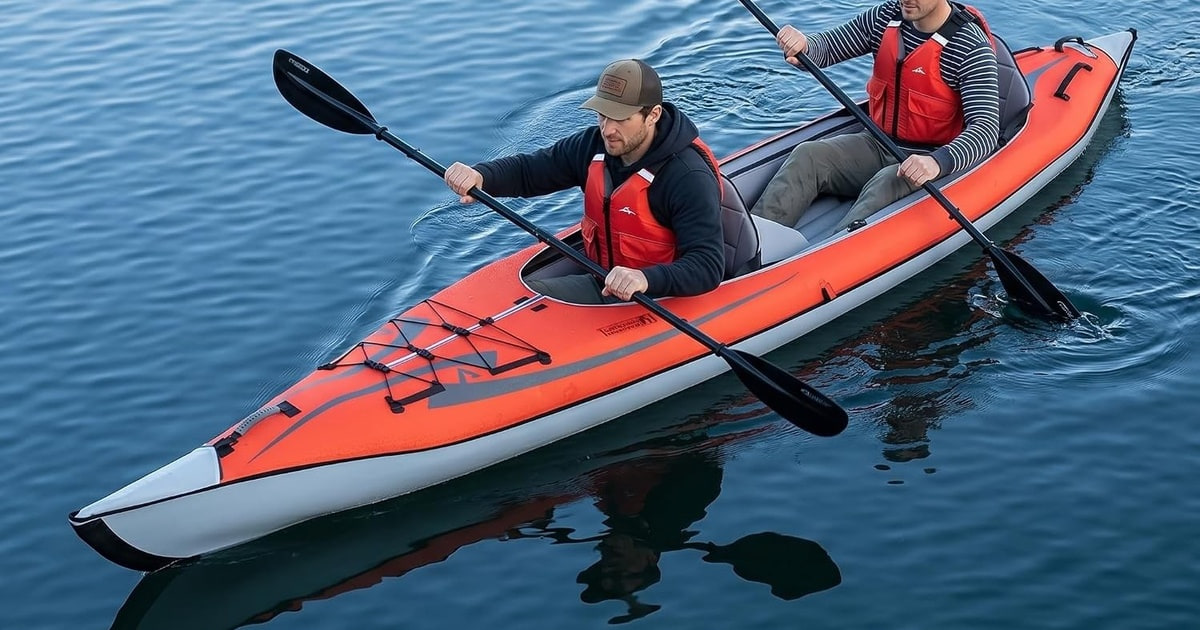
An inflatable kayak solves the problem that keeps most people off the water: where to put the thing. A hardshell needs a roof rack, a garage wall and a friend to help you load it. An inflatable lives in a closet and rides in your trunk. You pull it out, pump it up in ten or twenty minutes, and paddle. The better ones now use drop-stitch floors pressurized to 10 to 15 PSI, which makes the hull stiff enough to hold a line instead of wandering across the lake.
Here's what no inflatable does well. They're slower than hardshells over distance, and they ride higher on the water, so a stiff crosswind shoves you around. Every trip ends with a chore, too: you have to dry the hull before it goes back in the bag, or you'll open it next time to mildew. Setup is never zero. And a cheap single-layer PVC boat isn't a bargain. It's a raft that leaks, tracks badly and gives up after a season or two.
So think about where you'll actually paddle. A calm pond near the house asks very little of a boat. A rocky river with real rapids asks for a self-bailing floor and a hull that shrugs off scrapes. Weight matters more than people expect, too — a 58-pound bundle is fine at a boat ramp and miserable on a half-mile trail. We think that the Advanced Elements AdvancedFrame Convertible is the best inflatable kayak for most people, and that the Sea Eagle 380x Pro Package is the one to buy if you run whitewater.
Everything we recommend

Hardshell-like tracking that still fits in a closet

More boat than most lakes need, and worth it on real rivers

A complete two-person kit with almost nothing left to buy

Backpack-sized, and wide enough to feel steady
At a glance
| Product | Weight | Capacity | Price | |
|---|---|---|---|---|
| Advanced Elements AdvancedFrame Convertible 2 Person KayakTop pick | 21.7 lbs | 550 lbs / 2-Person | $499.90 |
| Sea Eagle 380x Inflatable Kayak with ProRunner-up | 40 lbs | 750 lbs / 3-Person | $1,149 |
| INTEX 68309EP Excursion Pro K2 Inflatable KayakBudget pick | 44.67 lbs | 400 lbs / 2-Person | $279.59On sale |
 | Kokopelli Packraft Rogue-lite - YellowAlso consider | 8.75 lbs | — | $1,037.77 |
 | AQUAGLIDE Noyo 90 Inflatable 9 FT KayaksAlso in lineup | 21 lbs | 250 lbs / 1-Person | $199.99 |
 | NRS Kaholo Inflatable KayakAlso consider | 36.1 lbs | — | $1,195 |
| ADVANCED ELEMENTS Packlite+ Packraft One Person InflatableAlso great | 13.4 lbs | — | $529.97On sale |
How we picked
Hull rigidity. We looked for drop-stitch floors or a structural frame, since those are what let a hull hold a line instead of flexing. Published reviews consistently rank high-pressure floors above standard air chambers for paddling feel.
Construction material. We ruled out single-layer PVC entirely and favored multi-layer laminates, thick PVC floors or TPU-coated nylon. Owner feedback across the category shows punctures and seam failures cluster on the thinnest hulls.
Tracking hardware. Skegs, fins and hull length decide whether you paddle straight or crab sideways. We prioritized boats with removable skegs, because those let one hull work on both open water and shallow creeks.
Packed weight. We compared packed weight against how far you'd realistically carry each boat. Anything above roughly 40 pounds needs a short walk from the car; anything under 15 pounds can ride in a backpack.
What's included. Pumps and paddles are expensive afterthoughts, and a hand pump that can't reach 10 PSI wastes a drop-stitch floor. We checked each package for a pump matched to the boat's inflation spec.
Top pick
Hardshell-like tracking that still fits in a closet
Advanced Elements AdvancedFrame Convertible 2 Person Kayak
The AdvancedFrame Convertible has aluminum ribs built into the bow and stern, so it holds a line the way a hardshell does. It paddles solo or tandem, carries up to 550 pounds of people and gear, and comes with a pump. It's heavy, but it's the most useful boat here.
$499.90fromAmazonThe aluminum ribs are the whole point. Most inflatables are just tubes of air, so the bow and stern end up round and blunt, and the boat pushes water instead of slicing it. Advanced Elements builds a rigid frame into both ends, which pre-shapes the hull before you add a single stroke of the pump. On flat water you'll notice it right away: fewer corrective strokes, less zig-zag, more glide per stroke than a plain air-chamber boat.
It's really two kayaks. Set it up as a tandem and two adults fit comfortably for a weekend on the lake. Reconfigure it for solo paddling and you get the same hull with one seat and room for gear. At 15 feet with a 550-pound capacity, you can bring a cooler, a dog and a dry bag without thinking hard about it. If you only want to own one boat, that flexibility is worth a lot.
The pump is in the box, and that matters more than it sounds. Underinflation is the number one reason an inflatable feels squirrely, and a weak hand pump is how people end up underinflated. You get a high-output pump and a duffel bag here, so nothing is missing on day one. Owners also mention using the pump in reverse to suck air out, which is the trick that gets the boat small enough to fit back in its bag.
Owners describe it as a boat, not a pool toy. The recurring theme in feedback is that it feels solid underfoot — no wobble when two people shift their weight, no folding in the middle when you paddle hard. People who already own hardshells say they reach for this one because it's the one they can actually get to the water. That's the highest praise an inflatable gets.
Flaws but not dealbreakers
It's heavy. At 58 pounds packed, this is a two-person carry from the car, or a slow one-person shuffle with breaks. Owners bring it up constantly, usually right after saying how much they like paddling it. If your put-in is more than a couple hundred yards from where you park, look at a packraft instead.
Setup takes longer than a simple air-chamber boat. Budget 15 to 20 minutes, because the ribs have to sit correctly before you inflate anything. Folding it back down is the fiddlier half — several owners say the first repack takes a few tries before everything fits in the duffel. It gets faster with practice, but it never becomes a five-minute boat.
A few owners report air loss and sagging seats. The complaint is a hull that goes soft after an hour or so on the water, and seat backs that gradually lean rearward as the day goes on. It isn't the common experience, but it's worth doing a driveway inflation test before your first real trip so you can catch a bad valve while you can still return it.
Runner-up
More boat than most lakes need, and worth it on real rivers
Sea Eagle 380x Inflatable Kayak with Pro
The Sea Eagle 380x is rated for Class IV whitewater and still behaves on a flat lake. Sixteen floor drains dump water on their own, the high-pressure drop-stitch floor keeps the hull stiff, and a removable skeg tightens up tracking once the water calms down.
$1,149fromAmazonSelf-bailing is the feature you can't add later. Sixteen drains in the floor let water leave on its own, so a wave that swamps a closed-cockpit boat just drains out from under you. Leave them open for wet whitewater and ocean chop, close them for a dry day on the lake. If you paddle anything above Class I, this is the single most important thing on the spec sheet.
The drop-stitch floor is what makes it feel like a boat. Thousands of threads hold the two fabric faces together, so you can pressurize the floor far past what a normal air chamber tolerates. The result is a nearly rigid platform instead of a flexing cushion. Strokes translate into forward motion, and the hull doesn't hinge in the middle when you lean into a paddle.
One skeg turns it into a lake kayak. Whitewater hulls are built to pivot, which is exactly wrong on open water. Slide the removable skeg on and the 380x holds a line well enough for touring and long flatwater days. Pull it off before you hit moving water. It's a two-second change that lets one boat cover two very different jobs.
It carries a serious load. Rated for three people or 750 pounds, it handles a tandem plus a kid, or one paddler with camping gear for an overnight. Owner feedback skews strongly positive and includes plenty of people who had never sat in a kayak before, which says something about how forgiving the hull is.
Flaws but not dealbreakers
You're paying for capability you may never use. This is the most expensive boat in this guide, and the whitewater rating is a big part of that. If your paddling is ponds, slow rivers and the occasional bay, the AdvancedFrame gets you there for a lot less and tracks better on flat water.
It's a package, not a light one. The boat is 40 pounds on its own, and the pro bundle adds paddles, seats and accessories on top. The high-pressure floor also takes real effort to bring up to spec with a hand pump. Plan on a longer setup than you'd expect, or get an electric pump.
Budget pickOn sale
A complete two-person kit with almost nothing left to buy
INTEX 68309EP Excursion Pro K2 Inflatable Kayak
The Excursion Pro K2 arrives as a full kit: two 86-inch paddles, a high-output pump, two skegs, rod holders and a repair patch. The 3-ply laminate PVC is a real step up from single-layer boats, and it carries 400 pounds — two adults plus a day's gear.
$279.59fromAmazonList priceYou get everything in one box. Two paddles, a pump, two removable skegs, two fishing rod holders, a phone and camera mount, a carry bag and a repair patch. Nothing else to order, nothing to discover missing at the ramp. For a first kayak that alone is worth a lot, because accessories bought separately add up fast and you don't yet know what you need.
The 3-ply laminate hull is the reason to pick this over the cheap stuff. Intex laminates three layers around a reinforced PVC formulation, which resists scrapes from gravel launches, bumps against docks and long days in the sun. It also holds more pressure than a single-layer boat, so the hull ends up stiffer. That's the line between a real kayak and something that belongs in a backyard pool.
Two skegs let you tune how it handles. Run them for straight-line tracking on open water, pull them for shallow creeks where a fin would drag and catch. The spring-loaded valves make inflation and deflation quick, which matters when you're doing it in a parking lot with the family waiting.
It's a decent fishing platform. Stainless D-rings hold dry bags down, the bow and stern have real storage, and the rod holders come attached. Anglers who own heavy sit-on-tops say this is the one they take when the water requires a walk-in. It's not fast, but it's stable enough to fish from all afternoon.
Flaws but not dealbreakers
The seats are the weak spot. Owners like almost everything else and keep circling back to the seating. The back support goes soft over a few hours, and taller paddlers end up slouching. For a two-hour lake loop it's fine. For a full day, a strap-in seat pad is a worthwhile add-on.
Quality control is uneven. This is by far the most-purchased boat here, and a real slice of owner feedback describes a hole or leaking seam within the first couple of inflations. Most units are fine. But inflate it fully in your driveway the day it arrives, check every seam and valve, and start a return immediately if anything hisses.
It's slow. Even paddlers who love it describe the hull as sluggish next to a hardshell. The wide, flat shape trades speed for stability. That's the right trade for beginners and anglers, and the wrong one if you want to cover miles.
Also greatOn sale
Backpack-sized, and wide enough to feel steady
ADVANCED ELEMENTS Packlite+ Packraft One Person Inflatable
The Packlite+ folds into its own backpack and weighs about 7 pounds in UltraLite mode. Its 39-inch beam is the widest in this guide, so it feels planted even if you've never paddled before. You trade straight-line speed for that stability.
$529.97fromAmazonList priceA 39-inch beam is a lot of boat width for something this small. Width is what stops a kayak from feeling twitchy, and this is the widest hull here. If you're nervous about tipping, or you want to turn around and grab a sandwich from the dry bag behind you, that extra beam is exactly what buys you the confidence to do it.
It packs down to about the size of a couch cushion. Folded, it's roughly 16 by 15 by 5 inches, and the included backpack carries the boat and its accessories together. That means a trailhead lake, a checked bag, or a studio apartment with one closet all stop being obstacles. Most inflatables claim portability. This one is genuinely carryable.
210D nylon with a TPU coating handles abuse better than thin PVC. Packrafts get dragged over rock, sand and roots, and the coated nylon shell resists the punctures and abrasion that end cheap boats early. It also stays flexible in cold water, which matters if your season starts before the lake is warm.
The removable floor is a comfort feature you'll actually use. Sitting on a thin hull over cold water gets old fast. Drop the floor panel in for cushioning on a long afternoon, or pull it out when you're counting every ounce for a hike. The included seat handles the rest.
Flaws but not dealbreakers
Short and wide means slow. The same beam that makes it steady also plows water. Against a longer, narrower hull you'll work harder for the same distance, and a headwind will feel personal. This is a boat for poking around a lake, not for covering miles.
Owner feedback is thin. Very few buyers have weighed in publicly, so there isn't a long track record of how the seams and valves hold up over several seasons. The materials and the brand's history are reassuring, but you're going more on specifications than on the crowd here.
Who this is for
Buy an inflatable if storage or transport is the thing standing between you and the water. Apartment dwellers, people without roof racks, travelers, and anyone who paddles a few times a season all get more use out of a boat that fits in a trunk than a hardshell that lives in the rafters. Beginners do well here too, because inflatables are wider and more forgiving than most entry-level hardshells. If you're paddling with kids or a partner, a tandem or convertible hull is the flexible choice.
Skip inflatables if speed is the point. Long-distance touring, sea kayaking in real conditions and racing all belong to hardshells, and no amount of drop-stitch closes that gap. This guide covers recreational and light whitewater kayaks plus two packrafts. It doesn't cover inflatable paddleboards, fishing pontoons, or the single-layer boats sold as beach toys — those last ones fail in ways that aren't worth the money you save.
How we picked
We started from published reviews, manufacturer specifications and owner feedback, then weighed five things. Rigidity: a drop-stitch floor or a built-in frame, because a soft hull flexes and wanders. Materials: multi-layer laminates, thick PVC or TPU-coated nylon, never single-layer PVC. Tracking: a skeg or fin, ideally removable, plus enough length to hold a line. Weight: honest numbers checked against how far you'd actually carry the thing. Contents: a pump that can reach the pressure the hull needs, since an underinflated drop-stitch floor paddles like a plain air chamber and you've paid for nothing.
Other inflatable kayaks worth considering
If you want a rock-solid fishing platform: The NRS Kaholo Inflatable Kayak ($1,195) — The NRS Kaholo is built to the standard outfitters expect, with a 0.7mm PVC tube and a thicker 0.9mm floor that shrugs off hooks, tackle and gravel launches. The 35-inch beam gives you a stable base for casting and long sits, the TPU-coated seat insert holds up better than foam, and four D-rings keep gear where you put it. The 110 model weighs only about 24 pounds, so a bank launch works without a ramp. What you give up is whitewater ability and a price that's hard to justify for occasional paddling. Public owner feedback is also scarce, so you're leaning on the brand's reputation.
If you're hiking to the water: The Kokopelli Packraft Rogue-lite - Yellow ($1,037.77) — The Kokopelli Rogue-lite is a packraft, not a kayak, and that's the point. At under 9 pounds it compresses small enough to ride inside a hiking pack, and the TPU nylon floor takes the rock scraping that comes with dragging a boat down a portage trail. An inflatable seat and back band make a long day tolerable, and the wider trim gives you somewhere to strap gear. On flat water it's slow and inefficient compared with a longer hull, and it costs more than boats that paddle better. Buy it if your boat has to travel overland before it ever floats.
The competition
This is what our research surfaced, not a census of the category. Inflatable kayaks turn over constantly, and plenty of capable boats from smaller brands never show up in a mainstream search. Here's the one we looked at that didn't earn a spot above.
The AQUAGLIDE Noyo 90 Inflatable 9 FT Kayaks ($199.99) — The AQUAGLIDE Noyo 90 is the least demanding way into solo paddling. It's a 9-foot covered kayak that weighs 21 pounds, inflates through a Boston valve, and includes a quick-release fin, zip-open dry compartments, a drain plug and a D-ring, backed by a one-year limited warranty. The covered cockpit keeps spray off your legs, which builds confidence early. It lost to the picks for two reasons. Owners who are average height or larger repeatedly say the cockpit is tight, sometimes tight enough that they can't get comfortable at all, and the seat draws steady complaints on longer paddles. No paddle is included either, which surprises people. Feedback overall is more mixed than anything above. Still, if you're a smaller paddler doing short trips on a calm pond and packability is your top priority, it does that job.
Care and storage
Inflatables die from neglect, not paddling. Rinse the hull with fresh water after every saltwater trip, since salt crystals grind at the fabric and corrode valve threads. Then dry it completely before it goes in the bag — a damp boat rolled up in a garage comes out smelling like a basement, and mildew stains don't come off. Store it deflated, loosely folded and out of direct sun, because UV is what makes PVC brittle. Inflate to the pressure printed on each chamber, using a gauge; overinflating stresses seams and can void a warranty, while underinflating costs you stability and tracking. Patch small punctures right away, before flexing turns a pinhole into a split. One catch: TPU nylon boats need TPU-specific repair tape, since standard PVC adhesive won't bond to them.
Questions we get
Are inflatable kayaks as good as hardshell kayaks?
For most recreational paddling, yes. A drop-stitch hull inflated to spec comes surprisingly close to an entry-level hardshell for stability and tracking. Hardshells still win on top speed over distance and in wind, since inflatables sit higher and catch more of it. If you're paddling a few hours at a time on lakes and easy rivers, you won't feel like you're missing much.
Can inflatable kayaks handle whitewater?
Purpose-built ones can. The Sea Eagle 380x is rated up to Class IV and uses a self-bailing floor with 16 drains so water leaves on its own instead of pooling around you. A standard recreational inflatable with a closed floor isn't appropriate above Class I, no matter how tough the hull feels. Look for an explicit whitewater rating from the manufacturer, not just thick material.
What PSI should I inflate to?
Check each chamber, because most boats mix pressures. Standard side tubes usually want 1.5 to 2.5 PSI, while drop-stitch floors need 10 to 15 PSI to do what they're designed to do. Below that, the floor flexes and you lose most of the rigidity you paid for. Use a pump with a gauge, and don't go past the printed rating — overpressure stresses seams.
How long does an inflatable kayak last?
Seven to ten years is realistic for a quality boat that's cared for. The variables are sun, salt and moisture: UV degrades hull material, salt abrades fabric and eats valves, and trapped damp breeds mildew. Rinse, dry and store it out of the light and you'll get the long end of that range. Cheap single-layer boats often don't make it past a couple of seasons.
What's the difference between a packraft and an inflatable kayak?
A packraft is built to be carried. It's shorter, lighter and packs down small enough to ride in a hiking pack, which is why the Kokopelli Rogue-lite and the Advanced Elements Packlite+ exist. An inflatable kayak is built to paddle — longer hull, stiffer floor, skegs, better tracking. If you hike to your put-in, take a packraft. If you launch from a parking lot, a kayak will paddle better.
What do I need to buy separately?
Read the package contents carefully, because they vary wildly. The Intex kit includes paddles and a pump; the AQUAGLIDE Noyo comes with neither paddle nor pump. Everyone needs a PFD, which isn't included with any of these and is legally required in most places. A pressure gauge and a spare repair kit are cheap insurance too.
Why you should trust us
For this guide:
- We read published reviews and category roundups from established outdoor testing outlets to see which hulls reviewers rank for tracking, stability and durability.
- We compared manufacturer spec sheets for every boat here, checking hull material, floor pressure, beam width, packed weight and what actually ships in the box.
- We read through owner feedback for each listing to find the failure modes buyers report repeatedly — leaking seams, sagging seats and cramped cockpits — and weighed those against the specifications.
- We read owner reviews on every listing, weighted toward the critical ones, because that is where the recurring failures show up.
- We have a systematic way of automatically fetching the latest prices, so the numbers on this page stay current.
- This is a research-focused guide, so the team may not own every product listed — though we often do own the top winners, which gives us extra context for the recommendations.
- We don't accept free products, and the retailer commission never changes which product we recommend.
Sources
Best Inflatable Kayaks — Wirecutter (NYT), Wirecutter
Best Inflatable Kayaks: Tested and Reviewed — OutdoorGearLab, OutdoorGearLab
Inflatable Kayak Reviews and Buying Guide — Paddling Magazine, Paddling Magazine
Best Inflatable Kayaks — Outside Magazine, Outside Magazine
Inflatable Kayak Buying Guide — REI Expert Advice, REI Expert Advice
Amazon product listings and owner reviews for all 7 products
Manufacturer specification pages for each product
Some passages in this guide may be paraphrased with AI help. Prices are refreshed automatically.
More like this.
Continue exploring lifestyle reviews and recommendations.

The Best Inflatable Kayaks and Paddleboards
The hardest part of owning a kayak or a paddleboard usually isn't the paddling. It's the roof rack, the garage space, the neighbor's car you nearly clip…

The Best Inflatable Kayaks and Paddleboards for Beginners
Getting on the water used to mean owning a roof rack, a garage and a free Saturday. Inflatable kayaks and paddleboards changed that. A good one packs into…

The Best Inflatable Kayaks and River Craft
An inflatable kayak solves the problem that keeps most people off the water: storage and hauling. You don't need a garage bay or a roof rack. You need a…

The Best Kayaks for Beginners
The first hour in a kayak decides whether you'll go back. If the boat wobbles under you every time you shift your hips, you'll spend the whole paddle…

The Best Gifts for Kayakers and Paddlers
Paddling gear gets soaked, dropped, and left in a hot car. That's the job. So the gifts that land well for a kayaker are the ones that survive all three…

The Best Inflatable Paddle Boards for Beginners
Your first hour on a paddle board is mostly about not falling in. That's why width matters more than length when you're starting out, and why a 32-inch…