The Best OBD2 Scanners
A check engine light tells you something is wrong and nothing about what. An OBD2 scanner closes that gap. Plug one into the 16-pin port under your dash — it's within about 16 inches of the steering wheel on every car sold here since OBD2 became mandatory — and in under a minute you'll have a fault code and a description. That's often enough to know whether you're looking at a loose gas cap or a tow truck. It's also enough to walk into a shop already knowing what they're likely to say.
Here's the part no scanner handles well: none of them tell you what to replace. A code points at a circuit, not a part, and a misfire on cylinder four can mean a coil, a plug, an injector or a vacuum leak. Coverage is uneven too. Every tool here reads generic engine codes on any OBD2 car, but ABS, airbag, transmission and service-reset functions depend on the maker having written support for your exact vehicle. Nobody covers everything, and the listings rarely make that obvious.
So buy for the lights you actually see. If your dash only ever shows a check engine light, a small Bluetooth dongle covers most of what you'll run into. If ABS or airbag lights turn up, you need a tool that reads those systems, and that's a real step up in price. Shop-grade tablets with active tests are a different category again, and most drivers will never touch those functions. We think that the Innova 5410 is the best OBD2 scanner for most people, and that the ANCEL BD310 is the one to buy if you only ever need to chase a check engine light.
Everything we recommend

Four systems, no phone required, nothing to subscribe to

Engine codes and battery health, and not much else

Dealer-level active tests, if you'll actually use them

The adapter the best diagnostic apps are built around
At a glance
| Product | Bidirectional | Systems Covered | Price | |
|---|---|---|---|---|
| Autel Scanner MaxiCOM MK808BT PROUpgrade pick | 3000+ Active Tests | All Systems | $519On sale |
| ANCEL BD310 Bluetooth OBD2 ScannerBudget pick | — | — | $56.98On sale |
| OBDLink MX+ OBD2 Bluetooth Scanner for iPhoneAlso great | — | — | $139.95 |
| Innova 5410 All-System OBD2 Scanner Diagnostic ToolTop pick | — | Engine/ABS/SRS/Trans | $161.99On sale |
 | 2026 FOXWELL Scanner NT809BT OBD2 Scanner DiagnosticAlso consider | 99% Bidirectional | 22+ Systems | $417.49On sale |
 | LAUNCH X431 CRP919E Bidirectional Scan ToolAlso consider | 4000+ Active Tests | All Systems | $449 |
 | Autel AutoLink AL619 OBD2 ScannerAlso in lineup | — | OBD2 + ABS/SRS | $99 |
How we picked
System coverage. We looked first at which modules each scanner actually reaches beyond the engine — ABS, airbag, transmission — since that's what separates the tiers. Anything claiming full-system access had to say so in its own specifications, not just imply it.
Bi-directional control. For the higher-end tools, we compared claimed active test counts and which systems they command. A tool that can only read codes is a different product from one that can operate an actuator, and we didn't let marketing language blur that.
Vehicle compatibility. We checked each maker's stated coverage and any hard limits, especially model-year cutoffs and make-specific gaps. Owner feedback was useful here, because compatibility complaints are the most common surprise buyers report.
Update and subscription costs. Published update policies vary from free app updates forever to paid annual renewals. We treated a long included update window as real value, since a scanner that can't learn newer vehicles gets less useful every year you own it.
Everyday usability. We favored clear menus, readable screens and workflows that don't assume prior diagnostic experience. Published reviews and owner comments consistently flag confusing navigation as the reason a capable tool ends up in a drawer.
Top pickOn sale
Four systems, no phone required, nothing to subscribe to
Innova 5410 All-System OBD2 Scanner Diagnostic Tool
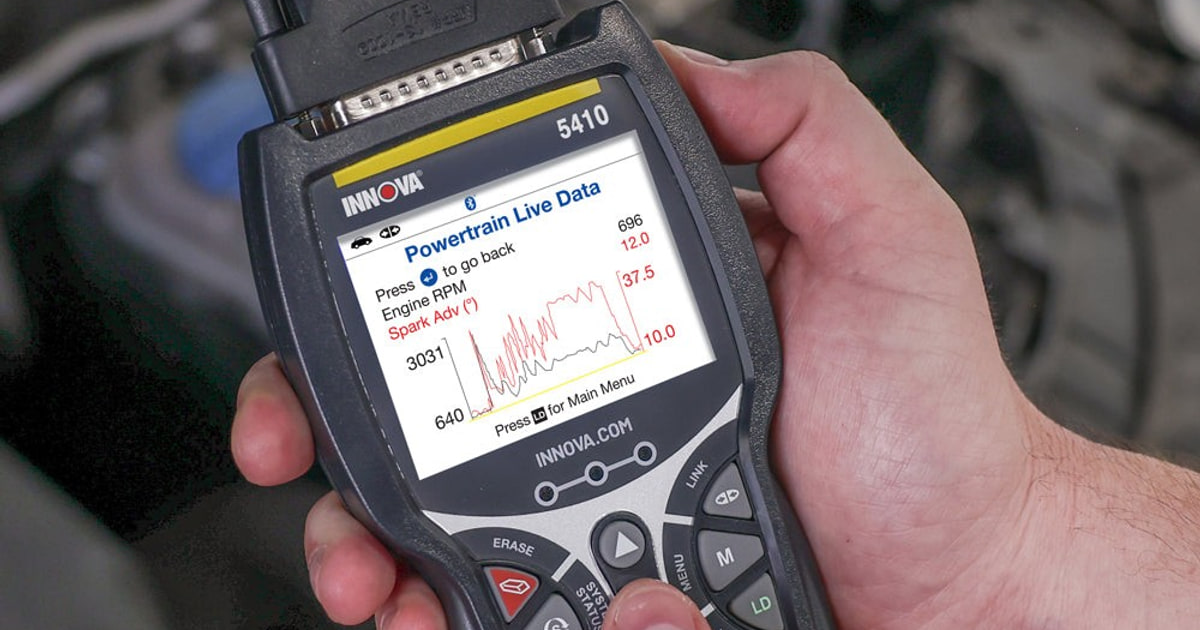
The 5410 is a handheld that reads and clears engine, ABS, airbag and transmission codes on its own, with no phone and no subscription. Pair it with the free RepairSolutions2 app and a fault code comes back with verified fixes attached, instead of a number you have to go look up.
$161.99fromAmazonList priceIt reads the four warning lights you're most likely to see. Engine, ABS, airbag and transmission — most handheld scanners in this range stop at the engine. The 5410 pulls codes from all four and clears them once you've done the repair, so a stubborn airbag light doesn't automatically mean a shop visit. There's no model-year cutoff either. If your car has an OBD2 port, the generic side works.
You don't need a phone to use it. It's a handheld with its own screen and buttons, and that matters more than it sounds like. A dead phone, a cold garage, gloves, a car with a weak battery — none of that stops you. You plug it in, walk through the prompts, and read the answer off the device. The step-by-step menus are written for people who don't do this every week.
The companion app turns a code into a repair. RepairSolutions2 pairs the fault code with verified fixes drawn from a large repair database, plus parts links, maintenance schedules and technical service bulletin lookup. That's the difference between P0420 and a plain description of what usually causes it on your car. Owners lean on this app heavily, and it doesn't cost anything on top of the tool.
Live data is here, and it's genuinely useful. You can watch RPM, fuel trims, coolant and intake temperature, oxygen sensor output and battery voltage while the engine runs. That's how you catch a problem before it sets a code — a lazy O2 sensor, fuel trims drifting rich. It's also the fastest way to confirm a repair actually worked before you put your tools away.
Flaws but not dealbreakers
There's no bi-directional control. It reads and clears; it can't command anything. If you want to cycle an ABS solenoid to prove a valve is dead, or run a cooling fan on demand, you need one of the tablets further down this guide. For most home repairs that never comes up. For chasing an intermittent fault that won't store a code, it's a real limit.
Service resets aren't included. No oil light reset, no electronic parking brake retract, no steering angle calibration, no throttle body relearn. On a lot of newer cars, that means a brake job you did yourself still ends with a trip somewhere else to reset the light. Know that going in.
Coverage varies by make and model, so check first. Innova publishes a coverage checker for exactly this reason. The generic engine side works on anything with an OBD2 port, but ABS and airbag support is written manufacturer by manufacturer, and a less common model can get less than the listing suggests.
Budget pickOn sale
Engine codes and battery health, and not much else
ANCEL BD310 Bluetooth OBD2 Scanner
The BD310 is a small Bluetooth dongle that also works as a plug-in wired code reader with its own screen. It covers engine codes, live data, emissions readiness and battery voltage tracking, which handles most check engine light situations at a fraction of what the tablets here cost.
$56.98fromAmazonList priceIt works two ways, and that's the whole trick. Plug it into the port and it's a wired code reader with a display — no pairing, no app, no phone battery to worry about. Pair it over Bluetooth instead and the free app adds live graphs, freeze frame, EVAP and O2 sensor tests, HUD mode and trip data. Most dongles this size make you pick one or the other.
The code explanations are written for people who aren't mechanics. You get a plain-English description of the fault plus built-in search, so a code arrives with some context rather than as a bare number. If this is your first scanner, that's worth more than any spec on the box. Published reviews have singled the BD310 out for exactly this kind of approachability.
Battery monitoring is the quiet reason to keep it in the glovebox. It graphs voltage while you drive, so you can watch the charging system work instead of taking one static reading in the driveway. A slowly failing alternator shows up here long before it strands you in a parking lot. Owners tend to use this more than the code reading itself.
It covers all ten standard OBD2 modes, including I/M readiness. So you can check whether your car will pass an emissions inspection before you drive to the station and waste the trip. App updates are free and ongoing, which means nothing about this tool expires or asks you for money later.
Flaws but not dealbreakers
It's engine-only, full stop. No ABS, no airbag, no TPMS, no transmission. If one of those lights is what sent you shopping, this isn't your tool — step up to the Innova 5410. It's the most common disappointment owners report, and it's right there in the specs if you look.
The good features live in the app. On its own, the device reads and clears engine codes. Graphs, trip analysis, performance timing and battery tracking all need your phone, which is fine right up until you're in a parking garage with a nearly flat battery and no signal.
Upgrade pickOn sale
Dealer-level active tests, if you'll actually use them
Autel Scanner MaxiCOM MK808BT PRO
The MK808BT PRO is a wireless diagnostic tablet with bi-directional control, meaning it can command your car's ECU to run components rather than just report on them. Add 28-plus service resets across 150-plus brands and it does most of what an independent shop's tool does.
$519fromAmazonList priceActive tests are what you're really paying for. Bi-directional control lets you tell the ECU to run a component — ABS solenoids, injectors, window motors, wipers, headlamps — instead of inferring its condition from a code. That's how you separate a dead part from a wiring fault upstream of it. Autel lists more than 3,000 of these tests across the major systems.
The service reset library covers the jobs that usually go back to a shop. Oil service intervals, electronic parking brake, steering angle calibration, battery registration, throttle body adaptation, injector coding, ABS bleeding — 28 and counting. If you do your own brakes on a car with an electric parking brake, that one function can pay for the tool over a couple of jobs.
It's wireless, and the freedom is real. The included MaxiVCI Mini stays in the port while you carry the tablet up to about 33 feet away. You can stand at a wheel during an ABS bleed, or watch a window motor move while you trigger it. With a cable, both of those are two-person jobs or a lot of walking back and forth.
Automatic VIN reading makes full-system scans quick. It identifies the car for you rather than making you tap through year, make and model, then sweeps every module the vehicle exposes. On an unfamiliar car — one you're thinking of buying, or a friend's — that single scan tells you more in a few minutes than an afternoon of guessing.
Flaws but not dealbreakers
It's the kind of tool you have to learn. The menu depth that makes it capable also makes it slow the first few times you pick it up. If what you want is to read a code and get on with your day, you'll find this frustrating rather than powerful.
Special functions aren't universal, and Autel says so. Which resets and active tests work depends on make, model and model year, and Autel asks buyers to send a VIN to support to confirm before ordering. Do that. It's the difference between the tool doing the job you bought it for and just running a generic scan.
Software updates eventually cost money. Autel runs a subscription after the included period, so there's an ongoing cost here that the app-based options in this guide simply don't have.
Also great
The adapter the best diagnostic apps are built around
OBDLink MX+ OBD2 Bluetooth Scanner for iPhone
The MX+ is a Bluetooth adapter with no screen of its own, so your phone or laptop is the interface. It's the officially recommended hardware for FORScan, BimmerCode, AlfaOBD and Torque Pro, and it decodes manufacturer data streams that cheap clones can't reach.
$139.95fromAmazonIt's the adapter the serious apps name by name. FORScan for Ford and Lincoln module work, BimmerCode for BMW and Mini coding, AlfaOBD for Fiat, Jeep, Chrysler and Alfa, plus Carista, Torque and DashCommand. No other dongle here is the recommended hardware for all of them at once. If you already know which app you need, this is the whole decision.
Enhanced OEM protocol support is the actual hardware difference. Beyond generic OBD2, it decodes manufacturer-specific data for Ford, GM, Mazda, Nissan and Infiniti, Toyota, Lexus and Scion, Honda, Hyundai and Kia. Cheap ELM327 clones can't reach those streams, which is why they miss codes and report shaky live data on European and some Japanese cars.
It works properly on an iPhone, which is not a given. Plenty of clone adapters simply fail on iOS. The MX+ is built for stable iPhone connections alongside Android and Windows, so you're not locked to one device or one household phone. Firmware updates are included and there's no annual fee attached to the hardware.
It protects itself and your battery. Over-voltage protection and low-power sleep mean you can leave it plugged in between drives without waking up to a car that won't crank. That's unglamorous, but a parasitic drain from a cheap dongle left in the port is the failure people actually run into.
Flaws but not dealbreakers
No screen means no scanner without a phone. Nothing happens until you've chosen an app, installed it and paired. That's extra setup, and some of the best apps cost money on top of the adapter. If you want to plug in and read a code cold, buy the Innova or the ANCEL instead.
It's the most expensive dongle here and it ships without software. You're buying an interface, not a finished tool. For someone who just wants the check engine light explained, that's a lot to spend on hardware that does nothing on its own.
Who this is for
This guide is for drivers who'd rather know what's wrong before paying someone to tell them. If a check engine light is your main concern, the budget pick covers it and you can stop reading there. If ABS, airbag or transmission lights come on, or you maintain more than one car, the top pick is the sensible floor. And if you do your own brakes, suspension or electrical work — or you fix other people's cars — the tablets are worth the jump, because service resets and active tests are the functions that otherwise send you to a shop.
It's not for you if you don't intend to turn a wrench. A scanner names the fault; it doesn't fix it, and clearing a code without repairing anything just delays the light. We've stuck to tools that plug into the standard OBD2 port on passenger cars and light trucks. Heavy-duty truck systems, motorcycle-specific protocols, OEM factory tools and generic no-name ELM327 clones are all outside what we cover here.
How we picked
We compared these on five things. System coverage: how far past the engine each tool actually reaches, since ABS, airbag and transmission access is what defines the price tiers. Bi-directional control: whether the scanner can command a component or only report on one, and how many systems it can command. Vehicle compatibility: the stated coverage per make and model, plus any hard model-year limits, because that's where buyers get burned. Update costs: free app updates versus an annual renewal, which changes what a tool costs over its life. Everyday usability: readable screens, sane menus, and workflows that don't assume you already know what a fuel trim is.
Other obd2 scanners worth considering
If you want a shop-grade tablet with the longest update window: The 2026 FOXWELL Scanner NT809BT OBD2 Scanner Diagnostic ($417.49) — The FOXWELL NT809BT is the most generous of the professional tools here on updates, with three years included — meaningful when the alternative is an annual renewal. It also has the longest wireless range of anything in this guide at 65 feet, which matters if you work around trucks or vans, plus a 7-inch touchscreen you can use with gloves on and six text sizes. CAN-FD, DoIP and FCA AutoAuth support means it talks to newer vehicles that older scan tools can't reach at all. It runs more than 3,000 active tests and 30-plus service functions including DPF regeneration. What it gives up against the LAUNCH is ECU coding and a few hundred active tests.
If you want ECU coding and the deepest active test list: The LAUNCH X431 CRP919E Bidirectional Scan Tool ($449) — The LAUNCH X431 CRP919E runs more than 4,000 active tests and 35-plus service functions, and it's the only tool here with online ECU coding for VW, Audi, Skoda, Ford, Lincoln and Mazda. That covers component matching, adaptive data resets and feature activation — the sort of work that normally means a dealer appointment. The PMI function for Ford, Lincoln and Mazda lets you copy data into a replacement module. Hardware is proper workshop stuff: Android, 3GB of RAM, 32GB of storage, a 6,100mAh battery and dual-band Wi-Fi, plus coverage of 160-plus brands with CAN-FD and DoIP. The trade-off is a shorter included update window than the FOXWELL, and coding support that varies a lot by make and model year.
The competition
This is what our research surfaced in a category with an enormous number of near-identical listings, not a survey of everything on the market. The scanner below is a real tool that does what it says. It just lost to a pick for reasons worth understanding before you buy.
The Autel AutoLink AL619 OBD2 Scanner ($99) — The Autel AutoLink AL619 is the least costly way here to read and clear ABS and airbag codes, and for the right car it's a clean little tool — ten OBD2 modes, live data, a simple handheld layout, no app and no subscription, with free lifetime software updates and support for more than 80 US, Asian and European makes. But there's a hard limit you can't work around: it covers model years 1996 through 2015 and won't function on anything newer. Autel states this plainly and asks buyers to confirm with a VIN before ordering. If your car falls inside that window and you want ABS and airbag access without spending more, it's a reasonable buy. For a newer vehicle, it's not a compromise — it simply won't work, and you want the Innova 5410 instead.
Plugging in and getting a clean scan
Find the port first. It's within about 16 inches of the steering wheel, usually under the dash near your left knee, sometimes behind a small trim cover. Turn the ignition on but don't start the engine unless the tool tells you to — ABS and airbag menus generally expect key-on, engine-off. Write down the codes before you clear anything, because clearing also wipes the freeze-frame data that shows what the car was doing when the fault hit. Don't unplug a tablet-style scanner mid-scan. And if your battery is weak, charge it before you diagnose anything. Low voltage makes modules drop off the bus and throws communication errors that'll send you chasing a problem you don't actually have.
Questions we get
What's the difference between a code reader and a full diagnostic scanner?
A code reader pulls and clears standardized engine codes and stops there. A full scanner also reads manufacturer-specific codes, reaches ABS, airbag, transmission and other modules, graphs live sensor data, and on the top tools sends commands to actuators. The price gap between the two groups is large. Most drivers only ever need the first kind.
What is bi-directional control, and do I need it?
It lets the scanner tell your car's computer to operate a specific component — cycle an ABS solenoid, fire an injector, run a window motor, kick on the cooling fan — so you can confirm the part works. A plain code reader can only report faults the car has already recorded. You need it for intermittent problems that don't store codes, for testing a part before you buy a replacement, and for procedures like an ABS bleed. Among our picks, only the MK808BT PRO has it.
Will clearing the code turn my check engine light off for good?
It turns the light off immediately. But if the underlying fault is still there, the car re-detects it on the next drive cycle and the light comes back. Clearing also erases the freeze-frame data that would have helped you diagnose it, so read and record first. Fix the cause, then clear.
Which of these read ABS and airbag codes?
The Innova 5410 does on any OBD2 vehicle, and it adds transmission. The Autel AL619 does, but only on model years 1996 through 2015. The MK808BT PRO, FOXWELL NT809BT and LAUNCH CRP919E all do, as full-system tools. The ANCEL BD310 is engine-only, and the OBDLink MX+ depends entirely on which app you pair with it.
Do OBD2 scanners work on hybrids and electric vehicles?
Yes — the OBD2 port is mandatory regardless of what's driving the wheels, so every tool here will connect and read generic codes. What they won't all reach is the interesting part. High-voltage system faults, battery management diagnostics and EV-specific parameters need manufacturer-specific protocols, which here means the MK808BT PRO, the FOXWELL or the LAUNCH.
Can I use a scanner to check a used car before buying it?
That's one of the best uses for one. Plug in before you hand over money and check for active and pending codes, then look at I/M readiness monitor status — if the monitors are incomplete, someone may have cleared codes recently to hide a problem. Every scanner here does readiness checks. A tool that also reads ABS and airbag systems, like the Innova 5410, tells you more.
Why you should trust us
For this guide:
- We read the manufacturer specification sheets and support documentation for every scanner in this guide, paying particular attention to which systems and service functions each one actually claims to support.
- We compared published reviews and owner feedback for recurring themes, especially connection dropouts, vehicle compatibility gaps and the quality of the companion apps.
- We cross-checked each maker's stated vehicle coverage against the limits buyers report running into on their own cars.
- We read owner reviews on every listing, weighted toward the critical ones, because that is where the recurring failures show up.
- We have a systematic way of automatically fetching the latest prices, so the numbers on this page stay current.
- This is a research-focused guide, so the team may not own every product listed — though we often do own the top winners, which gives us extra context for the recommendations.
- We don't accept free products, and the retailer commission never changes which product we recommend.
Sources
Best OBD2 Scanners 2026 — Popular Mechanics, Popular Mechanics
Best OBD2 Scanners and Code Readers — Car and Driver, Car and Driver
Best OBD2 Scanners — Forbes Wheels, Forbes Wheels
Best OBD2 Scanners: Tested and Reviewed — The Drive, The Drive
OBD2 Scanner Reviews and Buying Guide — CNET, CNET
Amazon product listings and owner reviews for all 7 products
Manufacturer specification pages for each product
Some passages in this guide may be paraphrased with AI help. Prices are refreshed automatically.
More like this.
Continue exploring lifestyle reviews and recommendations.

The Best Stud Finders and Wall Scanners
Hanging anything heavy starts with the same question: where's the wood? Drywall on its own won't hold a TV mount, a floating shelf, or a loaded bookcase.…

The Best Document Scanners for Home Offices
A document scanner earns its space on your desk in the boring moments. You come home with a folder of school forms, a year of receipts, or the closing…

The 11 Best Electric Commuter Bikes for City Riding in 2026: Tested & Reviewed
Expert-tested guide to the best electric commuter bikes of 2026, featuring top picks from Specialized, Trek, Rad Power Bikes, Aventon, and Giant.

The Best Electric Scooters for Adults
An electric scooter earns its keep on the trips that are too far to walk and too short to drive. Two miles to the train. A mile and a half across campus.…

The Best Backpacking Water Filters
Clean water is the one thing you can't carry enough of. A liter weighs about two pounds, so on any trip longer than an afternoon you're going to be…

The Best Graphic Novels for Adults
Graphic novels ask something different of you than prose does. You read a page in a minute and then sit with it for five, because the drawing carried a…