The Best Stud Finders and Wall Scanners
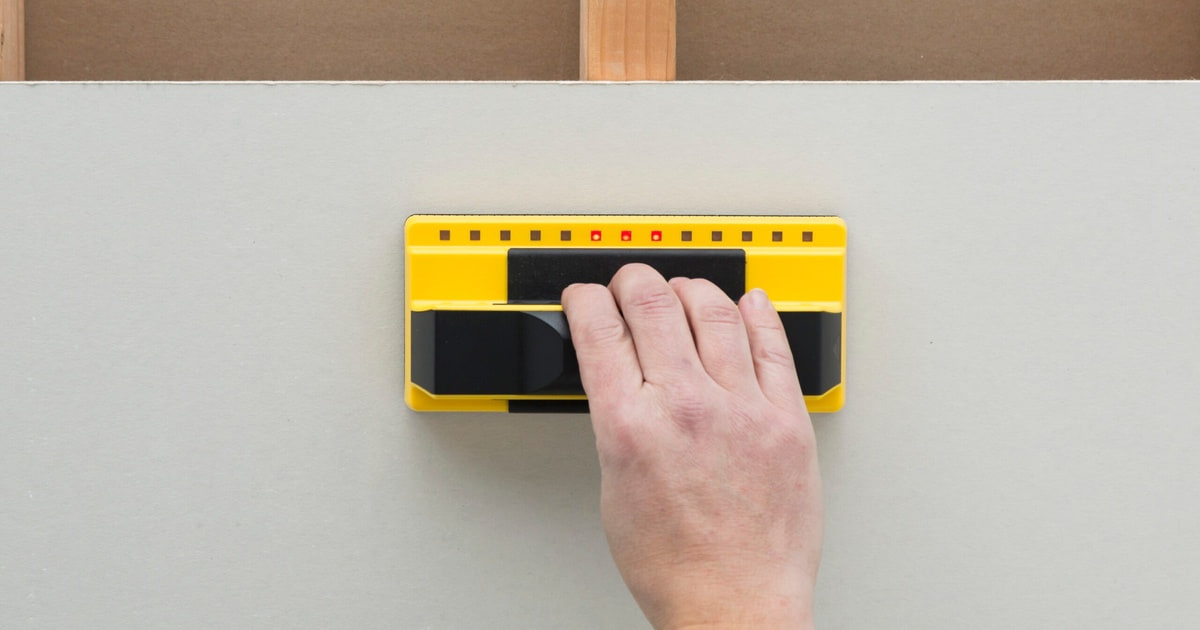
Hanging anything heavy starts with the same question: where's the wood? Drywall on its own won't hold a TV mount, a floating shelf, or a loaded bookcase. A stud finder answers that in a few seconds, and the good ones show you where the stud's center sits rather than just confirming something's back there. That difference matters when you're driving a lag bolt and get one shot at it. Miss by half an inch and you're patching, sanding, and repainting before the shelf ever goes up.
Here's the honest part: none of these tools sees through your wall. Most read changes in density, so a damp patch, a seam of joint compound, or a strip of metal tape can look a lot like framing. Plaster over lath confuses nearly all of them. Even the accurate ones want a second confirming pass from the other direction, and not one of them replaces a non-contact voltage tester before you drill. Treat any reading as a strong hint, not a guarantee.
Which tool you want depends less on the brand than on your walls. Modern drywall and the occasional weekend project point one way. Old plaster, a job site, or a wall you're about to cut into point somewhere else entirely. We read spec sheets, published reviews, and owner feedback across this lineup to sort out which is which. We think that the Franklin Sensors ProSensor 710+ is the best stud finder for most people, and that the CH Hanson 03040 Magnetic Stud Finder is the one to buy if your walls are plaster over lath or you'd rather never deal with batteries.
Everything we recommend

Shows the whole stud at once, so you stop guessing at edges

No batteries, no false alarms, and it works on old plaster

See a picture of what's in the wall before you cut into it
At a glance
| Product | Price | |
|---|---|---|
| Franklin Sensors ProSensor 710+ Stud Finder withTop pick | $54.95 |
 | BOSCH GMS120-27 Professional Wall ScannerAlso in lineup | $89On sale |
| Walabot DIY 2Upgrade pick | $209.95On sale |
 | Zircon StudSensor e50Also consider | $30.77 |
 | Milwaukee's Cut-Off ToolAlso in lineup | $109 |
 | DEWALT 20V Max XR Cordless RouterAlso in lineup | $132.99 |
 | CRAFTSMAN Stud FinderAlso consider | $9.98On sale |
| CH Hanson 03040 Magnetic Stud Finder PackBudget pick | $24On sale |
How we picked
Finding the center. Edge detection isn't enough when you're placing a lag bolt. We favored designs that show the stud's center directly, either by lighting up its full width or by drawing it on a screen.
Live-wire warning. Published reviews and spec sheets agree that many inexpensive finders skip AC detection entirely. We noted which tools include it, and we say plainly which ones don't so you can pair them with a voltage tester.
False readings. Owner feedback is full of finders that beep across an entire wall. We leaned toward multi-sensor and magnetic designs, which reviews and owners both describe as steadier on textured or freshly primed drywall.
Wall types covered. Specs told us the stated scan depth and the surfaces each maker supports. Anything limited to about three-quarters of an inch struggles with fire-rated board, and only some approaches handle plaster over lath at all.
Fuss to use. Calibration steps, mode switches, and phone pairing all add friction to a job you might do twice a year. We preferred tools that work the moment you press the button.
Top pick
Shows the whole stud at once, so you stop guessing at edges
Franklin Sensors ProSensor 710+ Stud Finder with
Thirteen sensors light up across the full width of the stud, so you see both edges and the center in a single press. It's the quickest way to mark an accurate drilling point on standard drywall, and it doesn't ask you to calibrate anything first.
$54.95fromAmazonThe whole point is that you stop hunting for edges. A single-sensor finder beeps when you cross into a stud, beeps again on the way out, and leaves you to split the difference with a pencil. The 710+ lights a row of LEDs across the width of the wood instead. Press it flat and the center sits under the middle light. For a TV mount that needs two bolts sixteen inches apart, that's one pass instead of four.
There's no calibration ritual either. Cheaper electronic finders want you to hold still on an empty stretch of wall while they zero themselves, and if you happen to start over a stud, every reading after that is wrong. Press the button here and it's working. It auto-adjusts through a single layer of drywall to about 1.6 inches, so half-inch board and fire-rated five-eighths both work without a mode switch.
The extras earn their space. A bubble level sits in the body, so you can mark a stud and a level line without setting one tool down and picking up another. There's a ruler along the edge for stepping off sixteen inches to the next stud. Small things, but they're the ones you'd otherwise be juggling at the top of a ladder.
Owner feedback is unusually consistent for this category. People who've bought and abandoned a drawer's worth of inexpensive finders describe this as the first one that stopped producing phantom hits, including through awkward surfaces like a composite shower surround. That lines up with what published reviews of multi-sensor designs report: more sensors reading at once leaves less room for a single bad signal to fool you.
Flaws but not dealbreakers
The big gap is that it doesn't detect live wires at all — no warning light, no beep, nothing. That's manageable if you pair it with a non-contact voltage tester, and you should, but it's a real omission on a tool at this level. Anywhere near a switch, an outlet, or a bathroom, treat this as half the job.
It's also wider than a slim single-sensor finder, which makes it awkward in a tight corner or up against door casing. And there's no depth number. You learn a stud is there, not how far under the surface it starts, and tile over backerboard is exactly where you'd want to know.
Budget pickOn sale
No batteries, no false alarms, and it works on old plaster
CH Hanson 03040 Magnetic Stud Finder Pack
Two pocket-sized neodymium magnets that stick to the drywall screws and nails already driven into your framing. There's nothing to calibrate and nothing to power, and no way for a damp wall or a textured surface to hand you a bad reading.
$24fromAmazonList pricePhysics does all the work. Drywall gets screwed into framing, so if you find a screw, you've found a stud. Slide one of these along the wall and it clunks onto the fastener and stays put, hands-free, while you mark. Nothing to calibrate, nothing to power, and no way for humidity or a fresh coat of primer to throw the reading off. It either sticks or it doesn't.
On plaster over lath, this is the one simple thing that works. Old plaster changes density from one square foot to the next, which is precisely what confuses a capacitance sensor — owners of older houses describe electronic finders chirping across an entire wall. Magnets don't care about density. They're looking for the nails driven into the lath, and those sit where they've always sat.
Two come in the pack, and that's more useful than it sounds. Stick one on a fastener above your working height and one below, and the line between them is the stud. Keep the spare in a kitchen drawer or a jacket pocket so the tool is wherever you happen to be. They're small enough that you'll forget you're carrying one.
Flaws but not dealbreakers
You're finding a fastener, not a stud center. Once it sticks, you still have to reason out that the wood runs roughly three-quarters of an inch to either side, and you'll want a second hit above or below to confirm you're on a vertical stud rather than a horizontal plate. It takes a few extra seconds — seconds the 710+ spends for you.
It can't help where there aren't fasteners, and it tells you nothing about wiring or plumbing. On metal framing it's unreliable, since the screw pattern isn't the same. Mapping a whole wall systematically is also slow compared with sweeping an electronic finder across it.
Upgrade pickOn sale
See a picture of what's in the wall before you cut into it
Walabot DIY 2
This pairs with your phone and draws a live picture of what's behind the drywall — studs, metal and plastic pipe, and wires both live and dead, down to about four inches. It's the tool you want before opening a wall, not before hanging a picture.
$209.95fromAmazonList priceEvery other tool here tells you something is back there; this one tells you what. Radio imaging builds a map on your phone screen instead of a beep, and it separates wood studs from metal, metal pipe from plastic, and live wires from dead ones. Before you cut in a new outlet or open a bathroom wall, that distinction is the whole ballgame. Owners describe spotting an electrical run sitting right where they'd already marked a hole.
Depth is the other advantage. It reads to about four inches, which covers stacked drywall, heavy skim coats, and walls that have been resurfaced a couple of times. A finder that tops out near an inch has nothing useful to say about those. If you keep getting muddled readings in an older house, more range is often what you were missing.
Setup is less annoying than a phone-connected tool has any right to be. The scanner broadcasts its own Wi-Fi, so you connect straight to it — no home network, no router settings, nothing to fight with in a basement where the signal drops out anyway. It works with both iPhone and Android.
Flaws but not dealbreakers
The app is where the complaints pile up. Reading the image takes practice, and what you get is an interpretation, not an X-ray — several owners expected a clean photograph of the wall cavity and came away feeling oversold. Plan on a few practice scans somewhere you already know what's behind the drywall before you trust it somewhere you don't.
It's also the most expensive tool here by a wide margin, and the manufacturer limits it to drywall and plywood. Point it at plaster, tile, or masonry and you're outside what it's built for. It needs a phone you're willing to hold flat against the wall too, which is fine at chest height and considerably less fine overhead.
Who this is for
This guide is for anyone who wants to hang something and not think about it again — a TV, shelves, a heavy mirror, a curtain rod that keeps sagging. It's also for people renovating older houses, where the wall behind the paint is a genuine unknown. If you own a finder that already works reliably on your walls, there's no reason to replace it. Upgrading only pays off when yours keeps lying to you.
We cover handheld tools for residential walls: drywall, plaster over lath, and the occasional tiled surface. We don't cover professional concrete scanners, rebar locators, or thermal imaging, all of which solve different problems at a very different scale. And no tool here is a substitute for a non-contact voltage tester, which you should own regardless of which finder you pick.
How we picked
Centering: we wanted the stud's middle shown directly, not inferred from two beeps and a pencil mark. Wire safety: AC detection is the feature most often missing on inexpensive finders, so we tracked which tools have it and flagged the ones that don't. False readings: owners report phantom hits constantly, and multi-sensor and magnetic designs come up far less often in those complaints. Wall types: stated scan depth and supported surfaces decide whether a tool can cope with fire-rated board, stacked layers, or old plaster. Fuss: calibration holds, mode switches, and phone pairing all cost you time on a job you do rarely, so simpler won where accuracy was equal.
Other stud finders and wall scanners worth considering
If you want a wire warning built into the finder itself: The Zircon StudSensor e50 ($30.77) — The Zircon StudSensor e50 puts the two safety-relevant features into one inexpensive body: a WireWarning circuit that flags live AC to about two inches, and a DeepScan mode that stretches detection from roughly three-quarters of an inch to an inch and a half. A small pointer projects an arrow onto the wall so you can mark without a free hand. What you give up is accuracy — it's a single-sensor design, so it finds edges and leaves the center to you, and DeepScan has to be switched on and re-settled each time. This particular listing also has very little owner feedback attached to it, so buy on Zircon's long track record rather than on the page.
If you want the simplest possible electronic finder: The CRAFTSMAN Stud Finder ($9.98) — The CRAFTSMAN CMHT77633 is a bare-bones edge detector that does one thing: hold the button, slide, listen for the beep. It reads through wallpaper and fabric, which is genuinely uncommon and useful in an apartment where the walls have collected layers over the decades, and the housing shrugs off drops and damp. But three-quarters of an inch of depth leaves no margin on fire-rated five-eighths board, there's no AC detection at all, and owner reports split sharply between people who found studs immediately and people whose unit beeped everywhere. It's fine for lightweight art and small shelves, and not enough tool for anything you'd hate to have fall.
The competition
This is what our research turned up in the lineup we looked at, not a census of every finder on the market. Plenty of capable tools sit outside it, and a model that didn't win here may still be the right pick if your walls or your work look different from the typical case.
The BOSCH GMS120-27 Professional Wall Scanner ($89) — The BOSCH GMS120-27 is the most ambitious tool here on paper: wood studs, metal framing, copper pipe, and live AC wiring in one pass, with a graphical display, a marking ring that goes red over a live wire, an IP54-rated body, and the option to run on a Bosch lithium-ion pack instead of AA cells. On a job site where you're scanning walls daily and need every mode, that's a genuinely strong argument. Owner feedback is what kept it out of the picks — reports are sharply divided, with a substantial share describing inconsistent or unusable stud readings straight out of the box, including from tradespeople who wanted to like it. Several also note that it insists on reporting plumbing and electrical when all they wanted was the framing. If you need multi-material detection in one device and are prepared to return a bad unit, it's still the tool built for that job.
Scanning a wall without regrets
A few habits make any of these more dependable. Start an electronic finder flat on a stretch of wall you're confident is empty and let it settle before you move — beginning over a stud poisons everything that follows. Sweep from both directions and mark where the two passes agree; if those marks land inches apart, something's wrong. Confirm vertically too, because a horizontal plate or a run of blocking reads like a stud in one spot and disappears six inches higher. Damp walls confuse capacitance sensors, so give fresh paint a couple of days. Whatever the tool says, run a non-contact voltage tester over the spot before the bit goes in. And pull the batteries from anything that's going to sit unused for a season.
Questions we get
Do magnetic stud finders actually work, or should I get an electronic one?
They work, and they're the most honest tool of the bunch — a magnet either sticks to a fastener or it doesn't, so there's no false positive to misread. The trade-off is speed and inference: you find a screw, then work out where the stud's center falls around it. For modern drywall and repeated hanging, a multi-sensor electronic finder like the ProSensor 710+ is faster. For plaster, the magnet wins outright.
Why does my stud finder beep everywhere on the wall?
Usually one of three things. It calibrated while sitting over a stud, so its baseline is wrong — lift it, find an empty span, and start again. Or the wall is damp from recent painting or humidity, which capacitance sensors read as density. Or it's plaster over lath, where the material itself varies enough to trigger constant hits; in that case switch to a magnetic finder.
Can a stud finder detect wires and pipes too?
Some can. The Walabot DIY 2 maps live and non-live wires along with metal and plastic pipe, and the Bosch GMS120-27 covers pipe and live AC as well. The Zircon StudSensor e50 warns about live wires but won't show you plumbing. The ProSensor 710+, the CRAFTSMAN, and the CH Hanson magnets detect structure only — pair those with a non-contact voltage tester every time.
How deep do these actually scan?
Basic electronic finders reach about three-quarters of an inch, which handles standard half-inch drywall and not much more. The Zircon's DeepScan mode roughly doubles that. The ProSensor 710+ reads to about 1.6 inches automatically, and the Walabot goes to about four. Standard interior board is half an inch and fire-rated is five-eighths, so know which one you have before you buy something shallow.
How do I find a stud with no tool at all?
Measure from a corner — framing in most newer homes sits sixteen inches on center, though some builds use twenty-four. Knock along the wall and listen for a dull thud instead of a hollow one. Or use an outlet: boxes are nailed to the side of a stud, so the wood is right beside it. Confirm with a small nail hole somewhere the artwork will cover.
Do stud finders work on tile or concrete?
Tile is hard on them. Ceramic and porcelain change density unpredictably, and the backerboard underneath adds thickness that pushes framing past most scan depths. Concrete and masonry are worse, because uniformly dense material gives a capacitance sensor nothing to compare. The Bosch has a metal mode that reaches deeper and is the most likely of these to help, but anchoring into masonry really calls for tools built for it.
Why you should trust us
For this guide:
- We read manufacturer spec sheets for every finder here, comparing stated scan depth, detection modes and the wall surfaces each maker actually supports.
- We compared published reviews of multi-sensor, single-sensor, magnetic and radio-imaging designs to understand where each approach tends to fail.
- We read through owner feedback for recurring complaints — phantom readings, trouble on plaster, app frustration and units that arrived inconsistent — and weighed those themes against what the specs claim.
- We read owner reviews on every listing, weighted toward the critical ones, because that is where the recurring failures show up.
- We have a systematic way of automatically fetching the latest prices, so the numbers on this page stay current.
- This is a research-focused guide, so the team may not own every product listed — though we often do own the top winners, which gives us extra context for the recommendations.
- We don't accept free products, and the retailer commission never changes which product we recommend.
Sources
Best Stud Finders — Wirecutter (The New York Times), Wirecutter
Best Stud Finders Tested — Popular Mechanics, Popular Mechanics
Stud Finder Buying Guide — This Old House, This Old House
Best Stud Finders 2026 — Bob Vila, Bob Vila
Stud Finder Reviews and Ratings — Consumer Reports, Consumer Reports
Amazon product listings and owner reviews for all 8 products
Manufacturer specification pages for each product
Some passages in this guide may be paraphrased with AI help. Prices are refreshed automatically.
More like this.
Continue exploring home reviews and recommendations.

The Best Pegboard Organizers for Garage Walls
A garage wall is storage you already paid for, and most of us waste it. Tools end up in a drawer, a bucket, or a pile on the workbench, and you spend ten…

The Best Garage Wall Storage Systems
A garage fills up fast. Bikes lean against the car, rakes slide down the wall, and the plastic bins you meant to stack end up as a pile you step around.…

The Best OBD2 Scanners
A check engine light tells you something is wrong and nothing about what. An OBD2 scanner closes that gap. Plug one into the 16-pin port under your dash - …

The Best Document Scanners for Home Offices
A document scanner earns its space on your desk in the boring moments. You come home with a folder of school forms, a year of receipts, or the closing…

The Best Marine GPS Fish Finders
A fish finder earns its keep on the slow days. When nothing's biting, the screen tells you whether you're sitting over flat mud or a submerged brush pile…

The Best Portable Kayak Fish Finders
A fish finder changes how you fish from a kayak. You stop guessing at depth and start reading the bottom - the drop-off, the weed edge, the brush pile…