The Best Portable Kayak Fish Finders
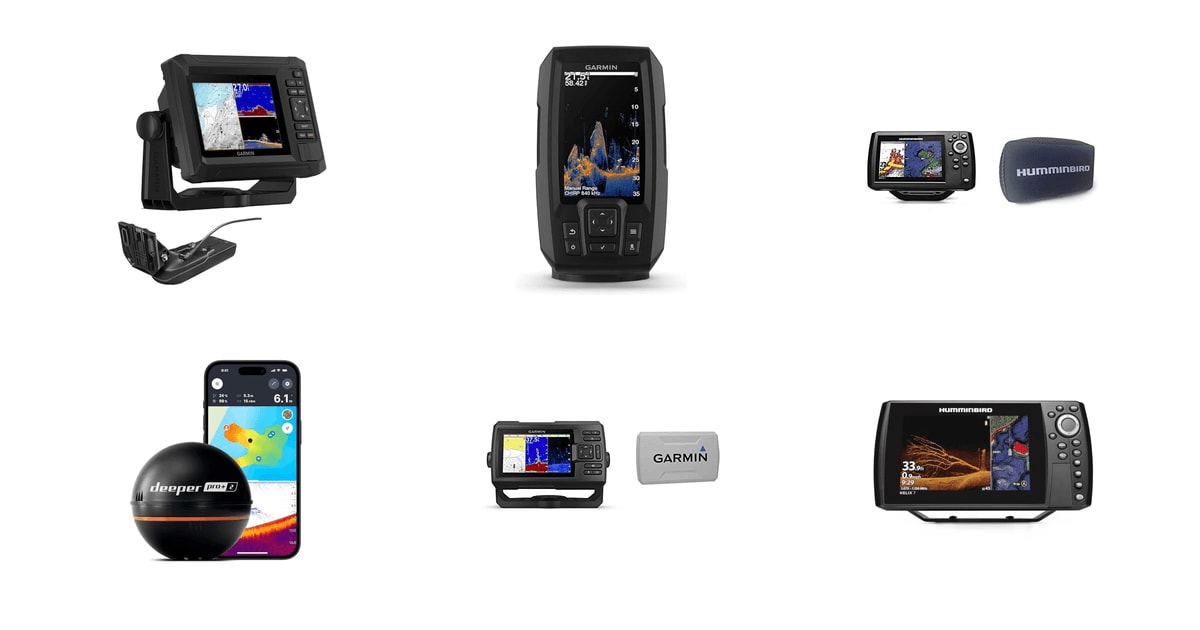
A fish finder changes how you fish from a kayak. You stop guessing at depth and start reading the bottom — the drop-off, the weed edge, the brush pile nobody else has found. But a kayak isn't a bass boat. You've got a hatch to open, rods to shuffle, and maybe eighteen inches of usable deck in front of you. Every ounce and every inch counts, and a screen you can't read at noon in bright sun is just a wet paperweight.
Here's the honest part: nothing in this category does everything well. The units with the sharpest imaging and the best charts are also the heaviest and the hungriest for power. The light, inexpensive ones give up screen size and detail. Castable pucks skip mounting entirely, but they tie you to a phone screen that dims and overheats in direct sun. And none of these will tell you what species is down there — a fish arch is a fish arch.
So pick for the way you actually fish. If you paddle big water and want real charts, buy the unit with charts. If you fish one small pond, a mapping-only unit will serve you for years. And if you fish from rentals, borrowed boats and the bank, don't mount anything at all. We think that the Garmin Echomap UHD2 54cv is the best portable kayak fish finder for most people, and that the Garmin Striker Vivid 4cv is the one to buy if you're rigging your first kayak and want to keep both the weight and the spending down.
Everything we recommend

The clearest picture and the best maps, in a kayak-sized box

Bright widescreen and on-the-fly mapping of your home water

Tiny, light and stingy with power — the basics done right
A big screen and real networking, if you'll add a transducer
No mounting, no wiring — sonar you can cast from anywhere
At a glance
| Product | Display Size | Sonar Type | Price | |
|---|---|---|---|---|
| Garmin ECHOMAP UHD2 54CV Chartplotter/FishfinderTop pick | 5 in | — | $499.99 |
| Garmin Striker Vivid 4cv Fishfinder with TransducerBudget pick | 4 in | CHIRP & ClearVü | $199.99 |
| Humminbird Helix 5 Chirp GPS G3 FishRunner-up | 5 in | — | $374.40 |
| Deeper PRO+ 2 Sonar Fish Finder -Also great | — | — | $159.99 |
 | Garmin STRIKER Plus 5cv with CV20-TM TransducerAlso consider | 5 in | CHIRP & ClearVü | $349.99 |
| Humminbird HELIX 7 G4N GPS Fish FinderUpgrade pick | 7 in | — | $726.95On sale |
 | Garmin Striker CastAlso in lineup | — | 2-D & Flasher | $199.99On sale |
How we picked
Sonar you can read. We favored units with CHIRP sonar, which sweeps a band of frequencies rather than pinging one. Garmin's published sonar documentation credits it with up to ten times finer target resolution than traditional single-frequency sonar, and that gap widens past 20 feet.
Screen size and glare. We treated 5 inches as the sweet spot for a kayak: per Kayak Angler Magazine, a 5-inch display offers about 56% more viewing area than a 4-inch one. Anything larger starts fighting you for deck space and hatch access.
Mapping you own. Preloaded charts skip most small water, so we weighted Quickdraw Contours and AutoChart Live heavily. In a Kayak Angler Magazine survey, 73% of tournament kayak anglers named on-the-fly contour mapping their most impactful electronics upgrade.
Power and weight. We compared published current draw and weight against realistic kayak batteries. Most units in this class pull 0.3 to 0.5 amps at 12 volts, so a 4Ah lithium battery covers 8 to 12 hours without a trolling motor pack.
Waterproofing and mounting. We set IPX7 as the floor — submersion to one meter for 30 minutes under IEC 60529 — because a kayak can go over. We also checked whether each transducer can realistically be mounted through a scupper, on an arm or inside the hull.
Top pick
The clearest picture and the best maps, in a kayak-sized box
Garmin ECHOMAP UHD2 54CV Chartplotter/Fishfinder
The Echomap UHD2 54cv pairs a 5-inch keyed screen with Garmin CHIRP and ClearVü sonar, plus LakeVü g3 and BlueChart maps with Navionics data already loaded. It's the rare unit that works as a serious chartplotter and still fits on a kayak deck.
$499.99fromAmazonFive inches is the right screen size for a kayak. Bigger heads eat the space you need for rods and hatch access. Four-inch screens make you lean in. Five inches gives you roughly 56% more viewing area than a 4-inch display, which you'll notice at midday with polarized glasses on. And physical keys beat a touchscreen when your hands are wet, cold or gloved — you can change a range setting without looking down.
Garmin rates this unit at 500 watts RMS, about four times the output of the Striker Vivid 4cv. That extra power buys separation: individual arches instead of one blurry smudge, and a bottom return that stays readable past 150 feet. Most days on a lake you won't need it. Paddle out over a channel edge or fish inshore structure, and you will.
The maps are what really set it apart. LakeVü g3 and BlueChart charts with Navionics data are already on board, so you get contours and marked channels the moment you power up. Quickdraw Contours fills in the rest — Wired2Fish reports it records roughly an acre of bottom contour per minute at normal trolling speed. Two passes across a small pond and you own a map nobody else has.
Owners who fish open water keep coming back to how much this does beyond finding fish. You see your position on a real chart, the next buoy ahead of you, and depth plotted the whole way. If you paddle anywhere you could get turned around — a marsh at dusk, a big reservoir, an intracoastal maze — that's worth as much as the sonar is.
Flaws but not dealbreakers
It asks more of you than the simple units do. Owners describe a genuine learning curve, and the paperwork in the box doesn't cover much — the full manual lives online, and you'll want it open the first weekend. There's also recurring confusion about which map cards this unit accepts, so confirm compatibility before you buy a card you may not be able to use.
It's also the most expensive unit we recommend here, and one of the largest. With the bail mount attached it takes real estate you might rather give to a rod or a crate, and it pulls more current than the little Striker does. Size your battery for it rather than hoping.
Runner-up
Bright widescreen and on-the-fly mapping of your home water
Humminbird Helix 5 Chirp GPS G3 Fish
The Helix 5 CHIRP GPS G3 gives you a 5-inch 800×480 widescreen, Dual Spectrum CHIRP and AutoChart Live, so you can map the small water no commercial chart bothers with. This bundle also includes a neoprene cover, which matters more on a kayak than it sounds.
$374.40fromAmazonAutoChart Live is the reason to buy this one. Paddle a pond for an hour and the Helix records depth contours, bottom hardness and vegetation to a microSD card — up to eight hours of it. In a Kayak Angler Magazine electronics survey, 73% of tournament kayak anglers called on-the-fly contour mapping the single most impactful upgrade they'd made. Small water is where kayaks shine, and small water is exactly what commercial charts skip.
The display is the other half of the argument. You get 800×480 pixels and 256 colors across a 5-inch widescreen, which reads cleanly at arm's length in glare. SwitchFire lets you strip clutter out of the picture in chop or stained water, then put the detail back when you're parked over structure. That's a setting you'll actually use, not a spec-sheet line.
DualBeam PLUS runs a wide beam and a narrow one together, so you cover water while still getting clean target separation underneath you. The Humminbird basemap covers more than 10,000 U.S. lakes, which is enough to launch anywhere without buying a card first. And the included cover means you can throw the whole thing in a hatch without babysitting the screen.
Flaws but not dealbreakers
There's no down imaging at this tier. You get CHIRP and DualBeam PLUS, which is plenty for finding depth, bait and arches, but you won't get the photo-like picture of brush and rock that a MEGA Down Imaging unit draws. If picking apart cover is your whole game, step up.
It also skips Wi-Fi and networking, so it stays a standalone head forever. The menus feel a generation behind Garmin's, and the housing is chunkier than the 5-inch screen implies — measure your deck before you commit to a mount position.
Budget pick
Tiny, light and stingy with power — the basics done right
Garmin Striker Vivid 4cv Fishfinder with Transducer
The Striker Vivid 4cv weighs about 0.44 pounds and draws roughly 0.3 amps, yet it still gives you CHIRP, ClearVü, GPS waypoints and Quickdraw Contours mapping. For a first kayak rig, it's the least fussy way to stop guessing at depth.
$199.99fromAmazonNothing else here asks so little of your kayak. At about 0.44 pounds and roughly 0.3 amps at 12 volts, a small 4Ah lithium battery runs it well past ten hours — a full day on the water with margin. It's rated IPX7, meaning it survives a meter of fresh water for half an hour, which is the realistic standard for a boat you can flip. The tilt-swivel bail mount takes almost no deck.
The included GT20 transducer runs Garmin CHIRP traditional sonar plus CHIRP ClearVü scanning. That's real imaging at the bottom of the range: bait balls separate from arches, and stumps look like stumps. The vivid color palettes aren't a gimmick either — switching palettes is the fastest way to pull structure out of a washed-out screen in bright light.
Quickdraw Contours is the sleeper feature on a unit this small. You can build your own 1-foot contour maps of the pond behind the church or the flooded quarry down the road, and keep them. Owners of small kayaks consistently describe it as simple to operate straight out of the box, which is exactly what you want the first time you're rigging something to a hull.
Setup is the other half of the appeal. One cable, one bracket, one battery. If you've never mounted electronics before, you can get this working on a Saturday morning without drilling anything you can't undo.
Flaws but not dealbreakers
The 4-inch screen is the compromise. A 5-inch display gives you about 56% more viewing area, and that gap shows up in glare and for anyone whose close vision isn't what it was. You'll find yourself leaning toward it more than you'd like.
There are no preloaded charts, so away from water you've mapped yourself you're navigating blind. A handful of owners also report occasional screen freezes that clear with a power cycle — annoying, not a dealbreaker, but worth knowing before you're a mile from the launch.
Upgrade pickOn sale
A big screen and real networking, if you'll add a transducer
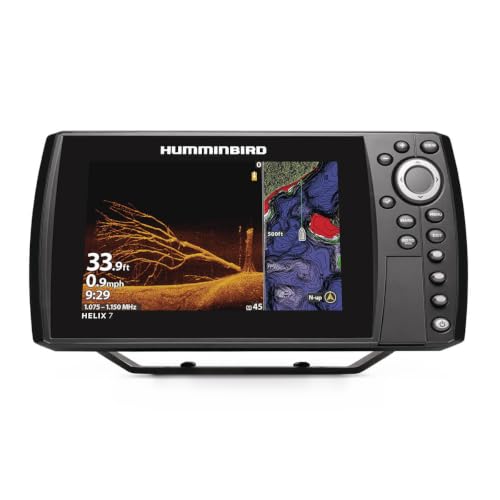
Humminbird HELIX 7 G4N GPS Fish Finder
The Helix 7 G4N brings a 7-inch 1024×600 display, MEGA Down Imaging and Dual Spectrum CHIRP, plus Bluetooth, ethernet and NMEA 2000. This listing is the control head only, so budget for a transducer separately.
$726.95fromAmazonList priceThe screen is the obvious upgrade. Seven inches at 1024×600 lets you split sonar and map without squinting at either half, and MEGA Down Imaging draws structure 125 feet below you with about three times the detail of standard imaging. If you fish brush piles, laydowns and bridge pilings, that difference is the whole reason to spend more.
Buy it for the network as much as the picture. Built-in NMEA 2000, ethernet and Bluetooth mean this head grows with your setup — a trolling motor, a second unit, a live imaging transducer later on. It integrates with Minn Kota and Cannon gear directly. Most kayak fish finders are a dead end; this one isn't.
Dual Spectrum CHIRP gives you a wide mode for covering water and a narrow mode for picking apart what you found. AutoChart Live records eight hours of your own contours, and the head accepts premium LakeMaster, CoastMaster and Navionics charts when you outgrow the built-in basemap of 10,000-plus lakes.
Flaws but not dealbreakers
The transducer isn't in the box. That's the single most important thing to know about this listing, and it's the thing owners get surprised by most often. Price the transducer and the cable run into your plan before you decide this is the affordable path to a 7-inch screen.
It's also a lot of hardware for a paddle craft. At 2.4 pounds and more than ten inches long, it changes where your hands and rods can go, and a bigger backlit screen pulls more from your battery than the 4-inch units do. A few owners have reported units arriving faulty, so unbox and power it up well before your first trip rather than at the ramp.
Also great
No mounting, no wiring — sonar you can cast from anywhere
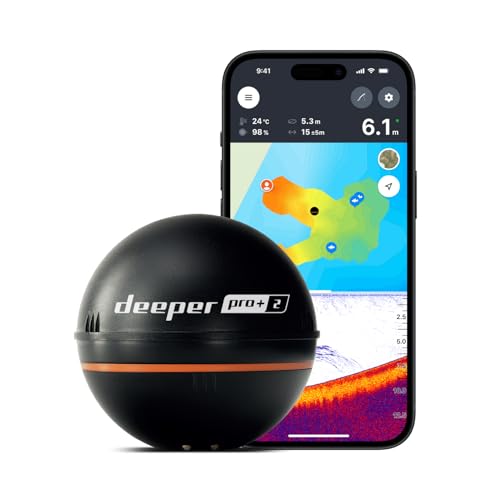
Deeper PRO+ 2 Sonar Fish Finder -
The Deeper PRO+ 2 is a 0.2-pound sonar ball you cast on a rod or tether off the deck, streaming to your phone over its own Wi-Fi. With built-in GPS it maps as you go, and it works just as well from a dock or the bank.
$159.99fromAmazonYou mount nothing, and that's the entire point. No transducer arm, no scupper adapter, no cable through a hatch, no battery to secure. If you fish rental kayaks, borrow a friend's boat, or split your time between a hull and a jetty, this is the only unit here that follows you everywhere. It lives in a tackle tray.
The specs hold up better than the format suggests. It reads to 262 feet and holds its own Wi-Fi link out to about 330 feet from your phone, so you can cast it well ahead of the kayak. Three beams — wide, mid and narrow — let you sweep a flat or drill into one spot, and target separation gets down to 0.4 inches on the narrow beam. That's fine enough to watch a jig fall.
Built-in GPS is what separates this from cheap castable pucks. It builds bathymetric maps from the shore, a dock or the deck and saves them in the app, so a slow afternoon of casting turns into a contour map of your local pond. Deeper rates the battery at about nine hours, which covers a full day.
Flaws but not dealbreakers
Your phone is the screen, and that's a real compromise. Phone displays wash out in direct sun, get warm and drain fast while running sonar, and now you've got a phone on a wet deck. Bring a case, a mount and a way to charge.
The workflow takes getting used to. Casting and retrieving between looks is slower than glancing at a fixed screen, and trolling it behind the kayak means managing an extra rod. Long-term durability is the other caveat — some owners report solid performance for a couple of seasons before the unit stops holding up.
Who this is for
This guide is for anglers fishing from a kayak, canoe or small paddle craft who want depth, structure and fish returns without rigging a boat console. That includes first-timers who just want to stop paddling blind, tournament anglers who need contour mapping of unfamiliar water, and inshore saltwater paddlers who need gear that survives a swim. If you fish from shore as often as you fish from a hull, the castable options here cover both.
It's not for you if you're outfitting a bass boat or a center console — those decks want bigger screens, more power and networked transducers that don't belong on a kayak. We also stuck to standalone fish finder and chartplotter units and one castable sonar. Live forward-facing imaging systems, standalone transducers, batteries and mounting hardware are all outside the scope here.
How we picked
We weighed each unit against the things that actually decide a day on the water. Sonar: CHIRP over single-frequency, since the sweep separates fish from structure far better once you're past 20 feet. Screen: 5 inches as the target, because it gives roughly 56% more viewing area than a 4-inch display without swallowing your deck. Mapping: Quickdraw Contours or AutoChart Live, since commercial charts ignore the small water kayaks are built for. Power: published current draw checked against a 4Ah lithium battery, so a full fishing day doesn't need a trolling motor pack. Waterproofing: IPX7 as the minimum, because full submersion is a realistic risk in a boat you can flip. Mounting: a transducer path that works through a scupper, on an arm or inside the hull.
Other portable kayak fish finders worth considering
If you want a 5-inch screen and your own maps but no charts: The Garmin STRIKER Plus 5cv with CV20-TM Transducer ($349.99) — The Striker Plus 5cv gives you the bigger, sunlight-readable display, CHIRP traditional sonar and ClearVü from the included CV20-TM transducer, and Quickdraw Contours mapping for up to 2 million acres. A protective cover comes in the box. What you give up is the chart side: there's no LakeVü or BlueChart data preloaded, so the map is blank until you draw it yourself. Owners have been caught out expecting full chart mapping and finding contours-only, so go in clear about that. It also skips Wi-Fi and the newer vivid color palettes.
The competition
This is what our research surfaced in the portable kayak category, not a survey of everything on the market. Plenty of good units — especially larger console-oriented combos and forward-facing imaging systems — sit outside what makes sense on a paddle craft.
The Garmin Striker Cast ($199.99) — The Garmin Striker Cast GPS is the simplest castable here: a 2.6-ounce puck that streams traditional 2-D sonar and an ice-fishing flasher view to your phone from up to 200 feet away, with built-in GPS and Quickdraw Contours for marking and mapping your spots. It lost to the Deeper PRO+ 2 on range, depth and beam options, and owners are consistently harder on its app than on the hardware — fiddly depth and gain sliders, a slow refresh, and trouble reading through heavy algae. Still, if you're already in the Garmin ActiveCaptain world and you mostly fish shallow ponds and the occasional rental kayak, it does the job for less.
Mounting and power
Most kayak anglers take one of three transducer routes: a scupper-hole puck, an adjustable arm on a track or RAM ball, or a shoot-through-hull install glued inside the hull with marine epoxy. Shoot-through is the cleanest and the hardest to undo, so try an arm first. Keep the transducer face flush and fully wetted, or your readings will drop out the moment you get moving. Route cables under the deck and away from your paddle stroke, add an inline fuse at the battery, and use waterproof connectors wherever you can. A 4Ah lithium battery in a dry bag covers a full day for most units here. Rinse everything with fresh water after saltwater trips, especially connectors, and pull the battery for storage.
Questions we get
Do I need a special transducer to mount a fish finder on a kayak?
Not usually — the transducer that ships with the unit will work, but the mounting method changes. Kayak anglers typically use a scupper-hole mount, an adjustable arm on a track or RAM ball, or a shoot-through-hull install with the transducer epoxied inside the hull. The key requirement is that the face stays fully in contact with water. Note that some head units, like the Helix 7 G4N listing here, don't include a transducer at all.
How many amp hours do I need to run a fish finder on a kayak all day?
A 4Ah lithium battery is the standard answer and covers most people. Typical kayak units draw 0.3 to 0.5 amps at 12 volts, which works out to roughly 8 to 12 hours of runtime. The Striker Vivid 4cv draws about 0.3 amps and can push past ten hours on that pack. Larger 7-inch screens pull more, so step up to a bigger battery if you go that route.
Is CHIRP sonar worth it for kayak fishing?
Yes, for almost anyone. CHIRP sweeps a continuous band of frequencies instead of pinging one, and Garmin's published documentation credits it with up to ten times finer target resolution than traditional single-frequency sonar. The difference is most obvious past 20 feet, where individual fish separate from the structure they're holding on. In water under 10 feet the advantage narrows, but you're not paying much of a premium for it anymore.
What's the difference between Down Imaging and Side Imaging?
Down Imaging looks straight beneath you and returns a photo-like picture of the bottom and any cover directly under the hull. Side Imaging sweeps out to both sides, so you can scan water you haven't paddled over yet. For a kayak, Down Imaging is usually the more useful of the two — you're moving slowly and fishing close to what's under you. Side Imaging shines when you're covering big flats looking for isolated structure.
Can you use a castable sonar from a moving kayak?
You can, but manage your expectations. Both castable units here can be tethered on a rod and trolled slowly behind the kayak, and owners do exactly that. At normal paddling speed the readings stay usable; push faster and the puck starts skipping and losing the picture. It also means dedicating a rod to it, which is the real cost.
What screen size is best for reading a fish finder in sunlight?
Five inches is the practical sweet spot on a kayak. Per Kayak Angler Magazine, a 5-inch display offers about 56% more viewing area than a 4-inch one, which matters in glare and for anyone whose close vision is aging. Seven inches reads better still, but it starts blocking hatch access and rod storage. Whatever the size, look for a sunlight-readable panel and use high-contrast color palettes.
Why you should trust us
For this guide:
- We read the manufacturer specification sheets for every unit here, comparing screen resolution, sonar output, depth range, current draw, weight and waterproof rating on the same terms.
- We drew on published sources including Garmin's sonar technology documentation, a Wired2Fish report on Quickdraw Contours mapping speed, Kayak Angler Magazine's display-size guidance and its electronics survey of tournament kayak anglers.
- We read through owner feedback for each listing to identify recurring themes — screen freezes, map card confusion, app complaints and long-term durability — and folded those into the flaws rather than the claims.
- We read owner reviews on every listing, weighted toward the critical ones, because that is where the recurring failures show up.
- We have a systematic way of automatically fetching the latest prices, so the numbers on this page stay current.
- This is a research-focused guide, so the team may not own every product listed — though we often do own the top winners, which gives us extra context for the recommendations.
- We don't accept free products, and the retailer commission never changes which product we recommend.
Sources
Best Fish Finders 2026 — Wirecutter, Wirecutter / NYT
Garmin Striker Vivid 4cv Full Review — Wired2Fish, Wired2Fish
Best Fish Finders for Kayaks — Kayak Angler Magazine, Kayak Angler Magazine
Lowrance Hook Reveal 5 TripleShot Review — In-Fisherman, In-Fisherman
Deeper PRO+ 2 Review — Bassmaster, Bassmaster
Humminbird Helix 5 CHIRP GPS G3 Official Specifications, Humminbird
Garmin Echomap UHD2 54cv Official Product Page, Garmin
Garmin Striker Cast GPS Official Specifications, Garmin
Fish Finder & Sonar Technology Buying Guide — Cabela's, Cabela's
Garmin Quickdraw Contours Hands-On Review — Wired2Fish, Wired2Fish
Kayak Fish Finder Mounting and Installation Guide — Kayak Bass Fishing, Kayak Bass Fishing Forums
CHIRP Sonar Technology Explained — Garmin, Garmin Technology Overview
Amazon product listings and owner reviews for all 7 products
Manufacturer specification pages for each product
Some passages in this guide may be paraphrased with AI help. Prices are refreshed automatically.
More like this.
Continue exploring electronics reviews and recommendations.

The Best Marine GPS Fish Finders
A fish finder earns its keep on the slow days. When nothing's biting, the screen tells you whether you're sitting over flat mud or a submerged brush pile…

The Best Kayaks for Beginners
The first hour in a kayak decides whether you'll go back. If the boat wobbles under you every time you shift your hips, you'll spend the whole paddle…

The Best Inflatable Kayaks
An inflatable kayak solves the problem that keeps most people off the water: where to put the boat. A hardshell wants a garage, a roof rack, and a friend…

The Best Inflatable Kayaks and River Craft
An inflatable kayak solves the problem that keeps most people off the water: storage and hauling. You don't need a garage bay or a roof rack. You need a…

The Best Stud Finders and Wall Scanners
Hanging anything heavy starts with the same question: where's the wood? Drywall on its own won't hold a TV mount, a floating shelf, or a loaded bookcase.…

The Best Metal Detectors for Finding Gold
Gold hides in ground that fights you. The dirt in most active goldfields is loaded with iron, and that iron talks back to a detector all day long - …