The Best Inflatable Paddleboards
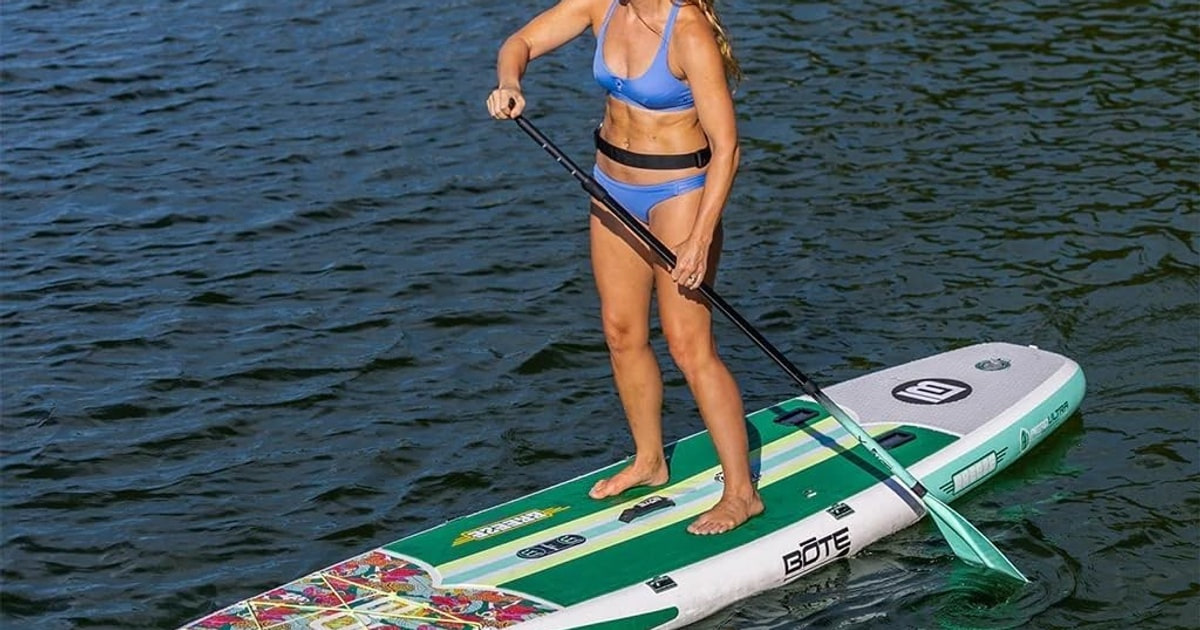
An inflatable paddleboard earns most of its keep off the water. It rolls into a bag you can shove in a closet or a trunk, and it doesn't need a roof rack, a garage wall or a second person to help you carry it. But that convenience only pays off if the board is stiff enough to paddle well. A board that flexes underfoot bends into the water on every stroke, and you'll feel it in your shoulders a mile from the launch.
Here's the honest part: no inflatable feels quite like a rigid board. Even the best ones give up a little glide and a little bite in a turn, and you'll spend six to fifteen minutes at the pump before every session. They're heavier than they look, too. A rolled 11-foot board plus a pump and a paddle is a real load on a long walk to the water. If you launch from the same dock every weekend and have somewhere to store it, a hardboard is still the better tool.
So we looked for boards that stay flat under an adult's weight, come from brands with a repair and support history, and cover the shapes most people actually need: a steady all-around deck for lakes and bays, a longer platform for taller paddlers and gear, and a wide deck for fishing or yoga. We think that the Red Paddle Co Ride 10'6" is the best inflatable paddleboard for most people, and that the Thurso Surf Waterwalker 132 is the one to buy if you want a longer, lighter board and already own a paddle and pump.
Everything we recommend

The stiffest ride here, if you don't mind pumping it up
Longer and lighter, but bring your own paddle and pump

A light, wide deck that carries gear without fuss
At a glance
| Product | Length | Board Weight | Price | |
|---|---|---|---|---|
| 2023 Red Paddle Co 10'6" x 32"Top pick | 10ft 6in | — | Check price |
| THURSO SURF Waterwalker 132 11 ft PaddleRunner-up | 11 ft | 22 lbs | $499 |
 | Atoll New 12ft Outrider Inflatable Stand UpAlso consider | 12 ft | 40 lbs | $699.99 |
| BOTE Breeze Aero 10'6" Inflatable Paddle BoardAlso great | 10ft 6in | 20 lbs | $799 |
How we picked
Stiffness underfoot. We leaned on standardized flex testing from OutdoorGearLab and stiffness index measurements from SUPBOARDER, which both show high-pressure laminate and double-layer boards resisting deflection far better than single-layer builds. Boards that need 15 psi to feel usable didn't make the cut.
Construction and seams. Gear Junkie's durability protocol found heat-welded seams outlasting glued seams by a wide margin across repeated inflation cycles. We prioritized double-layer, fusion or laminate boards with welded rails.
Size and stability. The Adventure Junkies found that decks 32 inches and wider let beginners stand and paddle in their first session. We treated 32 inches as the floor and looked at length against tracking, turning and packed bulk.
What's in the box. Forbes Vetted notes that complete kits bundle a paddle, pump, leash, bag and fins that add up to real money bought separately. We read each listing's contents closely and flagged board-only packages.
Support and warranty. Inflatables need valves, fins and occasional patches, so we favored brands with published warranty terms and an actual service operation. Owner feedback about repair responsiveness fed into this.
Top pick
The stiffest ride here, if you don't mind pumping it up
2023 Red Paddle Co 10'6" x 32"
The Ride is a 10'6" all-around board with a 32-inch deck and Red's MSL laminate construction, the most rigid build in this group. It's what you want if you'd like an inflatable that feels close to a hardboard underfoot on a long paddle.
Check priceatAmazonStiffness is the whole reason to buy this board. OutdoorGearLab's standardized flex testing found that premium laminate boards like Red's MSL series deflect less than an inch under an adult's weight at 20 psi, which matches plenty of entry-level hardboards. That number matters more than it sounds. Less flex means less of your stroke disappears into the board bending, so you cover more water for the same effort.
The shape is deliberately ordinary, and that's a compliment. At 10'6" with a rounded nose and a 32-inch width, the Ride sits in the range that suits most recreational paddling. It's steady enough that beginners can usually stand in their first session, and short enough to turn without a lot of sweeping strokes. For lakes, calm bays and the occasional slow river, this is the shape you want.
Red relies on laminate rather than sheer volume for rigidity, so the Ride runs thinner than the six-inch boards that now dominate the category. You get a board that sits a little lower and feels planted once there's wind on the water. Laminate boards also weigh less than comparable woven double-layer boards, per Paddling Magazine, and you'll notice that on the walk from the parking lot.
Pump it properly or you're wasting the construction. The gap between a lazy 12 psi and full pressure is the gap between a soft board and a stiff one. SUPBOARDER's stiffness index puts high-pressure boards roughly 40% ahead of single-layer 15 psi boards on flex resistance, which shows up as less energy lost per stroke. Take the extra two minutes at the pump.
Flaws but not dealbreakers
It's the most expensive board here, and you're paying for construction rather than a heap of included gear. Check exactly what your listing bundles before you order, because you may end up buying a paddle or a pump separately, and a decent fiberglass paddle isn't a small add-on.
The 32-inch width is stable, but it isn't enormous. If you want to do yoga on it, fish from it, or bring a kid and a dog along, a 34-inch deck gives you meaningfully more room to move. And at 10'6", it won't hold a line as well as a longer board on a windy open-water crossing.
Runner-up
Longer and lighter, but bring your own paddle and pump
THURSO SURF Waterwalker 132 11 ft Paddle
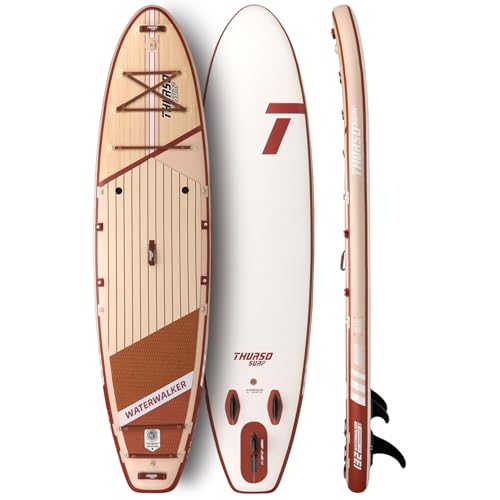
The Waterwalker 132 is an 11-foot, 32-inch board built with a woven drop-stitch core, fusion PVC and heat-welded rails. It's the one to get if you're a taller or heavier paddler, or if you haul a cooler, a kid or a dog, and you already own a paddle and pump.
$499fromAmazonLength is what you're really buying. At 11 feet with a 330-pound capacity, the Waterwalker tracks straighter than the 10'6" boards and holds its line better when the wind picks up. Thurso aims it at paddlers between 160 and 210 pounds, which covers a lot of adults who feel cramped and tippy on a shorter deck. Taller paddlers in particular tend to like the extra room.
The construction is the good kind. Woven drop-stitch with a fusion PVC coating and heat-welded rails is the build that survives seasons. Gear Junkie's durability protocol found heat-welded seams came through 200-plus inflation and deflation cycles without measurable failure, while glued seams started showing stress far earlier. Thurso claims about 20% less weight than knitted drop-stitch boards, and at 22 pounds the board backs that up.
The deck is set up for carrying things. You get 15 D-rings, thicker bungees at both the nose and the tail, a GoPro mount up front and two quarter-inch accessory mounts within arm's reach. If your idea of a good afternoon is strapping down a dry bag and a cooler and disappearing for a few hours, you won't be improvising with spare cord.
One thing to be clear about: this listing is the board on its own. You get the center fin, two side fins, a coiled ankle leash and a repair kit. No paddle, no pump, no bag. That's genuinely good news if you already own decent gear, since the aluminum paddles bundled with cheap boards usually get replaced anyway. It's a headache if this is your first board.
Flaws but not dealbreakers
The board-only kit is the obvious catch. Add a pump, a paddle and a bag and you're buying three more things, so compare it against complete kits with that in mind rather than looking at the board alone.
At 11 feet and 32 inches, it's a lot of board to spin around. In tight creeks or a crowded swim area you'll add a stroke or two to every turn. Rolled up, it's also a bulkier, heavier bundle to haul than a 10'6" board.
Also great
A light, wide deck that carries gear without fuss
BOTE Breeze Aero 10'6" Inflatable Paddle Board
The Breeze Aero is a 10'6" board with a 34-inch deck that weighs about 20 pounds and takes BOTE's MAGNEPOD and Rac accessories. Get it if you want a stable platform for a cooler, a rod holder or a morning of yoga on flat water.
$799fromAmazonThe extra width is the point. A 34-inch deck lets you stand wide, kneel, sit or shuffle around without the board twitching under you. The Adventure Junkies found beginners on boards 32 inches and wider could stand and paddle confidently in their first session, while narrower boards took three to five outings. Two more inches buys a surprising amount of confidence, and it's what makes yoga on the water plausible.
It's also light for its size. At roughly 20 pounds, the Breeze Aero is the easiest board here to carry from the car, and that matters more than people expect. A heavy board is a board that stays in the garage. BOTE's AeroULTRA construction is what keeps the weight down without leaving the deck feeling spongy underfoot.
Then there's the accessory system. MAGNEPOD points hold compatible cups and coolers magnetically, and the Rac System takes racks and holders, so you can rig the board for fishing or a lazy float and strip it back down in a minute. BOTE runs US-based customer service too, which is worth something the day you need a replacement fin or valve.
The trade-off is speed. A 34-inch board pushes more water than a 32-inch one, so you'll work a little harder to keep up on a long paddle. For cruising, fishing and fitness, that's a fair swap. If you mostly want to cover distance, the longer boards here suit you better.
Flaws but not dealbreakers
The listing doesn't state a maximum pressure or a weight capacity, so look those up for your specific size before you commit. That's a real gap if you're a heavier paddler or you plan to load the deck with gear.
The accessory ecosystem is a commitment. MAGNEPOD and Rac gear is BOTE's own, so the parts that make this board versatile are extra purchases from a single brand, and they don't transfer if you switch boards later.
Who this is for
This guide is for recreational paddlers on lakes, bays, slow rivers and mild coastal water: first-time buyers who want a stable board and a short learning curve, families sharing one board, travelers who'd rather check a bag than strap a hardboard to the roof, and people upgrading from a soft entry-level board to something stiffer. If you're over about 180 pounds, or you paddle with a kid, a dog or a cooler, the construction differences we describe matter a lot more than they would for a light paddler on a calm pond.
It isn't for surfers, whitewater paddlers or racers. Those disciplines need shapes we didn't consider here. And if you have a garage wall and a roof rack and you paddle the same spot every weekend, a hardboard will still be faster and livelier for the same money. Skip the pump entirely. One more scope note: we only wrote about boards, not the accessory listings that show up alongside them in search results.
How we picked
We narrowed the field on five things. Stiffness: boards that deflect least under an adult's weight at full pressure, based on OutdoorGearLab's flex testing and SUPBOARDER's stiffness index, because flex is energy you don't get back. Construction: double-layer, fusion or laminate cores with heat-welded rails, which Gear Junkie's cycle testing shows outlast glued seams. Stability: decks at least 32 inches wide, the threshold at which The Adventure Junkies saw beginners standing confidently on day one. Kit: a clear accounting of what's actually included, since a bundled paddle and pump are worth real money. Support: published warranty terms and a brand that answers the phone when a valve leaks.
Other inflatable paddleboards worth considering
If you want a fishing and expedition platform: The Atoll New 12ft Outrider Inflatable Stand Up ($699.99) — The Atoll Outrider is the biggest board in this guide. It's 12 feet long and 34 inches wide, rated to 400 pounds, built with dual-layer MSL fused PVC, reinforced rail stringers and heat-welded seams. Three action mounts and two Scotty mount plates mean rod holders and a fish finder bolt straight on instead of getting lashed to a D-ring, and it ships complete with a paddle, a 10-foot coil leash, an 8-inch touring fin, a backpack and a hand pump, backed by a two-year manufacturer's warranty. What you give up is agility and packed size. It's slow to turn, it's a heavy roll to carry any distance, and it's more board than most people need on a small lake. Buy it if you fish or camp off the deck.
The competition
This is what our research surfaced, not a survey of everything for sale. Inflatable SUPs turn over fast, and plenty of decent boards from smaller brands never show up in the review coverage we drew on. If a board you're weighing isn't here, the same criteria still apply: double-layer or laminate construction, heat-welded rails, a pressure rating toward the top of the 15-to-25 psi range, a deck at least 32 inches wide if you're new to this, and a capacity comfortably above your weight plus your gear.
Care and maintenance
Rinse the board with fresh water after any saltwater session, especially around the fin boxes and the valve, and let it dry before it goes back in the bag. Rolling up a wet board is how you get mildew and a smell that never quite leaves. If you have the space, store it inflated at low pressure; otherwise roll it loosely rather than crushing it. Keep it out of direct sun when you're not on the water, since heat raises internal pressure and UV is what ages PVC. Don't chase pressure past the rating printed on the valve, either. Beyond the rated maximum you're stressing seams without gaining stiffness. Keep the patch kit in the bag, because most punctures are a ten-minute fix on the beach.
Questions we get
What size inflatable paddleboard do I need for my weight?
REI's sizing guidance suggests picking a board with volume in liters of at least 1.1 times your body weight in kilograms. A standard 10'6" x 32" x 6" board lands around 275 to 310 liters, which supports paddlers up to roughly 250 pounds. Treat the listed capacity as a ceiling, not a target. Paddling at 70 to 80% of it gives you better handling and keeps the deck higher out of the water.
What PSI should I inflate my paddleboard to?
Most inflatable SUPs hit their best rigidity between 15 and 25 psi, and you should inflate to the number printed on the valve or in the manual. Underinflating is the most common mistake, and a board at 12 psi feels soft no matter how well it's built. Going above the rated maximum doesn't add meaningful stiffness and puts stress on the seams. Check pressure again after the board sits in the sun, since heat raises it.
Are inflatable paddleboards as good as hard boards?
For recreational paddling, they're close enough now that most people won't care. OutdoorGearLab's flex testing found premium laminate boards deflecting less than an inch under an adult's weight at 20 psi, matching many entry-level hardboards. Hardboards still glide better and carve more sharply, so racers and surfers stick with them. Inflatables win on storage, transport and the fact that the American Canoe Association treats them as inherently buoyant, which makes falling off less eventful.
How long does inflation take by hand versus with an electric pump?
Per CNN Underscored, an electric pump gets most 10- to 11-foot boards to 15 psi in about six to nine minutes, versus twelve to eighteen minutes with a manual double-action hand pump. The last few psi by hand are the hard part. If you paddle more than a handful of times a season, an electric pump is the accessory that gets you on the water more often. Keep the hand pump as a backup for trips without power.
Do inflatable paddleboards puncture easily?
Not really. Modern double-layer and laminate boards use PVC that shrugs off dock edges, gravel launches and dropped gear. Outside Magazine's multi-season field testing found woven double-layer boards showing less than 5% performance degradation after 150-plus hours of use, while single-layer boards developed visible seam fatigue at similar use. When a leak does happen, it's usually a slow one at the valve, and the included patch kit handles most punctures.
Is a 10-foot or an 11-foot board better for all-around use?
A 10' to 10'6" all-around shape suits the large majority of recreational paddlers. It turns easily, packs smaller and is plenty stable for lakes and bays. Go to 11 feet or longer if you're a taller or heavier paddler, if you carry gear or a passenger, or if you want to cover distance, since the extra length tracks straighter and holds speed. Below about 30 inches of width, expect a few sessions before you feel steady.
Why you should trust us
For this guide:
- We read standardized flex and stiffness testing from OutdoorGearLab and SUPBOARDER, along with Gear Junkie's seam durability protocol and Outside Magazine's multi-season field results, to separate construction claims from marketing.
- We compared every listing's stated dimensions, capacity, construction and included accessories against sizing guidance from REI and buying analysis from Forbes Vetted, CNN Underscored and The Adventure Junkies.
- We weighed recurring owner feedback themes about seam quality, valve leaks and brand support, and we set aside listings that turned out to be accessories rather than boards.
- We read owner reviews on every listing, weighted toward the critical ones, because that is where the recurring failures show up.
- We have a systematic way of automatically fetching the latest prices, so the numbers on this page stay current.
- This is a research-focused guide, so the team may not own every product listed — though we often do own the top winners, which gives us extra context for the recommendations.
- We don't accept free products, and the retailer commission never changes which product we recommend.
Sources
Best Inflatable Paddleboards — OutdoorGearLab, OutdoorGearLab
Best Inflatable SUP Boards — Paddling Magazine, Paddling Magazine
Stand Up Paddleboard Reviews — The Adventure Junkies, The Adventure Junkies
Inflatable Paddleboard Buyer's Guide — REI Expert Advice, REI Co-op
Best Inflatable SUPs Tested — Outside Magazine, Outside Magazine
SUP Board Comparison Tests — SUPBOARDER, SUPBOARDER
Best Inflatable Paddle Boards — Forbes Vetted, Forbes Vetted
Inflatable SUP Reviews — Gear Junkie, Gear Junkie
Global Stand Up Paddleboard Market Report 2025 — Grand View Research, Grand View Research
Paddleboard Safety and Size Guide — American Canoe Association, American Canoe Association
Best Paddle Boards of 2025 — CNN Underscored, CNN Underscored
Inflatable SUP Buying Guide — Watersports Warehouse, Watersports Warehouse
Amazon product listings and owner reviews for all 4 products
Manufacturer specification pages for each product
Some passages in this guide may be paraphrased with AI help. Prices are refreshed automatically.
More like this.
Continue exploring lifestyle reviews and recommendations.

The Best Inflatable Kayaks and Paddleboards
The hardest part of owning a kayak or a paddleboard usually isn't the paddling. It's the roof rack, the garage space, the neighbor's car you nearly clip…

The Best Inflatable Kayaks and Paddleboards for Beginners
Getting on the water used to mean owning a roof rack, a garage and a free Saturday. Inflatable kayaks and paddleboards changed that. A good one packs into…

The Best Paddleboard Fishing Accessories
Paddleboard fishing works because the setup is simple. You stand, you spot fish before they spot you, and you slide into water a boat can't reach. But a…

The Best Inflatable Kayaks
An inflatable kayak solves the problem that keeps most people off the water: where to put the thing. A hardshell needs a roof rack, a garage wall and a…

The Best Inflatable Hot Tubs
An inflatable hot tub is one of the few backyard upgrades you can be using the day after it arrives. You unroll it on a flat patch of patio, let the pump…

The Best Inflatable Kayaks and River Craft
An inflatable kayak solves the problem that keeps most people off the water: storage and hauling. You don't need a garage bay or a roof rack. You need a…