The Best Multi-Cookers and Pressure Cookers
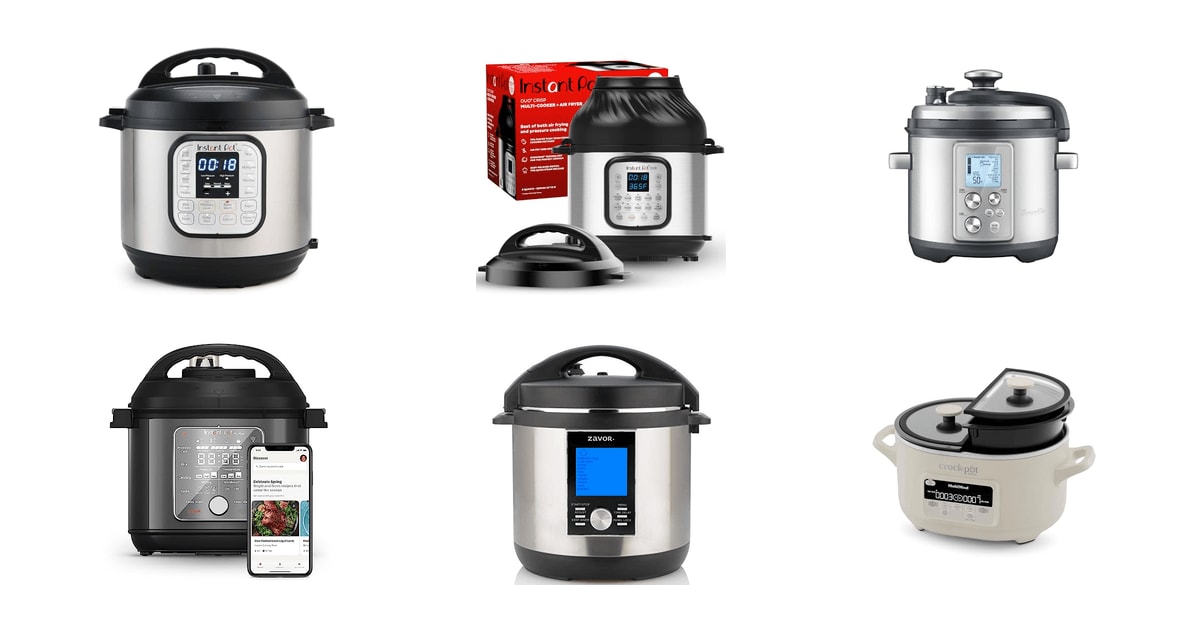
A good multi-cooker changes what a Tuesday night looks like. You throw in dried beans you forgot to soak, a chuck roast straight from the fridge, or rice for four, and you get dinner in a fraction of the usual time. America's Test Kitchen puts the savings at up to 70% versus stovetop and oven methods — beans that need 90 minutes on the burner finish in under 30 under pressure. And because everything happens in one sealed pot, you're not scrubbing a Dutch oven, a rice cooker, and a skillet afterward.
Here's the part the box never mentions: none of these machines are as fast as the timer on the front suggests. Every electric pressure cooker needs 8 to 12 minutes to build pressure before the countdown even starts, and natural release can add 15 more. Sauté mode on all of them runs cooler than a real burner, so browning takes patience. And no unit here browns the top of a braise the way an oven does. If you want crackling skin, you're either buying a combo model with an air-fry lid or finishing under the broiler.
We think that the Instant Pot Duo 7-in-1 is the best multi-cooker for most people, and that the Instant Pot Duo Crisp is the one to buy if you want air frying and pressure cooking from a single appliance.
Everything we recommend

The one most kitchens should get, and the easiest to live with

Pressure cooking and real air frying, if you have the counter space
A modern touchscreen and easy cleanup for less money

Real pressure control and a display that tells you what's happening
App control, quiet venting, and sous vide, for a bit more
At a glance
| Product | Capacity | Functions | Price | |
|---|---|---|---|---|
| Instant Pot Duo 6 Qt 7-in-1 ElectricTop pick | 6 Quarts | 7-in-1 | $109.99 |
| Instant Pot Duo Crisp 8 Qt 11-in-1Also great | 8 Quarts | 11-in-1 | $189.99On sale |
| Breville Fast Slow Pro Pressure Cooker BPR700BSSUpgrade pick | 6 Quarts | 11 Pressure Settings | $329.95 |
| Instant Pot Pro Plus 6 Qt 10-in-1Runner-up | 6 Quarts | 10-in-1 | $169.95On sale |
 | Zavor LUX LCD 6 Quart Programmable ElectricAlso consider | 6.3 Quarts | 33+ Settings | $199.95 |
 | Crock-Pot MultiMeal Multicooker and Programmable Slow CookerAlso consider | 8 Quarts (2x3.7qt) | 5 Functions | $159.99On sale |
| Cosori Pressure Cooker 6QTBudget pick | 6 Quarts | 9-in-1 | $80.99On sale |
How we picked
Pressure performance. We compared manufacturer pressure specifications and published lab results from outlets like Consumer Reports and America's Test Kitchen. A cooker had to hold a true high-pressure setting reliably, since that's what delivers the 70% time savings the category is sold on.
Capacity and footprint. We favored 6-quart models, which suit households of two to six and account for most sales. Larger units had to justify the extra counter space and longer pressurizing time with something meaningful, like air frying.
Function set. Pressure cook, slow cook, sauté, steam, and keep-warm were the floor. Extras like yogurt, sous vide, and air fry counted only when published reviews and owner feedback suggested they work rather than pad the box copy.
Cleaning and pot material. We looked for dishwasher-safe pots, lids, and racks, and weighed stainless versus ceramic. Cook's Illustrated found stainless builds better fond during sauté, so we treated a bare stainless pot as an advantage for anyone who braises.
Safety and support. We read spec sheets for lid interlocks, overpressure valves, and thermal cutoffs, and checked how easily replacement gaskets and inner pots can be found. Owner feedback about failures and repairs shaped how much we trusted each brand.
Top pick
The one most kitchens should get, and the easiest to live with
Instant Pot Duo 6 Qt 7-in-1 Electric
The Duo 7-in-1 pressure cooks, slow cooks, sautés, steams, and makes rice and yogurt in a 6-quart stainless pot. It has the biggest recipe community and accessory selection of any multi-cooker, which matters more day to day than any spec on the box.
$109.99fromAmazonThis is the model everything else gets compared to, and it earns that. Wirecutter named the Duo 7-in-1 its top overall pick after multi-year parallel testing, citing consistent high-pressure performance and the lowest total cost of ownership in the category. Instant Pot says it has sold over 10 million units. That scale is the real feature: when a recipe says "cook on high pressure for 12 minutes," it was almost certainly written for this pot.
The 6-quart size fits how most people actually cook. It handles up to six servings, which covers a family dinner with leftovers or a Sunday batch of grains and shredded chicken for the week. Roughly two-thirds of buyers pick this capacity. Go bigger only if you're feeding six or more regularly, or you're cooking a whole chicken most weeks — an 8-quart takes longer to reach pressure and eats more counter space.
The stainless inner pot is the quiet reason this one cooks better than cheaper competitors. It's 18/8 steel with a tri-ply bottom, and Cook's Illustrated found stainless develops noticeably better fond during sauté than non-stick coatings. That browned layer is where the flavor in your chili and pot roast comes from. Non-stick pots wipe clean faster, sure. But they also scratch, and you can't replace the coating once it goes.
Owners keep these for a long time, and that shows up in the feedback. People routinely describe pots still running after five, eight, or nine years across multiple moves. Sealing rings, extra pots, and steamer baskets are cheap and easy to find, so a worn part doesn't mean a new appliance. That's a meaningful difference from off-brand cookers where a cracked gasket ends the machine.
Flaws but not dealbreakers
The dial-and-button interface is dated. There's no touchscreen and no display of the actual pressure inside, so you're trusting the float valve and the beep. Newer models from Cosori and Zavor are easier to read at a glance.
Steam release is loud and startling the first few times, and the plume shoots straight up — you'll want to keep it out from under your cabinets. There's no app, no Wi-Fi, and no sous vide. If you want any of that, look at the Pro Plus.
Also greatOn sale
Pressure cooking and real air frying, if you have the counter space
Instant Pot Duo Crisp 8 Qt 11-in-1
The Duo Crisp pairs an 8-quart pressure cooker with a swappable air-fry lid that roasts, bakes, and dehydrates. You pressure cook a batch of wings or short ribs, switch lids, and crisp them in the same pot instead of moving everything to a sheet pan.
$189.99fromAmazonList priceCombo units are where the category is heading, and this is the sensible version of one. CNET reports that pressure cooker and air fryer combos now make up over 40% of electric multi-cooker sales. The appeal is obvious once you cook a pork shoulder: pressure cook it tender, swap the lid, and crisp the outside without heating your oven or dirtying a second pan. The Spruce Eats estimates the finish-in-place approach saves 15 to 20 minutes per recipe.
The air-fry side is genuinely capable, not a token setting. It runs from 70°F all the way to 450°F, so you can dehydrate fruit at the low end and roast potatoes at the high end. Instant Pot's EvenCrisp lid uses about 95% less oil than deep frying. Owners describe it as good but not quite equal to a dedicated air fryer — reasonable, given it's doing two jobs.
Two lids means two things to store. The pressure lid and the crisping lid don't nest, and the crisping lid is heavy and awkward. Some people leave it parked on the counter next to the base. It's the main practical tax of a combo unit, and worth thinking about before you buy.
At 8 quarts and 22 pounds, this is the biggest appliance here. That's great for a whole chicken, a big pot of chili, or meal prep for the week. It's a lot for one person cooking for one. The pot is still stainless with a tri-ply bottom, and it's stovetop- and oven-safe, which is handy for reheating.
Flaws but not dealbreakers
The 8-quart size takes longer to come to pressure than a 6-quart, and small batches can trip the burn warning because the liquid spreads thin across a wide base. Plan on a bit more liquid than a 6-quart recipe calls for.
It's tall enough that it may not clear the underside of standard upper cabinets when the crisping lid is on. Measure before you commit to a spot.
Budget pickOn sale
A modern touchscreen and easy cleanup for less money
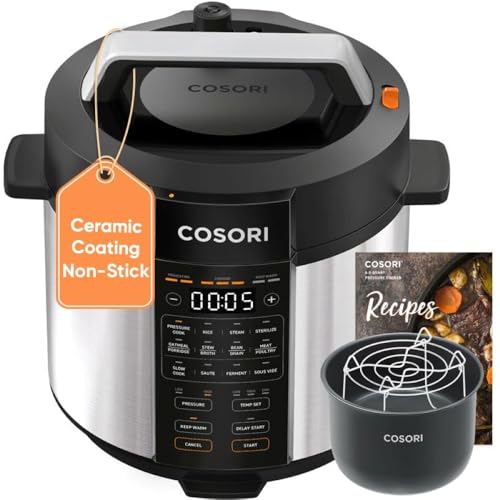
Cosori Pressure Cooker 6QT
The Cosori 6-quart covers pressure cooking, slow cooking, rice, sous vide, fermenting, and sautéing behind a clean touch panel. Its ceramic-coated pot wipes out with a sponge, and the venting design keeps the steam plume angled away from your hand.
$80.99fromAmazonList priceIf the Instant Pot's dial-and-abbreviation interface makes your eyes glaze over, this is the friendlier option. The touchscreen labels functions in plain words, and there are enough presets to cover most of what a beginner wants: rice, porridge, stew, beans, meat. Owners consistently describe it as the appliance that finally made them stop being nervous about pressure cooking.
Cleanup is where the ceramic pot pulls ahead. Baked-on rice and oatmeal come out with a sponge, no soaking. The lid, pot, and accessories are dishwasher safe, and the housing resists fingerprints. There's also a half-inch widened gap around the pot, which sounds trivial until you've fished a lentil out of the crevice on a cheaper cooker.
Cosori lists 12 safety features, including a double-layer anti-scald lid, overheat protection, and a lid lock that won't budge under pressure. Consumer Reports notes that modern electric cookers ship with 10 or more independent protections on average, so this is in line with the category. The vent button sits away from the release valve and the steam exits at a 30° backward angle, which keeps it off your fingers.
You do give something up for the price. The ceramic coating will wear eventually, and it won't build fond the way the Instant Pot's bare stainless does. If you make a lot of braises where you deglaze and build a pan sauce, that's a real trade-off. For rice, soup, beans, and steamed vegetables, it hardly matters.
Flaws but not dealbreakers
Ceramic coatings are consumable. Use wood or silicone tools, skip the metal spoon, and expect the surface to lose some slickness after a few years. Replacement pots aren't as easy to find as Instant Pot's.
The recipe ecosystem is thinner. You can adapt Instant Pot recipes without much trouble, but you'll be doing the translating yourself.
Upgrade pick
Real pressure control and a display that tells you what's happening
Breville Fast Slow Pro Pressure Cooker BPR700BSS
The Fast Slow Pro gives you a wide range of pressure settings instead of the usual high and low, plus an LCD that shows pressure, temperature, and countdown as it goes. It also picks the right steam-release method for you, hands-free.
$329.95fromAmazonAlmost every electric pressure cooker gives you two choices: high and low. This one doesn't. Consumer Reports counts 11 distinct pressure settings between 2.9 and 12 PSI on the Fast Slow Pro. That granularity matters if you cook things that fall apart under full pressure — fish, custards, delicate vegetables, a clear stock you don't want cloudy. Everything else here forces you to choose between too gentle and too aggressive.
The LCD is the other reason to pay up. It shows the pressure inside, the temperature, the countdown, and where you are in the steam-release cycle. On a standard cooker you're staring at a metal pin, guessing. Here you can see the pot come up to pressure and know exactly when the timer actually starts, which takes most of the mystery out of adapting a recipe.
Auto steam release is a genuinely nice safety feature. The cooker decides whether a recipe wants quick, pulse, or natural release, and it vents on its own, so your hand is never near the valve holding a wooden spoon. The lid is hinged, removable, and dishwasher safe, and the seal comes out easily for washing — a small thing that matters when you cook curry.
Build quality is a step above, and owners who use it daily say so. Several describe it as the appliance that stays out on the counter permanently and replaced several other gadgets. Dual sensors at the top and bottom of the bowl manage temperature and pressure together, which is why the slow-cook mode is better than the token setting on most multi-cookers.
Flaws but not dealbreakers
It costs far more than the Instant Pot Duo, and for beans, rice, and weeknight chili you won't taste the difference. Buy it because you want the pressure range and the display, not because you expect better everyday results.
Reliability is the real asterisk. A recurring theme in owner feedback is units that stop reaching pressure after months or a couple of years, sometimes with a lid-seal error that won't clear. Breville's support gets decent marks for handling returns, but it's a risk worth knowing about at this price.
The ceramic-coated bowl is PFOA- and PTFE-free and doubles as a serving dish, but it won't brown like the bare stainless in the Instant Pot.
Runner-upOn sale
App control, quiet venting, and sous vide, for a bit more
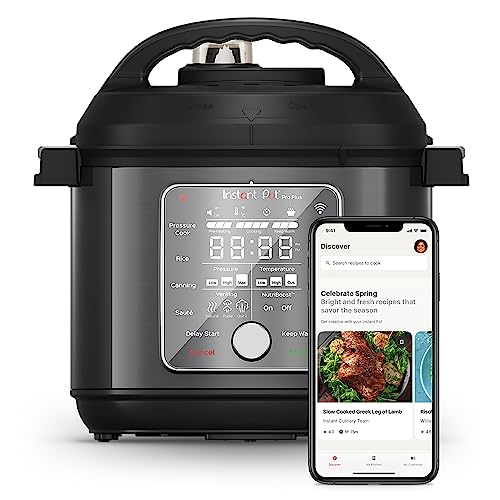
Instant Pot Pro Plus 6 Qt 10-in-1
The Pro Plus is the connected Instant Pot: Wi-Fi and Bluetooth let you start it, watch it, and vent it from your phone. It adds sous vide, canning, and a much quieter steam release to the standard 6-quart formula.
$169.95fromAmazonList priceThis is the Duo for people who plan meals from somewhere other than the kitchen. Pair it with the Instant Connect app and you can start a rice cycle from the driveway, watch the countdown from the couch, and switch functions without walking over. The app carries more than 2,000 guided recipes with step-by-step prompts, which is a real help if pressure cooking still feels like guesswork.
The quiet venting is the upgrade you'll notice most. Standard steam release is a jet-engine shriek that wakes a napping toddler; WhisperQuiet knocks that down considerably. You can also trigger the release from the app, which means nobody has to stand over the pot with a towel. If your kitchen opens onto a living room, this alone might justify the step up.
The extra functions are more than filler. Sous vide holds a low, steady temperature for steak or eggs. NutriBoost pulses the pot during cooking to keep soups, broths, and risotto from separating. The stainless pot has an aluminum core and a flat bottom for searing, plus two handles — a small change from earlier models that makes lifting a full pot much less precarious.
The canning function needs a caveat. It's designed for high-acid, water-bath-style canning only, not low-acid pressure canning, which still requires a tested pressure canner. Owners who understand that limit are happy with it. Owners who assume it replaces a proper canner will be disappointed and, more importantly, unsafe.
Flaws but not dealbreakers
App and Wi-Fi setup is the most common complaint. Some people connect in two minutes; others fight pairing issues for days before it sticks. If the app is the whole reason you're buying, that's a gamble.
You're paying a premium over the Duo for connectivity you may use twice. Pressure cooking is not slow cooking — you generally can't load it in the morning and start it remotely at 4 p.m., because raw meat shouldn't sit out that long.
Who this is for
Buy a multi-cooker if weeknights are tight and you'd rather not choose between a slow-cooked texture and a 40-minute dinner. It's the fastest route to dried beans, tough cuts, big batches of rice, and stock that would otherwise simmer for hours. Meal preppers get the most out of one, and so do apartment cooks trading a rice cooker, a slow cooker, and a steamer for a single machine. If you're nervous about pressure cooking, modern electric models are the gentlest possible introduction — Consumer Reports notes they ship with 10 or more independent safety mechanisms on average.
Skip it if you mostly cook for one and already own a small saucepan you like, or if the thing you actually want is a slow cooker you can load at 7 a.m. and forget. Pressure cooking is not walk-away cooking in that sense. This guide covers countertop electric multi-cookers and electric pressure cookers, so stovetop pressure cookers, dedicated air fryers, and standalone slow cookers are outside its scope. None of these units are USDA-approved pressure canners either, no matter what the control panel says.
How we picked
We built the shortlist around what actually decides whether a cooker gets used. Pressure performance: it has to hit and hold true high pressure, since that's where the time savings come from. Capacity: 6 quarts covers two to six people; anything bigger has to earn its footprint. Functions: pressure cook, slow cook, sauté, steam, and keep-warm are the baseline, and extras only count when reviews and owners say they work. Cleaning: dishwasher-safe pots and lids, with bare stainless preferred for anyone who browns and deglazes. Safety and support: lid interlocks and overpressure valves are table stakes, but easy-to-find gaskets and inner pots are what keep a cooker out of the landfill.
Other multi-cookers and pressure cookers worth considering
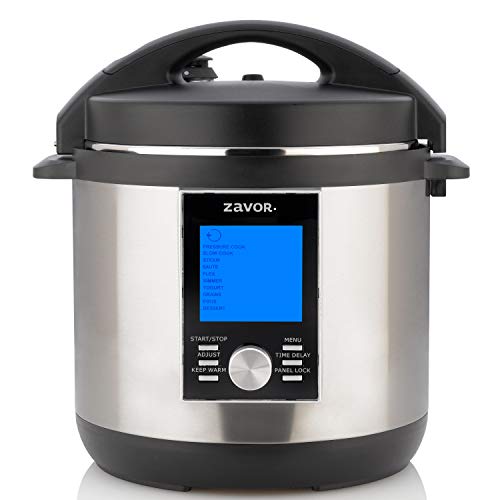
If you want a clear LCD without the premium price: The Zavor LUX LCD 6 Quart Programmable Electric ($199.95) — The Zavor LUX LCD sits between the budget cookers and the Breville. Its screen shows what's happening more clearly than a row of preset buttons, and it packs over 33 programmable settings including a Flex function that covers sous vide and lets you use the pot as a plain stockpot. Serious Eats has praised it for pressure results closer to stovetop than most electrics. Owner feedback splits, though: some people love it enough to abandon a Breville, while others report weak sauté performance and units that failed within weeks. Zavor's support seems responsive, but the accessory ecosystem is nothing like Instant Pot's.
If you want two dishes cooking at once and don't need pressure: The Crock-Pot MultiMeal Multicooker and Programmable Slow Cooker ($159.99) — The Crock-Pot MultiMeal has two 3.7-quart nonstick pots with separate controls, plus a smart timer that lands both dishes at the same moment. Roast on one side, potatoes and carrots on the other. It slow cooks, sears, bakes at 300°F or 350°F, and steams rice, and the ceramic-coated pots wipe clean. But it's not a pressure cooker, so none of the speed advantages in this guide apply. It's also wide — 18 inches across — and each pot alone is small for a big family. Think of it as a very good dual slow cooker with a bake setting.
The competition
This is what our research turned up in the category, not a census of everything sold. We focused on models with enough published coverage and owner feedback to say something useful about them.
Care and maintenance
The sealing ring is the part that decides how long your cooker lasts and how your food tastes. Silicone absorbs odor, so a ring that cooked curry will haunt your next batch of oatmeal. Pull it out after every use, wash it, and let it dry fully before reseating it; many people keep two rings, one for savory and one for sweet. Replace it when it stiffens, cracks, or stops holding pressure — usually every year or two with regular use. Also check the anti-block shield and float valve for stuck food, since a clogged vent is the most common reason a pot won't pressurize. Wipe the condensation collector, and if your pot is stainless, a paste of baking soda handles hard-water clouding.
Questions we get
What's the best multi-cooker for a family of four?
A 6-quart model, and for most people that's the Instant Pot Duo 7-in-1. It holds roughly six servings, which covers dinner plus lunch the next day. Only step up to 8 quarts if you're regularly cooking for six or more, or you batch-cook stock and shredded meat in bulk.
Do I need a combo pressure cooker and air fryer, or should I buy them separately?
Buy the combo if counter space is your constraint or you often want to crisp something you just pressure cooked. The Spruce Eats estimates the finish-in-place approach saves 15 to 20 minutes per recipe versus transferring food to a separate air fryer. Separate appliances still air fry a bit better and let two things cook at once. The trade-off is a second bulky lid you have to store.
How long does pressure cooking actually take?
Longer than the number on the timer. Tom's Guide notes that an Instant Pot Duo needs 8 to 12 minutes to reach full pressure depending on how full it is, and that happens before the countdown starts. Natural release can add another 10 to 20 minutes. A recipe listing 10 minutes of cook time realistically means 30 from plug-in to plate.
Are electric pressure cookers safe?
Yes, far safer than the stovetop cookers people remember exploding. Consumer Reports notes that modern electric models ship with an average of 10 or more independent safety mechanisms, including overpressure valves, lid-locking interlocks, anti-blockage vents, and automatic temperature cutoff. The lid physically will not open while pressure remains inside. Keep the vent and float valve clean and you've covered the main real-world risk.
Can I use one for pressure canning?
No. Electric multi-cookers aren't USDA-approved for pressure canning low-acid foods like green beans, meat, or corn, even when they have a canning button. Those buttons are meant for high-acid, water-bath-style work such as jams and pickles. For low-acid canning you need a tested stovetop pressure canner.
How do I get the smell out of the sealing ring?
Pull the ring out and run it through the dishwasher on the top rack, or soak it in a mix of white vinegar and water. Airing it out in sunlight for a day helps with stubborn odors. If it still smells, buy a replacement — they're cheap, and most people keep a second ring reserved for sweet dishes like yogurt and cheesecake.
Is the Breville Fast Slow Pro worth paying much more than an Instant Pot?
Only if you want the pressure range and the readout. Consumer Reports counts 11 pressure settings between 2.9 and 12 PSI on the Breville, versus the two-setting high/low standard everywhere else, and the LCD shows pressure and temperature as they change. For beans, rice, and chili you won't taste a difference. For delicate proteins, custards, and clear stocks, you will.
Why you should trust us
For this guide:
- We read manufacturer specification sheets and listing details for every cooker here, comparing capacity, pot material, pressure settings, and stated safety mechanisms side by side.
- We drew on published reviews and lab findings from Consumer Reports, America's Test Kitchen, Cook's Illustrated, Good Housekeeping, The Spruce Eats, Serious Eats, Tom's Guide, CNET, and Wirecutter.
- We read through owner feedback for recurring themes — long-term durability, sealing-ring odor, app pairing trouble, and units that stop reaching pressure — and let those patterns shape the flaws we call out.
- We read owner reviews on every listing, weighted toward the critical ones, because that is where the recurring failures show up.
- We have a systematic way of automatically fetching the latest prices, so the numbers on this page stay current.
- This is a research-focused guide, so the team may not own every product listed — though we often do own the top winners, which gives us extra context for the recommendations.
- We don't accept free products, and the retailer commission never changes which product we recommend.
Sources
The Best Instant Pots and Electric Pressure Cookers — Wirecutter, Wirecutter (NYT)
Best Pressure Cookers — Consumer Reports, Consumer Reports
The Best Multi-Cookers, Tested by Our Kitchen Lab — Good Housekeeping, Good Housekeeping
The Best Electric Pressure Cookers — Serious Eats, Serious Eats
Best Instant Pots and Pressure Cookers — CNET, CNET
Best Electric Pressure Cookers — America's Test Kitchen, America's Test Kitchen
Multi-Cooker Reviews — Cook's Illustrated, Cook's Illustrated
Ninja Foodi vs. Instant Pot — The Spruce Eats, The Spruce Eats
Best Pressure Cookers of 2025 — Tom's Guide, Tom's Guide
Is Pressure Cooking Healthy? — Harvard Health Publishing, Harvard Health
Amazon product listings and owner reviews for all 7 products
Manufacturer specification pages for each product
Some passages in this guide may be paraphrased with AI help. Prices are refreshed automatically.
More like this.
Continue exploring appliances reviews and recommendations.

The Best Instant Pots and Pressure Cookers
An electric pressure cooker earns its counter space by collapsing time. A pot roast that needs three hours on the stove is done in under an hour,…

The 7 Best Portable Bluetooth Keyboards for Travel in 2026: Lightweight, Multi-Device Picks
Expert-tested portable Bluetooth keyboards for travel in 2026. Compare weight, battery life, and multi-device pairing across 7 top picks from Logitech, Keychron, nuphy, and more.

The Best Bluetooth Multi-Device Keyboards
A multi-device keyboard earns its keep in the small moments. You're typing an email on your work laptop, a Slack message pops up on your personal desktop,…

The Best Oscillating Multi-Tools
An oscillating multi-tool is the thing you reach for when nothing else fits. It undercuts door casings so laminate slides underneath. It chews grout out…

The Best USB Hubs And Multi-Port Adapters For Laptops
Your laptop probably has two USB-C ports, maybe three. One of them is busy charging. That leaves one port for a monitor, a mouse, a keyboard, an external…

The Best Slow Cookers
A slow cooker is the rare appliance that does its best work while you're gone. You put a chuck roast, some onions and a can of tomatoes in the pot before…