The Best PetSafe Pet Products
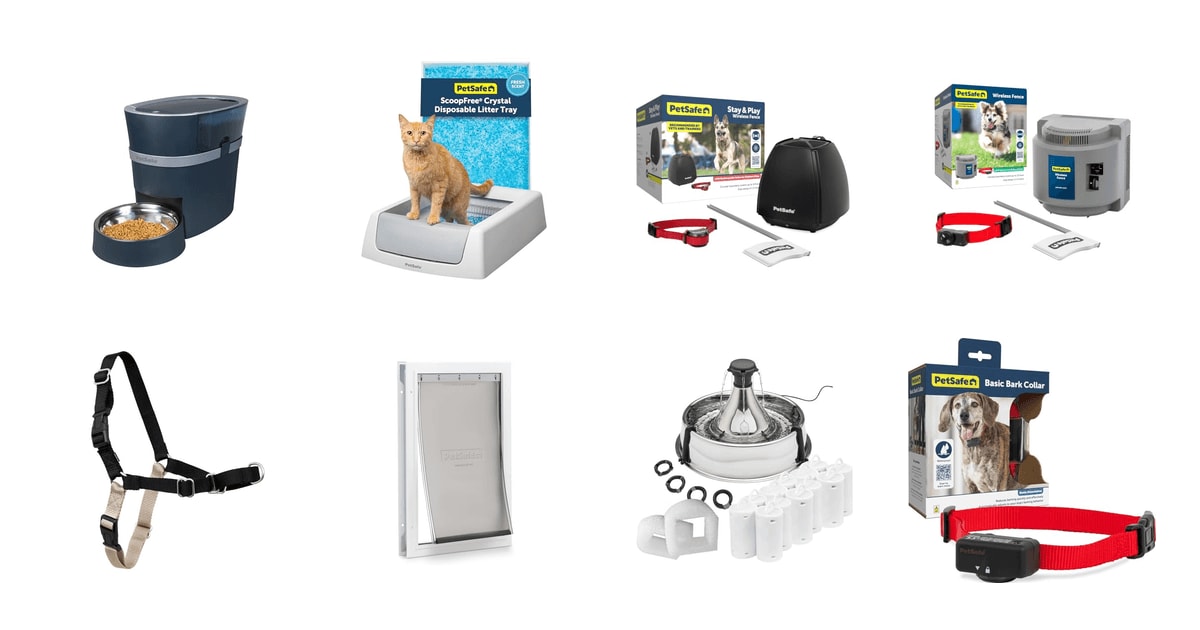
Pet gear earns its keep in the boring moments. It's the 6 a.m. feeding you slept through, the litter box you didn't scoop, the dog who stayed in the yard while you carried groceries inside. PetSafe has been making that kind of equipment since 1991, under Radio Systems Corporation, and the range now runs from wireless fences to water fountains. Some of it genuinely changes your daily routine. Some of it just moves the work around, and you'll want to know which is which before you buy.
Here's the honest part. Nothing in this category is set-and-forget. Wireless fences need two to four weeks of flag training before your dog respects the boundary, and even then they're a signal, not a wall. Self-cleaning litter boxes still need you to check the tray. Fountains need filter swaps, feeders need refills, and collars need batteries. The Good Housekeeping Institute has flagged battery life and receiver comfort as the two most common owner complaints across wireless fence brands, PetSafe included. Plan for maintenance and you'll be happier.
We looked at how each of these products fits into an actual week — how often you'd touch it, what breaks, what owners keep bringing up months later. Some models here are decades-old designs that still work. Others are newer and rougher around the edges. We think that the PetSafe Stay & Play Wireless Fence is the best PetSafe product for most people, and that the PetSafe Easy Walk Harness is the one to buy if you want the most useful thing PetSafe makes without wiring anything or charging anything.
Everything we recommend

The most yard, the most control, and it travels

The single most useful thing here, and it needs no power

Scheduled meals from your phone, even when you're stuck late
Built to survive a hundred-pound dog and a decade of weather
How we picked
Real daily payoff. We looked for products that remove work from your week, not products that just add a screen. Feeders, litter boxes and doors had to change the number of times you touch something each day.
Fit and sizing. Manufacturer size charts and owner feedback got weighted together, because sizing gaps are where this category fails most often. A harness or collar that doesn't fit your dog's build is worse than nothing.
Signal and range honesty. For containment, we compared stated coverage — half an acre for the PIF-300, up to three-quarters for the Stay & Play — against what owners describe on real, irregular lots. Adjustable boundaries scored higher than fixed ones.
Ongoing costs. Crystal trays, carbon filters, foam filters and RFA-67 batteries all keep costing money after checkout. We favored products where the refill schedule is predictable and stated in the specs.
Long-term support. PetSafe has been in containment and training since 1991 under Radio Systems, and owner accounts of warranty replacements and parts availability were part of the calculation for anything with a motor or a radio in it.
Top pick
The most yard, the most control, and it travels
PetSafe Stay & Play Wireless Fence for
This is the wireless fence to get if you're serious about containing a dog without digging trenches. You can dial the boundary anywhere from about 22.5 to 105 feet in every direction, which means you can shape it to your actual lot instead of accepting whatever circle you get.
$275.25fromAmazonThe adjustable radius is the whole reason to pay more here. The older PIF-300 gives you a circle and you live with it. This one lets you tune the boundary between roughly 22.5 and 105 feet, so you can pull the edge in from the road or push it out toward the tree line. If your yard isn't a neat square — and most aren't — that dial matters more than any other feature on the box.
Setup takes an afternoon, not a weekend. There's no wire to bury, no trencher to rent, no calling before you dig. You plug the transmitter in somewhere indoors and elevated, walk the perimeter with the collar to see where the signal actually falls, and plant your training flags. Owners who've moved houses report taking the whole system with them and having it running again the same day.
The collar gives you a tone-only mode plus five levels of static correction, which is more range than you'd think you need until you have a dog who ignores the beep. Static-free reentry is the quiet safety feature: if your dog does bolt through the boundary, they can come back home without getting corrected on the way in. That's the difference between a dog who returns and one who won't.
It's genuinely portable, which is easy to overlook. Take it to a rental cabin, a campsite with an outlet, a relative's yard over the holidays. You get the same boundary your dog already understands in a place they've never been. For anyone who travels with a dog, that's worth as much as the acreage number.
Training is not optional, and it takes weeks. Trainer guidance commonly cited by pet retailers puts the phased flag introduction at two to four weeks before a dog reliably respects the signal. Owners who rushed it are the ones reporting escapes. Owners who worked the flags for a month are the ones reporting years of trouble-free use, including with large, stubborn shepherds.
Flaws but not dealbreakers
The boundary is a circle generated by radio, and radio isn't perfectly round. Owners consistently describe hot spots and soft edges where the line drifts — metal siding, slopes, and large appliances all push it around. Walk your perimeter with the collar in hand before you plant a single flag, and expect the front yard edge to sit somewhere different than you assumed.
This is a deterrent, not a fence. A determined dog chasing a rabbit can and sometimes will run through the correction. Several owners describe a system that works 99% of the time, which is fine for a mellow dog and not fine for one with a strong prey drive near a busy road.
Reliability over the long haul is mixed. Some owners report three-plus years of solid service; others report transmitters that quit after a year or so. PetSafe's customer support comes up repeatedly as the saving grace — people describe replacements being handled without a fight — but you should expect this to be a product you may have to call about.
Budget pick
The single most useful thing here, and it needs no power
PetSafe Easy Walk Harness for Dogs -
The Easy Walk is a front-clip harness that turns your dog's own pulling force sideways instead of letting them lean into it. It costs a fraction of anything electronic in this lineup, and for a lot of households it solves the more urgent problem.
$22.95fromAmazonIf your dog drags you down the block, buy this before you buy a fence. The leash clips at the chest, so when your dog lunges forward the harness redirects them back toward you rather than letting them pull straight ahead. The American Kennel Club's affiliated trainers frequently recommend front-clip designs like this one for leash-reactive dogs, specifically because the force goes across the chest instead of into the throat.
The effect tends to show up fast. Owners describe the first walk as the surprising one — a 70-pound boxer mix who'd been towing someone down an apartment staircase suddenly walking at heel, a pug mix who'd slipped out of every other harness staying put. It isn't magic and it isn't training on its own. But it buys you the control you need to actually start training.
A martingale loop on the chest strap tightens gently as your dog pulls and releases when they stop, so the correction is gradual instead of a jerk. The straps are color-coded to make fitting less confusing, and quick-snap buckles at the shoulders mean you're not wrestling a squirming dog through leg holes in the rain. PetSafe has sold this design since 2004, and it shows in the small details.
There's less material here than on a full body harness, which matters in July. Your dog stays cooler, and there's less fur matting under wide straps. For short-coated dogs who overheat on summer walks, the lighter build is a real advantage over padded tactical-style harnesses.
Flaws but not dealbreakers
Sizing is the weak point and owners bring it up constantly. The gap between sizes can be awkward — one size runs huge, the next runs small — and deep-chested or barrel-shaped dogs often land between them. Measure your dog's girth just behind the front legs before ordering, and be prepared to exchange.
It doesn't work for every body type. Pomeranians and other small, fluffy, short-legged dogs come up repeatedly as poor fits, with the chest strap riding up into the armpits. If your dog is under about 15 pounds with a compact frame, check the size chart carefully or consider a different style entirely.
This manages pulling; it doesn't cure it. Take the harness off and most dogs go right back to pulling on a flat collar. Think of it as a tool that makes training possible, not a replacement for the training.
Also greatOn sale
Scheduled meals from your phone, even when you're stuck late
PetSafe Smart Feed Automatic Pet Feeder
The Smart Feed holds up to 24 cups of dry kibble and dispenses on a schedule you set from an app, with notifications when it's running low. If your workday runs long or your cat wakes you at 5 a.m., this is the fix.
$120.99fromAmazonList priceThe hopper is the spec that actually changes your life. Twenty-four cups means a single cat goes weeks between refills, and a medium dog still gets a solid stretch. You're not topping it off every few days. Combine that with the app schedule and the feeder mostly disappears into the background, which is exactly what you want from an appliance.
You can feed remotely, which sounds like a gimmick until you're stuck in traffic at 7:15 and dinner was at 7. The My PetSafe app runs on iOS 12 or later and Android 9 or later, and it pushes a notification when the hopper is low or empty or something's jammed. There's Alexa integration too if you want to say the word from the couch, and Dash Replenishment to reorder food automatically.
The slow feed setting is underrated. If your dog inhales a bowl and then brings it back up, this spreads any portion over an eighth of a cup across 15 minutes. Owners of large, fast-eating mixes describe it as the feature that ended the vomiting. It's the kind of thing a cheap bowl insert does badly and this does automatically, on schedule, whether you're home or not.
Longevity looks decent for a device with a motor and a Wi-Fi radio. Multiple owners describe four years of daily use across two household moves with no failures, and the unit accepts backup batteries — sold separately — that keep it dispensing through a power cut. If you live somewhere with flaky power, buy the batteries at the same time.
Flaws but not dealbreakers
The bowl doesn't lock down, and that's a real annoyance. Owners report cats and dogs nudging the bowl out of position, which means the next scheduled meal lands on the floor. It happens often enough that some people wedge the bowl in place themselves. On a splitter setup for two pets, it gets worse.
It's loud. The kibble hits the plastic chute with a clatter that startles some pets and wakes some owners on early schedules. Most animals get used to it within a week, but a noise-sensitive cat may need a few days of encouragement before they'll approach it while it's running.
Not every unit lasts. A meaningful share of owner feedback describes feeders that worked beautifully and then simply stopped, with mixed experiences getting them resolved. Given that this is the thing feeding your pet while you're away, set up the low-food notifications and check the app rather than assuming silence means everything's fine.
Upgrade pick
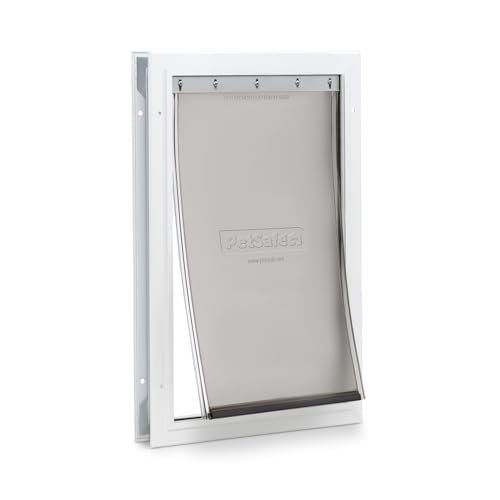
Built to survive a hundred-pound dog and a decade of weather
PetSafe Freedom Aluminum Dog & Cat Door
The Freedom Aluminum door is rated for pets up to about 100 pounds, with a 10¼-by-16¼-inch flap opening and reinforced aluminum corners. It's the piece of PetSafe gear most likely to outlast the house you install it in.
$104.95fromAmazonAluminum is the reason this one costs more and lasts longer. Plastic-framed pet doors crack at the corners after a couple of winters of a big dog shouldering through them. This frame is solid metal with reinforced corners, and owners with Dobermans, huskies, and Bernese mountain dogs describe years of hard use without the frame going soft. If you have a large dog, this is the part that matters.
The flap opening is genuinely large — 10¼ inches wide by 16¼ tall — and rated to 100 pounds. That's not a marginal fit for a big shepherd, it's a comfortable one. Owners who sized down and watched a 100-pound dog squeeze through a medium door describe injuries that followed. Size up, not down, and measure your dog at the shoulder before ordering.
The tinted flap seals with magnets and stays put in wind better than a loose flap does, which cuts the draft you'd otherwise feel across the floor in January. There's a slide-in closing panel too, so you can lock the door at night or when you don't want the neighborhood raccoon exploring your kitchen.
Installation is a real DIY job, and the kit takes it seriously: cutting template, hardware, and instructions, sized for doors between 3/8 and 2 inches thick. It works in wood, PVC, metal, and storm doors. People have fitted these into RV doors and exterior walls. Take your time with the template and measure twice — this is the one step you can't undo.
Flaws but not dealbreakers
Cutting a permanent hole in your door is not a reversible decision, and it's not a renter-friendly one. If you're leasing, this is off the table unless your landlord signs off. Even homeowners should sit with the placement for a day before picking up a jigsaw.
Some dogs refuse the flap at first, and older dogs are the stubborn ones. Owners describe a week of propping it open, taping it up, and coaxing before an established dog will commit. Puppies usually figure it out in minutes. Budget patience, not money.
Any pet door is a security compromise. The closing panel helps, but a large flap opening is a large flap opening. If it's going on an exterior door on the street side of the house, think about the trade-off before you cut.
Who this is for
This guide is for anyone shopping the PetSafe lineup specifically — because a neighbor recommended the brand, because you already own one of their fences and want a matching collar, or because you want a company with a long parts-and-support track record. It's most useful if you're a renter or homeowner who can't put up a physical fence, someone whose schedule doesn't line up with feeding times, or a cat owner who's tired of scooping. Multi-pet households will find several of these built for exactly that.
It's not for everyone. If your dog has a strong prey drive and you live near a busy road, no wireless fence — PetSafe's or anyone's — is the right answer; you need a physical barrier. If you're uncomfortable with static correction on principle, skip the fences and bark collar entirely and look at the harness and the automation instead. And since this guide covers only PetSafe, you're seeing the best of one brand, not the best of the whole market. Where another category guide would serve you better, we've pointed to it below.
How we picked
We weighed each product on the things that decide whether you're still glad you bought it a year later. Daily payoff: does it actually reduce the number of times you handle something, or just relocate the chore? Fit and sizing: we cross-checked manufacturer size charts against owner reports, because a harness that rides up or a collar that misfires on a toy breed is a failed purchase. Range and signal: for containment, adjustable boundaries beat fixed circles, and we took owner accounts of hot spots seriously. Ongoing costs: crystal trays, carbon and foam filters, and RFA-67 batteries keep billing you after checkout, so we favored predictable refill schedules. Support: PetSafe has made containment and training gear since 1991, and for anything with a motor or a radio, we counted parts availability and warranty handling as part of the product.
Other petsafe pet products worth considering
If you want wireless containment for less: The PetSafe Wireless Pet Containment System ($197.50) — The PIF-300 is the original, and it's still the one most people buy. It covers up to a half acre in a circle from an indoor transmitter, sets up in an afternoon with no digging, and offers the same static-free reentry as our top pick. What you give up is the adjustable radius — you get the circle the transmitter makes, and shaping it to an odd lot means moving the box around and hoping. It also lacks the tone-only mode and the five correction levels that make the Stay & Play better for a hard-headed dog. For a mellow dog on a roughly square half-acre, it's plenty, and it's the version to hand to a first-time owner who isn't sure this approach will work at all.
If you want a fountain built for a full house of cats: The PetSafe Drinkwell Stainless 360 Multi-Pet Cat Water ($74.99) — The Drinkwell Stainless 360 holds about 128 ounces — a full gallon — and has a drinking ring that lets several animals drink at once without shoving each other. You can run one to five streams and twist the top to adjust the flow, which helps if you've got one cat who likes a trickle and another who only drinks from a strong stream. Stainless steel is the real upgrade: owners describe rinsing it clean in about five minutes versus fifteen for plastic bowls, and it doesn't scratch or hold odor the way plastic does. The catch is upkeep. Carbon filter #3 and foam filter #5 both need replacing on a schedule, and even stainless builds up biofilm if you don't take it apart regularly. Get the multi-pack of filters and put a reminder on your calendar.
More from PetSafe
PetSafe's catalog is bigger than any one guide can cover, and what follows is what our research surfaced — not everything the brand sells. These are the models that didn't fit the specific jobs above but suit a particular shopper well. If one of them describes your situation better than our picks do, it's the right buy for you.
The PetSafe ScoopFree Crystal Classic Self-Cleaning Litter Box ($99) — The ScoopFree Crystal Classic is the self-cleaning box for a single-cat household that wants scooping off the daily list. A rake sweeps waste into a covered corner after your cat leaves, and the crystal litter absorbs urine and dries out solids — PetSafe markets a tray as lasting up to 30 days for one cat, against roughly 7 days for clay. The crystals are 99% dust free and don't stick to paws, so you're sweeping less litter off the floor. Owner feedback is genuinely split, though, and you should go in knowing it. The rake jams on some units, the plastic feels thin to some buyers, and because solid waste sits in an open tray rather than getting buried, odor bothers some households more than a covered box would. The Spruce Pets notes that automatic boxes like this drop daily scooping to near zero but still need you checking the waste level weekly. Best for one cat, a tolerance for occasional fiddling, and a real dislike of scooping.
The PetSafe Basic Bark Control Collar ($39.97) — The Basic Bark Control Collar suits an owner dealing with genuine nuisance barking who's already tried the training route. Six levels of static correction adjust automatically as your dog responds, the collar is waterproof for outdoor use, and the strap fits dogs from 8 pounds up to a 27-inch neck. It runs on PetSafe's RFA-67 battery, included, and you'll be buying more. Two honest caveats. Small-breed owners report the module looks bulky on a 6-pound dog, and PetSafe makes a Little Dog version specifically because standard collars often misfire on toy breeds — if your dog is tiny, look for that model instead of this one. And owner feedback splits sharply on whether the correction is humane; plenty of people describe it as the thing that finally gave a reactive dog and a frustrated household some peace, while others returned it uneasy. PetSafe's No Bark Promise lets you call customer care and swap for something else if it isn't right, which takes some of the risk out of trying.
Is PetSafe worth it?
PetSafe sits in a useful middle spot. Under Radio Systems Corporation, the company has made containment and training gear since 1991, and the Easy Walk Harness has been on the market since 2004 — that longevity is the main practical argument for the brand. Parts stay available. Filters, replacement pumps, RFA-67 batteries and collar receivers are all still stocked for products that have been out for years, which is not true of every pet-tech startup. Owners repeatedly describe customer care handling replacements without much friction, including on units that failed just outside a stated warranty window. The brand also publishes a No Bark Promise on its bark collars, inviting you to contact support for a different product if the one you bought isn't working out. The trade-off is that quality isn't uniform across the range. The mechanical products — the aluminum door, the harness — draw consistently strong feedback. The electronics are more variable, with transmitters and feeders that sometimes quit early. Buy the simple things confidently. Buy the powered things knowing you may need to make a phone call.
Not set on PetSafe?
If the ScoopFree's mixed rake reliability gives you pause, this guide compares the whole category, including enclosed designs that bury waste instead of raking it into an open tray. our full self-cleaning litter box guide →
Worth reading if you want to weigh the Drinkwell 360 against other stainless and ceramic fountains on capacity, noise, and how much of a pain each one is to take apart and clean. our pet water fountain guide →
Covers feeders across brands if the Smart Feed's unsecured bowl or noise level is a dealbreaker for your dog. our automatic dog feeder guide →
Setup and upkeep notes
Every powered product here has a maintenance rhythm, and knowing it upfront prevents the disappointment. For the wireless fences, walk the full perimeter with the collar in hand before planting a single flag — the circle bends around metal siding and slopes, and you need to see where it actually falls. Then commit to two to four weeks of phased flag training. Rushing that step is the single most common reason these systems fail. For the Smart Feed, set up low-food notifications and buy the backup batteries separately. For the ScoopFree, check the waste tray weekly even though the box runs itself. The Drinkwell needs its carbon filter #3 and foam filter #5 swapped on schedule, plus a full disassembly and scrub to stay ahead of biofilm. And keep spare RFA-67 batteries around for the bark collar.
Questions we get
Is a PetSafe wireless fence safe for dogs?
The static correction is designed to startle, not injure, and both fences here include a tone-only warning before any correction. Static-free reentry means a dog who crosses the line can come home without getting corrected on the way back. That said, a wireless fence is a signal, not a barrier — it won't stop a determined dog chasing something, and it won't keep other animals out of your yard.
How long does it take to train a dog on a PetSafe wireless fence?
Plan on two to four weeks of phased introduction using training flags, which is the guidance pet retailers commonly cite. You walk the boundary with your dog on leash, let them hear the tone, and reward them for turning back. Owners who compressed this into a weekend are the ones reporting escapes later. It's the least fun part of the purchase and the part that decides whether it works.
Is there a monthly subscription fee for the Smart Feed app?
No. The My PetSafe app handles scheduling, portioning and notifications without a subscription. You'll need an iPhone or iPod running iOS 12.0 or later, or an Android phone on 9.0 or later. Your ongoing costs are food and, if you want power-outage protection, the backup batteries that are sold separately.
How often do you replace ScoopFree litter trays?
PetSafe markets a crystal tray as lasting up to 30 days for a single cat, compared with roughly a week for traditional clay litter. Two cats will burn through it considerably faster. Even within that window, check the waste compartment weekly — the box rakes automatically but doesn't empty itself, and a full compartment is where the odor complaints come from.
Can the Easy Walk Harness be used on puppies or cats?
It's built for dogs, and fit is the deciding factor rather than age. A puppy who's grown into a size on the chart can wear one, but you'll be rebuying as they grow. Cats aren't the intended user — the martingale chest design assumes a dog's build and a dog's pulling mechanics. For very small or fluffy breeds like Pomeranians, check the size chart carefully; owners report the chest strap riding up into the armpits.
What's the best PetSafe product for a multi-pet household?
The Freedom Aluminum Door and the Drinkwell 360 are the two built for it. The door's reinforced aluminum frame handles repeated traffic from several animals, and it fits dogs up to about 100 pounds while still working for cats. The 360's gallon capacity and wide drinking ring let multiple pets drink at once. The Smart Feed is the weak link for multi-pet homes — the unsecured bowl gets worse with a splitter and two animals.
Why you should trust us
For this guide:
- We read PetSafe's published specifications for every product here, including boundary radii, flap dimensions, hopper capacity and filter part numbers.
- We compared guidance from the American Kennel Club on front-clip harnesses, The Spruce Pets on automatic litter boxes, and the Good Housekeeping Institute's notes on common wireless fence complaints.
- We reviewed recurring themes in owner feedback across all eight listings, weighting patterns that showed up repeatedly over one-off complaints.
- We read owner reviews on every listing, weighted toward the critical ones, because that is where the recurring failures show up.
- We have a systematic way of automatically fetching the latest prices, so the numbers on this page stay current.
- This is a research-focused guide, so the team may not own every product listed — though we often do own the top winners, which gives us extra context for the recommendations.
- We don't accept free products, and the retailer commission never changes which product we recommend.
Sources
PetSafe Official Product Specifications, PetSafe (Radio Systems Corporation)
The Spruce Pets - Dog Product Reviews, The Spruce Pets
American Kennel Club - Product and Gear Reviews, American Kennel Club (AKC)
Chewy - Customer Reviews for PetSafe Products, Chewy
Good Housekeeping - Pet Product Testing, Good Housekeeping Institute
Rover - Pet Care and Product Guides, Rover
PetMD - Pet Health and Product Guidance, PetMD
ConsumerAffairs - PetSafe Reviews and Ratings, ConsumerAffairs
Wirecutter - Pet Gear Reviews, Wirecutter (NYT)
Amazon product listings and owner reviews for all 8 products
Manufacturer specification pages for each product
Some passages in this guide may be paraphrased with AI help. Prices are refreshed automatically.
More like this.
Continue exploring pet reviews and recommendations.

The Best Cat Trees For Large Cats
A big cat changes what a cat tree has to do. A 20-pound Maine Coon doesn't step onto a perch - he lands on it, and the whole frame feels it. Platforms…

The Best Pet GPS Trackers
A tracker earns its keep in the ten minutes after a door gets left open. That's the whole pitch. You want to open an app and see a dot moving down the…

The Best Pet Stain and Odor Removers
Pet accidents never happen at a convenient hour. You find the damp patch on the rug at midnight, or you smell it before you see it, and the clock starts…

The Best Pet Grooming Supplies for At-Home Care
Fur on the couch, fur on your clothes, fur in your coffee. That's life with a shedding dog or a long-haired cat, and it's why most people start grooming…

The Best Dog Sweaters and Raincoats
A dog coat is not a fashion statement. It's the difference between a walk your dog leans into and one where she plants her feet on the porch and refuses.…

The Best Dog Food Brands
You buy dog food more often than almost anything else you own a decision about. Twice a day, every day, for ten or fifteen years. That repetition is what…