The Best Pocket Hole Jigs
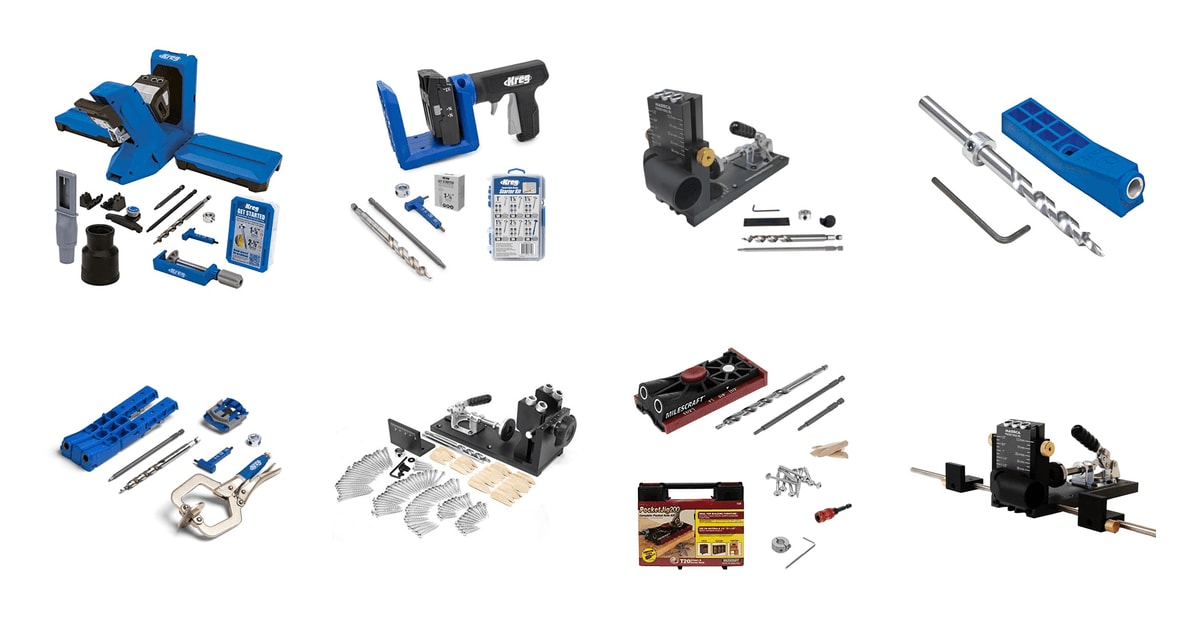
Pocket hole joinery is the shortcut that actually works. You drill an angled hole, drive a screw, and you've got a joint strong enough for a bookcase, a face frame, or a workbench — no chisels, no dovetail practice, no router table. The jig is the whole trick: it holds the drill bit at the right angle and stops it at the right depth so the screw exits where you want it. Get that part right and the rest of the job is fast. Get it wrong and you blow the tip out through the face of your board.
Here's the honest part. Every jig in this category does basically the same thing, and none of them make a pocket hole joint as strong as a mortise and tenon. Pocket screws pull hard in shear and give up in tension, so they're fine for cabinets and shelves and wrong for anything holding up a roof. The differences between jigs come down to how long setup takes, whether the body holds its tolerances after a few thousand holes, and whether the kit includes the clamp and bit you actually need.
Most of the frustration people report isn't with the joint — it's with the setup dance. Manual stop collars need a gauge and a careful eye, and if you're switching between 3/4-inch plywood and 2x4 stock all afternoon, that adds up. We think that the Kreg 720PRO is the best pocket hole jig for most people, and that the Kreg 520PRO is the one to buy if you want the same auto-adjust setup in something you can carry to the job.
Everything we recommend

Fastest setup, and the clamp is already attached
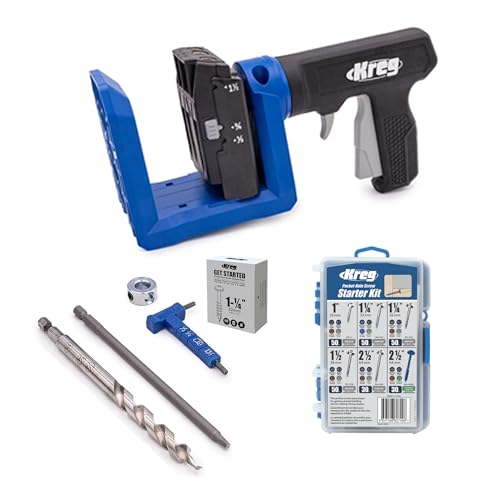
Same one-dial setup, but it goes where the work is

Machined aluminum instead of plastic, if you'll take manual setup
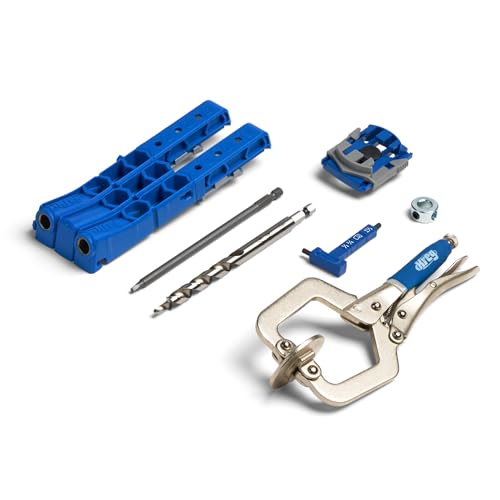
A real Kreg with the clamp already in the box

Two holes at once, for anyone drilling all afternoon
At a glance
| Product | Material Thickness | Weight | Price | |
|---|---|---|---|---|
| Kreg Tool KPHJ720PRO Pocket-Hole Jig 720PRO -Top pick | 1/2 to 1-1/2 in | 7.9 lbs | $149 |
| Kreg Pocket-Hole Jig 520PRO - Easy ClampingRunner-up | 1/2 to 1-1/2 in | — | $129.98 |
| Massca Pocket Hole Jig Kit M1 -Also great | — | 4.4 lbs | $79.99 |
 | Kreg MKJKIT Mini Jig Kit - SimpleAlso consider | Unlimited | 0.4 lbs | $18On sale |
| Kreg KPHJ320-22 Pocket-Hole Jig 320 with ClassicBudget pick | 1/2 to 1-1/2 in | 2.16 lbs | $49 |
 | Wen Pocket Hole Jig KitAlso consider | — | — | $43.02 |
 | Milescraft Pocket Jig200 Pocket Hole KitAlso in lineup | 1/2 to 1-1/2 in | 2.05 lbs | $29.99 |
| Massca Aluminum Pocket Hole Jig System ProUpgrade pick | — | — | $99.99 |
How we picked
Setup speed. We compared how each jig sets drilling depth, using manufacturer specifications and owner accounts of real setup times. Auto-adjust dials clear the bar easily; manual stop collars only pass if the adjustment is repeatable without a separate gauge.
Guide body material. Machined aluminum guides hold tolerance longer than composite ones, and owner feedback on long-term jigs bears that out. We treated aluminum construction as a real advantage for anyone drilling more than occasionally.
Thickness range. A jig needs to cover 1/2 inch to 1-1/2 inch to handle standard plywood, MDF and dimensional lumber. We checked spec sheets for that range and gave credit to designs that adjust continuously instead of snapping to presets.
Kit completeness. We read the listed contents for each kit to see whether it includes a step drill bit, stop collar, driver bit and screws. A jig body alone is not usable, and the missing pieces can cost as much as the jig.
Clamping. We looked for an integrated or bundled clamp, since hands-free drilling is what keeps holes square. Owner reports of boards shifting mid-drill were the clearest signal here.
Top pick
Fastest setup, and the clamp is already attached
Kreg Tool KPHJ720PRO Pocket-Hole Jig 720PRO -
The 720PRO sets drilling depth from a single dial, clamps your workpiece without a separate accessory, and takes a shop vac hose. It handles everything from 1/2-inch plywood to 2x4 stock, which covers nearly every board you'll put through it.
$149fromAmazonThe Material Selector dial is the reason to buy this jig. You set the thickness, and the stop collar positions itself. No gauge, no test hole in scrap, no locking a collar down and hoping. On a manual jig that same change takes 30 to 60 seconds and gives you a chance to get it wrong. Here it's a few seconds and you can't really mess it up. If you switch between plywood and dimensional lumber in the same session, that's the whole ballgame.
The integrated bench clamp is the part people underrate. Most jigs in this category expect you to buy a face clamp separately, and until you do, you're holding a board with one hand and running a drill with the other. That's how boards walk and holes end up crooked. The 720PRO's clamp grips across its full thickness range, so it's ready the moment you open the box.
There's a dust port too, sized for a standard shop vac hose. That matters more than it sounds. Pocket hole chips pack into the guide channels, and packed channels make the bit bind and the holes get ragged. Owners who run long sessions consistently say the dust collection here actually keeps up.
Owner feedback is broadly enthusiastic, with one recurring gripe worth knowing: parts of the body are plastic, and it feels lighter in the hand than the price suggests. Several people note the base flexes a little. Nobody reports it failing — the guides and clamping mechanism are where the quality went — but if you were expecting a slab of machined metal, adjust your expectations.
Flaws but not dealbreakers
It's the most expensive manual jig here by a wide margin, and if you build one bookshelf a year, you won't get that back. The 320 or the 520PRO does the same joinery for less.
The plastic base and housing are the common complaint. It works, and it holds tolerance where it counts, but the feel doesn't match the price. A few owners also find the workbench clamp fiddly to set, which is an odd flaw on a jig that's otherwise built around saving you time.
Runner-up
Same one-dial setup, but it goes where the work is
Kreg Pocket-Hole Jig 520PRO - Easy Clamping
The 520PRO uses the identical auto-adjust dial as our top pick in a body you can carry to a job site or into a half-built cabinet. The 360-degree rotating handle lets you drill at angles a benchtop jig can't reach, and it ships with a generous screw supply.
$129.98fromAmazonIf you've ever needed a pocket hole on the inside of an assembled carcass, you know the problem. A benchtop jig wants you to bring the board to it. The 520PRO reverses that: the handle rotates a full 360 degrees, so you clamp it onto the work in whatever orientation the job demands. Finish carpenters and anyone doing repairs on already-assembled furniture will use that constantly.
Setup speed matches the 720PRO exactly. Same one-step Material Selector dial, same few seconds to change thickness, same absence of stop-collar guesswork. You're not trading convenience for portability here — you're only trading the built-in bench clamp and the dust port.
The included screw assortment is the most generous starter supply in the Kreg range, with six of the common sizes in a case. That's genuinely useful for a beginner. Pocket screws come in specific lengths matched to material thickness, and figuring out which ones you need before you've built anything is a small hurdle this removes.
Owner feedback skews strongly positive, though the review volume is still modest compared with Kreg's older models. The theme that comes up most is portability — people who already own a benchtop Kreg buy this one to travel and end up reaching for it in the shop too.
Flaws but not dealbreakers
There's no clamp. For hands-free drilling you'll need Kreg's face clamp, and once you add it the price gap to the 720PRO narrows enough that the math gets murky if you mostly work at a bench.
No dust port either, so guide channels fill with chips faster on long runs. Clear them periodically or the bit starts to bind.
Also great
Machined aluminum instead of plastic, if you'll take manual setup
Massca Pocket Hole Jig Kit M1 -
The Massca M1 trades Kreg's auto-adjust dial for a CNC-machined aluminum body and a depth knob that stops anywhere, not just at presets. It's the jig to buy if you'd rather have metal where it counts and don't mind spending twenty seconds on setup.
$79.99fromAmazonBuild quality is the entire argument for the M1. The guide body is machined aluminum, not composite, and that's the part that determines whether your holes are still accurate after a few thousand cycles. Owners who've run hundreds of holes through it report the guide tubes pick up scratches but the bit still seats without wobble. That's the failure mode that eventually ruins cheaper jigs.
The depth knob adjusts continuously rather than clicking into fixed positions. So if you're working with an odd thickness — resawn stock, an old board that's not quite 3/4-inch, some import plywood that's metric — you can dial in exactly what you need. Preset-only jigs can't do that at all.
Setup takes roughly twenty seconds against Kreg's five. In practice that's only annoying if you're switching thicknesses constantly. If you set up once and drill forty holes, you'll never notice. The knob also gives you tactile feedback that an auto-dial doesn't, which some woodworkers genuinely prefer.
The kit is complete out of the box: step drill bit, stop collar, hex key, driver bit, and screws. Worth knowing the included screws are coarse-thread, meant for softwood and plywood. Oak or maple projects need fine-thread screws, which you'll buy separately.
Flaws but not dealbreakers
Single-guide, so you drill one hole at a time. On a face frame with dozens of joints, the M2 cuts that in half.
No auto-adjust and no included face clamp, so you're adding both a setup step and, eventually, a clamp purchase. It's not a beginner's grab-and-go tool the way the 520PRO is.
Budget pick
A real Kreg with the clamp already in the box
Kreg KPHJ320-22 Pocket-Hole Jig 320 with Classic
The 320 handles the same 1/2-inch to 1-1/2-inch range as Kreg's flagship and includes the Classic 2-inch face clamp, which most jigs make you buy separately. Setup is manual, so plan on about a minute per thickness change.
$49fromAmazonIncluding the face clamp is what makes this the smart entry point. A jig without a clamp isn't a complete tool — you end up holding stock by hand or improvising with whatever's on the bench, and that's where crooked holes come from. Kreg sells this clamp on its own, so getting it bundled meaningfully changes what you're actually paying for.
The tradeoff is setup time. You position the guides, lock them, drill. Figure 30 to 60 seconds per thickness change against five on the auto-adjust models. If you're building one project a season, that's noise. If you're producing cabinet parts on a Saturday, it's the difference you'll feel.
It's compatible with every Kreg screw and accessory, which matters more than it sounds. Kreg hardware is stocked at essentially every hardware store, so you'll never be stuck mid-project hunting for a specific screw length. Buying into that ecosystem at the low end and upgrading later is a reasonable plan.
One caveat from owner feedback: the included clamp opens to two inches, which covers 1x2 and similar small stock nicely but runs out of room on anything wider. Several owners keep the Kreg clamp for small work and reach for a bigger F-clamp on panels.
Flaws but not dealbreakers
Manual adjustment only, and the composite body won't hold up like machined aluminum under heavy production use.
The bundled clamp's two-inch capacity is limiting. Expect to buy a larger clamp before long if you work with panels or wide boards.
Single guide, single hole at a time. Fine for a hobbyist, slow for a face frame run.
Upgrade pick
Two holes at once, for anyone drilling all afternoon
Massca Aluminum Pocket Hole Jig System Pro
The Massca M2 drills two pocket holes simultaneously from an aluminum body, roughly halving the time per joint. A T-track slot lets you bolt it to a bench for repeatable positioning, and there's a dust spout for long runs.
$99.99fromAmazonDual guides are the whole point. Every other jig here drills one hole, then you reposition and drill again. The M2 does both at once. On a cabinet run where you're putting 200-plus pocket holes into face frames, that halves the repetitive part of the job. For a hobbyist it's a nice-to-have. For someone building kitchens, it's the difference between a long day and a longer one.
The T-track slot is the feature that separates this from the M1. Bolt the jig into a bench track and it stays put, so you're feeding boards to a fixed reference instead of re-clamping each time. That's how you get consistent hole placement across forty identical parts without measuring each one.
Owners repeatedly describe the aluminum body as the reason they chose it over a plastic-bodied competitor, and several came to it after a previous jig broke. The depth knob adjusts continuously like the M1's, so odd thicknesses aren't a problem.
One flaw shows up often enough to mention: the included drill bit. Multiple owners report receiving a bit that wasn't quite straight or dulled sooner than expected. It's an easy and cheap thing to replace, and the jig body itself gets consistently strong feedback.
Flaws but not dealbreakers
It's bigger and heavier than the single-guide jigs, so it's not something you toss in a bag for a trim repair.
No auto-adjust and no included face clamp, and it sits close enough to the Kreg 520PRO that you're weighing throughput against Kreg's much deeper accessory availability.
The bundled drill bit is the weak link. Budget for a replacement if you're doing serious volume.
Who this is for
This guide is for anyone who wants to build cabinets, face frames, shelving, drawer boxes or furniture without learning traditional joinery. If you own a drill and a couple of clamps, a pocket hole jig is probably the single biggest upgrade you can make to what you're capable of building. It's especially worth it if you're working with plywood, where traditional joints are awkward and pocket screws are genuinely the right answer.
Skip it if your projects are structural. Pocket hole joints are strong in the ways cabinets need and weak in the ways framing needs, so they don't belong in load-bearing connections. We're also only covering manual jigs here — the kind you clamp to a board and drill by hand. Bench-mounted machines with foot pedals and automatic clamping are a different category and a different budget.
How we picked
We weighed five things across the lineup. Setup speed: how long it takes to change from one board thickness to another, and whether that change needs a separate gauge to verify. Guide body: machined aluminum holds its tolerances through thousands of holes in a way composite bodies don't, which matters if you build regularly. Thickness range: anything under 1/2 inch to 1-1/2 inch leaves out common stock, and continuous adjustment beats fixed presets for odd material. Kit completeness: a step drill bit, stop collar, driver bit and starter screws should all be in the box, because buying them piecemeal wipes out any savings. Clamping: an included or integrated clamp is what lets you drill hands-free, and hands-free is what keeps holes from wandering.
Other pocket hole jigs worth considering
If you want an aluminum body without paying aluminum prices: The Wen Pocket Hole Jig Kit ($43.02) — The WEN WA1527 gets you an anodized aluminum body with hardened steel drill guides at a price where most competitors switch to plastic. The adjustable toggle clamp is the standout — it takes full 2x4 stock and locks with a lever instead of a thumbscrew you have to spin for every board. Owners repeatedly call out that lever action as a real time-saver, and the L-base gives it a stable footing on the bench. The weak points are the small corner adapter, which draws complaints about fit and finish, and the included driver bit, which several owners replaced early. Overall satisfaction sits below the Kreg and Massca models here, so it's the pick for people who prioritize metal construction over polish.
If you want something that lives in your tool bag: The Kreg MKJKIT Mini Jig Kit - Simple ($18) — The Kreg Mini is about the size of a thick paperback, and that's the whole appeal. It has no positioning fence, which sounds like a limitation and is actually why it works anywhere — you can put a pocket hole on any thickness of material at any spot you can reach, which is exactly what trim repairs and awkward on-site fixes demand. The guide holes are steel-reinforced, so it doesn't wear out the way all-plastic portables do. What you give up is speed and self-indexing: you measure and mark every hole yourself, and you'll need your own clamp. Owners describe it as slower to line up but reliably accurate once it is. It's a great second jig and a frustrating only jig.
The competition
This is what our research turned up across the four brands that dominate the retail pocket hole market, not a survey of everything available. We stuck to manual, clamp-and-drill jigs and left out bench-mounted production machines. Every jig below works — pocket hole geometry is standardized at 15 degrees, and a cheap jig drills the same angle as an expensive one. The differences are in setup time, how long the guides stay accurate, and what's in the box.
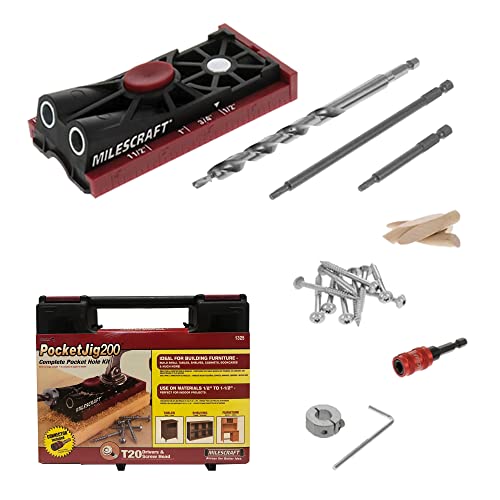
The Milescraft Pocket Jig200 Pocket Hole Kit ($29.99) — The Milescraft Pocket Jig200 is the most thoughtfully equipped kit at the low end. The spring-loaded sled button snaps between four common thicknesses — 1/2, 3/4, 1 and 1-1/2 inch — and there are imperial and metric scales printed right on the body so you can measure your stock without hunting for a tape. There's even a magnet that holds the clamp in position as you move down a board. It lost to the Kreg 320 on two counts: the body is composite, and those four presets are all you get, so a board that isn't a standard thickness leaves you stuck. Owner feedback also flags the drill bit binding in the guide until it's broken in. Choose it if you want the most complete beginner kit and you only ever cut standard lumber.
Getting good joints
Clamp before you drive. A face clamp holding the joint square is what keeps the two boards from shifting as the screw pulls them together, and shifting is the most common complaint you'll hear about pocket hole work. Put glue on the mating surfaces too — glue plus screws is dramatically stronger than screws alone, and it stops the joint from rotating over time. Match your screws to your material: coarse thread for pine, plywood and MDF, fine thread for oak, maple and other hardwoods. Using coarse thread in hardwood strips the joint more often than not. Length follows thickness, roughly 1-1/4 inch for 3/4-inch stock. And blow the chips out of the guide channels every so often, or the bit starts to bind and your holes get ragged.
Questions we get
Which pocket hole jig should a beginner buy?
The Kreg 520PRO is the easiest to learn on. Its auto-adjust dial removes the stop-collar step where most beginners make their first mistake, and the included screw assortment means you can start building without a second trip to the store. If you'd rather spend less, the Kreg 320 does the same joinery and includes a face clamp, but you'll set the depth manually.
Is the 720PRO worth it over the 520PRO?
If you work at a fixed bench, yes. The 720PRO adds an integrated clamp and a dust port that the 520PRO doesn't have, and the clamp alone is a purchase you'd otherwise make separately. If you're mostly working on-site or reaching into assembled cabinets, the 520PRO's rotating handle is more useful than either of those features.
Can you use these on plywood and MDF?
Yes. Standard 3/4-inch plywood and MDF fall comfortably in the 1/2-inch to 1-1/2-inch range that every jig here covers. Use coarse-thread pocket screws — the wider thread pitch grips the layered structure of sheet goods better than fine thread, which is meant for dense hardwood.
How strong is a pocket hole joint really?
Strong enough for cabinets, shelving and furniture, and not strong enough for anything structural. Pocket screws hold well against the loads a cabinet sees but give up much sooner than a mortise-and-tenon joint under tension or racking. Always add wood glue, which does most of the work. Don't use pocket holes in load-bearing connections.
What's the difference between coarse and fine thread pocket screws?
Coarse thread is for softwoods like pine, cedar and poplar, plus sheet goods like plywood and MDF. The wider pitch bites into softer fiber. Fine thread is for hardwoods — oak, maple, walnut, cherry — where a tighter pitch keeps the screw from stripping out dense grain. Most kits include only coarse thread, so buy fine thread separately if you work in hardwood.
Can I build outdoor furniture with 2x4s this way?
You can, with a couple of adjustments. The WEN WA1527's toggle clamp is specified for full 1-1/2-inch 2x4 stock, and the other adjustable jigs cover it too. Use exterior-rated stainless screws rather than the zinc-plated ones in most kits, and position your pocket holes on faces that won't collect standing water.
Why you should trust us
For this guide:
- We compared manufacturer specifications across eight jigs from four brands, looking at thickness range, guide body material, adjustment method and what each kit actually includes.
- We read owner feedback for every model to find the failure modes people run into repeatedly — plastic bases that flex, drill bits that arrive dull, clamps that don't open wide enough.
- We cross-checked published pocket hole joinery guidance on screw selection, thread type and joint strength against what the manufacturers claim.
- We read owner reviews on every listing, weighted toward the critical ones, because that is where the recurring failures show up.
- We have a systematic way of automatically fetching the latest prices, so the numbers on this page stay current.
- This is a research-focused guide, so the team may not own every product listed — though we often do own the top winners, which gives us extra context for the recommendations.
- We don't accept free products, and the retailer commission never changes which product we recommend.
Sources
Best Pocket Hole Jigs Tested and Reviewed, Popular Mechanics
Best Pocket Hole Jigs — Expert Picks and Reviews, Family Handyman
Best Pocket Hole Jigs for Every Budget, Bob Vila
Best Pocket Hole Jigs — Tested and Compared, The Spruce
Pocket-Hole Joinery Strength Testing and Analysis, Fine Woodworking
Amazon product listings and owner reviews for all 8 products
Manufacturer specification pages for each product
Some passages in this guide may be paraphrased with AI help. Prices are refreshed automatically.
More like this.
Continue exploring home reviews and recommendations.

The Best Pillows for Side Sleepers
When you sleep on your side, your pillow has one job: fill the gap between your ear and the mattress so your neck stays level with your spine. That gap is…

The Best White Noise Machines
A white noise machine earns its spot on your nightstand by doing one thing well: covering the sounds that wake you up. That's the garbage truck at 5 a.m.,…

The Best Pressure Washer Surface Cleaners
A surface cleaner is the attachment that makes a pressure washer worth owning. Instead of one jet carving stripes into your driveway, two nozzles spin…

The Best Smart Garden Systems for Fresh Herbs
Fresh herbs go bad fast. You buy a clamshell of basil for one recipe, use a third of it, and find the rest slimy in the crisper a week later. A smart…

The Best Double-Tier Countertop Dish Drying Racks
If you don't have a dishwasher - or you have one and still hand-wash the cast iron, the good knives and the wine glasses - the dish rack is the…

The Best Mattresses for Side Sleepers With Back Pain
Most adults sleep on their side, and if your lower back hurts, that position asks a lot of a mattress. Your shoulder and hip press in hard while your…