The Best White Noise Machines
A white noise machine earns its spot on your nightstand by doing one thing well: covering the sounds that wake you up. That's the garbage truck at 5 a.m., the upstairs neighbor who apparently roller-skates, a snoring partner, a dog that barks at nothing. The trick isn't volume — it's a steady, featureless wall of sound your brain stops noticing. Good machines produce that sound cleanly and hold it all night. Bad ones produce something your ear keeps catching on, which defeats the whole point.
Here's the honest catch: no machine sounds good to everybody. White noise is hissy and bright, and plenty of people find it grating. Pink and brown noise run warmer and lower, and some sleepers only get along with a real spinning fan. You can't audition these before you buy, so there's real trial and error involved. Digital machines also loop, and cheap ones loop short enough that light sleepers notice the seam. Nobody's solved that at the low end.
Most of the machines here do the core job. What separates them is sound quality, whether the loop is detectable, how quiet they'll go, and what else they're trying to be — a clock, a nightlight, a Bluetooth speaker. We think that the LectroFan EVO is the best white noise machine for most people, and that the Yogasleep Dohm Classic is the one to buy if you want the organic sound of a real fan and nothing else.
Everything we recommend

Non-repeating sound, a wide volume range, and it just works

A real fan inside, so the sound never repeats at all

Small, rechargeable, and it does the nursery job properly

A sound machine, sunrise alarm, and reading light in one

Real fan sound with scheduling and app control
At a glance
| Product | Sound Options | Power Source | Price | |
|---|---|---|---|---|
| Adaptive Sound Technologies LectroFan EVO Sound MachineTop pick | 22 Ocean Sounds | — | $64.95 |
| Yogasleep Dohm ClassicRunner-up | — | AC Power Cable | $49.94 |
| Hatch Restore 2 Sunrise Alarm Clock &Upgrade pick | — | — | $149.99 |
| SNOOZ Pro Smart White Noise Sound MachineAlso great | — | — | $119.99 |
| Dreamegg Portable Sound Machine Baby - D11Budget pick | 21 Sounds | USB Rechargeable | $29.99 |
 | Yogasleep Duet White Noise Sound Machine &Also consider | 30 Sounds | — | $44.99 |
 | Adaptive Sound Technologies LectroFan Micro 2 WhiteAlso consider | 11 Sounds | Rechargeable Battery | $44.95 |
How we picked
Loop-free sound. We prioritized machines that either synthesize noise continuously or use a real fan. Published lab analysis has found detectable loops as short as 28 to 45 seconds in budget digital units, which is exactly what wakes light sleepers.
Volume range. We looked for machines that go quiet enough for a nursery and loud enough to cover a snorer. Masking works best around 5 to 10 dB above your room's noise floor, so a usable low end matters as much as a high one.
Sound variety. Pink and brown noise are associated with better slow-wave sleep in peer-reviewed research, so we favored machines offering more than plain white noise. We weighed usable noise variants more heavily than nature-clip count.
Infant safety. For nursery-oriented picks we checked for volume limits, child locks, and dimmable lights. The American Academy of Pediatrics recommends keeping machines at least seven feet from a crib and below 50 dB.
Durability record. We weighed owner feedback about multi-year reliability and brand track record. Published durability work suggests fan-based machines outlast typical digital units by several years.
Top pick
Non-repeating sound, a wide volume range, and it just works
Adaptive Sound Technologies LectroFan EVO Sound Machine
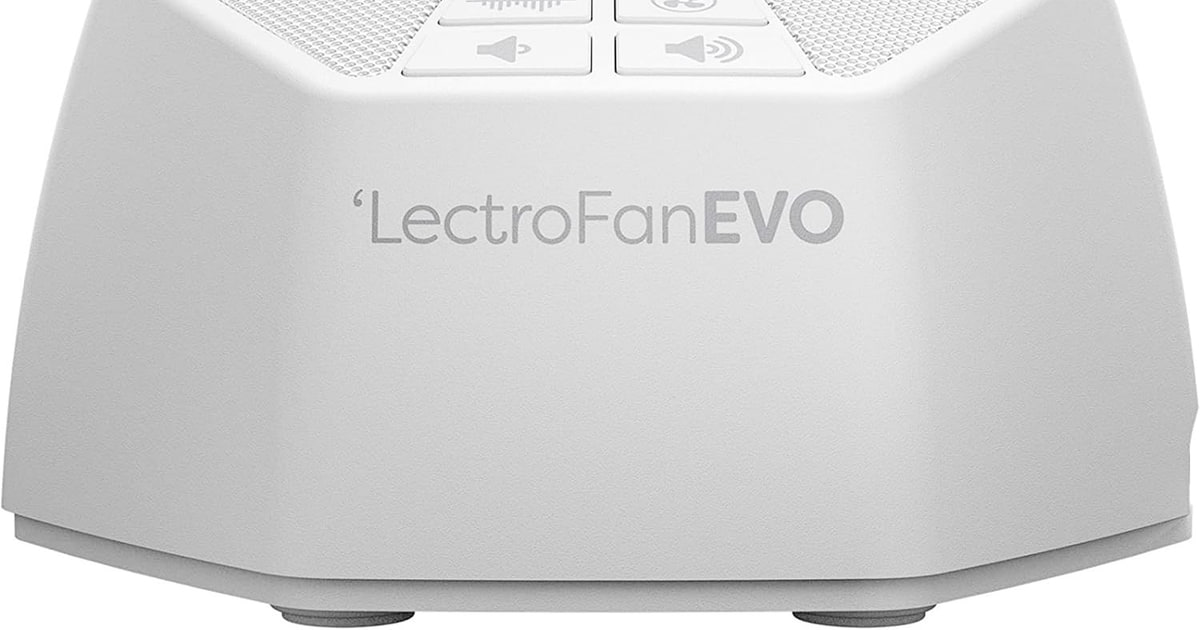
The LectroFan EVO generates 22 non-looping sounds — ten fan variations plus a dozen white, pink, and brown noise options — with upward-firing speakers and fine volume steps. It's the most flexible machine here for people who don't yet know what sound they'll settle on.
$64.95fromAmazonThe non-looping sound is the whole argument for this machine. Cheap digital units play a short recorded clip on repeat, and RTINGS.com has flagged loops as brief as 28 to 45 seconds in sub-budget models. Once you hear the seam, you can't unhear it. The EVO synthesizes its sound instead of replaying a file, so there's nothing to catch on. If you're a light sleeper, that's the single spec that matters most.
Twenty-two sounds sounds like marketing bloat. It isn't, quite. Most machines under a certain price offer six to ten, and they're mostly nature clips you'll never use. The EVO's range is almost entirely fan and noise variants, sorted from bright hiss down to a low rumble. You'll likely land on one setting within a week and never move it again — but you needed the range to find it.
The volume range is unusually wide at both ends. It goes quiet enough for a nursery and loud enough to bury a snoring partner or a thin apartment wall. That matters more than peak loudness. Sleep researchers suggest masking works best when the sound sits about 5 to 10 dB above the room's noise floor, so for a typical bedroom you're aiming for something in the low 40s — and a lot of machines can't go that low without cutting out entirely.
Owners keep mentioning the buttons, which sounds trivial until you're groping for the volume at 3 a.m. with one eye open. They're raised and easy to find by feel. There's also a headphone jack, which is genuinely rare here — useful if you share a bed with someone who can't stand the sound, or if you want to run it through a better speaker.
Flaws but not dealbreakers
It's bigger than the photos suggest — roughly the size of a grapefruit — and some buyers say they expected something more compact. It's fine on a nightstand but it's not a carry-on machine.
There's no app, no scheduling, and no nightlight. If you want your sound machine to also be your alarm clock and reading lamp, look at the Hatch instead. And for what it does, the EVO isn't cheap; a handful of owners have said the sound quality doesn't quite justify the step up from a basic model.
Runner-up
A real fan inside, so the sound never repeats at all
Yogasleep Dohm Classic
The Dohm Classic has an actual motor and fan spinning inside a vented housing, which produces genuinely organic sound rather than a synthesized approximation. Two speeds, one switch, no screen, no app — and a design that's been in continuous production since 1962.
$49.94fromAmazonYogasleep introduced the Dohm in 1962, and it's still built essentially the same way. That's not nostalgia — it's the reason people buy it. A spinning fan can't loop, because there's no recording. You get moving air noise without the moving air, which is why it works in winter and why it doesn't dry out your sinuses the way an actual box fan does.
Longevity is the Dohm's quiet advantage. Wirecutter's durability work found fan-based machines like this one averaging seven-plus years before failure, against three to five for typical digital units. Owner feedback backs that up hard — people routinely report a decade of nightly use, and several describe buying a second one only after the first finally developed a rattle. Very few electronics earn that kind of loyalty.
Setup takes about four seconds. Plug it in, flip the switch to low or high, and twist the top collar to change the tone. There's no menu, no pairing, nothing to update. If you're buying this for a parent, a nursery, or anyone who resents having to learn a device, that simplicity is a feature and not a compromise.
Flaws but not dealbreakers
You get one sound. If the fan tone doesn't work for you, there's no pink noise setting to fall back on, and no timer, no nightlight, no battery. It also has to be plugged in — no portability at all.
Because there's a real motor, there's real mechanical wear. Some owners report a rattle or a whine developing over time, and at least a few buyers who moved to a fan-based competitor said the Dohm was noticeably rougher-sounding by comparison. It's also a bit large for luggage.
Budget pick
Small, rechargeable, and it does the nursery job properly
Dreamegg Portable Sound Machine Baby - D11
The Dreamegg D11 packs 21 sounds, an adjustable nightlight, a timer, and a child lock into something the size of a hockey puck. It runs off its own battery, so it works in a stroller, a hotel room, or a nursery with no outlet nearby.
$29.99fromAmazonFor most parents, this is the right first sound machine. It has the pieces a nursery actually needs: a dimmable amber nightlight for feedings, a memory function so it resumes your last setting, a timer, and a child lock so a curious toddler can't crank the volume. Tom's Guide measured the related D11 Max at roughly 65 dB at a meter, which is more than enough to cover street noise while staying well under any exposure concern.
The battery is the sleeper feature. It charges over USB and runs for a long stretch — owners describe multiple nights on a charge — so it goes in a diaper bag, a car seat, or a hotel nightstand without hunting for an adapter. Anyone who has tried to get a baby down in an unfamiliar room knows how much a familiar sound helps.
Twenty-one sounds is a lot for something this cheap, though the mix skews toward lullabies, shushing, and nature clips rather than pure noise. The white noise options are decent. They're not EVO-grade, and if you're a light sleeper who hunts for loops you may hear one — but plenty of adults use this as their main machine and don't notice.
Flaws but not dealbreakers
It's a small speaker in a small body, so the sound is thinner than the bigger machines here. At high volume it can get a bit harsh.
You have to remember to charge it. Owners mention the frustration of waking up to a dead machine mid-night, and there's no way to know it's low until it quits. Leaving it plugged in solves that but gives up the portability you paid for.
Upgrade pick
A sound machine, sunrise alarm, and reading light in one
Hatch Restore 2 Sunrise Alarm Clock &
The Hatch Restore 2 replaces three bedside devices with one: a curated sound library, a dimmable light that runs from a soft glow to full reading brightness, and a sunrise alarm that brightens gradually before your wake time. It's controlled almost entirely through the app.
$149.99fromAmazonIf you're trying to build an actual sleep routine rather than just mask noise, this is the machine that supports one. A single button starts your wind-down — light dims, sound comes on — and a morning routine brightens the light over a set period before the alarm. Owners consistently describe waking up less groggy, which is the main thing people buy sunrise alarms hoping for.
The light is the real differentiator, not the sound. It's dimmable across the full range, so it works as a reading lamp at night and a clock you can dim to nothing when you want the room genuinely dark. Getting rid of a bright bedside clock display is an underrated sleep improvement on its own. No other machine here does this.
Its sound library leans toward curated, produced tracks — nature-inspired soundscapes rather than raw noise generation. That's a matter of taste. Several owners who found ordinary sound machines repetitive and boring say the variety here is what finally kept them engaged with a bedtime routine.
One practical note: Hatch now sells a newer Restore 3 with improved audio and more on-device controls. The Restore 2 remains a complete product, but it's worth knowing the line has moved on if you care about having the current generation.
Flaws but not dealbreakers
The app is the sticking point. Nearly everything meaningful runs through it, and the least happy owners are almost all complaining about the app's organization rather than the hardware. If you don't want a phone involved in your bedtime, this is the wrong machine.
It's the most expensive option here, and as a pure noise masker it's outclassed by cheaper units. You're paying for the light and the routine, not the white noise.
Also great
Real fan sound with scheduling and app control
SNOOZ Pro Smart White Noise Sound Machine
The Snooz Pro puts an actual fan inside a compact, travel-friendly shell and adds what the Dohm lacks: ten volume levels, adjustable tone, a sleep timer, auto on/off scheduling, and app control. It ships with a travel case and weighs just over a pound.
$119.99fromAmazonThis is the Dohm for people who want a schedule. You get the same non-looping mechanical sound — a real fan, not a recording — plus the ability to have it turn itself on at 9:30 and off at 7. For anyone running a toddler's nap schedule or a shift-work sleep pattern, that automation genuinely removes a chore from the day.
It's smaller and lighter than the Dohm and comes with a case, so it actually travels. Ten discrete volume steps and a tone adjustment give you far more control than the Dohm's two speeds. Several owners who switched from the Dohm specifically mention the Snooz running smoother, without the rattle or whine that older mechanical units can develop.
Setup stays simple despite the smart features. Three buttons on the unit handle power and volume, so you never have to open the app if you don't want to. The app is additive rather than required — the opposite of the Hatch's approach.
Flaws but not dealbreakers
Its maximum volume is the recurring complaint. Fan-based machines can't get as loud as a driven speaker, and at least some owners found even the top setting insufficient for genuinely loud environments like a busy hotel corridor. If you need brute-force masking, a digital unit will go louder.
It's a newer product from a smaller company, with a shorter track record than Yogasleep or LectroFan. And because there's a motor inside, the same long-term mechanical wear questions apply.
Who this is for
Buy one of these if noise is the thing standing between you and sleep — a partner who snores, a street that never quiets down, neighbors with hard floors, a nursery in a busy house. They also help with tinnitus, where a steady background sound gives your ear something else to attend to, and with focus work in an open office or a home with other people in it. The Sleep Foundation estimates 50 to 70 million Americans deal with chronic sleep problems, and for a meaningful slice of them, the problem is simply ambient noise.
Skip these if your sleep trouble is anxiety, pain, an irregular schedule, or apnea — noise masking won't touch any of that, and a machine you bought hoping it would is just an expensive nightstand ornament. This guide covers dedicated sound machines only. We're not looking at earplugs, fans sold as fans, smart speakers with a noise setting, or phone apps, though we'd note that a dedicated machine generally beats an app on speaker quality, steady output, and the simple fact that it can't interrupt you with a notification.
How we picked
Loop-free sound: we favored machines that synthesize noise continuously or spin a real fan, because published lab analysis has found audible loops as short as 28 to 45 seconds in budget digital units. Volume range: a machine has to go low enough for a nursery and high enough to bury a snorer, and masking generally works best at 5 to 10 dB above the room's noise floor. Sound variety: pink and brown noise are associated with better slow-wave sleep in peer-reviewed research, so we weighted usable noise variants above nature-clip counts. Infant safety: volume caps, child locks, and dimmable lights matter, and the AAP recommends at least seven feet of distance from a crib and under 50 dB. Durability: we looked at brand track record and multi-year owner feedback, since fan-based units tend to outlast digital ones.
Other white noise machines worth considering
If you want something that fits in a jacket pocket: The Adaptive Sound Technologies LectroFan Micro 2 White ($44.95) — The LectroFan Micro 2 is barely bigger than a golf ball and gets you 11 non-looping sounds from the same company as our top pick. It charges over USB, pairs as a Bluetooth speaker, has a built-in mic for calls, and its top swivels so you can aim the sound. Owners who travel constantly are its most enthusiastic buyers, and a few describe it as their fix for tinnitus in a quiet hotel room. What you give up is output — a speaker this small can't fill a room the way the EVO does, and it's better at covering a hallway than a highway. Some owners have had units fail within a few months, though the company's replacement handling gets consistently good marks.
If you want a nightlight and a Bluetooth speaker too: The Yogasleep Duet White Noise Sound Machine & ($44.99) — The Yogasleep Duet stacks 30 sounds — including two Dohm signature tones, plus white, pink, and brown noise — an amber nightlight, and a wireless speaker into one small cylinder. You can stream a podcast or a playlist to it, then switch to noise when you're ready to sleep, which makes it a tidy single device for a bedside table or a hotel room. The timer offers 45 minutes, 90 minutes, or eight hours. Two caveats: the nightlight brightness isn't adjustable on all units and several owners find it too bright for a small bedroom, and it has no battery — it must stay plugged in, and the wall adapter isn't included.
The competition
Here's what our research surfaced, not a survey of everything sold. The white noise category is crowded with near-identical machines under a handful of different brand names, and we focused on models with enough published coverage and owner feedback to say something useful about.
Placement and volume
Where you put the machine matters as much as which one you buy. For an infant, the American Academy of Pediatrics recommends keeping it at least seven feet from the crib and under 50 dB — a 2014 study in Pediatrics measured 14 infant sleep machines and found every one exceeded 50 dB at close range, with three passing 85 dB. For adults, resist the urge to crank it. Masking works best at roughly 5 to 10 dB above your room's noise floor, so for a typical bedroom sitting around 30 to 35 dB, a setting in the low 40s usually does the job. Put the machine between you and the noise — near the door or the shared wall, not tucked behind your head. And wipe fan-based units down occasionally, since dust in the housing is what starts the rattle.
Questions we get
Are white noise machines safe for babies?
Yes, with two rules. Keep the machine at least seven feet from the crib and keep the volume below 50 dB, per American Academy of Pediatrics guidance. A 2014 study in Pediatrics found that all 14 infant sleep machines it examined exceeded 50 dB at close range, and three went past 85 dB — so distance and a low setting do the real safety work, not the machine you pick.
What's the difference between white, pink, and brown noise?
White noise spreads energy evenly across frequencies, so it sounds bright and hissy, like static. Pink noise rolls off as frequency rises — its power drops proportionally to 1/f — which makes it warmer and closer to steady rain. Brown noise drops off faster still and sounds like a low rumble. Research in Frontiers in Neuroscience has linked pink noise stimulation to increased slow-wave activity during sleep, and many people simply find the lower-pitched options easier to sleep through.
Do white noise machines loop, and does it matter?
Digital machines that play recorded clips do loop, and RTINGS.com lab analysis has found loops as short as 28 to 45 seconds in budget models. Whether it matters depends on you — plenty of people never notice. But if you're a light sleeper, a repeating seam is exactly the kind of irregularity that pulls you out of sleep. Machines that synthesize noise, like the LectroFan EVO, or that use a real fan, like the Dohm and the Snooz Pro, sidestep the problem entirely.
Is a mechanical fan machine better than a digital one?
Better at one thing, worse at another. A real fan can't loop and tends to last longer — published durability work puts fan-based machines at seven-plus years against three to five for typical digital units. But you get exactly one sound, no timer or battery in most cases, and mechanical parts that can eventually rattle. If the fan tone works for you, it's a great buy. If you want pink noise, scheduling, or portability, go digital.
Can I just use a white noise app instead?
You can, and it's free, but a dedicated machine is meaningfully better. Phone speakers are small and thin-sounding, app volume can shift when other audio plays, and a notification at 2 a.m. undoes the whole point. Your phone also has to stay on your nightstand all night, charging. If you're only covering noise a few nights a year, an app is fine — otherwise the machine earns its place.
How loud should I set it for adult sleep?
Lower than you probably think. Masking works best when the sound sits about 5 to 10 dB above the room's background level, and a typical bedroom runs around 30 to 35 dB — so a setting in the low 40s is usually plenty. Going louder doesn't mask better, it just adds noise of its own. Turn it up only until the sound you're trying to cover stops registering.
Why you should trust us
For this guide:
- We compared manufacturer specifications for every machine here, covering sound count, loop behavior, volume range, power source, and stated features.
- We read published lab analysis and review coverage from outlets including RTINGS.com, Tom's Guide, and Wirecutter, along with American Academy of Pediatrics guidance and peer-reviewed sleep research on pink noise.
- We read through owner feedback for recurring themes — battery life, nightlight brightness, long-term rattle in fan units, and app frustrations — and used those patterns to shape the flaws sections.
- We read owner reviews on every listing, weighted toward the critical ones, because that is where the recurring failures show up.
- We have a systematic way of automatically fetching the latest prices, so the numbers on this page stay current.
- This is a research-focused guide, so the team may not own every product listed — though we often do own the top winners, which gives us extra context for the recommendations.
- We don't accept free products, and the retailer commission never changes which product we recommend.
Sources
Best White Noise Machines — Wirecutter, Wirecutter (NYT)
Best White Noise Machines — RTINGS.com, RTINGS.com
White Noise for Sleep: Benefits, Risks & Research, Sleep Foundation
Best White Noise Machines — Good Housekeeping Institute, Good Housekeeping
Best White Noise Machines 2026 — Tom's Guide, Tom's Guide
Safe Sleep Guidelines for Infants — HealthyChildren.org, American Academy of Pediatrics
Pink Noise vs. White Noise for Sleep — Healthline, Healthline
White Noise Machine Reviews — CNN Underscored, CNN Underscored
Acoustic Characteristics of Infant Sleep Machines — Pediatrics (AAP Journal), Pediatrics (AAP)
Pink Noise and Slow-Wave Sleep — Frontiers in Neuroscience, Frontiers in Neuroscience
Amazon product listings and owner reviews for all 7 products
Manufacturer specification pages for each product
Some passages in this guide may be paraphrased with AI help. Prices are refreshed automatically.
More like this.
Continue exploring home reviews and recommendations.

The Best Budget Noise Canceling Headphones
Noise canceling headphones earn their keep in the boring parts of your day. The bus that idles for ten minutes. The open-plan office where someone always…

The Best Noise Canceling Earbuds
Noise canceling earbuds earn their keep in a handful of specific moments. The rumble of a subway car. An open-plan office where three people type like…

The Best Noise-Cancelling Wireless Earbuds
Good noise cancelling changes how a commute feels. The train rumble drops away, an airplane's engine drone turns into a soft hush, and the open-plan…

The Best Noise-Reducing Garbage Disposals
A garbage disposal is one of the loudest things in your kitchen, and you run it almost every day. A cheap one turns a five-second cleanup into a jarring…

The Best Noise-Cancelling Wireless Earbuds
Good noise cancellation changes what a commute feels like. The subway rumble drops away, the plane engine turns into a distant hush, and the guy on…

The Best Noise-Cancelling Headphones for Focus and Deep Work
Most of us don't get to pick where we work. The open-plan office hums, the espresso machine shrieks, and the guy two desks over takes every call on…