The Best Wine Coolers and Beverage Refrigerators
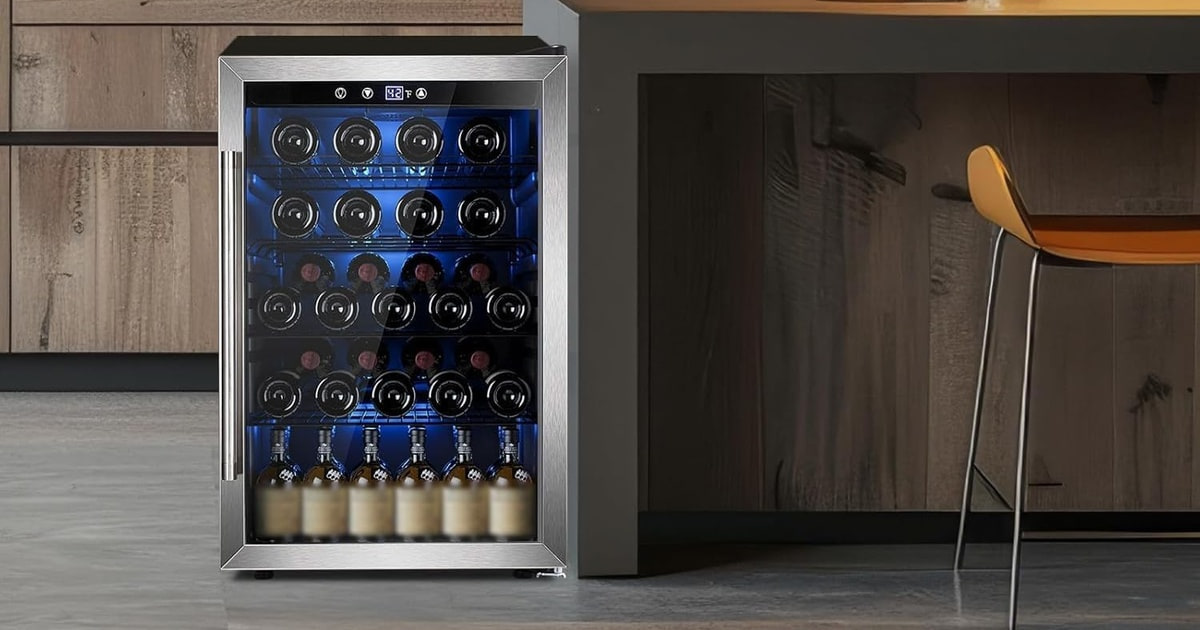
A wine cooler does one job: it holds a steady, cellar-ish temperature so your bottles don't cook on a kitchen counter or freeze in the back of the fridge. Reds want roughly 55 to 65 degrees, whites and sparkling closer to 45 to 55. A beverage fridge is a different animal. It runs colder, swallows a lot more cans, and gives you shelves you can move around for 2-liter bottles and tall cans. Figuring out which one you actually want is most of the work.
Here's the honest part. No unit in this price range ages wine the way a real cellar does. Almost none of them actively control humidity, and the ones that claim to are mostly relying on a tight door seal. Bottle counts are optimistic too, because manufacturers count skinny Bordeaux bottles. Load in Burgundy, Pinot or Champagne and you'll lose a fifth of your space. Thermoelectric models run silent but give up when your room gets hot. Compressor models don't care about the room, but you'll hear them.
So buy for your space and your drinking habits, not for a fantasy collection. If you've got a 24-inch gap under the counter, that changes everything. If the fridge is going in a living room, noise matters more than capacity. We think that the Kalamera 24 inch Wine Cooler is the best wine cooler for most people, and that the Wine Enthusiast 32-Bottle Dual Zone MAX is the one to buy if it's going to live out in the open where you'll see and hear it.
Everything we recommend

Two real zones, and it fits under a counter or doesn't

Wine-first tuning in a cabinet you won't want to hide

A lot of bottle space, minus the extras

The one that actually fits a narrow undercounter slot
At a glance
| Product | Capacity | Temp Range | Price | |
|---|---|---|---|---|
| Kalamera 24 inch Wine CoolerTop pick | 46 Bottles | 40-66°F | $562.82 |
| NewAir 15" Dual Zone Wine Fridge forAlso great | 29 Bottles | — | $530.11On sale |
| Electactic Wine Cooler 37 Bottle Freestanding FridgeBudget pick | 37 Bottles | 32-61°F | $269.98On sale |
 | COWSAR Wine CoolerAlso consider | 26 Bottles | — | $259.98 |
| Wine Enthusiast 32-Bottle Dual Zone MAX CompressorRunner-up | 32 Bottles | — | $529 |
 | Koolatron Urban Series 20 Bottle Wine CoolerAlso consider | 20 Bottles | 46-66°F | $250.78 |
 | Feelfunn 126 Can Beverage RefrigeratorAlso in lineup | 126 Cans | 34-64°F | $194.99On sale |
 | EUHOMY 4.5 Cu.ft Beverage Refrigerator and CoolerAlso consider | 145 Cans | 32-61°F | $254.99On sale |
 | Koolatron 18 Bottle Dual Zone Wine CoolerAlso in lineup | 18 Bottles | 46-66°F | $367.28 |
 | Antarctic Star 36 Bottle Wine Cooler/Cabinet BeverageRefrigeratorAlso consider | 36 Bottles | 32-61°F | $299.99 |
How we picked
Cooling technology. We favored compressor cooling for anything that has to survive a warm kitchen, garage or basement, since thermoelectric units lose efficiency above roughly 75 to 80 degrees ambient. Thermoelectric only earned a place where silence and zero vibration were the point.
Temperature range. We compared published spec sheets against the ranges wine writers recommend — roughly 55 to 65 degrees for reds and 45 to 55 for whites and sparkling. Units that couldn't cover both, or that only claimed a wide band without zone separation, dropped in the ranking.
Venting and fit. We separated genuinely front-venting built-in models from freestanding units that merely say "built-in or freestanding" on the box. We also checked stated dimensions against the standard 15-inch and 24-inch cabinet openings people actually have.
Honest capacity. Every bottle count on every listing assumes slim Bordeaux bottles, so we treated the stated numbers as ceilings, not promises. Where a listing quoted both bottles and cans, we looked at cubic feet to sanity-check the claim.
Noise and vibration. We read owner feedback themes and manufacturer decibel claims together, since a spec under 40dB and a compressor that clunks on startup are different problems. Vibration mattered most for anything meant to hold bottles longer than six months.
Top pick
Two real zones, and it fits under a counter or doesn't
Kalamera 24 inch Wine Cooler
The Kalamera 24 inch is a dual-zone compressor cooler that works either built into a 24-inch cabinet run or standing on its own. You get separate temperatures for reds and whites, wood racking, and stainless trim, without paying what a plumbed-in luxury brand costs.
$562.82fromAmazonTwo zones means you stop compromising. The upper zone runs 40 to 50 degrees and the lower runs 50 to 66, so whites and sparkling live up top while reds sit below at serving temperature. If you drink both — and most households do — this is the whole reason to spend more than the price of a single-zone box. Pull a bottle out and it's ready. No twenty minutes in an ice bath first.
It's built-in ready, which is rarer than the listings suggest. Plenty of coolers say "built-in or freestanding" and then vent out the back. This one is designed to slide into a standard 24-inch undercounter opening at 23.4 inches wide and 33 inches tall. If you're mid-renovation and you've already got the gap, that flexibility is worth a lot. And if your plans change, it works just as well parked at the end of a counter.
A compressor keeps working when the room gets warm. Thermoelectric coolers lose the plot above about 75 to 80 degrees ambient — a real problem in a July kitchen or an un-air-conditioned dining room. Compressor cooling doesn't have that ceiling. Published reviews of this class of unit consistently point to compressor cooling as the requirement for anything you plan to keep loaded year-round rather than seasonally.
The small stuff is thought through. The racking uses an FSC-certified wood frame instead of bare wire, which cushions bottles and keeps labels from scuffing when you slide a shelf out. There's a temperature memory function, so after a power blip it returns to your setting instead of defaulting to something random. The LED display sits on the front where you can read it without opening the door and dumping cold air.
Flaws but not dealbreakers
The bottle count assumes bottles you probably don't own. Like every manufacturer, Kalamera counts standard Bordeaux bottles. Stack in Burgundy, Pinot Noir or Champagne — all noticeably wider — and you'll lose real capacity, often 20 to 30 percent. If your collection skews that way, mentally knock the number down before you buy.
There's no app and no alerts. You won't get a phone notification if the temperature drifts or someone leaves the door ajar. You find out by walking over and looking at the display. That's fine for most people, but if the unit is going in a basement you rarely visit, an inexpensive standalone thermometer is a cheap insurance policy.
It's not a quiet-room appliance. A compressor cycles on and off, and while this one is on the quieter end of its class, you'll notice it in a silent open-plan space at night. It's not obtrusive in a working kitchen. It is noticeable in a home office.
Runner-up
Wine-first tuning in a cabinet you won't want to hide
Wine Enthusiast 32-Bottle Dual Zone MAX Compressor
The Wine Enthusiast 32-Bottle Dual Zone MAX is a freestanding dual-zone cooler from a brand that only does wine storage. It holds reds and whites at separate temperatures, runs quietly for a compressor unit, and looks like furniture rather than an appliance.
$529fromAmazonThis is the one to buy if it's going to be visible. The matte black cabinet and glass door read as furniture, not as a mini fridge someone shoved in the corner. At 17 inches deep and 19.5 wide, it slots against a wall in a dining room or next to a bar cart without dominating the space. If your cooler is part of the room instead of hidden under a counter, that matters more than an extra few bottles of capacity.
The dual-zone MAX compressor is tuned for wine, not for cans. Wine Enthusiast has been in this category for decades, and the temperature bands line up with what wine writers actually recommend: reds in the mid-50s to mid-60s, whites and sparkling in the mid-40s to mid-50s. Plenty of cheaper coolers advertise a range that's technically wide enough but wanders within it. This one is engineered around the narrow band that matters.
A digital touchscreen makes it easy to leave alone. You set each zone once and check it occasionally. The LED display is readable across a room, and the interior lighting turns the cabinet into a display case when you want it to. The racks are shaped to cradle bottles rather than pinch them, so labels stay intact even on bottles you slide in and out often.
Quiet operation is the underrated feature here. Compressor units all make noise, but the gap between models is wide. This one runs on the low end for its class, which is why it works in a bedroom or office where the Kalamera might annoy you. You'll hear it start. You won't hear it running.
Flaws but not dealbreakers
Freestanding only — don't try to build it in. There's no front venting here. Shove it into an enclosed cabinet and you'll block airflow, which makes the compressor run constantly, shortens its life and quietly raises your power bill. It needs several inches of clearance behind and beside it. If you have an undercounter slot to fill, buy the Kalamera or the NewAir instead.
You pay more per bottle than the budget options. Thirty-two bottles is a fine number for someone who drinks their wine within a year or two, but it's not a collection. Freestanding single-zone coolers hold more for less. You're paying for the tuning, the finish and the brand's track record, and whether that's worth it depends on how much you care about the bottles inside.
No connectivity, no humidity control. There's no Wi-Fi monitoring and no active humidification — it relies on a sealed door to keep the interior from drying out. For wine you'll drink within a couple of years, that's a non-issue. For corks you need to keep supple for a decade, this isn't the appliance category you want.
Budget pickOn sale
A lot of bottle space, minus the extras
Electactic Wine Cooler 37 Bottle Freestanding Fridge
The Electactic 37 Bottle holds a real collection — or 145 cans if you'd rather — for a fraction of what the built-in dual-zone units cost. It's single zone with a compressor, a reversible glass door and adjustable chrome racks, and that's about the whole story.
$269.98fromAmazonList priceYou get serious capacity without paying for a second zone. Thirty-seven bottles is more than most people ever fill, and if you'd rather load it with cans, the 4.5-cubic-foot interior swallows 145 of them. If you mostly drink one style of wine, or you're happy setting a single compromise temperature around 55 degrees, you're paying for the part you'll actually use.
It's a compressor, not a thermoelectric shortcut. The 32-to-61-degree range is compressor-driven, so a hot kitchen or a warm basement in August won't push it past its limits. That's the single most important spec at this price, and it's where a lot of budget coolers quietly cut corners. Published reviews of the category consistently flag ambient-temperature performance as the thing budget thermoelectric models get wrong.
The reversible door solves real placement problems. You can hang the door to open left or right, which sounds trivial until you're trying to fit a fridge into a corner of a pantry or a narrow bar nook. Add adjustable chrome racks and interior LED lighting and you've got a unit that adapts to your space rather than the other way around.
It's the right buy for a garage, basement or game room. At 31.5 inches tall and just over 20 wide, it slides in almost anywhere. If the cooler isn't a design object and you just want cold bottles nearby, spending more mostly buys you finish and a second thermostat.
Flaws but not dealbreakers
One zone means one compromise. Reds and whites share a temperature, so you're picking somewhere in the middle and letting one style sit slightly wrong. Fifty-five degrees is the usual answer and it works fine for wine you'll drink soon. It's not what you want if you're serving both styles at their best on a regular basis.
Electactic doesn't have much of a track record. It's a newer name, which means less long-term reliability history and less certainty about how a warranty claim goes if the compressor quits in year three. That's the real trade you're making here, and it's worth going in with eyes open.
No humidity control and no UV-coated glass called out. Reviewers who look at budget compressor coolers also note that temperature can vary noticeably between the top and bottom shelves. Drop a cheap standalone thermometer on the top rack and the bottom one after setup, and adjust where you store what accordingly.
Also greatOn sale
The one that actually fits a narrow undercounter slot
NewAir 15" Dual Zone Wine Fridge for
The NewAir 15" Dual Zone is built for the 15-inch cabinet opening that shows up in a lot of American kitchens. It front-vents, so it can go into a fully enclosed space, and it still manages two independent temperature zones and wood shelves.
$530.11fromAmazonList priceIt's sized for a cutout, not for a countertop. At 14.88 inches wide and 33.75 tall, it drops into a standard 15-inch undercounter opening without custom trim or filler panels. If your cabinetry already has that gap — a lot of kitchens do — this is the simplest way to fill it with something useful. Wider coolers mean demolition. This one means a Saturday.
Front venting is the spec that makes built-in installation legal. Rear- and side-venting coolers need several inches of clearance and will overheat in an enclosed cabinet. This one exhausts through the front grille, so it can be fully boxed in on three sides. That distinction is easy to miss on a listing page and expensive to get wrong.
Two zones in a narrow body is genuinely hard to find. The compressor runs independent temperatures for reds and whites, which most 15-inch units skip to save space. The double-pane UV-protected glass door helps insulate against a warm kitchen and keeps light off the labels. A reversible hinge means it opens whichever way your kitchen traffic runs.
Wood shelves slide out smoothly and treat bottles gently. The shelves cradle bottles rather than resting them on wire, so labels stay clean when you pull a bottle from the back. The LED display is bright enough to read in a dim kitchen without opening the door.
Flaws but not dealbreakers
Twenty-nine bottles is not a lot for what it costs. Cost per bottle is the highest among our picks by a wide margin. You're paying for the narrow footprint and the built-in engineering, and that's a reasonable trade if you have the cutout. If you don't, this is the wrong unit.
You'll hear the compressor start up. In a busy kitchen it disappears. In a quiet open-plan space at night, the startup cycle is audible enough to notice. That's typical for compressor coolers in a small cabinet, but worth knowing before you commit it to a room you sit in.
The beechwood shelving feels lighter than the price suggests. It does the job — bottles stay put and labels stay intact — but it doesn't have the heft you'd expect at this tier. Cosmetic, not functional.
Who this is for
Buy one of these if you're tired of storing wine on top of the refrigerator, or if your regular fridge is permanently full of cans. A dedicated cooler is worth it once you're keeping more than a case around, or once you've started caring whether a white is served at the right temperature. It's also worth it if you entertain and you'd rather not clear a shelf every time people come over. Renters, apartment dwellers and anyone with an open-plan living space should weight noise heavily — that's where the thermoelectric options earn their keep.
Skip this whole category if you're building a real cellar. Nothing here actively manages humidity, and none of it is designed for bottles you plan to hold for a decade. These are short- to medium-term storage appliances, and that's the honest framing. This guide covers freestanding and undercounter units in the roughly 18-to-40-bottle range plus beverage fridges up to about 145 cans. It doesn't cover full-height columns, passive cellar racking, or anything that needs a licensed installer.
How we picked
We started from spec sheets, published reviews and owner feedback themes rather than a showroom floor. Cooling technology: compressor for anything facing a warm room, thermoelectric only where silence and zero vibration are the actual goal. Temperature range: the unit has to cover roughly 45 to 65 degrees, and a dual-zone claim has to mean two independently controlled zones, not one thermostat and a divider. Venting and fit: front-venting models can be enclosed under a counter; everything else needs several inches of clearance, and we checked widths against real 15-inch and 24-inch cabinet openings. Honest capacity: stated bottle counts assume slim Bordeaux bottles, so we treated them as ceilings and cross-checked against cubic feet. Noise and vibration: manufacturer decibel figures only tell you so much, so we weighed them against what owners report about startup clunks and hum.
Other wine coolers and beverage refrigerators worth considering
If you want the most cans you can get: The EUHOMY 4.5 Cu.ft Beverage Refrigerator and Cooler ($254.99) — The EUHOMY 145-Can is the volume play. Its 4.5-cubic-foot interior takes 145 cans or, per the listing, 37 wine bottles, and the compressor is rated below 40dB, which is quiet for something this size. The 32-to-61-degree range and adjustable shelving make it flexible enough for a garage beer fridge that occasionally holds wine. What you give up is precision and footprint: it needs its own dedicated space, it isn't tuned for wine specifically, and you'll hear it in a quiet room. EUHOMY offers 12-month technical support on it.
If you want silence and zero vibration: The Koolatron Urban Series 20 Bottle Wine Cooler ($250.78) — The Koolatron Urban Series 20 Bottle uses thermoelectric cooling, which means no compressor and no vibration at all. That's a real advantage for bottles you plan to hold six months or longer, since sustained micro-vibration can disturb sediment and interfere with slow aging. It cools to 46 to 66 degrees, has touchscreen controls and a mirrored UV-protective glass door, and its five stainless racks come out for oddly shaped bottles. The catch is ambient temperature: keep it in a room that stays below about 75 degrees or it will struggle. Twenty bottles, single zone.
If you want wine and cans in one cabinet: The COWSAR Wine Cooler ($259.98) — The COWSAR 26 Bottle 130 Can splits the difference so you don't have to buy two appliances. It's ETL approved, runs a quiet compressor across a 40-to-61-degree range, and has four removable shelves plus a dual-pane glass door. At 17.32 inches wide it fits where a full-size beverage fridge won't, and the reversible door and adjustable feet make it workable in an RV or a dorm. The compromise is real, though: 26 bottles won't hold a collection, and neither side of the split is optimized the way a dedicated unit would be.
If you want a large single-zone freestanding cooler: The Antarctic Star 36 Bottle Wine Cooler/Cabinet BeverageRefrigerator ($299.99) — The Antarctic Star 36 Bottle is a straightforward compressor cooler with a 32-to-61-degree range and horizontal racking that keeps sediment undisturbed. The reinforced, air-tight glass door helps hold interior conditions steady, the blue LED lighting makes it presentable in a living room, and adjustable leveling legs help the door close properly. It's a good pick if you mostly drink one style at a time. But it's single zone only and the listing is explicit that it's freestanding — do not build this one in.
The competition
This is what our research surfaced, not a census of the market. Wine and beverage refrigeration turns over quickly, and plenty of capable units from smaller brands never make it into published roundups. The two below are legitimate products that lost to a pick for specific reasons.
The Feelfunn 126 Can Beverage Refrigerator ($194.99) — The Feelfunn 126 Can is a competent beverage fridge with a 34-to-64-degree range, four adjustable shelves and a low-E double-glazed door. Its quoted 36dB noise level and roughly 0.79 kWh daily draw are both good numbers, and the reversible door and adjustable feet make placement easy. It lost to the EUHOMY on raw capacity and to the Electactic on wine flexibility — it sits between the two without beating either. Feelfunn is also a newer brand with limited history. Worth a look if its dimensions happen to fit your space better; the company offers a one-year accessory maintenance service.
The Koolatron 18 Bottle Dual Zone Wine Cooler ($367.28) — The Koolatron 18 Bottle Dual Zone is the quietest thing here, full stop. Thermoelectric cooling in two separately controlled zones, each holding nine Bordeaux bottles at 46 to 66 degrees, with no vibration to disturb sediment and a UV-protective mirrored door. At 1.7 cubic feet it fits on a countertop. It didn't make the picks because 18 bottles is very few for the money, the zone temperature spread is narrower than a compressor can manage, and efficiency drops off above about 75 degrees ambient. If you want dual zones in a room where any appliance noise is unacceptable, it's still the answer.
Installation and placement
The rule that matters most: never enclose a freestanding cooler. Rear- and side-venting units need three to five inches of clearance on every side except the door. Box one into a cabinet and the compressor runs nonstop, which shortens its life by years and shows up on your power bill. Only units explicitly labeled front-venting or built-in ready belong in an undercounter slot. Beyond that, level the unit with the front legs slightly extended so the door swings shut on its own — a door left ajar is the most common cause of a cooler that "won't hold temperature." Put a cheap standalone thermometer on the top shelf and another on the bottom for the first week. Budget coolers often run a few degrees apart between racks, and once you know the gradient you can store bottles accordingly.
Questions we get
What's the difference between a wine cooler and a beverage refrigerator?
A wine cooler is tuned for the narrow 45-to-65-degree band wine wants, and usually adds vibration damping, UV-resistant glass and a tight seal to hold humidity. A beverage fridge runs colder — often into the mid-30s — and prioritizes volume and movable shelves for cans and 2-liter bottles. If you mostly drink beer and soda, the wine-specific engineering is money you don't need to spend.
Can I use a wine cooler as a regular refrigerator?
No. Wine coolers typically bottom out around 40 to 45 degrees, which is too warm for food safety — perishables need 40 degrees or below. They also lack the airflow and humidity management that a kitchen fridge uses to slow bacterial growth. Store drinks in one, not leftovers.
Thermoelectric or compressor — which should I get?
Compressor, for most people. It cools reliably no matter how warm the room gets and holds a tighter temperature. Go thermoelectric only when near-silent operation and zero vibration matter more than capacity, and only if the unit will live somewhere that stays below about 75 degrees year-round.
What temperature should I set for red and white?
Reds at 55 to 65 degrees, whites and sparkling at 45 to 55. Sparkling does best at the cool end, around 45 to 48. If you've got a single-zone unit and mixed bottles, 55 degrees is the standard compromise and it works fine for wine you'll open within a couple of years.
Do all wine coolers need venting, and can I put a freestanding one under a counter?
All of them vent — the question is where. Built-in models exhaust through the front and are designed to be fully enclosed. Freestanding models vent from the rear or sides and must not be boxed in. Doing it anyway makes the compressor run continuously and fail early, and it's not covered by any warranty we're aware of.
Will it really hold the number of bottles on the box?
Only if your bottles are slim Bordeaux-style ones, which is what every manufacturer counts. Burgundy, Pinot Noir and Champagne bottles are wider and can eat 20 to 30 percent of the stated capacity. If your collection skews that way, shop one size up from what the number suggests.
Why you should trust us
For this guide:
- We compared manufacturer spec sheets across all ten units, focusing on stated temperature ranges, venting type, decibel claims and interior volume rather than headline bottle counts.
- We read published reviews and buying guides from wine and appliance publications on how compressor and thermoelectric cooling behave in warm rooms, and on why vibration matters for longer-term storage.
- We drew on owner feedback themes to identify the failure modes that come up repeatedly in this category — door seals, shelf-to-shelf temperature variation and compressor noise — and weighted those over spec-sheet differences.
- We read owner reviews on every listing, weighted toward the critical ones, because that is where the recurring failures show up.
- We have a systematic way of automatically fetching the latest prices, so the numbers on this page stay current.
- This is a research-focused guide, so the team may not own every product listed — though we often do own the top winners, which gives us extra context for the recommendations.
- We don't accept free products, and the retailer commission never changes which product we recommend.
Sources
Best Wine Refrigerators of 2026 — Wirecutter (NYT), Wirecutter / NYT
Best Wine Coolers 2026 — Good Housekeeping, Good Housekeeping
Best Beverage Refrigerators 2026 — Consumer Reports, Consumer Reports
Best Wine Coolers — Forbes Home, Forbes Home
Best Wine Refrigerators — Bob Vila, Bob Vila
Wine Storage Temperature and Humidity Guide — Wine Spectator, Wine Spectator
The Science of Wine Storage — Decanter, Decanter
Built-In vs. Freestanding Wine Coolers — Appliances Connection Buying Guide, Appliances Connection
Amazon product listings and owner reviews for all 10 products
Manufacturer specification pages for each product
Some passages in this guide may be paraphrased with AI help. Prices are refreshed automatically.
More like this.
Continue exploring appliances reviews and recommendations.

The Best Portable Car Refrigerators
A 12V compressor fridge changes how you travel. There's no ice to buy, no meltwater sloshing around your sandwiches, no soggy cardboard at the bottom of…

The Best Electric Wine Openers
Opening a bottle shouldn't be a workout. But if your hands ache, or you're pouring for eight people at once, a waiter's corkscrew gets old fast. An…

The Best Soda Makers and Sparkling Water Machines
If you drink sparkling water every day, you already know the routine: hauling cases home, stacking cans in the garage, hauling the empties back out. A…

The Best Espresso Machines for Home Baristas
Good espresso at home comes down to three things happening at once: water at the right temperature, pressure that holds steady through the shot, and…

The Best Smart Kitchen Scales
Weighing your food is the fastest way to stop guessing. A cup of flour can swing by a third depending on how you scoop it, and a serving of peanut butter…

The Best Noise-Reducing Garbage Disposals
A garbage disposal is one of the loudest things in your kitchen, and you run it almost every day. A cheap one turns a five-second cleanup into a jarring…