The Best Portable Grills for Camping and Tailgating
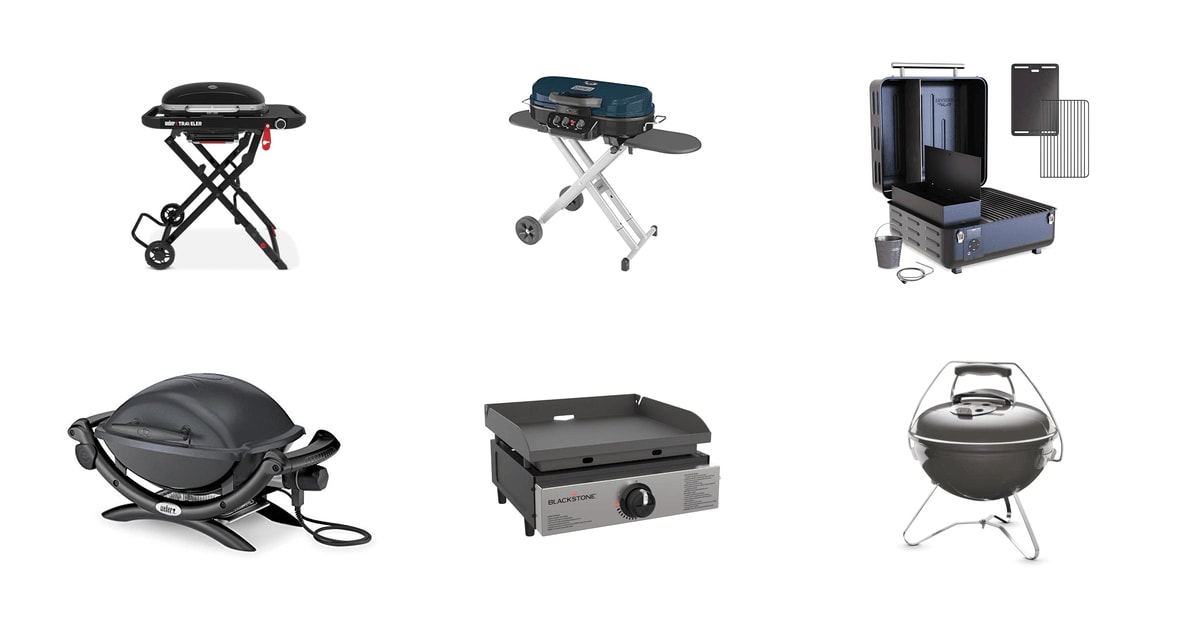
A portable grill lives a hard life. It rides in a trunk, gets set up on a picnic table that wobbles, and has to make dinner before everyone gets cranky. So the things that matter aren't the ones printed on the box. You want a grill that lights on the first try, holds its heat when the wind picks up, and folds down without a wrestling match. Cooking space matters too. Plan on roughly 200 square inches to feed three or four adults without cooking in shifts.
Here's the honest part: no portable grill does everything well. Small fireboxes shed heat fast, so a cold, breezy parking lot will cost you temperature no matter which model you buy. Grease management is worse than on a backyard grill, and you'll be scraping grates with no sink in sight. Fuel is a compromise too. Propane is easy but tame, charcoal tastes better and takes longer, and pellets need electricity. Mostly you're picking which annoyance you can live with.
Most people should start with propane. It lights fast, holds a steady temperature, and stays legal at campgrounds during fire restrictions, when charcoal and wood usually don't. Consumer surveys line up with that — roughly six in ten portable grill owners cook on gas. If you'd rather have real smoke, or a flat top for eggs and smash burgers, there are good options here for that too. We think that the Weber Traveler is the best portable grill for most people, and that the Coleman RoadTrip 285 is the one to buy if you're feeding a tailgate crowd of six or more.
Everything we recommend
Big grate and easy folding, if you can carry 37 pounds
More burners and a rolling cart, at the cost of real bulk

Real charcoal flavor in something you can carry one-handed

Genuine wood smoke on the road, if you can supply power

A flat top beats grates for breakfast and smash burgers
At a glance
| Product | Weight | Fuel Type | Price | |
|---|---|---|---|---|
| Weber® Traveler® Compact Portable Gas Grill forTop pick | 37 lbs | Propane | $299 |
| Coleman RoadTrip 285 Portable Stand-Up Propane GrillRunner-up | 46.67 lbs | Propane | $424.58 |
| Traeger Ranger Portable Wood Pellet Grill &Upgrade pick | 54 lbs | Wood Pellet | $479.99 |
 | Weber® Q 1400 Portable GrillAlso in lineup | 29.5 lbs | Electric | $349 |
| Blackstone 1971 Original 17" Omnivore Tabletop GriddleAlso great | 17.5 lbs | Gas | $129.99 |
| Weber Smokey Joe Premium Charcoal BarbecueBudget pick | — | Charcoal | $247.43 |
 | Charbroil Grill2Go X200 Portable Gas GrillAlso consider | 24 lbs | Gas | $179.99 |
How we picked
Cooking area. We sorted models by the grate dimensions manufacturers publish, so we could see how many people each one can actually feed at once. Anything under about 200 square inches means cooking in shifts for a group of four, so we treated that as the line between a couple's grill and a family's.
Real portability. We compared published weights, folded dimensions and carry hardware — locking lids, latches, handles and wheels. A grill that needs two people to load, or that sheds legs and parts into the trunk, loses to one that folds as a single piece.
Fuel and site rules. We checked National Park Service restriction language, which permits gas and pressurized-fuel devices even when charcoal and wood fires are banned. That made propane the safest default and pushed charcoal and pellet models into more specific roles.
Heat and wind. We looked at rated BTU output relative to grate size, plus grate material and firebox construction, since thin metal in a breezy lot is where cheap grills fail. Published reviews and owner feedback about even heating carried more weight than raw BTU numbers.
Cleanup and upkeep. We favored grease management you can handle without a sink: pull-out trays, rear grease channels, porcelain enamel that releases stuck-on food. Owner feedback about long-term burner and finish durability broke ties between otherwise similar models.
Top pick
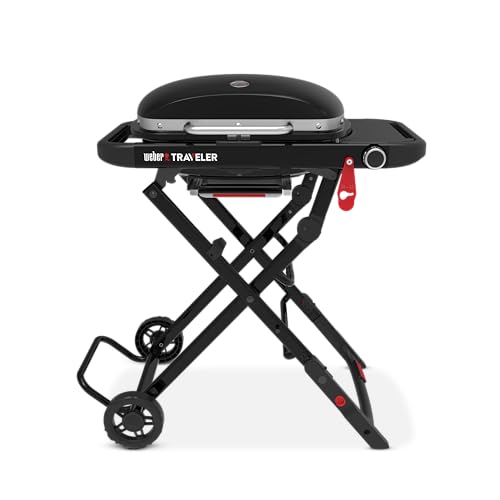
Big grate and easy folding, if you can carry 37 pounds
Weber® Traveler® Compact Portable Gas Grill for
The Traveler gives you a 320-square-inch cast iron grate that folds down to a 6.5-inch profile and locks itself shut for the ride home. It's heavy for a portable, but it cooks a dozen burgers at once and sets up in about the time it takes to unload a cooler.
$299fromAmazonThis is the portable grill that behaves like a real grill. The 320-square-inch porcelain-enameled cast iron grate is bigger than most tabletop models, and Weber rates it at 13,000 BTU per hour — enough to sear a steak rather than just cook it through. Weber says the grate holds 12 burgers or 15 sausages. That's dinner for four with room to spare, not four rounds of cooking while everyone hovers.
The folding is the part you'll appreciate at nine at night in a dark lot. Press the lever, the cart drops, the lid locks itself, and you roll the whole thing away on wheels that handle gravel. Weber lists the folded profile at 6.5 inches, thin enough to slide into a trunk next to a cooler. Nothing detaches, so there are no legs to lose.
Good Housekeeping Institute reviewers named it their best overall portable propane grill and singled out how evenly it heats across the full grate. That's the practical difference cast iron makes. Burgers near the edges cook at roughly the same pace as the ones in the middle, so you're not constantly shuffling food toward a hot spot the way you do on thin stainless grates.
Owners who moved over from Weber's smaller Q series say the Traveler gets hotter and goes up faster. Cleanup is easier than you'd expect too — cast iron scrapes down well while it's still warm, and the grease tray pulls out in one piece. If you camp a dozen weekends a year, that difference adds up fast.
Flaws but not dealbreakers
It's the heaviest thing here that still calls itself portable. At 37 pounds with a cart, it's awkward to lift over a tailgate by yourself, and it's not something you carry any real distance from the car. If your site is a hike from the parking spot, buy something smaller.
It also runs on 1-pound canisters out of the box, and no adapter hose is included — several owners flag that. Those small canisters give you about an hour to an hour and a half at full heat, so a long weekend means hauling a bag of them. An adapter hose to a standard 20-pound tank stretches that past 20 hours and costs far less per hour to run, but it's a separate purchase. And with a single burner, you can't set up a hot zone and a cool zone side by side.
Runner-up
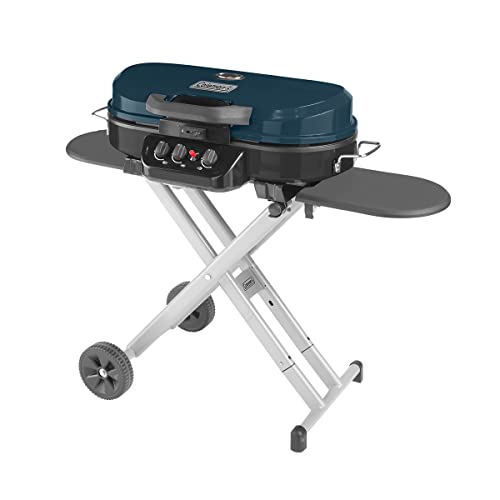
More burners and a rolling cart, at the cost of real bulk
Coleman RoadTrip 285 Portable Stand-Up Propane Grill
The RoadTrip 285 puts 285 square inches and 20,000 BTU on a wheeled stand that folds like a hand truck. Three adjustable burners let you sear on one side while food holds warm on the other, which is exactly what cooking for a crowd asks for.
$424.58fromAmazonPicture the standard tailgate problem. Brats need to stay hot while the burgers sear, and someone always shows up late wanting a hot dog. Three separately adjustable burners fix that. You run one section hot and one low, and finished food slides to the cool side instead of drying out. A thermometer in the lid tells you where you actually are, not where you're guessing.
No other grill here handles a crowd this easily. Coleman rates it at 20,000 BTU across 285 square inches, and the collapsible stand brings the cooking surface up to counter height, so you're not hunched over a picnic table for an hour. Quick-fold legs and two wheels mean one person can move it from trunk to lot. Outdoor Life's gear editors picked it as their top tailgate grill for the same reasons.
The Swaptop system is the sleeper feature. The grill grate lifts out and a griddle plate or cast iron insert drops in, so the same base makes pancakes on Saturday morning and burgers that afternoon. You're buying an accessory instead of a second grill. In an RV, where storage space is the real limit, that's worth more than it sounds.
Owners who cook on it several times a week report it lasting for years, partly because the grates sit above the drip path and keep the burners from gumming up. Push-button Instastart ignition lights it without matches, which you'll be grateful for in a wind. Replacement parts are easy to find too, and that isn't true of every grill in this price range.
Flaws but not dealbreakers
It's the bulkiest grill in this guide. At roughly 47 pounds with the cart attached, it's a Tetris problem in a small trunk, and lifting it in and out is a two-hands-and-a-grunt job.
Fit and finish sit a step below Weber's. The stand feels light next to the grill body, and the porcelain grates want cleaning before the grease bakes on rather than a week later.
Budget pick
Real charcoal flavor in something you can carry one-handed
Weber Smokey Joe Premium Charcoal Barbecue
At under 10 pounds, the Smokey Joe is the grill you take when weight is the whole problem. Its 147-square-inch grate holds about four burgers side by side, and the lid locks down over the bowl so the entire thing travels as one piece.
$247.43fromAmazonCharcoal still tastes better, and this is the smallest honest way to get it. The porcelain-enameled bowl and lid hold heat well enough to cook indirect, so chicken thighs finish through without the skin turning to carbon. A damper on the lid lets you adjust temperature without lifting it, and closing it all the way smothers the coals when you're done.
The Tuck-N-Carry lid is the detail that earns the Premium name. It locks over the bowl for the drive, then drops down to hold the lid off the dirt while you cook. Anyone who has balanced a hot kettle lid on the corner of a picnic table understands why that's worth something.
For two people, 147 square inches is plenty — four patties across, or a couple of steaks with room for peppers. For four, you'll cook in rounds and eat in waves. That's the trade you make for a grill that fits in a backpack-sized gap in the car and costs a fraction of what the propane models here do.
Flaws but not dealbreakers
Charcoal is slow. Figure 20 to 30 minutes from lighting to cooking, plus ash to bag up afterward, and you're packing briquettes and a chimney starter on top of the grill itself.
The bigger catch is where you're allowed to use it. Under Stage 1 and Stage 2 fire restrictions, parks and campgrounds routinely ban charcoal and wood while still permitting gas devices. If your trips run through dry season in the West, this can't be your only grill.
Upgrade pick
Genuine wood smoke on the road, if you can supply power
Traeger Ranger Portable Wood Pellet Grill &
The Ranger is a real pellet smoker shrunk to tabletop size, with a controller that holds anywhere from 165°F to 450°F. You can run a pork shoulder low and slow in the morning, then sear on the included cast iron griddle that evening without switching fuel.
$479.99fromAmazonThe Digital Arc Controller is what separates this from a box that simply gets hot. Traeger rates it to hold a set temperature within about 15 degrees, anywhere from 165°F up to 450°F. That's the difference between smoking a brisket and hoping for one. A built-in meat probe reads internal temperature, so you aren't lifting the lid every 20 minutes and bleeding off heat.
Nothing else here makes food that tastes like this. Hardwood pellets put actual smoke on ribs, chicken and pork, and owners who downsized from full-size Traegers report the flavor carries over intact. A Keep Warm mode holds everything at temperature until people are ready to eat, which matters when the game runs long or camp dinner slips an hour.
It's become a favorite with RV travelers, and the reasons are practical. Porcelain-coated grates and the cast iron griddle both wipe down without much fuss, and the unit sits on a table instead of demanding its own stand. Smoke a brisket at the site one day, cook eggs on the griddle the next morning, all out of one box.
Flaws but not dealbreakers
It needs a 120V outlet. Pellet grills run an auger, a fan and a controller, so without shore power, a generator or a decent battery pack, this is a very heavy box that does nothing. Check what your site actually offers before you commit.
It's also the heaviest unit here at 54 pounds, and the most expensive by a wide margin. Pellets go on the packing list too, and you can't grab a bag at any gas station the way you can grab a propane canister. Owners commonly gripe that the rubber feet covers work loose and fall off.
Also great
A flat top beats grates for breakfast and smash burgers
Blackstone 1971 Original 17" Omnivore Tabletop Griddle
This is a griddle, not a grill: 267 square inches of cold-rolled steel over an H-shaped burner, at 17.5 pounds. Eggs, bacon, pancakes, onions and smash burgers all work here, and nothing slips through the grate into the flames.
$129.99fromAmazonA flat top solves the campsite breakfast problem that no grill can. Grates can't hold eggs, hash browns or diced onions. Steel can. With 267 square inches you can run bacon at one end while pancakes cook at the other, and the H-style burner spreads heat well enough that the center isn't dramatically hotter than the edges.
It's the lightest cooking surface of this size in the guide, at 17.5 pounds, and it sets up in seconds on a picnic table with non-slip feet holding it steady. Blackstone says it reaches cooking temperature in under eight minutes on 12,000 BTU. Push-and-turn piezo ignition lights it without a match or a lighter.
Cleanup works differently from a grill, and mostly it's easier. Scrape the surface into the rear grease channel while it's hot, wipe it with a paper towel, then rub on a thin coat of oil. There's no grate to soak. Campers and RV owners keep going back to this one because it handles a whole week of meals, not just dinner.
Flaws but not dealbreakers
There's no lid, so you can't roast, and melting cheese means carrying a basting dome. It also means wind pulls heat straight off the surface — a cold, exposed lot will noticeably slow your cooking.
The steel needs seasoning, plus a light coat of oil after every use, or it rusts. Store it dry and get a cover if it lives outside. And if what you want is char and grill marks on a ribeye, this isn't the tool for it.
Who this is for
Buy one of these if you cook away from a kitchen a few times a season — car camping, tailgating, an RV site, a beach day, a driveway that can't fit a full-size grill. This guide covers grills you can lift into a vehicle and set up in a few minutes, roughly 145 to 320 square inches of cooking space. If you mostly grill at home for six or more, a full-size backyard grill will cost you less per square inch and cook better. And if you're backpacking, none of these are light enough; you want a canister stove instead.
We stuck to grills and griddles that cook a meal, so fire pits, fire-tending accessories, replacement parts and single-burner camp stoves aren't in scope. We also didn't consider built-in RV grills or anything that needs permanent mounting. If you're deciding between fuels, start with how your typical trip goes: propane if you want dinner fast and legal under fire restrictions, charcoal if flavor beats convenience, pellets if you're willing to bring power along for real smoke.
How we picked
Cooking area: we sorted models by grate dimensions and treated 200 square inches as the floor for feeding four adults in one round. Portability: we compared published weights, folded profiles, locking lids and wheels, since a grill that needs two people to load doesn't get used. Fuel and site rules: we checked park fire-restriction policies, which allow gas devices when charcoal and wood are banned, and that made propane the safe default. Heat and wind: we weighed rated BTU against grate size and looked at grate material and firebox construction, because thin metal fails first in an exposed lot. Cleanup: we favored pull-out trays, rear grease channels and porcelain enamel — anything you can manage with a scraper and a paper towel.
Other portable grills for camping and tailgating worth considering
If you want a grill that shrugs off wind and flare-ups: The Charbroil Grill2Go X200 Portable Gas Grill ($179.99) — The Char-Broil Grill2Go X200 uses a perforated steel emitter plate between the burner and your food, turning direct flame into radiant heat across all 200 square inches. Fat drips onto the plate instead of an open flame, so greasy burgers and chicken thighs don't touch off the flare-ups that scorch dinner. A cast-aluminum firebox and lid hold heat better than sheet steel in a breezy lot, and at 24 pounds with stainless latches it travels well. You give up cooking area — it's rated for about eight burgers — and it cooks a bit slower than an open-flame grill of the same output. Some owners also complain the regulator feels flimsy. It comes with a five-year warranty on the burner and lid, plus one year on the grate and other parts.
The competition
This is what our research turned up, not everything sold. A grill landing here isn't necessarily bad — it just lost to a pick on the priorities above, and it may still be exactly right for a specific situation.
The Weber® Q 1400 Portable Grill ($349) — The Weber Q 1400 is an electric grill, and that's the whole story. A 1560-watt element heats 189 square inches of porcelain-enameled cast iron inside a cast aluminum body, it arrives fully assembled, and the infinite-control valve lets you dial heat precisely. Owners are genuinely fond of it, and several report replacing one after years of use rather than switching brands. But the six-foot cord rules it out for most camping and every stadium lot. Choose it if you live somewhere that bans flame — many apartment balconies do — or if your RV site always has shore power and you'd rather not carry propane. For everyone else, the Traveler does the same job without hunting for an outlet.
Cleaning and storage in the field
The trick is cleaning while the grill is still warm, because cold grease turns into varnish. Scrape the grate with a stiff scraper right after you pull the food, then wipe it with a paper towel and a little cooking oil — that seasons cast iron and keeps rust off steel. Empty the grease tray before you drive anywhere, or it sloshes into your trunk. Let charcoal ash cool completely, then bag it out; never dump warm coals in a campground. Griddle tops need a thin oil coat every single time, without exception. At home, store everything dry and indoors if you can, and check the propane hose and regulator for cracks before the first trip of the season.
Questions we get
How many BTUs do I need in a portable camping grill?
Judge BTU against grate size, not on its own. Around 60 to 80 BTU per square inch is a healthy ratio for a portable, which is why a 13,000 BTU unit over 320 square inches can still sear well. A big BTU number on a thin, poorly insulated body just means it burns fuel faster.
What size portable grill do I need to cook for four people?
Aim for at least 200 square inches so four adults eat at the same time. A 320-square-inch grate handles about a dozen burgers, which covers four people with seconds. Below roughly 150 square inches you're cooking in rounds, which is fine for two but tiresome for a family.
Are portable grills allowed in national parks and campgrounds?
Usually, but it depends on fuel. Under Stage 1 and Stage 2 fire restrictions, the National Park Service typically bans charcoal and wood fires while explicitly permitting stoves and heating devices running on gas or pressurized liquid fuel. That means a propane grill stays legal when a charcoal one doesn't. Always check the specific park or campground before you go.
How long does a 1-pound propane canister last?
Roughly one to one and a half hours at full heat on a single-burner portable. Cook at medium and you'll stretch it further. If you grill often, an adapter hose that connects to a standard 20-pound tank pushes run time past 20 hours and cuts your fuel cost per hour dramatically — it's the first accessory most owners buy.
Is charcoal or propane better for camping?
Propane wins on convenience and legality; charcoal wins on flavor. Gas lights instantly, holds a steady temperature, and stays permitted during fire restrictions when charcoal doesn't. Charcoal takes 20 to 30 minutes to be ready and leaves ash to pack out, but the taste is genuinely different. If you can only own one, make it propane.
Can I use a portable grill under a canopy or in a tent vestibule?
Never inside a tent or vestibule. Burning propane, charcoal and wood all produce carbon monoxide, and enclosed spaces are where people get hurt. Under an open-sided canopy, keep well clear of the fabric overhead and make sure air moves freely on all sides.
Why you should trust us
For this guide:
- We read manufacturer specification sheets for every grill here, comparing rated BTU output, grate area, grate material and folded dimensions on the same terms.
- We reviewed published evaluations from outlets including the Good Housekeeping Institute and Outdoor Life, along with National Park Service fire-restriction policy and consumer fuel-preference survey data.
- We read through owner feedback for each model, looking for repeated themes about heat evenness, wind performance, cleanup and long-term durability rather than one-off complaints.
- We read owner reviews on every listing, weighted toward the critical ones, because that is where the recurring failures show up.
- We have a systematic way of automatically fetching the latest prices, so the numbers on this page stay current.
- This is a research-focused guide, so the team may not own every product listed — though we often do own the top winners, which gives us extra context for the recommendations.
- We don't accept free products, and the retailer commission never changes which product we recommend.
Sources
Best Portable Grills 2026 — Wirecutter, Wirecutter
Best Portable Grills for Camping and Tailgating — CNET, CNET
Best Portable Grills Tested in 2026 — Good Housekeeping Institute, Good Housekeeping
Best Portable Grills for Camping — Outdoor Life, Outdoor Life
Weber Traveler Portable Gas Grill Review — Serious Eats, Serious Eats
Best Portable Grills Tested by Editors — Popular Mechanics, Popular Mechanics
Traeger Ranger Portable Pellet Grill Review — Field & Stream, Field & Stream
How to Choose a Camp Stove or Grill — REI Co-op Expert Advice, REI Co-op
Best Tailgate Grills Ranked — Sports Illustrated Showcase, Sports Illustrated
Fire Restrictions in National Parks — National Park Service, National Park Service
Amazon product listings and owner reviews for all 7 products
Manufacturer specification pages for each product
Some passages in this guide may be paraphrased with AI help. Prices are refreshed automatically.
More like this.
Continue exploring lifestyle reviews and recommendations.

The Best Portable Camping Stoves
A camping stove is the difference between a hot dinner and a cold bag of trail mix. It's also one of the few pieces of gear you'll use every single day of…

The Best Portable Camping Toilets
A camping toilet earns its keep at 2 a.m., when it's raining and the campground bathroom is a quarter mile away. That's really the whole pitch. You want…

The Best Portable Camping Chairs
A camping chair is one of those things you don't think about until you're standing around a fire with nowhere to sit. Then it's the best thing in your…

The Best Portable Power Stations for Camping
A power station is the quiet fix for the two things that actually annoy you at a campsite: a cooler that has to keep working, and phones that die by…

The Best Outdoor Grills and BBQ Smokers
Most of the cooking you'll do on a grill isn't brisket. It's burgers on a Tuesday, chicken thighs before the kids melt down, a couple of steaks when…

The Best Camping Cots
A camping cot solves a problem that a sleeping pad never quite does. It gets you off the ground, so roots and rocks stop mattering, and you can sit up to…