The Best Portable Jump Starters
A dead battery never picks a good moment. It's the grocery store parking lot with melting ice cream in the trunk, or a work morning when you're already late. A portable jump starter turns that into a two-minute problem you solve yourself, without flagging down a stranger or waiting an hour for roadside assistance. The good ones are small enough to live in your glove box and hold enough charge to sit ignored for months. That's really the whole pitch: a small box that means you don't have to depend on anyone.
Here's the part nobody advertises. Peak amp numbers are lab ceilings, not what the unit actually pushes into your starter motor on a cold morning, and almost no brand publishes the cranking figure that would tell you the truth. Cold weather makes it worse — published reviews consistently find lithium units falling short of their rated start counts once the temperature drops toward 20°F. And every one of these packs slowly loses charge in storage, so the unit you never think about is the one most likely to let you down.
We looked at eight units across peak output, engine coverage, recharge speed, safety design and what owners report after a year or two of trunk duty. Most people don't need the biggest number — they need something that works at 0 volts and fits in a glove box. We think that the NOCO Boost X GBX55 is the best portable jump starter for most people, and that the NOCO Boost GB40 is the one to buy if you drive a normal car and want to spend less.
Everything we recommend

Fast to recharge, hard to misuse, small enough to forget

Enough power for a normal car, small enough for the glove box

The one for trucks and diesels, if you can charge it overnight

A real screen that tells you what's actually going on
Heavy, old-school and the one that still works at 20 below
At a glance
| Product | Peak Amps | Weight | Price | |
|---|---|---|---|---|
| NOCO Boost X GBX55: 1750A UltraSafe JumpTop pick | 1750A | 3.37 lbs | $174.95 |
| NOCO Boost GB40: 1000A UltraSafe Jump StarterBudget pick | 1000A | 2.4 lbs | $99.95 |
| NOCO Boost GB70: 2000A UltraSafe Jump StarterUpgrade pick | 2000A | 4.98 lbs | $189.95 |
| Hulkman Alpha85Also great | 2000A | 4.51 lbs | $119.99On sale |
 | Antigravity Batteries AG-MSA-10B Clampless Starting Harness forAlso in lineup | — | 0.05 lbs | $18.99 |
| Clore Automotive Jump-N-Carry JNC660 1700 Peak AmpRunner-up | 1700A | 18 lbs | $126.02 |
 | DEWALT DXAEJ14 Digital Portable Power Station JumpAlso consider | 1600A | 17.3 lbs | $169 |
How we picked
Engine coverage. We matched each unit's published gas and diesel displacement ratings against the vehicles people actually drive. Anything that couldn't cover a common V6 with margin to spare didn't make the picks.
Cold performance. Published cold-weather comparisons show lithium packs falling short of rated start counts as temperatures drop, so we weighed chemistry and cold ratings heavily. One lead-acid unit earned a place specifically for sub-zero climates.
Safety design. Spark-proof clamps and reverse polarity protection were non-negotiable, and we confirmed both from manufacturer documentation for every unit here. Reversed clamps without that protection can blow fuses or damage a car's electronics.
Recharge and storage. We compared published recharge times and charge-retention claims, since a jump starter's real job is being ready after months of neglect. Faster USB-C recharging earned points because it makes the maintenance habit easier to keep.
Owner-reported reliability. We read through owner feedback for recurring failure patterns — packs that wouldn't hold charge, clamps that wouldn't engage on a fully dead battery, units that swelled in hot trunks. Consistent complaints outweighed impressive spec sheets.
Top pick
Fast to recharge, hard to misuse, small enough to forget
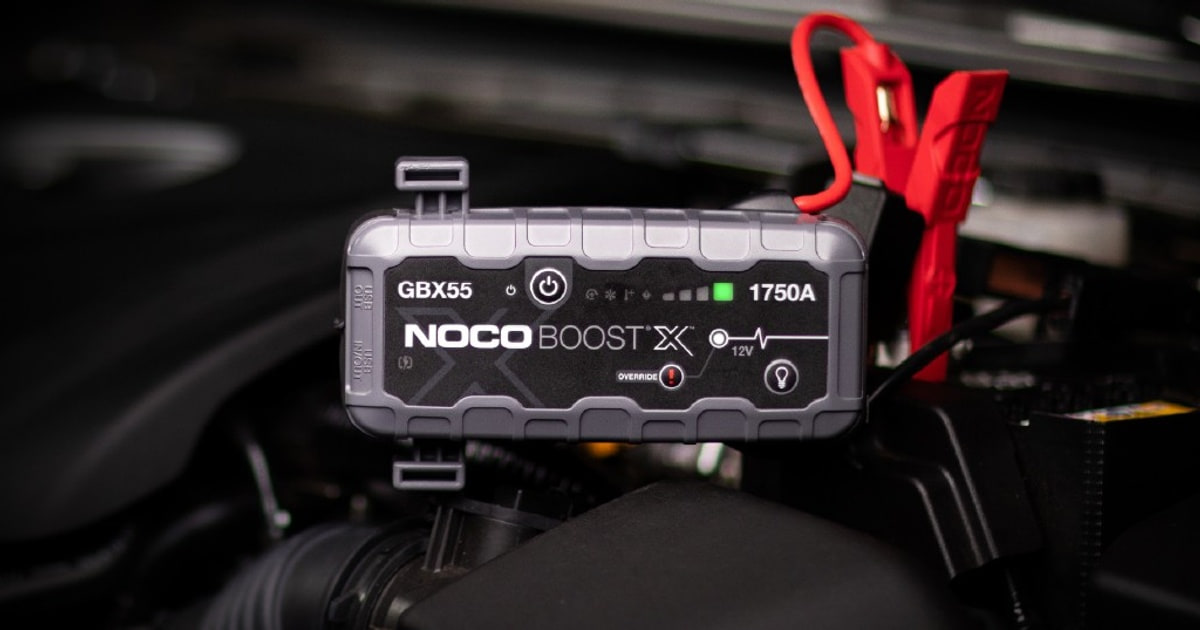
NOCO Boost X GBX55: 1750A UltraSafe Jump
The GBX55 puts out 1,750 amps, covers gas engines up to 7.5L and diesels up to 5.0L, and refills over USB-C in about 1.2 hours. It's the rare jump starter that's easy to keep ready, which matters more than raw amps for most drivers.
$174.95fromAmazonIt recharges fast enough that you'll actually keep it topped off. Most jump starters die in a drawer because refilling them is a chore. The GBX55 takes about 1.2 hours over USB-C Power Delivery — roughly the time it takes to watch a movie. Better still, five minutes of charge from a completely flat pack gets you one jump. If you discover a dead unit at the worst possible moment, plugging it into your car's USB-C port buys you a start.
The safety design means you can't really get it wrong. NOCO's UltraSafe 2.0 blocks current entirely if you reverse the clamps. No sparks, no blown fuses, no fried electronics. If you've only jumped a car a couple of times and get nervous about which clamp goes where, this removes the anxiety. Published reviews have long credited NOCO's UltraSafe units with starting vehicles at 0 volts, where plenty of rivals refuse to wake up below 2 volts.
The engine coverage lines up with what most people actually drive. At 1,750 amps it's rated for gas engines up to 7.5L, which covers essentially every sedan, crossover and half-ton pickup on the road. Diesel coverage runs to 5.0L. If your driveway holds a Camry, a CR-V, an F-150 or a Grand Cherokee, you're well inside spec, with headroom for the cold mornings when your battery is weaker than usual.
It doubles as a genuinely useful power bank and light. The 60-watt USB-C port charges phones, tablets and most laptops, and it works both directions, so the same cable that fills the pack empties it into your devices. The 200-lumen LED has seven modes including SOS and strobe. On a dark shoulder with a flat tire, that light is worth as much as the jump.
Flaws but not dealbreakers
You get LED dots, not a screen. A row of indicator lights tells you roughly how much charge is left, and that's it — no voltage reading, no error codes, no percentage. The Hulkman Alpha85 costs about the same and gives you a real display. If you like knowing exactly what's happening, this will nag at you.
Diesel owners hit the ceiling sooner than they expect. 5.0L is the diesel limit, which rules out the 6.7L Cummins and Power Stroke trucks that need a jump starter most. The GB70 handles those. Check your displacement before you assume the bigger amp number covers you.
Nine starts per charge isn't a lot on paper. The 60-second timer conserves power by design, but it means fewer starts per charge than a bigger pack. For one car and the occasional emergency, that's plenty. For a fleet or a driveway full of neglected project cars, it isn't.
NOCO covers most of its units with a one-year warranty.
Budget pick
Enough power for a normal car, small enough for the glove box
NOCO Boost GB40: 1000A UltraSafe Jump Starter
The GB40 puts out 1,000 amps and covers gas engines up to 6.0L and diesels up to 3.0L. It weighs about 2.4 pounds and uses the same spark-proof, reverse-polarity-protected clamp design as NOCO's pricier packs, for a lot less money.
$99.95fromAmazonA thousand amps covers the car you probably drive. Four-cylinders, V6s and small V8s up to 6.0L are all inside spec. That's a Camry, a CR-V, an Escape, a Civic, a RAV4 — the vast majority of what's parked in American driveways. If you don't tow and you don't own a diesel, buying more amps than this mostly buys you weight.
It's the one you'll actually keep in the car. At about 2.4 pounds and roughly the size of a paperback, it slides into a glove box or a saddlebag and stays there. The IP65-rated housing with rubber over-molding shrugs off dust, rain and getting knocked around under a seat. A jump starter you leave in the garage helps nobody.
The safety engineering is the same as the expensive NOCOs. Patented spark-proof clamps and reverse polarity protection are standard here, not a premium upgrade. Published long-term testing has found the GB40 starting vehicles with batteries flat at 0 volts, while competing budget units wouldn't activate below 2 volts. That's the single biggest difference between a cheap pack that works and one that doesn't.
Twenty starts per charge is more than you'll ever need in one trip. Realistically you'll use one. But the headroom means a weak battery you're nursing through a cold week won't strand you, and the built-in power bank keeps a phone alive while you wait for a tow if things go worse than expected.
Flaws but not dealbreakers
It runs out of engine before you'd like. Above 6.0L gas or 3.0L diesel, this isn't your unit. Owners who buy it for a big truck and then try it on a genuinely dead battery in the cold are the ones who come away disappointed. Match the rating to the engine, not to the price.
Three hours to recharge feels slow now. The GBX55 does it in about 1.2 hours over USB-C. Three hours is fine if you charge it overnight twice a year, which is what you should be doing anyway. It's only a problem if you drain it and need it again the same afternoon.
No display, and the LED readout is coarse. You get a rough sense of remaining charge and nothing else. There's no voltage reading to tell you whether your battery is actually the problem.
NOCO covers most of its units with a one-year warranty.
Upgrade pick
The one for trucks and diesels, if you can charge it overnight
NOCO Boost GB70: 2000A UltraSafe Jump Starter
The GB70 delivers 2,000 amps and covers gas engines to 8.0L and diesels to 6.0L, with up to 40 starts per charge. It's the NOCO to buy if you drive a full-size pickup or a half-ton diesel and want margin on a cold morning.
$189.95fromAmazonIt covers the trucks the GBX55 can't. Gas engines to 8.0L and diesels to 6.0L means the F-150 5.0L, the RAM 1500 HEMI and the Silverado 6.2L are all comfortably inside spec. If you tow, plow or park outside all winter, that margin is the point. Cold batteries pull far more current, and a unit rated right at your engine's limit is a unit rated too low.
Forty starts per charge means you can help other people. If you're the person in your family or on your street who gets the call when someone's car won't start, this holds enough charge to be useful repeatedly. The 400-lumen light is the brightest of the NOCOs here, which matters when you're crouched over someone else's engine bay after dark.
The same foolproof clamps, in a tougher body. Spark-proof connections and reverse polarity protection carry over from the rest of the NOCO line, wrapped in an IP65-rated housing with rubberized over-molding. At about five pounds it's still a one-hand carry, and it survives living in a truck bed toolbox better than a bare lithium brick would.
It's still a power bank when nothing's broken. The integrated USB output charges phones and tablets on job sites and campsites. That's the quiet argument for keeping it charged: you'll use it for something other than emergencies, so you'll notice when it's low.
Flaws but not dealbreakers
Six hours to recharge is the slowest here. If you use it and forget to plug it in, it's not ready for tomorrow. This is a unit that rewards a habit — plug it in the night you use it, every time.
It's the pricier NOCO and it still has no screen. You're paying for amps and start count, not information. For similar money the Hulkman Alpha85 gives you voltage readings and error codes on a real display.
Heavy-duty diesel owners are still out of luck. 6.0L is the ceiling, so a 6.7L Cummins or Power Stroke sits just outside it. The AVAPOW covers those on paper, with the caveats we get into below.
NOCO covers most of its units with a one-year warranty.
Also greatOn sale
A real screen that tells you what's actually going on
Hulkman Alpha85
The Alpha85 pairs 2,000 amps and up to 60 starts per charge with a 3.3-inch display showing voltage, charge level and error codes. If you hate guessing whether a pack is ready or why a jump failed, this is the one that answers you.
$119.99fromAmazonList priceThe display fixes the one thing every other pack here gets wrong. A 3.3-inch screen shows charge percentage, battery voltage and status codes. When a jump doesn't take, you learn whether the pack is low, the connection is bad or the vehicle battery is beyond help. Every other unit here leaves you staring at colored dots and guessing.
Sixty starts per charge is the most in this group. If you manage a small fleet, run a detailing shop or just own several cars that sit for weeks, that operational range is genuinely useful. It's fifty percent more than the GB70 and roughly six times the GBX55, and it means you're not rationing a pack during a cold snap.
It charges quickly and then holds it for a long time. 65-watt charging takes it from empty to 80 percent in about an hour and full in 90 minutes. Once full, it's rated to hold charge for up to 18 months. For a device that spends its life waiting, that shelf life is arguably more valuable than the amp rating.
Coverage runs to 8.5L gas and 6.0L diesel, the broadest gas figure here. Ten layers of protection include spark-proof and reverse-polarity safeguards with intelligent clamps. It also puts out 15V DC, so it can run a tire pump or a car fridge — handy on a camping trip where the nearest outlet is an hour away.
Flaws but not dealbreakers
Hulkman doesn't have the track record NOCO or Clore do. It's a newer name in a category where the thing you're buying is reliability after two years of neglect in a hot trunk. Owner feedback skews positive, but the long tail of evidence just isn't as deep.
It's bigger and heavier than the NOCO it competes with. At about 4.5 pounds and roughly nine inches long, it's a center-console or trunk item rather than a glove-box one. The screen is part of why.
USB-C output tops out at 18W. That's fine for a phone, slow for a tablet and not enough to meaningfully charge a laptop. The GBX55's 60-watt port is in a different league if you care about using this as a power bank.
Runner-up
Heavy, old-school and the one that still works at 20 below
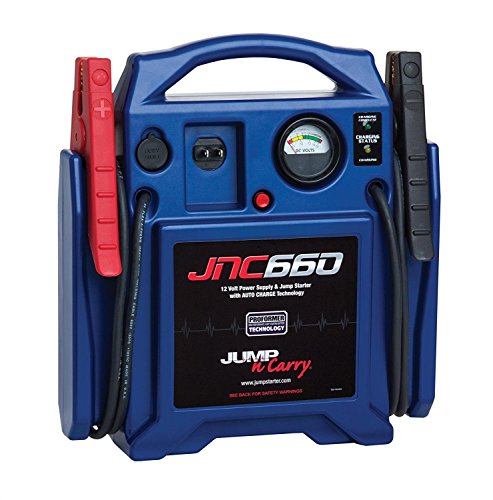
Clore Automotive Jump-N-Carry JNC660 1700 Peak Amp
The JNC660 is a lead-acid unit with a 22Ah battery, 1,700 peak amps and 46-inch cables. It's the pack professional mechanics keep on the shop floor, and the one to buy if your winters go seriously below zero.
$126.02fromAmazonLead-acid keeps working when lithium gets sluggish. Published cold-weather comparisons find lithium packs delivering meaningfully fewer successful starts once temperatures fall toward 20°F, while lead-acid units of this class hold consistent output down to about -20°F. If you live somewhere winter is a real adversary rather than an inconvenience, that difference decides the purchase.
The 46-inch cables reach where the little packs can't. Most lithium units give you 26 to 30 inches, which assumes you can set the pack right beside the battery. Try that on a car with the battery in the trunk, or on a vehicle you can't quite park next to. Heavy #2 AWG cable also loses less voltage over the run, which is exactly what you want when the battery is completely flat.
The voltmeter tells you where you stand before you connect anything. A dial on the unit shows the internal battery's charge status. There's no percentage to interpret and no app — you glance at it and know whether it's ready. For a device that lives on a shelf for months, that's the right kind of simple.
It's built for repetition rather than convenience. The 22Ah Clore Proformer battery is designed specifically for jump starting, and this is the unit that shows up in professional shops that jump cars all day. A DC outlet on the side runs 12V accessories. Nothing here is clever. All of it is durable.
Flaws but not dealbreakers
It weighs about 18 pounds and takes up real trunk space. This isn't a glove-box tool. It's a thing you carry with a handle, and if your priority is something you can forget about in a console, buy a lithium pack instead.
No USB, no power bank, no charging your phone. It jumps cars. That's the entire feature list, plus a 12V accessory outlet.
It demands maintenance you have to remember. Lead-acid needs regular topping off to stay ready, and a JNC660 left uncharged for a season won't do you much good. If you know yourself well enough to doubt you'll keep up, that's an honest reason to pick something else.
Who this is for
Buy one of these if you park outside, drive an older car, take road trips, or simply don't want to depend on a stranger's cables. A jump starter is cheap insurance against a problem that's nearly certain to happen eventually, and the modern lithium ones are small enough that keeping one in the car costs you nothing but a bit of glove-box space. It's also the right gift for a new driver, who is exactly the person most likely to get stuck and least likely to know what to do about it.
Skip it if your battery has already died more than once in a month — you need a new battery, not a way to keep reviving a failing one. This guide covers 12V portable jump starters for cars, trucks and SUVs. We're not covering wall chargers and trickle maintainers, heavy 24V commercial units, or full portable power stations that happen to include a jump-start port. We also don't cover accessories that require a separate jump starter to function.
How we picked
We ranked these on the things that decide whether a jump starter works when you need it. Engine coverage: rated gas and diesel displacement has to exceed what you drive, with margin for cold mornings when a weak battery demands more current. Cold performance: published comparisons show lithium packs losing ground below freezing, so chemistry and stated cold ratings mattered as much as peak amps. Safety design: spark-proof clamps and reverse polarity protection are required, not a bonus, because a reversed connection can cost you fuses or an ECU. Recharge and storage: fast USB-C refills and long charge retention keep a pack ready through months of being ignored. Owner-reported reliability: recurring complaints about charge loss, swelling or clamps that won't engage at 0 volts outweighed generous spec-sheet numbers.
Other portable jump starters worth considering
If you want a tire inflator built in: The DEWALT DXAEJ14 Digital Portable Power Station Jump ($169) — The DEWALT DXAEJ14 pairs 1,600 peak amps with a 120 PSI digital compressor, and that combination is genuinely useful if you drive a work truck or tow a trailer. Set the pressure, walk away, and AUTOSTOP shuts the compressor off when it hits the target, with a ten-minute timer as a backstop. It also has an alternator check and a reverse polarity alarm, plus 15W USB-A and 25W USB-C ports. What you give up is portability and amps: it weighs about 17 pounds, so it lives in a truck bed or a garage, and 1,600 amps trails the 2,000-amp lithium packs here. If you'd otherwise buy a separate inflator and a separate jump starter, this saves you a purchase and a shelf.
The competition
This is what our research surfaced among widely available jump starters, not a census of the market. New models arrive constantly, and a unit's absence here doesn't mean it's bad. What follows is the one product that didn't earn a pick, and why.
Care and storage
The single most useful habit is a recurring reminder to top off your jump starter every three to six months. Lithium packs lose charge slowly in storage, and heat makes it worse — an unattended pack is the most common way these fail people. Temperature matters more than most owners realize. Keep it between about 32°F and 95°F where you can. A trunk in July can push past 120°F, which permanently degrades lithium cells and shrinks capacity for good. If you live somewhere hot, bring the pack inside when the car will sit for days. Lead-acid units like the JNC660 need charging on a schedule too, and they punish neglect faster. Once a year, try your pack on a car you know starts easily. If it hesitates, replace it before an actual emergency does the testing for you.
Questions we get
How many amps do I need to jump start my car?
Most four-cylinder and V6 cars need somewhere around 600 to 1,000 amps, and a V8 up to 6.0L wants at least 1,000. Trucks and diesels above that should be on a 2,000-amp unit. Add 20 to 30 percent to your minimum if you regularly start cars below 20°F, since cold batteries pull far more current. When in doubt, buy the next size up — extra amps cost weight, not reliability.
What's the difference between peak amps and cold cranking amps?
Peak amps is the maximum current a pack can push for a fraction of a second in perfect conditions, and it's mostly a marketing number. Cold cranking amps measures sustained delivery over 30 seconds at 0°F, which is much closer to what starting a car actually demands. Almost no portable jump starter brand publishes CCA. A practical shortcut is to mentally discount any peak figure by a third to a half.
Can a jump starter revive a battery that reads 0 volts?
The good ones can. Published testing has found NOCO's UltraSafe packs starting vehicles with batteries at 0 volts, while various competing units refused to activate below 2 volts. Many cheaper packs include a low-voltage lockout that keeps them from engaging on a genuinely flat battery — which is precisely when you need them. If you expect deeply discharged batteries, confirm the unit has a bypass or boost mode before buying.
Do jump starters work in cold weather?
Lithium packs work below freezing, just less well. Published cold comparisons show them delivering fewer successful starts around 20°F than their ratings suggest, and well below zero some won't activate at all. Lead-acid units like the Clore JNC660 hold steady output down to roughly -20°F. If your winters routinely go below 0°F, that's the safer buy despite the weight.
Can I charge my phone or laptop from one of these?
Phones and tablets, easily — nearly every lithium pack here includes USB output. Laptops depend on wattage. The GBX55's 60-watt USB-C port can actually charge most laptops, while 18W to 25W ports on other units will slow a laptop's drain rather than refill it. If device charging matters to you, check the USB-C wattage rather than the total battery capacity.
What should I do right after a successful jump?
Drive at highway speeds for at least 30 minutes so the alternator can put real charge back into the battery. Short trips around town won't do it. Disconnect the pack within about 30 seconds of the engine catching rather than leaving it clamped on. If the battery dies again within a few weeks, it needs replacing — most auto parts stores will test your battery and charging system at no cost.
Why you should trust us
For this guide:
- We read manufacturer specifications and listing documentation for every unit here, comparing rated engine displacement, recharge times, start counts, safety features and port wattage side by side.
- We reviewed published comparisons from automotive outlets on lithium versus lead-acid performance in cold weather and on low-voltage starting behavior.
- We read owner feedback across these listings looking for repeated failure patterns — charge loss in storage, heat damage and clamps that won't engage on a fully dead battery.
- We read owner reviews on every listing, weighted toward the critical ones, because that is where the recurring failures show up.
- We have a systematic way of automatically fetching the latest prices, so the numbers on this page stay current.
- This is a research-focused guide, so the team may not own every product listed — though we often do own the top winners, which gives us extra context for the recommendations.
- We don't accept free products, and the retailer commission never changes which product we recommend.
Sources
Best Jump Starters — Wirecutter / NYT, Wirecutter
Best Portable Jump Starters Tested — Car and Driver, Car and Driver
Best Jump Starters — Popular Mechanics, Popular Mechanics
Portable Jump Starter Reviews — Consumer Reports, Consumer Reports
Best Jump Starters 2026 — Motor Trend, Motor Trend
Amazon product listings and owner reviews for all 7 products
Manufacturer specification pages for each product
Some passages in this guide may be paraphrased with AI help. Prices are refreshed automatically.
More like this.
Continue exploring lifestyle reviews and recommendations.

The Best Lithium Jump Starter Power Banks
A dead battery almost never happens at a convenient moment. It happens in a parking garage at 11 p.m., or on the first genuinely cold morning of the year,…

The Best Car Battery Jump Starters
A dead battery almost never happens at a convenient time. It's the school run, the grocery-store parking lot at dusk, or a driveway on the first genuinely…

The Best Disc Golf Starter Sets
Disc golf is easy to start and hard to shop for. A course near you is probably free, the rules take five minutes to learn, and one afternoon is usually…

The Best Beekeeping Starter Kits
Beekeeping gear is simpler than it looks. Nearly everything you'll see for sale is a Langstroth hive: a stack of boxes holding removable frames, with a…

The Best Weighted Jump Ropes for CrossFit
A jump rope is the simplest piece of gear in your gym bag and the one most likely to ruin your day. Double-unders show up constantly in CrossFit…

The Best Jump Ropes for CrossFit
A jump rope is one of the simplest pieces of gear in your gym bag, and it's the one most likely to ruin your workout. If the cable is too long, it drags.…