The Best Jump Ropes for CrossFit
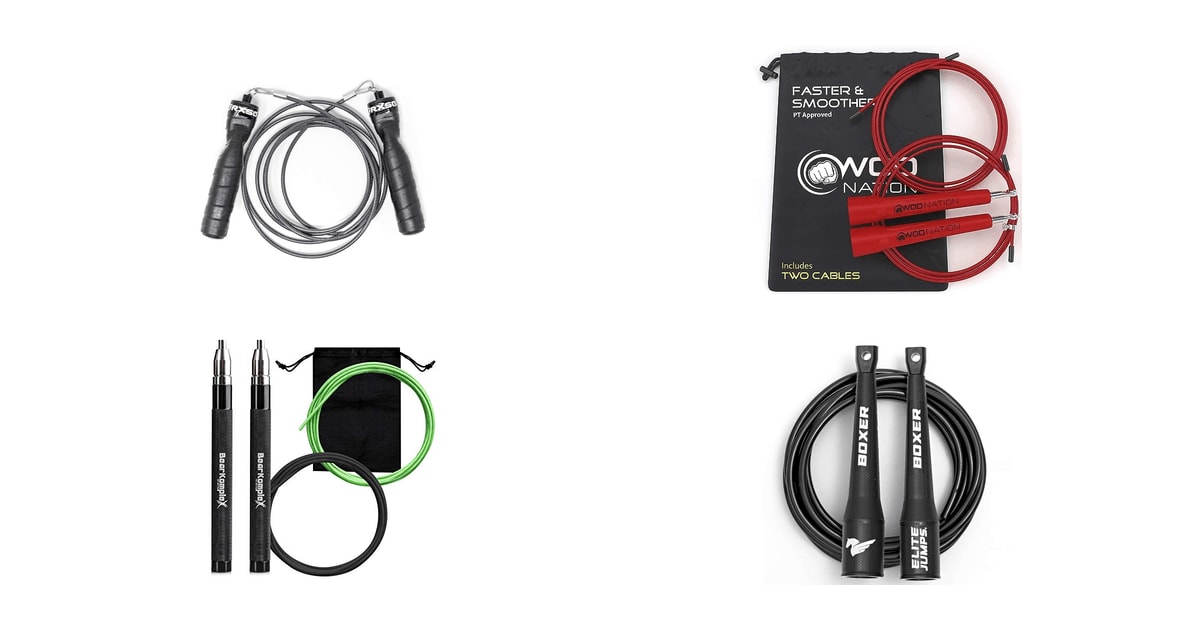
A jump rope is one of the simplest pieces of gear in your gym bag, and it's the one most likely to ruin your workout. If the cable is too long, it drags. If the handles spin poorly, your wrists do the work your rope should be doing. And if you're chasing double-unders, a bad rope turns a skill problem into an equipment problem — you'll blame your timing when the real culprit is a whippy cable that folds mid-rotation. The right rope won't hand you 50 unbroken reps, but it clears the obstacles that keep you from earning them.
Here's the honest part: no rope on this list survives concrete for long. Thin steel cables get chewed up on pavement and garage pads, and coated cables shed their jacket faster than anyone expects — owners of nearly every rope here report exactly that. The other catch is sizing. Almost every speed rope arrives too long, and most require you to cut the cable or fuss with a clamp until you find your length. That's a one-way decision on some models. Plan on a few frustrating sessions before your rope feels like yours.
We also want to be clear about scope. This guide covers ropes suited to CrossFit-style training — double-unders, conditioning intervals, and warm-ups — not weighted ropes for strength work or beaded ropes for freestyle. We think that the Rx Smart Gear Jump Rope is the best jump rope for CrossFit for most people, and that the WOD Nation Adjustable Speed Jump Rope is the one to buy if you're still learning double-unders and don't want to spend much to find out whether the skill sticks.
Everything we recommend

Balanced handles and swappable cables, if you'll use them

A real steel cable and a spare, for not much money
Sealed swivel bearings and aluminum handles for less money

The one that survives your driveway
Featherweight and easy to pack, at the cost of feel
At a glance
| Product | Cable Type | Length | Price | |
|---|---|---|---|---|
| Rx Smart Gear Jump Rope - BlackTop pick | — | 8'0" | $57 |
| WOD Nation Adjustable Speed Jump Rope -Budget pick | Alloy Steel | — | $18.99 |
| Bear KompleX - Speed Jump Rope -Runner-up | Steel Cable | — | $29.99 |
| EliteSRS 10 Foot Outdoor Rated 5Mm PvcAlso great | 5mm PVC | 10 ft | $21.99 |
| MOGOLD Speed Jump Rope - Black ErgonomicAlso great | PVC | 8 ft | $9.90 |
How we picked
Cable and handle spec. We compared published cable diameters, materials and handle construction across every listing. Sealed or swivel bearings and aluminum handles earned a product a closer look; fixed pivots and unspecified bearings did not disqualify a rope, but they capped where it could land.
Surface durability. Owner feedback on coating wear was the clearest signal in this whole category. We weighted reports of cables shredding on concrete heavily, and we checked them against each manufacturer's own surface guidance.
Sizing range. We looked at stated adjustment ranges and at owner reports from very tall and very short jumpers. A rope that can't reach your height is useless no matter how well it spins.
Replaceable parts. Cables are consumables. We favored ropes that ship with a spare or sell replacements, because a rope that dies with its first cable costs more over three years than its listing suggests.
Failure reports. We read through owner complaints looking for patterns rather than one-offs. Repeated reports of handles separating or clamps slipping kept a product out of the top spot even when its specs looked strong.
Top pick
Balanced handles and swappable cables, if you'll use them
Rx Smart Gear Jump Rope - Black
The Rx Smart Gear pairs long, tape-wrapped handles with a swivel attachment that keeps the cable moving smoothly at speed. You can swap in a lighter or heavier cable as your timing improves, which means one set of handles carries you from your first double-under to your hundredth.
$57fromAmazonThe handles are the reason to buy this rope. They're six inches long and an inch around, wrapped in absorbent tape, with contoured pinch points that tell your thumbs where to sit. That sounds fussy until you're 40 reps into a set and your grip hasn't shifted. Owners learning double-unders repeatedly credit the handle geometry — not the cable — for finally letting them string reps together. If your hands slide or your wrists ache during long sets, this is the fix.
Rx Smart Gear sells four cable weights, and the one in the box is not the fastest. That's deliberate. A slightly heavier cable gives you feedback — you can feel where the rope is in its arc, which is the whole battle when you're learning. Once your timing settles, you order a lighter cable and keep the same handles. Athletes who've bought four or five ropes chasing double-unders describe this rope as the one that ended the search.
The swivel attachment lets the cable find its own plane instead of fighting the handle. In practice, that means fewer of those ugly half-rotations where the rope folds and slaps your shin. Owners who train at boxing gyms mention grabbing this rope instead of hunting through a bin for something the right length. Made in California, and the company has been designing ropes long enough to have patents on the mechanism.
Buy this only if you'll actually use the cable system. If you plan to jump with the stock cable forever and never reorder, you're paying for flexibility you won't touch. But if you're training toward the Open, or you share the rope with someone taller, the swap costs a fraction of a new rope. That's the math that justifies the price gap between this and everything else here.
Flaws but not dealbreakers
The grip tape wears. Owners who train several times a week report it peeling away in pieces after heavy use, and the cable's coating can degrade to the point where the steel inside starts to fray. Tape is replaceable and cables are consumables, so neither is fatal — but budget for both if you train hard.
The stock cable is thin and whippy, and a few owners find it better suited to short bursts than long conditioning grinds. It also can't handle concrete. Rx buyers say this plainly: pick your jumping surface or expect to replace cables often. This rope wants rubber flooring or a mat.
Budget pick
A real steel cable and a spare, for not much money
WOD Nation Adjustable Speed Jump Rope -
The WOD Nation gives you a coated alloy steel cable, a second cable in the box, and a length adjustment you can dial in with wire cutters. It spins well enough to teach you double-unders, which is exactly what most people buying their first speed rope need.
$18.99fromAmazonThis is the rope to buy when you don't yet know if you'll stick with it. It costs a fraction of what the Rx does, and it does the one job a beginner needs: it turns fast enough that a missed rep feels like a miss. That immediate feedback — the sting, the sound — is how the skill gets built. Owners who bought it as a first speed rope routinely say it lasted years.
The second cable matters more than it sounds. Every speed rope cable eventually dies, usually because you cut it too short or wore through the coating. Having a spare in the bag means one bad decision doesn't end your rope. It ships with two sets of hardware and a carry bag too, which is a lot to include.
The ball-and-socket pivot isn't a sealed bearing, and you can feel that at high cadence — the spin is good, not glassy. But for anyone working in the range where you're stringing 10 to 30 double-unders, that difference doesn't show up. Owners coming from other budget cables describe the rotation as smooth and the adjustment as easy to get right for their height.
Flaws but not dealbreakers
The rubber coating on the cable is the weak point, and owners are blunt about it. Jump on anything rougher than a gym floor and the jacket starts shredding almost immediately. WOD Nation says as much in its own instructions: smooth surfaces only, no cement or asphalt.
You'll want to check the locking mechanism periodically. Owners report it working loose over time, which changes your effective cable length mid-session. It's a thirty-second fix, but you have to remember to do it.
Runner-up
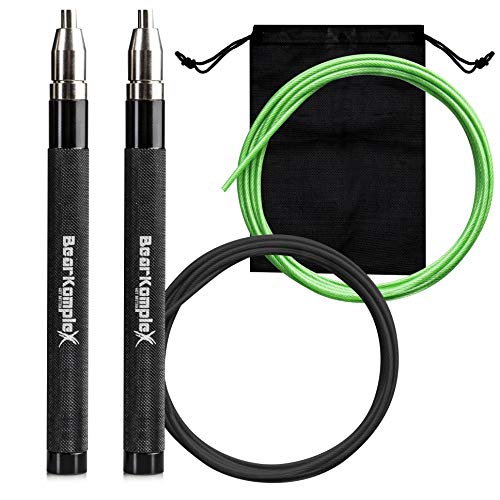
Sealed swivel bearings and aluminum handles for less money
Bear KompleX - Speed Jump Rope -
The Bear KompleX puts 360-degree swivel ball bearings in lightweight aluminum handles and ships with two cables and a bag. It's the closest thing here to premium hardware without the premium hardware price, and the coated cable stings less when you miss.
$29.99fromAmazonThe bearings are the story. Swivel ball bearings spin more freely than the pivot systems on cheaper ropes, and that shows up as less wrist effort at the same cadence. If you're already stringing 30 or more double-unders and starting to notice your forearms giving out before your legs do, this is the upgrade that helps.
The coated cable is a genuinely kind touch for people still missing reps. Bear KompleX puts a light protective jacket on the steel specifically to blunt the sting, and if you've ever welted your calf on a bare cable you know why that matters. Two cables come in the box, so you get a second chance at the cut.
Sizing is tool-free through a clamp, and one owner at six-foot-five reports getting it adjusted without trouble — a useful data point, since plenty of ropes top out well before that. The knurled aluminum handles hold on when your hands are wet. They're light enough that they don't fight you during long sets.
Flaws but not dealbreakers
Build quality is less consistent than the rest of this list. A meaningful share of owners report the cable pulling loose from the handle mid-workout, and a few describe the rope simply coming apart. Most people get a rope that works well for years — but the failures that do happen are total, not gradual.
The clamp needs to be cinched properly or the cable creeps out during use. Store it in the included bag; a loosely coiled cable takes a set and never quite travels in a clean circle again.
Also great
The one that survives your driveway
EliteSRS 10 Foot Outdoor Rated 5Mm Pvc
The EliteSRS Boxer 3.0 uses a 5mm PVC cable rated for concrete and pavement, on dimpled polymer handles that stay put in sweaty hands. It's too slow for competitive double-unders, but it's the rope you can take outside without watching it die.
$21.99fromAmazonEvery other rope here has a surface it can't touch. This one doesn't. The 5mm PVC cable is built for asphalt and concrete, and owners who train on rough streets — some for over a decade of rope work — call it the first rope that held up. If your only option is a driveway or a park, the choice is basically made for you.
The heavier cable changes what the workout does. You feel the rope in your forearms and shoulders in a way you never do with thin steel, which makes it a decent grip and endurance tool alongside your speed rope. Boxers have trained this way forever. It transfers to CrossFit as warm-up and conditioning work, not as your WOD rope.
The perpendicular handle-to-rope connection keeps it from tangling, and owners confirm it stays untwisted through long sessions. At ten feet it's long enough for taller athletes and for lateral footwork patterns that a tight competition cable won't allow. It packs down small enough to live in a suitcase.
Flaws but not dealbreakers
Dial in the length carefully. Owners report it takes real trial and error to find the right cut, and a cable that's even slightly too long will catch you across the back of the head hard. The extra weight makes those misses hurt more than they would with thin steel.
It's the wrong rope for timed double-under sets. The cable is simply too slow to rotate twice in a normal jump at CrossFit cadences. Buy it as your second rope, not your only one. Boxers with large hands also note the handles run a bit thin.
Also great
Featherweight and easy to pack, at the cost of feel
MOGOLD Speed Jump Rope - Black Ergonomic
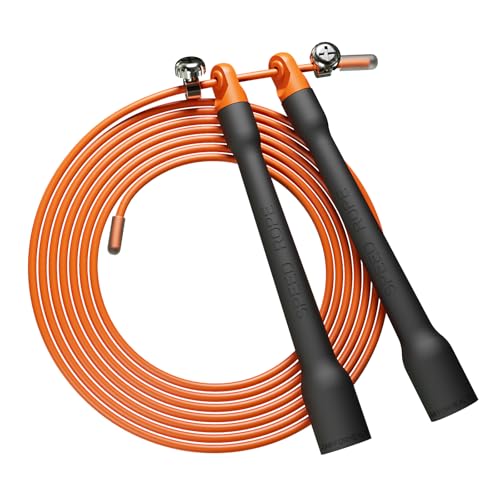
The MOGOLD weighs under three ounces for the whole set, with a 2.8mm coated cable mounted perpendicular to the bearing. It's the rope to throw in a carry-on or a gym bag you already overpacked, and it spins better than its weight suggests.
$9.90fromAmazonThe whole rope weighs less than a deck of cards — the handles are just over an ounce each. That's the entire pitch, and it's a good one if you travel or you're the person whose gym bag never zips. Owners who keep it in a bag mention the bright cable being easy to find, which is a small thing that turns out to matter.
The cable mounts at ninety degrees to the bearing rather than through it, and owners who've used a lot of ropes single that out as the reason the rotation feels clean. It doesn't catch, and it doesn't tangle when you coil it. For cardio intervals and single-unders, the spin is honestly fine.
Adjustment is a small screw clamp you can work with your fingers, so you can size it without tools and re-size it if someone else borrows it. Owners find it quick to dial in. That said, most people end up cutting the excess, because leftover cable sticking past the clamp gets in the way.
Flaws but not dealbreakers
The cable is light enough that some owners struggle to keep it whipping in a clean arc — a few report tripping on it repeatedly for exactly that reason. If you're new to double-unders, that lack of feedback works against you. This is a rope that rewards technique you already have.
It's the newest and least-proven product here, with far fewer owners reporting back than anything else on this list. Long-term durability is an open question, and replacement cables aren't readily available the way they are from the established brands.
Who this is for
Buy one of these if you're doing CrossFit-style conditioning and you've outgrown whatever vinyl rope your gym keeps in a bucket. That covers people learning double-unders, people who already have them and want to hold longer sets, and anyone doing rope intervals as cardio. If you jump indoors on rubber or wood, almost any pick here works. If your only surface is concrete, start with the EliteSRS and read the flaws before you order anything with a coated steel cable.
Skip this guide if you want a weighted rope for strength work, a beaded rope for freestyle skipping, or a smart rope that counts reps to an app. Those are real categories with real merits, and none of them are what we looked at here. We also didn't consider ropes that can't be shortened, since almost everyone needs to size a rope down and most people need to do it more than once.
How we picked
We built this guide from spec sheets, manufacturer sizing guidance and a lot of owner feedback, and we weighted five things. Cable and handles: diameter, material and bearing type, since a swivel or sealed bearing does more for your wrists than any marketing claim. Surface durability: how the cable coating holds up outdoors, which owners across every brand flagged as the thing that kills ropes. Sizing: whether the stated range actually covers tall and short jumpers, confirmed against real reports. Replaceable parts: whether a spare cable comes in the box or can be bought later, because cables are consumables and a rope that can't be recabled is a short-term purchase. Failure patterns: repeated reports of handles separating or clamps creeping, which mattered more to us than any single glowing review.
The competition
This is what our research surfaced, not a survey of everything sold. The speed rope market turns over constantly, and there are good ropes from smaller brands that never show up in a search. What follows is the rest of the lineup we looked at closely, and why each one lost to a pick — though in a category this cheap, a rope losing on points is still worth buying if it fits your situation.
Care and sizing
Size the rope before you cut anything. Stand on the midpoint with both handles pulled up — armpit height is a fine starting length while you're learning, and you shorten from there as your timing improves. Cut in small increments; you can't put cable back. Once you're jumping, watch your surface. Coated steel cables shred on concrete and asphalt, so use a mat outdoors or keep a cheap PVC rope for those days. Store the rope coiled loosely in its bag rather than folded, since a kinked cable never travels in a clean circle again. Check the clamp screws every few weeks, because they work loose and quietly change your length mid-session.
Questions we get
What's the best rope for learning double-unders?
A thin steel cable with decent bearings, because you need to feel and hear a miss the instant it happens. The WOD Nation is the low-risk way to start, and the Bear KompleX is the better rope if you're confident you'll stick with it. Skip heavy PVC while you're learning — the slow rotation makes the timing feedback mushy.
What cable diameter should a beginner use?
Start around 2mm to 3mm. Thicker cables move slower and are easier to see mid-jump, which helps you build rhythm before you chase speed. Once you can reliably string 20 or 30 double-unders, a thinner cable will let you turn faster with less wrist movement. Going thin too early is a common reason people stall out.
What actually makes a speed rope different from a regular jump rope?
Three things: a thin steel or coated cable instead of vinyl, bearings or a swivel in the handles instead of a fixed pivot, and light handles that don't fight your wrists. The combination means the cable rotates far faster for the same effort. A standard rope is fine for single-unders and cardio, but it won't get around twice per jump at any comfortable cadence.
How do I size a rope to my height?
Stand on the center of the cable and pull both handles straight up. Handles at armpit height is the beginner starting point and gives you clearance overhead. As your technique tightens, shorten it toward mid-chest — faster rotation, less wrist travel. Every rope here adjusts, but some require cutting the cable, so go slowly.
Are weighted ropes worth it for CrossFit?
They're useful for shoulder endurance and grip work, but they're the wrong tool for timed double-unders. Keep them in dedicated conditioning sessions and practice the skill with a fast rope. The EliteSRS 5mm PVC cable gives you a lighter version of the same stimulus if you'd rather not buy a third rope.
Which rope should I use outdoors on concrete?
The EliteSRS Boxer 3.0, whose 5mm PVC cable is rated for pavement. Thin coated steel cables lose their jacket fast on abrasive surfaces, and owners of every steel rope here report exactly that. If you want to use your speed rope outside anyway, put down a portable rope mat and it'll last dramatically longer.
Why you should trust us
For this guide:
- We compared manufacturer specifications, cable and handle materials, stated sizing ranges and surface guidance across all five ropes.
- We read owner feedback for each product looking for repeated failure modes — coating wear, clamps slipping, handles separating — rather than isolated complaints.
- We drew on published coaching guidance about cable diameter and sizing for double-under development to frame our criteria.
- We read owner reviews on every listing, weighted toward the critical ones, because that is where the recurring failures show up.
- We have a systematic way of automatically fetching the latest prices, so the numbers on this page stay current.
- This is a research-focused guide, so the team may not own every product listed — though we often do own the top winners, which gives us extra context for the recommendations.
- We don't accept free products, and the retailer commission never changes which product we recommend.
Sources
Best Jump Ropes 2026 — Garage Gym Reviews, Garage Gym Reviews
Best Jump Ropes for CrossFit — BarBend, BarBend
Best Speed Jump Ropes — Wirecutter / The New York Times, Wirecutter
CrossFit Open Movement Standards: Double-Unders, CrossFit Games
Jump Rope Training for Cardiovascular Fitness — Journal of Strength and Conditioning Research, Journal of Strength and Conditioning Research
RPM Training Speed Rope Product Specs and Open Bearing Technology, RPM Training
Crossrope Weighted Jump Rope System Review 2026 — Breaking Muscle, Breaking Muscle
Best Jump Ropes Tested by Personal Trainers — Prevention Magazine, Prevention Magazine
Amazon product listings and owner reviews for all 5 products
Manufacturer specification pages for each product
Some passages in this guide may be paraphrased with AI help. Prices are refreshed automatically.
More like this.
Continue exploring health reviews and recommendations.

The Best Weighted Jump Ropes for CrossFit
A jump rope is the simplest piece of gear in your gym bag and the one most likely to ruin your day. Double-unders show up constantly in CrossFit…

The Best Battle Ropes
A battle rope is one of the few pieces of home gym equipment that earns its floor space twice over. It's cardio and upper-body work at the same time, and…

The Best Tow Straps and Kinetic Recovery Ropes
Getting stuck is rarely dramatic. You back down a boat ramp that's slicker than it looked, or you pull onto a soft shoulder in the rain, and suddenly your…

The Best Portable Jump Starters
A dead battery never picks a good moment. It's the grocery store parking lot with melting ice cream in the trunk, or a work morning when you're already…

The Best Heavy Duty Jumper Cables
A dead battery almost never picks a good moment. It's the grocery store lot at closing time, or your driveway on the coldest morning of the winter. Jumper…

The Best Lithium Jump Starter Power Banks
A dead battery almost never happens at a convenient moment. It happens in a parking garage at 11 p.m., or on the first genuinely cold morning of the year,…