The Best Slow Feeder Dog Bowls
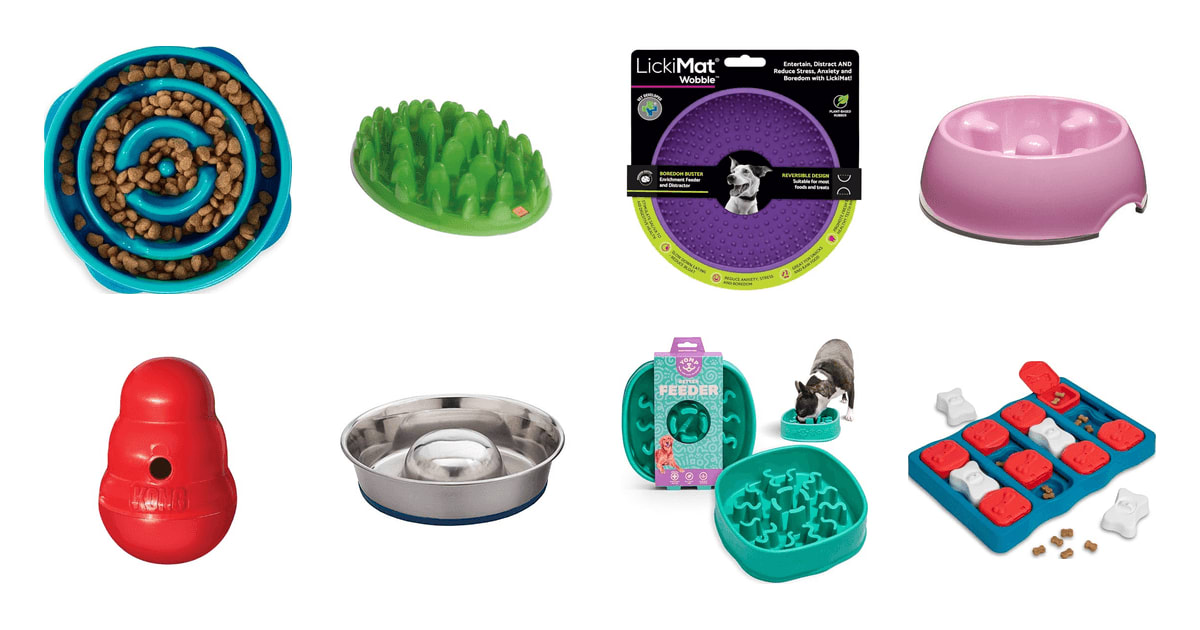
If your dog inhales a meal in twenty seconds, you already know the sound: a frantic clatter, then silence, then maybe a puddle on the rug. Fast eating swallows a lot of air along with the kibble, and that air has to go somewhere. For deep-chested breeds like Great Danes, Weimaraners and standard poodles, it's a real medical concern — veterinary groups point to rapid gulping as a contributing factor in bloat. A slow feeder is a cheap, low-effort way to stretch a thirty-second meal into a few minutes.
No slow feeder is a cure, though, and that's worth saying plainly. These bowls reduce a risk factor; they don't prevent bloat, and they won't fix a dog that's eating fast because of anxiety, competition with another dog, or an underlying gut problem. Smart dogs also adapt. A design that stumps your dog in week one can be routine by week six, especially the simpler ones. And every design here trades something away — the mazes that slow dogs down the most are also the most annoying to clean.
So the right pick depends on your dog's size, what you feed and how much prep you're willing to do before dinner. A kibble-only Lab needs something different from an anxious spaniel on wet food, and a dog that shoves its bowl across the kitchen needs weight more than it needs a clever maze. We think that the Outward Hound Fun Feeder Slo Bowl is the best slow feeder dog bowl for most people, and that the Company of Animals GREEN Interactive Feeder is the one to buy if you have a large or giant breed that needs more food and more challenge.
Everything we recommend

The deepest maze that's still easy to clean
More food, more challenge, more cleaning

The right tool for wet food and anxious dogs

Two simple bowls for the price of one good maze

Stainless and immovable, if you'll take a simpler maze
At a glance
| Product | Price | |
|---|---|---|
| Outward Hound Fun Feeder Slo BowlTop pick | $8.63On sale |
| Company of Animals GREEN Slow Interactive FeederUpgrade pick | $34.99 |
| LICKIMAT WobbleAlso great | $18.95 |
| Dogit Go Slow Anti-Gulping Dog Bowl [SetBudget pick | $16.95 |
 | KONG WobblerAlso consider | $24.96 |
| OurPets DuraPet Slow Feed Premium Stainless SteelRunner-up | $15 |
 | Yomp BetterFeeder Puzzle Slow Feeder Dog BowlAlso consider | $24.99 |
 | Outward Hound Nina Ottosson Dog Brick DogAlso consider | $14.30 |
How we picked
Actual slowdown. We compared manufacturer claims against published review findings and owner reports to separate bowls that meaningfully extend a meal from ones that just look complicated. Designs with deep, irregular channels consistently came out ahead of single-obstacle bowls.
Cleaning burden. We weighted dishwasher-safe designs heavily, because a feeder used twice a day gets neglected the moment cleaning becomes a chore. Where a bowl needs a brush, we say so.
Material and chew safety. We required explicit food-safe materials — BPA-free plastic, food-grade silicone, natural rubber or stainless steel — and checked owner feedback for cracking and chipping, which turns a bowl into an ingestion hazard.
Stability on the floor. We looked for bonded rubber rings, weighted bases or genuine non-slip treatment, since a bowl that slides across tile stops slowing anything down.
Capacity and fit. We checked stated capacity against what a real meal looks like for the dog each bowl targets, and flagged channel widths that don't suit small or flat-faced breeds.
Top pickOn sale
The deepest maze that's still easy to clean
Outward Hound Fun Feeder Slo Bowl
A deep drop-pattern maze that holds two cups and goes straight in the dishwasher. It's the most effective slowdown you can get for a small or medium dog without committing to hand-washing or a nightly setup routine.
$8.63fromAmazonList priceThe maze is genuinely hard to beat, and that's the whole point. Outward Hound calls this its slowest level, built for very fast eaters, and the drop-pattern channels back that up. Your dog can't scoop. It has to work each channel separately, tongue first, which is what turns a twenty-second meal into a few minutes. Published reviews of this bowl consistently land on the same result: meals take substantially longer, across a range of dogs.
Two cups is the right size for the dogs most likely to need one. That covers a full meal for most dogs up to roughly forty pounds — beagles, cockers, border collies, the mid-size mutts that make up most households. Outward Hound also sells this pattern in other sizes and three difficulty levels, so if your dog is smaller or newer to the idea, you can step down rather than starting at the hardest setting.
It's top-rack dishwasher-safe, which matters more than it sounds. A slow feeder gets used twice a day, every day. Any bowl you have to scrub with a bottle brush eventually gets a lazy rinse instead, and residue builds up in the channels. This one you rinse and rack. That's the difference between a bowl you keep using and one that migrates to the back of a cupboard.
The materials check the boxes you'd want checked. It's made without BPA, PVC, lead or phthalates, and the base has a non-slip treatment that holds well enough on tile and hardwood for small and medium dogs. If you've got an enthusiastic eater that still pushes it around, a rubber mat underneath solves it. That's a fifteen-second fix, not a reason to buy a different bowl.
Flaws but not dealbreakers
It's plastic, so chewers will eventually destroy it. Dogs that gnaw the rim between meals will crack or chip it over time, and chipped plastic is an ingestion hazard, not just an eyesore. Owners who report short lifespans almost always describe a dog that treats the bowl as a toy. If that's your dog, buy the stainless OurPets instead and skip this one entirely.
Wet food is a hassle in those deep channels. Kibble rinses right out. Broth-soaked food or pâté-style wet food packs into the narrow diagonals and sets like grout if you leave it overnight. The dishwasher handles it if you load it promptly, but a same-day rinse is non-negotiable. If your dog eats mostly wet or raw, this is the wrong shape of bowl.
Fast learners work out the pattern. Some owners find the slowdown fades after a few weeks as their dog figures out the most efficient route. Portioning less food per serving helps, since a thin layer is harder to sweep up than a full bowl. But no maze stays novel forever.
Upgrade pick
More food, more challenge, more cleaning
Company of Animals GREEN Slow Interactive Feeder
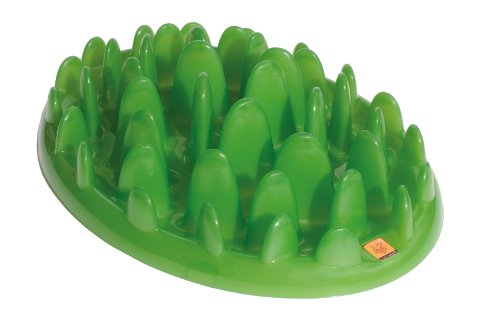
A tuft of flexible rubber grass blades that your dog has to nose through to find kibble. It holds a big-dog meal and stays interesting far longer than a maze, but you'll be cleaning it by hand with a brush.
$34.99fromAmazonIt's one of the few slow feeders actually sized for a big dog. The large version has a wide footprint and holds a full meal for a Lab, a shepherd or a Dane — the breeds most likely to need slowing down in the first place. Most maze bowls top out well below that, which means two servings or a frustrated dog. Here you sprinkle the portion across the blades and walk away.
Foraging beats a maze for dogs that have outsmarted mazes. A channel bowl rewards one efficient route, and clever dogs find it. The grass blades don't work that way — kibble scatters unpredictably down into the base, so your dog has to nose through different zones each meal. That irregularity is why owners of smart, food-driven dogs tend to stick with this one long after a maze bowl stopped working.
The engagement is mental, not just mechanical. Pushing blades aside to find food is closer to scavenging than eating, and dogs that eat fast out of boredom often settle better afterward. Company of Animals designed it around that idea, and the slower pace also does the practical job: less air swallowed per mouthful, which is the point for bloat-prone breeds.
It doesn't look like pet gear. That sounds trivial until you realize this thing lives on your kitchen floor permanently. It reads as a green object rather than a plastic dog bowl, which makes it easier to leave out where you actually feed your dog.
Flaws but not dealbreakers
Cleaning is the real cost of ownership. Kibble dust settles down between the blades where a sponge can't reach, and you'll want a bottle brush or an old toothbrush to get the base properly clean. Owners who skip this end up with a funky-smelling feeder within weeks. If you want to rinse and rack, buy the Outward Hound.
Don't put wet or raw food in it. The blades get sticky and are close to impossible to sanitize properly between meals. Stick to dry kibble here and use a lick mat for anything soft.
It's the most expensive option in this guide. For a small dog that a basic maze already slows down, you're paying for capacity and complexity you don't need.
Also great
The right tool for wet food and anxious dogs
LICKIMAT Wobble
A natural-rubber lick mat on a wobbling base, made for wet food, yogurt, peanut butter or supplement toppers. Sustained licking calms a lot of dogs, which makes this as much a behavior tool as a feeder.
$18.95fromAmazonLicking is the mechanism here, and it works differently than a maze. LickiMat's whole argument is that prolonged licking releases endorphins and settles an anxious dog. That's why this shows up during thunderstorms, fireworks and crate training, not just at dinner. A maze bowl slows eating; this one changes your dog's state while it eats.
The wobble keeps dogs engaged longer than a flat mat. The base rocks as your dog licks, so the target keeps shifting instead of sitting still. A smear of wet food that would vanish in under a minute from a normal bowl stretches into several minutes of work. Owners who've used flat lick mats before generally find the wobble holds attention noticeably longer.
It's the only thing here that handles wet and raw food well. Spread pâté, raw, yogurt or a liquid supplement across the dimpled surface and it stays put. Maze bowls turn soft food into a cleaning problem; this surface is designed for it. If your dog eats wet food or gets a topper over kibble, that alone makes it worth having.
The textured surface does something for teeth, too. The dimples generate saliva and scrape debris off the tongue as your dog works. It's not a substitute for brushing, but it's a small bonus on a bowl you're already using twice a day.
Flaws but not dealbreakers
It's useless for dry kibble on its own. Kibble doesn't stick to rubber, and a wobbling base just scatters it across your floor. This is a wet-food tool. If you feed dry only, you'd need to add a wet layer on top for it to do anything, which defeats the simplicity.
It's not a chew toy, and some dogs treat it like one. The natural rubber holds up to licking, not gnawing. Owners with determined chewers report damage, and the manufacturer specifically warns against unsupervised use with known chewers. Take it away when the food's gone.
The wobble needs a reasonably flat floor. On uneven tile or a bunched-up mat it can tip rather than rock, dumping food. It's a small footprint, so finding a flat spot is usually easy — but worth knowing before you assume it'll work anywhere.
Budget pick
Two simple bowls for the price of one good maze
Dogit Go Slow Anti-Gulping Dog Bowl [Set
A pair of central-post bowls that break up the wide scooping motion behind most gulping. They won't stop a determined speed-eater for long, but they're the easiest way to try the idea or feed two dogs at once.
$16.95fromAmazonTwo bowls in the box is the actual argument here. If you've got two dogs, you need two feeders, and buying two premium mazes gets expensive fast. This set covers both dogs for a fraction of that. It's also the low-risk way to find out whether your dog tolerates a slow feeder at all before you commit to something pricier.
The simple design is a feature for first-timers. A raised center post forces your dog to eat around the edge instead of burying its whole muzzle in a pile of kibble. That's a modest obstacle, but modest is exactly right for a dog that's never encountered one. Veterinary sources note that even a partial slowdown cuts the air a dog swallows per meal.
It's the easiest bowl here to clean. No deep diagonals, no rubber blades, no grooves. A rinse under the tap and a wipe gets it genuinely clean. If your dog eats wet food and you don't want a dedicated lick mat, the open shape is far more forgiving than a maze.
It comes in two sizes. The smaller one suits puppies and toy breeds whose muzzles can't navigate channels built for a Lab — a sizing problem that trips up a lot of small-dog owners buying their first slow feeder.
Flaws but not dealbreakers
Determined eaters figure it out fast. A single post is one obstacle, and a motivated dog learns to work around it within a few weeks. If your dog is vomiting after meals, start with the deep maze instead — this won't be enough.
There's no non-slip treatment on the base. On hardwood or tile, an enthusiastic dog will push it steadily across the room. A cheap silicone placemat underneath fixes it, but you should plan on needing one.
Capacity is modest. These bowls hold a small portion each, which is fine for a puppy or a little dog but means a second serving for anything medium-sized.
Runner-up
Stainless and immovable, if you'll take a simpler maze
OurPets DuraPet Slow Feed Premium Stainless Steel
A heavyweight stainless bowl with a raised center island and a rubber ring bonded to the base. It slows dogs less than a deep maze, but a chewer can't destroy it and it won't slide an inch.
$15fromAmazonStainless steel solves the hygiene problem plastic eventually creates. Plastic bowls accumulate micro-scratches over months of daily use, and those scratches hold bacteria through a wash cycle. Stainless doesn't scratch that way, resists rust and doesn't hold odors. If you're the kind of person who thinks about what's living in your dog's bowl, this is the one to buy.
The bonded rubber ring is the best anti-skid solution in this guide. It's permanently attached, not a stick-on pad that peels off in the dishwasher. Combined with the weight of the steel, the bowl simply stays where you put it. Big dogs that send plastic bowls skating across the kitchen can't move this one.
It's effectively chew-proof. A dog that has cracked two plastic mazes will not damage this. That changes the math on cost — you buy it once rather than replacing a plastic bowl every few months, and there's no chipped-plastic hazard to worry about.
Capacity is generous and it's dishwasher-safe. The medium holds several cups, enough for a full meal for most dogs, and the whole bowl goes in the machine. The manufacturer suggests going gentle to preserve the bonded base, but a rinse and wipe handles it in seconds anyway.
Flaws but not dealbreakers
One raised island isn't a deep maze. Your dog eats around the edge, which produces a moderate slowdown rather than a dramatic one. For a dog that regurgitates after meals, that may not be enough, and the Outward Hound is the better first try.
Repeated dishwasher cycles can work on the bonded base over time. Hand-washing is the safer habit if you want the rubber ring to stay put for years. Given how fast stainless rinses clean, that's a minor ask.
It's a poor choice for wet food. Smooth steel doesn't hold soft food in place the way rubber or silicone does, so your dog can push a wet meal into one corner and eat it in a couple of gulps.
Who this is for
Buy a slow feeder if your dog finishes a meal in under a minute, burps or regurgitates afterward, or belongs to a deep-chested breed at elevated bloat risk — Great Danes, Weimaraners, shepherds, boxers, standard poodles. It's also worth it if your dog eats fast out of boredom rather than hunger, in which case a puzzle feeder does more than a bowl. Puppies benefit too, since it's easier to build a slower habit than to fix a fast one later.
You can skip it if your dog already grazes or eats at a normal pace; adding an obstacle to a slow eater just creates frustration. This guide covers bowls, mats and puzzle feeders you'd use for a regular meal at home. It doesn't cover raised feeder stands, automatic portion dispensers, snuffle mats or outdoor and travel bowls. And a slow feeder isn't a diagnosis — if your dog keeps vomiting after meals even with one, that's a vet conversation, not a shopping problem.
How we picked
We started from what actually separates a feeder you keep using from one that ends up in a cupboard. Actual slowdown: we compared manufacturer claims with published review findings and owner reports, favoring deep irregular channels over single-post designs that clever dogs solve in a fortnight. Cleaning burden: dishwasher-safe designs got a real advantage, since a bowl used twice daily gets neglected the moment it needs a brush. Material and chew safety: we required explicit food-safe materials and read owner feedback for cracking, which turns a bowl into a hazard. Stability: bonded rubber rings and weighted bases beat bare plastic, because a bowl that skids stops working. Capacity and fit: stated capacity had to match a real meal for the dog the bowl targets, with channel widths that small and flat-faced breeds can actually use.
Other slow feeder dog bowls worth considering
If your dog eats fast because it's bored: The KONG Wobbler ($24.96) — The KONG Wobbler turns a cup of kibble into a twenty-minute project. You unscrew the base, fill it, and your dog has to bat and nudge the weighted body to shake kibble out an off-center hole, a piece or two at a time. For working breeds and high-drive dogs that eat fast because nothing else is happening, that addresses the cause rather than the symptom — and it's dishwasher-safe, so it's practical for daily meals. The trade-offs are real, though. It's kibble-only, it knocks loudly against hardwood in a way that spooks nervous dogs, and some dogs lose interest once the novelty wears off. Alternating it with a maze bowl keeps it fresh.
If your dog shoves its bowl across the kitchen: The Yomp BetterFeeder Puzzle Slow Feeder Dog Bowl ($24.99) — The Yomp BetterFeeder is a weighted silicone puzzle bowl built around stability. It's noticeably heavier than the plastic mazes, with a grippy base that holds on tile and hardwood, and the silicone is free of BPA and phthalates and soft on gums. The textured surface also copes with a wet topper over kibble better than hard plastic does. Two caveats. Yomp is a newer brand without the long track record of Outward Hound or KONG, so durability over years is an open question. And those texture grooves hold fine kibble dust, so give it a rinse before the dishwasher or it bakes on.
If you want mealtime to be a training session: The Outward Hound Nina Ottosson Dog Brick Dog ($14.30) — The Nina Ottosson Dog Brick is a Level 2 puzzle with sliding bones and flip-open lids that you rearrange across three difficulty settings. For a border collie or a Vizsla that's mastered every maze you own, it's the logical next step — Outward Hound cites fifteen minutes of puzzle work as roughly equivalent to half an hour of physical exercise, and the escalating difficulty means it stays useful for months. But it's an enrichment toy first. It holds three-quarters of a cup, needs a couple of minutes of loading before each meal, and is wipe-clean only, so it's dry kibble territory. Most people will want a regular bowl for the other meal of the day.
The competition
This is what our research surfaced as the most widely available and most discussed slow feeders, not a census of everything sold. The category is crowded with near-identical maze bowls from unfamiliar brands, and we focused on designs with a distinct approach — deep maze, foraging, lick mat, stainless, weighted silicone, dispensing toy and puzzle board — so that each recommendation answers a different problem. Every product we looked at appears somewhere in this guide.
Care and introducing a slow feeder
Go gradually. Dogs new to obstacles can get frustrated by a deep maze and simply walk away from dinner, so start with something simple like a central-post bowl for the first few days and step up from there. Wetting dry kibble with a little warm water or low-sodium broth makes it easier to dislodge from tight channels while your dog is learning. Most dogs settle in within a week; if refusal drags past that, drop back a level rather than waiting it out. For cleaning, rinse maze bowls the same day rather than letting food dry in the channels, and keep a bottle brush or an old toothbrush for the designs that can't go in the dishwasher. Check plastic bowls every few months for cracks and chips, and retire any bowl your dog has started chewing.
Questions we get
Do slow feeder bowls actually prevent bloat?
No, and you shouldn't buy one expecting a guarantee. What they do is reduce a known risk factor — the air a dog swallows while gulping — which is why the AKC and VCA recommend them for high-risk breeds. Bloat is a surgical emergency regardless of how your dog eats. Pair a slow feeder with two measured meals a day rather than one big one, and avoid hard exercise for an hour after eating.
Which slow feeder is best for a large breed like a Lab or a Great Dane?
The Company of Animals GREEN feeder in the large size is our pick — it holds a full big-dog meal and the foraging layout keeps smart dogs engaged. If you'd rather have something you can rinse in seconds and never worry about a chewer destroying, the OurPets DuraPet in a larger size is the other good answer. Both are more stable on the floor than lightweight plastic.
Can I use a slow feeder with wet or raw food?
Sometimes, but the design matters a lot. The LickiMat Wobble is built for it — soft food stays put on the dimpled rubber surface. Deep maze bowls work if you rinse them the same day, though residue in the channels is a real nuisance. Avoid wet food in the GREEN feeder entirely, since the grass blades get sticky and are hard to sanitize.
Are slow feeders safe for puppies?
Yes, and starting early is easier than breaking a gulping habit later. Choose a small size with a simple design so your puppy doesn't get frustrated and give up on meals — the small Dogit Go Slow suits puppies under about twenty pounds. Wait a week or two of successful eating before moving to a deeper maze.
My dog got frustrated and won't eat from it. Now what?
Step back to a simpler design and rebuild from there. Wetting the kibble slightly helps a lot during the adjustment period, since food comes loose more easily from tight channels. Most dogs adapt within a week. If your dog still refuses after that, the design is too hard for it — try a central-post bowl or a lick mat instead.
Stainless steel or plastic?
Stainless if your dog chews its bowl or you care most about long-term hygiene, since plastic develops micro-scratches that harbor bacteria and can crack under gnawing. Plastic if you want the deepest maze and the easiest cleaning, since the molded channel designs are far more complex than anything available in steel. For most non-chewing dogs, food-safe plastic is perfectly fine.
Why you should trust us
For this guide:
- We read manufacturer specifications and listing details for every feeder here, comparing stated capacity, materials and cleaning instructions against each other.
- We reviewed published evaluations from pet-focused publications and veterinary sources on how much slow feeders reduce eating speed and why that matters for bloat risk.
- We looked at recurring themes in owner feedback — cracking under chewers, bowls sliding on hard floors, residue in deep channels and dogs outsmarting simple designs — to write the flaws sections.
- We read owner reviews on every listing, weighted toward the critical ones, because that is where the recurring failures show up.
- We have a systematic way of automatically fetching the latest prices, so the numbers on this page stay current.
- This is a research-focused guide, so the team may not own every product listed — though we often do own the top winners, which gives us extra context for the recommendations.
- We don't accept free products, and the retailer commission never changes which product we recommend.
Sources
Best Slow Feeder Dog Bowls — The Spruce Pets, The Spruce Pets
Bloat in Dogs (Gastric Dilatation-Volvulus) — American Kennel Club, American Kennel Club
Gastric Dilatation-Volvulus (Bloat) in Dogs — VCA Animal Hospitals, VCA Animal Hospitals
Slow Feeder Dog Bowls: What Are the Benefits? — PetMD, PetMD
Best Slow Feeder Dog Bowls — Rover.com, Rover
Amazon product listings and owner reviews for all 8 products
Manufacturer specification pages for each product
Some passages in this guide may be paraphrased with AI help. Prices are refreshed automatically.
More like this.
Continue exploring pet reviews and recommendations.

The Best Elevated Dog Bowls and Feeding Stations
Feeding a dog is a floor-level job, and for plenty of dogs that's fine. But if your dog is tall, stiff in the shoulders, or simply old, dropping the head…

The Best Automatic Dog Feeders
Your dog knows when dinner is late. A feeder that runs on a schedule takes that pressure off you - the meeting that runs long, the flight that boards at…

The Best Heated Water Bowls for Outdoor Pets
When the temperature drops below freezing, an ordinary water bowl turns into a hockey puck in a couple of hours. A heated bowl fixes that with a…

The Best Slow Cookers
A slow cooker is the rare appliance that does its best work while you're gone. You put a chuck roast, some onions and a can of tomatoes in the pot before…

The Best Dutch Ovens for Slow Cooking
A Dutch oven earns its shelf space by doing one thing better than anything else in your kitchen: it turns cheap, tough cuts into something worth serving.…

The Best Stainless Steel Mixing Bowl Sets
A mixing bowl set is something you touch every day and think about almost never. You crack eggs into one, toss a salad in another, and stash leftovers in…