The Best Dutch Ovens for Slow Cooking
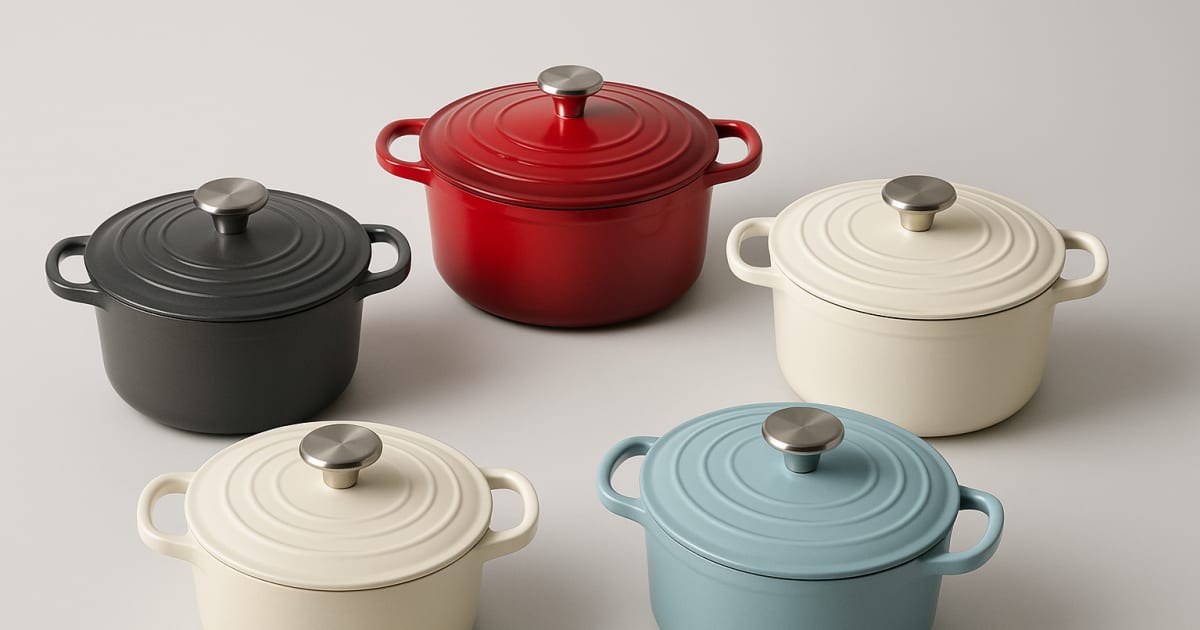
A Dutch oven earns its shelf space by doing one thing better than anything else in your kitchen: it turns cheap, tough cuts into something worth serving. You brown the meat on the stovetop, add liquid, put the lid on, and slide the whole pot into the oven. Three hours later you have short ribs that fall apart under a fork. The heavy cast iron holds steady heat, so the liquid never boils hard, and the lid keeps the steam where you want it. Bread bakers use the same pot for a different trick — a sealed, steamy chamber that gives a loaf a proper crust.
Here's the part nobody puts on the box: these pots are heavy, and no manufacturer has solved that. A five-and-a-half-quart pot weighs a good bit empty, and once you load it with a roast and a quart of stock, you're lifting something awkward out of a hot oven with mitts on. Owners across every brand here mention it, including people who otherwise love their pot. Enamel is also glass, which means it chips if you knock it or scrape it with metal. Buy accordingly.
The good news is that the performance gap between the expensive pots and the affordable ones is smaller than the price gap suggests. What you're really paying for at the top is enamel that survives a decade of hard use and a warranty that backs it up. We think that the Le Creuset Signature Round Dutch Oven is the best Dutch oven for slow cooking for most people, and that the Staub Cast Iron Cocotte Round is the one to buy if you braise more than you bake.
Everything we recommend
The pot you buy once, if you can stomach the cost
Better at braising, harder to sear in
Most of the performance, a fraction of the outlay
French-style build without the flagship price
A low-stakes way to find out if you'll use one
At a glance
| Product | Capacity (qt) | Max Oven-Safe Temp | Price | |
|---|---|---|---|---|
| Le Creuset Signature Round Dutch OvenTop pick | 5.5 qt | — | $360On sale | |
| Staub Cast Iron Cocotte RoundRunner-up | 5.5 qt | — | $299.95 | |
| Lodge Enameled Cast Iron Dutch OvenBudget pick | 6 qt | — | $69.90 | |
| Cuisinart Chef's Classic Enameled Cast IronAlso great | 5 qt | — | $105.78On sale | |
| Made In Enameled Dutch OvenAlso great | 5.5 qt | — | $299 |
How we picked
Heat retention. We looked for heavy-gauge enameled cast iron thick enough to hold a steady temperature through a three-hour braise. Published equipment reviews consistently separate the pots that hold temperature from the ones that swing.
Enamel durability. We weighted owner feedback about chipping and peeling heavily, since that's the failure mode that ends a pot's life. Reports clustering around a specific failure — enamel lifting from the interior bottom — counted against a product more than isolated complaints.
Lid fit. A loose lid means a dry roast and a thin sauce after three hours. We favored pots that published reviews and owners describe as sealing tightly, and noted where the fit is merely adequate.
Handling when loaded. We compared handle size and shape and read what owners say about lifting a full pot with mitts on. Weight complaints from otherwise happy owners were treated as a real limitation, not a nitpick.
Warranty and support. We compared stated coverage terms and looked at how owners describe the claims process when a pot arrived damaged or failed early. Unconditional lifetime coverage counted for more than defect-only coverage.
Top pickOn sale
The pot you buy once, if you can stomach the cost
Le Creuset Signature Round Dutch Oven
The Le Creuset Signature is a 5.5-quart enameled cast iron pot with a light interior, oversized loop handles and a lifetime warranty. It's the most consistently recommended Dutch oven in published reviews, and owners who've had one for years report the enamel still looks new.
$360fromAmazonList priceThe light-colored interior is the feature you'll appreciate every single time you cook. When you're browning beef before a braise, you need to see the fond — those brown bits stuck to the bottom that become your sauce. Against Le Creuset's sand-colored enamel, you can watch it develop and pull the meat at the right moment. In a dark pot, you're guessing. It's a small design choice that changes how confidently you cook.
Le Creuset has been making enameled cast iron in northern France since 1925, and the Signature line is the current version of a pot that hasn't fundamentally changed in a century. The loop handles on this generation are noticeably larger than the ones on older models, which matters more than it sounds — you can get a hand wrapped in a thick silicone mitt around them without fumbling.
Published equipment reviews put this pot at or near the top year after year, and the reason is consistency rather than any single standout number. It heats evenly, holds temperature through a long low oven session, and the enamel doesn't stain from tomato or wine. Owner feedback echoes it: people describe using theirs several times a week for months with no visible wear.
The warranty is a real part of the value, not marketing. Le Creuset's lifetime coverage is unconditional, and owners who received a pot with a defective lid or a shipping-damaged piece report straightforward replacement. When a pot costs what this one does, knowing a manufacturing flaw won't leave you stuck is worth something concrete.
Flaws but not dealbreakers
It's heavy, and that disqualifies it for some people. One owner described it as otherwise perfect and returned it anyway because she couldn't safely lift it — she's not alone in that. If you have wrist or shoulder trouble, or you're moving a full pot in and out of a wall oven at chest height, try lifting a loaded one before you commit. A smaller capacity helps, but only somewhat.
Some color variants ship with a phenolic knob rated well below the pot's own oven ceiling. If you bake bread at high heat, check your specific model's knob rating and swap in a stainless one if needed. Melting a knob is an avoidable mistake that most warranties won't cover.
It costs several times what a perfectly good enameled pot costs, and the performance difference is not several times better. You're paying for durability and the warranty, and that math only works if you cook a lot.
Le Creuset covers the Signature line with an unconditional lifetime warranty.
Runner-up
Better at braising, harder to sear in
Staub Cast Iron Cocotte Round
The Staub Cocotte matches Le Creuset on build quality but takes a different approach inside: a dark matte interior and a lid studded with spikes that drip condensation back onto the food. If braises and stews are most of what you cook, this is the better pot.
$299.95fromAmazonThe spike lid is the whole argument for this pot. As steam rises during a long cook, it condenses on the underside of the lid and collects on those raised points, then falls back over the food in a fine, even drip instead of running down the sides. You get self-basting without opening the oven. For a three-hour braise, that means more liquid left at the end and a sauce that tastes more concentrated.
The matte black interior gets better with age. Unlike a light enamel that stays exactly as it started, Staub's textured dark surface builds up something closer to the patina on a well-used cast iron skillet. Owners who've had theirs for several years describe food releasing more easily than it did when new. It also hides stains completely, which is why people who cook a lot of tomato and turmeric prefer it.
This is why plenty of professional kitchens keep a Staub around even when they already own Le Creuset. The two pots aren't really competing — they're optimized for different halves of the same job. If you're deciding, ask yourself whether you spend more time watching a sear or waiting on a braise.
Owner feedback is broadly consistent with the premium reputation: people describe holding steady temperature through long simmers, tenderizing tough stew meat reliably, and appreciating that the pot doesn't feel as unwieldy as its weight suggests. Several own multiple sizes and use them weekly.
Flaws but not dealbreakers
Searing in a dark pot is genuinely harder. You can't see the fond forming, so you're working by smell, sound and time rather than sight. Experienced cooks adjust fine. If you're newer to this, the Le Creuset makes the learning curve gentler.
It's slightly heavier than comparable Le Creuset sizes, and the textured interior takes a bit more attention when you're cleaning — residue can settle into the surface if you rinse and walk away. A soak and a soft brush handles it.
Staub's warranty coverage isn't as broad as Le Creuset's, even though the pots cost about the same. You're buying the braising advantage, not better protection.
Budget pick
Most of the performance, a fraction of the outlay
Lodge Enameled Cast Iron Dutch Oven
The Lodge Enameled 6-quart is the pot to buy if you don't want to spend heavily on cookware. It braises and bakes bread about as well as pots costing several times more, and its slightly larger capacity suits families and batch cooking.
$69.90fromAmazonIn a blind taste test, nobody can tell which pot the stew came out of. That's the honest summary of every published budget comparison. The Lodge's heat distribution is a touch less uniform than the French pots, but the difference only surfaces at very low temperatures over very long cooks. For a standard braise at a moderate oven temperature, the results are the same.
Lodge has been making cast iron in Tennessee since 1896, and the enameled line applies that manufacturing depth to a price point that doesn't hurt. The extra half quart over the 5.5-quart standard is genuinely useful if you cook for five or six, or if you like having leftovers. Owners consistently report making bread in it with excellent results.
The reason to consider this pot first, even if you can afford more, is anxiety. A Le Creuset makes people cautious — you hesitate before letting a teenager use it, and you wince when it clinks against the sink. With a Lodge, you just cook. For a lot of households, that's worth more than a few degrees of temperature uniformity.
There's a real argument for buying this pot as a test. Use it hard for a year. If you find yourself reaching for it four times a week, upgrade with confidence and keep the Lodge as a second pot. If it lives in the cabinet, you've lost very little.
Flaws but not dealbreakers
The enamel is the compromise. Owners report chipping more often here than on the French pots after a couple of years of heavy use, and independent durability testing has found edge chipping under impact where premium enamel held up. Skip metal utensils and abrasive pads and you'll extend its life considerably.
The lid doesn't sit quite as snugly as the premium pots, so you'll lose a little more liquid over a long cook. Not enough to ruin a braise. Enough that you might add a splash of stock partway through.
Handles are narrower and less contoured than Le Creuset's, which you'll notice when the pot is full and hot. Color options are limited too, if that matters to you.
Lodge's coverage is limited to manufacturing defects.
Also great
French-style build without the flagship price
Made In Enameled Dutch Oven
Made In sells its enameled Dutch oven direct rather than through stores, which cuts the markup. It's made in France with the same enamel-fused-to-cast-iron process as the premium pots, and it costs meaningfully less than Le Creuset or Staub.
$299fromAmazonThe pitch here is simple: skip the retail markup and put the savings into the pot. Made In launched with a direct-to-consumer model and manufactures this pot in France using the same process the established French brands use. Published reviews have called it a legitimate contender rather than a knockoff, and its heat uniformity lands closer to Le Creuset than to the budget tier.
The lid seals tightly, which is what actually matters for slow cooking. Moisture retention over a long braise comes down to lid fit, and this one seats well. Owners describe cooking evenly on low heat and getting good results with sourdough, yogurt and long-simmered sauces. The design is clean and unfussy, which appeals to people who find the classic French look dated.
Made In backs the pot with a lifetime warranty covering manufacturing defects, which is unusual at this price. That said, warranty claims mean packing the pot yourself and shipping it, and the company doesn't have the century of customer service infrastructure the older brands do.
Flaws but not dealbreakers
Long-term enamel durability is the open question, and owner feedback raises it directly. There are reports of enamel peeling from the interior bottom after a few years of light use, and of chips appearing after roughly a year and a half. Those accounts are a minority, but they're specific and they cluster around the same failure mode — which is exactly the thing decades of field data on Le Creuset would tell you about. Here, that data doesn't exist yet.
You can't handle one before buying. There's no retail shelf to walk up to, so you're judging weight and finish from photographs. If lifting a pot before committing matters to you, that's a real obstacle.
Shipping damage shows up in owner reports more than you'd like — pots arriving with a handle broken off. Replacements were handled, but it's a hassle you don't have when you carry a pot out of a store.
Made In offers a lifetime warranty on its cookware against manufacturing defects.
Also greatOn sale
A low-stakes way to find out if you'll use one
Cuisinart Chef's Classic Enameled Cast Iron
The Cuisinart Chef's Classic is a lighter, more affordable enameled cast iron pot that's easy to find in stores. It won't outlast the premium options, but it's a sensible first Dutch oven if you're not sure how often you'll actually cook this way.
$105.78fromAmazonList priceWeight is the reason to look at this one. It's lighter than the other pots here, and for anyone who struggles to lift a loaded cast iron pot out of an oven, that's not a minor spec — it's the difference between using the thing and leaving it in the cabinet. One owner who found her Lodge too heavy and awkward switched to this and cooks with it happily.
You can buy it in a store today. It's stocked at most major chains, so you can pick it up, feel the weight, check the handles and take it home the same afternoon. That matters if you're buying a gift, replacing a pot mid-recipe, or just want to see the color in person rather than on a screen.
The enamel is non-reactive and easy to clean after acidic dishes, and published reviews have specifically noted that it holds up against tomato-based sauces over long cooks. Owners describe using it for everything from gumbo to sourdough and being satisfied at the price.
Think of it as a trial run. Cook with it for a year. If the Dutch oven becomes a weekly habit, move up to a Lodge or a Le Creuset and hand this one to someone starting out. If it turns out you're a sheet-pan household, you haven't overcommitted.
Flaws but not dealbreakers
The walls are thinner than the other pots here, so it holds heat less steadily through a long low cook. On a three-hour braise at a moderate temperature you probably won't notice. Push past four hours at a low setting and you might.
Lid fit is looser than the premium pots, which means more evaporation over a long cook. Keep an eye on your liquid level.
Enamel quality varies by color variant, and it dulls faster than Lodge's under the same washing. It's built for a couple of dinners a week, not daily hard use. A few owners have also reported receiving a different color than they ordered.
Who this is for
This guide is for anyone who wants to braise, stew, make chili or bake bread at home and doesn't already own a pot that does it. If you cook for two to six people and want one vessel that goes from stovetop to oven, a five-to-six-quart enameled cast iron Dutch oven is the right tool, and everything here fits that description. If you've never used one, start at the affordable end — you can always upgrade once you know how often you'll reach for it.
A few people should skip this category. If you can't comfortably lift a heavy loaded pot out of a hot oven, cast iron may not be workable regardless of brand, and a lighter option or a countertop appliance makes more sense. If you want to leave dinner unattended for eight hours while you're at work, buy a slow cooker instead — a Dutch oven needs an oven running, which means someone home. We've stuck to round enameled pots in the common household sizes here; bare cast iron, oval shapes and very large batch pots are outside what we looked at.
How we picked
We judged these pots on the things that actually change how a long cook turns out. Heat retention: heavy walls that hold a steady temperature for three hours or more, not just a pot that gets hot. Enamel durability: resistance to chipping and peeling, weighted by the specific failure modes owners report rather than hypothetical ones. Lid fit: a tight seal, because even a small gap costs you liquid and leaves a roast dry. Handling when loaded: handles wide enough to grip with thick mitts, and honest accounting for weight that puts some pots out of reach for some cooks. Warranty and support: what's actually covered, and how straightforward owners find it when something goes wrong.
The competition
These five pots are what the research surfaced as the most consistently recommended and most widely owned enameled Dutch ovens in the common household sizes. It isn't every pot on the market — the category is crowded, and there are perfectly good options from smaller brands and store labels we didn't look at. Every product in this lineup ended up as a pick, because each one genuinely serves a different buyer. What follows in the sections above is the reasoning for each.
Care and maintenance
Enamel is glass fused to iron, so treat it like glassware that happens to weigh a lot. Use wood, silicone or nylon utensils and keep metal spoons and tongs out of the pot — most chipping starts with a scrape. Let the pot cool before it hits water, since dumping a hot pot in a cold sink is how thermal shock cracks enamel. For stuck-on food, fill with warm water and a little dish soap and let it sit an hour rather than attacking it with a scouring pad; a plastic scraper handles the rest. Baking soda takes care of stubborn browning on light interiors. Store it with the lid slightly ajar or a folded towel between lid and rim so the two enamel edges don't grind against each other in the cabinet.
Questions we get
Is a Dutch oven better than a slow cooker for braising?
For flavor, yes. You can sear meat and build fond in a Dutch oven before adding liquid, which a slow cooker can't do, and oven heat surrounds the pot instead of coming from a single element underneath. The gentle evaporation in an oven braise also concentrates the sauce. A slow cooker still wins if you need dinner to cook itself for eight hours while you're out.
What size Dutch oven should I buy for a family of four?
Five to five and a half quarts is the sweet spot. It holds a three-to-four-pound roast, a broken-down chicken, or enough stew for four to six servings with room for the liquid to move. If you regularly cook for five or six or do big batch prep, go to six or seven quarts. When you're genuinely torn, size up — a big pot handles a small recipe, but not the reverse.
Can I use a Dutch oven on an induction cooktop?
Yes, all of these work on induction. Cast iron is naturally magnetic, so it responds to an induction field without any special base. It takes a few extra minutes to come up to temperature compared with gas, so give it three or four minutes on medium before you add anything you want to sear.
Is Le Creuset actually worth it compared with Lodge?
It depends on how often you'll cook with it. If you use a Dutch oven three or more times a week and plan to keep it for fifteen or twenty years, the tougher enamel and unconditional warranty make the premium defensible over that horizon. If you cook this way once or twice a month, the Lodge gets you most of the way there. Our practical suggestion: buy a Lodge, live with it for a year, and upgrade only if it earns a permanent spot on your stovetop.
What's the real difference between Staub and Le Creuset?
They're both premium French enameled cast iron at similar cost, but they optimize differently. Le Creuset's light interior lets you watch browning develop, which helps during the stovetop sear. Staub's dark matte interior develops a slick surface over time and its spiked lid recirculates condensation, which favors long braises. Braisers tend to prefer Staub; bread bakers and all-purpose cooks tend to prefer Le Creuset.
Why do enamel Dutch ovens chip, and can I prevent it?
Enamel chips from three things: metal utensils scraping the surface, hard knocks against a sink or another pot, and thermal shock from cooling a hot pot too fast. All three are avoidable. Use soft utensils, set the pot down deliberately, and let it cool on the stovetop before washing. A chipped exterior is cosmetic, but chipping inside the cooking surface means the pot is done.
Why you should trust us
For this guide:
- We read published equipment reviews and long-running rankings from major test kitchens to see which pots hold their positions across multiple review cycles.
- We compared manufacturer specifications and stated warranty terms across all five brands, including oven temperature ratings and lid knob limits.
- We read through owner feedback for each pot, looking for failure modes that repeat — enamel peeling, chipping timelines, shipping damage and weight complaints — rather than one-off gripes.
- We read owner reviews on every listing, weighted toward the critical ones, because that is where the recurring failures show up.
- We have a systematic way of automatically fetching the latest prices, so the numbers on this page stay current.
- This is a research-focused guide, so the team may not own every product listed — though we often do own the top winners, which gives us extra context for the recommendations.
- We don't accept free products, and the retailer commission never changes which product we recommend.
Sources
The Best Dutch Ovens of 2026 — Wirecutter (NYT), Wirecutter / New York Times
Best Dutch Ovens, Tested by Food Network Kitchen, Food Network
The Best Dutch Ovens, According to Our Extensive Tests — Serious Eats, Serious Eats
Dutch Oven Reviews and Ratings — America's Test Kitchen, America's Test Kitchen
Best Dutch Ovens for Every Budget — Good Housekeeping, Good Housekeeping
Dutch Oven Buying Guide — Consumer Reports, Consumer Reports
Best Dutch Ovens Tested in 2026 — Bon Appétit, Bon Appétit
Lodge vs. Le Creuset Dutch Oven Comparison — The Spruce Eats, The Spruce Eats
Amazon product listings and owner reviews for all 5 products
Manufacturer specification pages for each product
Some passages in this guide may be paraphrased with AI help. Prices are refreshed automatically.
More like this.
Continue exploring appliances reviews and recommendations.

The Best Slow Cookers
A slow cooker is the rare appliance that does its best work while you're gone. You put a chuck roast, some onions and a can of tomatoes in the pot before…

The Best Slow Feeder Dog Bowls
If your dog inhales a meal in twenty seconds, you already know the sound: a frantic clatter, then silence, then maybe a puddle on the rug. Fast eating…

The Best Countertop Microwave Ovens
A countertop microwave is the appliance you touch most and think about least. You reheat last night's chili, soften butter, steam a bag of green beans,…

The Best Countertop Toaster Ovens
Most of the time, a toaster oven isn't cooking dinner. It's reheating two slices of pizza, browning a tray of frozen nuggets, or making toast while the…

The Best Pizza Ovens for Home Use
A home oven tops out around 500°F. That's the whole problem. At that heat the dough dries out before the top browns, and you get a cracker with toppings…

The Best Silicone Oven Mitts
An oven mitt is the one kitchen tool you grab without thinking, usually while holding something heavy and very hot. Silicone changed what you can ask of…