The Best Smart Home Gym Systems
A home gym only works if you'll walk over to it on a Tuesday night when you're tired. That's the whole game. The best connected systems shrink the distance between deciding to work out and actually starting one — the screen wakes up, a coach is already talking, and the weight is set before you've had time to talk yourself out of it. Owner surveys back that up: people with coached, connected equipment use it far more often than people with a pile of dumbbells in the garage. Convenience is the feature you're really buying.
Here's the honest part. Nothing in this category is a one-time purchase. Almost every system needs a paid membership to do the thing you bought it for, and without one you're left staring at a mirror or a blank control panel. Those fees stack up year after year, and they can change. The class libraries age, too — you'll find three coaches you like and ignore the other hundred. Work out the membership math before you compare hardware, or the total will surprise you a year in.
Space matters as much as strength. Wall-mounted gear needs real studs, a professional installer, and a landlord who won't mind. Freestanding equipment can move, but it eats floor and it's heavy. Think about where the thing lives before you think about what it does. We think that the Tonal 2 is the best smart home gym system for most people, and that the ProForm Carbon TLS is the one to buy if you mainly want cardio and can't drill into a wall.
Everything we recommend

A full strength gym on one wall, if you can commit to it

Simple foldable cardio that needs no wall and no coach

The deepest class library, if your shipment shows up right
At a glance
| Product | Display Size | Product Weight | Price | |
|---|---|---|---|---|
| Nordictrack Vault Complete Reflective Trainer with FitnessAlso great | 32" HD Touchscreen | 256 Pounds | $1,049.99 |
| ProForm Carbon TLSBudget pick | 5" LCD Display | 205 pounds | $645On sale |
| Tonal 2 Smart Home Gym System: AI-PoweredTop pick | — | 210 pounds | $5,185 |
How we picked
Coaching and feedback. We looked for systems that correct you rather than just play a video at you. Published evaluations of real-time form tracking and rep counting carried more weight than marketing claims about AI.
Membership math. We treated the subscription as part of the purchase, not an add-on. Anything that turns into a dead screen without a monthly fee had to earn that fee back in coaching quality.
Space and install. We compared wall clearance, footprint and whether a professional installer is required. Renters need gear that free-stands, so we kept at least one option that never touches a stud.
Owner-reported reliability. We read through owner feedback for patterns rather than one-offs, especially around delivery, missing accessories and early hardware failures. Repeated complaints about the same thing changed how we ranked a product.
Top pick
A full strength gym on one wall, if you can commit to it
Tonal 2 Smart Home Gym System: AI-Powered
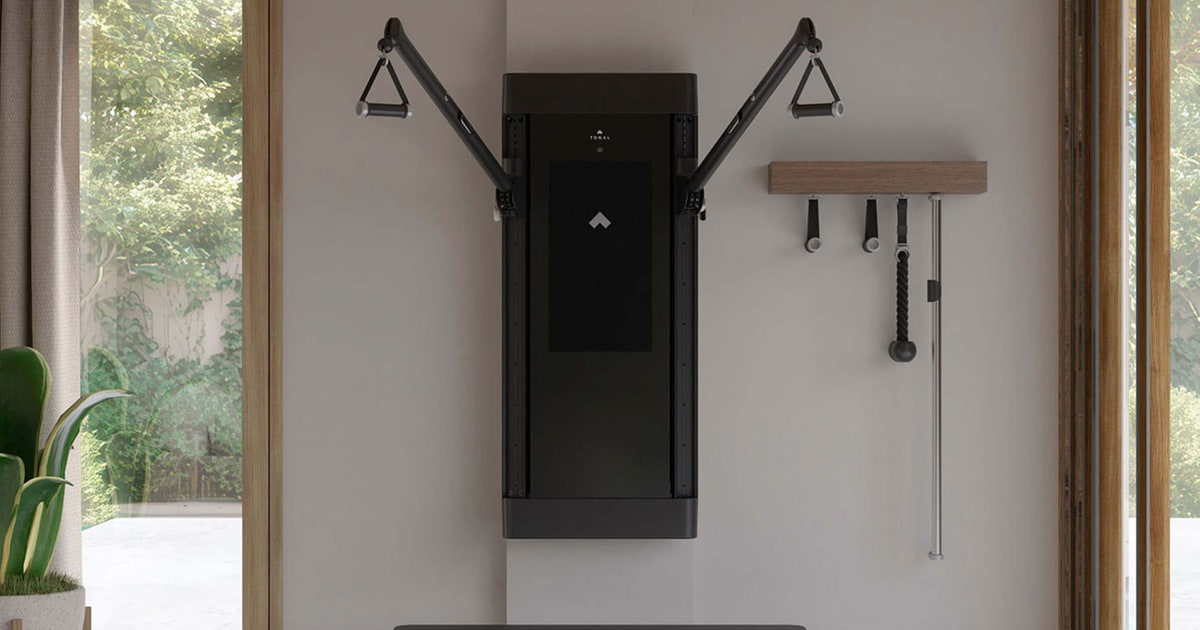
Tonal 2 mounts to your wall and stands in for a rack of dumbbells, a cable machine and a bench. It sets your weight, adjusts the load mid-set as you fatigue, and tracks every rep without you touching a phone or a plate.
$5,185fromAmazonThe digital weight is the reason to buy it. Tonal 2 uses electromagnetic resistance instead of plates — up to 250 pounds across two arms — and it changes the load almost instantly. So it can ease off when your last two reps go ugly, or add a little when they don't. You never rerack anything, and you never have to guess your working weight on a day when you feel off.
Picture the corner of a bedroom where a squat rack would never fit. Tonal takes about two feet of wall and nothing on the floor once the arms fold in. Owners in apartments and shared living rooms keep circling back to that point: the machine mostly disappears between sessions, so nobody trips over it and nobody has to look at a weight bench during dinner.
The coaching feels closer to a class than a spreadsheet. There are thousands of sessions across roughly fifteen modalities — straight strength, cardio, yoga, mobility, Aero HIIT — and the coaches cue your form instead of just counting for you. Research on connected training suggests that's what keeps people showing up: users who get real-time feedback stick with programs about a third longer than people following pre-recorded video.
It's also the safest way to lift heavy by yourself. There's no barbell over your chest and no plate to drop on your foot. If you stall halfway through a rep, the resistance gives. Owners who train early while the house is still asleep mention this more than any of the tech — they'll push a set close to failure, because failing here doesn't mean getting pinned under a bar.
Flaws but not dealbreakers
The membership isn't optional, and it comes with a twelve-month minimum commitment. Cancel it and you own an expensive wall panel. One subscription covers the whole household, which softens things for couples and families, but a solo lifter pays the same as a family of four.
Installation is a project. A pro handles it and a space survey happens before anything ships, but you still need proper studs and a wall you're allowed to drill into. Renters should look elsewhere. Service can also drag — some owners report long waits when a unit shows up damaged or fails early, which stings on a purchase this size.
Budget pickOn sale
Simple foldable cardio that needs no wall and no coach
ProForm Carbon TLS
The Carbon TLS is a folding treadmill with a small stat display and optional iFIT coaching — not a mirror. It walks, jogs and climbs to a 12% incline, then folds up and rolls into a corner when you're done with it.
$645fromAmazonList priceMost people who say they want a home gym mostly want to move for thirty minutes. The Carbon TLS is built for exactly that. It runs from an easy walk up to 10 mph, climbs to a 12% incline when you want your legs to burn, and cushions each step enough that your knees don't complain the next morning. Owners walking at 2.5 mph with a show on are the happiest buyers here.
It's the only pick that still works with no subscription at all. Speed and incline sit under your thumb on physical buttons, and the 5-inch display shows your stats without asking you to log in anywhere. Add iFIT later and trainers can drive the belt for you automatically. Skip it and you still own a working treadmill — which isn't true of the other two systems here.
Space is the other argument. The frame folds and drops back down on a hydraulic bar, so it lands softly instead of slamming. At about 205 pounds it isn't light, but it rolls, and it doesn't need studs, an installer or a permanent spot in your home. If you move every couple of years, that kind of flexibility beats a longer feature list.
Flaws but not dealbreakers
There's no mirror, no camera and no form feedback of any kind. Nothing counts your reps or fixes your squat depth, because this is a treadmill. If strength training is the whole point for you, this isn't your machine.
Assembly is the common gripe. The instructions read like a rough translation, and the box is heavy enough that a second set of hands is close to mandatory. A few owners also report motors quitting within months of daily use, so register it and hang onto your paperwork. Most people report smooth running, but we wouldn't call it bulletproof.
Also great
The deepest class library, if your shipment shows up right
Nordictrack Vault Complete Reflective Trainer with Fitness
The Vault is a freestanding mirror with a 32-inch touchscreen, a pivoting reflective panel, and a cabinet that stores dumbbells, kettlebells, bands and a mat. It runs iFIT, which has the biggest class library of any mirror platform.
$1,049.99fromAmazonNo other mirror gives you this much to work through. The iFIT library runs past 17,000 on-demand workouts across dozens of disciplines, and it's the same account that drives NordicTrack treadmills and bikes. If you already own iFIT gear, the Vault slots right in and shares your history. You can add up to five people, so everyone in the house gets their own profile and progress.
The hardware itself is nice to live with. The mirror pivots, so you can angle it toward where you actually stand instead of rearranging your furniture. The cabinet swallows the clutter, which is the quiet reason a mirror beats a heap of equipment in a shared room. And it free-stands, so nothing gets drilled and a renter's deposit stays where it belongs.
It's the most beginner-friendly option of the three. Classes are guided from the first rep, trainers tell you which weight to grab, and you can pair your own Bluetooth heart-rate strap to keep your effort honest instead of guessing. For a household with wildly different fitness levels, that structure matters more than any spec on the box.
Flaws but not dealbreakers
The buying experience is the real problem, and it's a big one. Owners repeatedly report Vaults arriving without the dumbbells, kettlebells and bands the listing promises, or with the screen cracked in transit, followed by weeks of chasing a refund. If you order one, open it the day it lands and photograph what's inside before you sign anything off.
The membership dependency is severe. Without iFIT, you've got a mirror with a dark screen, and owners are blunt about how that feels after spending this much. Some also note that certain iFIT strength workouts aren't supported on the Vault, which is an odd gap on a machine sold around weights. And at 256 pounds, it's a two-person move — once.
NordicTrack lists a 10-year frame warranty, a 2-year parts warranty and a 1-year labor warranty on the Vault.
Who this is for
Buy one of these if the gym commute is the thing stopping you, and if you'll realistically train at home three or four times a week. They suit apartment dwellers who can't fit a rack, parents who train in twenty-minute gaps, and beginners who need someone to tell them what to do first. If you already know how to program your own lifts and have room for a barbell, you're paying a lot for coaching you don't need.
This guide covers connected home fitness equipment you can buy on Amazon — wall-mounted strength systems, freestanding mirrors, and machines that pair with a coaching platform. It doesn't cover gym memberships, dumbbell sets, or the accessories and screen protectors that get sold alongside these machines. And it isn't a map of everything on the market; it's what our research turned up for this lineup.
How we picked
We weighed four things. Coaching: we favored systems that give real-time correction and adjust to you, since published research links that feedback to people sticking with a program. Membership: we counted the subscription as part of what you're buying, because most of these turn into furniture without it. Space and install: we noted wall clearance, floor footprint and whether you need a professional and a landlord's blessing, and we kept a renter-friendly option in the mix. Reliability: we read owner feedback for repeated patterns — missing accessories, transit damage, early failures — and let those patterns pull a product down.
The competition
This lineup is what our research surfaced for this category on Amazon, not a full census of the market. Several well-known mirrors and cable systems sell mainly through their own sites, so they don't appear here. Everything that belongs in this guide ended up as a pick, and the rest of the lineup is either an accessory or an unrelated product, which we've listed separately.
Installation and setup notes
Measure before you order. A wall-mounted system needs real studs, a couple of feet of clear wall, and enough room in front of it to extend your arms without hitting a lamp — so clear that zone and check the ceiling height if you plan to press overhead. Freestanding gear is easier, but it's heavy: plan on two people and a clear path from the door. Whatever arrives, unbox it the day it lands and check the contents against the listing, because accessory bundles are where shipments go wrong. Wipe screens with a dry microfiber cloth, not glass cleaner, and keep a treadmill's belt area free of dust. Start the free membership trial the same week so you're not paying for time you didn't use.
Questions we get
Are smart home gym systems worth the money?
They're worth it if the barrier to your workouts is time and hassle rather than motivation. Owners of coached, connected equipment use it far more often than owners of plain home gym gear, and the equipment pays back some of its cost once you drop a gym membership. If you already train consistently on your own, a barbell and plates will get you the same results for far less.
Do these need a monthly subscription to work?
Mostly, yes. Tonal 2 requires a membership with a twelve-month minimum, and the NordicTrack Vault is close to useless without iFIT. The ProForm Carbon TLS is the exception here — its buttons and stat display work fine on their own, and iFIT is optional. Look for the free trial period before you commit to anything long-term.
Can a smart home gym replace a gym membership entirely?
For strength training, a cable system like Tonal 2 covers most of what you'd do on commercial machines, with adaptive resistance up to 250 pounds. What it can't replace is the loaded barbell work some lifters want, or the social pull of leaving the house. If you go to the gym partly to be around people, keep that in mind before you cancel.
What works best in a small apartment?
A wall-mounted system wins on footprint, since Tonal 2 needs about two feet of wall and no floor space at all. If drilling isn't allowed, a folding treadmill like the Carbon TLS stands up and rolls away between sessions. The Vault free-stands but has a real footprint and weighs 256 pounds, so it's for a room you can dedicate.
Can renters use one without damaging walls?
Yes, but not all of them. Tonal 2 mounts into studs with professional installation, so it leaves holes and generally needs your landlord's approval. The Vault and the Carbon TLS both free-stand, so nothing gets drilled and both can move with you. That's the main reason we kept freestanding options in this guide.
How do these handle multiple people in a household?
Well, generally. Tonal's membership covers everyone under one roof, and the Vault supports up to five profiles with separate histories. Systems that set the weight for you adapt to each person automatically, which is what makes them workable when one person lifts heavy and another is just starting out. A treadmill needs no profiles at all.
Why you should trust us
For this guide:
- We read the manufacturer spec sheets and Amazon listings for every product here, along with published reviews and evaluations of resistance systems, form-tracking accuracy and content libraries.
- We compared membership requirements and long-term costs across platforms using published subscription comparisons.
- We read owner feedback for recurring themes — missing accessory bundles, transit damage, service delays and early hardware failures — and weighted repeated patterns over isolated complaints.
- We read owner reviews on every listing, weighted toward the critical ones, because that is where the recurring failures show up.
- We have a systematic way of automatically fetching the latest prices, so the numbers on this page stay current.
- This is a research-focused guide, so the team may not own every product listed — though we often do own the top winners, which gives us extra context for the recommendations.
- We don't accept free products, and the retailer commission never changes which product we recommend.
Sources
Best Smart Home Gym Equipment 2025 — Wirecutter, Wirecutter
Tonal Review: The Smartest Home Gym — CNET, CNET
Tempo Studio Review — Tom's Guide, Tom's Guide
Smart Fitness Mirror Market Report 2025–2030 — Grand View Research, Grand View Research
Home Gym Equipment Satisfaction Survey 2025 — IHRSA, IHRSA (International Health, Racquet & Sportsclub Association)
Fiture Core Review: AI Fitness Mirror — PCMag, PCMag
NordicTrack Vault Review — Forbes Health, Forbes Health
Echelon Reflect 50 Review — Healthline, Healthline
Home Fitness Technology Trends 2026 — Consumer Reports, Consumer Reports
Forme Studio Lift Review — Well+Good, Well+Good
ProForm Vue Smart Mirror Review — Garage Gym Reviews, Garage Gym Reviews
Lululemon Studio Mirror vs. Peloton Guide Comparison — Gear Patrol, Gear Patrol
Amazon product listings and owner reviews for all 3 products
Manufacturer specification pages for each product
Some passages in this guide may be paraphrased with AI help. Prices are refreshed automatically.
More like this.
Continue exploring health reviews and recommendations.

The Best Smart Home Gym Systems
The pitch for a smart home gym is simple: the equipment is already in your house, so the hardest part of working out - getting there - disappears. That's…

The Best Home Gym Systems
A home gym earns its keep in the small moments. You've got 40 minutes between a meeting and dinner, and the drive to the gym would eat half of it.…

The Best Smart Garden Systems for Fresh Herbs
Fresh herbs go bad fast. You buy a clamshell of basil for one recipe, use a third of it, and find the rest slimy in the crisper a week later. A smart…

The Best Smart Door Locks and Keyless Entry Systems
A smart lock earns its keep in the small moments. You're carrying groceries in both arms and the door opens anyway. Your kid gets home from school and you…

The Best DIY Smart Home Security Systems
A home security system earns its keep on the days nothing happens. You leave for a long weekend, glance at your phone in an airport line, and see every…

The Best Kettlebells for a Home Gym
A kettlebell is one of the few pieces of gym equipment that earns its floor space. One bell, a corner of the living room, and twenty minutes gets you…