The Best Universal Travel Adapters
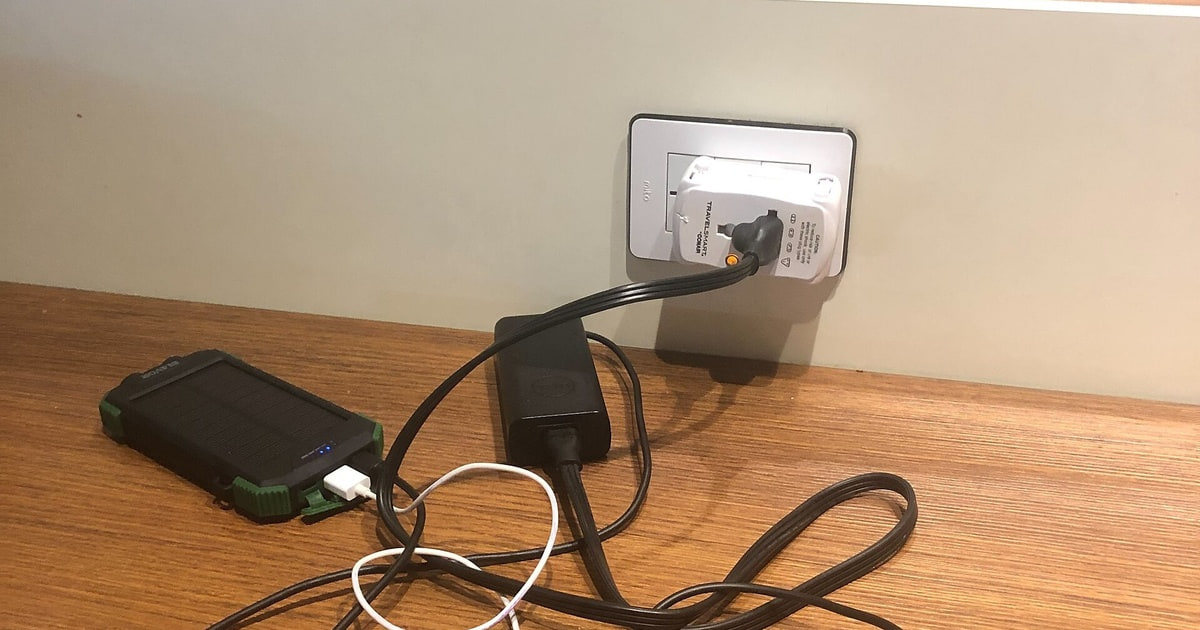
You land at midnight with a phone at 4 percent, a dead laptop, and a hotel room whose only free outlet sits behind the nightstand. That's the moment a travel adapter earns its spot in your bag. The good ones sit tight in the wall, hold a plug without sagging, and charge everything you carry from one socket. The bad ones fall out, run warm, or force you to pack a second brick. What you want is one small block that handles every country on your itinerary.
Here's the part the packaging tends to bury. A travel adapter changes the shape of your plug. It doesn't change the voltage behind it. Most of your gear — phones, laptops, cameras — runs on anything from 100 to 240 volts, so you're fine. Your flat iron probably isn't. And nothing in this category is built like a tank: all-in-one designs with sliding pins loosen over years of trips, and a heavy adapter can droop out of a tired hotel outlet.
The differences that matter here are dull ones. How many things charge at once, how fast the USB-C port pushes power, whether there's a fuse inside, and how the block sits in the wall. Everything else is marketing. We think that the EPICKA 45W Universal Travel Adapter is the best universal travel adapter for most people, and that the Ceptics 35W World Travel Adapter Kit is the one to buy if you want swappable plug heads and surge protection.
Everything we recommend

Five USB ports and real fast charging, in a chunky block

Swappable plug heads and surge protection, if you'll carry the bulk
Costs less and does less, but it still covers the world

Credit-card small with folding pins, but two-pin plugs only
Prices as of Oct 25, 6:48 AM PT · Details
At a glance
| Product | USB ports | Max USB power | Price | |
|---|---|---|---|---|
| EPICKA 45W Universal Travel Adapter PD&QCTop pick | 3 USB-C, 2 USB-A | 45W | $19.97On sale |
| Ceptics Universal Travel AdapterRunner-up | 2 USB-C, 1 USB-A | 35W PD | $59.99 |
| TESSAN Travel Adapter 009Budget pick | 2 USB-C, 1 USB-A | 20W max | $18.99 |
 | BESTEK Universal Travel Adapter 220V to 110VAlso in lineup | 4 USB | 5V/2.4A per port | Check price |
| Anker Nano Travel AdapterAlso great | 2 USB-C, 2 USB-A | 20W total | $25.99 |
 | OREI World Travel Plug Adapter M8 MaxAlso consider | 3 USB + USB-C PD | 18W PD | $39.99 |
 | Unidapt Universal Travel AdapterAlso consider | 1 USB-C, 4 USB-A | — | $18.99 |
Prices as of Oct 25, 6:48 AM PT · Details
How we picked
Plug coverage. We read spec sheets and kept adapters that handle Type A, C, G, and I at minimum. Those four cover the electrical standards used in more than 90% of popular destinations, per Travel + Leisure.
USB-C charging speed. We favored a USB-C PD port rated at 20W or higher, since published reviews peg that at roughly four times what a legacy USB-A port pushes. Below 20W, you're waiting on a phone that should be done.
Safety hardware. We looked for a stated fuse, outlet shutters, or a certification claim in the listing. Consumer Reports keeps flagging overheating in uncertified imported adapters, so an unstated fuse is a real strike.
Size and weight. We compared published dimensions and weights, because the whole point is that the thing disappears into a carry-on. Anything approaching a pound gets judged as luggage, not an accessory.
Devices at once. We counted AC outlets and USB ports against a normal trip: a phone, a laptop, earbuds, and a camera battery, all charging while you sleep. One outlet and two ports doesn't cut it for a family.
Top pickOn sale
Five USB ports and real fast charging, in a chunky block
EPICKA 45W Universal Travel Adapter PD&QC
This all-in-one adapter plugs into sockets in more than 200 countries and charges five USB devices at once, with up to 45W across its three USB-C ports. It's chunkier than the flattest adapters here, but it replaces the tangle of chargers you'd otherwise pack.
$19.97fromAmazonList pricePrices as of Oct 25, 6:48 AM PT · Details
This is the one adapter that can replace everything else in your charging pouch. It has a single AC outlet plus five USB ports, three of them USB-C. Your phone, tablet, earbuds, watch, and your partner's phone all charge from one socket. The USB-C side runs up to 45W, which covers a phone and a tablet together, or a thin laptop that charges over USB-C. Most adapters make you pick two devices and wait on the rest.
Five plug types slide out of the body, covering outlets in over 200 countries. A separate lock lets only one plug extend at a time, so you can't leave the UK pins hanging out while you shove the EU pins into a French wall. It's a small thing. It's also the detail that keeps an all-in-one adapter from getting bent sideways in a backpack.
The safety hardware is the boring part that matters most. There's a 10A fuse inside, shutters over the outlet, and that plug-lock system. Consumer Reports has warned repeatedly about uncertified imported adapters overheating, and a fuse is what stops an overload before the plastic gets involved. If something goes wrong, the adapter dies quietly instead of taking your charger with it.
It's a cube, and it takes up more room in the wall than the flat adapters here. In a firm outlet that's fine. In an old socket that's already loose, a bulky adapter with a cable hanging off it can sag and lose contact. Plug it into the tightest outlet you can find, and don't let a heavy cord pull on it while you sleep.
Flaws but not dealbreakers
There's no surge protection, and EPICKA says so plainly. For phones and laptops with their own power bricks, that's rarely a problem, since the brick handles the dirty work. If you're plugging something expensive straight into the wall, our runner-up has 85 joules of protection and this doesn't.
The 10A fuse sets a hard ceiling. Hair dryers, travel irons, and electric kettles pull more than this adapter will pass, and EPICKA warns about anything over 2000W. Use the dryer in the hotel bathroom.
One AC outlet means one wall-powered device. If you're traveling with a laptop brick and a camera charger that both need a socket, you'll be swapping them or looking at the Ceptics.
Runner-up
Swappable plug heads and surge protection, if you'll carry the bulk
Ceptics Universal Travel Adapter
Instead of pins that slide out of the body, this kit snaps on one of 14 plug heads covering 200-plus countries. You get two US sockets, a 35W USB-C PD port, surge protection, and a pouch to keep the spare heads from wandering off.
$59.99fromAmazonPrices as of Oct 25, 6:48 AM PT · Details
The Ceptics kit takes a different approach from the all-in-one adapters. You snap on the plug head for wherever you're standing, and there are 14 of them. Published reviews from travel outlets have noted that slide-on heads tend to hold up better over years of trips than rotating all-in-one dials, which develop a wobble and eventually stop gripping. If you fly abroad several times a year, that's worth something.
Two US sockets is the feature you'll miss on everything else here. Plug in your laptop's own brick and your camera battery charger at the same time, then hang a phone and a tablet off the USB ports. The PD USB-C port runs up to 35W, so your phone is full before you're out of the shower. Nothing else in this guide gives you two wall outlets in this size.
It's also the only pick that claims surge protection — 85 joules, enough to take the edge off a spike from an old hotel circuit. Two small LEDs tell you what you've plugged into: one lights for 110V, both light for 220V. That's genuinely reassuring the first time you're somewhere new and squinting at the fine print on a device label.
It weighs under 5 ounces and comes with a travel pouch and a USB-C cable. That sounds like packaging filler until you're the person who left a cable at the gate. The pouch matters more than usual here, because loose plug heads are exactly the sort of thing that migrates to the bottom of a bag and stays there.
Flaws but not dealbreakers
Fourteen plug heads means fourteen small things to lose. You only need one or two per trip, so most people leave the rest at home. Then you're the person who packed the head for Germany and landed in London.
It's the bulkiest of our picks, roughly 3.8 by 2.8 inches before you add a plug head. On a two-outlet wall plate it'll cover the socket next to it, which is annoying in a room that only has one plate.
Budget pick
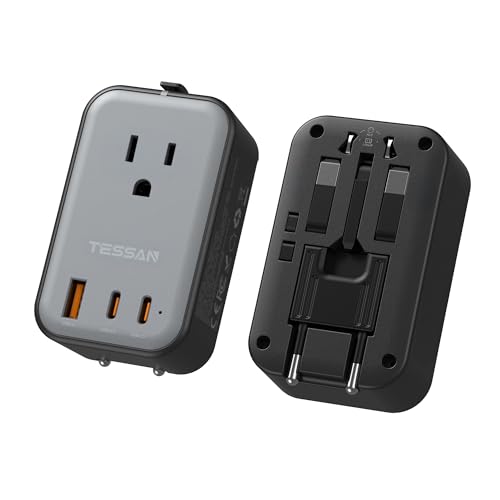
Costs less and does less, but it still covers the world
TESSAN Travel Adapter 009
At 3.65 ounces and about an inch and a quarter thick, this is the adapter that vanishes into a laptop sleeve. You get one AC outlet and three USB ports, two of them USB-C, with 20W of charging shared across all three.
$18.99fromAmazonPrices as of Oct 25, 6:48 AM PT · Details
This is the adapter you stop noticing in your bag. It's 1.24 inches thick and weighs 3.65 ounces, flat enough to slide into the front pocket of a laptop sleeve. If you travel carry-on only and you resent every cubic inch, that's the entire argument. The all-in-one adapters that do more also feel like a Rubik's cube in your hand.
You get one AC outlet and three USB ports, two of them USB-C. A single USB-C port runs up to 20W, which published reviews put at roughly half a phone battery in under half an hour. On an old 5W USB-A port the same charge takes closer to an hour. If you're grabbing power at a gate between flights, that gap is the whole game.
Coverage is not where budget adapters cut corners. TESSAN lists Type C for most of Europe, Type G for the UK and Ireland, Type I for Australia and Argentina, and Type A for Japan and the US, across more than 150 countries. Reporting from personal-finance outlets has made this point for years: inexpensive adapters cover essentially the same plug library as premium ones. What you give up is ports, wattage, and build.
The AC outlet is rated to 2000W, so a hotel fan or a laptop brick is no trouble. There's no surge protection and no cord, which is why TESSAN calls it cruise-friendly — cruise lines routinely confiscate surge-protected power strips at the gangway. If a ship cabin is in your plans, that's a quiet advantage over the Ceptics.
Flaws but not dealbreakers
All three USB ports share a 20W budget. One phone alone gets the full 20W. Plug in four things and they split it, and everything slows down. Overnight that's fine. With 40 minutes before boarding, charge one device.
TESSAN doesn't claim grounded three-prong support, so a chunky grounded laptop brick is a gamble. And with a single AC outlet and no surge protection, this is a charger for gadgets, not a hub for your whole setup.
Also great
Credit-card small with folding pins, but two-pin plugs only
Anker Nano Travel Adapter
Fold the pins away and the Nano is roughly credit-card sized, with one AC outlet and four USB ports in a block under an inch thick. The catch is that AC outlet, which takes two-pin plugs only — no grounded laptop bricks.
$25.99fromAmazonPrices as of Oct 25, 6:48 AM PT · Details
Fold the pins in and the Nano is about the footprint of a credit card, just under an inch thick. Anker puts it at 43% smaller than comparable adapters, and the listed dimensions back that up: 3.39 by 1.97 by 0.98 inches. This is the one you leave in a jacket pocket and forget about until a friend needs a charge in a café.
The retractable pins are the real reason to buy it. You press a side button and slide the pins out until they lock. Nothing snags on a bag lining, nothing bends, and there are no loose attachments to lose in a hotel drawer. Travel adapters usually die from being crushed in luggage, and this one simply has less sticking out to break.
There are five places to plug in: one AC outlet, two USB-C ports, two USB-A. A single USB-C port puts out up to 20W, and Anker's specs put an iPhone 16 at 50% in 28 minutes on it. Share the ports and the USB total drops to 15W. So think of it as charging two things fast or four things slowly, not both.
Plug coverage is narrower than our other picks: Type A, C, G, and I only. That's the US, Canada, Japan, China, most of Europe, the UK, Singapore, and Australia. Travel + Leisure notes those four types cover the standards used in more than 90% of popular destinations, so for most itineraries it's plenty. Check Italy, Switzerland, India, and South Africa before you count on it.
Flaws but not dealbreakers
The AC outlet accepts two-pin plugs only. No EU Schuko, no UK three-pin, no grounded laptop brick. Anker is upfront about it, and the two-pin design is safer by intent, but it rules out a lot of laptop chargers. That's why this isn't our top pick.
Anker doesn't list a fuse or surge protection in the specs. Treat it as a charger for your gadgets rather than a shield for them, and plug anything expensive into its own brick first.
The Nano comes with an 18-month warranty.
Who this is for
Buy one if you're flying overseas at all, even once. A single adapter costs less than the airport-shop version you'll panic-buy on arrival, and it keeps you from borrowing a stranger's charger in a lobby. You can skip it if your travel stays within the US, Canada, Mexico, and Japan, which all use the same flat Type A pins. And if you're bringing a single-voltage appliance — a US-only hair dryer, an older medical device — an adapter alone won't help you.
This guide covers plug adapters: small blocks that make your charger fit a foreign socket, usually with USB ports built in. It doesn't cover voltage converters or transformers, except to explain when you actually need one. It also skips surge-protected power strips, which many cruise lines confiscate at boarding, and it skips region-specific single-country adapters, which are cheaper but useless the moment your itinerary adds a stop.
How we picked
Plug coverage: we started with spec sheets and kept adapters that handle Type A, C, G, and I at minimum, since those four cover the standards used in more than 90% of popular destinations. Charging speed: we wanted a USB-C PD port rated at 20W or better, roughly four times what an old USB-A port pushes. Safety hardware: we looked for a stated fuse, shutters, or a certification claim, because consumer-safety reporting keeps flagging overheating in uncertified imports. Size: we compared published dimensions and weights, since the whole point is that it disappears into a bag. Devices at once: we counted AC outlets and USB ports against what a real trip demands — a phone, a laptop, earbuds, and a camera battery, all charging overnight.
Other universal travel adapters worth considering
If you want two US outlets in a slimmer body than the Ceptics: The OREI World Travel Plug Adapter M8 Max — The OREI M8 Max gives you two US sockets, three USB ports, and an 18W USB-C PD port, with snap-on attachments for Europe, Asia, China, Japan, and Africa. That's the same basic idea as our runner-up in a narrower shape. You give up charging speed, since 18W is the slowest USB-C rating among the adapters here, and the listing is thin on the safety details we'd want spelled out, like fuse rating and surge protection. If you mostly charge phones and camera batteries and you want a second wall socket, it does that job.
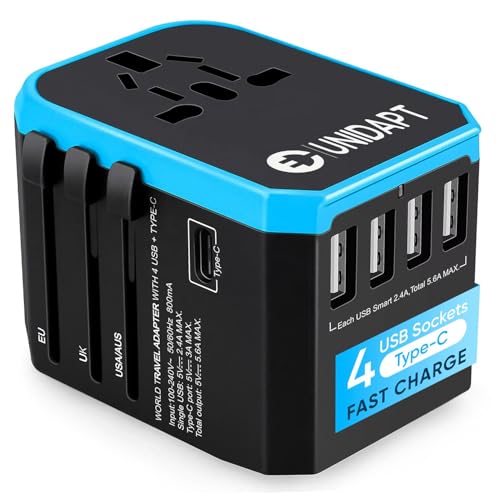
If your bag is still full of USB-A cables: The Unidapt Universal Travel Adapter — The Unidapt has six places to plug in — one AC outlet, four USB-A ports, and one USB-C — which is more USB-A than anything else in this guide. For a family with older cables, earbuds cases, and a power bank, that's genuinely handy. It covers Type A, C, G, and I across 160-plus countries, and it has the safety hardware we like on our top pick: a 10A fuse, shutters, and a plug lock, with Unidapt saying it meets CE, FCC, and RoHS requirements. What's missing is a published wattage. Without a stated PD rating, assume the USB-C port is slow, and buy the EPICKA if fast charging matters to you.
The competition
Here's what our research surfaced alongside the picks. It isn't everything on the market, just the one adapter that kept coming up and didn't fit the shape of this guide.
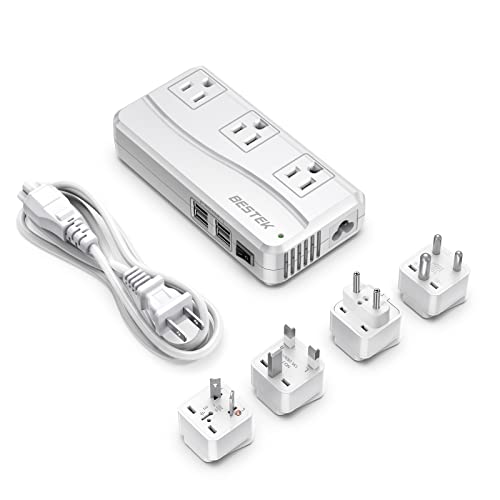
The BESTEK Universal Travel Adapter 220V to 110V — The BESTEK is the odd one out. It's a step-down voltage converter that happens to include travel plug adapters, not a plug adapter with a converter bolted on. It takes 220V from a European or Australian wall and hands you 110V through three US sockets, plus four USB ports at 5V and 2.4 amps each. That's a real fix if you're bringing a US-only device abroad — a small appliance or something else under its 250W ceiling. But it's 1.2 pounds with a 5-foot detachable cable, which is a completely different packing decision, and 250W still won't run a hair dryer. Most modern electronics don't need conversion at all. BESTEK backs it with a 24-month warranty, and it's the right buy for a narrow group of travelers.
Packing and safety notes
Before you leave, flip over each device and read the fine print near the plug. If it says 100–240V, the adapter is all you need. If it lists one voltage, an adapter won't save it, and a hair dryer in that category needs a converter or needs to stay home. Pack the adapter in your carry-on so a delayed suitcase doesn't strand your phone. In the room, use the tightest socket you can find, and don't let a heavy cable hang off the adapter — worn outlets lose their grip, and a sagging adapter arcs. Count your plug heads before checkout. After phone cables, they're the thing people leave behind most.
Questions we get
Do travel adapters convert voltage, or just change the plug shape?
Just the shape. Every adapter in this guide passes whatever voltage is in the wall straight through to your device. Most of the world runs 220–240V and North America runs 110–120V, so check your device's label. If it reads 100–240V you're fine anywhere, and if it lists a single voltage you need a converter instead.
Can I charge my laptop with one?
Usually, with two catches. If your laptop charges over USB-C, the EPICKA's 45W and the Ceptics' 35W PD port handle most thin models directly. If it uses a bulky grounded brick, you need an adapter whose AC outlet accepts three-prong plugs, and the Anker Nano explicitly doesn't. Check the outlet description before you buy.
Is it safe to use a hair dryer or curling iron through one?
Only if the device itself says 100–240V. Otherwise you're pushing 220V into a 120V heating element, which fails fast and sometimes smells like it. Even dual-voltage dryers strain these adapters: EPICKA warns that anything over 2000W can pop the internal 10A fuse. Use the hotel's dryer or buy a proper dual-voltage travel model.
What plug types do the UK, Europe, and Australia use?
The UK and Ireland use Type G, the chunky three-rectangle plug. Most of continental Europe uses Type C, the two round pins, though Italy and Switzerland add their own variants. Australia, New Zealand, China, and Argentina use Type I, with angled flat pins. All four of our picks cover those three.
Do I need a grounded three-prong adapter?
Only if you're carrying something with a grounded plug, which usually means a laptop brick. Published reviews have found that fewer than a third of compact universal adapters offer a grounded pin, and few of the adapters here spell out grounded support in their listings. If your charger has that third prong, read the AC outlet description carefully before buying.
How many countries do these usually cover?
The range here runs from four plug types across roughly 150 countries up to 14 snap-on attachments covering more than 200. Four types — A, C, G, and I — handle the standards used in over 90% of popular destinations, per Travel + Leisure. Unless your itinerary includes Italy, Switzerland, India, or South Africa, a compact adapter is enough.
Why you should trust us
For this guide:
- We read the manufacturer spec sheets and full listing details for every adapter here, side by side.
- We compared plug-type coverage, USB wattage, fuse and surge-protection claims, and published dimensions and weights.
- We also weighed published reviews from travel and technology outlets, along with recurring themes in owner feedback, especially reports of adapters loosening in the wall or running warm.
- We read owner reviews on every listing, weighted toward the critical ones, because that is where the recurring failures show up.
- We have a systematic way of automatically fetching the latest prices, so the numbers on this page stay current.
- This is a research-focused guide, so the team may not own every product listed — though we often do own the top winners, which gives us extra context for the recommendations.
- We don't accept free products, and the retailer commission never changes which product we recommend.
Sources
The Best Travel Adapter - Wirecutter, Wirecutter
Best Travel Adapters and Converters - Tom's Guide, Tom's Guide
Best Travel Adapter and Converter Kits - PCMag, PCMag
The Best Travel Plug Adapters for International Trips - The Points Guy, The Points Guy
Best Universal Travel Adapters, Tested - CNN Underscored, CNN Underscored
Best Travel Adapter 2026 - Digital Trends, Digital Trends
How to Choose a Travel Adapter - Condé Nast Traveler, Condé Nast Traveler
The Best Travel Adapters for Every Type of Traveler - NerdWallet, NerdWallet
Consumer Reports: Travel Gear Safety Guide, Consumer Reports
Best Universal Adapters for International Travel - Travel + Leisure, Travel + Leisure
Best Portable Chargers and Adapters for Frequent Flyers - Forbes Vetted, Forbes Vetted
The Best Gadgets for International Travel - Business Insider, Business Insider
Amazon product listings and owner reviews for all 7 products
Manufacturer specification pages for each product
Some passages in this guide may be paraphrased with AI help.
Product prices and availability are accurate as of the date/time indicated and are subject to change. Any price and availability information displayed on Amazon.com at the time of purchase will apply to the purchase of this product.
More like this.
Continue exploring electronics reviews and recommendations.

The Best USB Hubs And Multi-Port Adapters For Laptops (2026)
Your laptop probably has two USB-C ports, maybe three. One of them is busy charging. That leaves one port for a monitor, a mouse, a keyboard, an external…

The Best Trailer Wiring Harness Adapters
Trailer wiring is the part of towing nobody thinks about until the lights don't work. You hitch up the boat trailer at 5 a.m., flip on the turn signal,…

The Best Car Bluetooth and Aux Adapters of 2026
Most cars on the road still have a stereo that can't talk to your phone. If yours has an aux jack, a small receiver bridges that gap without touching your…

The Best Wireless CarPlay Adapters
Every trip starts the same way. You get in, dig out the cable, plug the phone in, and wait for the screen to catch up. A wireless adapter kills that…

The 7 Best Portable Bluetooth Keyboards for Travel in 2026: Lightweight, Multi-Device Picks
Expert-tested portable Bluetooth keyboards for travel in 2026. Compare weight, battery life, and multi-device pairing across 7 top picks from Logitech, Keychron, nuphy, and more.

The Best Car Travel Accessories
A long drive exposes every gap in how your car is set up. Your phone slides off the seat mid-turn. The kids' snacks migrate under the seat. Somebody's…