The Best WiFi Routers
Your router is the one piece of tech in your home that everything else depends on. When it's working, you don't think about it. When it isn't, the TV buffers during the good part, the video call freezes on your face, and someone upstairs starts yelling about the WiFi. Most people replace a router only after it's been failing for months. That's a shame, because the difference between a tired old box and a current one shows up everywhere: fewer dead spots, faster handoffs between rooms, and a lot less crawling behind the TV stand to unplug things.
Here's the honest part. WiFi 7 is the headline on nearly every new router, and for most homes it won't change much yet. TechRadar points out that those multi-gigabit numbers only appear when your phone or laptop also speaks WiFi 7, and most devices in active use don't. PCMag notes that most U.S. households have internet plans under 500 Mbps, which any decent WiFi 6 router already saturates. So the giant speed claims on the box are real in a lab and mostly theoretical in your living room.
What actually helps is matching the router to your floor plan and your devices. A single router covers a small home well and struggles past a couple thousand square feet. Mesh fixes that, at a cost. Multi-gig ports matter if you have a NAS or a wired gaming rig. We think that the TP-Link Archer BE800 is the best WiFi router for most people, and that the eero Max 7 is the one to buy if you want whole-home mesh coverage and a smart home hub in the same box.
Everything we recommend

Flagship ports and speed without flagship weirdness

The easiest whole-home setup, and a smart home hub too

For gamers and tinkerers who want every setting exposed

WiFi 6 that's plenty for an apartment, plus 2.5G ports

OpenWRT firmware and real VPN speed, if you'll tinker
Prices as of Oct 24, 6:27 AM PT · Details
At a glance
| Product | WiFi standard | Fastest wired port | Price | |
|---|---|---|---|---|
| TP-Link Tri-Band BE19000 WiFi 7 RouterTop pick | WiFi 7 tri-band | 10G WAN/LAN | $329.98On sale |
| Amazon eero Max 7 mesh wifi routerAlso great | WiFi 7 mesh | 10 Gigabit | $599.99 |
| ASUS RT-BE96U WiFi 7 Router - Tri-BandUpgrade pick | WiFi 7 tri-band | 10G WAN/LAN | $629.49 |
 | NETGEAR RS300-100NAR Nighthawk RS300 Tri-Band WiFi 7Also consider | WiFi 7 tri-band | 2.5 Gig | $129.99 |
 | TP-Link Deco 7 Outdoor BE65 BE11000 Tri-BandAlso in lineup | WiFi 7 tri-band | 2.5 Gbps PoE+ | $294.85 |
 | ASUS RT-AX86U ProAlso consider | WiFi 6 dual-band | 2.5G | Check price |
| TP-Link AX3000 WiFi 6 RouterBudget pick | WiFi 6 dual-band | 2.5 Gbps | $79.99On sale |
| GL.iNet GL-MT6000 Flint 2 Wi-Fi 6 GamingRunner-up | WiFi 6 dual-band | 2.5G | $169.99 |
Prices as of Oct 24, 6:27 AM PT · Details
How we picked
Standard vs. real need. We compared spec sheets and published reviews against how fast typical home internet plans actually are. A router earned a spot only if its wireless standard matched a real use case rather than a marketing tier.
Coverage and layout. We looked at manufacturer coverage claims and independent range testing for single-floor versus multi-floor homes. Anything over roughly 2,000 square feet pushed us toward mesh rather than a single router.
Wired ports. We favored routers with at least one 2.5G port and treated 10G ports as useful only for multi-gig plans, a NAS, or wired gaming. Gigabit-only routers had to be cheap to stay in contention.
Firmware and security. We weighed update frequency, whether security features require a subscription, and owner reports of post-update problems. A router with a long support track record beat one with better launch-day specs.
Setup and control. We read owner feedback on app quality and admin interfaces, then matched each router to the kind of person who'd be happy with it. Simple apps and deep firmware are both valid, for different people.
Top pickOn sale
Flagship ports and speed without flagship weirdness
TP-Link Tri-Band BE19000 WiFi 7 Router
The Archer BE800 is a tri-band WiFi 7 router with two 10G WAN/LAN ports, four 2.5G ports, and eight antennas. It's the rare high-end router that gives you room to grow on the wired side without asking you to learn a new hobby.
$329.98fromAmazonList pricePrices as of Oct 24, 6:27 AM PT · Details
The ports are the real reason to buy this one. You get two 10G WAN/LAN ports, one of them an SFP+ fiber and RJ45 combo, plus four 2.5G ports and USB 3.0. That's more multi-gig wired capacity than almost anything else here. Even if your internet plan is nowhere near 10 Gbps, those ports matter the day you add a NAS, a wired gaming PC, or a second router upstairs.
On the wireless side, TP-Link rates it at 11,520 Mbps on 6 GHz, 5,760 Mbps on 5 GHz, and 1,376 Mbps on 2.4 GHz. Treat those as ceilings, not promises. RTINGS' lab work found top WiFi 7 routers like this one sustaining well over 2 Gbps on 6 GHz at close range, roughly double what a typical WiFi 6E router manages. That's a real gap, but you only see it with a WiFi 7 phone or laptop in the same room.
It supports the WiFi 7 features that actually reduce lag rather than just raise the top speed. Multi-Link Operation lets a device use more than one band at once, which the Wi-Fi Alliance's certification program specifies alongside 320 MHz channels. In practice that means fewer stumbles when you walk from the couch to the kitchen mid-call. Add 4K-QAM and eight positioned antennas and you get a router that holds a connection well across an average home.
It plays nicely with more coverage later. The BE800 is EasyMesh-compatible, so you can pair it with other EasyMesh routers or extenders instead of throwing it out and buying a mesh kit. TP-Link's HomeShield service covers basic network scanning, IoT device identification, parental controls, and QoS for free. The deeper features sit behind a subscription, which is the usual arrangement now and still mildly annoying.
Flaws but not dealbreakers
It's big, and it looks like it wants attention. Nearly a foot long, almost five pounds, with an LED display on the front that some people love and others immediately want to turn off. This is not a router you tuck discreetly onto a shelf.
The best HomeShield features cost extra on an already expensive router. You get the basics free, but the more useful security and parental control tools are a subscription. Owner feedback on TP-Link's flagship routers also mentions occasional firmware quirks after updates, so plan on checking the release notes rather than updating blind.
Also great
The easiest whole-home setup, and a smart home hub too
Amazon eero Max 7 mesh wifi router
The eero Max 7 is a WiFi 7 mesh unit with two 10 Gigabit Ethernet ports and a built-in smart home hub for Thread, Matter, and Zigbee. Setup takes minutes in the app, and you can add nodes later without rethinking your network.
$599.99fromAmazonPrices as of Oct 24, 6:27 AM PT · Details
If you have smart bulbs, locks, sensors, and a couple of speakers scattered around, this is the one to get. The Max 7 works as a smart home hub, connecting Thread devices and acting as a controller for Matter and Zigbee gear. That means one fewer hub plugged into your outlet strip. For households that keep adding devices, eero rates it for 250 or more connections.
Mesh is the right answer for bigger homes, and eero makes it painless. Wirecutter recommends mesh for homes over roughly 2,000 to 2,500 square feet or with more than one floor, since a single router simply runs out of range. A single Max 7 covers up to 2,500 square feet, and you add nodes from there. The Verge found real-world throughput above 1 Gbps at range in a multi-room home, helped by tri-band backhaul that keeps the nodes talking to each other without eating your bandwidth.
The wired side is stronger than most mesh gear. Two 10 Gigabit Ethernet ports give you up to 9.4 Gbps wired, and eero supports internet plans up to 10 Gbps. If you ever move to a multi-gig plan, you won't need to replace the whole system. eero's TrueMesh routing picks the path for each transfer, which mostly shows up as your phone not clinging to a distant node when you walk into another room.
Setup is the part people underestimate. The eero app walks you through it, names your network, and handles updates on its own. If you're the person your family calls when the internet breaks, that matters more than a spec sheet. The tradeoff is that you get fewer knobs to turn than on an ASUS or a GL.iNet box.
Flaws but not dealbreakers
It's expensive per node, and mesh means buying more than one for a large home. That adds up fast compared with a single router plus an extender.
The advanced security tools live behind an eero Plus subscription. Without it you get a solid, simple network and not much control over it. Power users who want deep QoS rules, port forwarding flexibility, or custom firmware will find eero's app deliberately simple, and that simplicity is the whole point.
Upgrade pick
For gamers and tinkerers who want every setting exposed
ASUS RT-BE96U WiFi 7 Router - Tri-Band
The RT-BE96U is a tri-band WiFi 7 router rated at 19 Gbps with two 10G WAN/LAN ports and ASUS's deep firmware. If you want granular QoS, VPN options, and AiMesh expansion, this gives you more control than anything else here.
$629.49fromAmazonPrices as of Oct 24, 6:27 AM PT · Details
ASUSWRT is the reason to pick this over the BE800. You get real traffic prioritization, VPN client and server options, port forwarding that makes sense, and AiMesh so you can add ASUS routers as nodes later. RTINGS' latency work under load found that gaming-focused routers with proper QoS cut ping spikes compared with routers that don't prioritize traffic at all. If you play competitively while someone else streams, that's the feature that matters.
The hardware backs it up. ASUS lists dual 10G WAN/LAN ports and 4x4 MU-MIMO on the 6 GHz band, which spreads traffic across more streams when a lot of devices are talking at once. Add 320 MHz channels, 4096-QAM, and Multi-Link Operation, and you have the full WiFi 7 feature set rather than a partial implementation.
Security is included rather than rented. AiProtection Pro, powered by Trend Micro, comes with the router and doesn't need a subscription, which is a meaningful difference from TP-Link and eero over several years of ownership. You also get a one-tap scan and safe browsing built into the same interface you use for everything else.
Setup takes longer here, and that's the tradeoff. The interface assumes you want options, and there are a lot of them. If you enjoy that, you'll get a network tuned exactly how you like it. If you don't, the eero will make you happier in an afternoon.
Flaws but not dealbreakers
Owner feedback on this model is more mixed than on ASUS's older routers, with reports of firmware inconsistency and settings that need revisiting after updates. It's a newer platform, and it shows.
It's physically enormous and it costs as much as anything in this guide. Unless you'll actually use the 10G ports and the deeper firmware, you're paying for capability you won't touch.
Budget pickOn sale
WiFi 6 that's plenty for an apartment, plus 2.5G ports
TP-Link AX3000 WiFi 6 Router
The Archer AX55 Pro is a dual-band WiFi 6 router rated at AX3000 with two 2.5 Gbps ports and four antennas. For an apartment, a small house, or anyone on a plan under 500 Mbps, it covers what you actually use.
$79.99fromAmazonList pricePrices as of Oct 24, 6:27 AM PT · Details
Most people don't need WiFi 7, and this is the router that proves it. PCMag notes that most U.S. households have plans under 500 Mbps, and the AX55 Pro handles 2,402 Mbps on 5 GHz and 574 Mbps on 2.4 GHz. Your internet connection will be the bottleneck long before this router is. For streaming, video calls, and gaming in a one- or two-bedroom place, it's enough.
The multi-gig ports are the surprise here. You get a 2.5 Gbps WAN/LAN port and a second 2.5 Gbps LAN port, plus three gigabit ports. That's unusual at this price and genuinely useful if you have a NAS or want a fast wired link to a desktop. Most budget routers cap out at gigabit everywhere, which quietly limits your wired transfers.
It also does VPN client and server, so devices on your network can reach a remote VPN without you installing software on each one. TP-Link's HomeShield covers parental controls and IoT security. Four antennas and beamforming handle a typical apartment fine, though you'll notice the limits in a larger home.
This is the router we'd recommend to a renter, a student, or anyone who just wants their internet to work without a project. Owner feedback across a large number of buyers is consistently positive, which for a budget router usually means the firmware is stable and the setup is uneventful.
Flaws but not dealbreakers
It's dual-band WiFi 6, so no 6 GHz and no WiFi 7 features. If you're buying with a five-year horizon and you plan to own WiFi 7 devices, spend more now.
Range is fine for an apartment and mediocre for a house. In anything over roughly 1,500 square feet or across more than one floor, you'll find dead spots and want a mesh system instead.
Runner-up
OpenWRT firmware and real VPN speed, if you'll tinker
GL.iNet GL-MT6000 Flint 2 Wi-Fi 6 Gaming
The GL.iNet Flint 2 is a WiFi 6 router with dual 2.5 Gbps ports, OpenWRT-based firmware, and fast built-in VPN. It's for people who want to run their own DNS filtering and VPN tunnels without buying enterprise gear.
$169.99fromAmazonPrices as of Oct 24, 6:27 AM PT · Details
Nothing else here gives you this much control for this little money. The Flint 2 runs OpenWRT-based firmware, so you can install plugins, set up custom routing, and configure things most consumer routers hide. GL.iNet supports it directly rather than treating it as a hack. If you've ever been frustrated by a router app that won't let you do the thing you want, this is the fix.
The VPN performance is the standout number. GL.iNet rates WireGuard at up to 900 Mbps and OpenVPN at up to 880 Mbps, which is fast enough to run your whole household through a tunnel without noticing. Most consumer routers choke well below 200 Mbps on VPN, which is why people give up and install client software on every device instead.
AdGuard Home is built in, so you can block trackers and ads at the DNS level for every device on your network, including the ones with no ad blocker available. That covers smart TVs and phones. Dual 2.5 Gbps ports and 8-stream WiFi 6 handle a busy household, and GL.iNet says it supports well over a hundred connections.
It's WiFi 6, not WiFi 7, and that's a deliberate tradeoff. You're spending your money on firmware and CPU rather than on a 6 GHz band your devices may not use. For a privacy-minded household on a normal internet plan, that's the better trade.
Flaws but not dealbreakers
GL.iNet tells you to update the firmware immediately on first setup, which is a hint about the out-of-box experience. Expect to spend an evening in the admin panel rather than five minutes in an app.
There's no 6 GHz band and no WiFi 7 support, so the raw wireless ceiling is lower than the flagships here. Coverage is single-router coverage, too. In a large or multi-floor home you'll still need a mesh system or additional access points.
Who this is for
Buy now if your router is more than about five years old, if you've added a pile of smart home devices since you bought it, or if you have dead zones you've stopped trying to fix. Those are the cases where a new router changes your daily experience. If you're on a plan under 500 Mbps, live in an apartment, and your current WiFi 6 router works fine, you can skip this cycle without missing anything. Upgrading to WiFi 7 for its own sake mostly buys you a number on a box.
This guide covers home WiFi routers and mesh systems you buy separately from your internet service. We don't cover router-modem combos, business access points, or the equipment your ISP rents you. We also don't cover cellular or travel routers. If you have a large or oddly shaped home, read the mesh recommendations first, because no single router solves a floor plan problem.
How we picked
Standard: We matched WiFi 6, 6E, and 7 to what your devices and internet plan can actually use, not to what sounds newest. Coverage: We compared manufacturer coverage ratings and independent range testing, and pushed anyone over roughly 2,000 square feet toward mesh. Ports: We treated a 2.5G port as the floor and 10G ports as worthwhile only for multi-gig plans, a NAS, or wired gaming. Firmware: We weighed update history, whether security costs extra, and owner reports of trouble after updates. Setup: We read owner feedback on apps and admin panels, then matched each router to the person who'd be glad to own it.
Other wifi routers worth considering
If you want strong range in a smaller box: The NETGEAR RS300-100NAR Nighthawk RS300 Tri-Band WiFi 7 — The Nighthawk RS300 is a tri-band WiFi 7 router rated up to 9.3 Gbps with coverage up to 2,500 square feet. Tom's Hardware measured it holding strong signal through two floors and multiple walls in a typical suburban home, which is impressive for something this compact. Netgear includes automatic firmware updates and its Advanced Router Protection, and you get a 2.5 Gig internet port plus two 2.5 Gig and two 1 Gig LAN ports. What you give up compared with our top pick is wired headroom. There's no 10G port, so multi-gig plans and NAS transfers cap lower. The listing here is a certified refurbished unit, which is worth knowing before you buy.
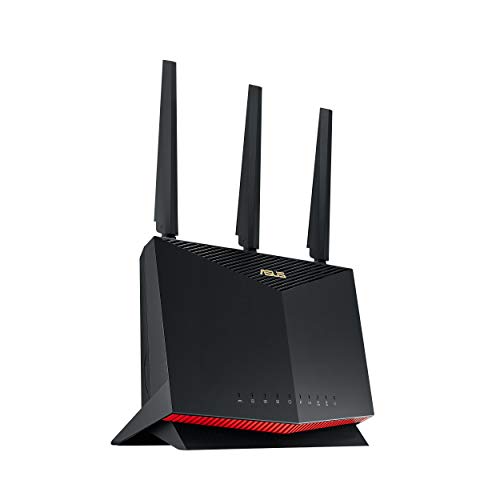
If you want a proven gaming router without paying for WiFi 7: The ASUS RT-AX86U Pro — The RT-AX86U Pro is a dual-band WiFi 6 router rated at AX5700 with a 2.5G port, mobile game mode, and the same ASUSWRT firmware depth as our upgrade pick. You get subscription-free network security, VPN support, port forwarding, and AiMesh compatibility, all on a chipset with years of firmware maturity behind it. For a gamer on a plan under a gigabit who wants QoS that works and settings that stay put, this is a smarter buy than a first-generation WiFi 7 router. You give up 6 GHz, 320 MHz channels, and Multi-Link Operation. This listing is a renewed unit, so factor that into your warranty expectations.
The competition
These are the other routers our research surfaced, not a survey of everything on the market. Router lineups turn over constantly, and a model that isn't here may still be worth your time. What follows is what each of these does, why it didn't beat a pick, and who might reasonably choose it anyway.
The TP-Link Deco 7 Outdoor BE65 BE11000 Tri-Band — The Deco 7 Outdoor BE65 is a tri-band WiFi 7 mesh extender built for outside. It's IP65 rated against rain, dust, and vibration, covers up to an additional 3,000 square feet, and has two 2.5 Gbps PoE+ ports plus pole and wall mounting hardware. TP-Link rates it at 5,765 Mbps on 6 GHz within an 11 Gbps total. It didn't win a pick because it's an extender for an existing Deco network rather than a standalone router, and most people don't need weatherproof WiFi. But if you have a detached garage, a workshop, a big yard, or a pool house where the signal dies, this is exactly the right tool. Buy it as an addition to a Deco system, not as your only router.
Setup and maintenance
Put the router out in the open, roughly central, and off the floor. Inside a cabinet or behind the TV is where signal goes to die, and no antenna count fixes that. Turn on automatic firmware updates if your router offers them, since update frequency matters more for long-term security than any launch-day spec. Change the default admin password during setup, not later, and use WPA3 if all your devices support it. Give your guest network its own password and put smart home gadgets on it if your router allows, which limits what a compromised bulb can reach. Reboot once in a while when things feel slow. If coverage is the problem rather than speed, adding a node beats replacing the router.
Questions we get
Do I really need a WiFi 7 router?
Probably not yet. TechRadar found that most WiFi 7 routers only hit their multi-gigabit speeds when paired with WiFi 7 client devices, and those are still a minority of phones and laptops in use. PCMag notes most U.S. households have plans under 500 Mbps, which WiFi 6 already handles. Buy WiFi 7 if you're keeping the router five years or you already own WiFi 7 devices.
Is mesh WiFi better than a single router?
It depends entirely on your floor plan. Wirecutter recommends mesh for homes over roughly 2,000 to 2,500 square feet or with more than one floor. Tom's Guide reports three-node mesh kits typically cover 5,000 to 6,500 square feet versus about 2,000 to 3,000 for a comparable single router. In an apartment, a single router is faster and cheaper.
Do I need 10G ports for a 1 Gbps internet plan?
No. A 2.5G port already gives you headroom over a gigabit connection. The 10G ports matter if your ISP plan exceeds 1 Gbps, or if you move large files between a NAS and a desktop over wired connections. For everyone else they're future-proofing you may never use.
What's the difference between WiFi 6, 6E, and 7?
WiFi 6 improved efficiency when many devices are connected at once. WiFi 6E added the 6 GHz band, which is less crowded but has shorter range. WiFi 7 builds on that with 320 MHz channels and Multi-Link Operation, which the Wi-Fi Alliance's certification program specifies, letting a device use several bands at the same time for lower latency.
How often should I replace my router?
Roughly every five years, or whenever the manufacturer stops shipping firmware updates. Security patches matter more than speed here, since an unpatched router is a permanent open door. If your current router still gets updates and covers your home, there's no urgency.
What's the best router for gaming with low latency?
Look for real traffic prioritization rather than a high top speed. RTINGS' latency testing under load found gaming-focused routers with QoS reducing ping spikes compared with routers that don't prioritize traffic. The ASUS RT-BE96U and RT-AX86U Pro both give you that control. Wired Ethernet still beats any wireless connection for competitive play.
Why you should trust us
For this guide:
- We read manufacturer spec sheets for every router here and compared their stated speeds, port counts, and coverage ratings against each other.
- We reviewed published testing from RTINGS, PCMag, The Verge, Tom's Hardware, Tom's Guide, TechRadar, CNET, and Wirecutter on throughput, range, and latency under load.
- We looked at recurring themes in owner feedback, particularly around firmware stability, setup difficulty, and coverage in real homes.
- We read owner reviews on every listing, weighted toward the critical ones, because that is where the recurring failures show up.
- We have a systematic way of automatically fetching the latest prices, so the numbers on this page stay current.
- This is a research-focused guide, so the team may not own every product listed — though we often do own the top winners, which gives us extra context for the recommendations.
- We don't accept free products, and the retailer commission never changes which product we recommend.
Sources
The Best Wi-Fi Routers for 2026 - PCMag, PCMag
Best Wi-Fi Router - Wirecutter, Wirecutter (NYT)
Wi-Fi Router Reviews and Speed Tests - RTINGS.com, RTINGS.com
Best Mesh Wi-Fi Routers 2026 - Tom's Guide, Tom's Guide
Best Wi-Fi 7 Routers Tested - TechRadar, TechRadar
Best Routers of 2026 - CNET, CNET
TP-Link Archer BE800 Review - RTINGS.com, RTINGS.com
ASUS RT-BE96U Specifications - ASUS, ASUS (Manufacturer)
eero Max 7 Review - The Verge, The Verge
Wi-Fi Alliance Wi-Fi CERTIFIED 7 Program Overview, Wi-Fi Alliance
GL.iNet Flint 2 (GL-MT6000) Product Page, GL.iNet (Manufacturer)
Netgear Nighthawk RS300 Review - Tom's Hardware, Tom's Hardware
Amazon product listings and owner reviews for all 8 products
Manufacturer specification pages for each product
Some passages in this guide may be paraphrased with AI help.
Product prices and availability are accurate as of the date/time indicated and are subject to change. Any price and availability information displayed on Amazon.com at the time of purchase will apply to the purchase of this product.
More like this.
Continue exploring electronics reviews and recommendations.

The Best Wood Routers
A router is the tool that makes furniture look finished. It cuts the round-over on a tabletop edge, the dado that carries a shelf, the groove for a drawer…

The Best WiFi Freeze Alarms and Temperature Sensors
A frozen pipe doesn't announce itself. It splits quietly, thaws a day later, and then, according to the American Red Cross, a single 1/8-inch crack can…

The Best Mesh WiFi Systems
Dead zones are the whole reason mesh systems exist. One router stuck in a corner means the back bedroom drops video calls and the garage gets nothing at…

The Best Smart Displays
A smart display earns its counter space by answering the things you'd otherwise pull out your phone for. You set a timer with flour on your hands. You…

The Best Soundbars
Flat TVs got thinner, and their speakers got worse. Voices sink into the mix, explosions turn to mush, and you end up riding the volume knob or switching…

The Best Extendable Snow Brushes and Ice Scrapers
Clearing a car after a storm is a small chore that turns miserable fast. The wrong tool means you're leaning across a cold hood, stretching for the middle…