The Best Outdoor Tech Gear
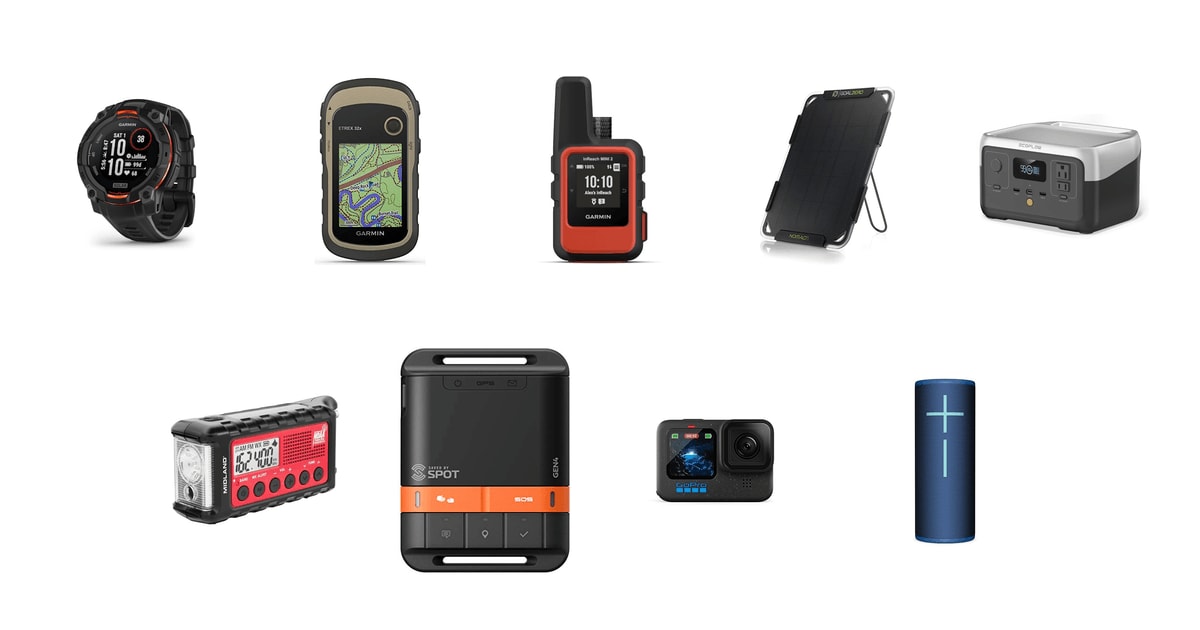
Outdoor electronics live a hard life. They ride in a hip belt through a rainstorm, sit on a dashboard at 130 degrees, get dropped on granite, and then have to work on the one day you actually need them. That's a different job than a phone does. The gear worth carrying handles cold without the battery collapsing, takes a knock without cracking, and stays readable with the sun straight overhead. Everything else is a gadget you'll leave home after two trips.
Here's the honest part: nothing in this category does everything, and most of it costs more than the phone you already own. Satellite devices need a subscription forever. Solar panels are slow and moody about clouds. Power stations are heavy. Action cameras eat batteries and storage. And every one of these things is one more item to charge, update, and keep track of. Buy the pieces that match how you actually go outside, not the ones that match a highlight reel.
We think that the Garmin inReach Mini 2 is the best outdoor tech buy for most people, and that the Garmin Instinct 3 Solar is the one to buy if you'd rather have navigation and tracking on your wrist than a dedicated safety beacon in your pack.
Everything we recommend

Two-way rescue messaging in something you'll actually carry

Navigation, tracking and a flashlight you never have to charge

Weather alerts and three ways to power them, for very little

Real wall-outlet power at camp, if you can drive to it

The camera to bring when the footage is the point
At a glance
| Product | Weight | Power Source | Price | |
|---|---|---|---|---|
| Garmin Instinct® 3 SolarRunner-up | 0.11 lb | Solar Charging | $299.99On sale |
 | Garmin eTrex 32xAlso consider | 0.31 lb | — | $299.99 |
| Garmin inReach® Mini 2Top pick | 0.21825763938 pounds | — | $299On sale |
 | Goal Zero Nomad 5 Solar PanelAlso consider | 0.79 lb | 5-Watt Solar Panel | $59.95 |
| EF ECOFLOW Portable Power Station RIVER 2Upgrade pick | 7.71617917 pounds | 110W solar input | $239 |
| Midland - ER310Budget pick | 1 lb | Solar Panel, Hand Crank | $79.99 |
 | Spot Gen 4 Satellite GPS MessengerAlso consider | 0.31 lb | — | $149.95 |
| GoPro HERO12 Black - Waterproof Action CameraAlso great | 0.78 lb | Rechargeable Battery | $299On sale |
 | Ultimate Ears Boom 4 Portable Waterproof BluetoothAlso consider | — | Rechargeable Battery | $129.99On sale |
How we picked
Real durability ratings. We looked for stated IP or ATM water ratings and MIL-STD-810 testing on spec sheets rather than vague "rugged" marketing. Anything meant for a pack had to survive rain and a drop without a case.
Battery you can plan around. We compared manufacturer runtime figures against what owners describe in the field, since cold weather and high-power modes routinely cut published numbers in half. Devices with recharge options — solar, crank, swappable cells — got extra credit.
Works with cold hands. Physical buttons, glove-friendly controls and sunlight-readable displays mattered more than screen resolution. Published reviews consistently flag touchscreens as the first thing to fail in rain or below freezing.
Honest coverage claims. For satellite devices we compared the underlying networks and what published reviews say about acquisition time in canyons and dense forest, not just the marketing map.
Ongoing cost and lock-in. We noted which devices require a subscription to function at all, and read owner feedback about activation, plan suspension and app quality — the parts that turn into daily friction.
Top pickOn sale
Two-way rescue messaging in something you'll actually carry
Garmin inReach® Mini 2
The inReach Mini 2 is a palm-sized satellite communicator that sends real two-way texts and an interactive SOS from anywhere with sky above it. It weighs about three and a half ounces, so there's no excuse to leave it behind.
$299fromAmazonList priceIf you only buy one piece of outdoor tech, buy this one. Everything else here makes a trip nicer. This one changes what happens when a trip goes wrong. It runs on the Iridium network, which covers the whole planet — oceans, deserts, high latitudes, the places where your phone is a paperweight. Press SOS and you're not sending a flare into the void. You're opening a conversation with a coordination center that can talk back.
Two-way messaging is the feature that separates this from cheaper beacons, and it matters more than it sounds. You can tell someone you're fine but slow. You can describe an injury instead of triggering a full helicopter response for a sprained ankle. Owners who've been through real emergencies with one consistently point to that back-and-forth as the thing that made the difference — being able to say what's actually happening.
It's small enough to clip to a shoulder strap and forget. That's the whole design argument. A safety device you leave in the truck because it's bulky protects nobody. Battery life stretches to about two weeks on a standard tracking interval, so you're not managing it daily. TracBack routing will walk you back along your own track, and the digital compass gives you a heading even standing still.
The Garmin ecosystem is a real advantage if you already own Garmin gear. Pair it with a compatible watch or handheld and you can read and send messages from your wrist without digging the Mini out of a pocket. The Explore app handles trip planning and topo maps on your phone, and your MapShare page lets family watch your dot move without calling you every night.
Flaws but not dealbreakers
The subscription is the catch, and it never goes away. No plan, no satellite, no SOS — the hardware alone is inert. Plans can be suspended seasonally if you only go out part of the year, but you're still paying to own peace of mind rather than buying it once.
Messaging is slow by any modern standard. Owners describe waiting minutes for a message to clear, longer in canyons or under heavy tree cover where the device is hunting for a satellite. The screen is tiny and typing on the device itself is genuinely tedious, so most people pair it with a phone and use the app keyboard. Think of it as a telegraph, not a text thread.
Some owners find it expensive for what it does, and they have a point — you're paying premium money for slow messages and a small screen. The value is entirely in the worst-case scenario, which is a hard thing to feel good about at checkout.
Runner-upOn sale
Navigation, tracking and a flashlight you never have to charge
Garmin Instinct® 3 Solar
The Instinct 3 Solar is a rugged GPS watch with a solar-charging lens that can stretch battery life to effectively unlimited with regular sun exposure. Multi-band GPS, a barometric altimeter and a built-in LED flashlight cover most of what you need on a trail.
$299.99fromAmazonList priceThe best argument for a GPS watch over your phone is that you never have to take it out. Your route, your heading, your elevation and your pace are on your wrist while your hands stay on trekking poles. The Instinct 3 Solar uses multi-band GPS with Garmin's SatIQ system, which improves positioning under canopy and in canyons while keeping the power draw sane. It's noticeably more accurate than a single-band watch in bad terrain.
Solar charging is the feature that makes this watch different, and it works better than you'd expect. Garmin's unlimited-battery claim assumes about three hours a day outside in bright conditions, which is a real assumption, not a marketing one — if you're inside all week it's just a very good long-life watch. But on a week-long backpacking trip in sun, owners report going the whole trip without touching a cable. That's the promise, and it holds.
The little stuff adds up. There's an LED flashlight in the bezel with variable brightness and a strobe, which sounds like a gimmick until you're setting up a tent at dusk and don't want to dig for a headlamp. The case is fiber-reinforced polymer with a metal bezel, rated to MIL-STD-810 for shock and temperature and 10 ATM for water. Buttons, not a touchscreen — so it works with gloves and wet hands.
It also handles the everyday health stuff: wrist heart rate, sleep tracking, Pulse Ox. None of it is medical-grade and Garmin says so. But if you want one watch for hiking, running, and sleeping, this covers it without the daily charging ritual an Apple Watch demands.
Flaws but not dealbreakers
It's chunky. The 45mm case with the reinforced bezel sits tall on a wrist, and under a shirt cuff it's a struggle. Several owners also mention the stock band slides around and wish they'd bought a replacement. It's a fine everyday watch if you like the look, and a bad one if you don't.
The display is memory-in-pixel, not the bright AMOLED you get on flagship smartwatches. It's superb in direct sun and sips power. Indoors, it looks dim and dated. That's the trade you're making for the battery life.
The feature set is genuinely overwhelming at first. Owners consistently describe a learning curve measured in weeks, not hours, before the menus stop feeling like a maze.
Garmin covers the Instinct 3 Solar with a one-year limited warranty.
Budget pick
Weather alerts and three ways to power them, for very little
Midland - ER310
The Midland ER310 is an emergency radio that pulls NOAA weather alerts and runs off solar, a hand crank, a rechargeable battery, or AA cells. It also puts out a bright LED beam with a Morse SOS mode and can top off a phone over USB.
$79.99fromAmazonThis is a small purchase that earns its place in a way little else here does. It costs a fraction of what the satellite devices do and it does something none of them do: it tells you what the weather is about to do. NOAA Weather Scan cycles the seven weather band channels and locks onto the strongest one, and the alert function will wake you up when there's a severe warning for your area. For car camping in tornado or hurricane country, that's the whole ball game.
The power story is why people keep this in a bug-out bag. Solar panel on top, hand crank on the side, a 2,600 mAh internal battery, and a AA compartment as the last resort. It's very hard to end up with a dead radio. Owners in hurricane regions describe leaving it in a window to trickle-charge and having it just stay ready for months at a time.
The extras aren't filler. The CREE LED puts out 130 lumens with high and low settings and a beacon mode that flashes SOS in Morse. There's an ultrasonic dog whistle meant to help search dogs find you. And the USB port will put enough charge into a phone to make a call, which is not the same as charging it fully but is exactly what you want when the grid is down.
Flaws but not dealbreakers
Audio is basic. It's an emergency radio, not a listening radio — voice comes through fine, music sounds thin and boxy. If you want something to enjoy at camp, that's not this.
The hand crank is real exercise for very little payoff. A minute of cranking buys you a few minutes of radio, not a phone charge. Treat it as the fallback after the fallback. Solar is slow too and depends entirely on where you set it.
It's larger and heavier than it looks in photos, and it's built to be functional rather than attractive. Nobody puts this on a shelf on purpose.
Upgrade pick
Real wall-outlet power at camp, if you can drive to it
EF ECOFLOW Portable Power Station RIVER 2
The RIVER 2 packs 256Wh into a 7.7-pound box with AC outlets, USB-C, and a battery chemistry rated for thousands of cycles. It refills from a wall outlet in about an hour, which is the feature that makes it practical.
$239fromAmazonThe one-hour AC recharge is what makes this usable in a way older power stations weren't. Stop for gas and lunch on the drive to the trailhead, plug it in, and it's full before dessert. Most competitors take four to eight hours, which means you plan your whole trip around charging. This one you just top off whenever there's an outlet.
It uses LFP cells rated past 3,000 cycles before dropping to 80 percent capacity — call it a decade of regular weekend use. That's a meaningfully longer life than the lithium-ion chemistry in older units, and it's the reason this makes sense as a long-term purchase rather than a gadget you replace. It also does double duty at home; owners lean on these hard during power outages.
At 256Wh, it's honest about what it can do. Phones, laptops, camera batteries, a string of lights, a CPAP for a night — all fine. One owner ran a CPAP for six hours and still had roughly 40 percent left, which is the kind of number that matters if you need one. It'll take a 110W solar input and refill in a couple of hours of good sun.
At 7.7 pounds with a molded handle, it's genuinely portable in the car-camping sense. You can carry it from the trunk to the picnic table one-handed. You cannot carry it up a mountain, and you shouldn't try.
Flaws but not dealbreakers
Capacity runs out fast on anything that makes heat. A kettle, a hair dryer, a space heater — 256Wh is minutes, not hours. Know what you're plugging in before you count on it.
Battery health complaints show up in owner feedback more than we'd like. Some report units that stop holding a full charge or self-discharge to zero over a few days of sitting. It's not the norm, but it's frequent enough that we'd check the unit thoroughly early and keep the receipt.
It's dead weight for anyone hiking in. This is a car-camping, van, and power-outage device, full stop.
EcoFlow includes a five-year service commitment with the RIVER 2.
Also greatOn sale
The camera to bring when the footage is the point
GoPro HERO12 Black - Waterproof Action Camera
The HERO12 Black shoots 5.3K video with HyperSmooth 6.0 stabilization and is waterproof to 33 feet with no housing. HDR on both video and stills handles the shadow-and-glare mess of real outdoor light better than most phones.
$299fromAmazonList priceStabilization is the reason a GoPro still beats a phone strapped to your chest. HyperSmooth 6.0 turns handlebar chatter and running footfalls into something watchable, and it's doing that in-camera rather than in an edit. If you're mounting a camera to a helmet, a bike, or a dog harness, this is what you want.
It goes 33 feet underwater with nothing added. No housing, no assembly, no forgotten O-ring. That single fact makes it the default choice for snorkeling, canyoneering, or just filming in rain without thinking about it. Owners who take it underwater report exactly what the spec promises, and the mounting ecosystem means there's a clamp for whatever you want to stick it to.
HDR on video and stills earns its keep outdoors. Shooting into a treeline with bright sky above is the classic case where cameras blow out the highlights or crush the shadows. HDR pulls back detail on both ends. And 5.3K gives you 91 percent more resolution than 4K, which mostly matters because you can crop and reframe later without the footage falling apart.
Flaws but not dealbreakers
Overheating is the flaw owners raise most, and it's not rare. At high resolutions and frame rates, some units get hot enough to shut down mid-recording — several people describe losing footage of a one-time event that way. Lower resolution and airflow help, but if you need a camera that runs continuously for an hour, plan around this.
Battery life falls off a cliff at 5.3K. Expect roughly an hour at 4K/30 and considerably less at higher frame rates. You'll want spares and a way to charge them, which is one reason people who own a GoPro often own a power station too.
The files are enormous. High-resolution footage fills fast cards quickly and makes editing a chore on an older laptop. Budget for storage and a card fast enough to keep up.
Who this is for
This guide is for people who spend real time away from outlets and cell towers: weekend backpackers, hunters, overlanders, paddlers, and anyone who camps somewhere the weather can turn. If your outdoor life is a state park with a parking lot and full bars, most of this is overkill — bring a power bank and a good headlamp and skip the rest. The devices here earn their place when help is hours away.
We've limited this to portable electronics you carry or pack: satellite communicators, GPS navigation, charging and power, emergency radio, an action camera and a speaker. We're not covering tents, sleeping systems, headlamps, water filtration, or home backup generators. We're also not covering phone-based navigation apps, which are excellent right up until your battery dies or the signal doesn't reach.
How we picked
We weighed five things across every listing. Durability: stated water ratings and MIL-STD-810 testing, not marketing adjectives — if it rides in a pack, it survives rain and a drop. Battery: manufacturer runtime checked against what owners actually report, since cold and high-power modes cut those numbers hard, with credit for solar, crank or swappable power. Controls: buttons and sunlight-readable screens over glossy touchscreens, because touch is the first thing to quit in rain or freezing weather. Coverage: for satellite gear, the real network footprint and how fast it locks on under canopy. Ongoing cost: which devices need a subscription to work at all, and how much friction the app and activation add.
Other outdoor tech gear worth considering
If you want a dedicated handheld with a real map screen: The Garmin eTrex 32x ($299.99) — The eTrex 32x is a stubbornly old-fashioned GPS and that's the appeal. It runs on AA batteries you can buy anywhere, has physical buttons that work with wet gloves, and shows preloaded TopoActive maps on a 2.2-inch screen you can read in desert glare. It pulls both GPS and GLONASS, which helps under canopy. What you give up is everything modern: the interface feels like a flip phone, there's no real connectivity, and the screen is small enough that owners with aging eyes end up upgrading. Plenty of hunters and hikers carry one alongside a watch anyway, because it's a second, independent way to know where you are.
If you want satellite safety for less money: The Spot Gen 4 Satellite GPS Messenger ($149.95) — The SPOT Gen4 gets you an SOS button and location tracking for meaningfully less than the inReach costs, both up front and monthly. It runs on the Globalstar network and sends pre-programmed check-in messages rather than free-form text. The hardware is dependable — long-time owners going back several generations say transmission is fast and battery life is excellent. The software is where it falls down: owners describe a confusing interface, an app noticeably weaker than the website, and a rough firmware update process. And Globalstar has coverage gaps that Iridium doesn't, particularly over oceans and near the poles. For a predictable backcountry area you know well, it's enough.
If you want to top up small devices without carrying a battery: The Goal Zero Nomad 5 Solar Panel ($59.95) — The Nomad 5 is a five-watt monocrystalline panel about the size of a notebook, with a kickstand and a USB-A port. It's light enough to strap to a pack lid and let it work while you walk. The realistic use is charging a power bank all day and then charging your phone off that bank at night — plugging a phone straight into it works in bright sun but stalls the moment a cloud passes. Owners are clear that expectations matter here: it's a trickle, not a fast charger, and it has no internal battery of its own. A few report units that stopped working early, so check it before a trip rather than at camp.
If you want music at camp that survives being knocked into the lake: The Ultimate Ears Boom 4 Portable Waterproof Bluetooth ($129.99) — The BOOM 4 puts out balanced 360-degree sound, runs 15 hours per charge, and is rated IP67 with drop protection to about five feet. It floats, which is the feature you appreciate exactly once. Bluetooth range runs to roughly 147 feet, so you can leave it on the picnic table and wander. Bass is limited by the cylinder's size, and it won't fill a large open field at max volume. Note that the USB-C charging cable isn't included on this listing. It's pure comfort, not safety gear — but for a campfire or a beach afternoon it's the right kind of durable.
The competition
Everything in this guide came out of the same lineup we researched, so this section is short by design — we found strong reasons to recommend nearly all of it for someone. What follows is the piece that didn't fit a clear role, along with a note about where the market is broader than this guide. There are dozens of satellite messengers, power stations and action cameras we didn't look at, and phone-based satellite SOS is quietly getting good enough to change this category.
Care and pre-trip prep
Do the boring work at home. Update firmware and download maps before you leave, because a device that wants a 400 MB update at the trailhead is useless. Verify your satellite subscription is actually active — a suspended plan looks identical to an active one until you press SOS. Charge everything, then charge the spares. In the field, keep port covers closed against sand and grit; a torn USB-C flap is how waterproof ratings quietly stop being true. Rinse salt water off with fresh water and dry gear fully before it goes in a pack. For storage, leave lithium batteries around half charge rather than full or empty, and check the seals and gaskets on anything waterproof once a year. Then test the whole kit in your backyard before a trip that matters.
Questions we get
What's the single most important piece of outdoor tech for safety?
A satellite communicator, without much competition. The inReach Mini 2 gives you two-way messaging and an interactive SOS anywhere on the planet, which means rescuers know what's wrong before they launch. The SPOT Gen4 does a simpler version of the same job for less. Everything else here makes a trip better; these two change the outcome of a bad one.
Are GPS watches worth it if I already carry a smartphone?
Yes, mostly because of battery and durability. A watch like the Instinct 3 Solar runs for days or weeks where a phone lasts a day, and it works with gloves, in the cold, and in rain. It's also the backup when your phone dies or gets dropped in a creek. If you never go beyond a few hours from the car, your phone is genuinely fine.
What's the difference between the Iridium and Globalstar satellite networks?
Iridium, which Garmin's inReach devices use, has true global coverage including oceans and polar regions. Globalstar, which SPOT uses, has gaps over open water and at high latitudes. Iridium costs more and supports free-form two-way messaging; Globalstar is cheaper and mostly sends pre-set messages. For most trips in the continental US both work, but the further off-grid you go the more Iridium's coverage matters.
How much solar do I need for a week-long backpacking trip?
For a phone, a GPS device and a headlamp, a five-watt panel like the Nomad 5 is enough in sunny conditions — as long as you use it to charge a power bank during the day rather than expecting to plug a phone in directly. Cloudy stretches will leave you short. If you're running more devices or want faster charging, step up to a 10 to 15 watt panel or chain two smaller ones.
Can I just use regular electronics outdoors?
For fair-weather day trips, sure. The problem shows up at the margins: cold that halves battery life, condensation inside a lens, a screen you can't read in direct sun, a drop onto rock. Outdoor-rated gear is built for those specific failures. If a device failing would end your trip or endanger you, buy the rugged version.
Should I choose a handheld GPS or a GPS watch?
A watch is more convenient and you'll actually use it — it's on your wrist for every trip. A handheld like the eTrex 32x gives you a larger map view, AA batteries you can replace anywhere, and better precision for technical route-finding. Plenty of serious hikers and hunters carry both, treating the handheld as the independent backup that doesn't share a failure point with anything else.
Why you should trust us
For this guide:
- We read manufacturer specifications and published reviews for every product here, comparing stated water ratings, battery figures and satellite network coverage side by side.
- We went through owner feedback for each listing to find the failure modes that show up repeatedly — overheating, battery degradation, clumsy software — rather than the ones a spec sheet would predict.
- We did not use, install or measure any of this gear ourselves; every claim here traces back to a specification, a published review, or a pattern in owner reports.
- We read owner reviews on every listing, weighted toward the critical ones, because that is where the recurring failures show up.
- We have a systematic way of automatically fetching the latest prices, so the numbers on this page stay current.
- This is a research-focused guide, so the team may not own every product listed — though we often do own the top winners, which gives us extra context for the recommendations.
- We don't accept free products, and the retailer commission never changes which product we recommend.
Sources
Amazon product listings and owner reviews for all 9 products
Manufacturer specification pages for each product
Some passages in this guide may be paraphrased with AI help. Prices are refreshed automatically.
More like this.
Continue exploring electronics reviews and recommendations.

The Best HyperX Gaming Gear
Gaming gear lives on your desk, your head, and under your hands for hours at a time. That's why the boring stuff matters more than the spec sheet does. A…

The Best Portable Audio Gear
Portable audio is one of the few gadget categories where a good pick genuinely changes your day. The right noise-canceling headphones turn a screaming jet…

The Best Razer Gaming Gear
Gaming gear is the part of your setup you actually touch. A mouse that fits your hand wrong will nag at you for years, and a headset that pinches will end…

The Best Car Covers for Outdoor Protection
A car that sleeps outside takes a beating you don't really see day to day. Sun bleaches the clear coat, sap drips from whatever tree you parked under, and…

The Best Outdoor Security Cameras Without a Subscription
An outdoor camera earns its keep on ordinary days, not dramatic ones. You check who rang the bell. You find out whether the package actually landed on the…

The Best Outdoor Smart Plugs for Christmas Lights
Stringing lights is the fun part. Remembering to unplug them at 11 p.m. in the freezing cold, night after night, is not. An outdoor smart plug fixes that:…