The Best Home Barista Gear
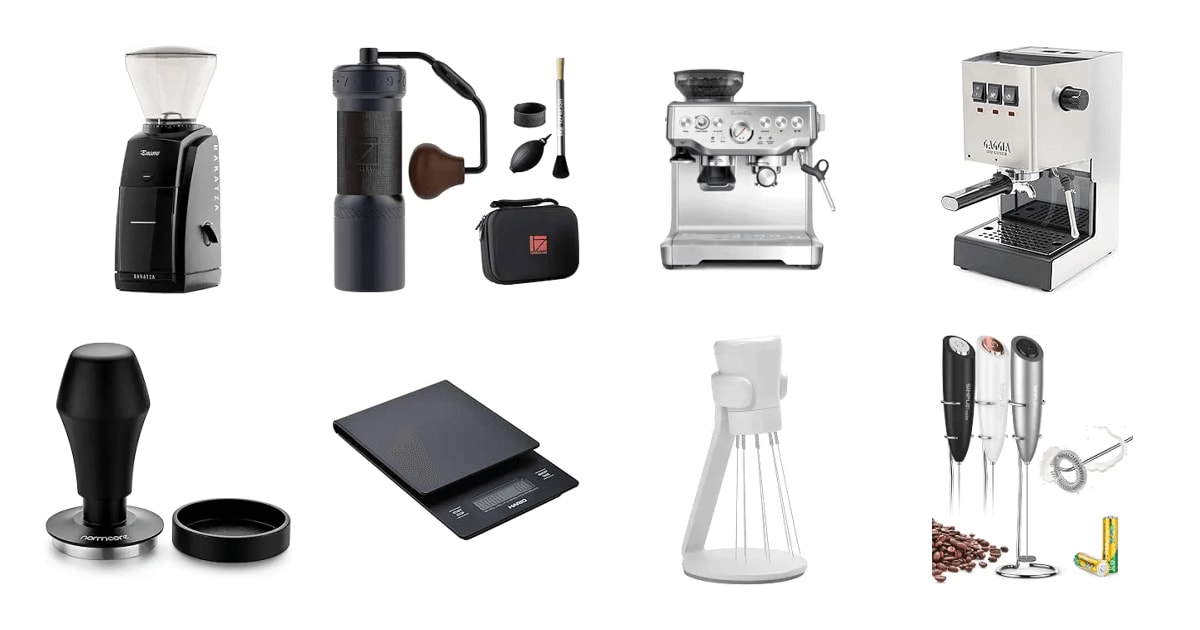
Espresso at home lives or dies on two things: an even grind and a machine that holds a steady temperature. Everything else — the tamper, the scale, the nice canister — just makes it easier to repeat what worked yesterday. That repeatability is the whole game. You want to walk into the kitchen half-awake, pull a shot that tastes like the one you liked on Sunday, and get on with your morning. Gear that fights you at that hour doesn't stay on the counter for long.
Here's the honest part. Nothing at this level does everything well. Single-boiler machines make you choose between brewing and steaming, so you wait between the shot and the milk. All-in-one machines bundle a grinder that's decent but not great. And every one of these needs real upkeep — backflushing, descaling, wiping the group head — or it starts dripping and sputtering within a few years. The owners writing the angriest reviews are usually the ones who skipped that part.
So the right buy depends on how much fiddling you actually enjoy. If you want to press a button and drink coffee, get the machine that hides the most complexity. If you like the ritual — dialing in, weighing doses, chasing a better shot — you'll be happier with separate pieces you can upgrade one at a time. We think that the Breville Barista Express is the best home barista setup for most people, and that the Gaggia Classic Evo Pro is the one to buy if you already own a good grinder and want a commercial-size portafilter.
Everything we recommend

One box, one learning curve, and a grinder you'll outgrow
A commercial-size portafilter, if you'll buy a grinder too

Warm foam in half a minute, nowhere near steam-wand texture

The most consistent grind here, if you'll turn the crank

A reliable everyday grinder, best at filter not espresso
At a glance
| Product | Power Source | Weight | Price | |
|---|---|---|---|---|
| Baratza Encore Coffee Grinder ZCG485BLKAlso great | 120 Volts | 5.58 lbs | $149.95 |
| 1Zpresso K-Ultra Manual Coffee Grinder Iron GrayUpgrade pick | Manual | 1.54 lbs | $259 |
| Breville Barista Express Espresso Machine BES870XLTop pick | 120V | 22.1 lbs | $689.99 |
| Gaggia RI9380/46 E24 Espresso MachineRunner-up | Corded Electric | 20 lbs | $451.90 |
 | Normcore V4 Coffee Tamper 53.3mm - Spring-loadedAlso consider | — | 1.03 lbs | $42 |
 | Hario V60 Drip ScaleAlso in lineup | 2 AAA Batteries | — | $46.11On sale |
 | Normcore WDT Tool V2.1 with Stand -Also consider | — | 6.7 oz | $23.99 |
| SIMPLETaste Milk Frother Handheld Battery Operated ElectricBudget pick | Battery Powered | 3.52 oz | $8.99 |
 | Fellow Atmos Vacuum Coffee Canister & FoodAlso in lineup | — | 1.32 lbs | $39.95 |
How we picked
Grind consistency. We compared burr type, size and adjustment range across spec sheets, and weighed published reviews that describe fines production and espresso capability. Anything that couldn't reach a true espresso grind was judged as a filter grinder instead.
Temperature and pressure. We looked for PID control or a well-documented workaround, plus a stated 9-bar extraction and a real steam wand. Machines with automatic frothers only were ranked lower for anyone who wants milk drinks.
Parts and repairs. We favored gear with published parts availability, standard portafilter sizes and user-serviceable internals. A machine you can rebuild beats one you replace.
Owner-reported failures. We read owner feedback for repeated failure patterns rather than one-off complaints — dead motors, leaking groups, boiler problems, dying scales. Anything with a consistent pattern is named in the flaws.
Top pick
One box, one learning curve, and a grinder you'll outgrow
Breville Barista Express Espresso Machine BES870XL
The Barista Express puts a conical burr grinder, a PID-controlled boiler and a real steam wand in one stainless box. It gets you from whole beans to a drinkable latte in about a minute, and it does that without asking you to buy three separate things first.
$689.99fromAmazonThis is the shortest path from beans to espresso you can buy. The grinder doses straight into the portafilter, a dial tells you roughly where you are, and the PID keeps brew water in the right window without any temperature surfing. You skip the part where you buy a machine and then discover you also need a grinder. For a lot of people, that's the difference between making espresso and meaning to.
Owners who've lived with one describe the same arc. The first month is fussy — grind too coarse, shots gushing, milk scalded. Then something clicks around week three and it turns into just the coffee maker. That pattern shows up again and again in the feedback, and it matters more than any spec on the box. This machine is forgiving enough that beginners actually stick with it.
The steam wand is the underrated part. It's manual, not an automatic frother, so you hold the pitcher and learn to make real microfoam — the glossy, wet-paint milk you need for latte art. Published reviews consistently call it the best wand at this tier. It takes practice, and your first ten cappuccinos will be foam hats. But it's a skill you keep.
The built-in grinder is good enough to start and not good enough to finish. It's a conical burr unit with dose control, and it'll get you to a clean shot. But its finest settings sit coarser than a dedicated espresso grinder's, and feeding it one dose at a time is awkward. Plenty of owners eventually add a separate grinder and keep using the machine happily. That's a normal outcome, not a failure.
Flaws but not dealbreakers
It's big. Twenty-two pounds, a footprint that eats a real chunk of counter, and you need clearance above it for the bean hopper. In a small kitchen you'll notice it every single day.
Plan for service life, too. Owners frequently report that after five or so years the automatic shot volume stops cutting off on its own, or the pump gets loud — repairable, but you'll be reading forum threads to do it. More than a few also describe frustrating rounds with customer service once a part fails out of warranty. Backflush weekly, descale on schedule, and don't let stale beans sit in the hopper.
Runner-up
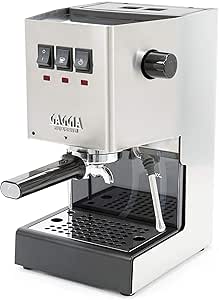
A commercial-size portafilter, if you'll buy a grinder too
Gaggia RI9380/46 E24 Espresso Machine
The Classic Evo Pro is a steel-bodied Italian machine with a 58mm commercial portafilter, a three-way solenoid valve and a serious steam wand. It gives you fewer conveniences than the Breville and far more room to grow, because nearly every espresso accessory made fits it.
$451.90fromAmazonStart with the portafilter, because it's the whole argument. 58mm is the commercial standard, so bottomless baskets, precision baskets, aftermarket screens and basically every tamper on the shelf drop right in. Machines built around 53mm or 54mm baskets narrow your options a lot. If you expect to tinker for years, this is the size you want to be standing on.
Build quality is the other reason people keep these for decades. The housing is solid steel, the internals are simple, and parts are easy to find — owners routinely rebuild these rather than replace them. The three-way solenoid dumps pressure the moment the shot ends, so the puck knocks out as a dry disc instead of a soupy mess. It's a machine you repair, which is rarer than it should be.
You do give up automation. There's no PID, so you learn a rhythm around the heating light, and the single boiler means waiting between the shot and the milk. The steam wand is powerful and unhelpfully so at first; it takes a few weeks before your milk stops looking like dish suds. None of that is hard. It just keeps you involved, every time.
Flaws but not dealbreakers
Owners of this generation have reported coating flaking inside the boiler, and several describe a slow, unsatisfying warranty process when they raised it. It doesn't seem to hit every unit, but it's the one thing we'd research hardest before ordering.
Beyond that, this is half a setup. Paired with a bad grinder it makes worse coffee than a cheap all-in-one, because a 58mm basket punishes uneven grounds. And a steady thread in owner feedback is that it wants more cleaning than people expect — the shower screen and the steam wand both need attention after every session, not every week.
Budget pick
Warm foam in half a minute, nowhere near steam-wand texture
SIMPLETaste Milk Frother Handheld Battery Operated Electric
This is a battery-powered wand with a stainless whisk that whips hot or cold milk into foam in 15 to 30 seconds. It won't make latte art. But it turns a plain espresso, a drip coffee or a matcha into something that feels like a treat.
$8.99fromAmazonFor milk drinks on a budget, nothing else here comes close. It runs on two AA batteries, sits in a little stand on the counter, and rinses clean under the tap in about five seconds. If your machine has no steam wand — or you're making chai, hot chocolate or a cold foam — this covers you. The motor is genuinely strong for something the size of a pen.
It's also the most flexible thing in this guide. Owners reach for it as often for protein powder, electrolyte mixes and matcha as for coffee. If you're building a setup piece by piece, this is the one that earns its space on day one and never becomes redundant, even after you eventually buy a machine with a proper wand.
The foam it makes is the airy, bubbly kind — closer to the top of a diner cappuccino than the dense microfoam off a steam wand. For a flat white, that's a real limitation. For a latte you're going to stir anyway, most people can't tell, and you got there without spending a morning learning to steam.
Flaws but not dealbreakers
Handhelds die. Owners report motors quitting after a few months of daily use often enough that you should treat this as a consumable rather than an heirloom — though replacing it isn't painful, and plenty of people are on their second or third quite cheerfully.
The stand is flimsy, and a fair number of buyers find theirs bent in the box. Holding the wand steady through a big pitcher gets tiring, too. Keep the whisk fully under the surface unless you want milk on the ceiling.
Upgrade pick
The most consistent grind here, if you'll turn the crank
1Zpresso K-Ultra Manual Coffee Grinder Iron Gray
The K-Ultra is a hand grinder with stainless conical burrs and an external dial that moves in 20-micron clicks. It makes cleaner, more uniform grounds than anything else in this guide, and it folds into a travel case when you're done with it.
$259fromAmazonThe external adjustment is what makes a hand grinder practical for espresso. You turn a numbered ring on the outside of the body, in clicks you can feel and count, so you can always get back to exactly where you were. Grinders that adjust internally make you take the thing apart and guess. Dialing in a new bag of beans stops being a chore.
Owners overwhelmingly describe this as the last grinder they'll buy. The feedback skews toward people who moved up from a blade grinder or a cheap hand mill and were startled by the difference — brighter, cleaner cups out of the same beans. Build quality draws the same reaction. It's steel and aluminum throughout, it comes apart without tools for cleaning, and nothing about it feels disposable.
It's quiet, too, which sounds trivial until you're the first one awake. Thirty grams takes under a minute of cranking and wakes nobody in the house. And if you travel, or make your coffee in an office kitchen, the folding handle and the included case turn a serious grinder into something you can throw in a bag.
The catch cup holds 35 to 40 grams. That's a double shot with room to spare, or one big pour-over, and it's also the ceiling. If you're making four drinks before work, you're grinding four times and your forearm will have opinions about it. For that household, an electric grinder is the honest answer.
Flaws but not dealbreakers
It's a hand grinder, and that's not a small caveat. A daily double is fine. A Saturday morning of drinks for guests is a workout, and anyone with wrist or grip trouble should skip it entirely.
It also needs calibrating before first use, and the instructions rather assume you'll go find a video. A few owners note it throws slightly more fines at coarse settings than the best dedicated filter grinders — a fair trade for burrs that also handle espresso, but worth knowing if pour-over is the only thing you make.
Also great
A reliable everyday grinder, best at filter not espresso
Baratza Encore Coffee Grinder ZCG485BLK
The Encore is the default first burr grinder for good reason: 40 settings, 40mm commercial conical burrs, one switch and a pulse button. It's built to be opened up and repaired, and Baratza sells every part inside it, which is why so many are still running a decade on.
$149.95fromAmazonBuy this if you want a grinder you never have to think about. It's an on/off switch and a numbered collar. Nothing to program, nothing to calibrate, no menu. The burrs are hardened steel, the DC motor doesn't bog down on normal roasts, and the whole thing takes up about as much counter as a large mug. For drip, French press, Aeropress or V60, it's all the grinder most people need.
The part that never shows up on a spec sheet is support. Owner accounts of Baratza's service are unusually warm — people describe getting replacement parts shipped out quickly, sometimes long after purchase, with instructions for swapping them at the kitchen table. Every wear item is user-serviceable. That's the real reason these keep turning up in kitchens years later.
For espresso, temper your expectations. The finest settings reach espresso range at the coarse end of it, and the steps between them are wide enough that you can land between too fast and too slow with nowhere to go. Owners who pull shots every day tend to move on eventually. Owners who brew filter and pull the occasional shot stay put happily.
Flaws but not dealbreakers
There's mess. Static flings grounds onto the counter, and retention in the chute means a gram or so of yesterday's coffee joins today's dose. A quick spritz of water on the beans before grinding fixes most of that.
A recurring thread in owner feedback is a motor that turns sluggish or stalls after a year or two, usually traced to a worn part rather than a dead grinder. It's fixable, and Baratza will walk you through fixing it. But expect to open the thing up at some point rather than treating it as sealed for life.
Who this is for
This guide is for someone building an espresso setup at home from scratch, or filling in the gaps in one they already have. If you drink one or two milk drinks a day and want them to taste like the good café down the road, the gear here gets you there. If you drink a single cup of black filter coffee each morning, buy the grinder and skip everything else — a good grinder and a pour-over cone will beat a cheap espresso machine every time.
It's not for people who want zero involvement. Every machine here asks you to grind, dose, tamp and clean, and none of them will hand you a perfect shot on the first try. Super-automatic bean-to-cup machines and pod systems are a different category, and we don't cover them. We also stick to countertop gear for one household, not commercial dual-boiler machines or plumbed-in setups.
How we picked
We built the shortlist around four things. Grind consistency: burr size and geometry, adjustment range, and whether published reviews describe a grinder that genuinely reaches espresso fineness or merely claims to. Temperature and pressure: PID control or a predictable warm-up rhythm, a stated 9-bar extraction, and a manual steam wand rather than an automatic frothing aid. Parts and repairs: standard portafilter sizes, published parts availability, and internals a normal person can get at with a screwdriver. Owner-reported failures: patterns in customer feedback — pumps, solenoids, boiler coatings, load cells — because a flaw that shows up in dozens of accounts is a design issue, not bad luck.
Other home barista gear worth considering
If you want more even shots without buying a new machine: The Normcore WDT Tool V2.1 with Stand - ($23.99) — A WDT tool is a bundle of very fine needles you stir through the grounds before tamping, and it's one of the smallest changes that makes a real difference in espresso. Clumps in the basket create channels, and channels are why one shot gushes and the next chokes. This one uses 0.23mm needles with a magnetic stand, and owners consistently report steadier shot-to-shot results after adding it. It adds maybe fifteen seconds to your routine. Be gentle with it — the needles bend, and a few buyers have fought an over-tightened cap on arrival.
If you want a level tamp every time on a Breville: The Normcore V4 Coffee Tamper 53.3mm - Spring-loaded ($42) — This spring-loaded tamper clicks when you hit the set pressure, and it self-levels against the rim of the basket, which kills the two most common tamping mistakes at once. It ships with 15, 25 and 30-pound springs so you can pick a weight and stop thinking about it. The catch is fit: it's made for Breville's tapered 54mm baskets, so it works with the Barista Express and its siblings but not with the Gaggia's 58mm portafilter. Check your basket before you order. Traditionalists who like feeling the puck compress will find it numb.
The competition
This is what our research surfaced in this category, not a survey of everything sold. A couple of things here are perfectly good products that simply lost to a pick, or serve a narrower job than the guide's main recommendations.
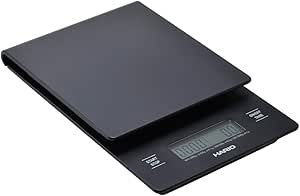
The Hario V60 Drip Scale ($46.11) — The Hario V60 Drip Scale weighs in 0.1-gram steps, has a built-in brew timer and a slim profile that slides under most drippers, and for pour-over that combination is genuinely useful. We didn't make it a pick because reliability is the weak spot: owner feedback includes a steady run of scales going inaccurate or dying outright after a year or two, plus touch buttons that ignore you at the worst moment. Hario's warranty team gets good marks for replacements. If you brew filter coffee and want a timer built in, it's still a reasonable buy — just don't expect it to outlast the grinder.
The Fellow Atmos Vacuum Coffee Canister & Food ($39.95) — The Fellow Atmos is a vacuum canister: twist the lid back and forth and it pulls air out, which slows the staling that starts the day your beans are roasted. It's well made, it looks good on a counter, and the glass body lets you see how much is left. Storage matters less than grind, though, which is why it isn't a pick — a sealed opaque container away from the stove gets you most of the benefit. Buy this if you go through pricey single-origin bags slowly, or you're keeping two roasts on the go at once. Note that it wants hand washing, and the vacuum only holds for roughly a week between openings.
Care and maintenance
Espresso machines fail from neglect far more often than from age. Wipe the steam wand and purge it right after every drink — dried milk turns to cement inside the tip and it's miserable to clear later. Backflush the group weekly with a blind basket and detergent if your machine takes one, and rinse the shower screen when you knock out the puck. Descale on the schedule in the manual, sooner if your water is hard, and consider filtered water instead. For grinders, brush out the burr chamber every couple of weeks; old oily grounds go rancid and taint everything after them. Empty the hopper if you're going away. None of this takes long, and it's the difference between five good years and fifteen.
Questions we get
Do I need to buy everything at once to start making good espresso?
No, and you shouldn't. Start with a machine and a grinder, since those two decide almost everything about how the coffee tastes. Add a tamper, a WDT tool and a scale later, once you know which part of your routine keeps going wrong.
What's the most important piece for a beginner?
The grinder. A great machine fed by an uneven grind makes sour, channeled shots, while a modest machine with a good grinder makes coffee you'll actually enjoy. If you're choosing where to put your money first, put it here.
Are manual grinders worth the effort?
For one or two drinks a day, yes. A good hand grinder like the K-Ultra matches or beats electric grinders that cost considerably more, and it's quiet and portable besides. For a household making four or five drinks each morning, the effort stops being charming fast.
Can I make decent milk drinks without a steam wand?
You can make good ones, not great ones. A handheld frother whips air into hot milk and gives you a foam cap in under half a minute, which is plenty for a latte or a chai. It won't produce the dense, glossy microfoam a steam wand makes, so latte art is off the table.
Should I buy an all-in-one machine or separate pieces?
All-in-one machines like the Barista Express save counter space and get you brewing immediately, at the cost of a grinder you may outgrow. Separates cost more up front and let you upgrade one piece at a time forever. If you're not sure how deep you'll go, start all-in-one — the machine stays useful even after you add a better grinder.
How long do beans stay fresh, and does storage really matter?
Beans hit their stride a few days to two weeks after roasting and slide downhill from there. Storage matters, but less than people think: an airtight container kept away from heat and light gets you most of the way. A vacuum canister helps if you buy expensive coffee and drink it slowly.
Why you should trust us
For this guide:
- We read manufacturer specifications and published reviews for every machine, grinder and accessory in this lineup, comparing burr sizes, portafilter standards, boiler design and stated extraction pressure.
- We reviewed owner feedback across the category, looking for failure patterns that repeat — pumps, solenoids, boiler coatings, dead load cells — rather than isolated complaints.
- We did not use, install or measure any of this gear ourselves, so every claim here traces back to a spec sheet, a published review or something owners report consistently.
- We read owner reviews on every listing, weighted toward the critical ones, because that is where the recurring failures show up.
- We have a systematic way of automatically fetching the latest prices, so the numbers on this page stay current.
- This is a research-focused guide, so the team may not own every product listed — though we often do own the top winners, which gives us extra context for the recommendations.
- We don't accept free products, and the retailer commission never changes which product we recommend.
Sources
Amazon product listings and owner reviews for all 9 products
Manufacturer specification pages for each product
Some passages in this guide may be paraphrased with AI help. Prices are refreshed automatically.
More like this.
Continue exploring home reviews and recommendations.

The Best Espresso Machines for Home Baristas
Good espresso at home comes down to three things happening at once: water at the right temperature, pressure that holds steady through the shot, and…

The Best Stump Removal Gear
A stump doesn't just sit there looking bad. It sprouts suckers, it hides in the grass and eats mower blades, and the roots keep feeding fungus into your…

The Best Hurricane Prep Gear
The power goes out first. Then your phone dies, the fridge warms up, and the tap water may or may not be safe to drink. A hurricane kit isn't about…

The Best Swimming Gear and Pool Accessories
Most swim gear does exactly one job. Goggles keep water out of your eyes and let you find the wall. A kickboard floats. Fins make your legs work harder…

The Best Coleman Camping Gear
Camping gear gets judged on the worst night, not the best one. The tent that stays dry when rain starts at 2 a.m. The cooler that still has ice on day…
The Best Agility Ladders, Cones, and Speed Training Gear
Footwork gear is cheap, portable, and easy to overthink. A ladder, a stack of cones, and a few low hurdles cover almost everything a youth coach, a high…