The Best Aquarium CO2 Systems
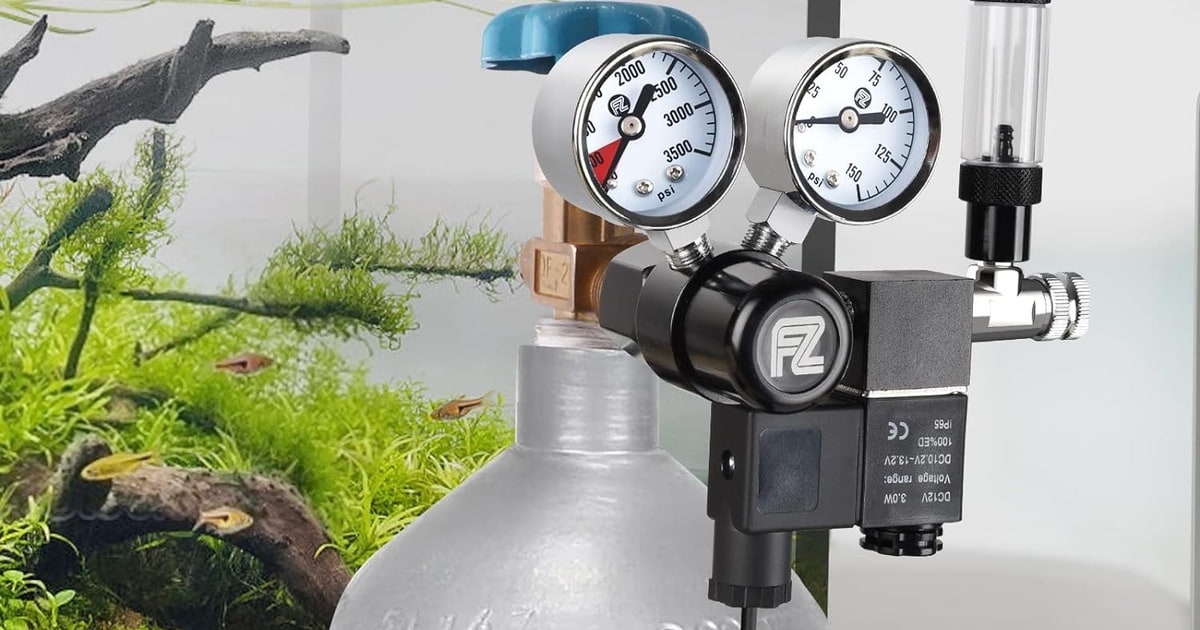
Plants in an aquarium run out of carbon long before they run out of light. Add CO2 and the change shows up within a few weeks: stems grow faster, carpets fill in, and the algae that's been coating your driftwood starts losing ground. A CO2 system is really four parts working together. You need a cylinder, a regulator that steps the pressure down, a needle valve that meters the flow, and something that dissolves the gas into the water. Get one of them wrong and the other three don't matter much.
Here's the part nobody prints on the box. CO2 is the one aquarium upgrade that can kill your fish in an afternoon. Too much gas drops the pH and suffocates them, and the warning signs stay subtle until they aren't. No regulator here removes that risk by itself. You still need a drop checker, a timer, and the habit of actually looking at the tank. Cheaper regulators add a second hazard called the end-of-tank dump, where a nearly empty cylinder unloads its last pressure all at once.
So we looked for regulators that fail safely, meter finely enough for a shrimp tank, and shut themselves off at night without you thinking about it. We read manufacturer specifications, published planted-tank guides, and the recurring themes in owner feedback, then compared what each unit actually puts in the box. We think that the FZONE Pro Series Aquarium Dual Stage CO2 Regulator is the best aquarium CO2 system for most people, and that the Hygger CO2 Aquarium Regulator is the one to buy if you'd rather have big, readable gauges and a longer warranty.
Everything we recommend
Steady pressure down to the last of the cylinder

Big readable gauges and a longer warranty, single stage

The plain workhorse for a first pressurized build

A desk-sized CO2 source with nothing to refill
Prices as of Oct 25, 6:48 AM PT · Details
At a glance
| Product | Solenoid | Cylinder fitting | Price | |
|---|---|---|---|---|
 | FZONE Mnin Aquarium CO₂ Regulator Kit forAlso consider | 12V DC | CGA320 | $47.99 |
 | Fluval Pressurized 1.6oz CO2 KitAlso in lineup | — | 1.6 oz cartridge | $99.99 |
| Hygger CO2 Aquarium Regulator with Dual PressureRunner-up | 12V DC | CGA320 | $49.99 |
| FZONE Aquarium Co2 Regulator DC Solenoid withBudget pick | 12V DC split-type | CGA320 side open | $54.99 |
| FZONE Pro Series Aquarium Dual Stage CO2Top pick | 12V DC | CGA320 | $135.99 |
| FZONE Desktop Aquarium CO2 SystemAlso great | — | 45g cartridge | $47.99 |
Prices as of Oct 25, 6:48 AM PT · Details
How we picked
Fail-safe regulation. We treated dual-stage designs as the safety benchmark, since published guides from CO2Art and Green Leaf Aquariums both flag the end-of-tank dump as the failure that kills fish. Single-stage units had to earn their place on gauges, warranty or price.
Needle valve precision. Green Leaf Aquariums treats adjustment down to about one bubble every few seconds as the threshold for nano and shrimp tanks. We looked for that rating in the specifications, or for owner feedback describing a valve that holds a slow rate without creeping.
Timer-ready solenoid. Practical Fishkeeping recommends cutting CO2 an hour or two before lights-out, which only works if the regulator has a solenoid. We favored 12-volt DC solenoids over 120-volt AC for lower heat and quieter operation in a living room.
Leak safety and seals. Sealing quality is the most common complaint theme in owner feedback across every brand here. We weighed stated sealing technology, check valves on the bubble counter, and pressure-relief provisions, then favored metal bodies over plastic.
What's in the box. A regulator alone won't run a tank. We noted which kits include tubing, a diffuser, mounting tools and a check valve, because the missing pieces add up fast for a first-time buyer.
Top pick
Steady pressure down to the last of the cylinder
FZONE Pro Series Aquarium Dual Stage CO2
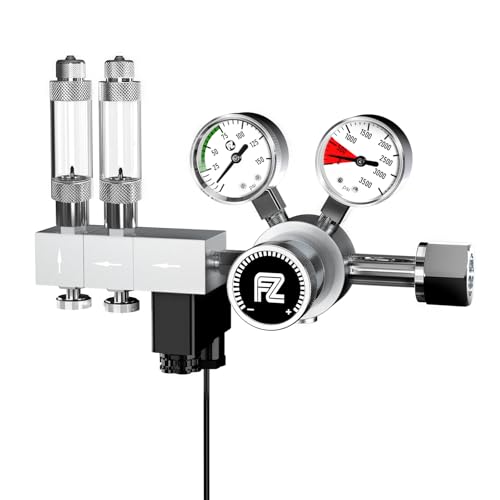
The FZONE Pro Series is a dual-stage regulator with a 12-volt solenoid, an integrated needle valve and bubble counter, and two independent manifold blocks. It holds output steady as the cylinder empties, which is the difference between a CO2 system you can leave alone and one you have to babysit.
$135.99fromAmazonPrices as of Oct 25, 6:48 AM PT · Details
A dual-stage regulator is the single best safety upgrade you can make. Single-stage units can surge as the cylinder runs low, and that spike crashes pH fast enough to kill fish overnight. The second reduction chamber in this FZONE holds output steady no matter how much gas is left. If your CO2 runs while you're at work, that matters more than any other spec on the page.
The output pressure is adjustable, which sounds minor until you change diffusers. A ceramic disc and an inline atomizer want different working pressures, and a fixed-output regulator leaves you fighting the needle valve to compensate. Here you set the working pressure once, then dial in bubbles with the valve. That's how the process is supposed to go, and it saves you a week of guessing.
Two manifold blocks come in the box, each with its own high-precision needle valve, each usable on its own. You can feed two tanks from one cylinder or leave the second block idle until the next tank shows up. Anyone who's kept fish for a while knows the next tank is coming. FZONE rates the valves down to one bubble every three seconds, fine enough for shrimp.
The 12-volt solenoid is the quiet kind. Older 120-volt AC solenoids buzz and get warm, and they usually sit in the room where you're trying to relax. This one runs cool, draws less power, and is meant to live on a timer. Put it on the same timer as your light with an hour or two of offset, and you'll stop paying for gas your plants can't use at night.
There's a built-in safety valve that vents automatically above 100 PSI. You'll probably never see it work. It's the kind of thing you want on a pressurized vessel sitting inside a wooden cabinet in your living room, especially if a knob gets bumped during a water change.
Flaws but not dealbreakers
It's big. The listing puts it near seven inches tall and about seven and a half deep, so a low cabinet shelf may not clear it once a cylinder is standing underneath. Measure before you commit to a spot.
Setup assumes a little confidence. The dual-manifold layout gives you more knobs to misread, and owner feedback across regulators at this level regularly mentions a slow leak at a fitting on arrival. Plan on an evening, fresh thread tape, and a spray bottle of soapy water to check every joint before you walk away.
It's built for North American CGA320 cylinders. If you already own a cylinder with a different valve, you're buying an adapter or a new cylinder.
Runner-up
Big readable gauges and a longer warranty, single stage
Hygger CO2 Aquarium Regulator with Dual Pressure
Hygger's regulator gives you two large pressure dials with the safe range printed in green, a 12-volt solenoid, and a bubble counter with a built-in check valve. It's single stage, so you trade some end-of-tank safety for gauges you can read from the couch.
$49.99fromAmazonPrices as of Oct 25, 6:48 AM PT · Details
The gauges are the reason to look at this one. Both dials are large, the scales are clear, and the safe operating band is marked in green, so a glance from across the room tells you whether the cylinder is running low or the working pressure has drifted. If you've ever squinted at a tiny dial behind a cabinet door with a flashlight in your teeth, you'll appreciate it.
The two-year warranty is the longest in this lineup. Solenoids are the part that dies on aquarium CO2 gear, usually after a year or two of cycling on and off every single day. Hygger covers the regulator for two years and says plainly that solenoids need occasional maintenance, which is more candor than most listings offer. A coil failure in month fourteen shouldn't cost you a whole regulator.
It's single stage, so the end-of-tank dump is a live risk. You can manage it. Swap the cylinder when the low-pressure gauge starts sliding instead of running it dry, and keep a drop checker somewhere you'll actually look. Plenty of people run single-stage regulators for years with no drama. But it asks for attention that our top pick doesn't.
The rest of the build holds up. The bubble counter uses thickened acrylic rather than the thin tubing that cracks at the threads, and its check valve keeps tank water from siphoning back into the body. Hard aluminum alloy throughout means it won't rust in a room that stays humid, and it fits standard CGA320 cylinders and most common atomizers and diffusers.
Flaws but not dealbreakers
The listing doesn't claim an adjustable output pressure, so you're metering entirely with the needle valve. That's fine with a ceramic diffuser and workable with most inline atomizers, but a high-resistance atomizer can push you toward the far end of the valve's useful range.
Take Hygger's own maintenance note seriously. A solenoid that sticks open is a solenoid that runs CO2 all night, and that's exactly the failure that kills fish. Check the drop checker in the morning for the first couple of weeks, and again after any power outage.
Hygger backs this regulator with a two-year warranty.
Budget pick
The plain workhorse for a first pressurized build
FZONE Aquarium Co2 Regulator DC Solenoid with
This FZONE regulator covers the basics and skips the rest: a split-type 12-volt solenoid, a bubble counter with a check valve, and a fine needle valve, all in hard aluminum. It's the low-commitment way to find out whether you want to keep a high-tech planted tank.
$54.99fromAmazonPrices as of Oct 25, 6:48 AM PT · Details
This is the regulator a lot of planted-tank people actually end up with, and the logic is simple. It regulates, it counts bubbles, and it shuts off on a timer. There's nothing else to pay for. If you're not certain you'll stick with injected CO2 past the first year, starting here costs you the least and teaches you the most.
The needle valve is finer than a basic regulator usually manages. FZONE rates it down to one bubble every three seconds, which is the range that matters for a nano tank or a shrimp tank where a heavy hand does real damage. The knurled pressure and fine-tuning knobs help too. You can nudge the rate without blowing past your target and starting over.
It uses the newer split-type 12-volt DC solenoid instead of an AC design, so it stays cool and quiet through years of daily cycling. The bubble counter's check valve keeps water out of the regulator. The tools for mounting it to a CGA320 side-open cylinder are included, which sounds trivial right up until you're standing in a hardware aisle on a Sunday morning.
Owner feedback splits about the way you'd expect at this level. Most units run for years without complaint. A minority arrive with a weeping fitting or a solenoid that quits early. Tape the threads properly, leak-check every joint with soapy water before you leave the room, and hold onto the receipt for the warranty period.
Flaws but not dealbreakers
It's single stage with no adjustable output pressure, so you get neither dual-stage protection nor the flexibility to match a demanding atomizer. Swap the cylinder as soon as the pressure gauge starts falling rather than squeezing out the last of it.
You're buying the regulator side only. Budget for a diffuser, tubing and a drop checker on top, because the box won't get you to a running tank by itself.
FZONE offers a one-year warranty on this regulator.
Also great
A desk-sized CO2 source with nothing to refill
FZONE Desktop Aquarium CO2 System
FZONE's desktop system stands under ten inches tall and less than two inches wide, and runs on disposable 45-gram cartridges instead of a steel cylinder. For a small tank on a desk or a shelf, it's the version of CO2 that doesn't take over the room.
$47.99fromAmazonPrices as of Oct 25, 6:48 AM PT · Details
Most small tanks never get CO2 because of the cylinder, not the cost. A five-pound aluminum tank needs a cabinet, and a lot of desktop aquariums don't have one. This kit is roughly the size of a tall water bottle at 9.84 inches by 1.96 inches, so it stands beside the tank instead of hiding under it. That alone makes injected CO2 realistic for a 5- or 10-gallon setup.
Cartridges take the refill trip out of the equation. FZONE says each bubble uses about 0.03 mL of CO2, and rates a 45-gram cartridge at up to 50 days on an eight-hour daily schedule at one bubble per second. When it runs out, you screw on another one. No driving to a welding supply shop, no wondering whether they'll fill an aquarium cylinder.
The threading is flexible for a small system. It takes standard 5/8-inch cartridges and includes a 3/8-inch adapter, so you're not hunting for a converter when the shop only stocks one size. The quick-connect fitting lets you push tubing on without twisting the line, which is genuinely nice when you're working in the six inches between a tank and a wall.
Build quality reads a step above the plastic mini kits. It's high-strength aluminum with a seamless body and precision sealing, and the single-use cartridge design removes the refill valve as a leak point. For a system that sits out in the open on a desk, looking like a piece of lab equipment rather than a science-fair project counts for something.
Flaws but not dealbreakers
Disposable cartridges cost more per gram of gas than refilling a cylinder, and the gap widens the longer you run CO2. If you're still injecting a year from now, a refillable setup will be cheaper to feed and easier on the recycling bin.
The listing doesn't mention a solenoid, so plan on the system running whenever the valve is open. Without automatic night shutoff you'll burn through cartridges faster and put your fish through a wider daily pH swing. Watch a drop checker closely, and keep the rate conservative.
It's a small-tank tool. On anything much past a nano or desktop aquarium, a 45-gram cartridge won't last long enough to be practical.
Who this is for
Buy a pressurized CO2 system if your plants are already getting decent light and fertilizer and still growing slowly, or if you want a carpet, a red stem plant, or the kind of dense growth that outcompetes algae. It's also the right move if you've been dosing a liquid carbon supplement and you're tired of the daily ritual. If your tank is a low-light setup with anubias, java fern and a few crypts, skip it. Those plants do fine without CO2, and adding gas mostly buys you more trimming and more risk.
This guide covers pressurized regulator systems and small cartridge-based kits for home aquariums, including nano and shrimp tanks where the flow has to stay very low. We're not covering DIY yeast-and-sugar generators, which produce output that swings with room temperature and yeast activity, and we're not covering the cylinders themselves, which you'll buy locally based on what your welding supply or homebrew shop will fill. If you keep sensitive shrimp, weight needle valve precision above everything else on this page.
How we picked
Fail-safe regulation: dual-stage designs prevent the end-of-tank dump that a single-stage regulator can produce as the cylinder empties, so we treated that as the safety benchmark and asked single-stage units to make up for it elsewhere. Needle valve precision: an adjustment range down to roughly one bubble every three seconds is what nano and shrimp keepers need, so we looked for that rating or for owner feedback describing a valve that holds a slow rate. Timer-ready solenoid: a 12-volt DC solenoid lets CO2 shut off before lights-out without buzzing in your living room. Leak safety and seals: metal bodies, stated sealing technology, check valves and pressure relief, because leaks are the most common complaint across every brand. What's in the box: tubing, diffuser, mounting tools and a check valve, since the gaps add up before you ever see a bubble.
Other aquarium co2 systems worth considering
If you want the whole system in one tidy block: The FZONE Mnin Aquarium CO₂ Regulator Kit for — The FZONE Mini folds the solenoid and bubble counter into a single compact aluminum body, and it's the only kit here that also ships a micro-pore diffuser, pressure-resistant tubing and suction cups. For a tank in a bedroom or an office where the equipment is visible, that matters. You give up dual-stage protection and any stated warranty term, and the small footprint means smaller gauges to read. But if you'd rather open one box and be done, this is the one to open.
The competition
This is what our research turned up, not a census of every CO2 system sold. The category is full of rebadged regulators from the same handful of factories, and new listings appear constantly. What follows is the one system here we can't recommend for a planted tank you care about.
The Fluval Pressurized 1.6oz CO2 Kit — The Fluval Pressurized 1.6oz CO2 Kit is a three-piece starter set rated for aquariums up to 30 gallons, and it's easy to install. The trouble is the scale. A 1.6-ounce cartridge holds a fraction of what a paintball-style or five-pound cylinder does, so on a tank near the top of that range you'll be swapping cartridges constantly. There's no solenoid in the kit either, so no automatic night shutoff. Owner feedback skews more negative than anything else in this lineup, with recurring complaints about how quickly the gas runs out. If you want a cartridge system for a small tank, the FZONE desktop kit is the better version of the same idea.
Installation and leak checks
Assemble everything on a table before it goes near the tank. Wrap the CGA320 threads, hand-tighten, then snug the fitting with a wrench without cranking on it. Open the cylinder valve slowly, close the needle valve, and spray every joint with soapy water. Bubbles mean you're losing gas, and a slow leak will empty a cylinder in days. Set your working pressure first, then dial the bubble rate. Start low, around one bubble per second on a 20-gallon tank, and give it two or three days before you increase. Put a 4dKH drop checker at the opposite end of the tank from the diffuser and read it in the afternoon: green means you're near the 30ppm target, blue means too little, yellow means back off now. Run the solenoid on a timer that starts an hour before your light and stops an hour or two before lights-out.
Questions we get
Do I really need CO2 injection for a planted aquarium?
No. Anubias, java fern, crypts and most mosses grow fine without it. You need CO2 when you want fast growth, carpeting plants, red stems, or the plant density that keeps algae from getting a foothold. Adding it also means more trimming, more fertilizer and more attention, so it's a commitment, not a shortcut.
What is the difference between a single-stage and dual-stage CO2 regulator?
A single-stage regulator drops cylinder pressure to working pressure once. As the cylinder empties, that output can surge in what's called an end-of-tank dump, which floods the tank with gas and crashes the pH. A dual-stage regulator adds a second reduction chamber that holds output steady regardless of what's left inside. If your system runs unattended, dual stage is the safer choice.
Can too much CO2 kill my fish?
Yes, and faster than most beginners expect. Excess CO2 lowers pH and makes it hard for fish to offload carbon dioxide through their gills. Watch for gasping at the surface or fish hanging near the filter outflow, and shut the gas off and add surface agitation if you see it. Increase your bubble rate in small steps over days, never all at once.
How do I know if my CO2 levels are correct without expensive equipment?
Use a drop checker filled with 4dKH solution. It turns green at roughly 30ppm, which is the target most planted-tank guides recommend, blue when CO2 is too low for strong growth, and yellow when it's high enough to stress fish. It lags by an hour or two, so read it mid-afternoon. Bubble counters only estimate flow, since bubble size varies by regulator and diffuser.
Do I need a solenoid valve, or can I run CO2 all the time?
Get the solenoid. Plants don't use supplemental CO2 in the dark, so running gas overnight wastes it and pushes your fish through a wider daily pH swing. Wire the solenoid to a timer that starts an hour before your light and stops an hour or two before lights-out. A cylinder lasts noticeably longer that way.
What's the best CO2 system for a nano or shrimp tank?
Look at needle valve precision first. You want a valve rated down to about one bubble every three seconds, because overshooting in a small water volume happens in minutes. Our top pick and our budget pick both claim that range. For a desktop tank where a steel cylinder won't fit, a cartridge system is the practical answer.
Why you should trust us
For this guide:
- We compared manufacturer specifications for every regulator here, focusing on stage count, stated needle valve range, solenoid voltage and what each kit actually includes.
- We read planted-tank guidance from Aquarium Co-Op, The 2Hr Aquarist, CO2Art, Green Leaf Aquariums, Green Aqua, Practical Fishkeeping, Aquarium Source and Fishkeeping World on CO2 targets, dosing and regulator safety.
- We reviewed recurring themes in owner feedback, particularly complaints about leaking fittings and solenoid failures, and used them to shape the flaws and cautions above.
- We read owner reviews on every listing, weighted toward the critical ones, because that is where the recurring failures show up.
- We have a systematic way of automatically fetching the latest prices, so the numbers on this page stay current.
- This is a research-focused guide, so the team may not own every product listed — though we often do own the top winners, which gives us extra context for the recommendations.
- We don't accept free products, and the retailer commission never changes which product we recommend.
Sources
Aquarium Co-Op CO2 Injection Guide, Aquarium Co-Op
The 2Hr Aquarist — High-Tech Planted Tank Resources, The 2Hr Aquarist
Green Aqua — Aquascaping Equipment & CO2 Setup Guides, Green Aqua
Practical Fishkeeping — CO2 Systems for Planted Aquariums, Practical Fishkeeping
Fishkeeping World — Aquarium CO2 System Reviews, Fishkeeping World
Aqua Design Amano (ADA) — Official CO2 System Specifications, ADA (Aqua Design Amano)
CO2Art — Regulator Technology & Dual-Stage Design Explained, CO2Art
Green Leaf Aquariums — CO2 Regulator Product Specs, Green Leaf Aquariums (GLA)
Aquasabi — Planted Tank CO2 Fertilization Basics, Aquasabi
Aquarium Source — Best CO2 Systems Comparison, Aquarium Source
JBL — ProFlora Bio CO2 System Documentation, JBL
Fluval — CO2 Advanced Kit Product Manual, Fluval
Amazon product listings and owner reviews for all 6 products
Manufacturer specification pages for each product
Some passages in this guide may be paraphrased with AI help.
Product prices and availability are accurate as of the date/time indicated and are subject to change. Any price and availability information displayed on Amazon.com at the time of purchase will apply to the purchase of this product.
More like this.
Continue exploring pet reviews and recommendations.

The Best Aquarium Heaters
A heater is the least interesting thing in your tank and the most likely to cause a disaster. Fish don't need water that's warm on average. They need it…

The Best Aquarium Filters for Freshwater Tanks
A freshwater filter is the one piece of equipment in your tank that never gets a break. It runs every hour of every day, pushing water through foam and…

The Best Aquarium LED Lighting
The light over your tank does more work than anything else you'll buy for it. It decides whether your plants carpet the substrate or melt into brown mush,…

The Best Quiet Aquarium Air Pumps
An air pump is one of the few pieces of aquarium gear you hear all day. It sits outside the tank, humming away in a living room or a foot from your…

The Best Aquarium Protein Skimmers
A protein skimmer does one job. It pulls dissolved organic waste out of your water before it breaks down into nitrate and phosphate. Fish waste, uneaten…

The Best Aquarium UV Sterilizers
A UV sterilizer is a lamp in a tube that your water flows past, and nothing else on the tank does its job. It kills the free-floating stuff: the…