The Best Aquarium Filters for Freshwater Tanks
A freshwater filter is the one piece of equipment in your tank that never gets a break. It runs every hour of every day, pushing water through foam and ceramic where colonies of nitrifying bacteria turn fish waste into something far less toxic. Get it right and you'll barely think about it — the water stays clear, the fish stay healthy, and cleaning day takes twenty minutes. Get it wrong and you'll hear the thing gurgling from across the room while your ammonia creeps up.
No filter here does everything. Mechanical and biological media handle waste and ammonia, but nothing meaningfully removes nitrate — that's what water changes are for, and no amount of filtration replaces them. Manufacturer tank ratings run optimistic, too. They assume a lightly stocked tank with tidy fish, so a filter rated for 100 gallons is really a filter for a moderately stocked 55 or 75. And every one of these still needs your hands in a bucket every few weeks.
Which filter suits you comes down to tank size, what lives in it, and how much noise you'll put up with in the room. A canister hides in the cabinet and holds the most media, which is why most large tanks eventually get one. A sponge filter costs almost nothing and won't hurt a baby shrimp. We think that the Fluval 407 Performance Canister Filter is the best aquarium filter for freshwater tanks for most people, and that the Eheim Classic 350 (2215) is the one to buy if you run CO2 in a planted tank and want the quietest, thriftiest option.
Everything we recommend

Quiet, big-capacity canister filtration for most midsize tanks

Quieter and thriftier, if you can live with a fussier setup

One less cable in the tank, if you'll pay for the integration

Gentle, fry-safe filtration for a nano or breeding tank
Prices as of Oct 23, 7:21 AM PT · Details
At a glance
| Product | Tank Size | Filter Type | Price | |
|---|---|---|---|---|
| Fluval 407 Performance Canister Filter - ForTop pick | 100 Gallons | Canister | $256.99 |
| EHEIM Classic Canister Filter 2215Runner-up | 92 Gal | Canister | $179.99 |
| HIKARI Bacto-Surge Foam Filter MiniAlso great | 10 Gallon | Foam | $8.44 |
| OASE BioMaster Thermo External Filter with Built-inUpgrade pick | 160 Gallons | Canister | $328.90 |
Prices as of Oct 23, 7:21 AM PT · Details
How we picked
Turnover for the tank. We matched published flow ratings against the 4-to-10x hourly turnover that fishkeeping references recommend. We treated each manufacturer's maximum tank size as an optimistic ceiling, not a target.
Biological media capacity. Spec sheets show how much media a filter holds and how water travels through it. We favored sealed, pressurized media columns and oversized baskets, because bacteria capacity is what keeps ammonia at zero on the week you overfeed.
Noise in the room. We read owner feedback specifically for humming, rattling and air-purging complaints. A filter runs all night in whatever room the tank is in, so this isn't a minor spec.
Maintenance and priming. We compared documented priming methods, basket design and pre-filter access. Filters you can clean at the tank scored better than ones that need a full teardown every time.
Who's in the tank. Fry, shrimp and long-finned fish rule out strong intakes and heavy flow. We made sure the lineup covered gentle options and not just high-capacity canisters.
Top pick
Quiet, big-capacity canister filtration for most midsize tanks
Fluval 407 Performance Canister Filter - For
The 407 is a full-size canister rated for tanks up to 100 gallons, moving 383 gallons per hour through four stages of media. It's quiet enough for a living room, the media baskets lift out with one finger, and parts are easy to find when you need them.
$256.99fromAmazonPrices as of Oct 23, 7:21 AM PT · Details
For a tank between 40 and 75 gallons, the 407 is the easy answer. Its 383 gallons per hour puts a 55-gallon tank at roughly seven times turnover, right in the middle of the 4-to-10x range fishkeeping guides recommend. That's enough to keep the water column moving without blasting your plants sideways. And the flow control lets you back it off if you're keeping something delicate.
The four-stage stack is where a canister earns its keep. Water gets forced through a sealed, pressurized column — foam, then chemical media, then two trays of biological media — instead of drifting past a single cartridge the way it does in a hang-on-back. Aquarium Co-Op puts usable biological capacity in canisters at three to five times what a comparable HOB holds. More bacteria means more headroom the week you overfeed.
Maintenance is the part most people dread, and Fluval clearly thought about it. The baskets stack under a center handle, so you lift the whole media column out with one finger instead of fishing trays out of a soupy bucket. Priming happens at the pump top, with no filling the canister by hand first. Owners routinely describe getting it running on the first try in under half an hour.
It's genuinely quiet. Fluval rates the pump 25% quieter than the previous generation, and owner feedback lines up with that — the common description is a faint hum you stop noticing after a week. If your tank sits in a bedroom or a home office, that matters more than any number on the box.
Flaws but not dealbreakers
The 407 has a reliability tail. Most owners run theirs for years without opening the pump head, but a real minority report motor heads that quit after a year or two, sometimes more than once. Fluval's parts availability makes that survivable rather than fatal, and it's a known trade-off for a pump this quiet.
It's also bulky. You'll want a cabinet with room for a canister roughly nineteen inches tall plus slack in the hoses, and it weighs close to ten pounds dry and considerably more full. For a 20-gallon on a bookshelf, this is more filter than the space allows.
Runner-up
Quieter and thriftier, if you can live with a fussier setup
EHEIM Classic Canister Filter 2215
The Classic 2215 is a bare-bones German canister rated for tanks up to 92 gallons. It draws just 8 watts, runs about as quietly as anything you can hang on an aquarium, and its media chamber is one open column you fill however you like.
$179.99fromAmazonPrices as of Oct 23, 7:21 AM PT · Details
Eight watts is the number that sells this filter. That's about what an LED bulb pulls, running around the clock for years on end. The trade-off is throughput: 164 gallons per hour is modest, so treat the 92-gallon rating as generous and size it for something closer to a moderately stocked 40 or 55. Under-filtering is the one mistake you don't want to make here.
If you inject CO2, this is the canister to get. The included spray bar can sit below the waterline and push flow along the glass instead of churning the surface, which is exactly what you want when you're paying for gas that escapes at the first ripple. Planted-tank guidance is consistent on this: near-zero surface agitation keeps CO2 in the water column where your plants can actually use it.
The design is old, and that's most of the appeal. There's a pump head, a canister, a silicone sealing ring, and media — no electronics to fail, no proprietary cartridge to keep buying. You fill it with the Mech and Substrat Pro it ships with, or with your own foam and ceramic. Owners keep these running for a decade or more, which is rare in aquarium gear.
It's also the quiet one. Nothing rattles because there are no baskets, and the common owner report is that you have to glance at the hoses to confirm it's still running. For a tank in a bedroom, that's worth more than the extra flow a bigger canister would give you.
Flaws but not dealbreakers
Setup is fussier than on a modern canister. Priming takes patience, and some owners never quite get the knack — there's a steady stream of complaints about repeated attempts before the siphon catches. Watch someone do it before your first go.
The open media chamber cuts both ways. Without trays, everything sits in one column, so reaching the foam at the bottom means pulling out everything above it first. Cleaning day takes longer than it does with a basket-stacked filter.
Upgrade pick
One less cable in the tank, if you'll pay for the integration
OASE BioMaster Thermo External Filter with Built-in
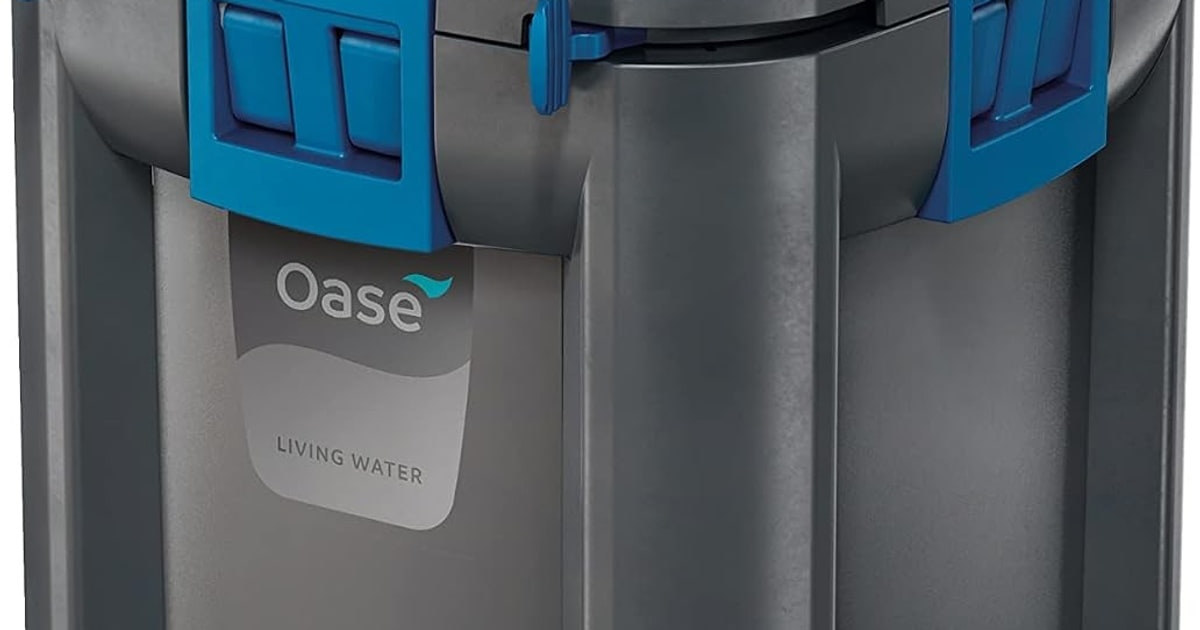
The BioMaster Thermo is a four-stage canister with an adjustable heater built into the body, rated for tanks up to 160 gallons. It's the most expensive filter here, and its pull-out pre-filter makes routine cleaning about as painless as canister maintenance gets.
$328.90fromAmazonPrices as of Oct 23, 7:21 AM PT · Details
The built-in heater is the whole point. Instead of a glass tube suction-cupped to the back wall, the element lives inside the canister, adjustable from 66 to 90 degrees with a second knob for fine-tuning. Your fish can't press against it, your aquascape loses a piece of hardware, and a display tank ends up looking like a display tank instead of an equipment shelf.
The EasyClean pre-filter is the feature owners talk about most. It's a foam module you pull out on its own, without opening the canister or hauling it to a sink, so the ninety-percent case of filter maintenance becomes a two-minute job at the tank. It also keeps debris off the main foams, which stretches the gap between full teardowns.
Everything else is built to match. Safety locks on the handle, pre-filter and aquastop keep water where it belongs during maintenance, and the detachable aquastop lets you carry the canister off without breaking down your tubing. The sealed four-stage path runs carbon foam, then foams of different pore densities, then Hel-X bio media for bacteria to colonize.
Flaws but not dealbreakers
You're paying a lot for integration, and integration means shared failure. If the bi-metal thermostat drifts, you're dealing with a filter component rather than swapping a cheap in-tank heater. There's a thermal shutoff for safety, but it's still one more thing sealed inside the box.
Owner feedback isn't spotless. A recurring theme is canisters that purge air and get louder over time, usually traced back to a seal or the impeller, plus a smaller group who describe flow that never quite settled. Most owners are delighted with theirs, but the unhappy tail here is longer than the Fluval's.
The BioMaster Thermo carries a four-year warranty — three years, plus a fourth if you register online.
Also great
Gentle, fry-safe filtration for a nano or breeding tank
HIKARI Bacto-Surge Foam Filter Mini
This is a corner-mounted foam filter driven by an air pump, sized for tanks up to about 10 gallons. Its coarse sponge physically can't pull in fry or baby shrimp, and it costs a small fraction of what any canister here does.
$8.44fromAmazonPrices as of Oct 23, 7:21 AM PT · Details
If you're breeding fish or keeping shrimp, a sponge filter isn't a compromise — it's the right tool. Standard HOB and canister intakes will happily inhale fry and juvenile shrimp. A foam intake can't. That's why professional breeders run them almost universally, and why shrimp keepers with canisters end up strapping a sponge over the intake anyway.
The foam does real biological work too. Bacteria colonize it the same way they colonize ceramic media, and the slow airlift gives them plenty of contact time. In a 5- or 10-gallon planted tank, that's all the filtration you need. In a bigger tank, one of these makes a fine second filter — a cycled backup you can move to a quarantine tank in a minute.
Bettas are the other obvious use. The airlift makes a soft current rather than the wall of flow off a hang-on-back, so a long-finned fish isn't swimming into a headwind all day. The corner shape tucks against the back glass instead of standing in the middle like a cylinder, which counts for a lot when you've only got a few gallons of space.
Flaws but not dealbreakers
You need an air pump and airline tubing, and neither comes in the box. Budget for both, and expect the pump to buzz — the filter itself is nearly silent, but a cheap pump on a hard shelf isn't. Setting it on a folded towel helps more than you'd think.
There's no chemical stage, so if you're pulling out tannins or leftover medication you'll need carbon somewhere else. The base is light, too; some owners end up weighing it down with a rock so it doesn't drift once the sponge saturates.
Who this is for
This guide is for anyone running or setting up a freshwater tank, from a 10-gallon on a desk to a heavily stocked 100-gallon in the living room. It covers canister and sponge filters you'd choose as your tank's primary filtration. It doesn't cover saltwater or reef systems, pond filtration, all-in-one tanks with filtration built into the rear chamber, or the replacement cartridges and media pads you buy for a filter you already own.
If your current filter is quiet and your water parameters are stable, you don't need to replace it — buy media, not hardware. If you're under-filtered, consider adding a second filter rather than swapping the first one out. Running two gives you redundancy, and it means you can clean or replace media in one while the other keeps the bacteria colony intact. That's also the safest way to move to a bigger filter: run both for a month, then retire the old one.
How we picked
Turnover: we checked published flow rates against the 4-to-10x per hour that fishkeeping references recommend, and sized filters to realistic stocking rather than the number on the box. Media capacity: we looked for sealed, pressurized media columns and roomy baskets, since biological capacity is what absorbs your mistakes. Noise: we read owner feedback for humming, rattling and air purging, because this thing runs all night in your room. Maintenance: we favored pull-out pre-filters, one-handle basket stacks and priming you can do without a bucket. Tank inhabitants: we made sure fry, shrimp and bettas had a gentle, intake-safe option and not just a big canister.
The competition
This is what our research surfaced, not a census of every freshwater filter on the market. Everything else that came up alongside these four turned out to be consumable media or replacement parts rather than filters — worth buying if you already own the matching unit, but not something to build a filtration setup around. We've set those aside instead of writing them up as filters.
Care and maintenance
The most common new-fishkeeper mistake is cleaning too well. Your media is where the bacteria live, so swapping all of it at once pushes the tank back toward uncycled and you'll see ammonia within days. Rinse foam and ceramic in a bucket of tank water you just siphoned out, never under the tap — chlorine kills the colony you spent weeks growing. Replace one piece of media at a time, spaced weeks apart. Expect a brand-new filter to take four to six weeks to cycle fully, and test the water rather than guessing. Once or twice a year, pull the impeller and clear the hair and grit off the shaft. That single step fixes most complaints about a filter getting loud or losing flow.
Questions we get
What size filter do I need for a 55-gallon freshwater tank?
Aim for 4 to 10 times the tank volume per hour, so 220 to 550 gallons per hour. The Fluval 407 sits at 383 GPH, which is comfortably in range. Over-filtering is safe as long as you can dial the flow back; under-filtering isn't.
How often should I clean my filter without killing the beneficial bacteria?
Rinse mechanical media — foam and floss — every two to four weeks, or whenever flow drops off. Do it in a bucket of water you just siphoned from the tank, not under the faucet. Leave the biological media alone except for a gentle swish, and never replace every piece at once.
What's the difference between a canister filter and a hang-on-back filter?
A canister sits under the tank and forces every drop through a sealed, pressurized column of media, which is why it holds roughly three to five times the biological media of a comparable HOB. A hang-on-back clips to the rim, costs less and is simpler to service, but its capacity is limited by the box on the glass. Canisters make more sense above about 40 gallons; HOBs are a fine entry point below that.
Can I run two filters on the same tank at once?
Yes, and it's one of the better habits in the hobby. Two filters give you redundancy if one quits, and they let you clean or replace media in one while the other keeps its bacteria colony untouched. A sponge filter makes a cheap, quiet second filter alongside a canister.
What's the best filter for a betta that doesn't create too much current?
A sponge filter like the Hikari Bacto-Surge. The airlift makes a gentle current instead of the steady push a hang-on-back produces, so a long-finned fish isn't fighting the flow all day. If you'd rather use a canister, point the spray bar at the glass and turn the flow down.
How long does a brand-new filter take to fully cycle?
Usually four to six weeks for the nitrifying bacteria to establish. You can shorten that dramatically by moving cycled media from an existing filter into the new one. Test for ammonia and nitrite rather than going by the calendar, and stock slowly until both read zero.
Why you should trust us
For this guide:
- We read manufacturer spec sheets for flow rate, wattage, rated tank size and media configuration on every filter here, then checked those numbers against the turnover guidance in standard fishkeeping references.
- We went through owner feedback looking for repeat themes — priming trouble, motor failures, air purging, noise over time — rather than isolated complaints.
- We leaned on published guides from Aquarium Co-Op, The Spruce Pets and FishLab for how canister, hang-on-back and sponge filters differ in practice.
- We read owner reviews on every listing, weighted toward the critical ones, because that is where the recurring failures show up.
- We have a systematic way of automatically fetching the latest prices, so the numbers on this page stay current.
- This is a research-focused guide, so the team may not own every product listed — though we often do own the top winners, which gives us extra context for the recommendations.
- We don't accept free products, and the retailer commission never changes which product we recommend.
Sources
Best Aquarium Filters — The Spruce Pets, The Spruce Pets
Best Aquarium Filter — FishLab, FishLab
Best Aquarium Filter — Aquarium Source, Aquarium Source
Types of Aquarium Filters Explained — Aquarium Co-Op, Aquarium Co-Op
Understanding the Nitrogen Cycle — Aquarium Co-Op, Aquarium Co-Op
Fluval 407 Performance Canister Filter — Official Specifications, Fluval (Hagen Group)
Eheim Classic 350 (2215) — Official Product Specifications, Eheim
Seachem Tidal Power Filter — Official Product Page, Seachem
Oase BioMaster Thermo 350 — Official Specifications, Oase
Marineland Penguin Bio-Wheel Power Filters — Official Product Page, Marineland
Amazon product listings and owner reviews for all 4 products
Manufacturer specification pages for each product
Some passages in this guide may be paraphrased with AI help.
Product prices and availability are accurate as of the date/time indicated and are subject to change. Any price and availability information displayed on Amazon.com at the time of purchase will apply to the purchase of this product.
More like this.
Continue exploring pet reviews and recommendations.

The Best Nano Reef Tanks
A nano reef sits on a countertop and asks for attention every few days. The water volume is small, so everything you do to it lands hard. Add a fish, and…

The Best Betta Fish Tanks
A betta is sold as the easy pet, the one that lives in a vase on a windowsill. It isn't. A betta is a tropical fish that wants warm, stable water, a place…

The Best Fish Tank Starter Kits for Beginners
A fish tank is the rare pet that asks for a little work every week instead of a lot every day. But the equipment you start with decides how pleasant that…

The Best Aquarium Protein Skimmers
A protein skimmer does one job. It pulls dissolved organic waste out of your water before it breaks down into nitrate and phosphate. Fish waste, uneaten…

The Best Aquarium CO2 Systems
Plants in an aquarium run out of carbon long before they run out of light. Add CO2 and the change shows up within a few weeks: stems grow faster, carpets…

The Best Aquarium Heaters
A heater is the least interesting thing in your tank and the most likely to cause a disaster. Fish don't need water that's warm on average. They need it…