The Best Blue Light Blocking Glasses
If you spend your workday staring at a screen, you've probably had that late-afternoon feeling: gritty eyes, a dull ache behind your forehead, and the sense that your monitor has gotten brighter than it was at 9 a.m. Blue light glasses are one of the simplest things you can try for it. A good pair is light enough that you forget you're wearing it, doesn't turn your screen a strange color, and holds up to being tossed in a bag every day. That's most of what separates a pair worth keeping from one that lives in a drawer.
Here's the honest part. The evidence that these glasses reduce daytime eye strain is weak — a randomized trial in BMJ Open Ophthalmology found no significant difference against standard lenses after two weeks of computer use, and a Cochrane review of 17 studies reached a similar conclusion. The American Academy of Ophthalmology says there's no evidence screen blue light damages your retina at all. The sleep side is more promising: Harvard researchers found blue light suppresses melatonin about twice as long as green light, and heavily tinted lenses before bed have shown real benefits in sleep studies. So buy for comfort and for sleep, not for a cure.
That distinction shapes the whole category. Clear lenses filter maybe 10 to 20 percent of blue light and leave your screen colors alone. Amber and orange lenses block far more but wash the world in yellow, which is fine at 10 p.m. and miserable in a video call. Most people need the first kind, and a smaller group needs the second. We think that the Gunnar Intercept Onyx is the best blue light blocking glasses for most people, and that the Pixel Eyewear Buteo is the one to buy if you need a genuinely clear lens for color-sensitive work.
Everything we recommend

Real filtration and all-day comfort, if you'll accept a tint

A clear lens that keeps your screen colors honest

Barely-there frames and strong filtration for very little money

The heaviest filtration here, for late nights and bad headaches
At a glance
| Product | Lens Color | Blue Light Blocked | Price | |
|---|---|---|---|---|
 | Felix Gray Roebling Blue Light Reading GlassesAlso consider | Sazerac Crystal | 15x More Filtered | $129 |
| Gunnar Intercept Onyx Gaming Glasses Amber LensTop pick | Amber | — | $48.50 |
 | Swanwick Classic Day Swannies - Premium BlueAlso consider | Clear | 98% at 400nm | $129.99 |
| Pixel Eyewear Designer Computer Glasses with Anti-BlueRunner-up | Clear | — | $84.54 |
| ANRRI Blue Light Glasses Men Women TransparentBudget pick | Crystal | 90% Blocked | $25.95 |
| GUNNAR Gaming Glasses - Intercept Onyx AmberAlso great | Amber | — | $58.36On sale |
How we picked
Verified filtration. We favored brands that publish a filtration figure tied to a specific wavelength rather than a vague percentage, and we gave real weight to ANSI Z87.1 certification. All About Vision identifies 415 to 455nm as the critical band for screen exposure, so a number without a wavelength attached tells you almost nothing.
Tint and color accuracy. We separated clear lenses from amber and orange ones instead of ranking them together, because they solve different problems. Clear lenses filter 10 to 20 percent and preserve screen color; amber and orange run from 65 to 99 percent and are meant for evenings.
All-day comfort. We compared frame weight, bridge and temple measurements, and material against owner reports of pressure points and end-of-day headaches. Anything heavy enough to cause a headache by itself defeats the purpose.
Build and durability. We read owner feedback for patterns in warped frames, loose hinges, and scratched lenses over months rather than days. Recurring complaints about frames arriving off-center counted against a pair.
Return terms. Fit is unpredictable when you can't try glasses on, so we noted return windows and warranty terms. A 30-day window and a stated warranty make an unknown fit a much smaller gamble.
Top pick
Real filtration and all-day comfort, if you'll accept a tint
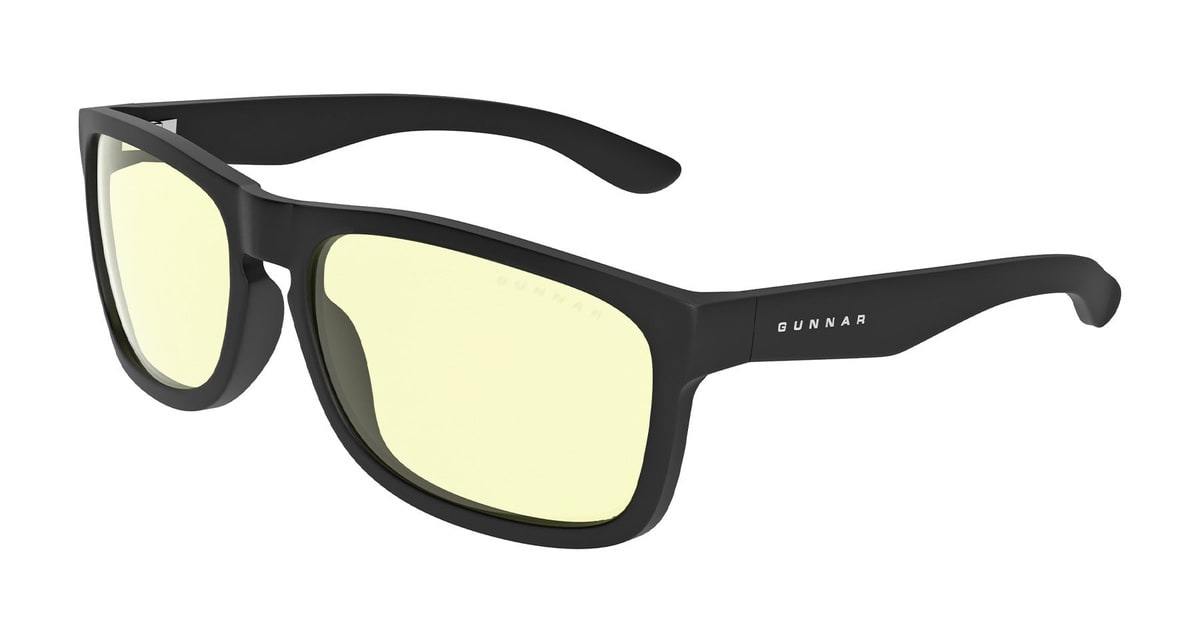
Gunnar Intercept Onyx Gaming Glasses Amber Lens
The Intercept is the rare pair that tells you exactly what it filters at the 450nm peak instead of making a vague claim. At 33 grams with a wraparound frame, it's light enough for an eight-hour shift and blocks glare coming in from the sides.
$48.50fromAmazonGunnar is the only major brand here that publishes a verified number. Most blue light glasses claim a percentage with nothing behind it. Gunnar's lenses are built to ANSI Z87.1 and the company reports its Blue Light Protection Factor at the 450nm peak — the band that actually matters for screens. All About Vision puts the critical range at 415 to 455nm. You don't have to take the marketing on faith, which is more than you can say for most of this category.
The frame weighs 33 grams, and you notice. Owners who wear these for eight-hour shifts and then game afterward consistently say the glasses stop registering after the first hour. The wrap shape does something the flat frames don't: it cuts the light coming in from a window or an overhead fixture at the edge of your vision. If you sit near a window or under office fluorescents, that peripheral glare is a real part of why your eyes hurt.
The amber tint is the trade-off, and it's not subtle. Whites go warm, and your screen looks like someone nudged the color temperature. For coding, spreadsheets, gaming, and general office work, you'll adapt within a day and stop seeing it. For photo editing or anything where color accuracy is the job, you can't use these. That's a hard line, not a preference.
The build quality justifies the price in a way most of this category doesn't. These come with a microfiber pouch, a cleaning cloth, a 30-day return window, and a one-year warranty. Owner feedback skews heavily toward long-term satisfaction rather than first-week enthusiasm, which is the pattern you want. Cheap Amazon frames tend to loosen at the hinge after a few months; this one doesn't show up in complaints that way.
Flaws but not dealbreakers
A slight magnification is built into the lens, and not everyone likes it. Some owners report a couple of days of adjustment before their eyes settle, and a few never fully do. If you already wear contacts or a prescription, that added curvature can feel like one correction too many.
The wrap fit is snug. Several owners with wider faces or larger heads describe pressure at the temples after long stretches. Gunnar lists the fit as medium, so if your current glasses run large, look at the frame width of 133mm before you commit.
It's a gaming brand, and it looks like one. The Onyx is a sober black frame, but the wrap shape reads sporty rather than professional. It's fine for a home office and slightly out of place in a client meeting.
The Intercept comes with a one-year warranty and a 30-day return policy.
Runner-up
A clear lens that keeps your screen colors honest
Pixel Eyewear Designer Computer Glasses with Anti-Blue
The Pixel Buteo filters blue light through a coating that leaves almost no visible tint, so your monitor looks the way it's supposed to. It's the pair to get if you edit photos, work in design, or just can't stand yellow.
$84.54fromAmazonIf the amber tint is a dealbreaker, this is where you land. Pixel's lenses use anti-blue coatings rather than a heavy dye, and owners repeatedly note that they look like ordinary glasses — no yellow cast on white backgrounds, no color shift in video calls. That matters more than it sounds. A tint you can see is a tint you'll get tired of, and glasses you get tired of end up in a drawer.
Clear lenses filter less blue light, and you should know that going in. Clear lenses typically cut 10 to 20 percent of blue light, while amber runs to 65 percent and orange to 99. Pixel targets the 455nm harmful peak specifically rather than blanketing the spectrum, which is the reasonable design choice for a clear lens. But if you want maximum filtration, this isn't the pair — this is the pair for accurate color plus a meaningful reduction in glare.
The 52-16-145mm Buteo frame is a classic full-rim acetate shape that works in an office without announcing itself. The lenses also carry anti-glare and full UV protection, which is genuinely useful if you're under harsh overhead lighting. Owners who bought these specifically because they wanted something that didn't look like gaming gear tend to be the happiest with them.
Owner feedback on the actual eye-strain benefit is unusually positive for a clear lens. People who stare at monitors for nine or ten hours describe less of the burning, itching end-of-day feeling. Some report better sleep too, though that's harder to credit to a lens that lets most blue light through.
Flaws but not dealbreakers
Build quality is the weak spot. A meaningful share of owner complaints describe frames arriving warped or off-center, and others describe the acetate feeling flimsy enough that they worry about snapping an arm. Check the fit the day it arrives so you're inside the return window.
Several owners find them heavy for all-day wear, with one describing a headache by end of day from the weight alone. Acetate frames can be heated and adjusted by an optician, which usually fixes pressure points, but that's an extra errand.
Budget pick
Barely-there frames and strong filtration for very little money
ANRRI Blue Light Glasses Men Women Transparent
The ANRRI is a lightweight TR90 frame with polycarbonate lenses that the company says cut 90 percent of blue light. It costs a fraction of the premium picks and it's the pair to buy first if you're not sure blue light glasses will help you.
$25.95fromAmazonSpending more doesn't reliably buy you more filtration. Spectrophotometry comparisons have found budget lenses performing comparably to premium options, and this pair claims 90 percent blue light reduction — well above what most clear lenses manage. Take that figure with some salt, since there's no independent certification behind it. But the price makes it a low-stakes way to find out whether these glasses do anything for you.
The TR90 frame is the reason to like these. It's a flexible nylon material that shrugs off being sat on and bent, and it weighs almost nothing. Owners who've cycled through several cheap Amazon pairs single these out for not feeling cheap — the frames don't tilt to one side, the nose pads sit properly, and thin frames on this shelf usually fail on exactly those two points.
This is the pair to buy for a kid heading into a semester of screen work, or as a second pair to leave at the office. At this price you can own two and not care if one gets scratched. ANRRI also backs them with a lifetime warranty, which is unusual at any price and especially here.
Lenses are non-prescription polycarbonate only. If you already wear glasses, these won't work for you and you'll want to add blue light filtering to your existing prescription instead.
Flaws but not dealbreakers
There's no third-party verification of the 90 percent claim. Gunnar publishes an ANSI-certified number; ANRRI publishes a marketing figure. That doesn't make it false, but you're trusting the manufacturer.
Polycarbonate scratches more easily than the acetate-and-glass construction on the premium picks. Use the case. Owners who toss these loose in a bag report the lenses getting hazy within months.
The crystal-clear frames look great on some faces and slightly plasticky up close on others. This is a budget frame doing a good impression of an expensive one, and in bright light it doesn't fully hold the illusion.
ANRRI offers a lifetime warranty on these frames.
Also greatOn sale
The heaviest filtration here, for late nights and bad headaches
GUNNAR Gaming Glasses - Intercept Onyx Amber
The Amber Max lens blocks up to 98 percent of blue light through 550nm, far more than any other pair here. It's built for screen use after dark and for people whose eye strain has escalated into regular migraines.
$58.36fromAmazonList priceThis is the same Intercept frame as our top pick with a much darker lens, and the difference is night and day — literally. Gunnar rates Amber Max at 98 percent blue light blocking up to 550nm under ANSI Z87.1. If you're gaming at midnight or answering email in bed, this is the lens that actually protects your melatonin. Harvard's research on blue light and circadian shifts is the reason that matters.
The tint is aggressive, and that's the entire point. Everything goes deep amber. Blues collapse toward gray. Owners describe it as controversial for exactly this reason — it's unusable for anything requiring color judgment and remarkable for late-night screen time. Sleep research on orange-tinted lenses worn two to three hours before bed has shown meaningful improvement in sleep quality scores among insomnia patients.
It's also worth considering if your eye strain has crossed into migraine territory. Owner feedback from people with a history of ocular migraines and screen-triggered headaches skews strongly positive on the heavier tint specifically. Lighter lenses didn't do enough for them. This isn't a claim about mechanism — just a consistent pattern in what people report.
Frame specs match the standard Intercept: 58mm lenses, 17mm bridge, 135mm temples, 33 grams. Same comfortable wrap, same headset compatibility if you wear over-ear cans while gaming, same accessories in the box.
Flaws but not dealbreakers
Daytime use is basically off the table. Wearing these in normal light distorts color badly enough that a few owners have taken to using them outdoors as sunglasses instead, which is not what they're for.
You're paying a premium for a gaming-branded product, and some owners say so directly. The lens technology is real and certified; the price still carries a brand tax.
Because the tint is so heavy, this is a genuinely narrow-use product. If you only occasionally use screens at night, a lighter amber pair or your phone's night mode will get you most of the way there for a lot less.
Gunnar backs it with a one-year warranty and a 30-day return policy.
Who this is for
Buy a pair if you spend six or more hours a day on screens and end the day with tired, dry, aching eyes — the Vision Council reports 59 percent of American adults have digital eye strain symptoms, so you're in good company. Buy a heavily tinted pair if you use screens in the two or three hours before bed and have trouble winding down; that's where the science is strongest. Gamers, students in exam season, and anyone whose home office has a bright window overhead all have a reasonable case for trying a pair.
Don't buy these expecting to prevent eye disease. The American Academy of Ophthalmology is clear that screen blue light doesn't damage your retina, and the controlled trials on daytime eye strain have been unconvincing. If your eyes hurt, the boring fixes — a bigger font, a dimmer monitor, looking at something 20 feet away every 20 minutes — probably matter more. This guide also covers non-prescription frames only. If you wear glasses already, ask about a blue light coating on your next lens order instead, which is generally the cheaper path.
How we picked
Verified filtration: we preferred a stated percentage tied to a specific wavelength, and ANSI Z87.1 certification counted for a lot in a category full of unverifiable claims. Tint and color accuracy: clear lenses and amber lenses were judged separately, because a lens that preserves your screen colors and a lens that protects your sleep are two different products. All-day comfort: we weighed frame weight, bridge width and temple length against owner reports of temple pressure and end-of-day headaches. Build and durability: repeated complaints about warped frames, loose hinges or lenses hazing over within months ruled a pair out of contention for a pick. Return terms: since you can't try these on, a stated warranty and a real return window made an uncertain fit a much safer bet.
Other blue light blocking glasses worth considering
If you want a graduated clear lens with a clear rationale: The Swanwick Classic Day Swannies - Premium Blue ($129.99) — Swanwick's Classic Day Swannies take an approach nobody else here does. The lenses block 98 percent of blue light at 400nm but taper down to 47 percent at 450nm, which lets some daytime blue through on purpose — the argument being that daytime blue light helps keep your circadian rhythm on schedule. It's a thoughtful design, and the acetate frames can be heated and molded by an optician for a custom fit. What you give up is track record: there's very little owner feedback to go on, so you're trusting the spec sheet more than you would with our picks. Swanwick also sells a separate night version, which is the honest admission that these aren't the sleep pair.
If you need reading magnification along with the filter: The Felix Gray Roebling Blue Light Reading Glasses ($129) — The Felix Gray Roebling combines +2.0 readers with blue light filtration infused into the lens material rather than applied as a coating — Felix Gray says that filters 15 times more blue light at 450nm than an uncoated lens, and a coating can't wear off if it isn't there. The bio-based acetate frames are genuinely nice, owners describe them as solidly built, and they're FSA and HSA eligible. Two catches: it's the most expensive pair here by a wide margin, and the fixed magnification makes it useless if you don't need readers. It's also non-prescription, which a few buyers have discovered the hard way after ordering.
The competition
This is what our research surfaced across published reviews, manufacturer specifications and owner feedback — not a survey of every blue light lens sold. Plenty of good frames exist that we didn't have data on, and this category churns quickly. Everything below is worth knowing about even if it didn't earn a spot above.
Care and sizing
Get the fit right before you worry about the lenses. Look at the inside of the arm on glasses you already own — you'll usually find three numbers, like 52-16-145, for lens width, bridge and temple length. Match those and the fit will be close. Acetate frames can be warmed by an optician and bent to fit, which fixes most temple pressure and slipping problems; TR90 and nylon frames flex on their own but can't be reshaped permanently. Clean lenses only with the microfiber cloth that came in the box, and dampen it with water if something's stuck on. Paper towels, shirt hems and household glass cleaner all scratch coatings, and once an anti-reflective coating is scratched you'll see it every time you look at a bright screen. Store them in the case, not loose in a bag.
Questions we get
Do blue light blocking glasses actually work, or is it a gimmick?
It depends on what you want them to do. For daytime eye strain, the controlled evidence is weak — a BMJ Open Ophthalmology trial found no significant difference versus standard lenses, and a Cochrane review of 17 studies reached a similar conclusion. For sleep, the case is stronger: heavily tinted lenses worn before bed have shown real improvements in sleep quality among insomnia patients. Plenty of people report feeling better wearing them during the day, and that's worth something even if the trials haven't captured it.
What percentage of blue light should the lenses filter?
There's no single right number, because it depends on when you're wearing them. For daytime screen work, a clear lens filtering 10 to 20 percent in the 415 to 455nm range is the sensible choice — it preserves your screen colors. For the hours before bed, you want an amber or orange lens blocking 65 percent or more. Be more skeptical of the percentage than the wavelength: a brand that names the wavelength it targets is telling you more than one that just says 90 percent.
Should I wear them all day or only at night?
Both, with different lenses. A clear or lightly tinted pair is fine for eight hours at a desk and won't distort what you see. Save the heavy amber or orange lens for the two or three hours before bed, which is when blue light exposure actually shifts your circadian rhythm — Harvard research found it suppresses melatonin about twice as long as green light does. Wearing a dark amber lens all day just makes everything look yellow for no added benefit.
What's the difference between amber and clear lenses?
Filtration strength and color distortion, and they trade directly against each other. Clear lenses typically filter 10 to 20 percent of blue light and leave your monitor looking normal. Amber lenses block around 65 percent and tint everything warm. Orange nighttime lenses block 90 to 99 percent and make color work impossible. Pick based on what you're doing, not on which number sounds most impressive.
Are they worth it for gaming?
This is the use case with the most enthusiastic owner feedback, especially for long evening sessions. Gunnar's frames are built around it — the wrap shape blocks peripheral glare and the arms are designed to sit comfortably under an over-ear headset. Whether the benefit comes from the filtration or simply from a slight magnification that relaxes your focus is genuinely unclear. Gamers who've used them for months tend to keep using them.
Do they work with a prescription?
None of the frames covered here take a prescription — they're all non-prescription lenses. If you already wear glasses, the better route is adding a blue light filter to your next lens order, which several budget online retailers offer as an inexpensive upgrade. That usually costs far less than buying a second pair of glasses. Buying non-prescription blue light frames to wear over contacts also works fine.
Why you should trust us
For this guide:
- We compared manufacturer filtration specifications against the wavelengths that peer-reviewed research and All About Vision identify as most relevant, and we noted which brands back their claims with ANSI Z87.1 certification.
- We read published research on blue light and sleep, including the BMJ Open Ophthalmology trial, the Cochrane review, and Harvard Health's reporting on melatonin suppression, alongside the American Academy of Ophthalmology's position on screen exposure.
- We read owner feedback across all six listings for recurring themes in fit, frame durability and tint tolerance rather than for individual verdicts.
- We read owner reviews on every listing, weighted toward the critical ones, because that is where the recurring failures show up.
- We have a systematic way of automatically fetching the latest prices, so the numbers on this page stay current.
- This is a research-focused guide, so the team may not own every product listed — though we often do own the top winners, which gives us extra context for the recommendations.
- We don't accept free products, and the retailer commission never changes which product we recommend.
Sources
Do Blue Light-Blocking Glasses Actually Work? — Wirecutter, Wirecutter / NYTimes
Blue Light and Sleep — Harvard Health Publishing, Harvard Health
American Academy of Ophthalmology: Blue Light Glasses Statement, American Academy of Ophthalmology
Blue Light Blocking Glasses Review 2025 — CNET, CNET
Blue Light and Sleep Quality — Sleep Foundation, Sleep Foundation
Digital Eye Strain Report — The Vision Council, The Vision Council
Best Blue Light Glasses — All About Vision, All About Vision
Effect of Blue-Light Blocking Spectacle Lenses on Visual Performance — BMJ Open Ophthalmology, BMJ Open Ophthalmology
Gunnar Optiks Lens Technology — Gunnar.com, Gunnar Optiks
Blue Light Glasses Worth It? — Healthline, Healthline
Zenni Blokz Lens Technology — Zenni Optical, Zenni Optical
Felix Gray Lens Filtration — Felix Gray, Felix Gray
Amazon product listings and owner reviews for all 6 products
Manufacturer specification pages for each product
Some passages in this guide may be paraphrased with AI help. Prices are refreshed automatically.
More like this.
Continue exploring health reviews and recommendations.

The Best Magnifying Glasses for Seniors
Small print stops being a minor annoyance somewhere around 60. Pill bottles, insurance letters, the ingredient list on a soup can - they all start…

The Best Yoga Blocks and Props for Beginners
A yoga block is just a brick you can't fall through, and that's the whole point. When your hamstrings won't let your hand reach the floor in Triangle, a…

The Best Yoga Blocks
A yoga block is the least glamorous thing in your gear bag and probably the most useful. It brings the floor up to your hands in a standing forward fold.…

The Best AI Smart Glasses
Smart glasses only work if you'd wear them anyway. That's the whole trick. The camera sits where your eyes already point, so you catch the toddler's first…

The Best RV Leveling Blocks
Pull into a campsite and the pad is never flat. One tire sits low, the trailer leans, and by dinner your soup slides to one side of the pot. Leveling…

The Best Red Light Therapy Devices for Home Use
Red light therapy sounds exotic, but the routine is dull in the best way. You sit or stand in front of a panel for 10 to 20 minutes, a few times a week,…