The Best Magnifying Glasses for Seniors
Small print stops being a minor annoyance somewhere around 60. Pill bottles, insurance letters, the ingredient list on a soup can — they all start demanding better light and a bit of help. A good magnifier fixes that in a way reading glasses alone often can't, because it adds both magnification and light right where you need it. The catch is that the right one depends less on power and more on how you'll actually use it: at a kitchen table, in a recliner, or tucked in a purse for the pharmacy.
No magnifier is a cure, though, and every one here makes a trade. More power always means a narrower window, so a strong lens shows you fewer words per pass and makes reading slower, not easier. Handheld models ask for a steady grip, which is exactly what arthritic or tremoring hands can't give. Lit models run on batteries that eventually need charging or swapping. And nothing in the optical category fixes serious central vision loss — that takes an electronic device with contrast modes and, ideally, speech.
So think about the task first, then the lens. If you read at a table and want both hands free, a gooseneck or stand model beats anything you hold. If you read in a chair by the window, a floor lamp with a lens is the honest answer. We think that the MagniPros Hands-Free Magnifying Glass is the best magnifying glass for most seniors, and that the GABORISH 37-LED handheld is the one to buy if you'd rather pick the magnifier up, use it, and set it back down.
Everything we recommend

Hands-free reading light and lens, no grip required

The brightest handheld here, if you can hold it steady
A whole page at once, for very little money

The right answer if your reading chair is your reading spot
For diagnosed low vision, when lenses stop being enough
At a glance
| Product | Magnification | LED Lights | Price | |
|---|---|---|---|---|
| Large Magnifying Glass with 37 LED LightRunner-up | 10X/20X/45X | 37 LED | $24.99 |
| 5X Large Full Page Magnifying GlassBudget pick | 5X | 48 LED | $12.91On sale |
| MAGNIPROS Hands-Free Magnifying Glass with Light forTop pick | 5X/10X | 48 LED | $29.95 |
 | Carson LumiLoupe Plus 17.5x Power Stand LoupeAlso consider | 17.5X | — | $12.66 |
 | JARLINK Magnifying Glass with Light and StandAlso consider | — | 34 LED | $9.49 |
| Brightech LightView Pro 2 in 1 MagnifyingAlso great | 2.25X | — | $129.81 |
 | Eschenbach 1436 ESCHENBACH Magnifying Glass Desktop MagnifierAlso in lineup | 2.2X | — | $288.53 |
| Optelec Compact 10 Video Magnifier with SpeechUpgrade pick | — | — | $1,895 |
How we picked
Magnification match. We compared stated magnification against the guidance low-vision programs give for different conditions: roughly 2x to 3x for ordinary age-related focusing trouble, around 5x for genuinely small print, and electronic zoom for diagnosed central vision loss. Products that oversold power without a wide enough lens lost ground.
Light output. We read spec sheets for LED count, brightness adjustment, and color modes, because reduced pupil size and contrast sensitivity mean seniors often need several times more light than younger readers. Anything with a fixed, dim strip of LEDs didn't make the picks.
Grip and form factor. We weighed how each design holds a lens in its focal window, since that's what tremor and arthritis make hard. Hands-free options — gooseneck, stand, floor lamp — scored higher for anyone with a diagnosed grip or steadiness problem.
Lens quality. We compared lens materials from manufacturer specifications: optical glass and premium resin hold clarity to the edges and don't warp, while acrylic and Fresnel designs trade some sharpness for weight and cost. Owner feedback about clouding and distortion helped separate the two.
Power and upkeep. We favored USB rechargeable models over small AAA compartments, because owners with arthritic hands consistently report battery doors as a real obstacle. We also noted which products ship without the batteries they need.
Top pick
Hands-free reading light and lens, no grip required
MAGNIPROS Hands-Free Magnifying Glass with Light for
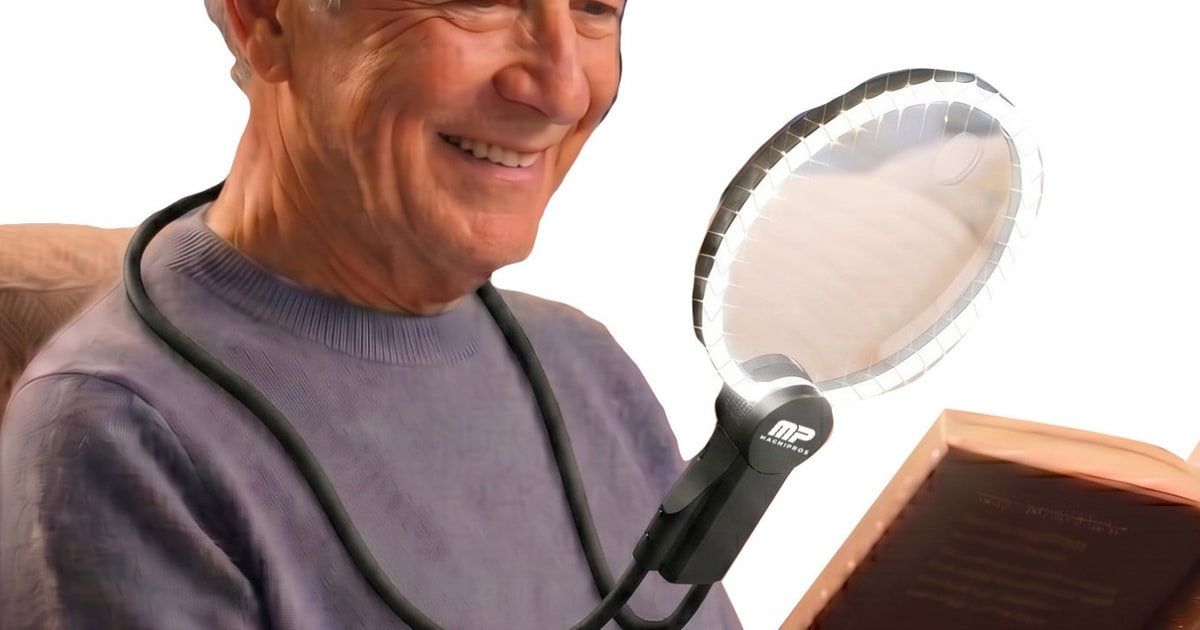
The MagniPros hangs from your neck or stands on a table, holding a 5.12-inch lens at the right distance so your hands stay free. It charges over USB, runs 48 LEDs in three color modes, and dims smoothly for glare-prone paper.
$29.95fromAmazonThe gooseneck solves the problem that sinks most magnifiers. A lens only works inside a narrow focal window, usually four to eight inches off the page. Holding it there for twenty minutes is fine at 45 and rough at 80. The adjustable arm parks the lens exactly where it needs to be and keeps it there. You can wear it around your neck for sewing or crochet, or set it on the table and turn pages underneath.
Forty-eight LEDs with stepless dimming beat a brightness that's fixed. Aging eyes let in less light and see less contrast, so more light on the page helps more than more magnification. But too much light bounces off glossy paper and washes out the words. This one dims smoothly rather than in three fixed steps, and it switches between warm, cool, and mixed. Warm for evening reading, cool for a low-contrast newspaper.
USB charging matters more than it sounds. Swapping three AAA batteries out of a stiff little door is a genuinely difficult job for arthritic fingers, and it's the reason a lot of lit magnifiers end up dark in a drawer. The MagniPros charges from a cable, runs up to about 24 hours per charge depending on brightness, and shows the level on a small LCD. No guessing, no fumbling with a battery compartment.
Two magnification levels cover most of what seniors actually read. The 5x main lens handles books, mail, and newspaper columns. The 10x steps in for medication labels and the fine print on a benefits statement. The 5.12-inch anti-glare lens gives you a wide enough field that you're not nudging it every few words, which is where cheaper high-power lenses get exhausting.
Flaws but not dealbreakers
It isn't enough for diagnosed low vision. If an eye doctor has told you that macular degeneration has moved past the early stage, 5x and 10x optical magnification won't get you back to comfortable reading. You need variable zoom and high-contrast display modes, which means an electronic device. The Optelec below is the right category for that.
The arm is short, so it's a table-and-chair tool. The gooseneck works within roughly a foot of a surface. Reading in a recliner with the lens hovering over a book on your lap is awkward at best. If your reading chair is your reading spot, a floor lamp reaches where this can't.
It's a newer listing without much of an owner track record. There's not a deep pool of long-term feedback on how the gooseneck holds its position after a year of daily bending, and flexible arms are the part that tends to loosen first on this kind of product. Worth knowing before you buy it as a gift.
Runner-up
The brightest handheld here, if you can hold it steady
Large Magnifying Glass with 37 LED Light
The GABORISH packs 37 LEDs around a 5.2-inch shatterproof lens, which is a denser array than most handhelds offer. It recharges over USB and adds 20x and 45x inset lenses for label-squinting, though the top power is a novelty.
$24.99fromAmazonLight is usually the real bottleneck, and this one floods the page. Pupils shrink with age and contrast sensitivity drops, so a senior can need several times the light a younger reader does for the same clarity. Thirty-seven LEDs is a noticeably denser array than the twelve-to-eighteen strips on most handhelds in this range. Brightness adjusts too, so you can pull it back on glossy magazine stock.
The 5.2-inch lens is big enough for real reading. Small handhelds show a handful of words and force you to crawl across every line. This one covers a decent chunk of a column at 10x, which cuts the repositioning that makes reading tiring. The lens is optical-grade, shatterproof, and scratch-resistant, so dropping it on a kitchen floor isn't the end of it.
It charges instead of eating batteries. The 1000mAh cell takes about two hours to fill and runs roughly five hours at full brightness. That's a full week of evening reading between charges for most people, and no trips to the store for AAAs.
A handheld still has a place. If your hands work fine and you want something you can carry to the pharmacy counter, take to a restaurant to read a menu, or hand across the table to your spouse, a stand or a floor lamp is the wrong shape. This is the one to grab and go.
Flaws but not dealbreakers
The 45x inset is essentially decoration for a reader. It focuses only within about an inch and a quarter of the object and shows a few characters at a time. That's a coin-and-stamp lens, not a reading lens. Don't let it influence your decision.
Every handheld asks for a steady grip. If you have essential tremor, Parkinson's, or arthritis that flares, holding any lens inside its focal window for a sustained reading session is a fight you'll lose. The gooseneck or the floor lamp is the better answer in that case.
Budget pickOn sale
A whole page at once, for very little money
5X Large Full Page Magnifying Glass
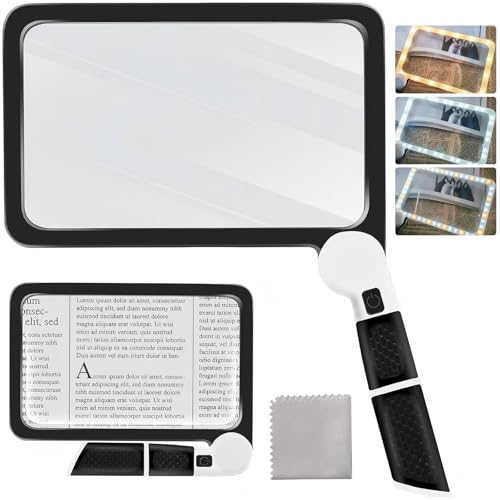
This full-page magnifier puts a 7.3-by-4.4-inch Fresnel lens over most of a book page, so you're not dragging a small lens across every line. Forty-eight LEDs switch between cool, warm, and mixed, and the whole thing weighs under five ounces.
$12.91fromAmazonList priceCovering the page is the whole point. With a small lens you reposition constantly, and that repetitive nudging is what wears out arthritic hands during a long chapter. A 7.3-by-4.4-inch lens takes in most of a paperback page at once. You read a column the way you always did, just larger.
It's light enough to hold for an actual reading session. At about 4.65 ounces, it's roughly the weight of a deck of cards. Heavy magnifiers get set down after ten minutes. The handle folds flat too, so it slides into a tote bag for the doctor's office or a trip to the grocery store.
Three light modes cover the day. Thirty-two cool-white LEDs give you focused brightness for low-contrast newsprint. Sixteen warm-white LEDs are easier on the eyes late at night. Mixed mode runs everything for maximum output. It doubles as an emergency light during a power outage, which is a small thing until it isn't.
Fresnel construction is why it costs so little and weighs so little. A conventional 5x glass lens this size would be thick, heavy, and expensive. The molded ridges of a Fresnel lens deliver the same magnification in something the thickness of a placemat, and it's shatter-resistant rather than fragile.
Flaws but not dealbreakers
Fresnel lenses distort more at the edges. You'll see softness and some ripple toward the outside of the frame compared with a good optical lens. Center clarity is fine; the corners are where you notice the compromise. If you read for an hour at a stretch and care about crispness, the Eschenbach is the sharper glass.
Batteries aren't included, and it takes three AAAs. That's an extra errand on day one, and it's the exact battery-door problem the rechargeable models avoid. Buy a pack when you buy the magnifier.
Five-power may be more than you need. If your reading trouble is ordinary presbyopia, 5x can feel like too much — the words get large but the window gets small. Owners who wanted mild help sometimes find it overshoots.
Also great
The right answer if your reading chair is your reading spot
Brightech LightView Pro 2 in 1 Magnifying
The Brightech puts a 6-by-4.5-inch glass lens and a 900-lumen LED on a 26-inch gooseneck that reaches into a recliner. It converts between floor lamp and table lamp, and it never needs a battery because it plugs into the wall.
$129.81fromAmazonNothing else here reaches a recliner. Desktop stands and neck-worn goosenecks assume you're at a table. If you read in your chair every evening, the 26-inch arm on a 47-inch stand swings the lens and the light over your lap and stays there. You don't hold anything, position anything, or charge anything.
The lens is real diopter glass, not acrylic. Glass doesn't warp with heat or age, and it resists scratches better than plastic. Acrylic lenses cloud and distort over a few years of use; this one should look the same in year five as it did on day one. That matters for something you'll leave standing next to a sunny window.
The light alone is worth the space it takes. Nine watts at 900 lumens is genuine task lighting, brighter than most dedicated reading lamps. A lot of what people call a vision problem is actually a lighting problem, and swinging this over a book fixes a surprising amount of it before you ever look through the lens.
It converts, so it's not stuck being a floor lamp. The stand shortens into a table configuration if you'd rather have it beside a desk or a sewing machine. And the LEDs are rated for 100,000 hours, which at a few hours a night is longer than you'll own the lamp.
Flaws but not dealbreakers
At 2.25x, the magnification is mild. It's a comfortable boost for ordinary age-related focusing trouble. It's not enough for diagnosed macular degeneration or any condition where you've been told you need serious magnification. Judge it as a great reading lamp that also magnifies.
If you wear progressives or bifocals, expect a learning curve. Looking through a lens on top of a lens can feel swimmy, and some people never fully adjust. Try it in your usual reading glasses before you commit to the floor space.
It's furniture, not a tool. Nearly five feet tall and awkward to move, it lives in one room and doesn't travel. If you read in three different chairs, this solves one of them.
The LightView Pro comes with a three-year limited warranty covering defects and malfunctions.
Upgrade pick
For diagnosed low vision, when lenses stop being enough
Optelec Compact 10 Video Magnifier with Speech
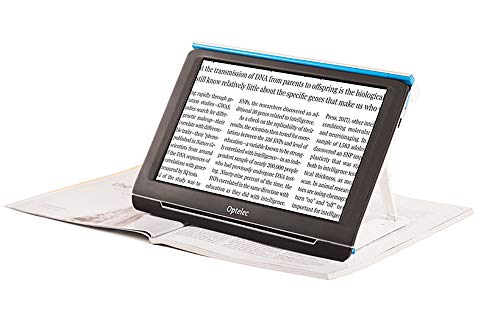
The Optelec Compact 10 is an electronic magnifier: a camera, a 10-inch touch screen, variable zoom, high-contrast modes, and text-to-speech that reads full pages aloud. It's built for people whose vision loss has outrun what any glass lens can do.
$1,895fromAmazonOptical magnifiers hit a wall, and this is what's on the other side. When central vision loss gets past the early stage, enlarging text with a lens stops helping — the damaged area of the retina just enlarges along with it. A camera-and-screen system zooms continuously and remaps color and contrast, which is the approach low-vision specialists turn to when lenses stop working.
Text-to-speech changes what you can do alone. The Compact 10 reads full pages out loud. That means a medication insert, a letter from Social Security, or a chapter of a novel without waiting for someone to come read it to you. For a lot of people that's the difference between managing their own paperwork and asking for help every time.
The 10-inch screen keeps you oriented. Most portable electronic magnifiers use a five- or six-inch display, and at high zoom that shows so little that you lose your place on the page. The larger screen holds more words at once, so navigating a long document doesn't turn into a scavenger hunt.
It's designed to be usable, not just capable. Easy Mode strips the controls down to contrast and magnification — two things, nothing else. Advanced Mode adds the menu and extras when you want them. There's an alignment indicator for lining up a full page underneath, and it turns on instantly rather than booting up.
Flaws but not dealbreakers
It costs many times what any lens here does. This is a medical device, not a gadget, and the price reflects it. If you're managing ordinary age-related reading trouble, you're buying capability you'll never use — start with an optical magnifier and see a low-vision specialist if it isn't enough.
There's a learning curve. A lens does nothing but sit there. This has modes, buttons, a battery, and a document-alignment routine. Someone will probably need to sit with the new owner for an afternoon, and if the user isn't comfortable with a tablet or a smartphone, that afternoon may need to be repeated.
Availability is thin. This isn't a stocked-in-quantity consumer item, so it may take time to arrive or go unavailable. Confirm you can actually get one before you build a plan around it.
Who this is for
This guide is for anyone whose eyes have gotten worse at close range with age — you can see across the room fine, but the pharmacy label and the crossword have gotten hard. That's presbyopia, and it reaches nearly everyone by 65. It's also for the adult children buying a magnifier for a parent, which is why we've flagged which picks work without knowing someone's exact prescription. Most people here should start modest: the lowest magnification that makes reading comfortable, with the best light you can get.
If an eye doctor has diagnosed you with moderate or severe macular degeneration, diabetic retinopathy, or another condition with real acuity loss, skip most of this guide and look at the electronic option — and talk to a low-vision rehabilitation specialist first, because the right device depends on the specific pattern of loss. We're also not covering wearable magnifying spectacles, prescription low-vision aids, or the desktop CCTV systems that live permanently on a table. And if you read mostly on a tablet or phone, the zoom controls already built in will serve you better than any lens.
How we picked
We built the shortlist from manufacturer specifications, published low-vision guidance, and what owners report after living with these things. Magnification match: we checked stated power against what low-vision programs actually recommend, since over-magnifying narrows your window and slows you down. Light output: LED count, adjustable brightness, and color modes mattered a lot, because aging eyes need far more light on the page than younger ones. Grip and form factor: we favored designs that hold the lens for you if tremor or arthritis is in the picture. Lens quality: glass and premium optical resin keep their clarity to the edges and over years, where acrylic and Fresnel trade sharpness for weight and cost. Power and upkeep: USB charging beats a stiff AAA door for arthritic hands, and we noted which products don't include batteries at all.
Other magnifying glasses for seniors worth considering
If you want hands-free at a desk without spending much: The JARLINK Magnifying Glass with Light and Stand ($9.49) — The JARLINK sits on a base with a 5.5-inch lens — the widest primary lens among the handhelds here — and 34 LEDs across three brightness settings. Pop it off the base and it's a handheld; leave it on and you've got a stable stand for reading mail at the kitchen table or working on a puzzle. What you give up is flexibility and convenience. The stand height doesn't adjust, so it only works at one distance, and it runs on three AAA batteries that aren't included rather than charging over USB. For a fixed spot at a desk it's mechanically steadier than a gooseneck. For anywhere else, it's stuck.
If you want to check expiry dates and fine print, not read books: The Carson LumiLoupe Plus 17.5x Power Stand Loupe ($12.66) — The Carson LumiLoupe Plus is the most powerful optical magnifier here at 17.5x, with a dual-lens focusing system that keeps distortion low at that power. It's tiny — two inches square, less than an ounce and a half — so it lives in a pocket or a purse. But the lens is only three-quarters of an inch across, which shows you three or four characters at a time. That makes it useless for reading a page and excellent for confirming a date stamped on a pill bottle, checking a serial number, or inspecting a coin. There's no light, so you need decent ambient lighting. Buy it as a second magnifier, not your only one.
The competition
These are the products our research surfaced in this category, not a survey of everything sold. Each one below is a real product with a real use case — it just lost out to a pick for most readers, for the reasons we give.
The Eschenbach 1436 ESCHENBACH Magnifying Glass Desktop Magnifier ($288.53) — The Eschenbach 1436 is the sharpest piece of glass in this guide, and it's the one an optometrist is most likely to hand you. The German-made PXM optical resin transmits more light and shows less color fringing than the acrylic everything else here uses, and the aspheric design kills the fishbowl warp you see at the edges of cheap lenses. That matters over a long session — less optical fatigue when you're forty minutes into a book. Two things kept it out of the picks. There's no light at all, so it needs a genuinely well-lit desk to work, and at 2.2x with a lens only about an inch and a third tall, it's a narrow window for the money. If you already have a good task lamp and you read daily for years, it's a defensible splurge. Most people are better served by something that brings its own light.
Care and everyday use
Keep the lens clean with the cloth that came in the box or any microfiber — paper towels scratch acrylic, and a scratched lens scatters light exactly where you're trying to read. Skip glass cleaner on plastic lenses; ammonia clouds them permanently. Find the focal distance once and remember it: hold the magnifier close to the page, then lift slowly until the text snaps sharp, and that's your spot. Don't leave any magnifier lens-up in a sunny window, since a convex lens concentrates sunlight and can scorch a tablecloth. For battery models, keep a spare set of AAAs in the same drawer. For rechargeable ones, charge on a schedule rather than waiting for the light to fade, because a dimming LED is easy to mistake for your eyes getting worse.
Questions we get
What magnification strength do seniors need for reading?
For standard book and newspaper print, 2x to 3x is usually plenty. Step up to 5x for genuinely small text — medication labels, ingredient lists, the fine print on a contract. Diagnosed low vision often needs 8x or more, or an electronic magnifier. Start with the lowest power that makes reading comfortable, because more power means a narrower window and slower reading.
Are lighted magnifiers better than plain ones?
For most seniors, yes, and it isn't close. Pupils get smaller with age and contrast sensitivity drops, so you need substantially more light than you used to for the same clarity. An LED magnifier puts that light directly on the page, which does more than turning on another lamp across the room. If you're choosing between a slightly better lens and a lit one, take the light.
What's the difference between an optical and an electronic magnifier?
An optical magnifier is a lens that bends light — fixed power, no batteries needed for the glass itself, and it works the moment you pick it up. An electronic magnifier uses a camera and a screen, so it zooms continuously, remaps colors for contrast, and in the Optelec's case reads text aloud. Electronic devices cost far more but serve people whose vision loss no lens can compensate for.
Can a magnifying glass help with macular degeneration?
In early stages, yes — enlarging text can let the healthier parts of your vision do more of the work. Once the condition is moderate or severe, optical magnifiers usually stop being enough, because the damaged central field enlarges right along with the text. Those cases call for an electronic magnifier with high-contrast modes. Talk to a low-vision rehabilitation specialist before buying anything expensive.
Are hands-free magnifiers worth it for someone with tremors?
For essential tremor or Parkinson's, a hands-free design isn't a luxury — it's often the only kind that works. A handheld lens has to stay inside a narrow focal range, roughly four to eight inches off the page, and tremor makes that nearly impossible to sustain. The MagniPros gooseneck holds that distance indefinitely. If the reading happens in a chair, the Brightech floor lamp does the same with far more reach.
Can I use an FSA or HSA to pay for one?
Electronic video magnifiers like the Optelec generally qualify as eligible medical devices when they're for a diagnosed low-vision condition, usually with a Letter of Medical Necessity from an ophthalmologist or low-vision therapist. Ordinary optical magnifiers typically don't qualify without a prescription. Check with your plan administrator first and ask your eye doctor for the documentation before you buy.
Why you should trust us
For this guide:
- We read manufacturer specifications for every product here, comparing lens material, lens size, LED count, magnification and power source side by side.
- We reviewed published low-vision guidance on matching magnification to condition, and used it to check that each award goes to the group of readers it actually suits.
- We looked through owner feedback themes for recurring complaints — edge distortion, battery doors, grip fatigue, availability — and folded those into the flaws sections rather than the marketing language.
- We read owner reviews on every listing, weighted toward the critical ones, because that is where the recurring failures show up.
- We have a systematic way of automatically fetching the latest prices, so the numbers on this page stay current.
- This is a research-focused guide, so the team may not own every product listed — though we often do own the top winners, which gives us extra context for the recommendations.
- We don't accept free products, and the retailer commission never changes which product we recommend.
Sources
Best Magnifying Glasses — Wirecutter / The New York Times, Wirecutter
Low Vision Magnification Devices — VisionAware (American Printing House for the Blind), VisionAware
Age-Related Macular Degeneration: Assistive Devices — American Academy of Ophthalmology, American Academy of Ophthalmology
Low Vision Rehabilitation — National Eye Institute, National Eye Institute (NIH)
Magnifying Devices for Low Vision — American Foundation for the Blind, American Foundation for the Blind
Amazon product listings and owner reviews for all 8 products
Manufacturer specification pages for each product
Some passages in this guide may be paraphrased with AI help. Prices are refreshed automatically.
More like this.
Continue exploring health reviews and recommendations.

The Best Blue Light Blocking Glasses
If you spend your workday staring at a screen, you've probably had that late-afternoon feeling: gritty eyes, a dull ache behind your forehead, and the…

The Best Mobility Scooters for Seniors
A mobility scooter earns its keep in small moments. You get to the far end of the grocery store without hunting for a bench. You join the family walk…

The Best Reacher Grabbers for Seniors
A reacher grabber earns its keep by the number of times you don't have to bend down. The dropped sock, the can on the top shelf, the remote that slid…

The Best Gifts for Elderly Parents and Seniors
Shopping for a parent in their late seventies is a strange kind of hard. They tell you not to spend money on them. They already own three sweaters they…

The Best Shower Chairs for Seniors
A shower chair is one of the simplest safety upgrades you can make to a home, and one of the few that changes a daily routine immediately. Standing on wet…

The Best AI Smart Glasses
Smart glasses only work if you'd wear them anyway. That's the whole trick. The camera sits where your eyes already point, so you catch the toddler's first…