The Best Car Polishers And Orbital Buffers
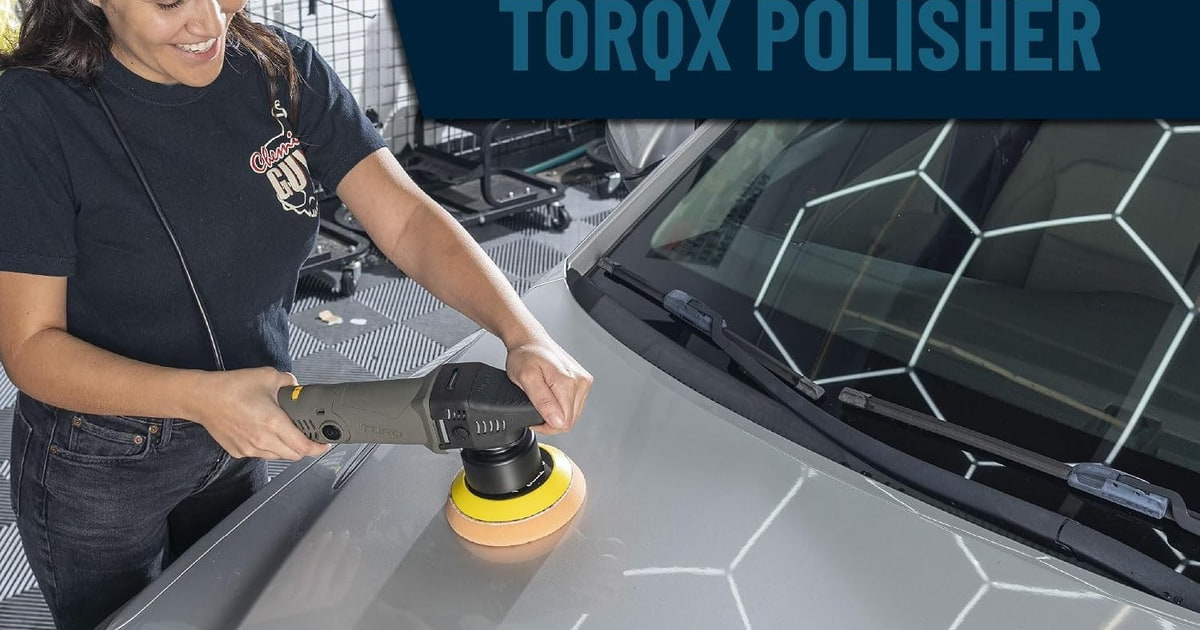
Swirl marks show up in direct sun as a spiderweb of fine scratches across your hood and doors. They come from washing, drying, and automatic car washes, and no amount of wax hides them for long. A machine polisher is the only practical way to level that damage back out. Do it once carefully and your paint looks deeper and darker for years. You'll need a few hours, a set of pads, and a compound. You won't need a professional shop.
Here's the honest part. No dual-action polisher removes a scratch you can catch with a fingernail, and the machines that cut hardest also fling the most compound around your garage. Polishing is slow, sweaty work, and a full-size SUV can eat a whole Saturday. Heat, not orbit size, is what actually hurts clear coat, so every machine here asks you to keep the pad moving. And none of them can fix paint that's already been polished too thin.
The good news is that the odds of ruining your paint with a random orbital are very low. These machines stall under load instead of digging in, which is part of why dual-action polishers now account for more than 70% of enthusiast polisher sales in North America, according to Car and Driver's market analysis. So pick based on how often you'll polish and how much correction you actually need. We think that the Griot's Garage G9 is the best car polisher for most people, and that the Meguiar's MT300 is the one to buy if you want a pro-grade machine with a D-handle and steadier speed under pressure.
Everything we recommend

Enough correction power for real swirls, without the mess
Pro-grade control and a handle that suits any grip

The safest way to learn, with a ceiling you'll hit

Much faster on big panels, if you polish cars often
A whole starter setup in one box, pads and polish included
At a glance
| Product | Orbit | Power | Price | |
|---|---|---|---|---|
| RUPES LHR21 Mark III BigFoot Random OrbitalUpgrade pick | 21mm | — | $594 |
| Meguiar's MT300 Variable Speed Dual Action PolisherRunner-up | — | — | $178.95 |
| Griot's Garage G9 Random Orbital PolisherTop pick | 9mm | 1000W | $176.99 |
 | Milwaukee 2738-20 M18 18-Volt Fuel Lithium-Ion BrushlessAlso in lineup | 18mm | 18V | $209.45On sale |
| Chemical GuysAlso great | 8mm | 800W | $219.99 |
 | RUPES Bigfoot Nano with iBrid Technology LongAlso consider | 12mm | Battery | $515 |
| PORTER-CABLE Buffer PolisherBudget pick | — | 4.5A | $159 |
How we picked
Orbit throw size. We treated throw as the defining spec, since it sets both correction speed and how forgiving a machine is. We looked for 8mm to 12mm for general-purpose picks and only recommended a 21mm machine where the extra speed justified the bulk.
Paint safety. We favored random orbitals that stall under load rather than spinning through clear coat, following Meguiar's professional training guidance on heat damage. Any machine we recommend to a first-timer had to fail safe.
Power under load. Motor wattage matters less than whether speed holds when you press. We prioritized machines whose specs list constant speed control or electronic torque management over ones that only quote a big watt figure.
Comfort over hours. Polishing a car takes an afternoon, so weight, grip design and vibration decide whether you finish. We weighed published vibration findings and consistent owner comments about hand fatigue on long sessions.
Pads and support. A polisher is only as good as the pads and compounds you can get for it. We checked backing plate sizing, whether a 5-inch conversion exists, and how widely available accessories are for each platform.
Top pick
Enough correction power for real swirls, without the mess
Griot's Garage G9 Random Orbital Polisher
The G9 is a corded random orbital with a 9mm throw and a 1,000-watt motor, which is the right balance for a car or two in your own driveway. It cuts swirls and light oxidation, finishes cleanly, and doesn't spray compound across your garage floor.
$176.99fromAmazonA 9mm throw is the sweet spot for home detailing. It's big enough to cut through swirls, water spots and light oxidation in a pass or two, but small enough to finish down without hazing. It also stays tidy. Detailed Image's product notes put the G9's splatter well below what 15mm and 21mm machines throw at the same speed, which means less wiping between stages and less compound in your hair.
The motor holds its speed when you lean on the pad. Griot's rates the G9 at 1,000 watts with constant speed control, so it doesn't bog down the moment you add pressure over a stubborn scratch. Six speed settings run from 2,000 to 6,400 OPM. That low end is genuinely useful for spreading a sealant, and the top end is where you'll do your compounding work.
It's comfortable for the three or four hours this actually takes. At 5.25 pounds it's one of the lighter full-size machines here, and the double-shot rubber grip and contoured shroud give you somewhere natural to put both hands. The speed dial sits where either a right- or left-handed user can reach it. A fan-cooled counterbalance and decent bearings keep the buzz in your forearms down.
The 6-inch plate covers ground, and you can shrink it when you need to. A 6-inch pad makes short work of a hood or a roof. Swap in the optional 5-inch backing plate and you get better contact on curved fenders, bumpers and door skins, where a big flat pad rides on its edge. The 10-foot quick-connect cord reaches further than you'd expect before you need an extension.
Flaws but not dealbreakers
A 9mm throw won't rescue badly neglected paint in a hurry. DetailingWiki's technical guide puts a 21mm machine at roughly three times the surface displacement per orbit compared with an 8mm throw at the same OPM. On a sun-baked single-stage repaint, that difference shows up as extra hours. You'll get there with the G9, but you'll make more passes.
It's corded, and the cord will find your paint. You'll be draping it over a shoulder or clipping it out of the way all afternoon. If you work in driveways without a nearby outlet, that's a real annoyance rather than a minor one.
Runner-up
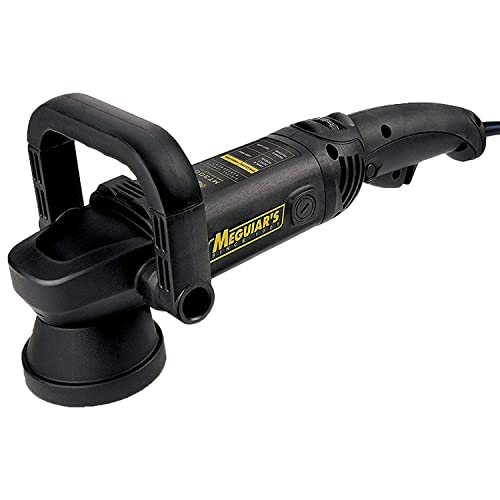
Pro-grade control and a handle that suits any grip
Meguiar's MT300 Variable Speed Dual Action Polisher
Meguiar's built the MT300 for detail shops, and it shows in how steady it stays under pressure. The multi-position D-handle and digital torque management make it forgiving to learn on, though its modest throw means slower going on heavy defects.
$178.95fromAmazonDigital torque management keeps the pad turning at the speed you set. Most polishers slow down when you press harder or hit a curve. The MT300 adjusts torque electronically to hold the loaded speed instead. In practice that means your results stay consistent from the flat of the hood to the shoulder of a fender, which is exactly what trips up new users on cheaper machines.
The multi-position D-handle changes how the whole job feels. You can grab it overhand for downward pressure on a hood, or reposition it for vertical panels and rocker areas. Meguiar's aims this at every skill level, and it's the single feature most likely to keep your wrists happy on a long session. At 5.4 pounds it's light enough to hold out at arm's length for a roof.
Soft start and a billet counterweight take the drama out of it. The machine ramps up instead of jumping when you pull the trigger, so you're less likely to launch compound across the driveway. The machined counterweight keeps the head from wobbling as it spins up. Owners of Meguiar's DA machines consistently point to that smoothness as the reason they stop reaching for other tools.
Its throw is tuned for finishing, not brute force. Meguiar's calls it a universal throw, and at roughly 8mm it's aimed at compounding, polishing and waxing on the same machine without swapping tools. That makes it a strong second-stage machine if you already own something more aggressive, and a safe single machine if your paint is in decent shape.
Flaws but not dealbreakers
You'll be slower on heavy correction than you'd like. A short throw means more passes on deep swirls and oxidation. If your car has been through years of tunnel washes, budget extra time or plan on a more aggressive pad and compound to make up the difference.
It's a bare tool, and it's long. Nothing comes in the box but the machine, so you're buying pads, compound and polish separately. At more than 18 inches nose to tail, it's also awkward around mirrors, spoilers and tight bumper corners.
Budget pick
The safest way to learn, with a ceiling you'll hit
PORTER-CABLE Buffer Polisher
The 7424XP is the machine that taught a generation of enthusiasts to polish. Its very short throw makes it hard to hurt your paint with, and its six-speed dial covers everything from waxing to moderate swirl removal, but deep defects will outlast it.
$159fromAmazonIts speed range covers more jobs than the price suggests. Porter-Cable's spec sheet lists 2,500 to 6,800 OPM across a six-position dial. That low end is right for spreading wax or sealant without slinging it, and the upper settings handle swirl-mark correction with the right pad and compound. One machine, both ends of the job.
The short throw is the whole point for a first machine. At 3mm to 4mm, the pad simply can't build the heat that damages clear coat before you notice something's wrong. Meguiar's professional training materials warn that a rotary held stationary above 1,800 RPM can cause irreversible heat damage in under 30 seconds. A random orbital like this one stalls under load instead, which is why it's the standard recommendation for people who've never done this before.
Parts and support are everywhere. This machine has been in enthusiast garages long enough that backing plates, counterweights and pad kits from a dozen brands are built to fit it. If you have a question at 10pm, someone has already answered it in a forum thread. That ecosystem matters more than you'd think when you're learning.
It's light and simple to handle. At 5.75 pounds, with a 5-inch counterbalance sized for 6-inch pads, it's easy to keep flat on a panel. There's no torque management or soft start to learn — you set a speed, keep the pad moving, and let the machine work.
Flaws but not dealbreakers
The correction ceiling is real, and it's low. Deep scratches and heavy oxidation will beat this machine no matter how many passes you make. If your paint is genuinely rough, you'll either step up to a longer throw or accept an improvement rather than a fix.
The 4.5-amp motor bogs under pressure. Lean into it with a big cutting pad and you'll feel the pad slow and hear the motor strain. Lighter pressure and more passes is the way to work with it, which again costs you time.
According to Popular Mechanics' category review, the 7424XP has carried an unchanged five-year warranty since its introduction — the longest standard warranty in the budget DA polisher segment.
Upgrade pick
Much faster on big panels, if you polish cars often
RUPES LHR21 Mark III BigFoot Random Orbital
The LHR21 Mark III is the machine most professional shops reach for first. Its 21mm throw covers enormous ground per pass and it's still forgiving to use, but it's heavy, it's the most expensive tool here, and it's clumsy on small panels.
$594fromAmazonThe 21mm throw is a different class of coverage. DetailingWiki's technical guide calculates roughly three times the surface displacement per orbit compared with an 8mm machine at identical OPM. On a hood or a roof that's the difference between one section pass and three. If you polish more than a couple of cars a year, that math is the entire argument for this machine.
Rupes redesigned the counterweight for the Mark III. Obsessed Garage independently verified that the new system reduces hand-arm vibration on sessions running past two hours compared with the Mark II. Vibration is what ends a detailing day early, not motor power. Anyone who has finished a full correction with numb fingers will understand why this revision matters more than the spec sheet suggests.
Big throw doesn't mean dangerous. The anti-spinning design keeps the pad from spinning up to high rotational speed, so it scrubs rather than burns. Professional detailers surveyed by The Drive named the LHR21 the machine they most recommend for new hires to learn on, citing its self-centering orbit and its habit of stalling under load. That's an unusual thing to say about the most aggressive tool in a category.
The controls suit long, careful work. An electronic speed dial sets your ceiling and a progressive trigger lets you feather up to it, which is how you avoid slinging compound at the start of a section. It takes 6- and 7-inch pads, so a hood goes quickly, and Rupes' own pad and compound line is matched to the throw.
Flaws but not dealbreakers
It's heavy and it's big. At 8.7 pounds with a head sized for 7-inch pads, it fights you on bumpers, mirrors, A-pillars and anything with a tight radius. Most people who own one also own something smaller for detail work.
A 21mm throw slings compound. Expect more spatter on adjacent panels, trim and your clothes than you'd get from a 9mm machine, and expect to wipe more between stages.
It's hard to justify for one or two cars a year. This is the most expensive machine here by a wide margin. If your car spends its life in a garage and gets polished occasionally, the speed advantage buys you back hours you weren't spending anyway.
Also great
A whole starter setup in one box, pads and polish included
Chemical Guys
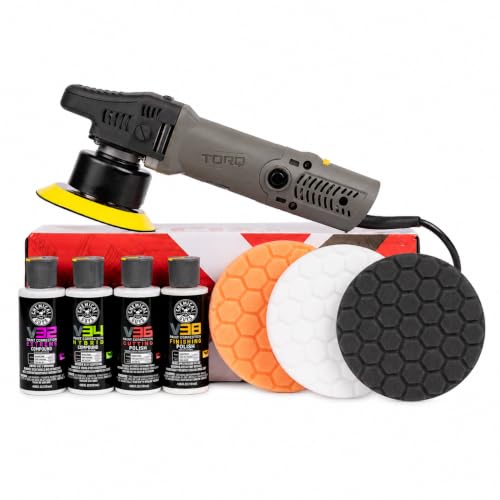
The TORQX kit ships with the polisher, pads, a compound and a polish, so you can finish a car the day it arrives. That matters more than it sounds, because pairing the wrong pad with the wrong compound is how most beginners get bad results.
$219.99fromAmazonThe bundle solves the problem that actually trips people up. Chemical Guys' own product education data attributes roughly 60% of reported beginner machine-polishing problems to incorrect pad-to-compound pairing. A nine-piece kit with matched pads and liquids takes that decision away from you. You follow the pairing in the box, and you get a predictable result on your first panel.
The machine itself is a sensible 8mm random orbital. That throw is safe on clear coat and gentle enough that you can use it on headlights, wheel faces and trim as well as paint. Chemical Guys quotes the motor in the 700-to-800-watt range, which is plenty for removing light scratches, swirls, oxidation and haze on paint that hasn't been neglected for a decade.
Nothing else to buy on day one. If you don't already own pads, backing plates, compound or a place to keep them, buying a bare machine means a second shopping trip and a lot of second-guessing. This gets you from box to finished hood in an afternoon, which is the point of a starter kit.
Flaws but not dealbreakers
You'll outgrow the consumables before you outgrow the machine. The included pads and liquids are there to get you started, not to be your long-term system. Once you know what your paint responds to, you'll be buying pads and compounds separately anyway.
An 8mm throw is modest for heavy work. Same story as the other short-throw machines here: on serious oxidation you're making more passes. And the listing quotes the motor at both 800 and 700 watts in different places, so treat that number loosely.
Who this is for
This guide is for anyone who wants to remove swirl marks, water spots and light oxidation from their own car, and for hobbyists and detailers who want to do it faster or more often. If your paint looks hazy in sunlight, or if a black car has gone gray-ish, a machine polisher is the tool that fixes it. It's also for people who just want an easier way to apply wax or sealant — every machine here does that on its lowest speed settings.
Skip this if your car has deep scratches you can catch with a fingernail, chipped paint, or clear coat that's already peeling. Polishing removes a tiny amount of clear coat, so it can't fix damage that's gone through it, and repeated correction on already-thin paint makes things worse. We're covering dual-action and forced-rotation machines only. True rotary buffers, which cut faster but can burn through clear coat in seconds, aren't in this guide — and if you're asking which polisher to buy, they're not the answer.
How we picked
Throw: we treated orbit size as the defining spec, favoring 8mm to 12mm for all-purpose machines and reserving 21mm for people who polish often enough to need the speed. Safety: every pick is a random orbital or forced-rotation machine that stalls under load rather than burning through clear coat, following Meguiar's professional training guidance on heat. Power: we cared more about whether speed holds when you lean on the pad than about headline wattage, so constant speed control and electronic torque management counted for more. Comfort: weight, grip design and published vibration findings decided a lot, because fatigue is what ends a detailing session early. Support: we checked backing plate sizing, 5-inch conversion options, and how easy it is to find matching pads and compounds for each platform.
Other car polishers and orbital buffers worth considering
If you want to polish door jambs, pillars and motorcycle tanks: The RUPES Bigfoot Nano with iBrid Technology Long ($515) — The Rupes iBrid Nano is a tiny long-neck machine built for the places a 6-inch pad can't reach. The starter kit includes a rechargeable power pack, a charger, a 12mm orbit unit and a 2-inch backing pad, and it runs either on battery or plugged in with identical torque, so you're not choosing between reach and power. You can also swap between random orbital and rotary modes for stubborn small spots. It's not a replacement for a full-size polisher — a hood would take forever — but it's the tool that finishes the 10% of a car that everything else misses.
The competition
This is what our research surfaced, not a survey of everything sold. Plenty of capable polishers exist that we didn't have listing data for, and the category changes as brands refresh their cordless lines.
The Milwaukee 2738-20 M18 18-Volt Fuel Lithium-Ion Brushless ($209.45) — The Milwaukee 2738-20 is an M18 Fuel cordless polisher with a 7-inch head and variable speed, sold as a bare tool. Cordless polishers have finally crossed the power threshold for full-vehicle work, and published runtime figures for M18 polishers on a 5.0Ah pack land in the 35-to-40-minute range under moderate load — enough for a correction pass on a compact car, not enough for a large SUV without swapping packs. It lost to our picks on two counts: at 7.54 pounds with a big 7-inch head it's tiring and clumsy on curved panels, and buying into it means buying batteries and a charger too. If you already own M18 packs and detail in driveways without power, it's the obvious choice anyway.
Pads, prep and technique
Wash and clay the car first. Polishing over grit just grinds it into your paint. Work one small section at a time — roughly two feet square — and keep the pad flat and moving, because heat, not orbit size, is what damages clear coat. Start with the least aggressive pad and compound that'll do the job, and only step up if that fails. Clean your pad after every panel or two with a brush or compressed air; a loaded pad stops cutting and starts hazing. Swap to a fresh pad when it's saturated. Wipe each section with a clean microfiber before judging your results, and check under a bright light rather than in shade. Store pads clean and dry, and let the machine cool between long sessions.
Questions we get
What's the difference between a DA orbital polisher and a rotary buffer?
A rotary spins the pad on a fixed axis, so the same spot gets constant friction and heat. A dual-action polisher spins and oscillates at once, and the pad stalls when you press too hard. That stalling is a safety feature: Meguiar's professional training materials warn that a rotary above 1,800 RPM can cause irreversible heat damage in under 30 seconds if held still, while a DA essentially can't. Cut speed is the tradeoff — rotaries are faster in trained hands.
What orbit throw size should I choose?
For most people, 8mm to 12mm. That range corrects real swirls, finishes cleanly, and doesn't spray compound everywhere. A 21mm machine covers roughly three times the surface per orbit at the same speed, per DetailingWiki, which is worth the bulk if you polish cars regularly. Anything under about 5mm is very safe but slow on serious defects.
Can I remove deep scratches with a dual-action polisher?
If you can catch it with a fingernail, no. That scratch has gone through the clear coat, and polishing only levels the clear that's left. A DA will remove swirls, haze, water-spot etching and light oxidation, and it'll make a deep scratch less visible by softening its edges. Anything more needs wet sanding or paint work.
Is the most expensive machine worth it if I only polish one car a year?
Probably not. The Rupes LHR21's advantage is speed on large panels, which pays off across many cars, not one. For an annual weekend on your own car, a 9mm machine like the Griot's G9 gets you the same finish with a few more passes. Spend the difference on better pads and compounds instead.
Can I use an orbital polisher to apply wax and sealant?
Yes, and it's one of the best reasons to own one. Drop to the lowest speed setting — around 2,000 to 2,500 OPM on most machines here — and use a soft finishing or applicator pad. You'll get a thinner, more even layer than by hand, in less time. Just don't use a cutting pad for it.
Which pads and compounds should a beginner start with?
Start with a medium polishing pad and a one-step polish rather than a heavy cutting combination. Chemical Guys' education data attributes about 60% of beginner problems to mismatched pad-and-compound pairings, so sticking to one brand's matched system removes most of the guesswork. Test on an inconspicuous panel first, wipe it down, and step up in aggressiveness only if the defects survive.
Why you should trust us
For this guide:
- We read manufacturer spec sheets and Amazon listing details for every machine here, and compared throw size, speed range and weight across the lineup.
- We drew on published technical writing and comparative reviews from DetailingWiki, Auto Obsessed, Detailed Image, Obsessed Garage, Popular Mechanics, Tool Box Buzz, Car and Driver and The Drive, plus Meguiar's and Chemical Guys' own training materials.
- We leaned on recurring themes in owner feedback — fatigue, splatter, cord management and motor bogging — to shape the flaws sections rather than to make performance claims.
- We read owner reviews on every listing, weighted toward the critical ones, because that is where the recurring failures show up.
- We have a systematic way of automatically fetching the latest prices, so the numbers on this page stay current.
- This is a research-focused guide, so the team may not own every product listed — though we often do own the top winners, which gives us extra context for the recommendations.
- We don't accept free products, and the retailer commission never changes which product we recommend.
Sources
Best Car Polishers 2026 — The Drive, The Drive
Best Car Polisher Reviews — Car and Driver, Car and Driver
DetailingWiki — Dual Action Polisher Guide, DetailingWiki
Rupes LHR21 Mark III Full Review — Obsessed Garage, Obsessed Garage
Flex XCE 10-8 125 — Auto Obsessed Review, Auto Obsessed
Milwaukee M18 FDAP Cordless Polisher Review — Tool Box Buzz, Tool Box Buzz
Best Car Polishers — Popular Mechanics, Popular Mechanics
Griot's Garage G9 Random Orbital Review — Detailed Image, Detailed Image
How to Choose a DA Polisher — Chemical Guys Learning Center, Chemical Guys
Rotary vs. DA Polisher — Meguiar's Training Center, Meguiar's
Best Orbital Polisher Comparison — Bob Vila, Bob Vila
Car Detailing Statistics & Industry Report 2025 — IBISWorld, IBISWorld
Amazon product listings and owner reviews for all 7 products
Manufacturer specification pages for each product
Some passages in this guide may be paraphrased with AI help. Prices are refreshed automatically.
More like this.
Continue exploring electronics reviews and recommendations.

The Best Gel Nail Polish Kits
A gel manicure is really three things working together: a bond that grips the nail, a color that resists chipping, and a lamp that cures both all the way…

The Best Random Orbital Sanders for Woodworking
Sanding is the part of woodworking nobody brags about. It's also the part that decides whether your finish looks like furniture or looks like a school…

The Best Trailer Wiring Harness Adapters
Trailer wiring is the part of towing nobody thinks about until the lights don't work. You hitch up the boat trailer at 5 a.m., flip on the turn signal,…

The Best Monitor Arms and Desk Mounts
Your monitor's factory stand puts the screen at one height, one angle, and one spot on the desk. That's fine until you actually work there all day. A…

The Best Wireless Earbuds
Wireless earbuds have quietly become the thing you reach for more than any other gadget. You wear them on the bus, on a work call, while loading the…

The Best Portable Car Heaters
A cold car is a visibility problem before it's a comfort problem. You get in, breathe twice, and the windshield fogs over. The factory defroster works,…