The Best Cat Trees And Scratching Posts of 2026
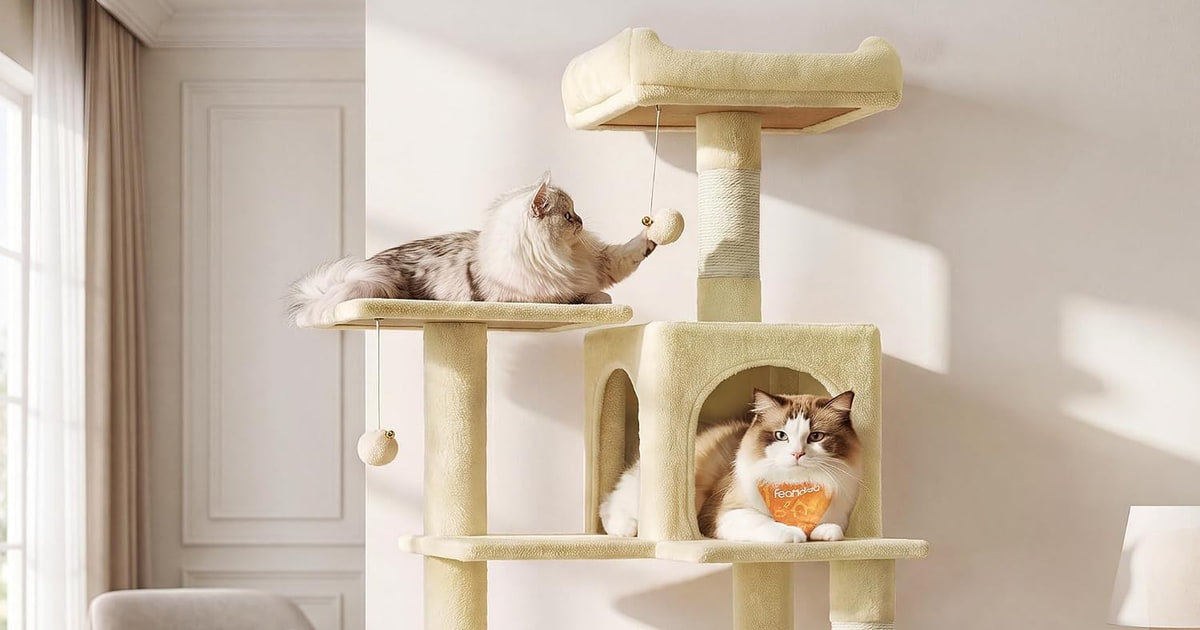
A cat tree isn't decoration. Scratching is how cats shed the outer sheath of their claws, stretch their backs, and leave scent marks that tell them the room is theirs. Give them nothing to climb and nothing to shred, and they'll pick your sofa arm instead. Height matters just as much: cats feel safest looking down on a room, and a tall perch is often the difference between a nervous cat and a settled one. The right tree solves several problems at once.
Here's the honest part. Nothing in this category is built like real furniture. Almost every tree is particleboard wrapped in plush and sisal rope, which means the sisal frays, the fabric collects fur, and the panels don't love being jumped on for a decade. Weight limits are real and often lower than you'd guess. Assembly is a floor-covered-in-bolts afternoon no matter which box you open. And no manufacturer can promise your cat will actually use the cave you paid for.
So we looked for the trees that get the fundamentals right: a base wide enough not to rock, a wall strap in the box, sisal instead of carpet on the posts, and a shape that fits a normal room. We think that the Yaheetech Large Multi-Level Cat Tree is the best cat tree for most people, and that the Feandrea 59.5-Inch Tall Cat Tower is the one to buy if you want the same idea in a slightly smaller, lighter package.
Everything we recommend
Enough tree for most cats, in a size most rooms can take

Nearly the same tree, a bit shorter and easier to place

Multi-level basics for less, if your cats aren't heavy

Far more climbing and scratching, if you've got the ceiling

Just a post — but the one cats actually stretch on
Prices as of Oct 24, 6:27 AM PT · Details
At a glance
| Product | Height | Material | Price | |
|---|---|---|---|---|
| Yaheetech Large Multi-Level Cat TreeTop pick | 63in | Particleboard | $53.98 |
| SmartCat Pioneer Pet Ultimate Scratching PostAlso great | 32in | Wood | $69.99 |
| Feandrea Cat TreeUpgrade pick | 81.1in | Particleboard | $75.99 |
| Feandrea Cat TreeRunner-up | 59.5in | Particleboard | $45.04On sale |
 | Floor-to-Ceiling Cat Tree with Natural Sisal RopeAlso consider | 55-119in | Pine Wood | $144.90 |
| BestPetBudget pick | 54in | Particleboard | $19.99 |
 | Amazon Basics Cat Tree Tower - Multi-LevelAlso in lineup | 45.9in | Engineered Wood | $54.17On sale |
 | PETEPELA 19" Scratching PostAlso consider | 19in | Plush, Sisal | $29.99 |
 | Feandrea Multi-Level Cat Tree with Feeder BowlAlso in lineup | 33.4in | Engineered Wood | Check price |
 | MECOOL Cat Scratching Post Premium Basics KittenAlso consider | 22in | Sisal | $16.99On sale |
Prices as of Oct 24, 6:27 AM PT · Details
How we picked
Stability and anchoring. We gave weight to trees with wide bases and an anti-tip strap in the box, since a tall tree that rocks is one cats quickly stop using. Anything over about four feet had to include wall-anchoring hardware to stay in the running.
Scratching surface. Sisal rope or woven sisal only — we set aside posts covered in carpet, which can snag a claw and hold odor. Published reviews and manufacturer specs both point the same way here.
Height that fits. A post needs at least 30 to 32 inches for an adult cat to stretch fully, and a tree needs to clear a standard ceiling. We checked stated heights against typical room dimensions rather than treating taller as automatically better.
Stated weight capacity. We read the per-cat and total load limits on every listing, because several popular trees are rated for cats far lighter than the average adult. Anything with a low ceiling on capacity had to say so up front.
Assembly and upkeep. We looked at owner feedback themes about instruction quality, loose hardware, and how quickly the sisal frays. A tree you assemble wrong is a tree that wobbles.
Top pick
Enough tree for most cats, in a size most rooms can take
Yaheetech Large Multi-Level Cat Tree
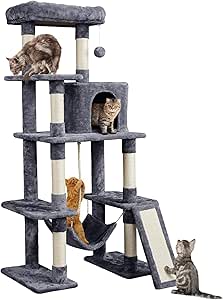
The Yaheetech is a 63-inch tower with a condo, a hammock, a top perch, and sisal posts running up the middle. It covers climbing, hiding, scratching, and napping without dominating a living room, and it ships with an anti-toppling kit.
$53.98fromAmazonPrices as of Oct 24, 6:27 AM PT · Details
Sixty-three inches is the sweet spot for a cat tree. It's tall enough that your cat can look down on the whole room, which is what they're after when they climb the bookshelf. But it still clears a standard eight-foot ceiling with room to spare. Anything taller starts to feel like a piece of architecture. If you've got one cat or two and a normal-sized room, this is the height you want.
The anti-toppling kit is the feature we'd refuse to go without. Yaheetech attaches the strap at the middle board, so you can anchor the tree to a wall stud. That matters more than the spec sheet suggests. A cat launching off a top perch puts sideways force on a tall, narrow object, and a 34-pound tree isn't heavy enough to shrug that off on its own. Use the strap. It takes five minutes.
Sisal on the posts, not carpet. Carpet loops can catch a claw and tear it, and they hold odor. Sisal rope is coarse enough that cats get real resistance when they drag their claws down it, which is the whole point. The posts here are wrapped rather than covered in fabric, so your cat gets a proper vertical scratch instead of a token one.
There's a spot for whatever mood your cat is in. The enclosed condo suits a cat who wants to disappear for a few hours. The hammock hangs low and sags in the middle, which is exactly what a sleeping cat wants. The top perch is for surveillance duty. Add the ladder, the rope, and the dangling ball, and one tree covers most of a cat's day.
Flaws but not dealbreakers
Check your ceiling fan before you buy. At 63 inches, the top perch puts a standing cat's head somewhere around five and a half feet. In a room with a low-hung fan or a sloped ceiling, that's a genuine problem, not a theoretical one. Measure the spot where you plan to put it.
Assembly takes patience, and rushing it costs you stability. There are a lot of panels and a lot of bolts, and the instructions ask you to build from the base up in order. If you leave connections loose, the tree wobbles and your cat stops trusting it. Go back and tighten everything after the last panel goes on.
The plush surfaces are fur magnets. Every platform, the condo, and the hammock all grab hair and hold it. You'll want to run a vacuum or a lint roller over it most weeks, or it starts looking grubby fast in a house with a long-haired cat.
Runner-upOn sale
Nearly the same tree, a bit shorter and easier to place
Feandrea Cat Tree
The Feandrea 59.5-inch tower gives you two top perches, two caves, a hammock, and five sisal posts. It's a few inches shorter and several pounds lighter than our top pick, which makes it simpler to assemble and easier to move.
$45.04fromAmazonList pricePrices as of Oct 24, 6:27 AM PT · Details
Two caves instead of one changes the math in a two-cat house. Cats guard resources, and an enclosed box is the most guarded resource on a tree. With two, the shy cat doesn't have to negotiate. Add the two separate top perches and you've got four distinct spots at four different heights, which is usually enough to keep peace between a pair of cats who mostly tolerate each other.
It's the easiest big tree here to put together. Feandrea uses universal screws and a simple structure, and the box includes the hex key. One person can do it. That sounds minor until you've spent an evening on the floor sorting hardware into piles. If assembly is the thing you dread, this is the one to pick.
The anti-tip kit is included and Feandrea is direct about wanting you to use it. The instructions say plainly to attach the tower to the wall because cats jump. That's the right advice for any tree in this height range, and it's good to see it stated instead of buried.
The two hanging pompoms do more work than they look like they should. Bells and a bit of swing are what get a cat to approach a brand-new object in the first place. Once they're batting at a pompom on the middle platform, they're already on the tree, and the scratching usually follows.
Flaws but not dealbreakers
The weight limit is the real constraint. Feandrea rates this for up to five cats at a maximum of 11 pounds each. Plenty of ordinary house cats weigh more than that. If you've got a big Maine Coon or a solid tabby on the heavier side, you're outside the spec and should size up.
Five scratching posts is fine for one or two cats, not a crowd. In a busy multi-cat house, posts get claimed and defended. You'd want either more scratching surfaces or a second standalone post somewhere else in the house.
Feandrea warns that the pompoms and elastic bands need watching. If your cat chews and swallows things, take them off. Same story with the cat caves — a badly shredded cave can leave sharp edges and should be repaired or replaced.
Budget pick
Multi-level basics for less, if your cats aren't heavy
BestPet
The BestPet 54-inch tower has three observation decks, two condos, sisal posts, a ladder, and hanging toys. It gives you the shape of a full multi-level tree at the low end of the category, with a wall anchor strap in the box.
$19.99fromAmazonPrices as of Oct 24, 6:27 AM PT · Details
You get the layout of a much pricier tree. Three perches at different heights, two enclosed condos, a ladder, sisal-wrapped posts, and toys already attached. For a household adding its first tree, that's the whole feature set. Nothing important is missing from the design; the savings show up in the materials, not the floor plan.
Two condos make it work for two cats. Cats sort themselves by height, and having a low hideout and an upper deck lets a timid cat and a bossy one share the same piece of furniture without much friction. That's a lot to get out of a budget tower.
A wall anchor strap comes with it. At 54 inches and 26 pounds, this tree needs anchoring more than a heavier one does. BestPet includes the strap, so there's no reason to skip it.
It comes in a few colors, which sounds trivial until it's in your living room. Beige, navy blue, and dark gray all read as furniture rather than pet gear. A tree you don't mind looking at is a tree you'll put in the room where your cat actually wants to be.
Flaws but not dealbreakers
The 44-pound total limit rules out heavy cats and crowds. That's the whole structure, not per level. Two average cats are fine. Two large cats plus a third who likes to join in is pushing it.
The sisal is the first thing to go. Budget rope tends to loosen and fray sooner under a determined scratcher, and once it unwinds, cats lose interest. You can rewrap a post with new rope, but plan on it.
Reviewers commonly flag the instructions as the weak point. The parts fit, but the diagrams leave you guessing on panel orientation. Lay everything out and match it against the picture before you drive a single screw.
Upgrade pick
Far more climbing and scratching, if you've got the ceiling
Feandrea Cat Tree
The Feandrea 81.1-inch tower runs five levels with 14 scratching zones, two perches, two caves, a basket, and a hammock. It's built for households where three or more cats have to share territory without fighting over it.
$75.99fromAmazonPrices as of Oct 24, 6:27 AM PT · Details
Scratching zones on every level is the point of this thing. Most trees give a cat two or three posts and hope for the best. Here there's something to claw wherever your cat happens to be standing, so nobody has to wait or push past anyone. In a three- or four-cat house, that alone cuts down on squabbling.
The levels are spaced 12 to 16 inches apart, which is a deliberate choice. Tall trees often ask cats to make big jumps, and older or heavier cats simply won't. Short hops mean a senior cat can still reach the top. The scratch ramp doubles as a ladder for the same reason.
It's rated for up to six cats at 15.4 pounds each — the highest capacity here. Feandrea backs that with a reinforced base and an anti-tip kit. If you've been buying a new tree every couple of years because the old one starts rocking, this is the structural answer.
Two caves, two perches, a basket, and a hammock cover every cat personality. The nervous one takes a cave. The confident one takes the top perch and stares at everybody. The one who just wants to sleep takes the hammock. You stop guessing which style your cat prefers and let them sort it out.
Cleaning is straightforward for something this big. The plush releases fur to a lint roller or a vacuum brush, which matters when there's five levels of it. Sisal you just leave alone until it frays.
Flaws but not dealbreakers
Eighty-one inches is nearly seven feet. Under a standard eight-foot ceiling, that leaves about a foot of clearance — enough, but not much. In a room with a fan, a sloped ceiling, or a light fixture in the wrong spot, it won't work at all. Measure first, and measure the doorway you'll carry the box through too.
Assembly is a project. Feandrea labels the parts and the structure is simple in principle, but five levels means a lot of pieces and a lot of steps. Set aside a real chunk of an afternoon.
The footprint is substantial and permanent. This isn't a tree you nudge across the room when you rearrange. Once it's up and strapped to a wall, it lives there.
Also great
Just a post — but the one cats actually stretch on
SmartCat Pioneer Pet Ultimate Scratching Post
The SmartCat Ultimate Scratching Post is 32 inches of woven sisal on a 16-by-16-inch base. It does one thing: it lets a full-grown cat stretch out completely while scratching, which most posts on the market are too short to allow.
$69.99fromAmazonPrices as of Oct 24, 6:27 AM PT · Details
Most scratching posts are too short, and that's why cats ignore them. A cat wants to reach up and pull down through a full body stretch. At 32 inches, this post lets an adult do exactly that. Cut four inches off and the same cat goes back to the couch, because the couch is tall enough.
The 16-by-16-inch base is what makes it usable. Scratching is a pulling motion, and a narrow post rocks or slides across the floor when a cat leans into it. Cats abandon anything that moves under them. This base is wide and heavy enough that the post stays put no matter how hard they go at it.
Woven sisal fiber isn't the same as sisal rope, and it's better. The fabric gives a consistent surface all the way around with no gaps between wraps and no rope ends to unravel. It grips claws evenly. SmartCat is explicit that this beats carpeted posts, which can snag a nail.
It assembles with two screws. That's the whole job. If you want a scratching solution in your house tonight without an evening of hardware sorting, this is it.
Flaws but not dealbreakers
There's nothing to climb, hide in, or nap on. It's a post. If your cat's problem is boredom or nowhere high to sit, this doesn't address it, and you'd be better off with one of the towers above.
The sisal will eventually wear through in the spot your cat favors. Heavy scratchers work one band of the post to death while the rest looks new. That's normal, but it means replacement rather than rewrapping.
Who this is for
Buy a tree if your cat is scratching furniture, if they're spending their day on top of the fridge, or if you've just brought a second cat home and want to head off the territory fights. Any of those is a sign your cat needs vertical space and a legitimate place to use their claws. If you only have the scratching problem — no climbing, no crowding — a tall standalone post solves it for a fraction of the footprint, and you can put it right next to whatever piece of furniture they've been ruining.
Skip a big tree if you rent a place with low ceilings, if you're moving soon, or if your cat is elderly and no longer jumping. Older cats often do better with a low perch and a horizontal cardboard scratcher than with anything tall. This guide covers freestanding trees and posts you assemble yourself. We're not covering wall-mounted shelving, cardboard scratchers, or custom-built cat furniture, all of which are reasonable options we simply didn't research here.
How we picked
We started from spec sheets, published reviews, and owner feedback themes, and we weighed five things. Stability: a wide base and an included anti-tip strap on anything tall, because a tree that rocks is a tree cats abandon. Scratching surface: sisal rope or woven sisal, never carpet, which can catch a claw. Height: at least 30 to 32 inches on a post so an adult cat gets a full stretch, and a total height that clears a normal ceiling with room to jump. Capacity: stated weight limits that match real cats, since several listings are rated well below what an average adult weighs. Assembly and upkeep: clear instructions, hardware that stays tight, and sisal that doesn't unravel in a season.
Other cat trees and scratching posts of 2026 worth considering
If you want height without giving up floor space: The Floor-to-Ceiling Cat Tree with Natural Sisal Rope — This floor-to-ceiling tree braces between your floor and ceiling and adjusts anywhere from 55 to 119 inches, so it takes almost no floor area while giving your cat more climbing than any tower here. Eight sisal posts in different lengths let you build the height and the route yourself, and the top fixtures are rated to 140 pounds with no drilling required. The trade-off is that you get very little horizontal lounging space, and the tension mount needs a careful ceiling measurement and a solid ceiling to press against. Some cats also take a while to warm to a narrow vertical climb after a wide-based tree.
If you want scratching and a nap spot in one small corner: The PETEPELA 19" Scratching Post — The PETEPELA is 19 inches tall with hand-wound natural sisal posts, a 15.7-inch base, and a plush 16-by-12-inch perch with raised rims on top. It fits beside a window or at the foot of a bed and gives a small cat somewhere to claw and somewhere to sleep without adding a piece of furniture to the room. What you give up is stretch height — 19 inches is well under what a full-grown cat needs for a proper vertical scratch — and there's only one perch, so it's really a one-cat piece. PETEPELA says as much, recommending it for small and medium cats and kittens.
If you just need a starter post for a kitten: The MECOOL Cat Scratching Post Premium Basics Kitten — The MECOOL is a 22-inch sisal post on a weighted MDF base with a hanging ball, and it's the simplest thing in this guide. For a kitten, it's a sensible first purchase: cheap to replace when they outgrow it, small enough to sit anywhere, and the dangling ball is good bait for getting a young cat to approach it in the first place. But 22 inches is short. A grown cat can't stretch out on it, and MECOOL is upfront that it's designed for kittens and smaller cats. If you're buying for an adult, get a taller post instead.
The competition
These are the trees and posts our research turned up alongside the picks, not a survey of everything sold. Both of them are decent designs that lost on a specific point rather than a general one, and either could be right for a particular household.
The Amazon Basics Cat Tree Tower - Multi-Level — The Amazon Basics tower is 45.9 inches with seven jute-wrapped posts and a square base that tucks neatly into a corner, and the round top platform with a curved rim genuinely works as a bed. Jute is a fine scratching surface, coarse without being snaggy. The problem is capacity: Amazon states this suits cats under about 7.7 pounds. That's a kitten or a small adult, not the average house cat. The climbing surfaces are also carpet rather than plush, which holds fur and needs regular vacuuming. If you've got a genuinely petite cat and a corner to fill, it's a reasonable choice. Most people should buy something rated higher.
The Feandrea Multi-Level Cat Tree with Feeder Bowl — The Feandrea tower with the feeder bowl is a clever idea — two condos, sisal posts, a padded top perch, and a removable bowl so your cat can eat up off the floor, which many cats prefer. A safety strap is included. But the food and the scratching surfaces are close neighbors, and spilled kibble on plush is a chore you've signed up for permanently. Some cats never take to an elevated bowl at all, and at 33.4 inches this is a shorter, more compact structure than the towers we picked. Worth considering if you're specifically trying to get a food bowl off the floor and away from a dog.
Care and maintenance
Check the sisal every month or so. When a wrap goes loose or the fibers start shedding in clumps, tighten it or rewrap that section with fresh rope — cats lose interest in a post that's gone soft. Vacuum the plush weekly with a brush attachment, or run a lint roller over the perches; fur builds up faster than you'd expect and it's much harder to remove once it's matted in. Every few months, go around with the hex key and retighten every bolt. Panels loosen from ordinary jumping, and a wobble is the first thing that makes a cat quit using a tree. If you've got the wall strap installed, check that it's still snug. Well-kept trees last years; neglected ones get abandoned long before they break.
Questions we get
How tall does a scratching post need to be?
At least 30 to 32 inches for an adult cat. The whole point of scratching is the stretch — your cat reaches up, sinks their claws in, and pulls down through their shoulders and back. A short post doesn't let them do that, so they go find something that does, usually your couch. The SmartCat post hits 32 inches, which is about the minimum that works.
Can several cats share one tree?
Yes, if it has enough separate spots and the capacity to hold everyone. Look for multiple perches at different heights, more than one enclosed cave, and scratching surfaces spread across levels rather than clustered together. Check the stated weight limit and make sure it covers all your cats at once, not just the heaviest one. If you see one cat blocking another from a level, add a second tree elsewhere in the house.
How do I stop a cat tree from wobbling?
Start with a wide base — 16 by 16 inches is a good floor for a standalone post. Then anchor it. Most trees over about four feet include a strap for exactly this, and you should use it on a wall stud rather than drywall alone. If it still moves, go back through the assembly and retighten every connection; loose bolts are the usual culprit, and they work loose again over time.
Why sisal instead of carpet?
Carpet loops can catch a claw and tear it, which hurts and teaches your cat to avoid the post. Sisal is a straight fiber, so claws drag through it and pull out cleanly. It also holds up longer under heavy scratching and doesn't trap odor the way carpet does. Every post we recommend uses sisal rope or woven sisal on the scratching surfaces.
How much floor space does a large tree need?
Most big towers occupy roughly three to four square feet, but check the actual base dimensions on the listing rather than guessing from the height. Leave clearance around it too — cats need a landing zone when they jump down. If floor space is the binding constraint, a floor-to-ceiling model claims almost none of it and puts all the structure overhead instead.
Will my cat actually use all the features?
Probably not all of them, and that's fine. Cats sort themselves by temperament: a nervous cat lives in the cave, a confident one takes the highest perch, and plenty rotate depending on the time of day. Variety is insurance, not a checklist. If your cat ignores a feature entirely after a few weeks, that's just information about what they like — put a treat or a bit of catnip on the neglected spot and see if it changes.
Why you should trust us
For this guide:
- We read the manufacturer specifications for every tree and post here, paying particular attention to stated height, base dimensions, and weight capacity, since those are the numbers that most often disqualify an otherwise appealing design.
- We compared published reviews and recurring themes in owner feedback across the category, especially around assembly quality, how quickly sisal frays, and which trees develop a wobble.
- We did not use, assemble, or handle any of these products; everything here comes from the research and from the original article's findings.
- We read owner reviews on every listing, weighted toward the critical ones, because that is where the recurring failures show up.
- We have a systematic way of automatically fetching the latest prices, so the numbers on this page stay current.
- This is a research-focused guide, so the team may not own every product listed — though we often do own the top winners, which gives us extra context for the recommendations.
- We don't accept free products, and the retailer commission never changes which product we recommend.
Sources
Amazon product listings and owner reviews for all 10 products
Manufacturer specification pages for each product
Some passages in this guide may be paraphrased with AI help.
Product prices and availability are accurate as of the date/time indicated and are subject to change. Any price and availability information displayed on Amazon.com at the time of purchase will apply to the purchase of this product.
More like this.
Continue exploring pet reviews and recommendations.

The Best Cat Trees for Large Breeds
A 20-pound Maine Coon uses a cat tree differently than a 9-pound tabby does. He doesn't hop onto a perch - he launches, lands hard, and then wants to…

The Best Cat Trees and Condos for Indoor Cats
A cat tree isn't decoration. For an indoor cat, it's the closest thing to territory - a high spot to nap, a post to shred instead of your sofa arm, and a…

The Best Cat Trees For Large Cats
A big cat changes what a cat tree has to do. A 20-pound Maine Coon doesn't step onto a perch - he lands on it, and the whole frame feels it. Platforms…

The Best Fence Post Setting Concrete
Setting a fence post is one of those jobs where the hard part isn't the post - it's the hole and what goes in it. You dig, you plumb, you brace, and then…

The Best Artificial Christmas Trees
An artificial tree is something you own for a decade and use for six weeks a year. So the things that matter aren't the ones printed on the box. You care…

The Best Heated Cat Beds for Outdoor Winter Use
When the temperature drops below freezing, an outdoor cat's night gets genuinely dangerous. Veterinary guidance puts hypothermia risk on the table once…