The Best Ceramic Heaters for Home Offices
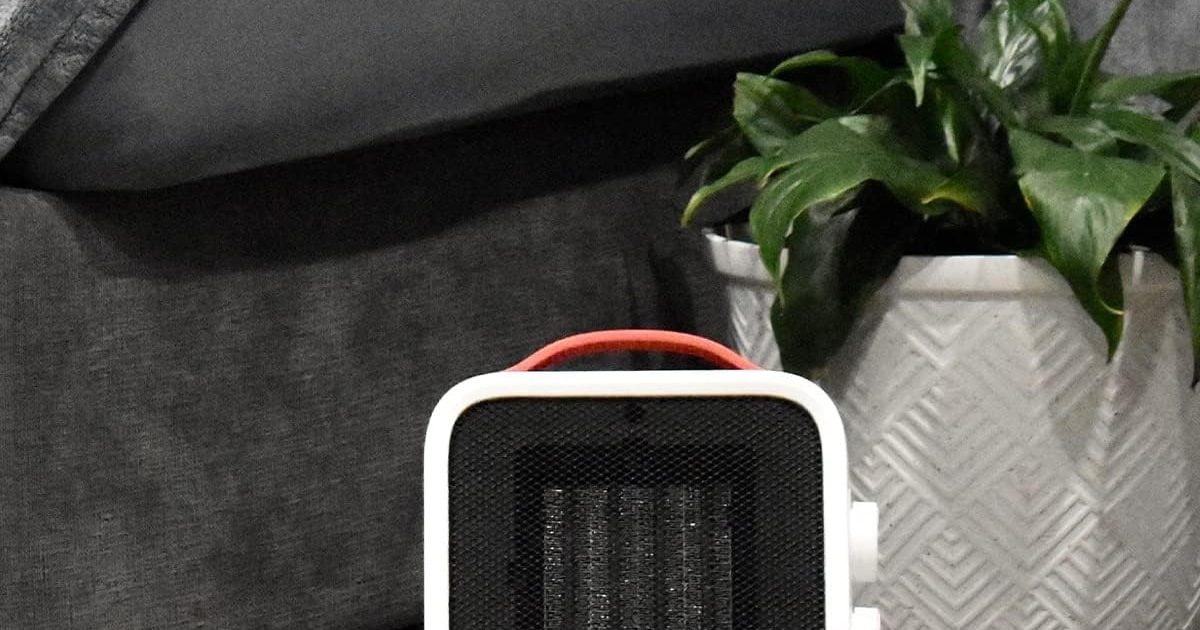
A home office gets cold in ways the rest of the house doesn't. You're sitting still for hours, often in a converted bedroom or a garage corner the furnace barely reaches. A ceramic heater fixes that in about a minute. The element warms up almost instantly, so you feel it while you're still opening your laptop. And because it heats one room, you can turn the central thermostat down and stop paying to warm empty bedrooms. That's the whole case for zone heating.
Here's the part nobody puts on the box. Nearly every plug-in ceramic heater sold in the U.S. tops out at 1500 watts, because that's about all a standard 15-amp circuit will take. So they all put out roughly the same heat, around 5,120 BTU per hour by the Department of Energy's math. None of them will fix a drafty, uninsulated room. And space heaters are involved in about two out of five home heating fires, which is why the CPSC wants three feet of clear space around yours. Wattage isn't the differentiator. Airflow, noise and the thermostat are.
So we read spec sheets, published reviews from outlets that test heaters, and the themes that come up over and over in owner feedback. We cared most about how quietly a heater runs during a call, how evenly it spreads warmth across a desk-sized space, and whether its safety shutoffs are certified by an independent lab. We think that the Dreo 25 Inch Electric Space Heater is the best ceramic heater for most home offices, and that the PELONIS Oscillating Ceramic Tower Heater is the one to buy if you want a remote and a 12-hour timer.
Everything we recommend

Quiet, even warmth for the whole room, if you have floor space

A remote and a 12-hour timer, at the cost of some quiet

No timer, no remote, just fast heat in a small footprint

Heat for a drafty room, in a heavy box you won't move often

Oscillation in a small cube, with strong support behind it
Prices as of Oct 25, 6:48 AM PT · Details
At a glance
| Product | Height | Oscillation | Price | |
|---|---|---|---|---|
| Lasko Portable Indoor Ceramic Space Heater -Budget pick | 9.2 in | — | $49.99 |
 | Honeywell UberHeat 5 Ceramic Space Heater forAlso consider | 6.3 in | — | $54.97 |
| PELONIS Oscillating Ceramic Tower Indoor Space HeaterRunner-up | 23 in | 75 degrees | $66.99 |
| Vornado Velocity CUBE 5 OSC Whole RoomAlso great | 9.87 in | 70 degrees | $119.99 |
| DREO 25 Inch Electric Space Heater forTop pick | 25 in | 70 degrees | $89.99 |
| Dr. Infrared Heater DR-968H Indoor Portable SpaceUpgrade pick | 15 in | — | $135.02 |
 | Space HeaterAlso in lineup | 10 in | 75 degrees | Check price |
Prices as of Oct 25, 6:48 AM PT · Details
How we picked
Quiet enough for calls. We compared published noise ratings and looked for complaint patterns in owner feedback, since a heater you can hear through a meeting gets unplugged. Anything rated well under 50 decibels made the short list.
Certified safety cutoffs. We required ETL or UL listing, an automatic tip-over switch and overheat protection on every pick. Those certifications mean the shutoffs were verified by an independent lab rather than just claimed on the box.
Even heat, not hot spots. Because almost every unit stops at 1500 watts, we weighted oscillation range, vent design and stated coverage area instead. Spec sheets and published reviews both point to sweep angle as the practical difference between models.
Thermostat and timer. We favored heaters whose thermostat holds a set temperature within a degree or two, plus an ECO mode that cycles the element. A timer running at least several hours matters for a full workday.
Fits a desk setup. We checked dimensions and weight against the reality of a small office, where a tower has to sit clear of the walkway. Compact units still had to push air far enough to reach your feet.
Top pick
Quiet, even warmth for the whole room, if you have floor space
DREO 25 Inch Electric Space Heater for
This 25-inch tower oscillates across 70 degrees and rates as low as 25 decibels, which matters the moment your camera turns on. A dedicated thermal sensor holds your set temperature to within a degree, so you won't be reaching down to fiddle with it every hour.
$89.99fromAmazonPrices as of Oct 25, 6:48 AM PT · Details
Noise is the whole reason this one wins. Dreo rates its airflow design as low as 25 decibels, quieter than most refrigerators. Published reviews of Dreo's tower line consistently place it among the quieter options, and owner feedback echoes that. A heater you can't hear is a heater you'll actually leave running through a meeting. Louder units make you choose between being warm and being audible, and you'll pick audible every time.
The 70-degree oscillation covers a claimed 100 to 270 square feet, which is more room than most home offices have. Point it toward the middle of the room rather than at your chair. Warm air then circulates instead of blasting one shin while your other foot stays cold. If your office is one of those long converted bedrooms, that sweep is what keeps the far end from feeling like a different climate.
The thermostat is the part you'll appreciate in month two. You can set a target anywhere from 41 to 95 degrees in one-degree steps, and ECO mode uses the onboard sensor to cycle the heat instead of running flat out. That's how a space heater actually saves you money. It runs less. Cheaper heaters with a vague dial tend to overshoot, then cook you out of the room.
Safety here is more than a checkbox. Dreo builds the housing from V0 flame-retardant material, uses a reinforced plug, and has the 45-degree tip-over and overheat cutoffs certified by ETL. There's also a child lock, which is the feature parents and cat owners ask about first. Given how large a share of home heating fires involve space heaters, independent certification is the line we wouldn't shop below.
Flaws but not dealbreakers
It's 25 inches tall and takes up floor space, so it isn't the heater for a cramped desk nook. At a little over seven pounds it moves between rooms easily enough, but you won't be setting it on a shelf.
The listing doesn't state app or voice control, so if you want to preheat the office from bed, this isn't the one. And like every fan-driven heater, it moves air. If dry eyes are already a problem by mid-afternoon, a fanless radiator will feel gentler.
Runner-up
A remote and a 12-hour timer, at the cost of some quiet
PELONIS Oscillating Ceramic Tower Indoor Space Heater
This 23-inch tower sweeps 75 degrees and comes with a remote plus a 12-hour timer, so you can set it before a long stretch of work and forget it. It rates under 55 decibels, louder than our top pick but still fine for most calls.
$66.99fromAmazonPrices as of Oct 25, 6:48 AM PT · Details
PELONIS built this one for people who don't want to get up. The digital panel is duplicated on a remote, the timer runs to 12 hours, and you can nudge the target temperature a single degree at a time. If your desk faces away from the heater, that remote saves you a dozen small interruptions a day. Small thing, but you'll notice it by Wednesday.
The 75-degree sweep is the widest here. PELONIS rates coverage at 220 square feet, and the extra vents across the front push warm air out along a broader arc than a fixed-direction heater manages. In a room where you and a second person share the space, or where a printer table sits across from your desk, that spread is worth more than raw output.
It's louder than the Dreo. The listing rates operation under 55 decibels, and owner feedback describes a steady fan hum rather than anything sharp or rattly. On a headset call nobody will hear it. On a laptop mic in a small room, someone might. If you're on camera all day, that's the reason to step up to our top pick.
ECO mode is the setting to leave it on. It holds a constant temperature instead of cycling between blast and off, which keeps the room from swinging warm and cold while you're trying to concentrate. The housing uses V0 flame-retardant material, and the plug goes straight into the wall with no adapter or extension cord, which is exactly how the CPSC wants any heater run.
Flaws but not dealbreakers
A 23-inch tower needs floor space and a clear three feet around it, which rules out tucking it beside a bookcase full of paper. The digital panel glows, too. If your office doubles as a bedroom, that light is noticeable in the dark.
There's no app or voice control, so scheduling happens on the unit or the remote. Lose the remote and you're back to walking over.
Budget pick
No timer, no remote, just fast heat in a small footprint
Lasko Portable Indoor Ceramic Space Heater -
The Lasko is a 9-inch box with two heat settings and a dial thermostat, and that's the entire feature list. For a small office where you want warm air at your feet within seconds of flipping a switch, it's all you really need.
$49.99fromAmazonPrices as of Oct 25, 6:48 AM PT · Details
You flip it to high, and warm air arrives before your machine finishes booting. There's a dial for the thermostat, a switch for high, low or fan-only, and a carry handle. No display, no remote, nothing to pair. For a lot of people that's the appeal, because there's nothing on it that can stop working.
The safety basics are all here. Lasko builds in a tip-over switch, overheat protection and a cool-touch shell, the same three-part list the pricier units carry. Reviewers treat those as non-negotiable for a heater sitting near cables and a stack of paper. Skipping the display and the app doesn't mean skipping the protection, and that's the trade worth making if you're spending as little as possible.
At under three pounds it goes wherever you go. Owners tend to buy these in pairs, leaving one under the desk and one in a bedroom. The 1500-watt high setting is the same ceiling every heater here hits, so in a genuinely small room you're not giving up warmth. You're giving up control over how that warmth gets delivered around the room.
Flaws but not dealbreakers
There's no timer, no remote and no digital readout, so setting a precise temperature is guesswork. You turn the dial until it clicks off, then adjust by feel. It also doesn't oscillate. Warm air goes one direction, which is fine at a desk and less fine across a room.
Small fan, small grille, and no published noise rating. Owner feedback describes a steady rush of air that's easy to ignore while you're typing and harder to ignore once you're on a call.
Upgrade pick
Heat for a drafty room, in a heavy box you won't move often
Dr. Infrared Heater DR-968H Indoor Portable Space
This one pairs an infrared quartz tube with a PTC ceramic element, so it warms the room and the people in it at the same time. A built-in humidifier adds cool mist, which helps if winter air leaves your eyes scratchy by lunch.
$135.02fromAmazonPrices as of Oct 25, 6:48 AM PT · Details
Dual heating is the reason to step up here. The infrared quartz tube warms objects and people directly while the ceramic element warms the air, and reviewers who cover this category note that the combination brings a cold room up faster than a fan-only heater. In a converted garage, or a room sitting over an unheated crawlspace, that's the difference between warm and almost warm.
The spec sheet shows the same 1500 watts and about 5,200 BTU every heater in this class works with. What changes is where the heat goes. You can set a target between 50 and 85 degrees, and the 12-hour auto shutoff means you can start it before a long morning and stop thinking about it. The cord runs six feet, which is more generous than most.
The humidifier is more useful than it sounds. Forced-air heat doesn't strip moisture out of a room, but it does make already-dry winter air feel drier against your eyes and throat. A cool-mist tank running alongside the heat takes the edge off. If you've ever finished a workday feeling like you'd spent it staring into a hair dryer, this is aimed at you.
Tip-over and overheat protection are built in, as they should be on a unit this size. And it is a unit: 23 pounds in a cherry-finished cabinet that's clearly meant to sit in one place and stay there. Think of it as a piece of furniture with a job rather than something you carry from room to room.
Flaws but not dealbreakers
It's big and heavy, and the cabinet eats about as much floor as a small side table. If your office is a corner of a bedroom, that's a real cost.
The humidifier needs filling and cleaning, or it turns into a source of smell rather than comfort. And a fan-plus-infrared unit isn't silent. Published reviews describe a moderate hum, fine for solo work but more than you get from the quietest towers here.
There's no app or voice control. Everything happens on the unit or the remote.
Also great
Oscillation in a small cube, with strong support behind it
Vornado Velocity CUBE 5 OSC Whole Room
The Velocity Cube 5 OSC is barely bigger than a tissue box, yet it oscillates across 70 degrees and includes a remote, three heat settings and a 1-to-12-hour timer. Vornado's circulation design pushes warmth farther than the cube's size suggests.
$119.99fromAmazonPrices as of Oct 25, 6:48 AM PT · Details
Most heaters that oscillate are towers, and towers need floor. This one is under ten inches on every side and still sweeps 70 degrees. Put it on a filing cabinet beside your desk and it covers the chair, the keyboard and your feet without eating the walkway. That combination is genuinely hard to find at this size.
Vornado stands behind these longer than anyone else here. The company promises to replace the unit for up to five years if it doesn't meet your expectations, and its products are designed and supported out of Andover, Kansas. Office heaters live hard lives, running eight hours a day for four straight months. A long replacement window is worth more on a heater than it is on most appliances.
The control set is thought through. Lockable controls stop a curious kid from cranking it to high, night mode dims the display so it isn't glowing at you in a dark room, and a fan-only setting keeps it useful in summer. Auto-climate control holds a temperature instead of making you babysit a dial.
Flaws but not dealbreakers
This is a newer model, and owner feedback on it is still thin next to the towers here. Older Vornado heaters have a long track record. This specific version doesn't have one yet.
The listing states no wattage, no decibel figure and no coverage area, so you're buying on the brand's circulation claims rather than published numbers. And a small heater with a fan still sounds like a small heater with a fan. Vornado units are known for moving a lot of air, which is the point, and it isn't silent.
Vornado promises to replace the Velocity Cube 5 OSC for up to five years, and that coverage applies only to units used in the U.S.
Who this is for
Buy one of these if you work from a room the central system underserves: a converted bedroom at the end of a duct run, a garage office, a rental where you don't control the thermostat, or a basement that runs five degrees behind the rest of the house. A ceramic heater is also the right answer if you're the only person home during the day and heating the whole house for one occupied room feels absurd. It pays off when you actually turn the central heat down.
Skip these if you're trying to heat more than one room, or if you want lower bills without touching the thermostat. Running a heater alongside unchanged central heat just adds to your total usage. This guide covers plug-in 120-volt ceramic heaters for a single room. It doesn't cover baseboard heat, wall-mounted units, mini-splits, propane or patio heaters, and it doesn't cover models that need an outlet a standard household circuit can't supply.
How we picked
Noise: we prioritized heaters with published decibel figures well under 50, because one you can hear on a call is one you'll switch off. Safety: ETL or UL listing, a tip-over switch and overheat protection were the floor, not a bonus. Heat distribution: oscillation range and vent design mattered far more than wattage, since nearly everything here stops at 1500 watts. Control: a thermostat that holds a real temperature, plus a usable timer, beats a dial you set by feel. Footprint: it has to fit beside a desk without blocking the walkway or crowding a stack of paper.
Other ceramic heaters for home offices worth considering
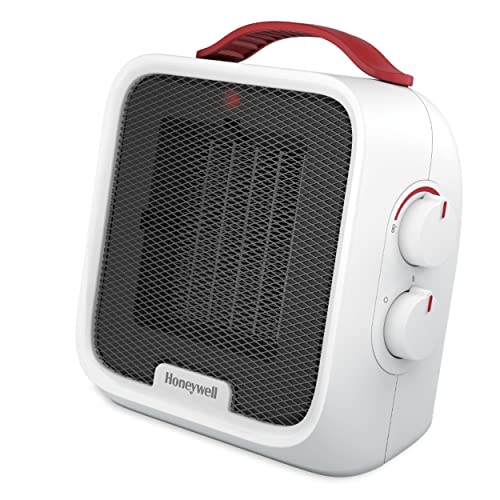
If you want the smallest heater that fits under a desk: The Honeywell UberHeat 5 Ceramic Space Heater for — The Honeywell UberHeat 5 stands about six inches tall and under nine wide, so it disappears into a footwell or a corner of the desk. You get the same two settings everything here offers, 1500 and 900 watts, plus an adjustable thermostat, a cool-touch housing, a tip-over switch and doubled overheat protection. What you give up is reach. There's no oscillation, no timer and no remote, so it warms the space directly in front of it and not much beyond that. For one person at one desk, that's often the entire requirement. For a whole room, it isn't.
The competition
This is what our research surfaced, not a census of every ceramic heater on sale. New models appear constantly, and a lot of them are the same few factory designs wearing different names. Here's the one from our lineup that didn't earn a spot.
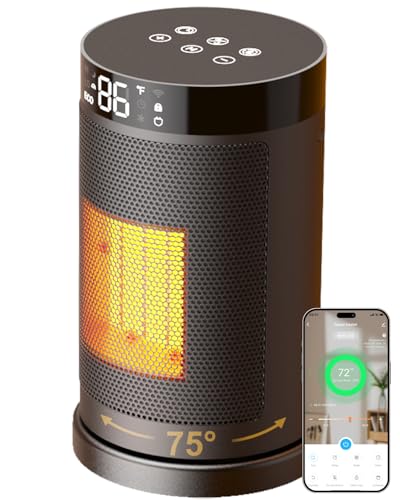
The Space Heater — The N NUTROMO smart space heater is the only unit here that lists Wi-Fi, app scheduling and Alexa voice control, which is exactly what a lot of remote workers want. Being able to shut a heater off from your phone answers the biggest worry about leaving one running. But it comes from an unfamiliar brand with a short history, owner feedback on it is still very limited, and the listing gives no noise rating or coverage area. On paper it's a 10-inch cube with 75-degree oscillation, a 24-hour timer, ECO mode and the usual tip-over and overheat cutoffs. If app control outweighs a track record for you, it's worth a look. We'd rather see how these hold up first.
Placement and safety
Give any heater three feet of clear space in every direction. That's the CPSC's guidance, and in a home office it mostly means moving the stack of paper, the fabric chair mat and the curtain hanging near the outlet. Plug it straight into the wall. Extension cords and power strips aren't built for a 1500-watt draw, and they're a common source of trouble. Don't wedge it into a footwell where the intake presses against a panel and heat has nowhere to go. Wipe the grille with a dry cloth every few weeks, because dust on the element is what produces that scorched smell on the first cold morning. And if the unit shuts itself off, treat that as a message, not a glitch.
Questions we get
Are ceramic heaters safe to leave on all day in a home office?
A certified heater with tip-over and overheat shutoffs is built to run for hours, and most people use one that way through a workday. The risk isn't the runtime, it's what sits near it. Keep three feet of clear space, plug it straight into a wall outlet, and switch it off when you leave the room. Space heaters are involved in about two out of five home heating fires, and placement is usually the cause.
Do ceramic heaters use a lot of electricity?
At 1500 watts, yes, a heater on high is one of the larger draws in your house. It only saves you money if you turn the central thermostat down while it runs, which is what ENERGY STAR calls zone heating. Run it on top of unchanged central heat and your total usage goes up. ECO modes help, because the heater cycles off once the room reaches your target.
What's the quietest ceramic heater for video calls?
Our top pick from Dreo rates as low as 25 decibels, the lowest figure in this group. The PELONIS tower lists under 55 decibels and is fine on a headset. Small box heaters like the Lasko push a lot of air through a small grille, so they're the ones a laptop mic tends to pick up. Placement helps too, since a heater behind your monitor is less audible than one right beside the mic.
Ceramic heater vs. oil-filled radiator: which is better for a home office?
Ceramic wins if you want heat now. The element reaches temperature almost immediately, while an oil-filled radiator needs several minutes to warm up. An oil radiator has no fan, so it's silent, it doesn't stir up dust, and it keeps radiating after it shuts off. For a room you occupy on a schedule, ceramic fits the routine better.
How many square feet can a 1500-watt ceramic heater heat?
Roughly 150 to 300 square feet, based on the Department of Energy's conversion of 1500 watts to about 5,120 BTU per hour. That assumes a reasonably insulated room and a heater doing supplemental work, not all of it. A drafty or converted-garage office will feel underserved at the top of that range. Manufacturer coverage claims tend to run optimistic.
Can I put a ceramic heater under my desk?
You can, and compact models like the Honeywell are made for it. Leave clear space on every side so the intake isn't pressed against a panel or a bag, and keep the cord away from chair wheels. Don't box it into a footwell that traps heat around the housing. If it keeps shutting itself off, that's the unit telling you airflow is blocked.
Why you should trust us
For this guide:
- We read manufacturer spec sheets for every heater here and compared stated wattage, oscillation range, noise ratings, coverage claims and safety certifications.
- We reviewed published guidance from the Department of Energy, ENERGY STAR, the NFPA and the CPSC on heater output, zone heating and fire risk.
- We looked for recurring themes in owner feedback about noise, thermostat accuracy and long-term reliability rather than weighing individual complaints.
- We read owner reviews on every listing, weighted toward the critical ones, because that is where the recurring failures show up.
- We have a systematic way of automatically fetching the latest prices, so the numbers on this page stay current.
- This is a research-focused guide, so the team may not own every product listed — though we often do own the top winners, which gives us extra context for the recommendations.
- We don't accept free products, and the retailer commission never changes which product we recommend.
Sources
The Best Space Heaters, Wirecutter
Space Heater Buying Guide, Consumer Reports
Best Space Heaters, CNET
Best Space Heaters for Every Room, Good Housekeeping
The Best Space Heaters, The Spruce
Home Heating Fire Safety, National Fire Protection Association (NFPA)
Portable Electric Space Heater Safety, U.S. Consumer Product Safety Commission (CPSC)
Space Heaters, U.S. Department of Energy / ENERGY STAR
UL Mark Verification and Product Safety Standards, UL Solutions
Best Space Heaters, Real Simple
Best Smart Space Heaters, PCMag
Best Space Heaters, Tested by Experts, Popular Mechanics
Amazon product listings and owner reviews for all 7 products
Manufacturer specification pages for each product
Some passages in this guide may be paraphrased with AI help.
Product prices and availability are accurate as of the date/time indicated and are subject to change. Any price and availability information displayed on Amazon.com at the time of purchase will apply to the purchase of this product.
More like this.
Continue exploring appliances reviews and recommendations.

The Best Document Scanners for Home Offices
A document scanner earns its space on your desk in the boring moments. You come home with a folder of school forms, a year of receipts, or the closing…

The Best Paper Shredders for Home Offices
A paper shredder spends most of its life doing nothing, then has to work hard for twenty minutes when a filing box finally gets opened. That pattern is…

The Best Ionic Ceramic Hair Dryers
Most of us dry our hair on autopilot: head down, dryer on high, out the door. But the tool you grab every morning does more to your hair over a year than…

The Best Ceramic Coating for Car Paint
A ceramic coating is a thin layer of liquid glass that bonds to your clear coat and changes how your car behaves in the weather. Rain sheets off instead…

The Best Ceramic Cookware Sets
Ceramic nonstick is what most people buy when they want eggs to slide out of the pan without cooking on a coating made with PFAS. It's the pan you grab on…

The Best Smart Thermostats for Heat Pumps
A heat pump asks more of a thermostat than a furnace does. It has to know when to run the compressor, when to give up and call for backup strips, and when…