The Best DeWalt Power Tools
Most of what a power tool does for you is unglamorous, and that's the point. You hang a curtain rod. You break down a sheet of plywood in the driveway. You pull an old deck apart on a Saturday. What you want is a tool that wakes up when you squeeze the trigger, holds a charge through the job, and doesn't leave your wrist aching afterward. DeWalt's 20V MAX line covers that ground, and the batteries you buy today still fit the tools you buy later.
Here's the honest part: nothing in this category escapes trade-offs. Power and runtime cost you weight, so the saws that rip framing lumber all day are the ones you'll feel when you hold them overhead. The light, one-handed tools give up depth and torque. Batteries wear out, and replacements sting. Bare tools look tempting until you remember they don't include a pack. And a big ecosystem only pays off if you stay in it, because switching brands later means buying every battery over again.
So the right question isn't which DeWalt tool is strongest. It's which one you'll reach for on a Sunday afternoon, and whether the battery in it will still be useful in five years. If you're starting from nothing, buy a kit and add specialists as jobs come up. If you're already deep in 20V MAX, buy bare tools and skip the batteries you don't need. We think that the DeWalt 20V MAX Drill and Impact Driver Combo Kit (DCK240C2) is the best set of DeWalt power tools for most people, and that the DeWalt 20V MAX XR Impact Driver (DCF887B) is the one to buy if you already own a drill and want screws driven faster.
Everything we recommend

Two tools, two batteries, and enough power for most home jobs
More driving power, if you already own a drill
Masonry power and a metal chuck, if the kit drill falls short

Corded-level cutting for framing, at a real weight penalty
How we picked
Battery platform fit. We favored tools on the 20V MAX platform, since ToolGuyd counts more than 200 tools sharing those packs. FLEXVOLT tools earned a spot only where the extra voltage does something a 20V MAX tool can't.
Brushless where it counts. Family Handyman reports brushless motors run notably longer per charge than comparable brushed ones. We treated brushless as the expectation for anything you'd use for hours, and flagged it when a tool doesn't have it.
Weight and reach. We compared published lengths and weights, because a tool that won't fit between studs or that tires your arm gets left in the case. Owner feedback consistently ranks handling above raw output.
Kit value versus bare. This Old House notes combo kits usually cost less per tool than buying bare tools plus separate batteries. We recommended kits for people starting out and bare tools for people who already own packs.
Durability and support. We looked at chuck and shoe materials, brake and kickback features, and DeWalt's three-year limited warranty with a free one-year service contract. Consumer Reports has ranked DeWalt among the top cordless brands for owner-reported reliability.
Top pickOn sale
Two tools, two batteries, and enough power for most home jobs
DEWALT 20V MAX Cordless Drill and Impact
This kit pairs a compact 1/2-inch drill/driver with a 1/4-inch impact driver, and it comes with two batteries, a charger and a bag. For hanging shelves, assembling furniture, building a workbench or driving deck screws, it's all the tool most homeowners ever need.
$169fromAmazonList priceA drill and an impact driver together cover nearly everything you'll do around the house. The drill bores holes and has a clutch, so you can set a screw without punching it through the drywall. The impact driver hammers as it turns, which is how a three-inch screw goes into a stud without stalling or stripping out. This Old House notes that combo kits generally give you better per-tool value than buying bare tools and batteries one at a time.
The sizes matter more than the spec sheet makes them sound. The impact driver is 5.55 inches long and weighs 2.8 pounds; the drill is 7.5 inches and 3.6 pounds. That's the difference between reaching inside a cabinet box and giving up on the angle. Under a sink, between joists, inside a closet — you'll notice it every time you work somewhere tight.
Small conveniences add up over a weekend. Both tools have LED work lights that stay lit for 20 seconds after you release the trigger, which is long enough to check the screw you just set in a dim crawlspace. The impact driver's hex chuck loads one-handed, so your other hand can keep holding the board. The drill's single-sleeve ratcheting chuck grips bits hard and swaps them fast.
The battery is the real purchase here. ToolGuyd counts more than 200 tools on the 20V MAX platform, which is among the largest cordless ecosystems any major brand offers. Every pack you buy later drops straight into these two tools, and every tool you add runs on the packs in this box. DeWalt also ranked among the top cordless brands for owner-reported reliability in a Consumer Reports survey, which is worth something when you're committing to a battery mount.
Flaws but not dealbreakers
Neither tool comes from DeWalt's brushless XR line. Family Handyman reports brushless tools can run notably longer per charge, and that gap shows up on long jobs rather than short ones. The included packs are the compact kind too, so they keep the tools light but won't carry you through an afternoon of hole saws. Plan on a spare if you work in long stretches.
The drill handles wood and light metal fine, but it has no hammer mode, so brick and block are out. And while most owners describe years of trouble-free use, a few report a drill that loses power partway through a hole and needs warranty service. The coverage is there, but shipping a tool off mid-project is a hassle.
DeWalt lists a three-year limited warranty on this kit, and its 20V MAX tools also carry a free one-year service contract.
Runner-up
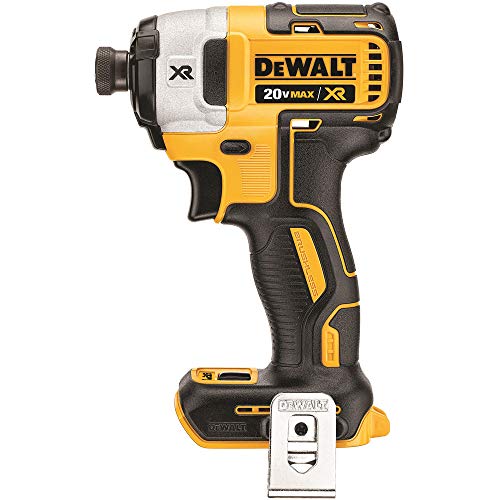
More driving power, if you already own a drill
DEWALT 20V MAX XR Impact Driver
The DCF887B is a bare-tool impact driver with a brushless motor and three speeds, including a slow mode for delicate fasteners. If your drill still works and you just want screws driven faster and straighter, this is the tool pros keep buying two and three at a time.
$126.95fromAmazonDrive a three-inch screw into a stud with a plain drill and you'll feel it. The drill bogs, the bit cams out, and your wrist takes the twist. An impact driver adds quick rotational blows, so the screw keeps moving and your arm doesn't absorb the fight. DeWalt lists up to 1,825 in-lbs of max torque here, which is more than a house will ever ask of you.
Speed 1 is the setting that earns the upgrade. Precision drive starts the fastener slowly, so a small screw doesn't spin off, snap, or bury itself in a cabinet door before you can react. Then you shift to speed 3 for lag bolts and structural screws. Cheaper impact drivers give you one speed and a lot of stripped heads.
It's small and light for what it does — about 2.7 pounds, with a body short enough to work between studs. Three LEDs ring the chuck instead of sitting under it, so you get light without a shadow from the bit. Owners who use these daily on crews report driving screws, boring holes and tightening nuts with the same tool for years without it slowing down.
Popular Mechanics found DeWalt's XR-series tools consistently near the top in torque-to-weight comparisons, and this driver is the clearest example. You're getting serious output from a tool you can hold overhead in one hand. If you already own 20V MAX batteries, buying the bare tool is the sensible move — you skip packs you don't need.
Flaws but not dealbreakers
It's loud. Impact drivers rattle, and this one is no exception, so wear ear protection if you're driving a few hundred screws. It also isn't a drill replacement: the 1/4-inch hex chuck only takes hex-shank bits, and there's no clutch for careful work.
Torque control is coarse, even with three speeds. For wheel lugs or anything with a torque spec, finish with a torque wrench rather than trusting your trigger finger. And since this ships as a bare tool, it's a poor first purchase if you don't already have batteries and a charger.
DeWalt covers most of its 20V MAX tools with a three-year limited warranty plus a free one-year service contract.
Upgrade pick
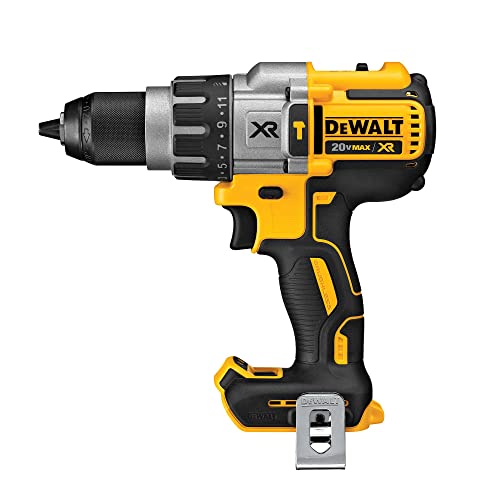
Masonry power and a metal chuck, if the kit drill falls short
DEWALT 20V MAX XR Cordless Hammer Drill
This is DeWalt's heavy-duty XR hammer drill: brushless, three speeds, and a nitro-carburized metal chuck that holds bits without slipping. If you drill into brick or block, or bore wide holes through framing, it does work the kit's drill simply can't.
$159fromAmazonAnchoring a handrail into a concrete stoop is where an ordinary drill quits. Hammer mode adds rapid forward blows to the rotation, which is what actually breaks up masonry ahead of the bit. For a few dozen holes in brick, block or a basement wall — fence brackets, shelf anchors, a mailbox post — this is the right level of tool without stepping up to a dedicated rotary hammer.
The three-speed metal transmission is what separates this from a homeowner drill. Low speed trades RPM for grunt, which is what you want with a hole saw or a spade bit in a 2x10. Top speed spins small twist bits fast enough to cut cleanly instead of burning. The middle setting handles most driving. A one-speed drill makes you compromise on every one of those jobs.
The brushless motor matters most on long days. DeWalt says it runs up to 75 percent longer than the 18V NiCad brushed motors it replaced, and Family Handyman reports the same pattern across brushless tools generally: more work per charge, less heat, no brushes to swap. Owners who use this in utility and fabrication work describe boring through poles and metal enclosures without drama.
The details hold up. The 1/2-inch ratcheting chuck is metal with carbide inserts, so big bits don't walk loose under load. The three-mode LED includes a spotlight setting with a 20-minute shutoff, which is genuinely useful when you're working in a crawlspace and want light that stays put while you fish a wire.
Flaws but not dealbreakers
It's heavy and bulky at about four pounds bare, and that's before you clip on a big battery. For assembling furniture or hanging blinds, it's more drill than the job deserves, and you'll get tired holding it overhead.
Hammer mode is hungry. Owners report it doesn't run consistently on small compact packs, and that you want a 5.0Ah battery or larger for masonry work — which adds weight and cost to a tool that's already bare. If you drill concrete every week rather than every few months, an SDS rotary hammer is the better buy.
DeWalt covers most of its 20V MAX tools with a three-year limited warranty plus a free one-year service contract.
Also great
Corded-level cutting for framing, at a real weight penalty
DEWALT FLEXVOLT 60V MAX* Circular Saw for
This FLEXVOLT saw takes a full 7-1/4-inch blade and cuts 2-7/16 inches deep at 90 degrees, so it rips doubled 2x lumber in a single pass. It's the saw to buy if you're framing walls or breaking down sheet goods all day.
$290.40fromAmazonThis is the one tool here that lets you leave the extension cord in the truck. DeWalt rates it at 5,800 RPM and says it rips through doubled 2x lumber in one pass, and FLEXVOLT batteries auto-detect voltage, so the same pack runs your 20V MAX drill when the saw's back in the case. For framing and long rips, it closes most of the gap with a corded saw.
The layout is built for sightlines. The blade sits left of the motor with the handle at the rear, so if you're right-handed you watch your pencil line directly instead of leaning over the tool. The shoe is magnesium, which stays flat and slides clean. Bevels go to 53 degrees with detents at 45 and 22.5, which covers rafter and stair work.
Two touches you'll use constantly: an electronic brake that stops the blade when you release the trigger, and a rafter hook for hanging the saw. On a ladder or a roof deck, both matter more than any spec. You set the saw down less, and the blade isn't still spinning when you do.
Buy this if you cut wood in volume rather than occasionally. A compact saw is pleasant for plywood and trim, but it slows down in framing lumber and runs out of depth at a bevel. This one doesn't flinch either way, which is why it shows up on job sites where cuts are measured in hundreds per day.
Flaws but not dealbreakers
It weighs 10.9 pounds bare. Owners say that mass actually steadies a long rip, and they're right, but cutting overhead or one-handed is a different story. For someone who cuts a few boards a month, it's a lot of saw to wrestle.
It needs a FLEXVOLT battery. Standard 20V MAX packs won't power it, and owners have been caught out by exactly that after unboxing a bare tool and finding nothing in their kit fits. Budget for the biggest, heaviest battery DeWalt sells, and understand that it hangs off the back of an already heavy saw.
Who this is for
This guide is for anyone buying into DeWalt cordless tools, whether that's your first drill or your fifteenth bare tool. If you're a homeowner with no cordless tools at all, start with a kit — you need batteries and a charger anyway, and buying them attached to two tools is the efficient path. If you're a contractor, a fabricator or a serious woodworker already on 20V MAX, skip the kits entirely and buy the specific bare tools your work demands.
You should probably wait if you're already invested in another brand's batteries and only need one more tool. Swapping platforms means rebuying every pack, and that rarely pays off for a single purchase. We're covering cordless tools and the platform they share, not corded gear, benchtop machines, hand tools or the batteries and chargers themselves — those deserve their own comparisons, and we mention them here only where they change which tool you should buy.
How we picked
Battery platform: we stayed on 20V MAX wherever possible, because the packs carry across more than 200 tools, and reached for FLEXVOLT only when 60V does something 20V can't. Motor: brushless was the expectation for anything you'd hold for hours, since it runs longer per charge and generates less heat. Weight and reach: published dimensions and weights carried real weight themselves, because a tool that won't fit between joists doesn't get used. Kit versus bare: kits won for first-time buyers, bare tools for people who already own packs. Durability and support: metal chucks, magnesium shoes, electronic brakes, and DeWalt's three-year limited warranty plus a free one-year service contract.
Other dewalt power tools worth considering
If you cut or grind metal: The DEWALT 20V MAX* Angle Grinder Tool Cordless ($148.17) — The DCG413B is the tool to add. Pro Tool Reviews found its brushless motor holds RPM steady under load, which is where brushed grinders bog down and scorch. The safety hardware is the real story: a kickback brake that senses a pinch or bind and stops the wheel with full force, an electronic brake that halts the wheel in about two seconds, a paddle switch, and a no-volt release so it can't restart on its own after a power cut. What you give up is a battery, since it ships bare, and grinders drain packs fast — plan on a big one. Owners also grumble about the loose wrench for changing discs, which is easy to misplace.
If you want a lighter saw for plywood and trim: The Dewalt DCS571B-DCB240-BNDL ATOMIC 20V MAX Brushless 4-1/2 ($370) — This ATOMIC bundle pairs a compact 4-1/2-inch brushless circular saw with a 4.0Ah compact battery, so it's ready to cut out of the box. It's dramatically easier to steer than a full-size 7-1/4-inch saw, which matters when you're breaking down a sheet of plywood alone or trimming out a closet. Owners like it for scoring drywall to depth and cutting cement board, jobs where a big saw is clumsy. The trade-off is depth: the small blade limits how thick a cut you can make, so it's a finish and sheet-goods saw, not a framing saw. If you're cutting rafters or ripping doubled lumber, buy the FLEXVOLT instead.
The competition
Here's what our research turned up, which isn't everything DeWalt sells. The 20V MAX catalog runs to hundreds of tools, and plenty of good ones didn't surface in the reviews and specifications we worked from. This section covers the shortlisted tool that didn't make the picks.
The DEWALT FLEXVOLT 60V MAX* Reciprocating Saw ($273) — The DCS389B is a FLEXVOLT 60V MAX reciprocating saw, and it's a demolition specialist through and through. DeWalt rates it at 0 to 3,000 strokes per minute with a 1-1/8-inch stroke and up to 19 percent more power than the DCS388 it replaced, which is what you want for nail-embedded studs, cast pipe and thick tree limbs. The keyless blade clamp and pivoting shoe make it pleasant to work with. It lost a pick spot because most people don't demo often enough to justify it: at 7.43 pounds bare it's tiring, it needs a FLEXVOLT battery on top of the bare-tool price, and a handful of owners report the blade clamp releasing mid-cut. If you gut kitchens or clear brush regularly, it's still the one to get.
Battery care and storage
Your tools will outlast your batteries, so treat the packs well. Don't leave them in a truck bed through a July afternoon or a January night — heat kills lithium cells fastest, and a frozen pack won't take a charge until it warms up. Pull a battery off the charger once it's full rather than leaving it there for weeks. If a tool bogs down under load, stop and let it cool instead of pushing through; that heat is what shortens motor and cell life. Store packs around half charge if you won't touch them for a season, and check the state-of-charge indicator before a big job rather than after you've climbed the ladder. Keep the terminals clean, and blow sawdust out of the tool vents now and then.
Questions we get
Is a DeWalt 20V MAX battery interchangeable with FLEXVOLT tools?
It goes one direction, not both. FLEXVOLT batteries auto-detect voltage, so a single pack runs both 20V MAX tools and 60V MAX FLEXVOLT tools. A standard 20V MAX pack won't power a FLEXVOLT tool like the DCS577B saw — it physically mounts on 20V MAX tools only. That surprises a lot of people who buy a bare FLEXVOLT tool assuming their existing packs will work.
What's the difference between DeWalt's XR and ATOMIC lines?
XR is the heavy-duty line: brushless motors, more torque, more transmission speeds, and generally more tool in your hand. ATOMIC is the compact line, built around brushless motors in smaller, lighter bodies for tight spaces and one-handed work. If you're framing or drilling masonry, buy XR. If you're doing trim, cabinet work, or anything overhead, ATOMIC is often the more pleasant tool.
Are POWERSTACK batteries worth the extra cost?
It depends on how you work. DeWalt says POWERSTACK compact packs weigh about 25 percent less than a standard 20V MAX 5.0Ah battery while giving comparable runtime, which is a real difference if you're holding a tool overhead or driving screws all day. For occasional projects on the ground, a standard pack is fine and costs less. Buy POWERSTACK for the weight, not for the runtime.
What's the best DeWalt drill for concrete and masonry?
Among the tools here, the DCD996B hammer drill is the one to buy. Hammer mode handles anchor holes in brick, block and concrete, and the three-speed metal transmission gives you the low-end torque those bits need. Use a 5.0Ah or larger battery, since owners report it runs inconsistently on small packs in hammer mode. If you drill concrete daily, step up to a dedicated SDS rotary hammer instead.
What's the best DeWalt combo kit for a beginner DIYer?
The DCK240C2 drill and impact driver kit is the standard answer, and it earns it. You get the two tools that handle most household jobs, plus two batteries, a charger and a bag, which means no separate battery purchase to figure out. Add specialists — a circular saw, a grinder, a reciprocating saw — as actual projects come up. They'll run on the packs you already own.
Why you should trust us
For this guide:
- We read DeWalt's published specifications for every tool in this guide, along with coverage from Pro Tool Reviews, Popular Mechanics, Family Handyman, This Old House and ToolGuyd.
- We compared motor type, weight, chuck design and battery platform across the lineup, then checked those specs against recurring themes in owner feedback.
- We also weighed Consumer Reports survey results on owner-reported reliability and satisfaction among cordless tool brands.
- We read owner reviews on every listing, weighted toward the critical ones, because that is where the recurring failures show up.
- We have a systematic way of automatically fetching the latest prices, so the numbers on this page stay current.
- This is a research-focused guide, so the team may not own every product listed — though we often do own the top winners, which gives us extra context for the recommendations.
- We don't accept free products, and the retailer commission never changes which product we recommend.
Sources
DeWalt 20V MAX XR Impact Driver Specifications, DeWalt (Manufacturer Spec Sheet)
DeWalt 20V MAX XR Brushless 3-Speed Hammer Drill Specifications, DeWalt (Manufacturer Spec Sheet)
DeWalt FLEXVOLT 60V MAX Circular Saw Specifications, DeWalt (Manufacturer Spec Sheet)
Best Cordless Power Tool Brands, Tested by Pros, Pro Tool Reviews
DeWalt Cordless Tool Reviews and Buying Guides, ToolGuyd
Power Tools Ratings and Reliability Survey, Consumer Reports
Best DeWalt Power Tools for Homeowners, Family Handyman
DeWalt Tool Reviews: Circular Saws, Drills, and Combo Kits, This Old House
DeWalt ATOMIC Compact Circular Saw Specifications, DeWalt (Manufacturer Spec Sheet)
DeWalt POWERSTACK Battery Technology Overview, DeWalt (Manufacturer Spec Sheet)
DeWalt FLEXVOLT Reciprocating Saw Specifications, DeWalt (Manufacturer Spec Sheet)
DeWalt Warranty and Service Information, DeWalt (Manufacturer Policy Page)
Amazon product listings and owner reviews for all 7 products
Manufacturer specification pages for each product
Some passages in this guide may be paraphrased with AI help. Prices are refreshed automatically.
More like this.
Continue exploring home reviews and recommendations.

The Best Aluminum Cable Deck Railing Kits
Cable railing sells itself on one thing: you stop noticing the railing and start noticing the yard. Thin horizontal cables block a fraction of the view…

The Best Modular Closet Systems
A closet system is one of those purchases you think about for about a week and then live with for a decade. The good ones disappear into the room and just…

The Best Garage Ceiling Storage Racks
Garage floors fill up in a way that sneaks up on you. A cooler here, a bin of holiday lights there, and one day the second car doesn't fit. Ceiling…

The Best Solar Attic Fans
Your attic is the hottest room in the house, and nobody lives in it. On a clear summer afternoon the air up there can push past 150°F, and that heat…

The Best TV Stands and Media Consoles
A TV stand is furniture you stop noticing about a week after you buy it, which is exactly the problem. You notice it again when the cable box runs hot…

The Best Fermentation Kits
Fermenting at home is mostly a waiting game, and the gear either helps you wait calmly or makes you anxious. A good kit does three quiet things: it keeps…