The Best Dictionaries and Thesauruses for Students
A good dictionary sits open on your desk and settles arguments. You're mid-sentence, unsure whether a word means what you think it means, and you need an answer you can trust when a professor pushes back. Print references still do this better than a phone. There's no ad blocking the definition, no autocorrect guessing at your intent, and no dead wifi in the library basement. A dictionary also does something screens rarely do: it shows you the words next to the one you looked up.
Here's the honest part. No single book on this list does everything, and the differences between good dictionaries are smaller than publishers want you to believe. Most students look up maybe 20,000 to 40,000 distinct words across four years of coursework, and every collegiate edition here covers all of them. The real gaps show up at the edges — disputed grammar, archaic literary vocabulary, technical jargon. And none of these books are light. They're desk references, not backpack books.
So the choice comes down to your reading level, your writing, and whether you need English or a second language. We think that Merriam-Webster's Collegiate Dictionary, 11th Edition is the best dictionary for most students, and that Merriam-Webster's Intermediate Dictionary is the one to buy if you're shopping for a student in grades 6 through 10.
Everything we recommend

The American English authority most professors expect

Definitions a seventh grader can actually read

A better way to find the right word, if you'll learn the system

The only dictionary that puts contested grammar to a vote
At a glance
| Product | Price | |
|---|---|---|
| Merriam-Webster's Collegiate DictionaryTop pick | $26.54On sale |
| American Heritage Hardbound Dictionary Of The EnglishUpgrade pick | $24.01 |
| Webster's New Roget's ThesaurusBudget pick | $6.49 |
| Merriam-Webster's Intermediate Dictionary - Middle School DictionaryAlso great | $16.59On sale |
 | Compact Oxford English Dictionary: For University andAlso consider | $25.90 |
 | Collins French Dictionary and GrammarAlso consider | $12.76 |
 | Random House Webster's College DictionaryAlso in lineup | $16.78On sale |
How we picked
Reading-level fit. We compared how each dictionary pitches its definitions, favoring books that don't explain a hard word with three harder ones. For younger readers this mattered more than raw entry count.
Coverage and depth. We looked at published entry counts and page counts against what students at each level actually encounter in coursework. A collegiate edition needed enough range to handle assigned literary and technical reading.
Usage guidance. We gave weight to references that flag disputed grammar and explain distinctions between similar words, since that's what separates a lookup tool from a writing aid.
Build and navigation. We reviewed binding type, weight and whether a book has indexed tabs. Owner feedback on reference books consistently points to spine wear as the failure mode that ends a paperback's life.
Availability. We checked how reliably each title can actually be bought, and treated out-of-print or thin-stock editions as conditional recommendations rather than default choices.
Top pickOn sale
The American English authority most professors expect
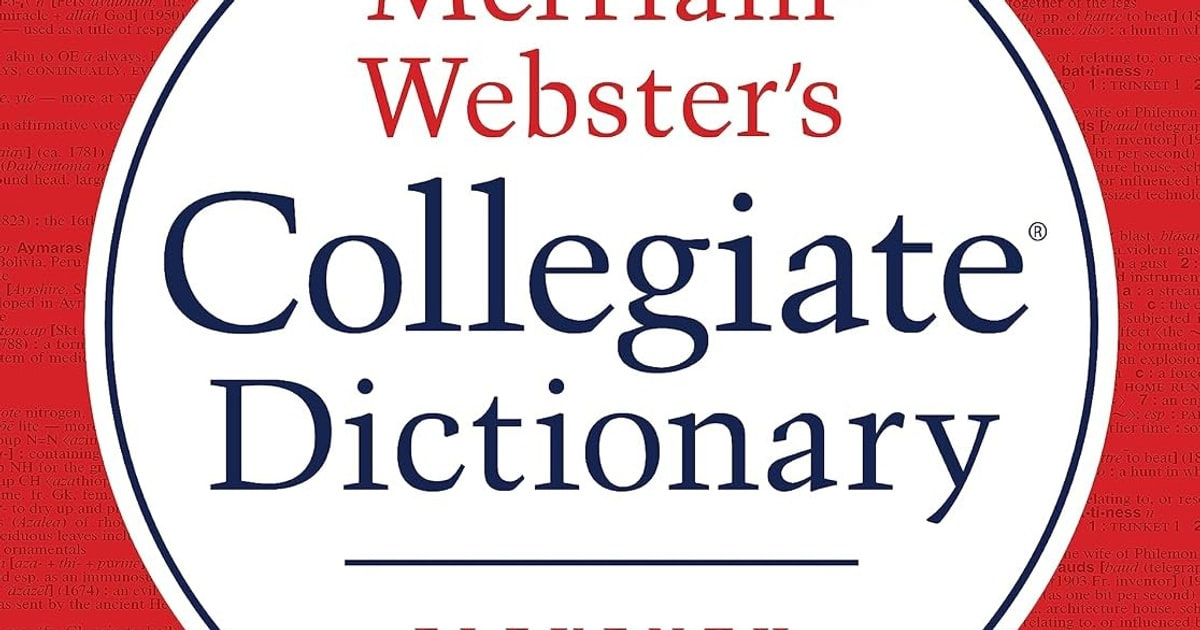
Merriam-Webster's Collegiate Dictionary
A 1,664-page hardcover with more than 225,000 definitions and indexed spine tabs. It's the reference American style guides point to, and it's built to survive four years of getting yanked off a shelf and dropped back down again.
$26.54fromAmazonList priceThis is the dictionary American academic style guides actually name. Chicago, APA and MLA all treat Merriam-Webster as the standard for American English spelling and usage. When a professor tells you to check a dictionary, this is the one they mean. That matters more than it sounds — you're not just looking up a word, you're settling a question in a way your instructor will accept without argument.
The coverage runs deep enough that you'll rarely hit a wall. More than 225,000 definitions and roughly 70,000 usage examples sit across those 1,664 pages. Most entries carry two to four senses with numbered sub-senses for specialized meanings. If you're reading nineteenth-century fiction or a dense journal article, that depth is what keeps you from having to go online halfway through.
The indexed spine tabs sound trivial until you use them. Finding the letter M in a book this thick takes a couple of seconds instead of a fumbling flip-through. Cheaper dictionaries skip the tabs to save money, and you feel it every single lookup. Over four years of daily use, that small convenience is a big part of why this book stays on your desk instead of in a drawer.
Each entry includes a date of first use, which is quietly useful for test prep. Seeing when a word entered English pushes you toward its Latin or Greek roots, and root recognition is the single most reliable strategy for unfamiliar words on the SAT, ACT or GRE. You're building word families rather than memorizing lists. It's a study tool disguised as a footnote.
The jacketed hardcover holds up to real student use. At just under four pounds it's a substantial book, and the binding is built for a reference that gets opened thousands of times. Paperback dictionaries fray at the spine within a couple of semesters under that kind of load. This one is meant to outlast your degree.
Flaws but not dealbreakers
There's no usage panel for disputed grammar. If you want to know whether your professor will flag "hopefully" at the start of a sentence, this book won't tell you. American Heritage covers that ground and Merriam-Webster doesn't. For most writing it doesn't matter, but if you argue in print for a living someday, you'll want both.
It's big and it's heavy. This is a desk reference, full stop. Nobody's carrying a four-pound book to a lecture hall, and you shouldn't plan to. If you want something that travels, you're looking at a phone or a much smaller volume, and you'll give up depth either way.
Nothing digital comes with it. No app, no bundled online access, no code in the front cover. You can use merriam-webster.com for free, but that's a separate thing you're choosing, not something the purchase includes.
Also greatOn sale
Definitions a seventh grader can actually read
Merriam-Webster's Intermediate Dictionary - Middle School Dictionary
Merriam-Webster's editorial standards applied at a middle school reading level, with more than 70,000 entries, illustrations and sample sentences. It's the right book for grades 6 through 10, and buying up to a collegiate edition too early backfires.
$16.59fromAmazonList priceCollegiate dictionaries define hard words using other hard words. That's the whole problem this book solves. A twelve-year-old looks up an unfamiliar term, hits three more unfamiliar terms in the definition, and gives up. The Intermediate edition runs every definition through a grade-appropriate filter, so a middle schooler can work out the meaning without an adult sitting next to them.
The 70,000-plus entries cover what students in these grades actually run into. Class reading lists, science units, state assessments, the PSAT. You're not paying for archaic literary vocabulary a fourteen-year-old will never meet. The scope is narrower than the Collegiate on purpose, and that's the point.
Sample sentences come from contexts a kid recognizes. Instead of a scholarly quotation from some nineteenth-century essayist, you get a sentence about something that happens in a classroom or at home. That's what makes an abstract definition stick. Illustrations for concrete nouns and processes help too, especially for kids who learn better from a picture than a paragraph.
It carries the same editorial process as the Collegiate. This isn't a dumbed-down knockoff from a budget publisher. Merriam-Webster's lexicographers built it with the same rigor, just calibrated for younger readers. So a student learns to trust the same source they'll keep using in college.
Flaws but not dealbreakers
It runs out by junior year. An eleventh grader taking AP English or drafting college application essays needs the full breadth of a collegiate edition. If you're buying for a tenth grader, you're looking at replacing this book within two years — and buying both costs more than starting with the Collegiate would have.
No usage guidance for disputed grammar. Same gap as the Collegiate, and honestly less of an issue here, since middle schoolers aren't usually arguing about whether "data" takes a plural verb. But it's worth knowing the book won't help with that.
It's about 155,000 entries short of the Collegiate. For its intended reader that's fine. For anyone in accelerated coursework, or a student who reads well above grade level, the gaps will show up sooner than you'd like.
Budget pick
A better way to find the right word, if you'll learn the system
Webster's New Roget's Thesaurus
This compact thesaurus uses Roget's concept-based organization instead of a straight alphabetical list. You look a word up in the back index, then turn to a category — and you get the full range of an idea rather than six obvious swaps.
$6.49fromAmazonConcept-based organization finds you a better word, not just a different one. An alphabetical thesaurus hands you synonyms that share a definition. A Roget-format book groups words by idea, so you see the whole semantic neighborhood at once — including the word you actually meant but couldn't summon. For an essay writer stuck repeating "important" four times a page, that's a real difference.
Professional writers have preferred this format for well over a century, and the reason is practical. You're browsing a range instead of picking from a short list. The word you want is often three or four entries away from where you'd have stopped in an alphabetical book. Published guidance on writing reference tools consistently favors the Roget approach for exactly this reason.
It's small enough to actually keep with you. Under a pound and roughly the size of a paperback novel, so it fits in a bag next to a laptop without being the thing that makes the bag heavy. Every other book here is a desk anchor. This one isn't.
Collins editorial standards apply throughout. The synonym groupings aren't a scrape of some public-domain list. Entries reflect current usage rather than words that fell out of the language decades ago, which matters when a thesaurus can otherwise steer you toward something that sounds faintly Victorian.
Flaws but not dealbreakers
The navigation takes some getting used to. You look up your word in the alphabetical index, find a category number, then flip to that category in the main body. It's two steps instead of one, and the first few times it feels backwards. Most people get comfortable within a week, but if you want instant lookups, you'll find this annoying.
The office edition is a pared-down version. Entry counts are smaller than a full Roget's International, and specialized technical synonyms are thinner on the ground. If you're writing in medicine, law or a hard science, expect to hit gaps in your field's vocabulary.
There are no usage notes telling you which synonym to pick. The book gives you options and leaves the judgment to you. Two words in the same group can carry very different connotations, and a student with a shaky feel for register can end up choosing something that reads oddly formal or oddly casual.
Upgrade pick
The only dictionary that puts contested grammar to a vote
American Heritage Hardbound Dictionary Of The English
American Heritage carries more than 2,000 usage notes backed by a panel of 200 linguists and writers, with voting percentages printed alongside the entries. Nothing else in a single volume tells you which usages a professor is likely to circle in red.
$24.01fromAmazonIts usage panel is genuinely unmatched in a single-volume dictionary. Two hundred linguists, writers and scholars vote on more than 2,000 contested questions — "literally," "hopefully," "whom," whether "data" is singular. The percentages print right there with the entry. You don't get a ruling, you get the actual state of educated opinion, which is far more useful when you're deciding how to phrase something in a graded paper.
Those notes turn a dictionary into a style guide. For an argumentative essay or a research paper, knowing that a construction splits the panel tells you to rewrite the sentence. Knowing that ninety percent accept it tells you to stop worrying. That's directly actionable in a way a plain definition never is.
The word histories and Indo-European root appendix go deeper than the competition. American Heritage traces words back to reconstructed roots, so you can see how a cluster of unrelated-looking English words descend from the same ancient source. For anyone studying linguistics, classics or literature, that appendix alone justifies keeping the book.
Synonym paragraphs draw fine distinctions rather than listing alternatives. Instead of dumping five near-synonyms on you, the entries explain what separates them. That's closer to what a good writing instructor would tell you, and it's why editors and publishers have leaned on this dictionary for decades.
Flaws but not dealbreakers
Availability is the real problem. This edition is hard to source reliably, and copies come and go. If you find one, you're buying it because it's there, not because you planned to. Anyone who can't get a print copy can reach American Heritage's content online instead.
It's the heaviest book here by a wide margin. Close to eight pounds and roughly a foot tall. This lives on one desk and never moves. If your study setup involves carrying anything anywhere, this isn't the book.
The panel reflects American academic norms. That's exactly what you want if you're writing for a U.S. university. It's less helpful if you're working in British, Australian or Indian English, where the consensus on some of these same questions runs differently.
Who this is for
Buy one of these if you write regularly and want an answer you can point to — a college student drafting essays, a high schooler prepping for the SAT, a parent shopping for a middle schooler who keeps asking what words mean. Print references also make sense if you study somewhere with unreliable wifi, or if you'd rather not have a phone open while you work. If you look up a word twice a month and always have a browser handy, a free website covers you fine and you can skip this entirely.
This guide sticks to single-volume print dictionaries and thesauruses aimed at students, plus one bilingual French reference. We're not covering multi-volume unabridged sets, subscription apps, or specialized technical and medical dictionaries. Nearly every student wants an abridged collegiate edition rather than an unabridged dictionary — the full Oxford English Dictionary runs past twenty volumes and isn't a thing anyone keeps on a dorm desk.
How we picked
We built this guide from publisher specifications, published reviews of reference works, and recurring themes in owner feedback. Reading-level fit: definitions shouldn't lean on vocabulary harder than the word being defined, which is the difference between a middle schooler learning something and giving up. Coverage and depth: we weighed entry counts against what students at each level actually read, since the last 60,000 entries only matter for archaic and technical vocabulary. Usage guidance: notes on disputed grammar and fine distinctions between synonyms turn a dictionary into a writing tool. Build and navigation: indexed tabs, hardcover binding and sane weight decide whether a book stays on your desk or gets abandoned. Availability: an edition you can't reliably buy isn't a recommendation, however good it is.
Other dictionaries and thesauruses for students worth considering
If you're taking French: The Collins French Dictionary and Grammar ($12.76) — This Collins volume folds a bilingual dictionary and a grammar guide into one book, which is two purchases most language students make separately. It works in both directions, French to English and back, so you're not switching books mid-translation. Entries include common idiomatic phrases rather than bare word-for-word swaps, which is what you need when you're writing a composition instead of decoding a vocabulary list. The grammar section handles the structures you meet in first- and second-year courses. What you give up is depth: this won't carry an advanced student through subjunctive edge cases or register differences in literary French, and it's no help at all for English coursework.
If you study literature or humanities: The Compact Oxford English Dictionary: For University and ($25.90) — Oxford's university-focused compact edition brings a different emphasis than the American collegiate books here — more global English variants, more literary and historical quotations in the usage examples, and deeper etymology. If you're reading British texts or working in linguistics, that orientation is a genuine advantage rather than a quirk. Oxford's editorial standards are as high as any publisher's. The catch is that its spelling and usage guidance follows British conventions, and American style guides don't. Treat this as a supplement to a Merriam-Webster on your desk, not a replacement for one, and expect fewer entries than a full collegiate edition.
The competition
Here's what our research surfaced, not a survey of every dictionary in print. The reference market is full of regional editions, school printings and older revisions that come and go from shelves, and we focused on the widely available titles a student is most likely to encounter.
The Random House Webster's College Dictionary ($16.78) — Random House Webster's College Dictionary is a competent 160,000-entry collegiate edition with clear definitions, etymologies and standard pronunciation notation. Random House has published well-regarded reference books for decades, and for checking spellings and looking up unfamiliar words during reading, it does the job without stumbling. It loses to the Merriam-Webster Collegiate on two counts: about 65,000 fewer entries, and no standing as the reference American style guides cite. The gap shows up when you go looking for a low-frequency word — a technical term, something archaic in a literary text — and come up empty. Stock also runs thin. It still makes sense if a course specifically requires this edition, or if you use a dictionary rarely enough that the extra coverage would go unused.
Care and shelf life
A hardcover dictionary that gets daily use will outlast a paperback by years, and most of what shortens its life is avoidable. Don't leave it splayed open face-down — that's what cracks a spine. When you open it, support the covers rather than letting the block hang from the binding. Keep it off windowsills and away from radiators, since heat and sun dry out the glue and yellow the paper faster than anything else. The dust jacket isn't decoration; it takes the scuffs your covers would otherwise absorb, so leave it on. If a page tears, archival tape from a craft store repairs it invisibly and won't yellow the way office tape does. And store it upright on a shelf, not stacked flat under other books, which slowly warps the boards.
Questions we get
What's the best dictionary for college students?
Merriam-Webster's Collegiate Dictionary, 11th Edition. It carries more than 225,000 definitions and 70,000 usage examples across 1,664 indexed pages, and it's the reference that Chicago, APA and MLA all point to for American English. If you also write argumentative essays where contested grammar comes up, American Heritage is the strongest supplement — assuming you can find a copy.
Should I buy a print dictionary or just use a free website?
For casual lookups, a free site like merriam-webster.com is plenty. For serious academic work, print gives you depth that free web entries trim — full definition trees, etymology, usage notes — and it works without a connection. A hardcover you use through four years of college also costs very little per year of use. If you always study at a desk with wifi, you can skip print entirely.
What's the difference between a dictionary and a thesaurus, and do I need both?
A dictionary tells you what a word means. A thesaurus gives you alternatives when you've used the same word three times in a paragraph. If you write regularly, both earn their space. If you mostly need definitions, start with a dictionary and add a thesaurus when repetition becomes a problem in your writing — for most students that's around junior year of high school.
Is Merriam-Webster better than Oxford for American English?
For academic writing submitted in the United States, yes. Merriam-Webster sets the standard for American spelling, pronunciation and usage, and it's the reference the major U.S. style guides name. Oxford follows British conventions, which produces occasional divergences your professor may flag. Use Merriam-Webster as your primary and reach for Oxford on global English, literary vocabulary or etymology questions.
What's the best dictionary for a middle schooler?
Merriam-Webster's Intermediate Dictionary. Its 70,000-plus entries are calibrated for grades 6 through 10, with definitions and sample sentences that don't assume adult vocabulary. That's the whole difference — a collegiate edition explains hard words with other hard words, which leaves a twelve-year-old more confused than when they started. Plan to move up to the Collegiate around junior year.
What's the difference between an abridged and unabridged dictionary?
An unabridged dictionary tries to cover everything in the language; the full Oxford English Dictionary runs past twenty volumes and hundreds of thousands of entries. An abridged or collegiate edition selects the 160,000 to 225,000 words people actually use and fits them in one book. Almost every student wants the abridged version. You'd have to be doing specialized historical or lexicographic work before an unabridged set earns its shelf space.
What should an ESL student studying in the United States buy?
Start with Merriam-Webster's Collegiate, since American style guides define the norms you'll be graded against. If collegiate definitions feel dense while you're still building your English base, the Intermediate edition works well — its definitions are written in plainer language without sacrificing accuracy. Collins references are also well regarded for writing definitions in non-circular, learner-friendly English.
Why you should trust us
For this guide:
- We read publisher specifications, page and entry counts, and editorial descriptions for every title in this lineup.
- We compared published reviews and reference-work guidance on how collegiate, intermediate and concept-organized editions differ in practice.
- We reviewed recurring themes in owner feedback, particularly around binding durability, navigation and reading-level fit.
- We read owner reviews on every listing, weighted toward the critical ones, because that is where the recurring failures show up.
- We have a systematic way of automatically fetching the latest prices, so the numbers on this page stay current.
- This is a research-focused guide, so the team may not own every product listed — though we often do own the top winners, which gives us extra context for the recommendations.
- We don't accept free products, and the retailer commission never changes which product we recommend.
Sources
Merriam-Webster's Collegiate Dictionary — Official Product Overview, Merriam-Webster
American Heritage Dictionary — About the Usage Panel, American Heritage Dictionary
Collins Dictionary — About Collins English Dictionary, Collins Dictionary
Oxford Languages — Word of the Year and Quarterly Updates, Oxford University Press
HarperCollins — Roget's International Thesaurus, 8th Edition Overview, HarperCollins Publishers
Amazon product listings and owner reviews for all 7 products
Manufacturer specification pages for each product
Some passages in this guide may be paraphrased with AI help. Prices are refreshed automatically.
More like this.
Continue exploring lifestyle reviews and recommendations.

The Best Gifts for College Students
A dorm room is about 12 feet across, the walls are thin, and the nearest outlet is behind the bed. That's the reality any gift you send has to survive.…

The Best Rolling Backpacks for Students and Commuters
A bag loaded with textbooks, a laptop and a water bottle can easily hit twenty pounds, and your shoulders feel every one of them by the third block.…

The Best Cookbooks for Beginner Home Cooks
A first cookbook has one job: get you cooking dinner without panic. That sounds simple, but most cookbooks aren't built for someone who has never sweated…

The Best Gifts for Tea Lovers
Tea is a small ritual that repeats itself two or three times a day, which makes it unusually good gift territory. The person you're shopping for probably…

The Best Pool Floats and Accessories
A pool float has one job: keep you comfortable long enough that you stop checking your phone. The ones that do it well are boring in the right ways. They…

The Best Hiking Boots
A hiking boot has one job: get you back to the car with your feet intact. That sounds simple, but it's mostly about fit and friction. A boot that's a hair…