The Best Electric Kettles
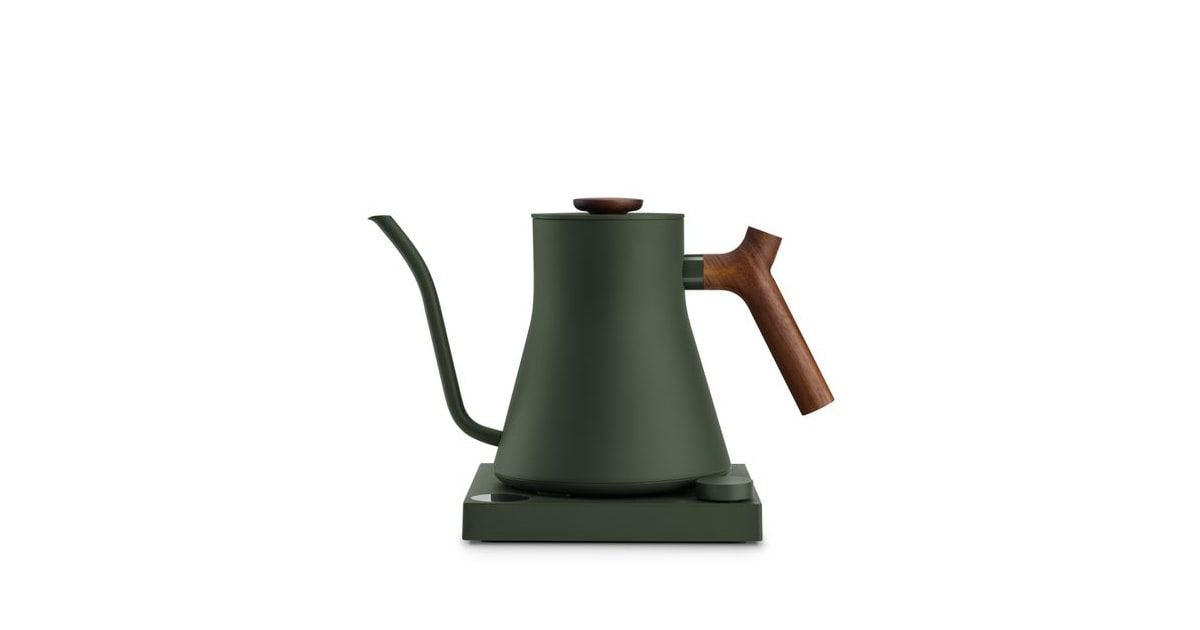
A kettle is one of the few appliances you touch before you're fully awake. You fill it, press a button, and it either gets out of your way or it doesn't. The good ones heat fast, sit steady on their base, and pour without dribbling down the side. The great ones let you choose a temperature, which matters more than it sounds. Green tea turns bitter at a full boil, and coffee brewed below 190°F tastes thin and sour. Most of us just want hot water, now, at the right heat.
No kettle solves everything. Keep-warm modes are shorter than you'd like, and all of them eventually quit and let the water cool. Every kettle scales up if your water is hard, and descaling is a chore nobody schedules. The fast ones are loud, too — a 1500-watt boil isn't a quiet thing before anyone else is up. Plastic lids and gaskets can hold onto smells if you shut them away wet. Pick the compromises you can live with, because you'll live with them daily.
So the right kettle depends on how you drink. If you brew a couple of teas and the occasional French press, a simple variable dial covers you. If you weigh your coffee and pour in slow circles, you need a gooseneck spout and tight temperature control. And if your house drinks tea from morning to night, a boiler-warmer beats reboiling six times. We think that the OXO Brew Adjustable Temperature Kettle is the best electric kettle for most people, and that the Fellow Stagg EKG Pro is the one to buy if you brew pour-over coffee daily.
Everything we recommend

The easiest temperature control here, minus a pour-over spout
To-the-degree control and a true gooseneck, for pour-over
Six labeled presets and a fast boil, with rougher edges

All-day hot water on tap, if you have the counter space
At a glance
| Product | Capacity | Wattage | Price | |
|---|---|---|---|---|
| Fellow Stagg EKG Pro Electric Gooseneck KettleUpgrade pick | 0.9L | — | $179.95 |
| OXO Brew Adjustable Temperature KettleTop pick | 1.75L | — | $119.95 |
| Cuisinart Electric KettleBudget pick | 1.7L | 1500W | $89.95 |
 | Breville BKE830XL IQ Kettle Pure Water HeaterAlso in lineup | 57 oz | — | $199.95 |
| Zojirushi CD-WGC40TS Micom Water Boiler & WarmerAlso great | 4.0L | — | $186 |
How we picked
Temperature control. We compared spec sheets and published reviews for how each kettle sets temperature — a continuous dial, labeled presets, or nothing at all. Anything short of 175°F for green tea and 205°F for coffee got ruled out.
Boil speed. Wattage and reported boil times told us which kettles clear a liter in about four minutes. The 1500-watt models pull ahead, and reviewers agree the gap is noticeable on a weekday morning.
Keep-warm hold. We looked at how long each kettle holds a set temperature and how far it drifts, according to published measurements. Twenty minutes is a real limitation; an hour or all-day warming is what slow brewers need.
Spout and pouring. Gooseneck spouts matter for pour-over and nothing else, so we weighed spout shape against how you brew. We also read owner feedback about dribbling, splashback and lids that dump steam on your hand.
Cleaning and scale. Wide openings, removable filters and interiors that don't trap odors make descaling less miserable. Owner feedback about lingering plastic smells and visible mineral buildup shaped where each kettle landed.
Top pick
The easiest temperature control here, minus a pour-over spout
OXO Brew Adjustable Temperature Kettle
This is the kettle we'd hand to almost anyone. One dial sets any temperature from 104°F up to boil, the glass body holds enough water for a table of tea drinkers, and the handle stays cool and comfortable even when the kettle is full.
$119.95fromAmazonThe dial does one job, and it does it clearly. You turn it, the backlit screen shows your target, and the kettle tells you when it gets there. There are no menus, no mode buttons, nothing to look up. Anything from 104°F to a full boil is a wrist flick away, so green tea at 175°F takes the same effort as boiling water for pasta. That's rarer than it should be.
It holds enough water that you're not refilling all morning. At 1.75 liters, this is the roomiest conventional kettle here. Two tea drinkers can each get a mug and still leave water for a French press. Ounce and milliliter markings run up the side, so you can fill exactly what you need instead of heating a full pot every time. Less water also means a quicker heat-up.
You can see everything, which makes it easier to trust. The body is BPA-free borosilicate glass, so you always know how much water is in there and whether it's actually boiling. A perforated stainless filter sits in the spout and catches loose scale on the way out, and it pops free for rinsing. If your tap water is hard, that little screen is the difference between clean water and gritty tea.
The parts you touch feel considered. The handle is non-slip and stays cool, which matters when the kettle is full and heavy. The lid opens slowly instead of snapping back and pushing steam at your knuckles. The base swivels a full 360°, so it doesn't matter which way you set the kettle down. None of this is flashy. All of it is why people keep this one for years.
Flaws but not dealbreakers
The spout fills mugs well and pours coffee badly. It's a standard wide-bore spout, and the stream comes out fast. For a teapot or a travel mug, that's exactly what you want. Over a V60 or a Chemex, it's too much water with too little control, and you'll get channeling through the coffee bed. If pour-over is your morning ritual, buy a gooseneck instead.
Keep-warm gives up after 30 minutes. That covers a normal cup of tea. It doesn't cover a long session of multiple infusions, or the twenty minutes you lose when someone calls. After that you're reheating, which works but grates. The Fellow holds for an hour, and the Zojirushi holds all day.
Glass and gaskets ask for a little upkeep. Owners report that the lid gasket can pick up odors if the kettle sits closed and wet, so leave the lid open between uses. Glass also shows scale sooner than steel hides it, which is honest but visible. And it is glass — treat it like a carafe, not a camping pot.
Upgrade pick
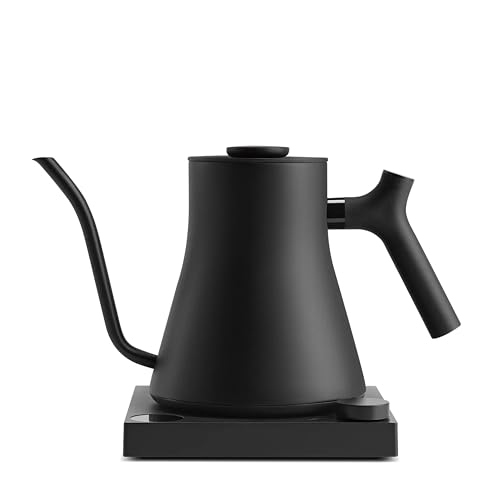
To-the-degree control and a true gooseneck, for pour-over
Fellow Stagg EKG Pro Electric Gooseneck Kettle
If you grind your own beans and pour in slow circles, this is the kettle that stops fighting you. The narrow gooseneck gives you a thin, steerable stream, and you can set the temperature to the exact degree rather than the nearest preset.
$179.95fromAmazonThe gooseneck is the whole point. The spout narrows the stream into a thin, steady arc you can steer. That's what pour-over needs — a slow, even soak across the grounds instead of a splash down the middle. Fellow shapes the handle so the kettle stays balanced while you circle. If you've ever wrestled a wide spout over a V60, the difference shows up in the first cup.
Temperature control goes to the degree, not to the nearest preset. Set 205°F for a light-roast pour-over or 180°F for sencha, and published reviews consistently praise how closely the Stagg tracks the number on the screen. Hold mode keeps it there for up to an hour, so a slow brew doesn't drift cold. For coffee, that's the gap between a repeatable recipe and a lucky cup.
It's built around a brewing routine, not just boiling. Guide Mode offers preset temperatures by coffee style and tea type, so you don't have to memorize numbers. A brew stopwatch tracks your bloom and pour. You can schedule a boil so water is ready when you walk into the kitchen. Small things on their own, but they add up when you make the same drink every day.
The screen and the finish earn their counter space. The full-color display is legible across the room, and the click dial makes setting a temperature quick and hard to overshoot. Firmware updates arrive over WiFi through Fellow's updater app, so the kettle picks up improvements after you buy it. The matte body looks like something you'd leave out, which helps, because you'll reach for it often.
Flaws but not dealbreakers
It's small. At 0.9 liters, you get roughly two mugs. That's plenty for one person brewing carefully and not nearly enough for a dinner party or back-to-back French presses. You'll refill, and refilling means waiting again. If you regularly make tea for a table, this is the wrong shape of kettle for your house.
It heats slower than the 1500-watt crowd. Reviewers and owners both note that the Stagg takes longer to reach a boil than a full-power kettle like the Cuisinart or the Breville. For a single pour-over you won't care, since you're grinding anyway. If you want water for pasta in a hurry, you will, and the narrow spout is slow at filling a pot.
It's the most expensive kettle here, and some of what you're paying for is optional. Scheduling, app updates and a stopwatch are pleasant, but they don't make coffee taste better on their own. What actually justifies the money is the spout and the temperature accuracy. If you brew pre-ground medium roast or everyday black tea, that precision buys you very little.
Budget pick
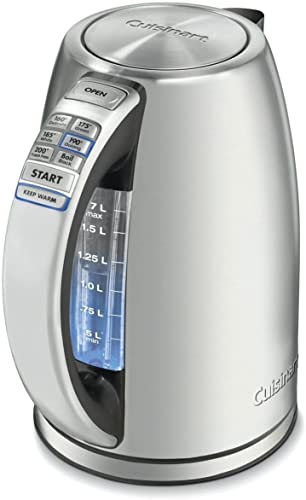
Six labeled presets and a fast boil, with rougher edges
Cuisinart Electric Kettle
Press the button marked green tea and walk away. The Cuisinart heats 1.7 liters quickly and takes the guesswork out of temperature for far less money than the dial-and-screen kettles, as long as you accept plainer plastic and presets you can't nudge.
$89.95fromAmazonPresets beat numbers if you'd rather not think about numbers. There are six, printed right on the unit: green, white and oolong tea, black tea, French press and boil. Press one and the kettle handles the rest. For anyone who finds a dial of temperatures vaguely stressful, this removes the decision entirely, and the labels line up with the ranges tea sellers actually recommend.
1500 watts makes it quick. A liter of cold water gets to a boil in roughly four minutes, which puts this kettle alongside models that cost considerably more. On a weekday morning, speed is the feature you notice first and complain about last. The 1.7-liter body handles two or three mugs per fill without a top-up.
It's the easy call for a first upgrade. If you're coming from a stovetop kettle or a boil-only model, this is a big step up for a small outlay. Cuisinart sells these everywhere, so service and replacement parts aren't a scavenger hunt, and the cordless base, auto shut-off and keep-warm are all present. Nothing about it is exciting. Plenty about it is sensible.
Flaws but not dealbreakers
You get six temperatures and no others. If your white tea wants 170°F, or a lightly oxidized oolong wants 188°F, you're stuck — the presets are fixed and there's no way to fine-tune them. Most people won't mind. Anyone fussy about a particular leaf will hit that ceiling fast, and it's the main reason this isn't our top pick.
Keep-warm drifts. It holds for 30 minutes on paper, but the accuracy slips well before the window closes, and the water ends up cooler than the setting suggests. For tea you drink right away, that's fine. For a long steeping session, plan on reheating. The OXO stays closer to its number.
It feels less premium than the rest. The plastic trim and lid don't have the heft of the OXO or the Breville, and the stainless interior shows scale plainly once mineral buildup starts. Owners who've kept one for years mostly report that it keeps working. They rarely report loving how it feels in the hand.
Also great
All-day hot water on tap, if you have the counter space
Zojirushi CD-WGC40TS Micom Water Boiler & Warmer
This isn't really a kettle. It's a 4-liter insulated hot water station you fill in the morning and draw from all day, and for a household that drinks tea from breakfast to bedtime it replaces a dozen small boils with one.
$186fromAmazonIt changes the rhythm of drinking tea. You fill it once and then stop thinking about boiling. Press the dispense button, get water at the temperature you picked, and go back to what you were doing. For a home office, or a house with three tea drinkers, that's a genuinely different day than waiting on a kettle six separate times.
Four keep-warm settings cover most of what you brew. The 160°F, 175°F, 195°F and 208°F options line up with delicate white and Japanese green teas, Chinese greens, oolong, and black tea or coffee. The control panel shows the actual water temperature at all times, so you're never guessing whether it's still sitting where you left it.
Dispensing beats pouring once the vessel is heavy. A full 4-liter carafe is not something you want to tilt over a mug. The electric pump sends out a controlled stream instead, which is safer with kids around and easier on your wrists. The interior is rust-resistant stainless, and Zojirushi keeps PFAS and BPA out of every surface the water touches.
It can use less power than you'd guess. Holding water hot inside a vacuum-insulated body costs far less energy than heating it from cold over and over, and an energy-saving timer backs off the warming for 6 to 10 hours when nobody's drinking. Auto shut-off protects it from boiling dry. If you reboil all day today, this is likely the more efficient habit.
Flaws but not dealbreakers
The first heat takes a while. Filling four liters with cold water and bringing it up is a fifteen-to-twenty-minute proposition. This is not the appliance for one cup of tea, right now, before you run out the door. Plenty of owners keep a small kettle alongside it for exactly that, which is a sensible plan and an extra purchase.
It's furniture. The footprint is much larger than any kettle here, it's tall enough to fight with an overhead cabinet, and it stays plugged in. On a small counter it costs you real workspace. Think about where it lives before you buy it, not after it arrives.
You have to actually use it. It costs more than most of the kettles here, and the math only works if your household drinks a lot of hot water. If you brew two or three cups a day, a conventional kettle does the same job with less fuss and less counter.
Who this is for
Buy now if your current kettle only boils and you drink anything other than black tea. A variable-temperature kettle fixes bitter green tea and sour coffee in one purchase, and the difference shows up in the first week. You should also upgrade if you brew pour-over with a standard spout and have been quietly blaming your beans. If you drink one mug of black tea a day and your kettle still works, none of this will change your life, and you can skip the whole category.
This guide covers countertop electric kettles and one insulated boiler-warmer — the machines you plug in to heat water for tea and coffee. It doesn't cover stovetop kettles, espresso machines, coffee makers with built-in heaters, or travel kettles for hotel rooms. We also stay out of the sub-boil-only tier, since those models can't hit the temperatures that make delicate tea worth brewing.
How we picked
We weighed five things and let the rest go. Temperature control: a kettle needs to reach 175°F for green tea and 205°F for coffee, whether by dial or by labeled preset. Boil speed: 1500-watt models clear a liter in roughly four minutes, and slower kettles have to earn that time back elsewhere. Keep-warm hold: we looked at how long each one holds and how far it drifts, because a 20-minute window doesn't survive a long steep. Spout and pouring: goosenecks matter for pour-over, wide spouts fill faster, and lids shouldn't steam your knuckles. Cleaning and scale: removable filters, wide openings and interiors that don't hold odors make descaling something you'll actually do.
The competition
This is what our research surfaced in this category, not everything you can buy. The kettle below is a good machine that lost to a pick on a specific trade-off, and it may still be the right one for you if that trade-off doesn't apply to how you brew.
The Breville BKE830XL IQ Kettle Pure Water Heater ($199.95) — The Breville BKE830XL IQ Kettle is the fastest boil here and the nicest lid. Its soft-top mechanism opens gently and vents steam away from your hand, the brushed stainless build feels a step above the Cuisinart, and five one-touch settings cover black, green, white and oolong tea plus French press. What keeps it out of the picks is the 20-minute keep-warm window — the shortest in this guide — plus fixed presets you can't fine-tune the way the OXO's dial lets you. If you brew and drink immediately, and speed is what you care about, it's an easy kettle to like.
Care and maintenance
Descale every four to eight weeks, sooner if your water is hard. Fill the kettle with equal parts white vinegar and water, or use a citric acid packet, bring it to a boil, let it sit for twenty minutes, then rinse two or three times until the smell is gone. Scale isn't just ugly — it insulates the heating element, so a scaled kettle gets slower and eventually quits. Don't fill past the max line, or you'll get sputtering water out of the spout during a hard boil. Leave the lid open between uses so the gasket dries and doesn't hold onto odors. If your kettle has a spout filter, pull it out and rinse it when you descale.
Questions we get
What's the difference between a gooseneck and a standard kettle spout?
A standard spout pours fast and wide, which is what you want for filling a mug, a teapot or a pot on the stove. A gooseneck narrows the stream into a thin arc you can aim and slow down. That control is what pour-over needs, because uneven saturation of the coffee bed causes channeling and a muddy cup. For steeping tea, the difference barely matters.
What temperature should I use for green, white, oolong and black tea?
White tea and Japanese greens like sencha and gyokuro want 160–170°F. Chinese greens such as dragonwell handle 175–185°F. Oolong runs 185–205°F depending on how oxidized it is, and black tea takes 200–212°F. Delicate leaves hold aromatic compounds that break down above their range, which is what turns a good cup bitter and astringent.
Can I use a regular kettle for pour-over coffee?
You can, and it'll be frustrating. A wide spout dumps water faster than you can steer it, so the bed saturates unevenly and the extraction goes with it. If you already own a standard kettle, try it before spending anything — you'll understand the problem in one brew. If you're buying specifically for pour-over, get a gooseneck.
Do plastic interiors affect the taste of the water?
Quality BPA-free plastic from a known brand usually settles down after the first few boils, which drive off residual manufacturing compounds. Cheap plastic from unfamiliar brands is a different story and can leave a detectable off-flavor that hangs around. If you're sensitive to taste, stick with stainless steel or borosilicate glass, which every kettle in this guide uses for the water path.
How long should an electric kettle last?
Three to seven years of daily use is a reasonable expectation from a reputable brand. The two things that kill kettles are scale choking the heating element and mechanical wear on lids and switches. Descaling on schedule is the single biggest factor you control. More moving parts mean more to fail, which is worth remembering with something like the Breville's soft-open lid.
Is a variable dial better than labeled presets?
It depends on how specific you get. A dial like the OXO's lets you land on any temperature, which matters if you brew a leaf that wants 188°F. Presets like the Cuisinart's remove the decision entirely and are faster in daily use. Buy the dial if you're curious about tea; buy presets if you just want the right water without thinking.
Why you should trust us
For this guide:
- We read published kettle roundups and reviews from major appliance and kitchen outlets, then compared their temperature-accuracy and boil-time findings against each manufacturer's own specifications.
- We went through owner feedback for each model, looking for repeated complaints about scale, lid gaskets, drift in keep-warm mode and long-term reliability rather than one-off problems.
- We compared capacity, wattage, spout shape, interior material and keep-warm duration across all five listings to see which trade-offs each brand chose.
- We read owner reviews on every listing, weighted toward the critical ones, because that is where the recurring failures show up.
- We have a systematic way of automatically fetching the latest prices, so the numbers on this page stay current.
- This is a research-focused guide, so the team may not own every product listed — though we often do own the top winners, which gives us extra context for the recommendations.
- We don't accept free products, and the retailer commission never changes which product we recommend.
Sources
The Best Electric Kettle — Wirecutter (NYT), Wirecutter / New York Times
Best Electric Kettles — CNET, CNET
Best Electric Kettles — Good Housekeeping, Good Housekeeping
Best Electric Kettles — Reviewed (USA Today), Reviewed / USA Today
Best Electric Kettles — Tom's Guide, Tom's Guide
Best Electric Tea Kettles — The Spruce Eats, The Spruce Eats
Electric Kettle Ratings & Reliability — Consumer Reports, Consumer Reports
Estimating Appliance Energy Use — US Department of Energy, US Department of Energy
Amazon product listings and owner reviews for all 5 products
Manufacturer specification pages for each product
Some passages in this guide may be paraphrased with AI help. Prices are refreshed automatically.
More like this.
Continue exploring appliances reviews and recommendations.

The Best Pour-Over Coffee Kettles
A gooseneck kettle is the one piece of coffee gear that changes your cup immediately. The narrow spout slows the water down so you can wet the grounds…

The Best Smokeless Indoor Electric Grills
Indoor electric grills solve a specific problem: you want a seared burger in February, or you live somewhere a propane tank isn't allowed on the balcony.…

The Best Electric Tankless Water Heaters
Hot water on demand sounds simple. Then you look at the wiring diagram. An electric tankless heater doesn't store anything, so every gallon you use has to…

The Best Electric Griddles for Pancakes and Breakfast
A good electric griddle solves one specific problem: cooking breakfast for everyone at the same time. On a stovetop, you're working a 10-inch pan and…

The Best Electric Spice Grinders
Pre-ground spice is convenient, and it's also a slow leak. The oils that make cumin smell like cumin start escaping the moment the seed breaks open, so a…

The Best Electric Buffet Warming Trays
Getting eight dishes hot at the same moment is the hardest part of hosting. The turkey needs to rest, the rolls need the oven, and the mashed potatoes…