The Best Emergency Weather Radios
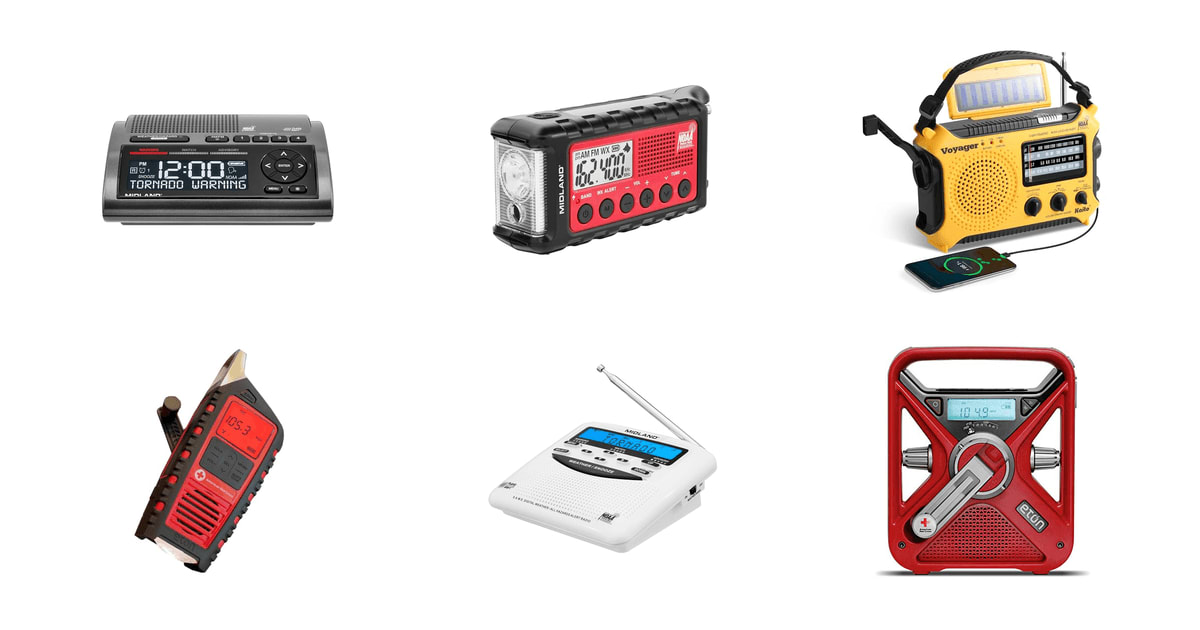
Severe weather doesn't wait for you to check your phone. A NOAA weather radio sits in the corner of a room and does one job: it makes noise when the National Weather Service issues a warning for where you live. NOAA runs more than 1,000 transmitters and reaches over 99% of the US population, on a band reserved entirely for alerts between 162.400 and 162.550 MHz. Nothing preempts it. That's the whole appeal — a dedicated channel that isn't competing with anything else for airtime.
No radio here is a joy to set up. SAME programming means digging out your county's six-digit FIPS code and punching it in through a small LCD and a handful of buttons, and the manuals are uniformly grim. Reception is line of sight, so a transmitter 40 miles out can still be blocked by a ridge or a steel-framed building. And every one of these radios makes noise you won't fully love — beeps, tones, and the occasional alert for a county you don't live in.
You may already assume your phone covers this. It mostly does, until it doesn't. Wireless Emergency Alerts ride on cell broadcast, and the FCC has documented cellular outages lasting a day or more in disaster areas. FEMA lists a battery-powered or hand-crank weather radio as a required item in a household kit for exactly that reason. We think that the Midland WR400 is the best emergency weather radio for most people, and that the Midland WR120B is the one to buy if you just want dependable county alerts without the clock and extras.
Everything we recommend
Loud, easy to read, and it doubles as your bedside clock

The alert essentials, minus the clock and the speaker
Shortwave, Bluetooth and a big battery in one rugged shell

The one to throw in a go-bag and forget about
At a glance
| Product | Power Options | USB Charge Output / Battery mWh | Price | |
|---|---|---|---|---|
| Midland - WR400 Weather Radio Deluxe -Top pick | Battery Backup | — | $89.50 |
| Midland - ER310Also great | Crank | — | $79.99 |
 | Kaito KA500 5-way Powered Solar PowerAlso consider | 5-Way Powered | 5V USB Output | $49.99 |
| Eton Odyssey Adventure Hand Crank NOAA WeatherUpgrade pick | Multiple Power Sources | USB Output | $65 |
| Midland - WR120B - NOAA Emergency WeatherBudget pick | — | — | $47On sale |
 | Eton The American Red Cross Frx3 EmergencyAlso in lineup | — | Smartphone Charger | $109.94 |
 | Runningsnail 7400mWh Hand Crank Emergency Radio withAlso in lineup | Hand Crank | 7400mWh | $23.39On sale |
How we picked
Alert reliability. We leaned on manufacturer spec sheets and published reviews to sort out which radios hold NOAA reception and which SAME implementations really filter by county. Radios that owners describe missing alerts on didn't make the picks.
Siren volume. Published expert coverage points to alarm loudness as one of the two things that separate mediocre weather radios from good ones. We looked for a siren rated loud enough to wake someone through a closed bedroom door.
Power redundancy. At home we favored a wall adapter with battery backup; in portables we wanted crank, solar and USB together. Owner feedback in this category comes back to dead batteries more than anything else.
Setup you can finish. SAME programming defeats a lot of buyers. We gave weight to radios where the county-code process is documented clearly and where owners describe getting through it without calling support.
Build for a kit. For portables we compared weight, size and shell material from spec sheets, along with owner feedback about cranks, hinges and antennas after a stretch of being ignored in a bag.
Top pick
Loud, easy to read, and it doubles as your bedside clock
Midland - WR400 Weather Radio Deluxe -
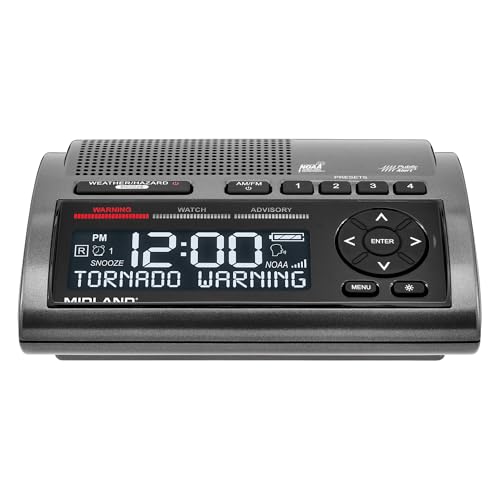
This is the tabletop radio to leave plugged in beside your bed. It handles SAME county programming, scans for the strongest NOAA channel on its own, and wakes you with an 85-decibel siren, a voice alert, a flashing LED, or all three at once.
$89.50fromAmazonThe WR400 does the two things that actually matter, and does them without fuss. It scans the available weather channels and locks onto the strongest one by itself, so you don't have to guess which of the seven NOAA frequencies serves your area. Then it filters alerts down to the counties you program in. You hear about your county, not the one two over.
Picture a warning at two in the morning. The siren goes off at 85 decibels, the LED flashes, and the radio reads out the alert type in plain voice. You choose which of those you want. If you sleep through phone buzzes — and plenty of people do — the combination of sound and light is the reason to own one of these instead of trusting a notification.
It runs on the wall adapter with batteries as backup, which is the right arrangement for a radio that lives in one place. Published reviews of tabletop models favor that setup over battery-only portables, which can miss intermittent alerts as their cells drain. You lose nothing by leaving it plugged in, and you don't lose coverage when the power goes out.
It also earns its space on the nightstand the rest of the year. There's a clock with an alarm and a snooze button, plus AM/FM, so it can replace the radio already sitting there. It switches over to an alert on its own when one comes in, no matter what you were listening to. A USB port on the back tops off a phone.
Flaws but not dealbreakers
Programming is the weak spot. You enter your county's FIPS code through a small display and a few buttons, and the process is fiddly enough that plenty of owners give up and leave the radio in all-alerts mode. That works, but then you hear about counties you don't live in, which is how people end up muting the thing entirely.
The speaker is fine for alerts and merely okay for music. If you want a radio you'll enjoy listening to, this isn't it.
Budget pickOn sale
The alert essentials, minus the clock and the speaker
Midland - WR120B - NOAA Emergency Weather
This is the stripped-down version of our top pick, and for a lot of households it's enough. You get SAME programming for up to 25 counties, color-coded alert indicators, and the same automatic override that cuts in the moment a warning lands.
$47fromAmazonList priceStrip away the clock, the AM/FM tuner and the USB port, and what's left is the part you're buying a weather radio for. The WR120B receives NOAA alerts, filters them by county, and makes noise. It covers more than 60 kinds of hazards and emergencies, which is most of what the National Weather Service pushes out on any given week.
Twenty-five programmable counties is more than most people will ever need. That matters if you live near a county line, commute across one, or keep an eye on where your parents live. Color-coded indicators tell you at a glance whether you're looking at a watch, a warning or a statement, which is genuinely useful in the ten seconds after you wake up confused.
It's small, it's white, and it disappears on a shelf. There's a continuous backlight option if you want the display readable in a dark room. Batteries handle the outage case and the adapter handles everything else. If you want one radio in the house, don't care about extras, and would rather spend less, start here.
Flaws but not dealbreakers
Setup is the same chore as on our top pick, which is to say it takes patience and the manual. Owners regularly describe needing a second attempt to get the county code entered correctly.
There's no AM/FM, no clock and no phone charging. This radio sits in the house and waits, and that's the whole of it. It's also not the one to grab on your way out the door, since nothing about it is built for a backpack.
Upgrade pick
Shortwave, Bluetooth and a big battery in one rugged shell
Eton Odyssey Adventure Hand Crank NOAA Weather
The Odyssey is the radio you take camping and keep in the closet for storms. It covers AM, FM, shortwave and NOAA, charges by solar or hand crank, holds a 2000mAh battery, and streams music over Bluetooth when nothing is going wrong.
$65fromAmazonMost emergency radios sit in a drawer until you need them, which is how you find out the batteries died. The Odyssey sidesteps that by being something you'd use anyway. It's a Bluetooth speaker at a campsite, a shortwave receiver for late-night listening, and a phone charger with a USB output. The weather alerting runs underneath all of it.
Shortwave is the reason serious preppers pay more. When local infrastructure is down, shortwave still pulls in broadcasts from far outside the affected area. That's a need most households will never have. But if you want a radio that keeps talking when the stations near you don't, this is the band that does it, and few emergency radios include it.
Power redundancy is solid: a solar panel, a hand crank, and the rechargeable 2000mAh pack. The three-mode LED light has high, low and flood settings plus an SOS alarm, so it's a real flashlight rather than a token one. The backlit LCD is big enough to read in a dim tent. At a little over a pound, it still travels fine.
RDS is a small thing that adds up. It puts station names and text on the display instead of leaving you to guess at frequencies, which makes tuning far less annoying than on cheap crank radios. Paired with a digital tuner, it's the difference between finding a station and hunting for one with a thumbwheel in the dark.
Flaws but not dealbreakers
It doesn't do SAME. There's no county filtering here, so alerts come through for the whole broadcast area. That's a real step down from the Midlands if you live somewhere with a busy warning season and you're trying to sleep through the ones that don't apply to you.
It's also the most expensive radio here, and a good chunk of what you're paying for — Bluetooth, shortwave, RDS — has nothing to do with staying safe. If you only want alerts at home, a tabletop unit serves you better.
Also great
The one to throw in a go-bag and forget about
Midland - ER310
The ER310 is built for the closet shelf and the evacuation bag, not the nightstand. It runs on a hand crank, solar, AA batteries or USB, puts out enough current to bring a phone back to life, and has a flashlight bright enough to be worth using.
$79.99fromAmazonFour power inputs is the whole argument for this radio. Crank it, set it in a window, drop in AA batteries, or top it up over USB before a storm rolls through. When an outage stretches past a day, the radios that keep working are the ones that don't lean on a single source. That's the scenario FEMA has in mind when it puts a hand-crank radio in a household kit.
The USB output pushes 1,000mA, enough to take a modern phone from empty to roughly half charge in two or three hours on AA power alone. That's not fast. But a half-charged phone is the difference between calling someone and staring at a dead screen, and you can do it in a basement with no grid at all.
It's noticeably chunkier than a pocket radio, at about a pound and eight inches long. That's the trade for the bigger crank handle and the better flashlight, and both are worth it. The beam is bright enough to walk a dark hallway or read a breaker panel, which is more than the smallest crank radios manage.
For everyday listening you get AM/FM plus the weather band, and that's the end of the list. No shortwave, no Bluetooth, no aux in. It's a tool rather than a stereo. Owners who want a radio to enjoy look elsewhere, and owners who want one that works when nothing else does keep coming back to this one.
Flaws but not dealbreakers
There's no SAME programming, so you'll hear alerts for everything your transmitter covers. In a busy storm season that gets old fast, and it's the main reason we'd still keep a tabletop radio in the bedroom.
Hand cranking is work. A minute of steady turning buys you a short stretch of radio or a sliver of phone charge, and it's no substitute for charging the thing before the weather turns.
Who this is for
Buy one of these if you live where warnings actually arrive — tornado country, a hurricane coast, a flood plain, a wildfire corridor. Buy one if someone in the house sleeps hard or won't hear a phone. And buy one if you're building a 72-hour kit, since FEMA puts a battery or hand-crank weather radio on the required list next to water and a first aid kit. The alerts cover far more than storms: AMBER Alerts, chemical spills, 911 outages and national security warnings all come through the same channel.
You can skip this if your phone alerts are enough for you and outages where you live are short and rare. This guide covers consumer NOAA weather radios for homes, emergency kits and camping. It doesn't cover scanners, ham gear, two-way radios or whole-home alerting systems, and we don't rank anything on reception range, because that mostly depends on where you sit relative to the nearest transmitter rather than which radio you bought.
How we picked
Alert reliability: the radio has to catch NOAA broadcasts consistently, and SAME county filtering has to work without hand-holding. Volume: the siren needs to wake a sleeping household, not just get your attention across a kitchen. Power redundancy: we favored radios that run more than one way, since extended outages are the entire reason to own one. Setup: entering a six-digit county code shouldn't take three tries, though it often does. Build: anything headed for a go-bag has to survive months of being ignored in a closet and still work when you pull it out.
Other emergency weather radios worth considering
If you want the widest range of power options: The Kaito KA500 5-way Powered Solar Power ($49.99) — The KA500 takes power six ways — hand crank, solar panel, three AA batteries, USB in, a wall adapter sold separately, and a built-in rechargeable pack — which is more redundancy than anything else here. It also covers two shortwave bands alongside AM, FM and the seven NOAA channels, with a 14.5-inch telescoping antenna and a signal-strength indicator that makes fringe-area tuning less of a guessing game. The impact- and water-resistant shell suits a truck bed or a boat. What you give up is polish: no SAME filtering, no Bluetooth, and a control layout that costs you a session with the manual. Preppers love it. Casual buyers usually want something simpler.
The competition
This is what our research surfaced, not a census of the category. Weather radios are a crowded shelf, and plenty of competent units never show up in expert coverage or owner discussion. The two below are worth knowing about, and one of them might suit you even though it didn't take a pick.
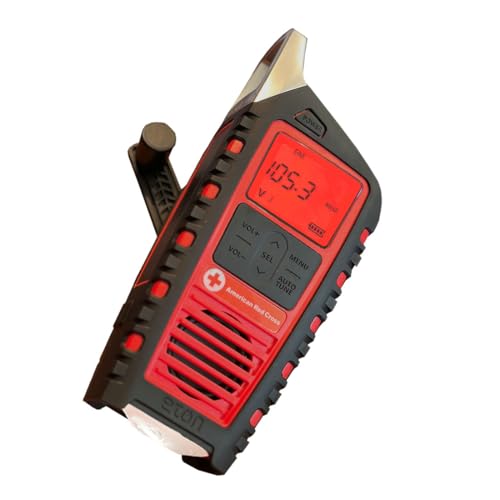
The Eton The American Red Cross Frx3 Emergency ($109.94) — Eton's American Red Cross FRX3 is the radio a lot of people already own, usually because someone gave it to them. It covers the basics — NOAA reception, hand crank and solar power, an LED light, and a USB output for a phone — in a package that's easy to hand off as a gift. The Red Cross branding buys real trust, and that counts with people who won't research this on their own. But the ER310 is the more capable take on the same idea, and Midland's alerting has the stronger reputation in expert coverage. Get the FRX3 if the branding matters to you or you find one bundled into a kit.
The Runningsnail 7400mWh Hand Crank Emergency Radio with ($23.39) — The RunningSnail MD-090P is tiny — about five inches long and half a pound — with a 7400mWh (2000mAh) pack, a hand crank, solar charging, an SOS siren, a flashlight, and an LCD that shows frequency and battery level. It auto-scans for weather alerts around the clock, which is more than most radios this small bother with. It's a sensible first emergency radio and easy to tuck into a glovebox or a kid's camp bag. It loses to the ER310 on flashlight output, crank feel and general sturdiness, and like every portable here it can't filter by county. If space and weight are your real constraints, though, it's the one that fits.
Placement and upkeep
Put the radio where the signal is, not where it looks tidy. NOAA broadcasts are line of sight from a transmitter that may be 40 miles out, so a window, an exterior wall or an upper floor beats a basement shelf almost every time. Extend the antenna fully — a collapsed whip is behind a surprising share of reception complaints. Keep fresh alkalines in the backup compartment and swap them on a schedule you'll actually remember, because the batteries that fail are always the ones nobody checked. If you have a crank or solar model, top it off before a storm rather than during one. And re-enter your county code if you move, since a radio programmed for your old address is worse than no radio at all.
Questions we get
Do I need a weather radio if my phone already gets emergency alerts?
Wireless Emergency Alerts are useful and you should leave them on. But they ride on cell broadcast, and the FCC has documented cellular outages lasting a day or more in disaster areas, plus congestion during mass-casualty events. NOAA radio uses its own dedicated RF band that nothing else shares. The two aren't redundant so much as complementary.
What is SAME, and how do I program county codes?
SAME stands for Specific Area Message Encoding. It uses a six-digit FIPS code for your county, and once you enter it, the radio only sounds off for alerts that include your area. You look up your county's code on the National Weather Service site, then punch it in through the radio's menu. Budget about ten minutes and keep the manual handy.
Will the alarm actually wake me up at night?
On a tabletop model like the WR400, yes — an 85-decibel siren in a bedroom is hard to sleep through, and the flashing LED helps if you're a heavy sleeper or hard of hearing. Portables tend to be quieter, since the speaker is smaller. If waking up is the main job, keep a tabletop radio in the bedroom instead of relying on the one in your go-bag.
Will a weather radio work in a basement or storm shelter?
Sometimes, and you shouldn't count on it. NOAA broadcasts are line of sight, and concrete, earth and steel all eat into the signal. The usual fix is to keep the radio upstairs near a window and carry a portable down with you, or to run an external antenna if the shelter is where you plan to ride out warnings.
Do these radios only alert for tornadoes?
No. NOAA Weather Radio All Hazards carries more than 40 event types, including AMBER Alerts, hazardous material spills, civil emergency messages, 911 telephone outages and national security warnings. Weather is the biggest share of what you'll hear, but the network works as a general-purpose public warning channel.
How far does a NOAA signal reach?
Transmitters run up to 1,000 watts and typically cover about 40 miles under normal conditions, from a network of more than 1,000 sites that reaches over 99% of the US population. Hills, valleys and dense urban construction shorten that. If you sit near the edge of coverage, extend the antenna fully and move the radio toward a window facing the transmitter.
Why you should trust us
For this guide:
- We read the manufacturer spec sheets for every radio here and checked them against NOAA and FEMA guidance on weather radio use.
- We reviewed published expert coverage of the category and looked for recurring themes in owner feedback, especially around SAME programming and alarm volume.
- We did not assess reception in any particular location, since that depends on your distance from the nearest transmitter and the terrain in between.
- We read owner reviews on every listing, weighted toward the critical ones, because that is where the recurring failures show up.
- We have a systematic way of automatically fetching the latest prices, so the numbers on this page stay current.
- This is a research-focused guide, so the team may not own every product listed — though we often do own the top winners, which gives us extra context for the recommendations.
- We don't accept free products, and the retailer commission never changes which product we recommend.
Sources
Best Emergency Radios — Wirecutter / NYTimes, Wirecutter
NOAA Weather Radio All Hazards — National Weather Service, NOAA / National Weather Service
NOAA Weather Radio Frequencies — National Weather Service, NOAA / National Weather Service
SAME Codes and Technology — National Weather Service, National Weather Service
Build a Kit — FEMA Ready.gov, FEMA Ready.gov
NOAA Weather Radio Event Codes — National Weather Service, National Weather Service
Best Weather Radios — PCMag, PCMag
Best Emergency Radios — SafeWise, SafeWise
Keeping Connected During Disasters — FCC Consumer Guide, FCC
Best Emergency Radios — Popular Mechanics, Popular Mechanics
Best Emergency Radios for Camping and Outdoors — Outdoor Life, Outdoor Life
NOAA Weather Radio Coverage Map, NOAA / National Weather Service
Amazon product listings and owner reviews for all 7 products
Manufacturer specification pages for each product
Some passages in this guide may be paraphrased with AI help. Prices are refreshed automatically.
More like this.
Continue exploring electronics reviews and recommendations.

The Best Car Emergency Kits
A car emergency kit is the thing you ignore for years and then need at 11 p.m. on a shoulder with your hazards blinking. The jobs are boring and…

The Best All-Weather Car Floor Mats
Winter doesn't stay outside. Salt, slush, sand and gravel ride in on your boots and grind into the carpet every time you get in. A good all-weather mat…

The Best All-Weather Windshield Wipers
Wipers are easy to ignore until the moment you can't see. You merge onto a wet highway, a truck throws up a sheet of spray, and a worn blade smears it…

The Best Cold-Weather Dog Coats
Cold hits some dogs much harder than others. A husky can nap in the snow. A whippet starts shivering on a 40-degree sidewalk, and a 12-year-old terrier…

The Best Cooling Tents and Hot-Weather Camping Gear
Heat is the one camping problem you can't sleep through. A tent sitting in afternoon sun turns into an oven fast - Wirecutter's summer tent research found…

The Best All-Weather Family Camping Tents
The tent that matters is the one you're stuck inside at 2 a.m. when the rain starts. That's when you find out whether the fly reaches the ground, whether…