The Best Ergonomic Laptop Stands

A laptop puts your screen about a foot below where your eyes want it. You lean in, your chin drops, and after a few hours your neck lets you know. A stand fixes that geometry, and it costs far less than a new chair or a standing desk. It lifts the display so the top third sits near your natural eye line, and it opens up airflow under the chassis as a bonus. Most people need somewhere between five and eight inches of rise at a standard desk. Tall people need more.
Here's the part the listings skip: a stand on its own can make things worse. Raise the screen and the built-in keyboard goes up with it, so your elbows climb above 90 degrees and your shoulders creep toward your ears. You've swapped neck strain for shoulder strain. Every stand here needs an external keyboard and mouse to actually do its job. And plenty of stands sold as adjustable only change the tilt angle. Tilt doesn't fix a screen that's too low.
So the real question is where the stand lives. If it stays on one desk, put your money toward stability and adjustment range. If it rides in your bag, weight and folded thickness matter more than anything else, and that engineering isn't cheap to buy. We think that the Roost V3 is the best ergonomic laptop stand for most people, and that the Lamicall Aluminum Laptop Stand is the one to buy if you want solid adjustable lift without paying for travel-grade weight savings.
Everything we recommend

Featherweight and rock steady, if you don't need tilt

Adjustable height and angle, with a base that stays put

Real aluminum and real airflow, at one fixed height

Total freedom of position, if you'll clamp it to the desk
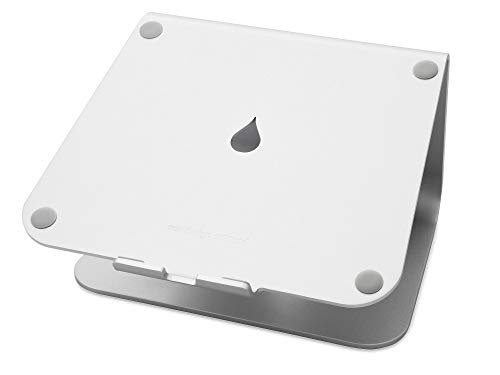
A fixed, solid perch that looks made for a MacBook
At a glance
| Product | Laptop Size Fit | Height Lift | Price | |
|---|---|---|---|---|
| Roost V3 Laptop StandTop pick | 12-18 in | 6.5-12.5 in | $89.95 |
| Rain Design 10032 mStand Laptop StandAlso great | Depth <10.4 in | 5.9 in | $38.99 |
 | Twelve South Curve FlexAlso consider | 10-17 in | 2-11 in | $79.95 |
 | K11 Vertical Laptop StandAlso in lineup | Universal | — | $12.99 |
| ErgotronUpgrade pick | Up to 17.3 in | 13 in | $340 |
| Nulaxy Full Aluminum Laptop StandBudget pick | 10-16 in | 7 in | $17.99 |
| Lamicall Aluminum Laptop Stand for Desk forRunner-up | 10-17.3 in | — | $28.99On sale |
 | BoYata Laptop StandAlso consider | Up to 17 in | — | $29.99 |
How we picked
Real height lift. We only counted stands that physically raise the screen, since tilt alone doesn't fix a chin-down posture. Anything offering less than about five inches of rise had to justify itself some other way.
Stability while typing. Wobble is the complaint owners raise more than any other, so we weighted base weight, grip pads and frame design heavily. Stands with rotating bases or thin hinges started at a disadvantage.
Fit and weight limit. We read each spec sheet for supported screen size and rated capacity. A 17-inch gaming laptop eliminates several of these stands outright, and a very light ultrabook can fall below an arm's minimum.
Airflow under the chassis. Published reviews consistently find that open-frame and vented designs run cooler than solid platforms under sustained load. That gap matters most on fanless laptops, so we favored open backs and vent holes.
Packing and portability. For anything meant to travel, we looked at folded thickness and weight before adjustment range. A stand that adds noticeable bulk to a bag doesn't get carried.
Top pick
Featherweight and rock steady, if you don't need tilt
Roost V3 Laptop Stand
This is the stand to buy if your laptop moves. It weighs about six ounces, folds down thinner than a paperback, and still lifts your screen from 6.5 to 12.5 inches without the bounce that makes cheap folding stands maddening to type on.
$89.95fromAmazonIt disappears into your bag. At roughly six ounces and pencil-thin when folded, the Roost slides into a laptop sleeve and you forget it's in there. That matters more than it sounds. A stand you resent hauling around is a stand you leave at home, and then you're hunched over a coffee-shop table for three hours anyway.
The lift range is wide enough for a standing desk. Roost rates screen lift at 6.5 to 12.5 inches. The low end handles a normal seated setup at a standard desk. The top end gets you close to eye level standing up, which almost nothing else this small manages. If you're tall, or your chair rides high, that extra headroom is the whole reason to pick this one.
Your screen stays still while you type. The frame is an interlocking truss instead of a hinge on a rotating base, and you feel the difference immediately. Cheap folding risers bob with every keystroke, which looks awful on a video call. Owners who've cycled through other stands point to this rigidity as the reason they stopped shopping.
You set the height once and forget it. The two-handed lock snaps open to a height you've already memorized, so redeploying takes a few seconds. The self-adjusting PivotGrips clamp any laptop from 12 to 18 inches without slipping. If you set up somewhere different every day, that consistency beats a longer spec sheet.
Flaws but not dealbreakers
You're paying a steep premium for grams. Against the aluminum risers in this guide, the Roost costs several times more and puts your screen in the same place. The money buys weight savings and packed thickness, nothing else. If the stand is going to sit on one desk forever, that's a bad trade — get the Lamicall or the Nulaxy instead.
There's no tilt or angle control. It goes up and it goes down. That's the whole range. Some people like to kick the screen back a few degrees, and something like the BoYata does that in a second. The Roost doesn't, so you adjust your chair instead.
Deployment takes both hands. The lock isn't a one-finger flick — you brace it and set it. It's a couple of seconds, not a dealbreaker. But when you're juggling a coffee in a crowded lounge, you'll notice.
Runner-upOn sale
Adjustable height and angle, with a base that stays put
Lamicall Aluminum Laptop Stand for Desk for
The Lamicall gives you most of what a desk stand needs: real height lift, angle adjustment, and a weighted aluminum base that doesn't skate around. It fits laptops from 10 to 17.3 inches, and it folds flat when you want it out of the way.
$28.99fromAmazonList priceThe heavy base is the reason to buy it. Lamicall widened and weighted the base specifically to stop the shaking that makes budget risers unpleasant. It sits on the desk and stays there, even if you tap on the laptop keyboard now and then. That's the single most common complaint owners have about stands in this price tier, and it's the one this stand answers.
It fits almost any laptop you own. The supported range runs from 10 inches all the way to 17.3, which covers everything from a small Chromebook to a chunky gaming machine. If you're buying for a household with mixed hardware, or you expect to change laptops in a couple of years, that range saves you from buying twice.
Height and angle both adjust, and it still folds. You can set the rise and tip the surface to suit your chair, then collapse the whole thing into a laptop bag. Fixed stands make you adapt to them. This one adapts to you, which matters if you share a desk or move between a home office and a kitchen table.
The vent holes and silicone do quiet work. Openings in the platform let air move under the chassis instead of trapping it against a solid slab. Anti-skid silicone keeps the laptop from creeping forward, and smooth edges mean no scuffs on an aluminum lid. None of this is exciting. All of it is the difference between a stand you keep and one you return.
Flaws but not dealbreakers
Adjustment is stepped, not smooth. You're picking from set positions rather than dialing in any height you want. If your ideal spot lands between two notches, you'll be a little off. Most people won't care, but it's a real limitation next to a continuously adjustable stand.
There's no cable management. Your charger and dongles hang off the edge exactly the way they did before. If a tidy desk is part of why you want a stand, look at the mStand or the Ergotron instead.
Folding flat doesn't make it a travel stand. It packs down, but it's aluminum with a deliberately heavy base, so it adds real bulk to a bag. This is a stand that folds for storage, not one you'll want to carry daily.
Budget pick
Real aluminum and real airflow, at one fixed height
Nulaxy Full Aluminum Laptop Stand
The Nulaxy gets you the core benefit — seven inches of screen lift — in CNC-cut aluminum with an open back for airflow. It holds up to 22 pounds, so a heavy gaming laptop won't faze it, and it splits into three pieces for storage.
$17.99fromAmazonIt's actual aluminum, not painted plastic. Most stands in this tier are injection-molded ABS with a metallic finish. The Nulaxy uses 5mm aluminum alloy, which means it doesn't flex under a heavy laptop and it doesn't look tired after a year. You can feel where the money went the moment you pick it up.
The open back lets heat escape. Published comparisons of laptop risers have found that solid platforms can trap enough air to push chassis temperatures up a few degrees under sustained load, while open-frame designs let ambient air keep moving. If you're running a fanless laptop through long video calls or exports, that's worth having. Nulaxy also puts rubber pads on the contact points, so the metal touches your laptop as little as possible.
It holds far more weight than you'll ever put on it. The rated capacity is 22 pounds. A big 17-inch gaming laptop tops out around eight. That headroom is why the platform doesn't creak or sag, and it's why you can lean on the desk without watching the whole setup shudder.
It breaks down into three parts. If you move desks, clear the table for dinner, or pack a home office into a closet, the Nulaxy comes apart without tools and goes back together the same way. That's rare at this end of the market, where most stands are one welded shape you either have room for or don't.
Flaws but not dealbreakers
Seven inches is all you get. There's no fine-tuning. For a person of average height at a standard desk, seven inches lands about right. If you're tall, or your chair sits low, you'll be looking slightly up or slightly down forever, and the only fix is a different stand.
It wobbles if you type on the laptop keyboard. Nulaxy says so in its own listing, which is more honest than most. Pair it with a Bluetooth keyboard and mouse and the problem vanishes. Skip that step and you'll be annoyed within a week.
Big laptops don't fit. Compatibility stops at 16 inches, so a 17-inch machine is out. Check your screen size before you order — this is the most common reason people send this kind of stand back.
Upgrade pick
Total freedom of position, if you'll clamp it to the desk
Ergotron
The Ergotron LX holds your laptop on an articulating arm instead of a platform, so it floats above the desk with 13 inches of lift, 360 degrees of rotation and 75 degrees of tilt. Nothing else here comes close to that range of motion.
$340fromAmazonIt gets the laptop off your desk entirely. Every other stand in this guide occupies surface area. The LX clamps to the edge and holds the laptop in the air, which gives you back the whole footprint underneath. On a small desk shared with an external monitor, a keyboard and a coffee, that reclaimed space changes how the desk feels.
Thirteen inches of lift covers sitting and standing. You can raise the tray up to about 17 inches above the worksurface, so one push takes you from a seated position to a standing one. If you actually use your sit-stand desk — as opposed to owning one — this is the only stand here that keeps up without a fight.
It rotates and tilts to wherever you need it. Full 360-degree rotation means you can swing the screen toward a colleague and swing it back. Seventy-five degrees of tilt lets you angle the display for your height rather than compromising. Built-in cable management runs the charger along the arm instead of letting it dangle.
It fits big laptops, docks and all. The tray takes machines up to 17.3 inches and 12 pounds, and it works whether or not your laptop sits in a docking station. That covers heavy 16-inch workstations that most freestanding risers can't safely hold.
Flaws but not dealbreakers
It costs more than the rest of this guide put together. That's the honest framing. For a static seated setup, a good aluminum riser puts your screen in the same place for a small fraction of the outlay. The LX earns its keep only if you move between sitting and standing, or if desk space is genuinely scarce.
Installation is permanent and picky about desks. The included clamp fits desks between 0.4 and 2.4 inches thick, and you need a usable edge. If your desk is thicker, wall-mounted, or has a lip, you're buying the grommet mount separately and drilling a hole. Measure before you order.
Very light laptops fall below the minimum. The arm is rated from 2.5 to 12 pounds. Some ultralight 13-inch machines come in under that floor, and an underloaded gas-spring arm drifts upward instead of holding position. Check your laptop's weight, not just its screen size.
Ergotron backs the LX with a 10-year warranty.
Also great
A fixed, solid perch that looks made for a MacBook
Rain Design 10032 mStand Laptop Stand
The mStand is one piece of brushed aluminum that raises your screen 5.9 inches and never moves again. It doubles as a heat sink, routes your cables through a two-inch hole in the back, and matches Apple hardware so closely it looks like it came in the box.
$38.99fromAmazonOne piece of aluminum means zero wobble. There are no hinges to loosen and no joints to creep. The mStand is a single machined shape with real mass behind it, so a laptop sits on it the way a monitor sits on a desk. If wobble is what made you give up on your last stand, this is the fix.
The body pulls heat off the laptop. Aluminum conducts, and Rain Design shaped the mStand so the laptop's underside meets a large metal surface. On a passively cooled MacBook Air grinding through a long call or a big export, that helps. It's not a cooling pad, but it beats a slab of plastic.
The cable hole and keyboard stash tidy your desk. A two-inch opening in the back swallows your charger and dongles, so wires run behind the stand instead of across it. The space underneath is sized to park a slim keyboard when you're done. Small touches, but they're why this stand keeps showing up on tidy desks.
5.9 inches is the right height for a lot of people. At a standard 28- to 30-inch desk with a normal chair, that lift puts the top of a 13- or 14-inch screen right around eye level. You don't adjust anything and you don't think about it again.
Flaws but not dealbreakers
It doesn't adjust. At all. No height, no tilt, nothing. If you're tall, or you use a sit-stand desk, this stand is simply the wrong tool — at standing height it puts your screen near your belt. Buy the Roost or the Ergotron instead.
Deep laptops won't sit right. Rain Design specifies laptops less than 10.4 inches deep, which rules out most 16- and 17-inch machines. It's built around MacBook proportions, and it shows.
It's staying on that desk. At over two pounds with no folding mechanism, the mStand isn't going in a bag. That's the trade for the stability, and it's the right trade — just know you're buying one stand for one place.
Who this is for
Buy a stand if you work on a laptop for more than an hour or two at a stretch and your neck has started complaining. It's a small outlay for a meaningful ergonomic change, and it takes about a minute to set up. But budget for an external keyboard and mouse at the same time. Without them, you'll lift the screen, raise your hands with it, and trade one ache for another. If you already work on an external monitor with the laptop lid closed, you don't need a riser at all — you need a dock or a shelf.
This guide covers freestanding risers and one desk-mounted arm for laptops between roughly 10 and 17.3 inches. It doesn't cover monitor arms for external displays, cooling pads with built-in fans, lap desks, or full sit-stand desk converters. Those solve related problems, and a couple of them solve different problems entirely. If your main issue is that your desk is the wrong height rather than your screen, a stand won't help you much.
How we picked
Real lift: we only considered stands that raise the screen a useful distance, because tilt alone leaves your chin on your chest. Stability: owners complain about wobble more than anything else, so weighted bases, grip pads and rigid frames counted heavily against thin hinges and spinning bases. Fit: we checked every spec sheet for supported screen size and weight rating, since a heavy 17-inch machine rules out several of these and a very light one falls below an arm's minimum. Airflow: published reviews find open frames run cooler than solid platforms under sustained load, which matters most on fanless laptops. Portability: for travel picks, folded thickness and weight mattered more than adjustment range, because a stand that's a hassle to carry stays home.
Other ergonomic laptop stands worth considering
If you want a premium adjustable stand for a MacBook: The Twelve South Curve Flex ($79.95) — The Twelve South Curve Flex adjusts from 2 to 11 inches, which is the widest continuous range of any freestanding stand here. Textured silicone covers the whole arm, so nothing metal ever touches your laptop's finish — a genuine concern if you've watched a cradle-style stand leave marks on an aluminum lid. It folds flat and ships with a neoprene pouch, so it travels better than any other desk stand in this guide. What you give up is weight: it's heavier than the Roost and bulkier in a bag, so it's a stand that occasionally travels rather than one built for it. Owners also note that height retention at middle positions can feel a bit soft under a heavy laptop, and the matte black finish picks up fingerprints.
If you want to change the angle as easily as the height: The BoYata Laptop Stand ($29.99) — The BoYata uses a Z-shaped alloy steel frame that swings through both height and viewing angle at once, so you can find a position rather than pick from a short list. Four silicone pads underneath grip hard desks and soft mats equally well, and it takes laptops up to 17 inches — broad coverage for a stand at this end of the market. The catch is material: alloy steel is heavier than aluminum, so this one is firmly a desk stand and not a travel companion. There's no cable channel, and the silver finish tends to pick up scratches over time. If you want maximum positioning freedom without spending much, though, it's the most flexible option here.
The competition
This is what our research turned up, not a survey of everything for sale. Laptop stands are a crowded, fast-moving category, and near-identical folding aluminum risers appear under new brand names constantly. Here's the one we looked at closely and didn't put in the picks, and why.
The K11 Vertical Laptop Stand ($12.99) — The Nexstand K11 isn't really a riser — it's a vertical dock. Your laptop slides in on its edge, an automatic grip holds it, and the machine sits closed like a small tower, which frees more desk surface than anything else in this guide. That's genuinely useful, but it doesn't lift your screen because the screen isn't in use. You need an external monitor, keyboard and mouse for this to be an ergonomic setup at all. Given those, it's arguably the best posture you can have, since a closed lid removes the temptation to glance down. But it isn't a stand that fixes a laptop-only workflow, so it loses to every pick here for the person shopping for eye-level lift. Buy it if you already run an external display and just want the laptop out of the way.
Setup and fit notes
Set the height by sitting up straight, looking forward, and adjusting until the top third of the screen meets your gaze — not the middle, and not the top edge. Then add the external keyboard and mouse, because that's the half of the job the stand can't do. If you're clamping the Ergotron, measure your desk thickness first and check that the edge is clear underneath. On freestanding stands, keep the silicone pads clean; dust turns a grippy pad into a sliding one, and a quick wipe restores it. Don't exceed the rated weight, especially with a heavy 16-inch laptop on a stand rated for lighter machines. And check your laptop's depth, not just its screen size, before buying anything with a fixed cradle.
Questions we get
How high should my laptop screen sit?
Aim for the top third of the display to land at or just below your natural eye line when you're sitting upright. At a standard desk with a normal chair, that usually means raising the laptop about five to eight inches. Tall people, or anyone with a high chair, often need nine to twelve inches to get there.
Do I really need an external keyboard and mouse?
Yes, and this is the step people skip. Once the screen is at eye level, the built-in keyboard is too high to type on comfortably, which pushes your elbows above 90 degrees and tenses your shoulders. You'd be fixing your neck and hurting your shoulders instead. Any Bluetooth keyboard and mouse will do.
Will a stand actually help with neck and back pain?
For neck and upper back pain caused by looking down at a screen, it's one of the most effective changes you can make. A flat laptop on a desk forces your head forward and down for hours at a time, and that load adds up. Lower back pain is a different problem, and a stand only helps indirectly by getting your head back over your spine. Pair it with a chair that supports your lumbar curve.
Do vented stands really keep a laptop cooler?
For fanless laptops, yes, and the difference is measurable in published comparisons — solid platforms can trap enough air to raise chassis temperature by a few degrees under sustained load. Open-back designs like the Nulaxy let ambient air keep moving underneath. If your laptop has active cooling fans, the gap narrows considerably since the fans compensate.
What's the difference between a laptop stand and a laptop arm?
A stand sits on your desk and holds the laptop at a set or adjustable height. An arm like the Ergotron LX clamps to the desk edge and floats the laptop above the surface, clearing the footprint entirely. Arms give you far more positioning freedom and height range. Stands cost much less, need no installation, and can move to another room in a second.
Will one of these hold a heavy 17-inch laptop?
Some will. The Ergotron takes laptops up to 17.3 inches and 12 pounds, the Nulaxy is rated to 22 pounds but only fits screens up to 16 inches, and the Lamicall and BoYata handle 17.3-inch and 17-inch machines respectively. Watch the weight rating as closely as the screen size, since gaming laptops often clear six to eight pounds. Check both numbers against your specific model before ordering.
Why you should trust us
For this guide:
- We read the manufacturer spec sheets for all eight stands, comparing lift range, weight limits and supported laptop sizes side by side.
- We reviewed published write-ups of portable and desk risers, including thermal comparisons between open-frame and solid-platform designs.
- We read through owner feedback for each listing, looking for repeated themes around wobble, slipping, finish wear and laptops that didn't fit.
- We read owner reviews on every listing, weighted toward the critical ones, because that is where the recurring failures show up.
- We have a systematic way of automatically fetching the latest prices, so the numbers on this page stay current.
- This is a research-focused guide, so the team may not own every product listed — though we often do own the top winners, which gives us extra context for the recommendations.
- We don't accept free products, and the retailer commission never changes which product we recommend.
Sources
Best Laptop Stands 2026 – Wirecutter, Wirecutter / The New York Times
Best Laptop Stands – Tom's Guide, Tom's Guide
Best Laptop Stands – PCMag, PCMag
Best Laptop Stands 2026 – TechRadar, TechRadar
Best Laptop Stands – CNET, CNET
Amazon product listings and owner reviews for all 8 products
Manufacturer specification pages for each product
Some passages in this guide may be paraphrased with AI help. Prices are refreshed automatically.
More like this.
Continue exploring electronics reviews and recommendations.

The Best USB Hubs And Multi-Port Adapters For Laptops
Your laptop probably has two USB-C ports, maybe three. One of them is busy charging. That leaves one port for a monitor, a mouse, a keyboard, an external…

The Best Laptops
A laptop is the thing you carry every day, so what matters most is boring stuff. How long it runs off the charger. Whether the fan spins up when you open…

The Best Ergonomic Snow Shovels
Shoveling is one of the few chores where the tool you grab decides how your back feels the next morning. A driveway after a six-inch storm means dozens of…

The Best Ergonomic Office Chairs for Back Pain
Your chair decides how your lower back feels at 4 p.m. If you sit six to ten hours a day, that's not a small thing. The spine has a natural inward curve…

The Best Laptop Backpacks for Commuters
A commuter backpack has one job that matters more than the rest: get your laptop to the office and home again without a scratch. But you feel the other…

The Best Wireless Charging Pads and Stands
Wireless charging isn't about speed. It's about the small friction you stop noticing: no fumbling for a cable in the dark, no worn-out port on a…