The Best Face Masks
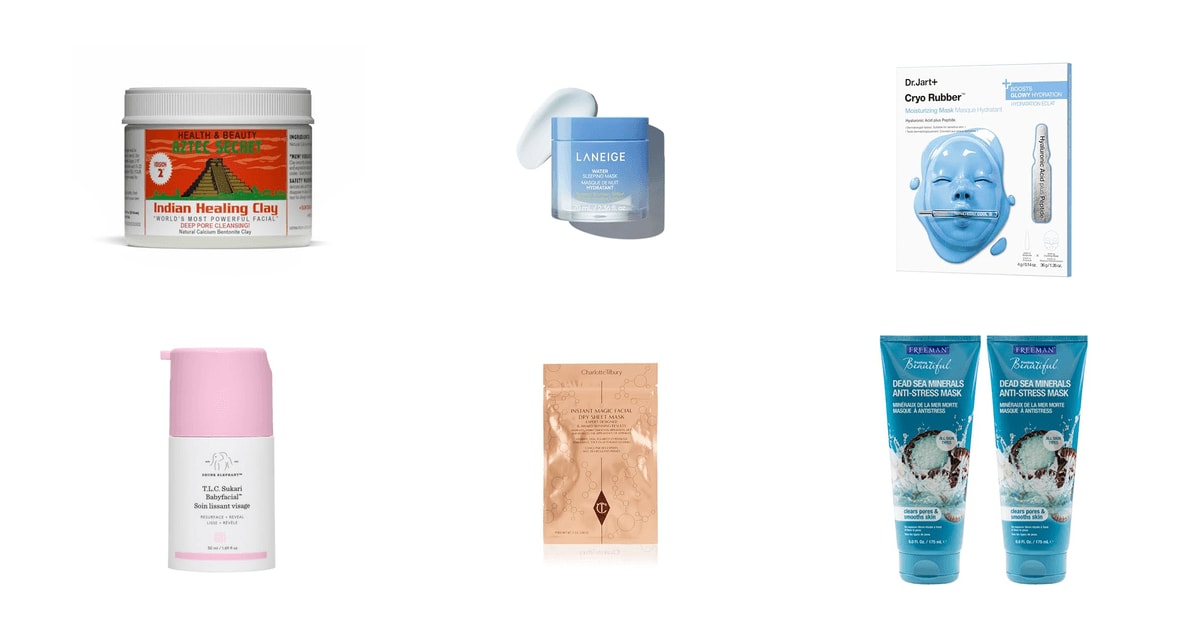
A face mask is skincare on a schedule you'll actually keep. You put it on, you wait ten or twenty minutes, and you rinse. Nothing else in a routine hands your skin that much active ingredient in one sitting. A clay mask pulls oil out of a shiny T-zone before a long day. A hydrating one softens the tight, flaky feeling you get after a winter shower. And because you only use it once or twice a week, a single jar or tube tends to last months.
Here's the part the packaging won't tell you: no mask changes your skin for good. The plumping you see in the mirror afterward is mostly water, and it fades within a day or two. Pores don't shrink, either. They just look cleaner once the gunk is out. Masks also can't fix cystic acne or melasma, and that's a dermatologist's job. Treat a mask as a weekly boost sitting on top of a decent cleanser, moisturizer and sunscreen, not as the thing doing the heavy lifting.
So we looked for masks that do one job well and are honest about how often you can use them. We leaned on ingredient disclosures from the manufacturers, published dermatology guidance on exfoliation and hydration, and the themes that come up again and again in owner feedback. We think that the Laneige Water Sleeping Mask is the best face mask for most people, and that the Aztec Secret Indian Healing Clay is the one to buy if your skin runs oily and breaks out.
Everything we recommend

Deep overnight hydration with almost no effort

Serious oil control, if you don't mind mixing it yourself
A near-clinical peel for texture, if your skin can take it

One-shot hydration for the night before something big
At a glance
| Product | Format | Time | Price | |
|---|---|---|---|---|
| Aztec Secret - Indian Healing Clay 10ozBudget pick | Clay Mask | 5-10 Min | $14.95 |
| LANEIGE Water Sleeping Mask: Hydrating Korean OvernightTop pick | Sleeping Mask | Overnight | $33 |
| Dr.Jart+ Cryo Rubber Moisturizing and Cooling KoreanAlso great | 2-Step Mask | 20 Min | $16.50 |
| Drunk Elephant T.L.C. Sukari Babyfacial - 50Upgrade pick | Exfoliating Mask | Up To 20 Min | $80 |
 | Charlotte Tilbury Instant Magic Dry Sheet FaceAlso in lineup | Dry Sheet Mask | 15 Min | $25 |
 | Freeman Feeling Beautiful Dead Sea Minerals ClayAlso consider | Clay Mask | 10 Min | $17.99 |
How we picked
Skin type fit. We matched format to concern: clay for oil and congestion, hyaluronic acid for dryness, acids for texture and tone. A mask that suits your skin beats a better-reviewed one that doesn't.
Stated concentrations. We compared manufacturers' own ingredient disclosures rather than marketing copy, and favored formulas that name a percentage. A 25% acid blend or a three-form hyaluronic complex is a claim you can check.
Safe use frequency. We read published dermatology guidance on exfoliation limits alongside each brand's own directions. Anything needing a hard weekly cap had to say so plainly on the label.
Format and volume. We looked at how many uses a jar, tube or single sheet actually gives you. A months-long tub and a one-shot mask are very different purchases, even when they promise similar results.
Sensitivity and fragrance. We noted which formulas skip fragrance, essential oils and drying alcohols. We also tracked which ones owners with reactive skin repeatedly flagged as harsh.
Top pick
Deep overnight hydration with almost no effort
LANEIGE Water Sleeping Mask: Hydrating Korean Overnight
A light gel you smooth on as the last step before bed and rinse off in the morning. It packs three forms of hyaluronic acid plus squalane, niacinamide and ceramides, so dry and combination skin wakes up softer without the greasy film a heavy night cream leaves behind.
$33fromAmazonThe best mask is the one you'll actually use, and this one asks almost nothing of you. You put it on after your moisturizer, you go to sleep, you rinse in the morning. There's no timer, no sink, no ten minutes standing around with a wet sheet stuck to your face. Laneige suggests two or three nights a week, which is easy to fit around a normal week rather than a spa afternoon.
The formula stacks humectants under occlusives, which is the whole trick with overnight hydration. Three hyaluronic acids pull water into the skin — the American Academy of Dermatology notes that hyaluronic acid can hold up to a thousand times its own weight in water — and squalane and ceramides sit on top so that water doesn't evaporate while you sleep. Niacinamide rounds it out for tone and barrier support.
It's a gel, not a cream, and that matters if your skin runs oily. Owners with combination skin consistently report that it doesn't leave them shiny or clogged by morning, which is the standard complaint about rich night creams. If you've given up on hydrating products because they all make you break out along the jaw, this is the rare one worth another try.
A jar this size lasts a long time, because a thin layer is genuinely enough. Keep it in the fridge if you like — plenty of owners do, and the cool gel feels good on a hot night or on skin that's been sitting under air conditioning all day. It's also mild enough to use through a dry stretch without irritation building up.
Flaws but not dealbreakers
It's a hydrator, and only that. If your concerns are rough texture, dark spots or clogged pores, this won't move the needle, and you'd get more out of an exfoliating or clay mask. Laneige also tells you to apply it after your moisturizer and rinse it in the morning, so it's an extra step rather than a replacement for your night cream — despite how sleeping masks are usually sold.
The jar is the other small annoyance. You're dipping fingers into a product you'll use for months, so clean hands or a little spatula are worth the trouble. And it costs considerably more than a drugstore clay tube for something you wash down the drain every morning.
Budget pick
Serious oil control, if you don't mind mixing it yourself
Aztec Secret - Indian Healing Clay 10oz
A tub of pure calcium bentonite clay powder that you mix with water or apple cider vinegar right before you use it. Nothing else here pulls oil out of a congested T-zone this thoroughly, and one jar makes far more masks than a tube of ready-mixed clay.
$14.95fromAmazonOpen the tub and you'll find powder, which is the part people miss. You spoon some into a bowl, add roughly equal parts water or apple cider vinegar, stir until it's smooth, and spread it on. Those extra two minutes are the price of a mask with one ingredient in it and nothing else — no preservatives, no thickeners, no fragrance.
The clay does something measurable, not just cosmetic. Calcium bentonite is the entire formula, and a study in the Journal of Antimicrobial Chemotherapy found that bentonite clay showed antimicrobial activity against Cutibacterium acnes, the bacterium behind most breakouts. That's a lab result, not a promise about your face. But it lines up with what owners with oily, acne-prone skin describe after a use or two: fewer clogged pores and a clearer look.
It's also the most flexible product in this guide. The same tub works as a body mask across your back or shoulders, a scalp treatment, or a spot treatment on one stubborn bump. Because you mix only what you need, a jar goes a very long way, and the cost per use is a fraction of anything else here.
Flaws but not dealbreakers
It's drying, which is the point, and that's exactly how it goes wrong. Aztec Secret says to keep it on no longer than five to ten minutes if your skin is sensitive, and to expect some temporary redness that fades in about half an hour. Once a week is plenty for most people. If your skin already feels tight and dry, skip this one entirely.
It's messy, too. You need a bowl, a non-metal spoon and a sink you don't mind rinsing clay out of, and the mask sets hard enough that taking it off takes warm water and a little patience. Patch test on your forearm first, as the label asks.
Upgrade pick
A near-clinical peel for texture, if your skin can take it
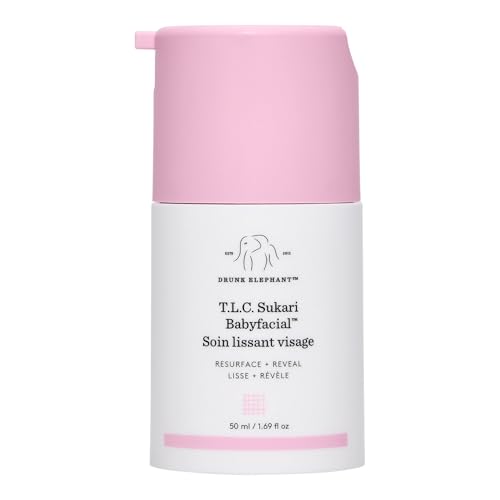
Drunk Elephant T.L.C. Sukari Babyfacial - 50
A once-a-week resurfacing mask with 25% AHAs and 2% salicylic acid, about as strong as an over-the-counter peel gets. Twenty minutes on clean, dry skin leaves it visibly smoother, and it's the one to buy if rough texture and dark spots bother you more than dryness does.
$80fromAmazonThis is the most powerful thing in the guide, and the concentration is why. The blend runs 25% AHAs — glycolic, tartaric, lactic and citric — plus 2% BHA. Glycolic is the smallest AHA molecule at 76 g/mol, so it works deeper into skin than lactic or mandelic acid does. That's the reason a single use can leave your face noticeably smoother when a gentle daily exfoliant takes weeks to show anything.
You'll feel it working. Tingling is normal and Drunk Elephant says so outright; owners new to it often start at ten minutes and build up to the full twenty. Some flushing right afterward is common and settles down. If you're already on a retinoid or a daily acid toner, don't stack this on top in the same week.
The formula leaves out the things that usually cause trouble alongside acids. No fragrance, no essential oils, no drying alcohols, no silicones, and it's dermatologist-tested and cruelty-free. That matters more than it sounds. An acid mask irritates plenty on its own without a lavender scent riding along with it.
Texture and tone are where it earns its keep. Chickpea extract and the acid blend go after dullness and the flat, uneven look skin picks up over time. If your complaint is that foundation catches on rough patches around your nose, or that old spots never quite fade, this is the mask to spend on rather than another hydrating one.
Flaws but not dealbreakers
Once a week is the ceiling, and you should treat it as a hard limit. The American Academy of Dermatology warns that exfoliating more than twice a week can compromise your moisture barrier, which shows up as redness, stinging and — annoyingly — more breakouts rather than fewer. More is not better here.
The bottle is small for what it costs, and it empties faster than you'd expect, because a thin layer over a whole face isn't actually thin. It's also the wrong mask for genuinely sensitive or eczema-prone skin. If you're pregnant, check with your doctor before using acids at this strength.
Also great
One-shot hydration for the night before something big
Dr.Jart+ Cryo Rubber Moisturizing and Cooling Korean
A two-step mask: you smooth on a hyaluronic acid and peptide ampoule, then press a cold rubber sheet over it for twenty minutes. It's a single use, which makes it a splurge, but nothing else here leaves skin looking this plump and glassy this fast.
$16.50fromAmazonYou work the ampoule into the rubber sheet, unfold it over your face and lie still for twenty minutes. The sheet is properly cold — Dr. Jart+ says it drops skin temperature by around 10°F — and it seals tight enough that nothing drips down your neck or slides off when you turn your head. That's the usual failure mode of wet sheet masks, and it's solved here.
The rubber isn't a gimmick; it's what makes the ampoule work harder. The sheet sets up from sodium alginate, a seaweed-derived gel that forms an occlusive layer across the skin. Research on alginates describes exactly that behavior: it blocks evaporation, so the hyaluronic acid and peptides stay in contact with your face for the full twenty minutes instead of drying into the air.
It's a sensible choice for reactive skin, because there's nothing aggressive in the formula — hydration and a cooling effect, and that's the list. Owners with dry, easily irritated skin describe it as a reset rather than a treatment. Use it the night before a wedding or a long flight, and your makeup will sit better the next morning.
Flaws but not dealbreakers
One mask, one use, and that's the whole catch. Per use it's the most expensive product in this guide by a wide margin, and it can't replace a weekly routine. Most people buy a few and save them for occasions.
Peeling the sheet apart and getting it flat against your face takes a minute of fumbling the first time, and it needs you horizontal and still while it sets. It's also purely hydrating, so it does nothing for breakouts or rough texture.
Who this is for
This guide is for anyone who already has a cleanser, a moisturizer and sunscreen in place and wants a weekly treatment on top. We cover masks you use on your face: rinse-off clay, exfoliating acid masks, overnight gels and sheet masks. If you're building a first routine, start with the basics and add a mask once those are habit — a mask can't compensate for skipping the daily stuff.
Skip these if you're in the middle of a rosacea flare, dealing with cystic acne, or using a prescription retinoid without your dermatologist's blessing to add acids. We also left out a few adjacent things on purpose: under-eye patches, daily moisturizers, hair and scalp masks, and medicated acne treatments. Those solve different problems and deserve their own comparison.
How we picked
We started from the concerns people actually shop with, then narrowed on evidence. Skin type fit: clay for oil and congestion, hyaluronic acid for dryness, AHAs and BHAs for texture — the format has to match the problem. Stated concentrations: we read manufacturers' ingredient disclosures rather than marketing language, and favored masks that publish a percentage. Safe use frequency: published dermatology guidance caps acid exfoliation at twice a week, so anything stronger had to say so on its own label. Format and volume: a months-long tub and a single sheet are different purchases, and we weighed how many uses you really get. Sensitivity: fragrance-free, essential-oil-free formulas got the benefit of the doubt, especially among the stronger actives.
Other face masks worth considering
If you want a clay mask that's ready to use straight from the tube: The Freeman Feeling Beautiful Dead Sea Minerals Clay ($17.99) — Freeman's Dead Sea Minerals clay mask does most of what the Aztec Secret does with none of the mixing. You squeeze it out, spread it on, wait ten minutes and rinse — twice a week, per the label. Dead sea minerals and sea salts handle oil and clogged pores, and you get two full tubes, so it lasts a while. The trade-offs are real, though. It's scented with lavender and bergamot, which rules it out if fragrance sets your skin off, and it's gentler than pure bentonite, so heavily congested skin may want more punch. It'll also turn a washcloth blue.
The competition
This is what our research surfaced in this category, not a survey of everything on the shelf. One mask here is worth knowing about even though it didn't make the picks.
The Charlotte Tilbury Instant Magic Dry Sheet Face ($25) — The Charlotte Tilbury Instant Magic Dry Sheet Face Mask is a clever idea: a dry sheet you hook over your ears and massage for fifteen minutes to activate niacinamide, peptides and botanical oils, with no serum dripping down your face. Niacinamide has real evidence behind it — research in the British Journal of Dermatology found it reduces hyperpigmentation at concentrations as low as 2 to 5%. But owner feedback splits sharply. Some people get exactly the pre-event glow they wanted; others say they couldn't tell it did anything, and the ear loops don't sit snugly on every face. For an occasion mask, the Dr. Jart+ is more dependable. Choose this one if you travel constantly and want something flat, dry and good for up to three uses in a carry-on.
Use and frequency
Masks are the easiest step in a routine to overdo. Start on clean, dry skin and set an actual timer — leaving clay on until it cracks doesn't clean any deeper, it just pulls water out of your face. Rinse with lukewarm water, never hot, and put moisturizer on while your skin is still slightly damp. Space out your actives: an acid mask and a clay mask in the same week is a lot for most skin, and an acid mask plus a retinoid on the same night is asking for trouble. Patch test anything new on your forearm first. And wear sunscreen the day after you exfoliate, because fresh skin burns faster.
Questions we get
What's the best face mask for very dry skin?
Look for hyaluronic acid paired with something occlusive to hold the water in, which is exactly what the Laneige Water Sleeping Mask does with squalane and ceramides. For a fast fix before an event, the Dr. Jart+ Cryo Rubber gives you a bigger hydration surge in twenty minutes. Neither is a cure — dry skin needs a good daily moisturizer underneath, and a mask is the boost on top.
How often can you use a clay mask without over-drying your skin?
Once a week is right for most people, and twice is the outer limit if your skin is genuinely oily. Aztec Secret specifically says to keep its clay on for only five to ten minutes if your skin is sensitive, and mild redness afterward is normal. If your face feels tight and squeaky an hour later, you left it on too long or you're doing it too often.
Can I use a face mask every single day?
Not the strong ones. Exfoliating acid masks should stay at once a week, and the American Academy of Dermatology warns that going past twice weekly can damage your moisture barrier and cause more breakouts, not fewer. A gentle hydrating gel is a different story — Laneige suggests two or three nights a week, and daily use of a plain hydrator is unlikely to hurt anything.
What's the difference between a sleeping mask and a night cream?
Less than the marketing implies. The Laneige mask goes on after your moisturizer as a sealing layer and gets rinsed off in the morning, so it's an addition to your routine rather than a swap. A night cream is meant to stay on and be your only night step. If you want one product instead of two, buy a good night cream.
Do face masks actually shrink your pores?
No — pore size is largely genetic, and nothing you rinse off changes it. What a clay mask does is clear oil and debris out, which makes pores look smaller because they aren't stretched open and darkened. The effect is real but temporary, and it comes back as your skin produces oil again. Consistent weekly use keeps them looking clearer than a single dramatic session will.
Are expensive masks actually better than drugstore ones?
It depends on the job. For pulling oil out of congested skin, the inexpensive bentonite clay in Aztec Secret is hard to beat, and the Freeman tube is fine for a gentler version. Where you do pay for something is high-concentration actives: a 25% AHA blend like the Drunk Elephant's isn't something drugstore formulas match. Spend on the treatment masks, save on the clay.
Why you should trust us
For this guide:
- We read each manufacturer's own ingredient disclosures — acid percentages, hyaluronic complexes, sheet materials — rather than relying on the front of the box.
- We compared those formulas against published dermatology guidance on exfoliation frequency, hyaluronic acid and niacinamide, plus peer-reviewed work on bentonite clay and alginate sheets.
- We also read through owner feedback across every product here, looking for recurring themes: tingling and redness, mess, fragrance reactions, and how long each format really lasts.
- We read owner reviews on every listing, weighted toward the critical ones, because that is where the recurring failures show up.
- We have a systematic way of automatically fetching the latest prices, so the numbers on this page stay current.
- This is a research-focused guide, so the team may not own every product listed — though we often do own the top winners, which gives us extra context for the recommendations.
- We don't accept free products, and the retailer commission never changes which product we recommend.
Sources
Best Face Masks of 2026, Tested by Editors — Allure, Allure
The Best Face Masks, Tested and Reviewed — Byrdie, Byrdie
Best Face Masks Tested by the Good Housekeeping Beauty Lab, Good Housekeeping Beauty Lab
Best Face Masks for Every Skin Type — Healthline Beauty, Healthline
Best Face Masks Recommended by Dermatologists — InStyle, InStyle
How to Exfoliate Your Skin — American Academy of Dermatology, American Academy of Dermatology
Moisturizers: Do They Work? — American Academy of Dermatology, American Academy of Dermatology
Antimicrobial activity of bentonite clay — Journal of Antimicrobial Chemotherapy, Journal of Antimicrobial Chemotherapy (Oxford)
T.L.C. Sukari Babyfacial Product Page — Drunk Elephant, Drunk Elephant (manufacturer)
Water Drench Hyaluronic Cloud Mask — Peter Thomas Roth, Peter Thomas Roth (manufacturer)
Global Face Mask Market Size & Forecast — Grand View Research, Grand View Research
Best Face Masks Tested — Vogue Beauty, Vogue
Amazon product listings and owner reviews for all 6 products
Manufacturer specification pages for each product
Some passages in this guide may be paraphrased with AI help. Prices are refreshed automatically.
More like this.
Continue exploring beauty reviews and recommendations.

The Best LED Face Masks and Red Light Therapy Devices
Red light therapy asks very little of you and gives back slowly. You put on a mask, sit still for a few minutes, and repeat that several times a week for…

The Best Anti-Aging Face Moisturizers
An anti-aging moisturizer does two jobs at once. It keeps your face comfortable all day, and it carries actives - retinol, peptides, niacinamide - that…

The Best Face Cleansers
Washing your face is the one skincare step almost everyone does, and it's the easiest one to get wrong. A cleanser that's too aggressive strips the oils…

The Best Mineral Sunscreens for Face
Sunscreen only works if you'll actually wear it. That's the whole game with a daily face SPF: it has to feel good enough that you reach for it on a gray…

The Best Anti-Aging Face Serums
A serum is the step in a routine where the actual chemistry happens. Cleanser, moisturizer and sunscreen mostly support the work a serum does. A good one…

The Best Sunscreens for Face and Body
Sunscreen only works if you actually wear it. That sounds obvious, but it's the whole game. The formula you like - the one that doesn't sting your eyes,…