The Best Hammocks for Outdoor Relaxation
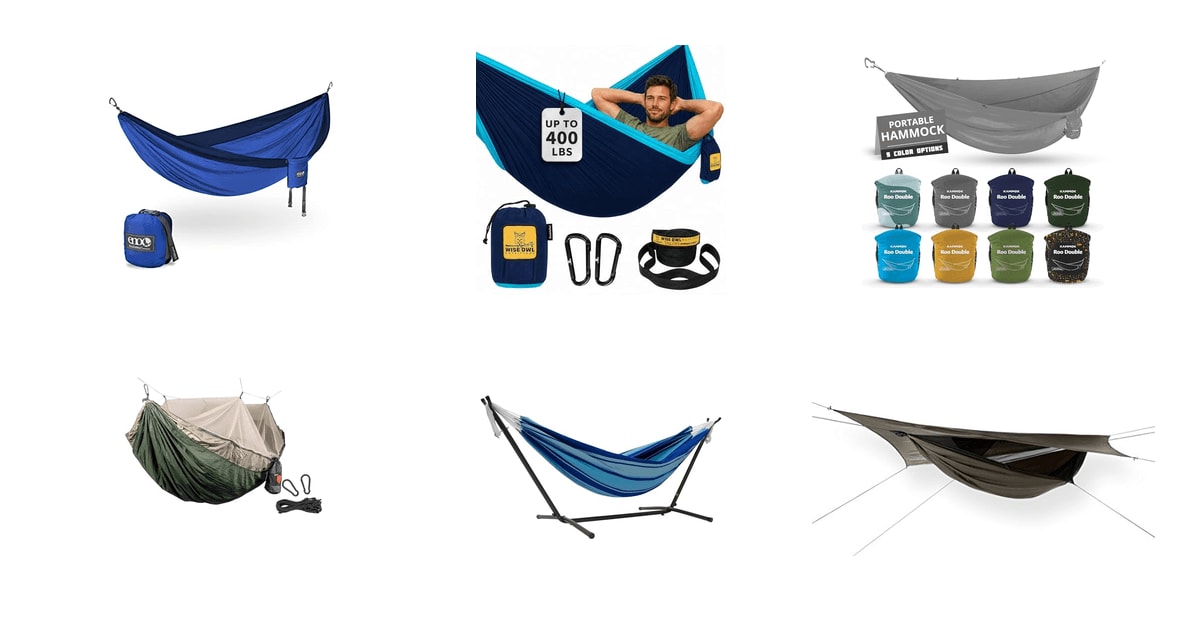
A hammock is one of the few pieces of outdoor gear that earns its keep in a backyard and on a trail. You clip it between two trees, lie down at a slight diagonal, and the fabric does the rest. The good ones go up in about a minute and pack down smaller than a loaf of bread. The bad ones sag into a taco, pinch your shoulders, and leave you with a sore lower back. Most of the difference comes down to fabric, width, and the straps you hang it with.
Here's the honest part: no hammock is comfortable if you hang it wrong, and every hammock in this guide can be hung wrong. REI's hanging guide puts the sweet spot at about 30 degrees from horizontal, and once you push past 45 degrees you get shear force on your anchor points and an aching back. You also need trees. Most doubles want them 10 to 15 feet apart, and a lot of yards simply don't have that. No fabric solves either problem for you.
We think that the ENO DoubleNest is the best hammock for most people, and that the Wise Owl Outfitters Camping Hammock is the one to buy if you want straps and carabiners in the box without spending much.
Everything we recommend

Light, roomy, and it works with almost any strap
Nearly the same hang, with the straps thrown in
Softer fabric, more capacity, and a lifetime guarantee

Bug netting built in, and flip it over when you don't need it

No trees required, and it fits two adults side by side
At a glance
| Product | Weight Capacity | Weight | Price | |
|---|---|---|---|---|
| ENOTop pick | 400 lbs | 1.2 lbs | $74.95 |
| Wise Owl Outfitters Camping HammockBudget pick | 500 lbs | 1 lb | $27.91On sale |
| KAMMOK: Roo Double HammockUpgrade pick | 500 lbs | 1.0692419707 lbs | $94.95 |
| Grand Trunk Skeeter Beeter Pro Mosquito Hammock:Also great | — | 1.8 lbs | $69.99 |
| Vivere Double Cotton Hammock with Space SavingAlso great | 450 lbs | 27.6 lbs | $139.99 |
 | Hennessy Hammock - Explorer Deluxe Zip XLAlso consider | 300 lbs | 3 lb 9 oz | $219.95 |
How we picked
Capacity and construction. We compared stated weight ratings against fabric denier and seam construction from manufacturer spec sheets. Anything under a 400-pound rating for a double didn't make the cut, since dynamic load from sitting down can briefly spike well past your body weight.
Fabric and dry time. Published reviews put parachute nylon at 15 to 30 minutes of sun to dry, versus two-plus hours for woven cotton. We favored nylon for anything meant to leave the yard, and reserved cotton for stand-based lounging where dry time matters less.
Suspension included. OutdoorGearLab found that hammocks bundled with straps and carabiners cut first-time setup by about eight minutes. We noted exactly what's in each box, and we checked strap width against the one-inch Leave No Trace minimum.
Packed weight and bulk. We read spec sheets for packed weight and stuff-sack size, and weighted them heavily for backpacking use and barely at all for backyard use. A hammock that packs to golf-ball size and one that weighs 27 pounds can both be right answers.
Comfort geometry. We looked at bed width, length, and whether the design supports a diagonal lie, since that's what determines whether your back hurts in the morning. Asymmetric cuts and structural ridgelines got credit for making a good hang repeatable.
Top pick
Light, roomy, and it works with almost any strap
ENO
The DoubleNest is a 9.5-foot nylon hammock rated to 400 pounds that packs to about 19 ounces. It's wide enough for one adult to sprawl or two to sit, and it hooks up to nearly every suspension system on the market.
$74.95fromAmazonThis is the hammock that does the most jobs well. At 19 ounces it's light enough to throw in a daypack and forget about. It's rated for 400 pounds, so a couple can sit in it while you watch a game. And the fabric is breathable nylon taffeta with triple-stitched seams, which means it dries fast after a rain instead of staying clammy for hours the way cotton rope does.
Setup is genuinely quick once you've done it twice. Owners describe getting it hung in a couple of minutes, which matches the sub-60-second claims from experienced users. Nothing here is fiddly — there's no ridgeline to tension, no net to zip. You clip in, you lie down at a diagonal, you adjust the height once. That simplicity is why it works as well at a trailhead as it does on a porch.
Compatibility matters more than people expect. Because ENO's ecosystem is so widely stocked, the DoubleNest works with every ENO strap and accessory, and it plays fine with third-party straps too. If you decide later that you want a bug net, a rain tarp, or an underquilt, you won't have to buy a whole new hammock to get there. That's a real advantage over closed systems.
Longevity is where the owner feedback gets interesting. People routinely report using the same DoubleNest for years — through college, on repeat camping trips, packed in carry-on luggage. Wear shows up first in cosmetic places like the attached stuff sack, not in the fabric or the seams. For a piece of gear that spends its life outside in the sun, that's about as good a track record as you'll find.
Flaws but not dealbreakers
It ships without straps. That's the single biggest gotcha, and it catches first-time buyers all the time. You'll need to buy tree straps separately, and they should be at least an inch wide — that's the Leave No Trace minimum, and straps narrower than three-quarters of an inch can damage a tree's cambium in one overnight hang. Budget for that from the start.
It's called a double, but two adults lying down is a stretch. Two people sitting works fine. Two people sleeping means one of you rolls into the other all night. If you want a true two-person sleeping setup, you want a hammock and stand combo, not this.
Budget pickOn sale
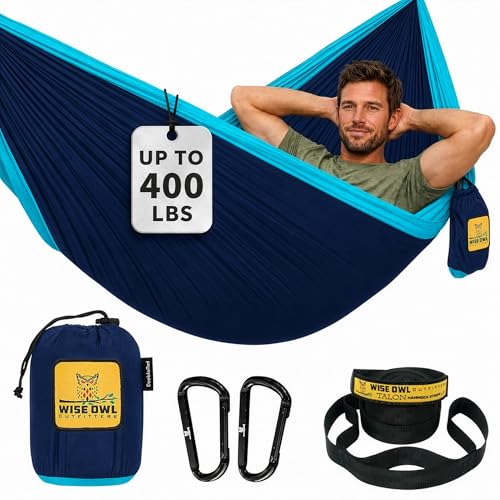
Nearly the same hang, with the straps thrown in
Wise Owl Outfitters Camping Hammock
The Wise Owl includes 9-foot tree straps, carabiners, and a built-in stuff sack, so there's nothing else to buy. It's parachute nylon with triple-stitched seams, and it packs to about 16 ounces in the single size.
$27.91fromAmazonList priceEverything you need is in the bag, and that's worth more than it sounds. OutdoorGearLab found that hammocks bundled with straps and carabiners cut first-time setup time by roughly eight minutes compared with hardware-only hammocks. If this is your first hammock, that difference is the gap between a relaxing afternoon and a frustrating one. The straps have five loops, so dialing in height is trial-and-error-free.
The fabric is the same basic idea as our top pick: quick-dry parachute nylon, triple-stitched, rated to hold serious weight without stretching out of shape. Owners who've used both brands say the hang feels close enough that the difference doesn't justify the gap in what you pay. Where you notice it is in the small stuff — stitching finish, the feel of the hardware, how neatly it stuffs back into the sack.
This is also the hammock we'd hand to someone who isn't sure they'll like hammocks yet. It's cheap enough to test the idea and good enough that you won't outgrow it in a season. It comes in single and double sizes; the single at 9 by 4.5 feet gives one person room to lie diagonal, which is the part that actually determines comfort.
The reputation is enormous and well earned. This is one of the most-reviewed outdoor hammocks on Amazon by a wide margin, and the feedback themes are remarkably consistent — easy setup, dries quickly, holds up to repeated use. When that many people report the same things, it tells you the quality control is steady rather than lucky.
Flaws but not dealbreakers
The included carabiners are the weak link. They're fine for lounging, but people who hammock a lot tend to swap them for higher-rated climbing-style carabiners within a season or two. It's a cheap upgrade, and you don't need to do it on day one.
The finish isn't premium. Seams and hardware are functional rather than refined, and the fabric doesn't have the soft hand of the pricier nylons here. None of that affects safety or comfort much. It just means the thing looks like what it costs.
Upgrade pick
Softer fabric, more capacity, and a lifetime guarantee
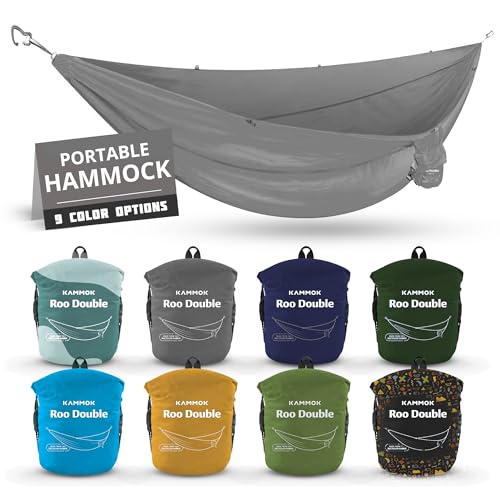
KAMMOK: Roo Double Hammock
The Roo Double uses Kammok's 40D diamond ripstop nylon, carries a 500-pound rating, and packs into an attached roll-top stuff sack. Eight gear loops let you add a pillow or insulation without rigging anything yourself.
$94.95fromAmazonThe first thing people notice is the fabric. Kammok's GravitasX ripstop is noticeably softer against skin than standard parachute nylon, and it's water-resistant, so a light drizzle beads instead of soaking in. Owners describe it as one of the most comfortable hammocks they've used. If you're going to spend whole afternoons in this thing, that texture difference stops being a luxury detail.
The 500-pound rating leads the category, and it matters more than the number suggests. Weight ratings assume a static load. When you drop into a hammock or swing hard, the momentary force on your anchor points can spike well above your body weight. Extra headroom in the rating is really extra margin for the way people actually use hammocks. Two adults, a dog, and a cooler is not a problem here.
The gear loops are the sleeper feature. Eight of them run along the sides, and they let you clip in a pillow or snap in sleep insulation without inventing a rigging system. If you're building toward a full hammock camping setup rather than just lounging, this is a platform you can grow into. The roll-top sack is attached, so you can't lose it in a pack.
Kammok backs it with a lifetime guarantee, and the fabric is 100% recycled. Neither of those changes how it hangs. But if you're deciding between two hammocks that both feel good, a warranty that outlives the product and a material story that isn't greenwashing are reasonable tiebreakers.
Flaws but not dealbreakers
It's the most expensive hammock here, and the jump in comfort over our top pick is real but not dramatic. If you use a hammock a few times a summer, you probably won't feel the difference enough to justify it.
The review pool is small compared with the mass-market options, so there's less long-term data to lean on. At least one owner reported a tear on a relatively new unit and had trouble reaching the seller quickly. The lifetime guarantee should cover that kind of thing, but it's worth knowing the support process isn't instant.
The Roo Double is covered by Kammok's lifetime Adventure Grade guarantee.
Also great
Bug netting built in, and flip it over when you don't need it
Grand Trunk Skeeter Beeter Pro Mosquito Hammock:
The Skeeter Beeter Pro wraps the sleeping zone in no-see-um mesh that hangs overhead rather than resting on your face. Flip the whole hammock over and it becomes a normal open hammock, so the net isn't a permanent commitment.
$69.99fromAmazonIf you camp anywhere humid in summer, the built-in net changes the calculation entirely. Add-on nets are fiddly, they cost extra, and they never sit quite right. This one is sewn in and held away from you by an elastic hold-open, so you can read a book or drink something without mesh on your nose. Campers in genuinely brutal bug country — Scottish midges, southeastern swamps — consistently point to this as the reason they bought it.
The reversible design is the smart part. When the bugs aren't out, you flip the hammock over and the netting ends up underneath you. You get an ordinary open hammock with no zipper in the way. That means you don't need two hammocks for two kinds of nights, which is the usual compromise with netted models.
Practical details add up. A double-sided zipper means you can get in and out from either side without contorting. Two interior pockets hold a phone and a headlamp, so you're not groping around in the dark. Triple-stitched reinforcement runs along the mesh-to-fabric seam, which is exactly where a netted hammock usually fails first.
It's the pick for someone who wants overnight bug protection without buying a full shelter system. Long-term owners report dozens of nights in these without the net tearing or the zipper giving out. That's a good sign for a component most people assume is the fragile part.
Flaws but not dealbreakers
The included hardware is the weak point. Owners commonly replace the stock carabiners and cordage with better rope and rated carabiners early on. The hammock itself is solid; the accessories that come with it are the budget part of the package.
At 1.8 pounds packed, it's heavier and bulkier than the plain nylon hammocks here. That's the price of carrying a net with you. If you're counting grams for a multi-day trip, this isn't your hammock.
Also great
No trees required, and it fits two adults side by side
Vivere Double Cotton Hammock with Space Saving
The Vivere pairs a cotton double hammock with a 9-foot powder-coated steel stand rated to 450 pounds. It assembles without tools in minutes, and it's the only pick here that works on a deck, a patio, or a treeless lawn.
$139.99fromAmazonIf your yard doesn't have two well-spaced trees, this is the answer. Most doubles need anchors 10 to 15 feet apart, and plenty of yards, decks, and patios simply don't offer that. The 9-foot steel stand solves it outright. You get a consistent hang angle every time because the geometry is fixed, which quietly eliminates the most common source of hammock discomfort.
The bed is genuinely big — 63 by 94 inches, with a total length of 130 inches. Two adults fit side by side without one person rolling into the other, which is more than we can say for the nylon doubles here. Combined capacity is 450 pounds. For lazy weekend afternoons with another person, this is the most comfortable option in the guide.
Cotton feels better than nylon for lounging, and that's not a small thing when you're in it for hours. It breathes, it doesn't get slick against skin, and it has more give. The stand assembles without tools; owners commonly report having it together in 10 to 20 minutes on the first try. Some found the single-sheet instructions thinner than they'd like.
Durability here is about the stand as much as the fabric. Owners report using the same Vivere stand for a decade or more, swapping hammocks onto it as the fabric ages. That's a useful way to think about the purchase — you're buying a frame that outlives its bed, and replacement beds are easy to find.
Flaws but not dealbreakers
Cotton is the wrong material for wet weather. Parachute nylon dries in 15 to 30 minutes of sun; woven cotton needs two-plus hours. Leave this out in a rainstorm and you're looking at a damp hammock the next day, and repeated soakings shorten its life. Bring it in or use a cover.
It weighs 27.6 pounds with the stand, which makes it portable only in the sense that it fits in a car. It's not backpacking gear, and it's not something you'll casually relocate around the yard on a whim.
It's a lounger, not a camping shelter. There's no bug net, no rain protection, and no way to add either cleanly. For summer evenings when the mosquitoes come out, you'll want a separate plan.
Who this is for
Buy a hammock if you want a comfortable place to lie outside that packs away when you're done. It's the right call for backyard afternoons, trailside breaks, beach days, and — with the right model — overnight camping. If you're new to this, start with a plain nylon double and a set of one-inch straps. You'll learn quickly whether you want to go further, and you'll have spent very little to find out.
Skip it if you don't have two anchors roughly 10 to 15 feet apart and don't want a stand taking up yard space. Skip it also if you're replacing a tent for cold-weather camping — hammocks lose heat underneath you, and staying warm means adding an underquilt or pad, which is a separate purchase and a separate learning curve. This guide covers gathered-end hammocks and one stand-included lounger. It doesn't cover hammock chairs, bridge hammocks, tarps, underquilts, or standalone suspension kits.
How we picked
We weighted five things. Capacity and construction: stated ratings checked against fabric denier and seam type, with a 400-pound floor for doubles because dynamic load spikes past your body weight when you drop in. Fabric and dry time: nylon dries in 15 to 30 minutes of sun where cotton takes two-plus hours, so nylon won anything that leaves the yard. Suspension included: bundled straps and carabiners cut first-time setup by roughly eight minutes, and strap width had to clear the one-inch Leave No Trace minimum. Packed weight: critical for backpacking, close to irrelevant on a patio. Comfort geometry: bed width, length, and whether the design lets you lie diagonal, since that's what your lower back actually feels.
Other hammocks for outdoor relaxation worth considering
If you want to sleep in a hammock every night on a trip: The Hennessy Hammock - Explorer Deluxe Zip XL ($219.95) — The Hennessy Explorer Deluxe Zip XL is a complete shelter, not just a hammock. It includes a 70D polyester ripstop rainfly, no-see-um mesh with an elastic hold-open, a gear loft on the ridgeline, and webbing straps. The asymmetric cut positions you diagonally across the fabric, which produces a much flatter lie than a symmetrical gathered-end hammock — that's the design that makes overnight sleeping actually work. The structural ridgeline means you get the same sag every night regardless of tree spacing, so there's no guesswork. It's sized for people up to 7 feet and 300 pounds, and long-term owners report hundreds of nights in them. What you give up is weight and simplicity: at 3 pounds 9 ounces packed it's the heaviest fabric hammock here, and owners note it's not built for cold or heavy wind without a larger fly. There's a learning curve to getting in and moving around, too.
The competition
Here's what our research surfaced, which isn't everything on the market. The hammock category is enormous and much of it is undifferentiated — dozens of near-identical parachute nylon doubles from brands you'll never hear from again. We focused on models with a documented track record in published reviews, a clear spec sheet, and enough owner feedback to spot patterns rather than one-offs. Every product in our lineup earned a spot as a pick or an also-consider, so there's nothing here that we looked at and set aside.
Hanging it right
Two things determine whether a hammock is comfortable, and neither is the hammock. First, hang angle: aim for about 30 degrees from horizontal on your straps. REI's guide notes that going past 45 degrees drives lateral shear force into your anchor points and puts a hard curve in your lower back. If your hammock looks like a tight banana, your straps are too high and too taut. Second, lie diagonal, not straight down the centerline — that flattens the fabric under you and is the single biggest comfort upgrade available for free. Use straps at least an inch wide; narrower webbing can girdle bark in one night. Let nylon dry in the sun before packing it, and bring cotton inside after rain.
Questions we get
How far apart do my trees need to be?
Most double hammocks want anchors 10 to 15 feet apart. Shorter spans need longer extension straps to get the right angle, and spans past about 16 feet sag more than you'll find comfortable without a ridgeline system. Measure before you buy straps, not after.
What straps do I need so I don't hurt the trees?
Use webbing straps at least one inch wide. That's the Leave No Trace minimum, and it exists because narrow cord concentrates load — straps under three-quarters of an inch can damage the cambium layer in a single overnight hang. Never use bare rope or wire directly against bark.
Nylon or cotton for lounging?
Cotton feels better against skin and has more give, so it wins for long afternoons on a patio. Nylon wins everywhere else because it dries in 15 to 30 minutes of sun versus two-plus hours for cotton. If the hammock ever leaves your yard, get nylon.
How much weight can a camping hammock actually hold?
The picks here are rated from 400 to 500 pounds, but those numbers assume a static load. Dropping into the hammock or swinging hard can briefly double the effective force on your anchor points. Leave real headroom above your combined body weight rather than treating the rating as a target.
Can I hang a hammock without any trees?
Yes, with a stand. The Vivere bundle includes a 9-foot steel stand rated to 450 pounds, and it works on a deck, a patio, or a bare lawn. Stands also give you a consistent hang angle every time, which removes the most common cause of hammock back pain.
Do I need a bug net, a ridgeline, and a rain fly?
For backyard lounging, no — straps and carabiners are enough. For summer camping in the eastern US or Pacific Northwest, a net is close to essential, and buying one built in beats adding it later. A structural ridgeline is a genuine convenience for overnight use because it locks in the same sag every night; a rain fly matters only if you're sleeping out.
Why you should trust us
For this guide:
- We read manufacturer specifications for every hammock here, comparing stated weight ratings, fabric denier, packed weight, and exactly what hardware ships in each box.
- We reviewed published guidance from REI on hang angle and tree spacing, Leave No Trace standards on strap width, and side-by-side coverage from OutdoorGearLab and Switchback Travel.
- We read owner feedback across each listing for recurring themes — setup time, hardware quality, dry time, and how these hold up after multiple seasons outdoors.
- We read owner reviews on every listing, weighted toward the critical ones, because that is where the recurring failures show up.
- We have a systematic way of automatically fetching the latest prices, so the numbers on this page stay current.
- This is a research-focused guide, so the team may not own every product listed — though we often do own the top winners, which gives us extra context for the recommendations.
- We don't accept free products, and the retailer commission never changes which product we recommend.
Sources
Best Hammocks of 2026 — OutdoorGearLab, OutdoorGearLab
Best Hammocks — Wirecutter / The New York Times, Wirecutter
Best Camping Hammocks 2026 — GearJunkie, GearJunkie
Best Backpacking Hammocks 2026 — Backpacker Magazine, Backpacker Magazine
Best Hammocks for Camping — Clever Hiker, Clever Hiker
Best Camping Hammocks 2026 — Switchback Travel, Switchback Travel
How to Hang a Hammock — REI Expert Advice, REI
Hammock Camping — Leave No Trace Center for Outdoor Ethics, Leave No Trace Center for Outdoor Ethics
ENO Hammock Buying Guide — REI, REI
Best Hammocks — The Adventure Junkies, The Adventure Junkies
ENO DoubleNest Product Specifications, Eagles Nest Outfitters
Kammock Roo Double Product Specifications, Kammock
Amazon product listings and owner reviews for all 6 products
Manufacturer specification pages for each product
Some passages in this guide may be paraphrased with AI help. Prices are refreshed automatically.
More like this.
Continue exploring lifestyle reviews and recommendations.

The Best Outdoor Dining Sets
A patio dining set gets used in ways indoor furniture never does. It sits in July sun, gets rained on, holds a wobbling stack of plates, and then waits…

The Best Outdoor Solar Garden Lights
Solar garden lights solve a problem that used to mean digging a trench. You want the front walk lit so nobody trips on the step, or the back fence lit so…

The Best Gas Grills for Outdoor Entertaining
A grill that's fine for two pork chops on a Tuesday falls apart when twelve people show up. You need enough grate space to get everything off at once,…

The Best Waterproof Outdoor Bluetooth Speakers
A speaker that lives outdoors leads a rough life. It gets set down in wet sand, splashed by a cannonball, knocked off a picnic table, and left in a hot…

The Best Sunscreens for Outdoor Activities
Sunscreen for a long day outside has a different job than the stuff you dab on before the commute. It has to survive sweat running down your forehead, a…

The Best Outdoor Grills and BBQ Smokers
Most of the cooking you'll do on a grill isn't brisket. It's burgers on a Tuesday, chicken thighs before the kids melt down, a couple of steaks when…