The Best Wind-Resistant Compact Umbrellas

A compact umbrella earns its keep on the walk from the train to the office, when the rain is coming sideways and you've got a bag on one shoulder. What matters isn't the canopy print. It's whether the frame flexes and springs back when a gust catches the edge, whether the thing fits in the bag you actually carry, and whether the open button still works a year from now. Most umbrellas fail at one of those three. The good ones get all three right.
Here's the part nobody advertises: no compact umbrella is windproof. Companies print wind ratings — 80 km/h, 115 km/h, 100 mph — and there's no shared test behind any of them, so you can't rank brands by the number on the box. For scale, the National Weather Service calls 39 to 46 mph a gale and 55 to 63 mph a storm. In a true gale, your smartest move is to close the umbrella and get wet. Size works against you, too. A wider canopy covers more of you and catches more wind.
So the real question isn't which umbrella beats a storm. It's which one shrugs off the everyday 25 mph gust at a crosswalk, pops back into shape, and keeps doing that for years. Flexible fiberglass ribs and a vented or shaped canopy help a lot. A serious warranty helps more, because it tells you what the company expects to happen. We think that the Davek Solo is the best wind-resistant compact umbrella for most people, and that the Blunt Metro is the one to buy if you'd rather repair a frame than replace an umbrella.
Everything we recommend
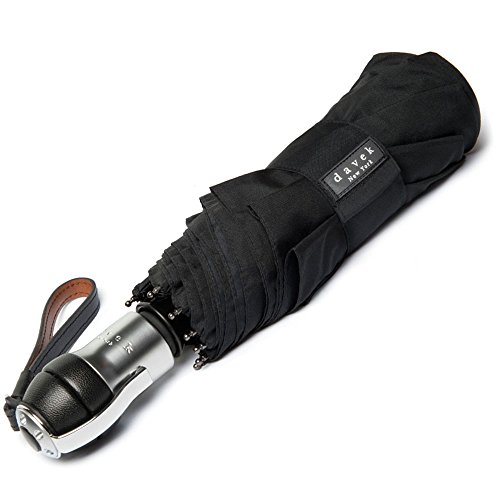
Heavier than most compacts, and far tougher in a crosswind

A frame you can take apart and fix, if you'll carry the heft

Light, vented and sold as a pair, with a shorter life

An asymmetric shape that cuts the wind, if you can aim it
Prices as of Oct 27, 8:28 AM PT · Details
At a glance
| Product | Canopy width | Weight | Price | |
|---|---|---|---|---|
| DAVEK SOLO UMBRELLATop pick | 37 in | 1.125 lb | $120 |
| Senz° Mini Automatic Windproof UmbrellaAlso great | 35.82 in | 0.92 lb | $72.95 |
| BLUNT Metro Travel UmbrellaRunner-up | 39.4 in | 0.79 lb | $119 |
| Repel Umbrella Windproof Travel Umbrellas for RainBudget pick | — | Under 1 lb | $37.99On sale |
 | Totes Titan Compact Travel UmbrellaAlso in lineup | — | 1.05 lb | $23.80 |
 | Knirps Emergency Pack - T.200 Duomatic AutomaticAlso consider | 39 in (auto) | 130 g (X4U) | Check price |
 | Gustbuster Umbrella - LTD - Automatic Open/CloseAlso consider | 44 in arc | 0.65 lb | $70.81On sale |
 | EuroSCHIRM Swing Liteflex Ultra-Light Weight Trekking UmbrellaAlso consider | 37.5 in | 0.55 lb | $65.25 |
Prices as of Oct 27, 8:28 AM PT · Details
How we picked
Frame and ribs. We favored flexible fiberglass or composite ribs over rigid aluminum, because spec sheets and owner feedback both point the same way: fiberglass bends and recovers where metal creases and stays creased.
Canopy shape. Vented double canopies and aerodynamic shapes let a gust escape instead of lifting the umbrella. We looked for one or the other, and we read wind-speed claims as marketing rather than measurement.
Packed size and weight. We compared stated folded length and weight across the lineup, and prioritized anything that fits a work bag or glove box. Under a pound and under about 12 inches folded is the sweet spot for daily carry.
Mechanism reliability. Auto open/close is the single most common failure point on compact umbrellas, so we weighted owner feedback about latching and retracting heavily, especially on inexpensive models.
Warranty and repairs. A lifetime guarantee or a frame you can disassemble tells you what the company expects of its own build. We treated that as a proxy for durability where independent testing doesn't exist.
Top pick
Heavier than most compacts, and far tougher in a crosswind
DAVEK SOLO UMBRELLA
The Solo is a small, heavy, frankly overbuilt umbrella with a solid steel shaft and ribs that bend in a gust instead of folding backward. It's the one to buy if you're tired of dropping dead umbrellas into sidewalk trash cans.
$120fromAmazonPrices as of Oct 27, 8:28 AM PT · Details
The frame is the whole reason to buy this one. Davek builds it from steel, fiberglass, zinc alloy and aluminum, with flexible carbon polymer ligaments running through the ribs and a solid steel shaft down the middle. In plain terms: when the wind grabs the edge, the ribs give a little and then come back. Owners in places with real weather — Chicago microbursts, coastal Oregon rain — report years of use without a bent rib.
Pick it up and you'll notice the weight right away. The zinc alloy handle is plated in brushed nickel so it won't corrode, and it's got a clip so the umbrella hangs off a belt loop or stays put inside a bag instead of rolling around. The automatic open fires fast with one hand, which matters when your other hand has coffee or a kid in it.
The lifetime guarantee is what should close the deal. An umbrella company willing to replace the thing forever has made a bet about its own frame. Wirecutter's umbrella guide, which puts compact and stick models through wind-durability and portability testing, treats the Solo as a reference point for this tier, and owner feedback lines up: people describe it as the last umbrella they bought, and several keep a second one in the car.
The canopy is a thin microweave with a water-repellent coating outside and a polyurethane layer inside, and it sheds water fast enough that the sleeve isn't soaked by the time you sit down. At 37 inches across, it covers you and your bag well. It won't cover two adults. None of these compacts really do, no matter what the listings suggest.
Flaws but not dealbreakers
It's the heaviest kind of compact you'd want to carry — a little over a pound, and thick in the hand. If your standard is a flat pocket umbrella that disappears into a jacket, the Solo will feel like a tool you packed on purpose. A few owners also find the hooked handle and clip awkward against the shaft when the umbrella is folded.
It's also the most expensive umbrella here by a wide margin, and a small share of owners report canopy pinholes or seam trouble within months. That's what the guarantee is for, but you shouldn't have to use it that early. If you lose umbrellas regularly, spending this much on one you'll leave in a restaurant is the wrong move.
Davek backs the Solo with a lifetime guarantee, which is unusual in this category.
Runner-up
A frame you can take apart and fix, if you'll carry the heft
BLUNT Metro Travel Umbrella
The Metro spreads gust force across the whole canopy instead of loading it onto the rib tips, and the canopy, frame, shaft and handle come apart for repair. It's bulkier than a pocket umbrella, and the rounded tips won't catch anyone's eye on a crowded platform.
$119fromAmazonPrices as of Oct 27, 8:28 AM PT · Details
Blunt's canopy pulls tension outward to the rim through what the company calls a Radial Tensioning System, so a gust gets distributed across the fabric rather than concentrated where the ribs end. That's why the edge looks squared off and the tips are rounded nubs instead of spikes. Blunt says the Metro holds up to 115 km/h. Treat that like every other number in this category — a company claim, not an independent result.
The modular build is the quiet selling point. The canopy, frame, shaft and handle detach, so a single broken part doesn't retire the whole umbrella. That's rare, and it changes the math on buying something this expensive. One owner describes pulling an eight-year-old Blunt out of storage and finding it essentially unchanged, which is the kind of feedback you almost never see about an umbrella.
At 39.4 inches, the canopy is the widest of our picks, and it's still the lightest of the three premium options at about 0.79 pound. The auto-open button gets you covered in a second, and the canopy spins freely on the shaft, so you can twist it out of someone's way on a narrow sidewalk or shake water off before you step inside.
If you walk through crowds — subway stairs, school pickup, a packed farmers market — the blunt tips are a real feature and not marketing. There's no point at eye level. Several owners buy it specifically as the umbrella they're comfortable holding over someone else, which is also why it shows up a lot as a gift.
Flaws but not dealbreakers
Owners say the same thing over and over: it's bulkier and heavier in the hand than the specs led them to expect. Folded, it's a fat cylinder, not a slim wand. It'll ride in a tote, a car door or a backpack side pocket, but it won't vanish into a small purse.
The button opens it; you close it by hand, which is a step backward from the one-touch mechanisms on the Repel and the Senz. And while the frame is repairable, the listing doesn't state a warranty term, and some owners describe slow, vague responses from support when a part failed inside the first year. Buy it for the hardware, not the service.
Budget pickOn sale
Light, vented and sold as a pair, with a shorter life
Repel Umbrella Windproof Travel Umbrellas for Rain
Repel's compact folds to about 11.5 inches, weighs under a pound, and puts nine fiberglass ribs under a vented canopy so gusts can push through instead of lifting it. This listing is a two-pack, so one can live in your bag and one in the car.
$37.99fromAmazonTypical pricePrices as of Oct 27, 8:28 AM PT · Details
For most people, this is enough umbrella. The vented double canopy lets air escape through the overlap rather than ballooning, and the nine fiberglass ribs flex instead of creasing. Repel says it's tested to 100 mph, which tells you nothing useful — no standard exists behind claims like that. What does mean something is the size of the owner base, and the broad pattern in that feedback is that it survives ordinary windy commutes.
The practical stuff is where it wins. It folds to 11.5 inches and weighs under a pound, so it fits a glove compartment, a backpack water-bottle pocket or a work bag without you planning around it. One touch opens it, one touch closes it, and the mechanism needs almost no force — handy when you're half in and half out of a car door.
Two umbrellas in one box also solves the problem you actually have. You will leave one at a restaurant, or lend it and never see it again, or find the first one wet in the trunk when you need it. Keeping a spare in the car means the backup isn't whatever flimsy thing the gas station sells.
Buy it as the umbrella you can afford to lose. It costs a small fraction of what the Davek or the Blunt does, and if the wind wins on a bad day, you're out very little. For a student, a gift, a guest bedroom or a second car, that's often the right answer — and if a vented compact is all you've ever needed, there's no reason to spend more.
Flaws but not dealbreakers
Auto open/close mechanisms are the most common failure point on inexpensive compacts, and that's where this one tends to go. Owner feedback includes units that stop latching or stop retracting after a season or two of daily use. It's not a dealbreaker on a two-pack, but don't expect a decade.
The canopy gets marketed as covering two people. In practice it's one person and a bag, same as the rest of these. The handle is plastic rather than metal, and the listing doesn't state a warranty term, so plan on replacement rather than repair.
Also great
An asymmetric shape that cuts the wind, if you can aim it
Senz° Mini Automatic Windproof Umbrella
Senz's mini has a lopsided, bird-wing canopy with a long tail at the back, so wind slides over it instead of getting underneath. Point the short end into the gust and it holds its shape while the round umbrellas around you fold inside out.
$72.95fromAmazonPrices as of Oct 27, 8:28 AM PT · Details
The shape looks strange until you've used it in a headwind. The canopy sits low and short in front and stretches long and high behind you, so air flows over the top instead of catching the rim. Senz rates the mini to 80 km/h — roughly 50 mph — without inverting. That's the company's own figure, but the aerodynamics behind it are real, and owners who walk windy city blocks tend to become evangelists.
A shape beats a vent when the wind has a direction. Vented canopies bleed off pressure from any angle, which is forgiving. Senz does something different: it turns the umbrella into a wing that wants to sit nose-into-the-wind. On an exposed waterfront or between tall buildings, that's a bigger advantage than any rib material. In swirling, shifting gusts, it's less of one.
The rest is well sorted for a commute. It weighs about 0.92 pound, the folded shaft is 11.1 inches, and the one-touch mechanism opens and closes it. The pongee canopy dries quickly and carries a UPF 50+ coating, and the reflective version puts a bright band at the rim so drivers see you at a dark crosswalk. Blunt Eyesavers cap the tips.
You should also know what you're holding. The canopy is 91 by 91 cm, so coverage is generous behind and tight at the front corners. If you walk with your head down into the rain, that's exactly backward from how most umbrellas fail you — and exactly why people who try one stop shopping.
Flaws but not dealbreakers
You have to aim it. Turn your back to the wind and it's superb; get caught in a crosswind while you're looking over your shoulder for a bus and it'll shove you around. There's a learning curve of a few storms, and it's an awkward umbrella to hand to someone else.
Owner feedback on this model is thin compared with the rest of the lineup, and it isn't all good — some buyers report the canopy collapsing partway through use and then needing a close-and-reopen to lock again, plus unhelpful support afterward. It also attracts comments, which is either fun or annoying depending on you.
Who this is for
This guide is for anyone who keeps buying umbrellas and keeps throwing them away — the commuter who walks four windy blocks each way, the traveler who wants rain coverage that doesn't eat a carry-on, the person shopping for a gift that'll outlast the wrapping paper. If you only need something for the occasional drizzle between your car and a store entrance, almost any cheap compact works, and you can stop reading. Spending more makes sense when wind is the problem, not rain.
We stuck to compact and folding umbrellas you'd carry daily, plus one ultralight trekking model for hikers. We didn't look at full-size stick umbrellas, golf umbrellas or patio umbrellas, and we're not covering sun-only parasols, though a few picks here carry UV coatings. Everything we write about comes from manufacturer specs, published reviews and themes in owner feedback — not from our own storms.
How we picked
Here's what we weighed. Frame and ribs: flexible fiberglass or composite over rigid aluminum, since fiberglass bends and springs back where metal creases for good. Canopy shape: a vented double canopy or a true aerodynamic profile, so gusts have somewhere to go. Packed size and weight: under a pound and around 12 inches folded, the point where you stop leaving the umbrella at home. Mechanism: auto open/close that owners report still working after a couple of seasons, because that's where budget compacts die first. Warranty and repairs: a lifetime guarantee or a frame that comes apart, which is the closest thing to durability evidence this category offers.
Other wind-resistant compact umbrellas worth considering
If you want an everyday automatic plus an ultralight backup: The Knirps Emergency Pack - T.200 Duomatic Automatic — This Knirps pack bundles two umbrellas with different jobs. The T.200 Duomatic is the daily driver: one-touch open and close, a 98 cm (39 in) canopy, folding down to 28 cm (11 in), and claimed wind resistance to 150 km/h. The X4U is the one you forget you're carrying — 21 cm (8 in) folded, 130 grams, manual, wind-tunnel tested to 100 km/h per Knirps, with a microfiber case that soaks up the drips. Knirps has been building folding umbrellas about as long as anyone, and the frames have a long reputation for surviving daily abuse. The catch is that you're buying two umbrellas whether you want two or not, this particular pack has almost no owner feedback yet, and the X4U's tiny canopy covers your head and not much else.
If you want a wider canopy backed by a lifetime guarantee: The Gustbuster Umbrella - LTD - Automatic Open/Close — The GustBuster LTD opens to a 44-inch arc — noticeably more coverage than the compacts above — and GustBuster says it resists 55-plus mph winds, with hi-impact carbon steel joint connectors at the stress points and a lifetime guarantee behind it. It's light for its size at about 0.65 pound, and it opens and closes automatically. Owner feedback skews long-term: people describe keeping one in a truck for a decade, replacing one after several years of hard student use, buying several as gifts. What you give up is pocketability, since 16.25 inches folded is long for a small bag, and polish — the canopy is plain polyester, and the whole thing looks like gear rather than an accessory.
If you want the lightest umbrella for hiking: The EuroSCHIRM Swing Liteflex Ultra-Light Weight Trekking Umbrella — The EuroSCHIRM Swing Liteflex is a different animal: a fixed-shaft trekking umbrella at 0.55 pound, with high-density fiberglass ribs and a fiberglass shaft that flexes rather than snaps. The 37.5-inch Teflon-coated canopy sheds water and grime, the silver exterior adds 50+ UV protection while the black underside kills glare, and the sleeve has mesh panels so it dries while strapped to your pack. A safety runner keeps you from pinching a finger, and the grooved EVA handle stays grippable when wet. But it doesn't fold — it's 25 inches long, period — so it rides on a backpack, never in a purse. Hikers love it for shade on an exposed 90-degree climb as much as for rain.
The competition
This is what our research surfaced, not a census of every umbrella for sale. Plenty of capable models never made the list, and the lineup here reflects what we could confirm on Amazon with enough specs and owner feedback to say something honest about.
The Totes Titan Compact Travel Umbrella — The Totes Titan is the familiar drugstore-aisle compact done a bit better, with auto open/close and a canopy that's roomier than most pocket umbrellas. Two things kept it out of the picks. Its frame is aluminum, and rigid metal ribs are exactly what tends to crease and stay creased after an inversion — the opposite of what we look for. And the listing is thin: no canopy diameter, no wind claim, no warranty term, with very little owner feedback to fill the gaps. Still, it's cheap, it's everywhere, and replacing one is painless. If you want an umbrella you can grab at a moment's notice from a brand your parents owned, it's a reasonable default.
Care and drying
Most compact umbrellas don't break — they rot. If you fold a wet one into its sleeve and leave it in a bag, you'll meet the mildew smell in about a week, and no amount of washing fully clears it. So open it indoors and let it dry fully before it goes back in the case, ideally propped over a tub or a towel. Shake the water off with a quick spin rather than whacking it against a wall, which is how ribs get bent. Wipe grit out of the rib joints now and then, since sand and road salt chew up the hinges. When water stops beading, a spray-on fabric treatment restores the repellency. And don't force a stuck auto mechanism. Close it by hand, dry it, then try again.
Questions we get
Do windproof umbrellas actually work in strong wind?
Up to a point, yes. Flexible fiberglass ribs and vented or aerodynamic canopies really do survive gusts that destroy a cheap flat-canopy umbrella. But "windproof" is a marketing word, not a standard. In sustained gale-force wind, the right call with any of these is to close it and get wet.
How much wind can a windproof umbrella handle?
Nobody can tell you precisely, because there's no shared test. The claims on these listings range from 80 km/h to 100 mph, and they're all generated in-house. For context, the National Weather Service calls 39 to 46 mph a gale and 55 to 63 mph a storm. A good compact should handle everyday 20 to 30 mph gusts without inverting, and that covers nearly every commute.
Fiberglass or metal ribs: which is better in wind?
Fiberglass, in most cases. It bends under load and springs back to shape, which is why premium frames use it or a composite. Aluminum and steel ribs are stiffer and resist small gusts well, but once they take a hard inversion they tend to crease permanently. The sturdiest frames, like the Davek Solo's, combine a steel shaft for rigidity with flexible ribs.
Why do umbrellas flip inside out?
Air gets under the canopy and pressure builds with nowhere to escape, so the dome turns over at its weakest hinge point. Vented double canopies give that air an exit through the overlapping panels. Asymmetric designs like the Senz avoid the problem differently, by shaping the canopy so wind flows over it rather than into it. Holding the umbrella tilted into the wind helps a lot with either design.
Do auto-open umbrellas break more easily?
The mechanism is the most common failure point on inexpensive compacts, and auto open/close adds a second spring assembly to go wrong. On well-built models it's a non-issue for years. On budget ones, expect the latch or the retract to get cranky eventually — which is part of why we like a two-pack at that end of the market.
What's the best compact umbrella to keep in a purse or backpack?
Look for something under a pound that folds to roughly 11 or 12 inches. The Repel fits that profile at 11.5 inches folded, and the Senz mini has an 11.1-inch folded shaft. If you need smaller still, the X4U in the Knirps pack folds to 21 cm (8 in) and weighs 130 grams, though you trade away canopy size to get there.
Why you should trust us
For this guide:
- We read the manufacturer spec sheets and wind-resistance claims for every umbrella in this lineup, and compared stated folded length, weight and canopy diameter side by side.
- We consulted published umbrella guides, including Wirecutter's, which covers wind durability and portability for compact and stick models, and we read National Weather Service wind definitions to put the marketing numbers in context.
- We read through owner feedback for each model, looking for repeated themes about frame failures, mechanism trouble and long-term durability rather than one-off complaints.
- We read owner reviews on every listing, weighted toward the critical ones, because that is where the recurring failures show up.
- We have a systematic way of automatically fetching the latest prices, so the numbers on this page stay current.
- This is a research-focused guide, so the team may not own every product listed — though we often do own the top winners, which gives us extra context for the recommendations.
- We don't accept free products, and the retailer commission never changes which product we recommend.
Sources
Best Umbrellas - Wirecutter, Wirecutter
Umbrella reviews - Consumer Reports, Consumer Reports
Davek Solo product and guarantee page, Davek (manufacturer)
Senz° Mini Foldable specifications, Senz° (manufacturer)
Blunt Metro and Radial Tensioning System, Blunt (manufacturer)
Beaufort wind force scale, NOAA / National Weather Service
Knirps T.200 specifications, Knirps (manufacturer)
Euroschirm Swing Liteflex specifications, Euroschirm (manufacturer)
Amazon product listings and owner reviews for all 8 products
Manufacturer specification pages for each product
Some passages in this guide may be paraphrased with AI help.
Product prices and availability are accurate as of the date/time indicated and are subject to change. Any price and availability information displayed on Amazon.com at the time of purchase will apply to the purchase of this product.
More like this.
Continue exploring lifestyle reviews and recommendations.

The Best Wind-Resistant Patio Umbrellas
Wind is what kills patio umbrellas. Sun fades a canopy slowly, over seasons, and rain mostly just beads up and rolls off. But one gust under an open…

The Best Compact Rowing Machines
Rowing is the rare cardio machine that doesn't punish you for using it. One stroke pulls in your legs, back, core and arms at once, and your knees never…

The Best Compact Photo Printers
A compact photo printer turns the thousands of pictures buried on your phone into something you can stick on a fridge, tuck into a card, or hand to your…

The Best Metal Detectors for Finding Gold
Gold hides in ground that fights you. The dirt in most active goldfields is loaded with iron, and that iron talks back to a detector all day long - …

The Best Outdoor Dining Sets
A patio dining set gets used in ways indoor furniture never does. It sits in July sun, gets rained on, holds a wobbling stack of plates, and then waits…

The Best Satellite Messengers and Two-Way Communicators
Cell coverage ends sooner than you'd think. Drive an hour past the last gas station, drop into a canyon, or push a few miles up a drainage, and your phone…