The Best Hiking Poles
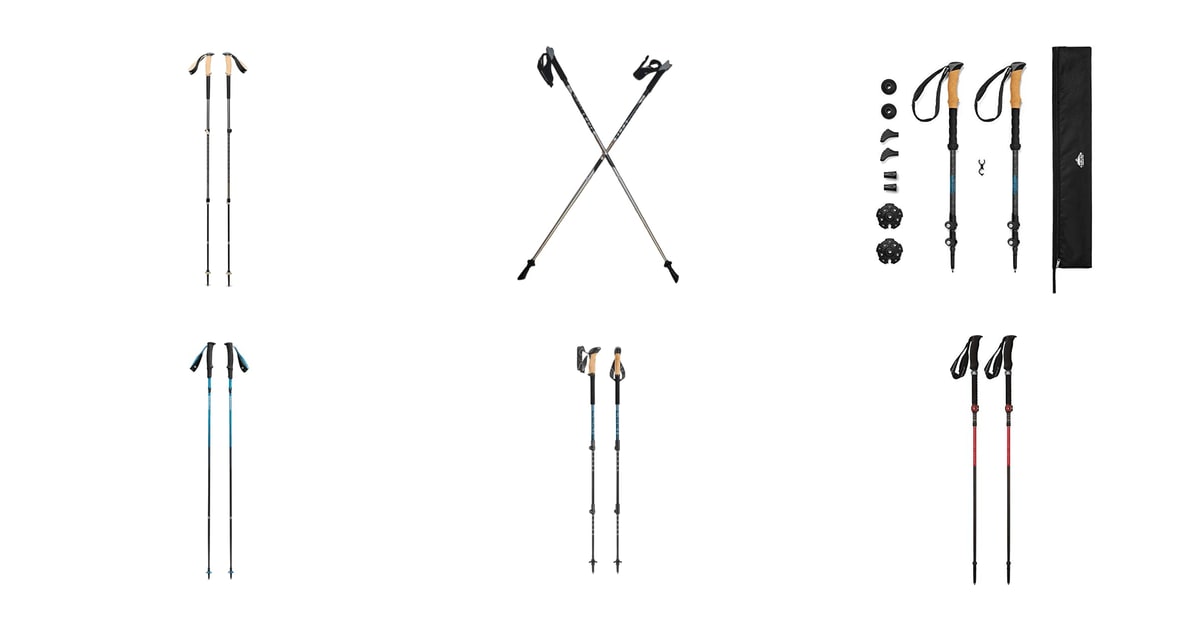
Hiking poles change how a trail feels. On a steep descent, they take a real bite out of what your knees absorb — research published in Clinical Biomechanics puts the reduction in compressive knee force somewhere between 12 and 25 percent. On a loose scree slope or a slick creek crossing, they give you two more points of contact. And on a long day with a heavy pack, they spread the work to your arms and shoulders. Most people who try a pair don't go back.
Here's the honest catch: no pole does everything. Carbon is lighter, but it can snap under a sudden sideways load — the kind you get when a tip wedges between two rocks. Aluminum takes that abuse and bends instead of breaking, but you carry the extra grams every step. Folding poles pack small enough for a carry-on and give up length adjustment to do it. Telescoping poles adjust freely but never get as short. You're picking which compromise you can live with.
We looked at what published reviewers, spec sheets and owner feedback say about six poles, across price ranges and designs. We think that the Black Diamond Trail Cork is the best hiking pole for most people, and that the Cascade Mountain Tech Carbon Fiber Trekking Poles are the ones to buy if you're new to poles or shopping on a tight budget.
Everything we recommend

Cork grips and locks that hold, in any season
Carbon shafts and cork grips for a fraction of the ask

The lightest, smallest option, if you'll accept fixed length

Built for snow, splitboards and genuinely rough seasons
At a glance
| Product | Weight | Material | Price | |
|---|---|---|---|---|
| BLACK DIAMOND Trail Cork Trekking PolesTop pick | 1.07 lb | Aluminum | $129.95 |
 | LEKI Nordic Walking Speed Pacer Vario HMAlso in lineup | 144 g | Carbon | $69.99 |
| Cascade Mountain Tech Trekking Poles - CarbonBudget pick | 8.1 oz | Carbon Fiber | $51.99On sale |
| BLACK DIAMOND Distance Carbon Z PolesAlso great | 0.57 lb | Carbon Fiber | $209.95On sale |
 | LEKI Makalu Cork Lite Trekking Poles-Stone BlueAlso consider | 8.8 oz | Aluminum | $159.95 |
| MSR Dynalock Ascent Carbon Backcountry PolesUpgrade pick | 17 oz | Carbon Fiber | $189.95 |
How we picked
Locking reliability. We weighted lever-lock mechanisms over twist locks based on GearJunkie's field findings that levers hold their set length more than 95 percent of the time in cold and wet conditions. A pole that collapses mid-descent is worse than no pole.
Grip material and comfort. We compared cork, foam and rubber against Switchback Travel's grip material findings, which favor cork past the three-hour mark and foam below freezing. Every pole here uses cork or EVA foam, not bare rubber.
Weight versus toughness. We treated the 20 to 30 percent weight savings of carbon over aluminum, per REI's material guide, as a real benefit that carries a real cost in lateral-impact resistance. We wanted both options represented, not one declared the winner.
Packed length. We looked at folded and collapsed dimensions from manufacturer specs, because a pole that fits inside a 30-liter pack or a carry-on is a different tool than one that always rides outside.
Baskets and tip swaps. We favored poles that include or accept snow and mud baskets and rubber tips, since off-trail and shoulder-season hiking depends on them and they're cheap to add at the factory.
Top pick
Cork grips and locks that hold, in any season
BLACK DIAMOND Trail Cork Trekking Poles
The Trail Cork pairs natural cork grips with Black Diamond's FlickLock lever system on three-section aluminum shafts. It adjusts from 100 to 140 cm, swaps between carbide and rubber tips, and handles summer switchbacks and winter snowshoeing without complaint.
$129.95fromAmazonThis is the pole we'd hand to almost anyone. The combination that matters most — a grip that stays comfortable for hours, a lock that doesn't creep, and a shaft that survives being jammed into rock — is all here in one package. Black Diamond's Trail Ergo Cork, the close sibling of this model, has taken Outdoor Gear Lab's Editors' Choice award across multiple consecutive testing cycles for exactly that combination.
Cork is the reason your hands stay happy. Switchback Travel rates cork above foam and rubber for hikes past the three-hour mark, because it wicks sweat instead of getting slippery. It also molds to your palm over a season of use. The dual-density grip tops and extended foam sleeves below let you choke down on a steep pitch without stopping to shorten anything.
The FlickLock levers are the other half of the argument. GearJunkie's field work across alpine and wet conditions found lever-lock mechanisms hold their set length more than 95 percent of the time, while twist locks can quietly slip under sustained load. If you've ever had a pole collapse mid-step on a descent, you know why that number matters. Owners who've taken these on knife-edge ridges and scree runs consistently report the locks catching full body weight.
Aluminum is the deliberate choice here, not a cost-cutting one. Per REI's material comparison, carbon runs 20 to 30 percent lighter than aluminum of the same design — but aluminum shrugs off the sudden lateral impacts that crack carbon. On rocky scrambles where a tip can catch and torque, that's the trade you want. The pair lands right around a pound.
The range is genuinely useful. At 100 to 140 cm, these fit hikers from roughly five feet to well over six, and leave room to shorten 5 to 10 cm for sustained climbs and lengthen the same for long descents, which is how REI and other fitting guides tell you to use poles anyway.
Flaws but not dealbreakers
They're not light. If you're counting grams for a thru-hike, a carbon pole saves you a couple of ounces per pair, and over a few million steps that adds up. These are for people who'd rather have margin than the lowest number.
Three sections means they don't pack especially small. They'll strap to the outside of a pack fine, but they won't disappear inside a daypack or a carry-on the way a folding pole does. A few owners also mention the levers take some hand strength to release at first, which eases once the mechanism breaks in.
There's no anti-shock system. Backpacker Magazine's gear lab puts vibration reduction from shock systems at roughly 30 percent on rocky ground, at a cost of 30 to 50 grams per pole. If your elbows complain on long rocky descents, you may want that.
Budget pickOn sale
Carbon shafts and cork grips for a fraction of the ask
Cascade Mountain Tech Trekking Poles - Carbon
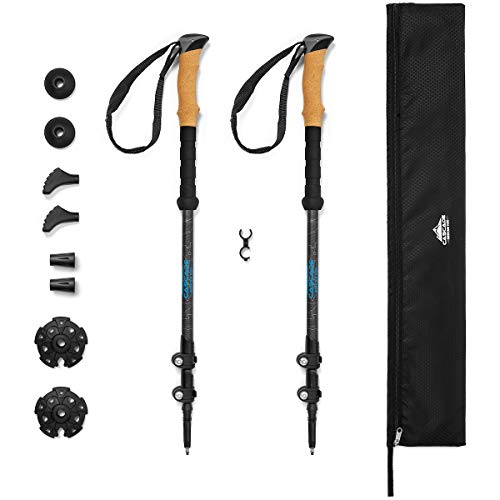
Cascade Mountain Tech puts carbon fiber shafts, cork grips and quick-release levers into a pair that weighs about 8.1 ounces and costs a small fraction of the premium brands. The kit includes snow baskets, mud baskets, rubber tips and a carry bag.
$51.99fromAmazonList priceWe keep coming back to how much you get here. Carbon shafts, cork grips, tungsten carbide tips, lever locks, and a full basket-and-tip kit in the box. Switchback Travel's budget pole comparison found this pair matching mid-range carbon poles from brands charging three to four times more. That's the whole pitch, and it holds up.
If you're not sure you even want poles, buy these first. They adjust from 26 to 54 inches, which covers essentially every adult and doubles as a lend-to-a-friend range. Owner feedback skews heavily toward first-timers and people managing arthritis or spinal issues who found the poles let them walk farther on uneven ground. That's a lot of usefulness from an entry-level product.
The quick-lock levers are the right mechanism at this price. Twist locks are what budget poles usually get, and they're the ones that loosen when they're cold and wet. Getting levers here means you get the reliability advantage that GearJunkie documented, not just the cheaper version of it.
The bonus kit deserves a mention because those accessories usually cost extra. Snow baskets matter for shoulder-season and winter hiking, mud baskets for soft ground off-trail, rubber tips for pavement and slickrock. Buying them separately for a premium pole can meaningfully close the price gap.
Flaws but not dealbreakers
Carbon at this price means thinner tolerances than a premium carbon pole. These handle normal trail use well, but they're the poles we'd worry about in a rock-jamming scramble. If your hiking involves a lot of technical terrain, spend up or go aluminum.
The straps and grip hardware are the visible compromise. They work, and owners rarely complain, but the finish and the feel of the adjustment levers are a step below what Leki and Black Diamond deliver. That's a fair trade at this price, not a hidden flaw.
The cork is a blend rather than the pure natural cork on the Black Diamond, so it doesn't conform to your hand quite the same way over time.
Also greatOn sale
The lightest, smallest option, if you'll accept fixed length
BLACK DIAMOND Distance Carbon Z Poles
The Distance Carbon Z is a fixed-length, Z-folding carbon pole that deploys with one pull and folds into a bundle short enough to stash almost anywhere. At roughly 170 grams per pole it's the lightest thing here, aimed squarely at runners and gram-counters.
$209.95fromAmazonList priceFor trail running and fastpacking, nothing else here is close. The Z-fold design collapses to about 15 inches and weighs roughly 170 grams per pole — among the lightest adjustable-capable poles in Outdoor Gear Lab's multi-year comparisons. You can carry these strapped to a vest for miles and forget they're there, then deploy them with a single pull when the grade kicks up.
Fixed length is the trade, and it's a real one. There's no adjustment collar, no lever, nothing to slip — which is exactly why they're so rigid and so light. But you buy your size once, and you can't shorten them for a long climb or lengthen them for a descent. Before you order, size yourself carefully: on flat ground, your elbow should sit at roughly 90 degrees with the tip planted.
The EVA foam grips make more sense here than cork would. Foam insulates better in cold, per Switchback Travel's grip comparison, and it's lighter. The mini-grip extensions below the main handle give you somewhere to put your hands on a steep switchback without stopping. For a pole built around efficiency, foam is the consistent choice.
Owners who came from cheaper folding poles after breaking a few tend to stay with these. The carbide tips bite on rock and packed snow, and rubber tips and snow baskets swap in — though several owners note that changing the tips is genuinely fiddly and worth watching a video before you try.
Flaws but not dealbreakers
Carbon plus a folding joint is the least forgiving construction for lateral impact. These are poles for moving fast on trail, not for prying yourself up a boulder field. Treat them accordingly.
Fixed length also means the poles don't shrink for travel beyond their folded state, and they can't be shared with someone of a different height. If you want one pair for a household, look elsewhere.
Swapping the tips is harder than it should be. Owner reports describe needing pliers and some patience, which is an odd rough edge on an otherwise refined pole.
Upgrade pick
Built for snow, splitboards and genuinely rough seasons
MSR Dynalock Ascent Carbon Backcountry Poles
MSR's DynaLock Ascent Carbon uses a Kevlar-reinforced carbon shaft with a tool-free tension-adjustable lock, 20 cm of length range, and both winter and summer baskets. It collapses to about 14.25 inches and weighs around 17 ounces per pair.
$189.95fromAmazonThis is the pole for people whose hiking involves snow. Winter and summer baskets come in the box, the three-piece design folds to about 14.25 inches, and the Kevlar-reinforced carbon shaft is built for backcountry skiing and splitboarding as much as summer trails. If your season doesn't end when the snow starts, that matters more than a couple of ounces.
The DynaLock mechanism is the reason to pay up. You can adjust its clamping tension by hand, without a tool, which means when the lock starts to slip after a hard season you tighten it on the trail instead of shipping the pole back. Twenty centimeters of length range covers the shorten-for-uphill, lengthen-for-downhill routine with room left over.
The folded size is what owners talk about most. At 14.25 inches these fit in a carry-on or a messenger bag, which makes them a genuinely good travel pole on top of a genuinely good winter pole. Extended EVA lower grips give you multiple hand positions for traversing a slope where one hand is always higher than the other.
Owner feedback from people carrying 60-pound packs and from hikers recovering from serious injuries points the same direction: these hold up under load without slipping. A few describe bending aluminum poles before switching to these and not looking back.
Flaws but not dealbreakers
They're the most expensive poles here by a clear margin, and for a casual day hiker on maintained trails that money buys capability you'll never use.
Sizing runs short. Owners at 5'5" report the small size being too short for backcountry skiing, where you want more length than summer hiking. Check the range against your height and your intended use before ordering, not just your height.
A couple of owners report the internal cord stretching after a year or so of hard use, and the baskets rotating on the shaft rather than staying oriented. Neither is common, but both are worth knowing.
Scrambling is where these feel worst. Several owners note the poles get in the way when you need your hands on rock — which is true of most poles, but the folding design makes stowing them mid-move more awkward.
Who this is for
Buy poles if your hikes involve real elevation, if you carry a pack, or if your knees have started filing complaints. The knee-load research is the strongest single argument — a 12 to 25 percent reduction in compressive force on descents is the kind of number that shows up in how you feel the next morning. And poles aren't a niche accessory anymore: a Pacific Crest Trail Association survey found more than 85 percent of PCT thru-hiker respondents used them for most of their hike. If you walk on flat, groomed paths and your joints are fine, you can skip them.
This guide covers general-purpose trekking and hiking poles you'd take on a day hike, a backpacking trip or a winter outing. It doesn't cover dedicated ski poles, walking canes, monopods, or Nordic walking poles built for pavement fitness technique — those are different tools with different geometry. We also don't cover women's-specific or youth sizing in depth, though several picks here adjust into those ranges.
How we picked
Locking reliability: we favored lever-lock systems over twist locks, because published field testing shows levers hold their set length far more consistently when it's cold and wet. Grip material: cork for long warm hikes, foam for cold — no bare rubber grips made the cut. Weight versus toughness: carbon saves 20 to 30 percent over aluminum but gives up lateral-impact resistance, so we kept both materials in the lineup rather than crowning one. Packed length: we compared folded and collapsed dimensions from spec sheets, since a pole that fits inside your pack behaves differently from one that rides outside. Baskets and tips: we gave credit to poles that ship with snow and mud baskets and swappable rubber tips, because off-trail and shoulder-season hiking needs them.
Other hiking poles worth considering
If you want cork grips and aluminum toughness in a smaller package: The LEKI Makalu Cork Lite Trekking Poles-Stone Blue ($159.95) — The Leki Makalu Cork Lite uses dual Speed Lock Plus levers to pack down to about 25.2 inches — noticeably shorter than most three-section aluminum poles — while keeping an Aergon Air cork grip with a foam extension. The compact version adjusts from 90 to 125 cm and weighs about 8.4 ounces, so it suits shorter hikers and anyone who wants aluminum without the bulk. Two things give us pause. It drops the spring anti-shock system that longtime Leki owners of the older Super Makalu liked for descents, and at least one owner reported a shaft breaking within the first hike. That's a small sample, but it's the reason this sits here rather than among the picks.
The competition
This is what our research surfaced across major brands and price tiers, not a census of every pole sold. Plenty of good poles exist that didn't come up — particularly from smaller ultralight cottage makers — and a strong pole missing from this list isn't a knock against it.
The LEKI Nordic Walking Speed Pacer Vario HM ($69.99) — The Leki Speed Pacer Vario HM Carbon is a Nordic walking pole, not a trekking pole, and that distinction is bigger than it sounds. It's built around the Nordic walking stride: a Powergrip pad, a Speed Tip and Speed Basket meant for pavement and packed paths, and an adjustment range of only 110 to 120 cm around its 115 cm size. The carbon shaft is genuinely light at 144 grams. But that narrow range won't let you shorten for a climb or lengthen for a descent the way trail hiking asks, and the tip and basket setup isn't made for mud, scree or snow. If Nordic walking on roads and rail-trails is what you actually do, this is a well-made tool for it. For hiking, get one of the picks.
Fit, sizing and upkeep
Size your poles by elbow angle, not by a chart. Stand on flat ground with the tip planted and set the length so your elbow bends to roughly 90 degrees. From there, shorten by 5 to 10 cm for sustained climbs and lengthen the same amount for long descents — that's the guidance REI and other fitting resources give, and it's the single biggest thing most people get wrong. After wet or muddy hikes, collapse the sections, wipe the shafts and let them dry fully open, since grit trapped inside a lever clamp is what causes slipping later. Carbide tips wear down over hundreds of miles and unscrew for replacement on most poles. Swap in wider mud or snow baskets before shoulder-season trips; they're cheap and they keep the tip from sinking.
Questions we get
Are hiking poles worth it for casual day hikes?
For most people, yes — especially on anything with real elevation change. The stability on loose or wet ground is immediate, and the knee-load reduction on descents is well documented. If you only walk flat, paved paths, you probably won't notice much difference.
What are the best hiking poles for bad knees?
Any pole helps, since the descent benefit comes from the poles themselves rather than a specific feature. The research puts compressive knee-force reduction at 12 to 25 percent on downhills. If you want more, look for an anti-shock system, which published testing links to roughly 30 percent less transmitted vibration on rocky ground at a cost of 30 to 50 grams per pole.
Are carbon fiber poles worth it over aluminum?
It depends on your terrain. Carbon runs 20 to 30 percent lighter for the same design, which matters if you're covering big miles or counting every gram. But aluminum handles sudden sideways impacts better, so if you scramble over rock or wedge your tips a lot, aluminum is the safer bet.
How do I find the right pole length for my height?
Plant the tip on flat ground and hold the grip — your elbow should be at about 90 degrees. That's your baseline. Shorten 5 to 10 cm for sustained uphill and lengthen 5 to 10 cm for sustained downhill. With a fixed-length folding pole, you have to get this right at purchase, so measure before ordering.
What's the difference between twist-lock and lever-lock poles?
A twist lock tightens by rotating the shaft sections against each other; a lever lock clamps them with an external cam you flip. Levers are faster to adjust, easier to operate with gloves on, and far more reliable when cold and wet — field testing shows them holding their length more than 95 percent of the time. Every pole we recommend uses a lever-style lock.
Are folding poles as durable as telescoping ones?
Not quite, though good ones come close. Folding poles use an internal cord and joint sections, which adds failure points — stretched cords are the most common long-term complaint. They pack far smaller, which is the whole reason to buy them, but most give up length adjustability to do it.
Why you should trust us
For this guide:
- We read manufacturer specifications for every pole here, comparing weight, adjustment range, packed length, grip material and locking mechanism side by side.
- We reviewed published findings from Outdoor Gear Lab, Switchback Travel, GearJunkie, Backpacker Magazine and REI, plus the Clinical Biomechanics research on knee loading, to establish what actually separates a good pole from a mediocre one.
- We read through owner feedback for each product and looked for repeated themes — lock slippage, cord stretch, tip-swap difficulty and sizing surprises — rather than isolated complaints.
- We read owner reviews on every listing, weighted toward the critical ones, because that is where the recurring failures show up.
- We have a systematic way of automatically fetching the latest prices, so the numbers on this page stay current.
- This is a research-focused guide, so the team may not own every product listed — though we often do own the top winners, which gives us extra context for the recommendations.
- We don't accept free products, and the retailer commission never changes which product we recommend.
Sources
Best Trekking Poles of 2026 — Outdoor Gear Lab, Outdoor Gear Lab
Best Trekking Poles — Wirecutter (New York Times), Wirecutter
How to Choose Trekking Poles — REI Expert Advice, REI
Best Trekking Poles 2026 — Switchback Travel, Switchback Travel
Best Trekking Poles 2026 — GearJunkie, GearJunkie
Best Hiking Poles Tested — Backpacker Magazine, Backpacker Magazine
Best Trekking Poles 2026 — Outside Online, Outside Magazine
Mechanical Effect of Walking Poles on Lower-Extremity Loading During Downhill Walking — Clinical Biomechanics, Clinical Biomechanics (peer-reviewed journal)
Black Diamond Trail Ergo Cork In-Depth Review — Outdoor Gear Lab, Outdoor Gear Lab
Leki Micro Vario Carbon Review — Outdoor Gear Lab, Outdoor Gear Lab
Cascade Mountain Tech Carbon Trekking Poles Review — Switchback Travel, Switchback Travel
Trekking Poles and Hiking — Pacific Crest Trail Association, Pacific Crest Trail Association
Amazon product listings and owner reviews for all 6 products
Manufacturer specification pages for each product
Some passages in this guide may be paraphrased with AI help. Prices are refreshed automatically.
More like this.
Continue exploring lifestyle reviews and recommendations.

The Best Hiking Boots and Trail Running Shoes
Footwear is the one piece of hiking gear you feel with every single step. A boot that rubs at mile two can ruin a whole weekend, and a sole that slides…

The Best Waterproof Hiking Boots
Wet feet ruin a hike faster than a steep climb does. A creek crossing, an hour of rain, a morning of soaked grass - any of them will leave you squelching…

The Best Camping and Hiking Gear Essentials
Gear failures rarely announce themselves at home. They show up at 2 a.m. when a zipper jams, or three miles from the trailhead when your headlamp dies and…

The Best Hiking Daypacks
A daypack is the piece of hiking gear you notice most when it's wrong. A pack that rides badly turns a pleasant six-mile loop into a shoulder-ache you…

The Best Hiking Backpacks
A backpack is the one piece of gear you never put down. Everything else - tent, stove, sleeping bag - gets used and stowed away. The pack rides on you for…

The Best Hiking Boots
A hiking boot has one job: get you back to the car with your feet intact. That sounds simple, but it's mostly about fit and friction. A boot that's a hair…