The Best Journal Notebooks for Daily Writing
A journal notebook only earns its place if you actually reach for it. That sounds obvious, but it's where most notebooks fail. The paper feathers your ink, the spine won't stay open, and after two weeks the cover curls in your bag. You stop writing, and you blame yourself instead of the notebook. The things that matter day to day are unglamorous: how thick the paper is, whether the binding lies flat when you're writing near the gutter, and whether the cover survives being shoved under a laptop.
No notebook here does everything. Thick paper that handles a wet fountain pen adds bulk and cost, so you get fewer pages for the same size. Numbered pages and a printed index are great if you go back and reference old entries, but they're dead weight if you never do. And the notebooks with the most features often come from smaller brands with less consistent production runs. You're picking which compromise you can live with, not finding a notebook without one.
We read manufacturer paper specs, published stationery reviews, and owner feedback across twelve notebooks to sort out which trade-offs actually matter. Paper weight came up again and again as the thing buyers regret ignoring. Binding style came second. We think that the LEUCHTTURM1917 Medium A5 Hardcover is the best journal notebook for daily writing for most people, and that the PAPERAGE Lined Journal is the one to buy if you're still figuring out whether journaling sticks.
Everything we recommend

Numbered pages and a flat spine, if you'll use them

Thicker paper than the top pick, minus the organization

The one to buy if you write with a fountain pen

Thick paper, a pen holder, and tear-out pages
At a glance
| Product | Page Count | Paper Weight | Price | |
|---|---|---|---|---|
| LEUCHTTURM1917 - Notebook Hardcover Medium A5-251 NumberedTop pick | 251 Pages | 80 g/m² | $25.50 |
 | Moleskine Classic NotebookAlso consider | — | — | $24.95 |
| PAPERAGE Lined Journal NotebookBudget pick | 160 Pages | 100 GSM | $9.99 |
| Rhodia A5 WebnotebookAlso great | 96 Sheets | 90 g | $29.96On sale |
 | Midori MD Note Horizontal Ruled lineAlso in lineup | — | — | $15 |
| Dingbats* Wildlife Lined Writing Journal Notebook A5Upgrade pick | — | 100 GSM | $15.37 |
 | PERCUN B5 Lined Journal Notebook - 365Also in lineup | 365 Pages | 100 Gsm | $18.99 |
 | PAIBAS Lined Journal Notebook with 300 PageAlso in lineup | 300 Pages | — | $17.99 |
 | Decomposition Rainforest College Ruled Composition Notebook -Also in lineup | 160 Pages | — | $14.99 |
 | Nuuna Notebook Graphic L Heaven 256 PagesAlso consider | 256 Pages | 120 g | $48 |
 | PETER PAUPER PRESS Mystic Moon JournalAlso consider | 160 Pages | 120 gsm | $9.99 |
 | Erin Condren INSPIRED A5 Journal - WatercolorAlso in lineup | — | 70 lb | $10.99 |
How we picked
Paper weight. We treated gsm as the single most predictive spec and pulled it from manufacturer listings for every notebook. Our threshold was 80gsm for general daily writing and 90gsm or higher for anything we'd recommend to fountain pen users.
Binding and lay-flat. We favored thread-sewn bindings, which published reviews and owner feedback both credit with opening flat and surviving a full notebook's worth of daily use. Glued spines had to earn their place on other merits.
Everyday durability. We looked at cover material and construction, then checked owner feedback for the failure modes people actually report: warped covers, cracked spines, and pages loosening partway through.
Organization features. Numbered pages, a printed index, ribbon bookmarks, closures, and back pockets separated notebooks that support a long-running journal habit from ones that just hold paper.
Size and page count. We centered the guide on A5, the format most daily writers settle on, and noted how long each notebook lasts at roughly a page a day so you know how often you'll be buying another.
Top pick
Numbered pages and a flat spine, if you'll use them
LEUCHTTURM1917 - Notebook Hardcover Medium A5-251 Numbered
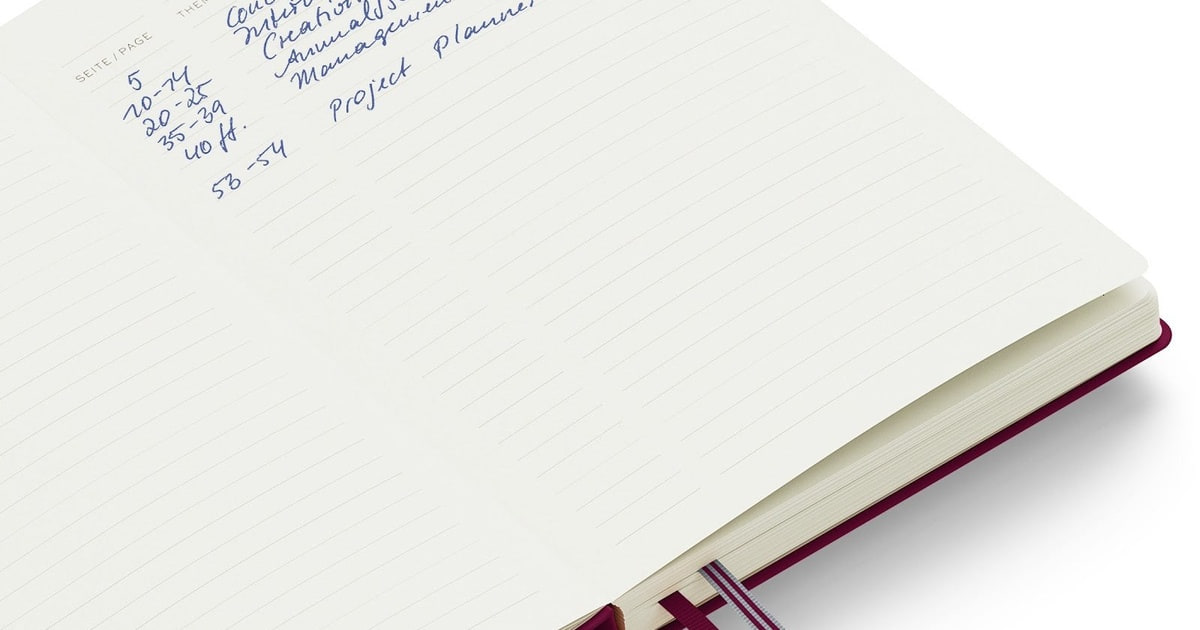
A hardcover A5 with 251 numbered pages, a blank table of contents at the front, and a thread-sewn spine that opens flat. It's the notebook to buy if you go back and read what you wrote, because it turns a stack of journals into something you can actually search.
$25.50fromAmazonThe numbered pages and index are the reason to buy this one. Every page carries a number, and the front holds a blank table of contents you fill in yourself. That sounds fussy until you've filled three journals and want to find the entry about your grandmother. Write the page number in the front, and it's a thirty-second job instead of a twenty-minute flip-through. No other notebook here does this as well.
The thread-sewn binding opens flat from the first page. You don't have to crack the spine or weigh down the corner with a coffee mug. That matters most when you're writing across the gutter in the middle of a spread, which on a glued notebook means fighting the page the whole way. Owners who journal daily consistently mention this as the thing they'd miss most if they switched.
The 80gsm acid-free paper handles the pens most people actually own. Ballpoints, gel pens like a Pilot G2, and standard rollerballs write cleanly with only faint ghosting on the reverse. That's the everyday case for the vast majority of journalers. It's rated for ink compatibility rather than just thickness, which is why it does better than some heavier papers with rougher surfaces.
The small extras are the ones you'll use every session. Two ribbon bookmarks let you hold your current entry and a reference page at the same time — a habit you pick up fast once you have the second ribbon. The elastic band keeps it shut in a bag. The gusseted back pocket expands for receipts and sticky notes without splitting at the corners, and eight sheets at the back tear out cleanly.
Flaws but not dealbreakers
80gsm is the floor for fountain pens, not a comfortable margin. With a fine or medium nib you'll be fine. With a wet broad nib or a saturated ink, owners report feathering and enough show-through to bother them. If fountain pens are your main instrument, the Rhodia is the safer buy.
You're paying for structure, not paper. The PAPERAGE uses thicker 100gsm paper and costs about half as much. If you don't index your entries and don't care about two bookmarks, you're paying extra for features you'll never open.
The cover is stiff at first. For the first week or so the hardcover pushes back a little when you fold the notebook open. It settles down, but it's noticeable early on if you're used to a softcover.
Budget pick
Thicker paper than the top pick, minus the organization
PAPERAGE Lined Journal Notebook
A hardcover journal with 100gsm paper and a lay-flat thread binding, which is a combination you normally pay a lot more for. It skips numbered pages and an index, but the writing experience is genuinely comparable to notebooks that cost twice as much.
$9.99fromAmazonThe 100gsm paper is thicker than what our top pick uses. Gel pens, rollerollers, and most markers write without bleeding to the next page. Ghosting is faint enough that most people won't care. If you've been frustrated by a notebook where your writing shadows through, this is the fix, and you don't have to spend much to get it.
It's thread-bound and lays flat, which budget notebooks almost never do. Most inexpensive journals are glued, so they fight you near the spine and can crack in a cold car. This one opens flat like the premium picks. Left-handed writers get the biggest benefit, since you're not dragging your hand up a curved page.
You get the accessories without the price. There's a ribbon bookmark, an elastic closure, an expandable inner pocket, and a sheet of sticker labels for the cover and spine. The vegan leather cover is water-resistant, so a spilled water bottle in your bag isn't a disaster.
It's the right first notebook if journaling is new to you. Buy this before you spend on a Leuchtturm or a Rhodia. Three months in you'll know whether you want lined or dotted, whether A5 is right, and whether you write daily or twice a week. Then upgrade with actual information instead of a guess. It comes in lined, blank, dotted, and grid, so you can try a ruling cheaply.
Flaws but not dealbreakers
There's no page numbering and no index. If you want to find something you wrote two months ago, you're flipping. That's the single clearest gap between this and the top pick, and it's the reason to spend more if you reference your entries.
160 pages goes fast. Write a page a day and you're shopping again in about five months. Heavier writers will burn through it quicker. Buy two if you know you fill notebooks.
Color and ruling variety is decent but not deep. You won't find the range of formats and finishes that the bigger stationery brands offer, which matters if you like your shelf of finished journals to match.
Also greatOn sale
The one to buy if you write with a fountain pen
Rhodia A5 Webnotebook
A dot-grid A5 with 90gsm Clairefontaine-family paper, which is the surface fountain pen users keep coming back to. Wet broad nibs don't feather and don't bleed, and ink colors look noticeably richer than they do on ordinary journal paper.
$29.96fromAmazonList priceThe paper is the whole point. The 90gsm Ivory Brushed Vellum is sized to resist absorption, so ink sits on the surface instead of soaking into the fibers. That's what stops feathering — those fuzzy hairline spreads off your letters — with a wet nib. If you've written in a fountain pen and watched your careful handwriting turn woolly, this paper solves it.
Your inks will look better here than anywhere else in this guide. Shading inks show their light and dark variation. Sheening inks actually sheen. The smooth surface also lets a nib glide with almost no drag, which changes how long you can write before your hand tires.
The dot grid gives you structure without lines in the way. Dots guide your handwriting, and they also let you sketch, draw a quick table, or lay out a bullet journal spread on the same page. You get a leatherette cover with an elastic strap, a ribbon, and an expanding back pocket, so it's fully equipped for daily carry.
Flaws but not dealbreakers
It's overkill if you write with a ballpoint. A gel pen on 90gsm Rhodia paper writes the same as a gel pen on the PAPERAGE. You're paying for fountain pen headroom you won't use.
There's no page numbering, no index, and only 96 sheets. For organization it's well behind the Leuchtturm, and it's a shorter notebook than most here. Dot grid is also a hard no for some people who just want clean ruled lines.
It's the priciest way to get a page here. Per page it costs more than any other fountain-pen-friendly option in this guide, which is easier to swallow if you write a page a week than a page a day.
Upgrade pick
Thick paper, a pen holder, and tear-out pages
Dingbats* Wildlife Lined Writing Journal Notebook A5
A vegan leather A5 with 100gsm paper, micro-perforated pages, and a built-in pen holder. It handles fountain pens nearly as well as the Rhodia while giving you 192 pages and the daily-carry features the Rhodia leaves out.
$15.37fromAmazonIt gets close to the Rhodia on ink behavior with heavier paper. The 100gsm cream stock is smooth rather than toothy, which is why it handles fountain pen ink better than most notebooks at the same weight. Rougher 100gsm paper lets ink spread along the fibers; this one doesn't. Gel pens and markers are a non-issue.
The built-in pen holder is the feature you'll notice most. It sounds trivial. Then you spend a week not digging through a bag for a pen, and it stops sounding trivial. Combined with the elastic closure, expandable pocket, and ribbon bookmark, the whole writing kit travels as one object.
Every page is micro-perforated, so it tears out straight. Pull a page for a note, a list, or something you want to hand to someone, and you get a clean edge instead of a ragged one — and the neighboring page stays put. Standard notebooks either don't perforate at all or do it badly enough that you avoid tearing.
The sustainability claims are backed by something. The paper is FSC-certified, the cover is certified vegan, and the company donates per notebook to wildlife conservation. If those credentials matter to you, this is the pick that doesn't ask you to give up paper quality to get them. At 192 pages it's good for roughly four to five months of daily writing.
Flaws but not dealbreakers
The wildlife cover art isn't for everyone. It's attractive, but it's a statement. If you want a notebook that looks like nothing at all on a conference table, the Leuchtturm or the Midori is closer.
It's slightly bigger than a true A5. At about 6.3 by 8.5 inches it won't sit neatly next to your other A5 notebooks on a shelf, and it's a touch snugger in a small bag.
You won't find it in a store. Compared to Moleskine or Leuchtturm, physical retail availability is thin, so replacing it in a hurry means waiting on shipping.
Who this is for
This guide is for you if you write by hand most days and want a notebook that doesn't get in the way — morning pages, a gratitude log, a bullet journal, or just somewhere to think. If you write with a fountain pen, pay close attention to the paper weight notes, because that's where cheap notebooks fail you fastest. And if you've never kept a journal before, start cheap. Discovering that you prefer dot grid over lines is a lot less painful when you haven't already committed to an expensive notebook.
This isn't the guide for planners with dated pages, sketchbooks meant for watercolor or heavy ink wash, or disposable spiral notebooks for lecture notes. We stuck to bound journals in the A5 range plus a couple of larger desk formats, and we didn't cover pocket-sized notebooks or refillable leather covers. If you need archival storage for decades, look specifically for acid-free paper, which several picks here call out on the listing.
How we picked
Paper weight: We pulled gsm from every manufacturer listing and used 80gsm as the floor for daily pens, 90gsm and up for fountain pens. Binding: Thread-sewn spines that open flat beat glued ones, according to both published reviews and what owners report after months of use. Durability: We read owner feedback for the failures people actually hit — warped covers, cracked spines, pages working loose — rather than guessing at what might go wrong. Organization: Numbered pages, an index, bookmarks, a closure, and a back pocket are what separate a journal you keep from a stack of paper. Size and longevity: We centered on A5 and worked out roughly how many months each notebook lasts at a page a day.
Other journal notebooks for daily writing worth considering
If you travel and want a notebook you can replace anywhere: The Moleskine Classic Notebook ($24.95) — The Moleskine Classic is the one you can buy in an airport bookstore in almost any city, and that's a real feature if you're mid-trip with a full notebook. It's slimmer than most hardcovers here, so it slides into a jacket pocket, and the warm ivory paper is easy on the eyes over a long session. The catch is the 70gsm paper: with a gel pen you'll see your words shadowing through the reverse side. It's ghosting, not bleed-through, so nothing transfers — but it bothers some writers a lot. The binding also resists lying flat until you've broken it in.
If you want a notebook that's also an object: The Nuuna Notebook Graphic L Heaven 256 Pages ($48) — The Nuuna Graphic L uses 120gsm Munken paper, the heaviest in this guide, with 256 numbered pages on a precise 3.5mm dot grid. For meticulous bullet journaling it's about as good as the page gets, and the screen-printed cover with 360-degree printed edges makes it look like something you'd leave out on a desk. The flexcover is made from recycled leather punching residue and the paper is cradle-to-cradle certified. It's also the most expensive notebook here by a wide margin, which makes it a milestone purchase or a gift rather than the notebook you burn through every few months.
If you want great paper in a small package: The PETER PAUPER PRESS Mystic Moon Journal ($9.99) — The Peter Pauper Press Mystic Moon hides 120gsm smooth-finish paper behind a decorative cover, which is an unusual amount of paper quality for what it costs. The pages are acid-free and archival, the edges are gilded, and there's an elastic closure and a back pocket. At 5 by 7 inches it's smaller than the A5 standard, so long entries feel cramped, and the book-bound binding doesn't lie flat the way a sewn spine does. The celestial artwork is either exactly your thing or entirely not.
The competition
These are the notebooks our research surfaced alongside the picks, not a complete map of the market. Each one lost to a pick for a specific reason, but a few of them are the right answer for a particular kind of writer.
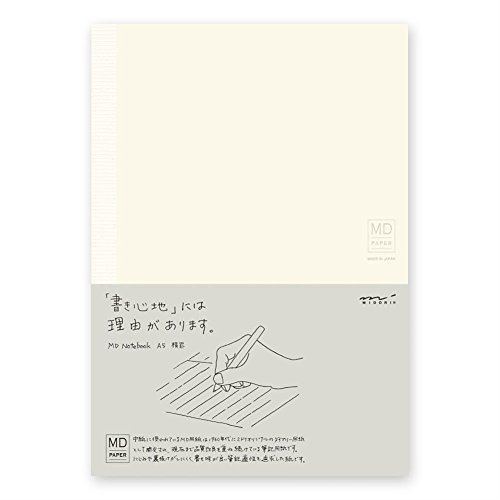
The Midori MD Note Horizontal Ruled line ($15) — The Midori MD Note has one of the most devoted followings in stationery, and it's earned it. The cream MD paper has a subtle texture that Western notebooks don't replicate, the sewn binding opens flat from page one, and the cover is plain white with no branding at all. What holds it back for daily use is 70gsm paper, which ghosts with gel pens and alcohol markers, and the complete absence of extras — no elastic, no ribbon, no pocket. Buy it if paper feel is the thing you care about most and you write with a pencil or a fine-nib pen.
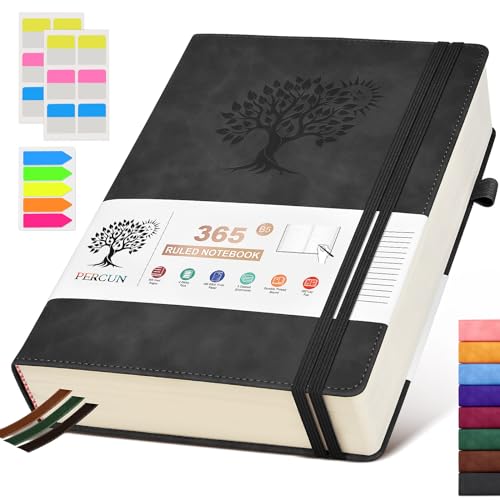
The PERCUN B5 Lined Journal Notebook - 365 ($18.99) — The PERCUN B5 packs 365 pages of 100gsm paper, three ribbon bookmarks, an elastic pen holder, dual closures, and a 180-degree lay-flat spine — a feature list that beats notebooks costing considerably more. At roughly a page a day it can carry you through a full year. But at 7.6 by 10.3 inches it's a desk notebook, full stop; it's awkward to carry and the decorative cover reads casual rather than professional. If you journal at the same desk every night and hate replacing notebooks, it's a strong argument.
The PAIBAS Lined Journal Notebook with 300 Page ($17.99) — The PAIBAS Vintage Leather Journal offers 300 numbered pages plus a contents section, which is the Leuchtturm's best trick at a much lower price, along with a waterproof leather cover, pen holder, back pocket, dual closures, and three ribbons. The gap is that the listing never states the paper weight. For a ballpoint that's fine. For fountain pens or markers you're buying blind, and that's the reason it isn't a pick. The A4 size also makes it strictly a desk notebook.
The Decomposition Rainforest College Ruled Composition Notebook - ($14.99) — The Decomposition Rainforest notebook is made in the USA from 100% post-consumer recycled paper and printed with soy ink, which gives it the strongest environmental credentials here. It's thermal bound with lay-flat pages and comes in a wide range of nature cover art. The trade-offs are real: recycled paper has a noticeably rougher texture than premium stock, thermal binding is less durable than sewn under heavy daily use, and the softcover gives you less structure on a desk. It's college-ruled only. Choose it if recycled content outranks paper feel for you.
The Erin Condren INSPIRED A5 Journal - Watercolor ($10.99) — The Erin Condren INSPIRED A5 is really a productivity notebook wearing a journal's clothes. You get an undated 12-month structure with monthly spreads, notes pages, goal sections, and two sheets of stickers, which is genuinely useful if your journaling is half planning. The Wire-O spiral binding lies perfectly flat, a plus for lefties. But the frosted plastic covers scratch and flex more than the hardcovers here, the 70 lb. text paper is on the light side, and the built-in structure gets in the way if you just want blank ruled pages to fill however you like.
Care and everyday use
Test your pen on the back page before you commit to a new notebook — a single line and a small scribble tells you more about ghosting than any spec. If you're using a fountain pen, give the ink a few seconds before closing the cover, especially on lower-gsm paper where a wet line sits on the surface longer. Keep the elastic band off the cover when the notebook's open on your desk, since leaving it stretched across the boards over months can leave a permanent indent. Hardcovers handle a bag better than softcovers, but neither likes being stored spine-down under weight. And if you're indexing, fill in the table of contents as you go. Nobody has ever successfully caught up on that later.
Questions we get
What paper weight should I look for in a journal notebook?
If you write with a ballpoint, gel pen, or rollerball, treat 80gsm as your minimum — that's enough to avoid bleed-through and most ghosting. Fountain pen users should look for 90gsm or higher, which is where feathering stops being a problem. If you use markers or brush pens, go to 100gsm and up. Paper weight predicts daily satisfaction better than brand or price does.
Are dotted journals better than lined ones?
It depends on what you put on the page. Lined is better if you write continuous prose and want a consistent guide for your handwriting. Dot grid is better if you also sketch, make tables, or run bullet journal layouts, because the dots guide without boxing you in. Dot grid has become the more popular format among committed journalers, but lined is easier to start with.
What size notebook is best for carrying every day?
A5, roughly 5.5 by 8.5 inches, is the consensus. It fits most bags, gives you enough room for a real entry, and every major brand offers it. Smaller formats like the Peter Pauper Press at 5 by 7 inches carry better but feel cramped for long entries. B5 and A4 notebooks like the PERCUN and PAIBAS are desk notebooks — carrying one every day gets old fast.
Which notebooks here work best with fountain pens?
The Rhodia Webnotebook is the first recommendation, since its 90gsm Ivory Brushed Vellum is the surface fountain pen users point to as the standard. The Dingbats* Wildlife and the Nuuna Graphic L both perform well at 100gsm and 120gsm. The Leuchtturm handles most nibs but feathers with wet broad ones. Skip the Moleskine and the Midori for fountain pen work — at 70gsm they're not built for it.
Is an expensive notebook actually better than a cheap one?
Not on paper quality alone. The PAPERAGE uses thicker paper than the Leuchtturm, and the Peter Pauper Press matches the Nuuna at 120gsm despite costing far less. What premium notebooks buy you is organizational features, consistency from one production run to the next, and covers and spines that survive being carried daily. If all you want is a good writing surface, the budget options genuinely compete.
How many pages do I actually need?
Work from about a page a day. A 160-page notebook like the PAPERAGE or the Decomposition gets you roughly five months. The Leuchtturm's 251 pages runs eight to ten months for most writers, and the Nuuna and PAIBAS land in similar territory. The PERCUN's 365 pages can cover a full year. If you like starting fresh each January, look for 200 pages or more.
Why you should trust us
For this guide:
- We compared manufacturer paper specifications, binding descriptions, and stated page counts across all twelve notebooks in this lineup.
- We read published stationery reviews and fountain-pen community write-ups on how these papers behave with wet inks and gel pens.
- We reviewed owner feedback themes for each notebook, paying particular attention to reports of ghosting, spine failure, and cover wear over months of daily use.
- We read owner reviews on every listing, weighted toward the critical ones, because that is where the recurring failures show up.
- We have a systematic way of automatically fetching the latest prices, so the numbers on this page stay current.
- This is a research-focused guide, so the team may not own every product listed — though we often do own the top winners, which gives us extra context for the recommendations.
- We don't accept free products, and the retailer commission never changes which product we recommend.
Sources
The Best Notebooks for 2026 — Wirecutter, Wirecutter
Best Journals for Writing 2026 — Stationery Experts Review, JetPens
Best Notebooks for Fountain Pens 2026, Goulet Pens
Leuchtturm1917 vs Moleskine: Which Is Better for Journaling?, Bradford Pens
Bullet Journal Official Guide to Notebooks, Bullet Journal
Amazon product listings and owner reviews for all 12 products
Manufacturer specification pages for each product
Some passages in this guide may be paraphrased with AI help. Prices are refreshed automatically.
More like this.
Continue exploring lifestyle reviews and recommendations.

The Best Gifts for Writers
Writers are easy to shop for and easy to get wrong. Almost every writer already owns a pen, a laptop and a drawer of half-filled notebooks, so a gift…

The Best Bullet Journals
A bullet journal is just a notebook you bring your own system to. But the notebook still matters, because you'll open it several times a day for months.…

The Best Face Sunscreens for Daily Wear
Face sunscreen only works if you actually put it on, and that comes down to how it feels. A formula that stings your eyes by lunch, or leaves a chalky…

The Best Cold Weather Camping Sleeping Bags
A cold night in a tent isn't dangerous so much as it's miserable. You wake at 2 a.m. with cold feet, pull the drawcord tighter, and then lie there doing…

The Best Yoga Mats and Accessories for a Home Practice
A yoga mat is the one piece of gear that touches every part of your practice. It decides whether your hands slide forward in downward dog, whether your…

The Best Weber Grill Accessories
A Weber grill is a long-term relationship. The kettle or the Genesis in your yard will probably outlast the car in your driveway, and the accessories you…