The Best Cordless Ice Fishing Augers
Drilling a hole through 20 inches of ice used to mean yanking a starter cord in the dark with cold hands, then breathing two-stroke exhaust for the rest of the morning. Cordless augers changed that. You pull a trigger, the bit sinks, and you're fishing 10 seconds later. They're quiet enough that you won't spook a shallow-water school, and they produce no carbon monoxide — which matters, because the CDC has flagged gas augers as a fatal hazard inside enclosed shelters. If you fish out of a shanty, that alone settles the argument.
The catch is the battery. Lithium cells lose roughly 30 to 40 percent of their rated capacity once you're operating below 14°F, so the hole count printed on the box assumes conditions you may never actually fish in. On a brutal January morning you'll get fewer holes than you expect, and you'll want a spare pack tucked inside your jacket. Blade sharpness swings the math even harder than the motor does. Dull blades make the motor work, and a working motor drains a pack fast.
We think that the ION Alpha Gen 3 is the best cordless ice fishing auger for most people, and that the Eskimo E40 8-Inch is the one to buy if you want a lighter powerhead and a variable-speed trigger for drilling inside a shelter.
Everything we recommend
The fastest cut here, in a package you can carry all day

Lighter powerhead and a trigger you can dial back

If you already own a good cordless drill, start here

A 10-inch hole from the lightest powerhead here
At a glance
| Product | Bit Size | Voltage/Power | Price | |
|---|---|---|---|---|
| ION® AlphaTop pick | 8-Inch | 40V | $529.99 |
| Eskimo E40 8-Inch Electric Ice AugerRunner-up | 8-Inch | 40V | $499.99 |
 | StrikeMaster Lithium 40V Maven Ice AugerAlso consider | 8 Inch | 40V | $579.99 |
| K-Drill 8.5 Inch Ice AugerBudget pick | 8.5 inches | — | $269.99 |
| Eskimo E40 10-Inch Electric Ice AugerAlso great | 10-Inch | 40V | $599.99 |
How we picked
Sustained torque, not top speed. No-load RPM is easy to advertise and tells you little. We looked for manufacturer figures on speed under load in thick ice and for published head-to-head comparisons that drilled real holes rather than quoting spec sheets.
Holes per charge. We prioritized dedicated 40V lithium systems over 20V drill conversions after Wired2Fish's comparison showed 62 holes versus 38 on a single charge in 18-inch ice. Anything under about 40 holes in 8-inch diameter didn't make the cut for serious use.
Weight and balance. Anything over roughly 22 pounds gets punishing on a long walk. We read manufacturer weight specs closely and weighed them against owner feedback about carrying and handling on a full day.
Blade quality and service. Outdoor Life found sharp blades cut motor amperage draw by up to 25 percent, so blade life drives battery life. We favored augers with documented sharpening cycles and affordable, easy-to-source replacement blades.
Reverse and shelter use. A one-button reverse gets a bound auger out of refreezing ice in seconds instead of turning it into a two-person job. Variable-speed triggers earned extra credit for anglers drilling inside hubs and wheelhouses.
Top pick
The fastest cut here, in a package you can carry all day
ION® Alpha
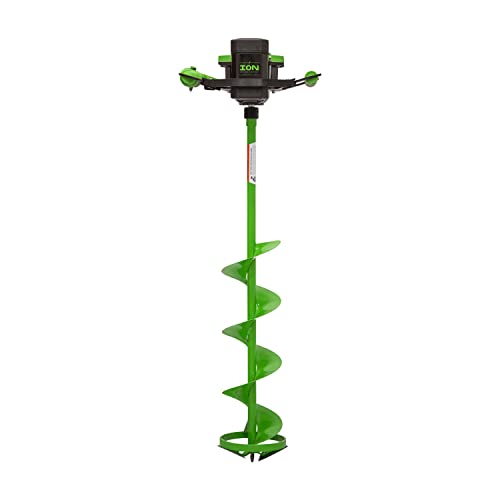
The ION Alpha Gen 3 pairs a 40V lithium system with an aggressive cutting head that chews through a foot of ice in a few seconds. ION rates it for up to 2,000 inches of ice per charge, which covers a long day of run-and-gun drilling for most anglers.
$529.99fromAmazonThis is the auger that makes drilling a non-event. ION rates the Alpha's average cutting speed at up to 3.4 inches per second, based on the company's own testing across more than 10,000 holes. In practice that means a 16-inch hole opens in a handful of seconds. Owners who came off hand augers describe the difference as the reason they now fish twice as many spots in a morning instead of committing to one.
The hole-count claim is the number worth understanding. ION rates a single 4Ah Gen 3 battery for up to 2,000 inches of ice — that's roughly 100 holes through 20-inch ice, in ideal conditions with sharp blades. Real cold cuts into that figure hard. Still, even a conservative read leaves you with more holes than a typical outing needs, and a second pack removes the question entirely.
Weight is where the Alpha earns its keep on a long walk. ION lists the powerhead-and-bit package under 20 pounds and calls it the lightest 40V series it builds. The full shipping weight comes in near 22 pounds with everything included. That's not featherlight, but it's balanced enough that you can sling it over a shoulder to the next spot without dreading the trip back.
The cutting system handles re-drills, which is the chore nobody talks about. Old holes skim over between visits, and a lot of augers chatter or grab when you drop a bit into refrozen slush. ION designed the Turbo head to bore old holes with minimal resistance, and owner feedback backs that up. If you run tip-ups and revisit the same spread all day, it saves real time and battery.
Flaws but not dealbreakers
It's the heaviest option in this guide once you account for the whole package, and it's noticeably more than a drill-based setup. If you walk a mile out on a lake with a sled, the difference is manageable. If you're carrying gear by hand, you'll feel it.
The Alpha ships with a single 4Ah battery. That's enough for most days in moderate cold, but in sub-zero weather you're on borrowed time by afternoon, and a second pack is a real added cost on an already expensive auger. Budget for one if you fish the far north.
Runner-up
Lighter powerhead and a trigger you can dial back
Eskimo E40 8-Inch Electric Ice Auger
The Eskimo E40 8-Inch weighs 17.5 pounds and uses a variable-speed trigger that lets you slow the bit to keep ice shavings from spraying around a shelter. Eskimo's Quantum blade system is rated for 150-plus holes between sharpenings.
$499.99fromAmazonThe variable-speed trigger is the feature that wins people over, and it's a shanty-specific problem you may not have considered. Full-speed drilling inside a hub or wheelhouse throws slush and shavings across the floor. Ease off the trigger and the bit still cuts, just without the mess. If you drill most of your holes indoors, this matters more than a few RPM at the top end.
At 17.5 pounds, Eskimo calls this the lightest steel auger in its class, and it's meaningfully easier to handle than our top pick. Steel bits also take abuse better than composite when you clip a rock in shallow water or set the auger down hard on a truck bed. That combination — light for steel, but still steel — is a sensible middle ground.
The blade system is the quiet reason to buy this one. Eskimo rates the Quantum 2 multi-edge blades for more than 150 holes per sharpening cycle, and replacement sets are cheap relative to the auger. That's not a spec-sheet flourish. Outdoor Life's reporting found that sharp blades cut motor amperage draw by as much as 25 percent, which translates to 20 to 30 percent more holes per charge on any electric platform.
In Wired2Fish's head-to-head comparison, the E40 drilled 62 holes in 8-inch diameter through 18-inch ice on a single 40V charge, versus 38 for the leading 20V converted drill setup. That's the clearest evidence we found for why a dedicated 40V system beats a drill conversion when you're drilling all day. The reverse toggle also flushes slush down the fresh hole, which keeps the rim clean.
Flaws but not dealbreakers
Eskimo doesn't publish the kind of RPM-under-load figures that ION does, so it's harder to compare cutting speed directly. Owner feedback consistently describes it as fast, but if raw speed is your priority, the Alpha has the better-documented case.
Like the Alpha, it ships with one 4Ah pack and a 2-amp charger that needs about two hours for a full cycle. You can't top up over lunch and get back to a full charge.
Budget pick
If you already own a good cordless drill, start here
K-Drill 8.5 Inch Ice Auger
The K-Drill 8.5-inch bit chucks into any half-inch cordless drill and cuts through 36 inches of ice without extensions. The auger alone weighs 3.2 pounds, so the whole rig lands around 14 pounds instead of the 22 a dedicated 40V system carries.
$269.99fromAmazonIf you own an M18 or 20V drill, this is the simplest way onto the ice. You're buying a bit, not a machine. K-Drill lists the auger at 3.2 pounds on its own; paired with a typical brushless drill you're carrying roughly 14 pounds versus about 22 for a dedicated 40V setup. For anglers who walk out or fish from a kayak sled in early season, that's a real advantage.
The tool steel blades hold up. Owner feedback on this auger runs unusually long in years — people describe multiple seasons before sending blades in for service — and K-Drill's sharpening program is a common reason buyers pick it over augers with hard-to-service heads. Blade servicing is the hidden long-term cost of any auger, and this one keeps it low.
There's a side stabilizer arm and a large center point, and both address the same problem: control. A drill-driven auger wants to twist your wrists if it grabs, and the stabilizer gives your off hand something to hold. The center point keeps the bit from wandering when you drop it into an old, skimmed-over hole rather than skating across the surface.
The 8.5-inch diameter is a genuinely useful size. It's wide enough for a decent walleye and most pike you'll pull through, without demanding the extra rotational energy a 10-inch hole needs. If you fish a mixed bag — perch in the morning, walleye at dusk — one hole size covers the day.
Flaws but not dealbreakers
You don't get 40V performance. Wired2Fish's comparison put a leading 20V converted drill setup at 38 holes per charge against 62 for a dedicated 40V auger. If you drill 30-plus holes an outing, you'll be swapping packs.
It's auger-only, so a drill is a required purchase if you don't already have one — and a weak or brushed drill will struggle and overheat. There's also no reverse-toggle slush flush the way the purpose-built augers have, and no variable-speed control beyond whatever your drill's trigger offers.
Also great
A 10-inch hole from the lightest powerhead here
Eskimo E40 10-Inch Electric Ice Auger
The Eskimo E40 10-Inch uses a composite bit to hit 14 pounds — lighter than the 8-inch steel version despite cutting a wider hole. It's the pick for pike and tip-up anglers who need to fit a big fish through the ice.
$599.99fromAmazonA 10-inch hole exists for one reason: getting a big fish through it. If you run tip-ups for pike or you've ever had a thick-shouldered walleye stick at the rim, you know the frustration. This is the only auger in this guide that cuts that diameter, and Eskimo pulled it off at 14 pounds by going with a composite bit instead of steel.
That weight number is the surprise. At 14 pounds it's lighter than the company's own 8-inch steel model and meaningfully lighter than our top pick, even though it's moving 56 percent more ice per hole. Composite gives up some abuse tolerance to steel, but for anglers who mostly drill clean lake ice and hate hauling weight, the trade lands in the right place.
It shares the E40 platform's best traits. Same 40V motor, same variable-speed trigger for cutting down on shavings inside a shelter, same reverse toggle for flushing slush, same Quantum multi-edge blade system rated past 150 holes per sharpening. If you liked the runner-up but need the bigger diameter, nothing else about the experience changes.
Flaws but not dealbreakers
The physics work against you on hole count. A 10-inch hole takes roughly 56 percent more rotational energy than an 8-inch one, so you'll get noticeably fewer holes per charge than the 8-inch models. Most 40V systems are only rated for 10-inch use in ice up to about 24 inches thick.
The composite bit is less forgiving than steel if you're careless with it, and at least one owner reported a cracked retention collar early on — though Eskimo's customer service replaced it without a fight. It's worth handling with a bit more care than a steel auger.
If you're a panfish angler, this is more auger than you need. A 10-inch hole in a shelter means a bigger heat leak and a lot more slush to deal with for no benefit.
Who this is for
Buy a cordless auger if you're still running gas and you fish out of any kind of enclosed shelter. The carbon monoxide risk from gas augers in a closed hub is not theoretical — the CDC has issued advisories after fatalities. Cordless also means no oil mixing, no fouled carburetor in October, and no pull-starting at 5 a.m. If you drill fewer than 20 holes a trip, almost any 40V auger here will get you through a day without a battery swap.
Skip the upgrade if you own a working gas auger, fish exclusively on open ice in extreme cold, and routinely drill through more than 30 inches. Lithium loses 30 to 40 percent of its capacity below 14°F, and that's the one place gas still has a clean argument. This guide covers battery-powered augers and drill-mounted bits in 8- to 10-inch diameters. It doesn't cover gas augers, propane hybrids, hand augers, or dedicated 6-inch panfish models.
How we picked
Torque under load: we looked for figures on RPM in thick ice, not marketing no-load numbers. Holes per charge: dedicated 40V systems beat 20V drill conversions in published comparisons, 62 holes to 38, so 40V got priority for high-volume anglers. Weight: anything past roughly 22 pounds punishes a long walk, and we cross-checked spec weights against owner feedback about handling. Blades: sharp blades cut amperage draw by up to 25 percent, so documented sharpening cycles and cheap replacements mattered as much as motor specs. Reverse and shelter manners: a one-button reverse frees a bound auger in seconds, and a variable-speed trigger keeps slush off your shanty floor.
Other cordless ice fishing augers worth considering
If you want a brushless motor and Lazer blades: The StrikeMaster Lithium 40V Maven Ice Auger ($579.99) — The StrikeMaster Lithium 40V Maven pairs a high-torque brushless powerhead with an 8-inch Lazer steel drill assembly and stainless blades, plus a reverse function for flushing slush. StrikeMaster has been building ice augers for decades, and the Lazer blade lineage is well regarded among anglers who fish hard, dirty ice. Brushless motors also tend to run cooler and last longer than brushed equivalents. The catch is that it's new enough that there's very little owner feedback to draw on, and StrikeMaster doesn't publish the hole-count or cutting-speed figures that let us compare it directly with our picks. If you already trust the brand, it's a reasonable buy — we just can't yet say it beats the Alpha.
The competition
This is what our research turned up in the cordless auger category, not a complete map of everything sold. Several brands we'd have liked to include — notably Jiffy's propane-electric hybrid and the smaller 6-inch panfish augers — weren't available to us in a form we could write about confidently. Everything above is either a pick or a close alternative, and each product we looked at appears somewhere in this guide.
Cold-weather care and battery handling
Keep your spare battery inside your jacket or in the heated shelter, not in the sled. Lithium cells lose 30 to 40 percent of their capacity once they're sitting below 14°F, and a warm pack recovers most of that the moment you clip it on. Let a cold pack warm to room temperature before charging — charging a frozen battery shortens its life. Blades are the other half of the equation. Dry the cutting head before it goes in the truck, because a wet blade rusts overnight and a rusty edge drags. Slip the blade guard on every time; a single knock against a hitch can nick an edge enough to double your motor's amperage draw. Send blades out for sharpening at the end of the season rather than the start, so they're ready when first ice comes.
Questions we get
Are cordless electric ice augers as powerful as gas augers?
For most fishing, yes. A 40V lithium auger cuts through 18 to 24 inches of ice about as fast as a comparable gas unit, and it starts every time. Gas still holds an edge in extreme cold and on very thick ice, where lithium capacity drops sharply. But electric has overtaken gas in units sold, which tells you how the tradeoff shakes out for most anglers.
How many holes can a cordless ice auger drill on one charge?
In Wired2Fish's head-to-head comparison, a 40V auger drilled 62 holes at 8-inch diameter through 18-inch ice on one charge, while a 20V drill conversion managed 38. Expect fewer than that in deep cold or with dull blades — sometimes 30 to 40 percent fewer. Sharp blades are the single biggest variable you control.
Should I get a 20V or 40V system?
Get 40V if you're buying a dedicated auger. The sustained torque and hole count are meaningfully better, and 20V drill setups fade faster under load in thick ice. A 20V drill conversion like the K-Drill makes sense only if you already own the drill and batteries, or if you're drilling a handful of holes per trip.
Can I use my Milwaukee M18 drill as an ice auger?
Yes, with a conversion bit like the K-Drill, which chucks into any half-inch drill. Use a brushless, high-torque model — a light homeowner drill will bog down and overheat in thick ice. A high-capacity battery helps a lot, and you'll want a second one. Owners routinely report drilling through two feet of ice this way without trouble.
What blade size do I need for walleye?
Eight inches covers walleye comfortably and is the most common size for good reason. Six inches is plenty for perch and panfish and saves both weight and battery. Step up to 10 inches only if you're targeting pike or running tip-ups where a big fish needs room — a 10-inch hole takes about 56 percent more energy to cut.
Can I use a cordless auger inside an ice shanty?
Yes, and it's the main reason to switch. Electric augers produce no carbon monoxide, which makes them the only safe choice in an enclosed shelter — the CDC has issued advisories after deaths involving gas-powered units indoors. If your auger has a variable-speed trigger, ease off it while drilling to keep ice shavings from spraying across the floor.
Why you should trust us
For this guide:
- We read manufacturer specifications and published cutting-speed and hole-count claims for every auger here, and compared them against independent head-to-head reporting from Wired2Fish, Outdoor Life and Field & Stream.
- We reviewed owner feedback across all five listings for recurring themes around weight, battery life in cold weather, blade durability and customer service.
- We cross-checked cold-weather battery behavior against published lithium discharge data rather than relying on manufacturer runtime figures alone.
- We read owner reviews on every listing, weighted toward the critical ones, because that is where the recurring failures show up.
- We have a systematic way of automatically fetching the latest prices, so the numbers on this page stay current.
- This is a research-focused guide, so the team may not own every product listed — though we often do own the top winners, which gives us extra context for the recommendations.
- We don't accept free products, and the retailer commission never changes which product we recommend.
Sources
Best Ice Fishing Augers 2025–2026 — In-Fisherman, In-Fisherman
Ice Auger Reviews and Buyer's Guide — Ice Fishing Guru, Ice Fishing Guru
Best Electric Ice Augers — Outdoor Life, Outdoor Life
ION Electric Ice Auger Alpha X Review — Field & Stream, Field & Stream
Cordless Ice Auger Comparison Lab Test — Wired2Fish, Wired2Fish
Strikemaster Lithium 40V Review — Tackle Warehouse Blog, Tackle Warehouse
K-Drill Ice Auger System Review — Fishing Minnesota, Fishing Minnesota
Ice Auger Power Sources: Electric vs. Gas vs. Propane — Game & Fish Magazine, Game & Fish Magazine
Lithium Battery Cold Weather Performance Testing — Battery University, Battery University
Eskimo Ice Auger Blade Technology Overview — Eskimo Fishing, Eskimo Fishing (Manufacturer)
Best Ice Fishing Gear 2026 Roundup — Popular Mechanics, Popular Mechanics
Amazon product listings and owner reviews for all 5 products
Manufacturer specification pages for each product
Some passages in this guide may be paraphrased with AI help. Prices are refreshed automatically.
More like this.
Continue exploring lifestyle reviews and recommendations.

The Best Ice Fishing Tip-Ups and Hard-Water Gear
Tip-up fishing is a waiting game you play with your feet up. You set a baited line under the ice, walk away, and watch for a flag. When one pops across…

The Best Drain Snakes And Augers
A slow drain isn't an emergency until it is. You notice the tub filling around your ankles, or the kitchen sink holding an inch of gray water after you…

The Best Crampons For Ice Climbing And Mountaineering
Crampons are one of the few pieces of gear where the wrong choice isn't just annoying - it's dangerous. A good pair bites into hard blue ice, stays put on…

The Best Coolers for Ice Retention
A cooler's whole job is to hold a temperature you can't see. You pack it in the driveway, drive four hours, and don't really learn how good it is until…

The Best Fishing Gear for Beginners
Fishing asks less of you than almost any other outdoor hobby. You need something to cast with, something to tie on the end, and a place to stand. But the…

The Best Paddleboard Fishing Accessories
Paddleboard fishing works because the setup is simple. You stand, you spot fish before they spot you, and you slide into water a boat can't reach. But a…