The Best Klein Tools for Electricians
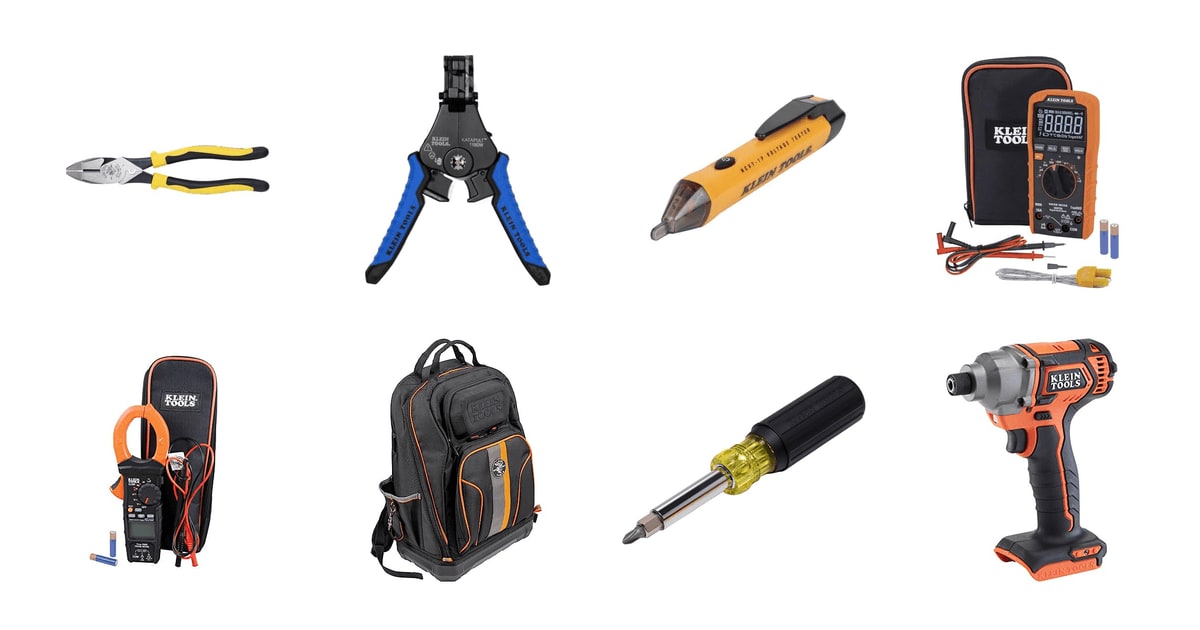
Electrical work punishes tools in ways most trades don't. You cut ACSR overhead, you strip a hundred conductors during a rough-in, and then you crawl into an attic in July and ask the same pliers to crimp a lug. The tools that survive that share a few traits: hardened cutting edges that don't roll, handles that don't chew up your palm by hour six, and meters that read correctly the first time. Klein has been making tools for the trade since 1857, and its hand tools are the default on most job sites for a reason.
But no single Klein tool covers everything, and the brand isn't uniformly strong. Its hand tools are the benchmark. Its meters are solid mid-tier instruments that undercut Fluke without quite matching Fluke's calibration reputation. And its cordless line is young — owners who already run DeWalt or Milwaukee batteries routinely report that Klein's impact driver doesn't hit as hard as what they already own. Klein's lifetime warranty covers hand tools against defects, not the electronics. Know which category you're buying into before you spend.
You also can't skip the safety math. A meter's CAT rating tells you what transient energy it's built to survive, and OSHA guidance is clear that instruments used near live panels need a rating matched to the circuit. That's not a spec-sheet detail — it's the difference between a bad day and a very bad one. We think that the Klein Tools J213-9NECR Journeyman lineman's pliers are the best Klein tool for most electricians, and that the Klein Tools 11063W wire stripper is the one to buy if you spend your days on rough-in wiring.
Everything we recommend

The one tool that earns its spot on your belt every day

Faster strips on rough-in, at the cost of one more tool

The simplest way to stop guessing whether a circuit is dead
A daily-driver meter with real panel-rated safety
Forty pockets and a molded bottom, if you carry it all
How we picked
Build and materials. We favored forged, US-made steel and induction-hardened cutting edges over cast or coated alternatives, using Klein's published specs. Where owner feedback described edges rolling or joints loosening after a season, we treated that as disqualifying for a pick.
Safety ratings. For anything that touches a live circuit, we required a stated CAT rating appropriate to panel work — CAT III 1000V or CAT IV 600V at minimum, per OSHA's guidance on matching instrument rating to installation category. Unrated testers didn't make the cut.
Measurement accuracy. We treated true-RMS as a baseline for meters, following Electrical Contractor magazine's guidance that averaging meters misread the non-linear loads common on modern sites. Low-impedance mode counted heavily because ghost voltage wastes real hours.
All-day ergonomics. We weighted grip comfort and leverage geometry using published hand-tool reviews and recurring owner comments about hand fatigue. Pro Tool Reviews' rankings of electrician hand tools informed how we ranked comfort against cutting durability.
Warranty and support. Klein's lifetime warranty against defects on hand tools lowers the risk of a premium purchase, so we gave hand tools more benefit of the doubt on price. Electronics and cordless tools don't carry that, and we judged them accordingly.
Top pick
The one tool that earns its spot on your belt every day
Klein Tools J213-9NECR Journeyman Pliers Connector Crimp
These 9-inch Journeyman lineman's pliers cut, grip, twist and crimp non-insulated connectors without a second tool. The rivet sits closer to the cutting edge for more leverage, and Klein's lifetime warranty against defects makes them close to a one-time purchase.
$50.99fromAmazonIf you buy one Klein tool, buy these. Lineman's pliers are the tool an electrician reaches for most, and the J213-9NECR handles the whole rotation: cutting THHN, twisting wire nuts, gripping a stubborn conduit locknut, and crimping non-insulated lugs and terminals. The crimping die sits behind the hinge, so you get real leverage on a crimp instead of mashing it near the tip. That means one less tool on your belt.
The high-leverage geometry is the part you actually feel. Klein moves the rivet closer to the cutting edge, which the spec sheet puts at 46 percent more cutting and gripping power than a conventional plier design. Translated: you close your hand less hard, a hundred times a day. Owners who've run these for decades keep coming back to grip comfort and edges that stay sharp — the same thing Pro Tool Reviews flags in its hand-tool rankings.
Klein hot-rivets the joint, so there's no handle wobble the way there is on cheaper pliers that loosen after a season. The handle tempering is meant to absorb the snap when you cut heavier wire, which matters if your wrist already complains. And these are made in the USA from Klein's own tool steel, which is part of why they cost what they do.
The lifetime warranty changes the math on price. Klein covers its hand tools against defects in materials and workmanship for life. You're not buying a nine-inch plier for this year — you're buying one you'll hand to an apprentice in twenty years. Spread across that, the premium over a house-brand plier stops looking like a premium at all.
Flaws but not dealbreakers
They're big. At 9 inches and just over a pound, they're a lot of tool if you have smaller hands or you're doing delicate low-voltage work — one handyman owner noted the grips felt oversized for general home wiring. If that's you, a shorter lineman's plier or a set of needle-nose will serve better for the fine stuff.
The crimping die handles non-insulated connectors only. If you work mostly with insulated terminals, you still need a dedicated crimper, and the combo feature won't save you a trip to the bag.
Klein's lifetime warranty covers these pliers against defects in materials and workmanship.
Runner-up
Faster strips on rough-in, at the cost of one more tool
Klein Tools 11063W Wire Cutter/Stripper
This automatic stripper grips and strips 8-20 AWG solid and 10-22 AWG stranded wire in one squeeze, pulling up to an inch of jacket. If you're stripping conductors all day, it pays for itself in saved motion faster than any other tool here.
$30.97fromAmazonPicture a rough-in: forty devices, three conductors each, and your hand cramping by lunch. That's the job this tool exists for. One squeeze grips the wire and pulls the insulation in a single compound-action motion, and the tension-loaded grip holds the cable without deforming it. You're not measuring, not rotating, not adjusting a dial for gauge.
The stripping holes are the reason it doesn't nick conductors. They're precision-machined for each gauge, so the blade opens to the copper and stops. Owners doing fine work — 18 AWG LED runs, aircraft wiring — consistently report clean strips with no ring damage, which is the failure mode that makes cheap self-adjusting strippers frustrating. It'll also strip mid-run without cutting the conductor, handy for splices and taps.
The chassis is cast alloy with an E-coat finish, so it takes being dropped in a wet trench better than a plastic-bodied stripper. It covers a genuinely wide range: 8-20 AWG solid handles everything from a range circuit down to thermostat wire.
It's the runner-up rather than the top pick because it does one job. The lineman's pliers cut, grip, twist and crimp; this strips and cuts. But if stripping is what your day is made of, buy this first and the pliers second.
Flaws but not dealbreakers
It's bulkier than a plain pair of Klein 11055 strippers, and it doesn't fit a pouch as neatly. On a service call where you strip four wires total, you'll probably leave it in the bag.
Automatic strippers have more moving parts than manual ones. The spring and jaw mechanism is the thing that eventually wears, and no stripper mechanism lasts as long as a solid forged plier.
Budget pick
The simplest way to stop guessing whether a circuit is dead
Klein Tools NCVT1P Voltage Tester
The NCVT1P is a pen-style non-contact tester that detects 50 to 1000V AC and clips in your shirt pocket. It's rated CAT IV 1000V and survives a 6.6-foot drop, which is why it's usually the first tool an apprentice buys.
$19.95fromAmazonThis is the tool you touch before you touch anything else. Hold it near a wire, a breaker, an outlet or a fixture, and it flashes red and beeps if there's AC present. A green LED tells you the tester itself is alive, which matters — a dead NCVT that reads "no voltage" is worse than no tester at all.
The CAT IV 1000V rating is the part that justifies buying the name. OSHA guidance says test instruments near live panels should carry a CAT rating matched to the installation category of the circuit, and CAT IV is the top tier — service entrance and utility connection. A no-name pen from a bin doesn't give you that assurance, and owners who buy Klein for exactly this reason say so repeatedly.
It's pocket-sized, weighs almost nothing, and auto-powers-off so you're not replacing batteries because it sat on in a drawer. The 6.6-foot drop rating covers the reality of dropping it off a ladder. Owners report the sensitivity is fine enough to distinguish a hot conductor from a dead one an inch away in the same box.
For a homeowner doing their own switch and outlet swaps, this is the single highest-value electrical purchase available. It costs a fraction of what the meters here do and it's the tool that keeps you from becoming a statistic.
Flaws but not dealbreakers
Non-contact testers tell you voltage is present, not that it's absent. Induced voltage on a nearby conductor can trigger it, and shielded cable or a grounded metal enclosure can hide a live wire from it. Before you put hands on a conductor, confirm dead with a meter.
It won't read below 50V, so it's no help on low-voltage control, thermostat or doorbell circuits.
Also great
A daily-driver meter with real panel-rated safety
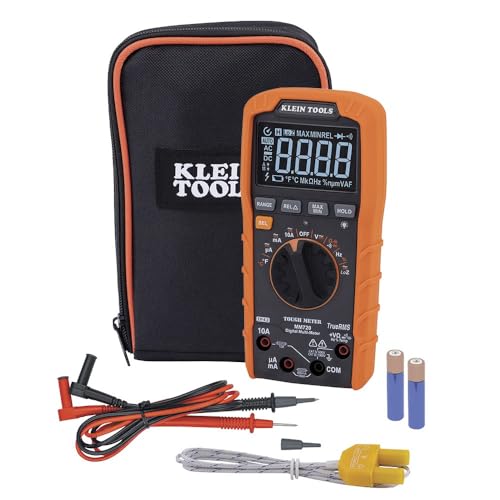
Klein Tools MM720 Digital Multimeter
The MM720 is an auto-ranging true-RMS multimeter that reads 1000V AC/DC, 10A current and 60 megohms, with low-impedance mode for killing ghost voltage. Its reverse-contrast display stays readable in a dim mechanical room.
$99.97fromAmazonTrue-RMS is the spec that matters here and it isn't marketing. Electrical Contractor magazine treats true-RMS as a baseline requirement for reading the non-linear loads that fill modern buildings — LED drivers, VFDs, switching supplies. An averaging meter reads those wrong, sometimes badly wrong. If you're troubleshooting a lighting retrofit, an averaging meter will send you chasing a problem that isn't there.
LoZ mode is the feature that saves the most time. Long parallel runs in conduit induce phantom voltage, and a high-impedance meter will happily show you 40 volts on a dead conductor. LoZ dumps that stray charge so you get a real reading. Owners who bought the MM720 specifically for LoZ say it's the reason they picked it over a similarly priced Fluke.
The reverse-contrast LCD — light digits on dark — is easier to read in a dark crawlspace than a standard display, and owners consistently call the screen the meter's best feature. There are lead holders on the back, a kickstand, and it takes an optional magnetic hanger so you can stick it to a panel and keep both hands free.
It also covers the extras you occasionally need: capacitance, frequency and duty cycle, temperature, diode test and continuity. That's a full diagnostic set in one body, which is why it works as the meter you leave in the bag permanently.
Flaws but not dealbreakers
It's a mid-tier instrument, not a Fluke. Owners who cross-check against a Fluke 117 generally find the MM720 close but note it falls short in specific areas depending on what they need. If your work demands documented calibration, this isn't the meter.
It's fairly large for a handheld, and the 10A current ceiling means any real load measurement needs a clamp meter instead.
Upgrade pick
Forty pockets and a molded bottom, if you carry it all
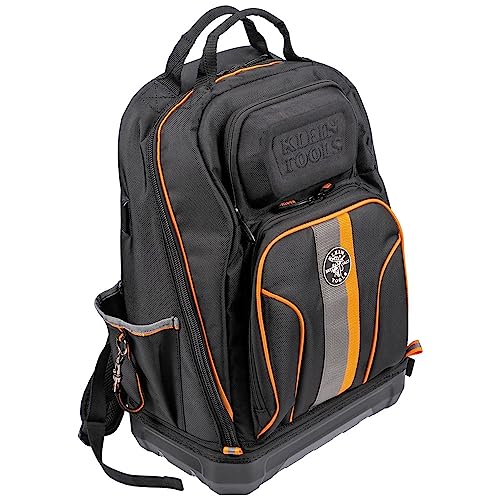
Klein Tools 62800BP Backpack Tool Bag
The 62800BP Tradesman Pro backpack has 27 interior and 13 exterior pockets, a curved molded base that keeps it upright in a wet parking lot, and a USB-C charging port. It's the bag that turns a pile of tools into a system.
$119.99fromAmazonA bag sounds like the least exciting purchase on this list. In practice it's the one that changes your day the most. When every tool has a pocket, you stop dumping the bag on a customer's floor to find a torpedo level. Forty pockets is enough that you can assign locations and actually remember them.
The molded bottom is the detail worth paying for. It's curved and wide, so the pack stands up on its own instead of flopping over and spilling, and it keeps the contents off wet concrete. The 1680d shell is water-resistant, and owners who load these with 50 pounds of tools and haul them for years report the zippers and base hold up.
The USB-C port is more useful than it sounds. It runs a 1.5-foot cord from outside to inside, so you drop a battery pack in a pocket and charge your phone while the bag sits in the van. There's also a bracket for a Klein headlamp, sold separately, if you work in unlit spaces.
It's the upgrade pick because it's a real expense and it's not for everyone. If you work out of a van with a shelving system, a backpack is redundant. If you're doing service calls where you carry everything from the truck to a third-floor unit, it's the difference between one trip and three.
Flaws but not dealbreakers
Despite how the listing reads to some buyers, there's no dedicated padded laptop compartment. Owners have flagged this specifically. There's room for a tablet in the main cavity, but nothing purpose-built to protect a laptop.
It's extra-large, and loaded it gets heavy fast. Owners also mention the external tape-measure clip is on the flimsy side. If you only carry a meter, a tester and a few hand tools, a smaller Tradesman Pro tote makes more sense.
Who this is for
This guide is for anyone assembling or upgrading an electrician's kit — an apprentice buying their first belt, a journeyman replacing worn pliers, a contractor outfitting a van, or a homeowner who's decided to stop paying someone else to swap outlets. It's also a reasonable gift list; the tester and the 11-in-1 screwdriver are the two most reliably welcome things you can hand a first-year apprentice. Everything here is Klein, so it's a brand roundup rather than a survey of the whole market.
It's not for you if you're shopping for a cordless platform. Klein's 20V line is newer and thinner than Milwaukee's or DeWalt's, and it makes sense mainly if you're already deep in Klein hand tools and want battery cross-compatibility. It's also not the guide if you need documented calibration for compliance work — that's Fluke territory, and we'd point you there without apology. We've covered hand tools, testers, meters, storage and one cordless tool; we haven't covered conduit benders, fish tape, knockout sets or Klein's insulated 1000V-rated hand tool line.
How we picked
We weighed each tool against five things. Build and materials: forged US steel and induction-hardened edges, per Klein's specs, with owner reports of rolled edges or loose joints counting against a tool. Safety ratings: anything touching a live circuit needed a stated CAT III 1000V or CAT IV rating, matching OSHA's guidance on installation category. Measurement accuracy: true-RMS as a hard baseline for meters, since Electrical Contractor magazine flags averaging meters as unreliable on LED drivers and VFDs, plus low-impedance mode to kill ghost voltage. All-day ergonomics: leverage geometry and grip comfort, drawing on Pro Tool Reviews' hand-tool rankings and recurring owner comments about hand fatigue. Warranty and support: Klein's lifetime warranty on hand tools takes most of the risk out of paying up, though it doesn't extend to electronics.
Other klein tools for electricians worth considering
If you want the highest-utility tool for the least money: The Klein Tools 32500 11-in-1 Screwdriver/Nut Driver Set ($15.97) — The 32500 11-in-1 replaces eight screwdrivers and three nut drivers with one cushion-grip handle — #1 and #2 Phillips, two slotted, T10 and T15 Torx, two square recess, and 1/4, 5/16 and 3/8-inch nut drivers. Bits store in the shaft and swap in a second, and the blast-finish tips bite instead of camming out. It's the tool everyone owns three of because they keep losing them in trucks and junk drawers. What it gives up is torque and reach: a fat multi-bit handle can't get into a tight device box the way a slim dedicated driver can, and it doesn't ratchet. Buy it anyway. If you're putting together a gift for a new apprentice, pair it with the NCVT1P.
If you want a clamp meter for commercial and HVAC troubleshooting: The Klein Tools CL900 Digital Clamp Meter ($182.65) — The CL900 reads true-RMS AC and DC current up to 2000 amps through the jaw, which is well past anything residential and into service-entrance and light industrial territory. It captures inrush current in a dedicated mode — the thing you actually need when a compressor won't start — and it does LoZ, NCVT, resistance, continuity, frequency, capacitance and diode test through the leads. IP40 ingress protection and a 6.6-foot drop rating cover the abuse. The trade-off is size: owners note it's noticeably larger than a Fluke 179 or Klein's own smaller clamps, and it doesn't read temperature, which HVAC techs sometimes discover after the box is open. If your amperage never exceeds a residential panel, the MM720 plus a smaller clamp is the lighter kit.
More from Klein Tools
Klein makes hundreds of tools, and this is what our research surfaced — not the full catalog. The model below didn't earn a pick, but it fits a specific shopper, so here's who that is.
The Klein Tools BAT20CD 20V Battery-Operated 1/4-Inch Impact ($204.15) — The BAT20CD is Klein's compact 1/4-inch 20V impact driver, sold as a bare tool. It's rated at 210 ft-lbs of max torque, runs a brushless motor with variable speed, and has an LED, a safety lockout and a forward/reverse/lock trigger. The compact body is genuinely good for panel work and overhead fastening where a full-size driver won't fit. But owner feedback splits hard on power: several commercial electricians say it drives noticeably softer than the DeWalt or Milwaukee they already own, and a few report trigger problems after a few months. Klein's cordless line is newer than its competitors', with a smaller battery ecosystem behind it. This one makes sense if you're already on the Klein 20V platform and want a light, compact driver for tight electrical work. If you're choosing a cordless platform from scratch, look elsewhere first.
Is Klein Tools worth it?
Klein has been making hand tools since 1857, which makes it one of the longest continuously operating tool brands still selling directly to the electrical trade. That history isn't just marketing — it's why Klein's lineman's pliers are the tool other lineman's pliers get compared to, and why Pro Tool Reviews keeps ranking them near the top for grip comfort and edge durability. The lifetime warranty on hand tools, covering defects in materials and workmanship, is the concrete part of the value story: you're buying once. Where Klein sits relative to rivals depends on the category. Against Fluke, Klein's meters cost less and hit the same CAT III and CAT IV safety tiers, but Fluke keeps the edge on calibration reputation for compliance work. Against Milwaukee and DeWalt, Klein's hand tools hold their own and its cordless line doesn't — the 20V platform is younger, with fewer tools and less battery infrastructure. Buy Klein for what goes on your belt. Shop harder for what takes a battery.
Not set on Klein Tools?
If you're choosing a cordless platform rather than filling out a hand-tool kit, Milwaukee's M12 and M18 lines have a far deeper catalog and a more established battery ecosystem than Klein's 20V line. our Milwaukee tools guide →
If the real problem is that your tools live in piles at home rather than in a bag, that guide covers shelving rated to hold serious weight in a garage or shop. our heavy-duty garage shelving guide →
Care and maintenance
Hand tools mostly need to stay dry. Wipe your lineman's pliers down at the end of a wet day and put a drop of light oil on the hot-riveted joint every few months — that's what keeps the action smooth and the joint from seizing. Don't use cutting edges on hardened steel like screws, nails or spring wire; that's what rolls an edge, and a rolled edge is the one thing a lifetime warranty won't cover because it's wear, not a defect. Keep the stripper's jaws clean of insulation crumbs so the gauge holes stay true. For meters and testers, pull the batteries if a tool's going to sit unused for a season — leaking alkaline cells destroy more meters than drops do, and owners bring this up often enough that it's worth doing. Inspect test leads for cracked insulation before every panel job, and replace them at the first nick.
Questions we get
Are Klein Tools worth the extra cost compared to cheaper hand tool brands?
For hand tools, yes. The lifetime warranty against defects means a plier or screwdriver is close to a one-time purchase, and spread across a decade the premium disappears. Klein's cutting edges and hot-riveted joints hold up under daily use in ways that budget pliers don't. The calculation is different for Klein's electronics and cordless tools, which don't carry that warranty.
What's the best Klein multimeter for residential electricians?
The MM720 covers almost everything a residential electrician does. It's auto-ranging, true-RMS, reads up to 1000V AC/DC, and has low-impedance mode for clearing the ghost voltage you get on long parallel runs. If you're mostly doing quick live/dead checks rather than diagnostics, the NCVT1P plus a basic meter is a cheaper starting point.
Klein Tools vs. Fluke: which is better for professional electricians?
Klein wins on hand tools without much argument — Fluke doesn't really compete there. On meters it's closer. Klein's instruments hit the same CAT III and CAT IV safety tiers for less, and owners who compare an MM720 against a Fluke 117 generally find it holds up. Fluke keeps the edge if you need documented calibration or long-term measurement traceability for compliance work.
What does the CAT rating on a multimeter actually mean?
CAT ratings describe how much transient energy a meter is built to survive, based on where in the electrical system you're measuring. CAT III covers distribution panels and fixed installations; CAT IV covers the service entrance and utility connection, where fault energy is highest. OSHA guidance says instruments used near live panels should carry a rating matched to the circuit's installation category. Higher-numbered CAT at the same voltage means more protection, so don't take a CAT II meter into a panel.
Do Klein lineman's pliers come with a lifetime warranty?
Yes. Klein's Journeyman and standard lineman's pliers are covered for life against defects in materials and workmanship. That doesn't cover normal wear or damage from misuse — cutting hardened screws and rolling the edge is wear, not a defect. Keep them dry and off hardened steel and they'll outlast the warranty claim.
Does Klein make cordless power tools, and are they any good?
Klein has a 20V cordless line, including the BAT20CD compact impact driver. It's decent and the compact size genuinely helps in panels and overhead, but owner feedback is mixed on power compared with DeWalt and Milwaukee. The lineup and battery ecosystem are also smaller than what the established platforms offer. It makes sense if you're already invested in Klein; it's not a reason to switch platforms.
Why you should trust us
For this guide:
- We read Klein's published specifications for every tool here, including stated CAT ratings, measurement ranges, wire gauge capacities and warranty terms.
- We compared those specs against published hand-tool and meter guidance from Pro Tool Reviews and Electrical Contractor magazine, plus OSHA's guidance on CAT ratings for instruments used near live panels.
- We read owner feedback across all eight listings and looked for repeated themes — grip comfort, ghost-voltage handling, bag durability, cordless torque complaints — rather than isolated opinions.
- We read owner reviews on every listing, weighted toward the critical ones, because that is where the recurring failures show up.
- We have a systematic way of automatically fetching the latest prices, so the numbers on this page stay current.
- This is a research-focused guide, so the team may not own every product listed — though we often do own the top winners, which gives us extra context for the recommendations.
- We don't accept free products, and the retailer commission never changes which product we recommend.
Sources
Klein Tools Journeyman Lineman's Pliers — Product Specifications, Klein Tools
Klein Tools NCVT-3 Non-Contact Voltage Tester Specifications, Klein Tools
Klein Tools MM700 Auto-Ranging Digital Multimeter Specifications, Klein Tools
Klein Tools CL800 Digital Clamp Meter Specifications, Klein Tools
Klein Tools Katapult Wire Stripper/Cutter Overview, Klein Tools
Best Electrician Hand Tools Tested — Pro Tool Reviews, Pro Tool Reviews
Klein Tools Cordless Impact Driver Review, Pro Tool Reviews
Multimeter Buying Guide for Electrical Contractors, Electrical Contractor (ECmag)
Best Voltage Testers and Multimeters for Electricians, Popular Mechanics
How to Choose the Right Wire Strippers for the Job, Family Handyman
Klein Tools Company History and Warranty Policy, Klein Tools
Understanding CAT Safety Ratings for Test Equipment, OSHA
Amazon product listings and owner reviews for all 8 products
Manufacturer specification pages for each product
Some passages in this guide may be paraphrased with AI help. Prices are refreshed automatically.
More like this.
Continue exploring home reviews and recommendations.

The Best Cold Brew Coffee Makers
Cold brew asks one thing of you that morning coffee doesn't: a little planning the night before. Get that part right and the payoff is real. Coarse…

The Best Gifts for Gardeners
Gardening is one of those hobbies where the gear actually matters. A dull pruner tears a stem instead of slicing it. A watering can with a clumsy spout…

The Best Door Threshold Seals and Weatherstripping
You can feel a bad door seal before you can see it. Stand near the front door on a cold morning and there's a cool ribbon of air across your ankles. In…

The Best Sunrise Alarm Clocks
The alarm on your phone works by startling you. A sunrise alarm clock tries something gentler: it brightens your room over 20 or 30 minutes so you're…

The Best Window Well Covers
A window well is a small pit that fills with whatever falls into it. Leaves, rain, a stray tennis ball, the occasional frog. Left open, it collects water…

The Best Lightweight Cordless Stick Vacuums
A cordless stick vacuum earns its place by being the vacuum you actually reach for. It hangs on a wall or leans in a closet, and you grab it when the dog…