The Best Crab Pots and Lobster Traps
Crabbing is mostly waiting, and the gear you drop over the side decides whether that wait pays off. A good trap sits flat on the bottom, holds its shape when the tide pushes, and lets crabs walk in without walking back out. It also has to survive salt water, which chews through cheap wire faster than you'd expect. And it has to be legal where you fish — escape rings, mesh size, rot cord, buoy markings. Get those wrong and you're not crabbing, you're donating gear to the state.
Here's the honest part: no trap on this list solves the regulation problem for you. Rules on trap dimensions, escape gaps, soak time and trap counts change by state, by species and sometimes by zone, and a listing that says "crab trap" tells you nothing about whether it's legal in your water. One trap here carries an explicit warning that it isn't compliant in California. Collapsible traps also share a physical limit — in heavy current over rock, they tip and drift, and a trap that isn't on the bottom catches nothing.
So think of these as starting points, and check your state agency before your first soak. Most people fishing docks, piers and calm bays want a complete rig they can throw in a truck and use the same afternoon. We think that the KUFA CT50 2-Pack is the best crab pot setup for most people, and that the BRILISLE 2PCS Crab Trap is the one to buy if you're new to this and want two traps in the water without spending much.
Everything we recommend
Two fully rigged pots, ready to fish the day they arrive
Four doors and legal escape rings, but not for California

Two traps, rope and bait bag for a first season

Purpose-sized for blue crab, with a frame that survives salt
At a glance
| Product | Trap Size | Frame Material | Price | |
|---|---|---|---|---|
| 2-Pack of KUFA CT50 Sports Foldable CrabTop pick | 30 x 10" | Stainless Steel | $160.32 |
| Promar TR-555BC: Collapsible Blue Crab Trap -Also great | 21 x 17 x 9" | Vinyl-Coated Steel | $59.99On sale |
| Danielson 24" Fold-Up Pacific Coast Crab TrapRunner-up | 24 x 24 x 13" | Vinyl-Coated Steel | $64.95 |
 | Frabill Crawfish TrapAlso in lineup | 10 x 9.75 x 9" | Vinyl-Dipped Steel | $19.99 |
 | BEAU MAC Crab Pot Super Buoy Red/WhiteAlso consider | 14" | — | $35.65 |
| BRILISLE 2PCS or 1PCS Crab TrapBudget pick | 24 x 12in | — | $22.98 |
 | SOUTH BEND Wire Minnow TrapAlso in lineup | 9" dia x 16.5" | Corrosion-Resistant | $22.99On sale |
How we picked
Salt water survival. We compared frame materials across every listing, and gave weight to vinyl- or PVC-coated wire over bare galvanized. Coated wire holds up several times longer in salt, which is the single biggest factor in whether a trap lasts more than one season.
Entry design. We looked at how many funnels or doors each trap uses and how they're shaped. Multi-entry traps give crabs more approach angles in current, and published crabbing guidance consistently favors them over single-entry designs.
Legal compliance. We checked each listing for escape rings, escape gaps and biodegradable rot cord, since most coastal states require all three. Traps that state their compliance — or their non-compliance — clearly scored better than listings that stay silent.
Complete rigs. We favored kits that include line, float and bait bag, because buying those separately costs more and delays your first trip. A trap alone isn't a fishing setup.
Storage and transport. We compared folded thickness and open dimensions from the spec sheets. For dock, pier and kayak crabbers, a trap that stows flat is the difference between owning two and owning one.
Top pick
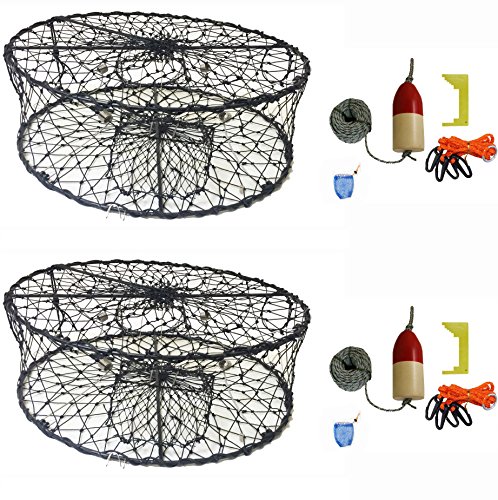
Two fully rigged pots, ready to fish the day they arrive
2-Pack of KUFA CT50 Sports Foldable Crab
The KUFA CT50 2-Pack ships two collapsible 30-by-10-inch traps with floats, harnesses, bait bags, sinking line and a crab caliper. It's the rare crabbing purchase that doesn't send you back to the store for rope, and the flat-fold frame stows under a kayak seat.
$160.32fromAmazonYou get everything you need to fish, twice over. Each of the two traps comes with a 14-inch red-and-white float, a harness, a bait bag and 100 feet of quarter-inch lead-core sinking line. There's a crab caliper in the box too, so you can measure a crab on the water instead of guessing. First-time crabbers usually discover the accessory problem the hard way, standing on a dock with a trap and no rope.
The stainless hinge hardware is the part that matters long-term. Three stainless steel spring clips lock the frame open and release it flat. Salt water is brutal on hinges, and cheaper zinc-plated or bare steel springs are the first thing to seize or snap after a season of immersion. Stainless holds up better. It's a small detail on the listing, but the hinge is where collapsible traps usually die.
It folds flat in about three seconds, which changes how you fish. A trap that stows flat means you can carry two in a hatch, a truck bed or under a kayak seat and cover two spots instead of one. Two positions doubles your chances on a slow tide. If you crab from a small boat or a pier where deck space is tight, that flat pack is worth more than an extra funnel.
The 30-inch body is sized for Dungeness, and KUFA says so plainly. The manufacturer states the mesh is too large for blue crab and other small species — a useful admission, since plenty of listings pretend to fit everything. If you're on the West Coast chasing Dungeness, that's the right mesh. If you're on the Chesapeake, this isn't your trap, and the maker will tell you as much.
Flaws but not dealbreakers
Two entrances is fewer than the competition offers. The CT50 uses two single-direction entrances with ramps, while some traps here run four doors. More doors mean more approach angles for a crab working the current, and multi-entry designs generally out-catch single- and dual-entry ones. The ramps do a good job holding crabs once they're in — but you're trading entry count for containment.
The mesh rules out blue crab entirely. This is a West Coast tool. If you fish tidal creeks in Maryland, Virginia or the Gulf, small legal crabs pass right through, and you'll pull an empty trap all afternoon while wondering what you did wrong. Read the mesh note before you buy.
It's a newer listing without much of a public track record. There isn't a deep well of owner feedback to lean on the way there is for older, widely stocked traps. The construction details are sound on paper, but you're buying somewhat on spec rather than on years of accumulated reports.
Runner-up
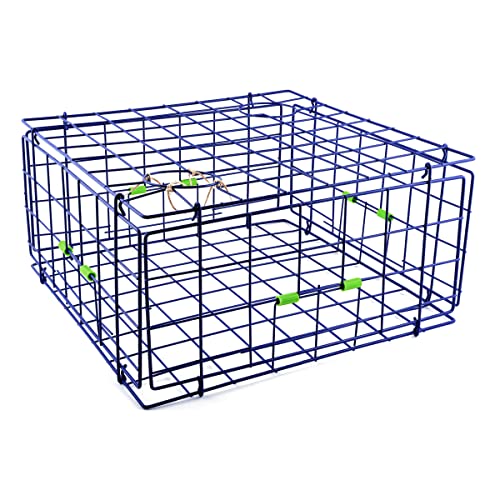
Four doors and legal escape rings, but not for California
Danielson 24" Fold-Up Pacific Coast Crab Trap
Danielson's 24-inch fold-up trap is the most regulation-minded option here, with two escape rings and a factory fall-away rot cord already installed. Its four entrance doors give crabs more ways in than any other trap on this list.
$64.95fromAmazonFour entrance doors give crabs more chances to find their way in. Multi-entry traps generally out-fish single-entry designs because a crab moving across the bottom in current only approaches from one direction. Four doors mean it doesn't have to find the right side. If you're soaking short — an hour or two per pull — that extra contact area does real work.
The escape rings and rot cord are the features cheap traps skip. Two built-in escape rings let undersized crabs leave on their own, so you're not opening the trap to sort them. The fall-away rot cord is the other half: if the trap is ever lost, the biodegradable cord breaks down and the panel opens, so the trap stops fishing. Most Pacific states require both, and plenty of budget traps ship without either.
Vinyl-coated steel wire lasts far longer in salt than bare galvanized. The coating puts a polymer layer between the wire and the water, and the difference in usable trap life runs several times over. If you soak weekly through a season, that's the difference between one trap and three. It also means no sharp burrs when you're handling it barehanded on a wet deck.
It folds flat, which makes a 24-inch trap practical to own more than one of. At 24 by 24 by 13 inches open, it's a real crab pot, not a novelty. Folded, it slides behind a seat or under a gunwale. For pier and small-boat crabbers who want to set a legal limit of pots without filling the truck, that combination is hard to beat.
Flaws but not dealbreakers
It is explicitly not legal in California. The manufacturer says so directly. If you crab California waters, stop here and find a CDFW-approved trap — the state enforces its own rules on dimensions, mesh and biodegradable panels, and non-compliant gear gets confiscated.
Twenty-four inches is small for serious Dungeness work. The traditional Pacific Northwest pot runs closer to 32 inches, and the extra volume matters when the bite is on. In strong tidal current over rock, a lighter folding frame also has a harder time staying put than a heavy rigid pot.
Nothing else is in the box. No line, no buoy, no bait cage. Budget for all three before your first trip, and remember the buoy usually has to carry your name or license number to be legal.
Budget pick
Two traps, rope and bait bag for a first season
BRILISLE 2PCS or 1PCS Crab Trap
The BRILISLE set gives a beginner two collapsible traps, 27 feet of soft rope and a bait bag with nothing else to buy. Each folds to an inch and a half thick, so both fit in a backpack alongside your license and measuring tape.
$22.98fromAmazonIt gets you fishing without a second shopping trip. The kit includes 27 feet of thick soft rope and a bait bag, which covers a dock or pier deployment in shallow tidal water. The bait bag takes chicken necks, fish heads or a commercial block without modification. For a first outing, that's the whole list.
Two traps let you cover two spots at once. Crabbing is a numbers game, and the fastest way to learn where the crabs are holding is to fish two positions and compare. One trap by the pilings, one out on the mud. You'll figure out your dock in an afternoon instead of a month.
It packs down to almost nothing. Folded, each trap is about an inch and a half thick, which means both fit in a dry bag or under a kayak seat. The snap closures on either side open and fold the trap in seconds, one-handed — useful when you're also juggling a paddle, an anchor line and a bag of bait.
The 0.16-inch frame wire is thicker than the flimsiest options. It gives the trap enough rigidity to hold shape in calm bay and harbor water. That's the environment this trap is for, and within it, the frame does its job.
Flaws but not dealbreakers
Nylon monofilament netting is the weak link. It abrades on oyster shell and barnacle-covered pilings, and it doesn't take the punishment that vinyl-coated wire shrugs off. In strong current or on rough bottom, expect a shorter life. If you find yourself crabbing every weekend, plan on upgrading rather than replacing this one twice.
No escape gap dimensions are published. That's a problem, because escape gap size is among the most commonly enforced recreational trap rules. Measure the openings yourself and check them against your state's requirement before you set it — the listing won't do that work for you.
The 27-foot rope caps where you can fish it. That's fine off a dock or a shallow tidal creek. It's not enough for anything deep, so treat depth as a hard limit rather than something you'll work around.
Also greatOn sale
Purpose-sized for blue crab, with a frame that survives salt
Promar TR-555BC: Collapsible Blue Crab Trap -
Promar's TR-555BC is built specifically for blue crab at 21 by 17 by 9 inches, with a fold-down vinyl-coated frame and heavy poly netting. It's the trap to buy if you're working the Chesapeake, the Gulf or the South Atlantic regularly.
$59.99fromAmazonList priceIt's sized for blue crab and nothing else, which is the point. At 21 by 17 by 9 inches, it's compact next to a Dungeness pot but right for the species. You're not hauling a bigger frame than you need, and you're not fighting mesh scaled for a crab twice the size. If blue crab is your target, buy the trap built for it.
The vinyl-coated frame fixes the failure that kills budget traps. Corrosion at the frame is what finishes most cheap crab traps, usually within a season. The polymer coating keeps salt water off the steel and stretches usable life several times over. If your trap soaks weekly for six months, that's the difference between buying once and buying every year.
Heavy poly netting flexes instead of denting. Crabs thrash, and wire mesh takes a set and eventually develops burrs that catch your hands and your bait bag. Poly gives and springs back. It also handles dragging across oyster shell better than you'd guess from looking at it.
It folds down, so you can run several without filling the boat. Most blue crab fishing is a multi-trap game — you set a line of them and work it. The collapsible frame means you can carry a legal limit in the back of a small skiff and still have room to stand.
Flaws but not dealbreakers
Nothing comes with it. No rope, no float, no bait cage. Budget for the full rig, and know that a compliant buoy is a legal requirement in many states, not a nicety.
Availability tends to be thin. Stock on this listing has run low, and it's not a trap you'll reliably find in quantity when you decide you want three more. If you're building out a line of traps, buy them together rather than assuming you can add later.
It costs more than the basic collapsible traps it sits next to. You're paying for the coating and the netting. That's a good trade if you crab often, and a poor one if you go twice a summer.
Who this is for
This guide is for recreational crabbers fishing docks, piers, small boats and kayaks in bays, estuaries and inshore tidal water — the people setting a handful of traps for an afternoon, not running commercial gear. If you're chasing blue crab on the Chesapeake or the Gulf, Dungeness off Oregon or Washington, or shrimp and small lobsters in protected water, there's something here for you. If you fish rocky bottom in heavy Pacific tidal current, you want a heavy rigid welded-wire pot instead, and none of the collapsible traps here will hold position the way one does.
One thing this guide can't do is tell you what's legal where you fish. Trap dimensions, mesh size, escape gap measurements, rot cord requirements, buoy markings, soak limits and trap counts all vary by state, by species and sometimes by zone. Florida spiny lobster has its own escape panel spec that standard crab traps don't meet. California enforces rules that differ from the rest of the Pacific coast. Check with your state fish and wildlife agency before you buy, not after — non-compliant gear gets confiscated, and the fines aren't small.
How we picked
We read spec sheets, manufacturer listings and published crabbing guidance, then weighed each trap against five things. Salt water survival: coated wire over bare galvanized, since the coating multiplies usable trap life and keeps burrs off your hands. Entry design: more funnels beat fewer, because a crab working the current only approaches from one side. Legal compliance: escape rings, escape gaps and a factory rot cord, all of which most coastal states require and many cheap traps skip. Complete rigs: line, float and bait bag in the box, so you're not shopping again before your first soak. Storage and transport: folded thickness and open size, because dock and kayak crabbers need traps that stow flat and travel easy.
Other crab pots and lobster traps worth considering
If you already own traps and need a proper marker buoy: The BEAU MAC Crab Pot Super Buoy Red/White ($35.65) — The BEAU MAC Crab Pot Super Buoy is a 14-inch red-and-white float built for marking a pot line in tide and current. That color scheme is the recreational standard in Washington, Oregon and Alaska, and it distinguishes your gear from commercial rigging and floating debris. In most states a marked buoy carrying your name, address or license number isn't optional — an unmarked pot can mean a citation and lost gear. What it gives up is obvious: it's a buoy, not a trap, so it completes a setup rather than being one. Stock also runs thin, so grab one when you see it.
The competition
This is what our research turned up on Amazon, not a survey of every trap sold. Plenty of good rigid welded-wire pots and regional builds never show up in a listing search, and if you're serious about Dungeness in heavy current, a local tackle shop is a better starting point than a marketplace. The traps below all do something well. They just lost to a pick on fit, completeness or how much of the legal work they leave to you.
The Frabill Crawfish Trap ($19.99) — The Frabill Crawfish Trap is a well-made tool for the wrong job, if crab is what you're after. The torpedo shape sits stable in flowing water where flat-frame traps tip and drift, the two-piece body opens fast for baiting and dumping, and the black vinyl-dipped steel handles both camouflage and corrosion. Frabill has been making fishing gear since 1938 and it shows. But at roughly 10 by 9.75 by 9 inches, it's built for crawfish and small baitfish — it won't hold a legal blue crab, and it won't meet saltwater crab trap requirements in most coastal states. Buy it if crawfish or bait is the actual goal.
The SOUTH BEND Wire Minnow Trap ($22.99) — The SOUTH BEND Wire Minnow Trap is a bait tool, not a crab trap, and it's genuinely good at that. At 9 inches across and 16.5 inches long with corrosion-resistant plating, it works in fresh water and salt, and it saves you from buying minnows all season. Coastal crabbers often set one alongside their pots to catch fresh menhaden or mullet, and fresh oily fish out-produces commercial bait blocks for blue crab by a wide margin. What it isn't is a legal crabbing rig — the dimensions, mesh and entry design don't meet saltwater crab requirements anywhere. Treat it as a bait supply, and it earns its spot in the truck.
Care and rigging notes
Rinse every trap with fresh water after a soak and let it dry all the way before you stack it. Salt left on wire keeps working even out of the water, and stored-wet traps corrode from the inside of the coating outward. Keep them out of direct sun between trips, since UV degrades vinyl coating and poly netting over a few seasons. Check the stainless clips and springs once a year and replace anything showing surface rust before it fails under load with a full trap on the line. Never leave a bare-wire trap submerged between seasons. On the water, rebait every two to three hours — scent dispersal falls off fast, and fresh bait beats frozen, which beats stale, no matter what trap you're running.
Questions we get
What's the best crab trap for blue crabs?
The Promar TR-555BC is built specifically for blue crab, with a 21-by-17-by-9-inch frame that's sized right for the species and a vinyl coating that survives repeated soaks. The fold-down frame lets you carry several without filling the boat. If you want to spend less, the BRILISLE two-pack gets you two traps with rope and bait bag, enough to fish two positions off a dock. Skip the KUFA CT50 for blue crab — the maker states the mesh is too large.
Are collapsible crab traps as good as rigid wire pots?
In calm bays, estuaries and off docks, they're close enough that it doesn't matter, especially the multi-entry designs. In strong tidal current or over rocky Pacific bottom, rigid pots win clearly — they hold shape and stay planted, and a trap that tips or drags catches nothing regardless of how clever the funnels are. For kayak and pier crabbers in protected water, collapsible is the practical choice. For serious Dungeness work in current, it isn't.
What mesh and escape gap size do I need?
It depends entirely on your state and your target species. Blue crab traps typically run 1.5- to 2-inch mesh, Pacific states generally specify a minimum around 1.75 inches for Dungeness, and Florida spiny lobster requires a specific biodegradable escape panel instead. Escape gap rules vary the same way, and they're among the most commonly enforced violations. Pull your state agency's current regulation booklet before you buy, because the numbers differ by coast and get revised.
What's a biodegradable rot cord and does my trap need one?
It's a section of untreated natural fiber twine — usually cotton or hemp — woven into the trap's escape panel. If the trap is lost, the cord rots away over a few weeks, the panel falls open, and anything inside gets out instead of dying in gear nobody can retrieve. That's the whole point: preventing ghost fishing. Most US coastal states require one, and buying a trap without it in a regulated state is both illegal and bad for the fishery.
Do I need a license to set crab traps?
Almost certainly yes. Virtually every US coastal state requires a recreational fishing license, and many add a separate shellfish or crabbing endorsement on top. Washington wants a Dungeness endorsement, Maine requires a recreational lobster license with a strict trap limit, and Florida has its own saltwater licensing and lobster season rules. Trap counts vary too — a handful of pots per person is typical. Confirm both before your first trip, because penalties include losing the gear.
How long should I leave a trap soaking?
For blue crab in tidal bays, 30 to 90 minutes per pull works well, resetting and rebaiting every hour or two. Pacific Dungeness crabbers commonly run two to four hour soaks in deeper water. Leaving traps overnight is illegal in most states and raises the odds of a lost trap ghost fishing if the line gets cut. Check your state's specific soak limits — they're species- and zone-specific.
Why you should trust us
For this guide:
- We compared manufacturer spec sheets and listing details across every trap here, looking specifically at frame material, mesh size, entry count and whether escape rings or a rot cord ship installed.
- We read published crabbing guidance and state agency regulation material on escape gaps, buoy marking and rot cord requirements to judge which listings leave the compliance work to the buyer.
- We weighed owner feedback themes about frame corrosion, hinge failure and netting abrasion when deciding which flaws were worth calling out.
- We read owner reviews on every listing, weighted toward the critical ones, because that is where the recurring failures show up.
- We have a systematic way of automatically fetching the latest prices, so the numbers on this page stay current.
- This is a research-focused guide, so the team may not own every product listed — though we often do own the top winners, which gives us extra context for the recommendations.
- We don't accept free products, and the retailer commission never changes which product we recommend.
Sources
Best Crab Traps 2026 — Outdoor Life, Outdoor Life
Florida Spiny Lobster Recreational Regulations — FWC, Florida Fish and Wildlife Conservation Commission
Recreational Lobster Licensing and Trap Limits — Maine DMR, Maine Department of Marine Resources
Crab Gear and Regulations — Washington Department of Fish & Wildlife, Washington Department of Fish & Wildlife
Dungeness Crab Recreational Fishing — California Department of Fish and Wildlife, California Department of Fish and Wildlife
Amazon product listings and owner reviews for all 7 products
Manufacturer specification pages for each product
Some passages in this guide may be paraphrased with AI help. Prices are refreshed automatically.
More like this.
Continue exploring lifestyle reviews and recommendations.

The Best Mosquito Traps and Backyard Bug Zappers
Mosquitoes ruin summer evenings in a very specific way. You're fine for ten minutes, and then you're slapping your ankles and going inside. The devices…

The Best Instant Pots and Pressure Cookers
An electric pressure cooker earns its counter space by collapsing time. A pot roast that needs three hours on the stove is done in under an hour,…

The Best Garage Tire Inflators
Tire pressure is the one bit of car maintenance you can actually do yourself in two minutes. Tires lose roughly a pound of pressure a month, and more when…

The Best Children's Cookbooks for Ages 9 to 12
A kid at this age can do real cooking. Nine- to twelve-year-olds can handle a knife with supervision, read a recipe start to finish, and use a stovetop…

The Best Enduro Mountain Bike Helmets
A full-face enduro helmet has one job on a rough descent: keep your face out of the rocks. Head injuries account for roughly 22 to 29 percent of mountain…

The Best Family Camping Tents
A family tent is the one piece of camping gear everybody in your family has to live inside. It's where a toddler naps at two in the afternoon, where five…